Tag Archives: sam wilson

Film Review: Captain America: Brave New World is a low point for the Marvel Cinematic Universe and is neither entertaining, thought-provoking, funny, or interesting to look at
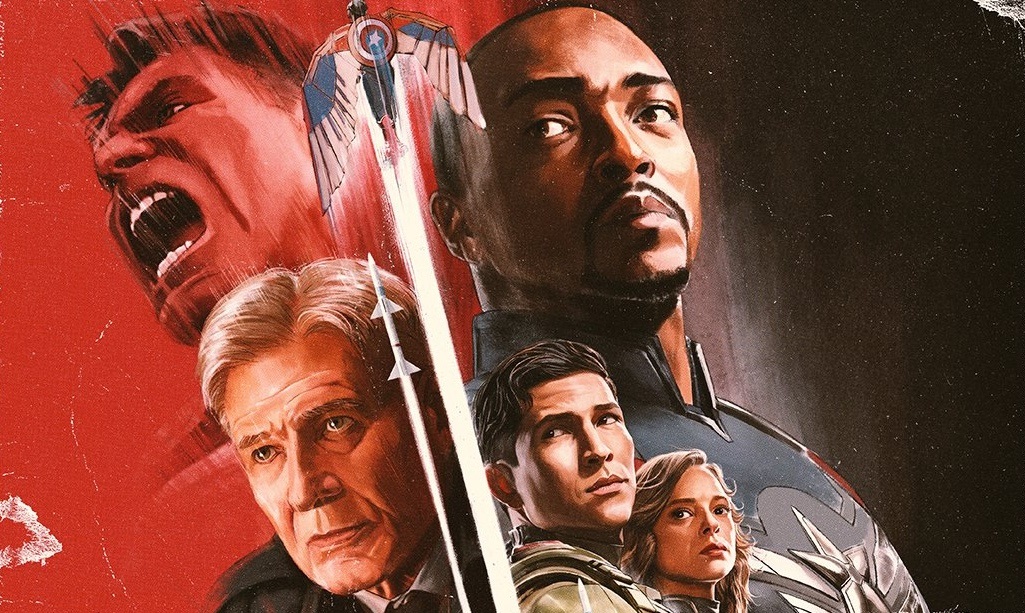
When something catches on fire, you’re supposed to immediately smother/cover it and/pr finish it off with a fire extinguisher. What you’re not supposed to do is keep throwing stuff into the fire while wearing a nighty and continuing to live stream. All this to say is that I wasn’t surprised when the credits rolled for Captain America: Brave New World, and there were five credited writers, including director Julius Onah. New chefs kept respawning in the burning kitchen that was the screenplay for this film. Captain America: Brave New World is simultaneously Sam Wilson’s (Anthony Mackie) first cinematic outing as Captain America, a follow-up to Incredible Hulk and Eternals, and a bit of a prequel to Thunderbolts and anything the Marvel Cinematic Universe wants to do with Wolverine/the Weapon X program. It succeeds at being none of these things (Although, Harrison Ford’s Thaddeus Ross/Red Hulk is a somewhat delightful grump), has muddled visual effects, corny dialogue, and above all else, bad politics.

Captain America: Brave New World begins at the inauguration of Ross as president of the United States, which is a controversial choice thanks to his actions towards the Hulk in his solo film and to superheroes as a whole in Captain America: Civil War. But, like a good centrist, he’s ready to cross the aisle and work with the new Captain America to start a new Avengers team. Unfortunately, this plan immediately backfires when something triggers forgotten/screwed over by the United States government super soldier Isaiah Bradley (Carl Lumbly), and he attacks President Ross at a reception for world leaders centered around the adamantium discovered in “Celestial Island” in the Indian Ocean. The film follows Sam Wilson and Joaquin Torres’ attempt to clear Bradley’s name and figure out who is really behind the assassination attempt.

This plot synopsis makes it seem like Brave New World is a political thriller like the excellent Captain America: Winter Soldier, but it’s unfortunately a pale echo of the previous film. The writing (and let’s face it, marketing) team shows their hands too early, and we go from Wilson and Torres rooting around in sketchy labs in West Virginia to squabbling with fighter planes, aircraft carriers, and Celestial heads. Secondary villain Sidewinder (Giancarlo Esposito) mentions something about the CIA paying him to steal adamantium from the Japanese, but it’s brushed over for explosions, rage-outs, stale quips, and empty speeches that not even Mackie’s (And a sleep walking Sebastian Stan in one scene.) charisma can salvage.

The opening scene where Sam Wilson and Joaquin Torres fight Sidewinder and the Super Society has well-choreographed hand-to-hand action augmented by whiz bang special effects for Wilson’s Wakanda-enhanced Captain America costume, but it’s all downhill from there in the action department. The fights seem just a perfunctory part of the superhero genre than revealing anything about the characters in them although Wilson often complains about not taking the super-soldier serum while he fights foes from the Hulk’s rogues gallery. It’s fun to see Ford freak out as Red Hulk and be consumed by rage until he gets talked down by Sam Wilson’s plot-relevant background as a social worker. (Winter Soldier handled this part of his character much better.)
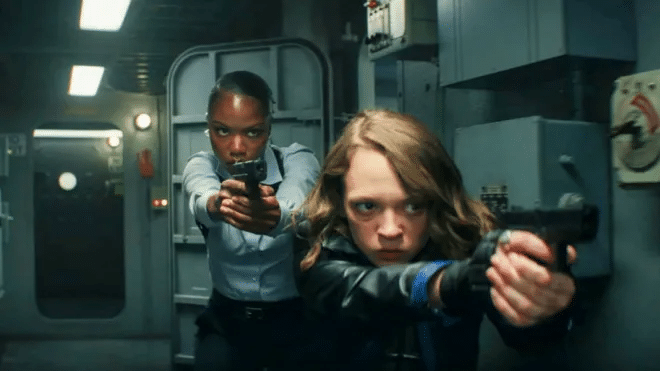
In keeping with the through-line of Brave New World being a Xerox of a Xerox of Winter Soldier, the film has its own (Former) Black Widow. It’s not Scarlett Johansson’s Natasha Romanov even though the performer playing her is also a Zionist: Israeli actress Shira Haas appearing as Ruth Bat-Seraph. (The character’s comic book codename Sabra and backstory as a Mossad agent don’t appear in this adaptation.) Politics aside, Bat-Seraph is a nothingburger of a character, who represents President Ross’ distrust of superheroes and love of the covert. Let’s just say she’s no Romanov, Maria Hill, or even Sharon Carter. It’s puzzling how such a controversial character survived multiple reshoots and plays no meaningful role in the film even though an American president having an Israeli secret agent as a key figure in his security detail could have led to compelling commentary on the relationship between the United States and Israel. Instead we get to see a stilted performance by an actress from a country that is currently committing genocide, who hasn’t spoken out against it.

Sometimes, Captain America: Brave New World feels like it’s actually about something, and that’s usually in scenes featuring Isaiah Bradley, who was also the best part of the Falcon and Winter Soldier TV show/six hour movie. Although, most of his interactions are responding to ageist quips from Joaquin Torres, Bradley also talks to Sam Wilson about his misgivings of going to the White House and standing with President Ross after how he was treated by the US government. He finds common ground with Wilson’s imprisonment in Captain America: Civil War, but this is immediately brushed aside by the new Captain American saying something about having a seat at the table. Ideological tension is swept aside for “there are fine people on both sides” type of rhetoric, and of course, Isaiah Bradley needing to be at the White House to kick off the plot, being benched for the rest of the movie, and not receiving any kind of recognition or reparations at the end of the film. If Brave New World has any kind of overarching theme, it’s to throw scary, traumatic, soul and society shattering things in a literal prison and get back to the status quo. In this way, it connects to one of the chief criticisms of the MCU, which is the films care more about getting to the next movie/event than telling a compelling story in the current film.

Captain America: Brave New World is truly a low point for the Marvel Cinematic Universe and is neither entertaining, thought-provoking, funny, or interesting to look at. (They did nail Sam Wilson’s Captain America costume.) Most of the film is empty spectacle a la Michael Bay’s Transformers sequels, and the whole endeavor is a waste of Anthony Mackie, Harrison Ford, Giancarlo Esposito, and Tim Blake Nelson’s talents. Maybe, Galactus should eat this universe and its cowardly politics.

Overall Verdict: 3.0
People’s History of the Marvel Universe, Week 19: The Racial Problematics of “Snap Wilson”

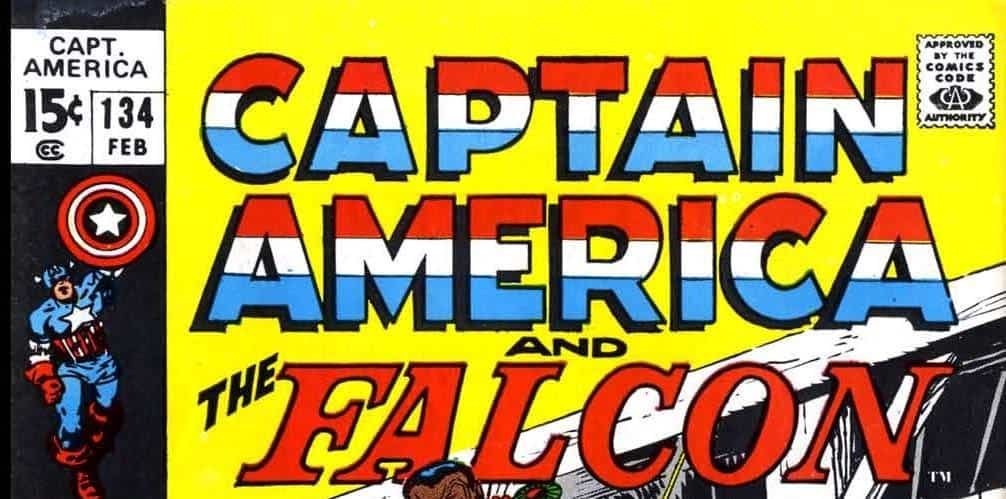
As discussed last time, starting in Captain America and the Falcon #120, various Marvel writers[1] made a good deal of use out of the Falcon’s secret identity as Sam Wilson, social worker – Stan Lee used it as a vehicle for stories about youth problems, organized crime, and urban unrest (albeit ones that ended with costumed superheroes getting into punch-ups with similarly-attired supervillains), while Steve Englehart and Alan Weiss used it as a pretext to have Captain America and the Falcon investigate abuse in America’s prisons and encounter the Queen of the Werewolves.[2]

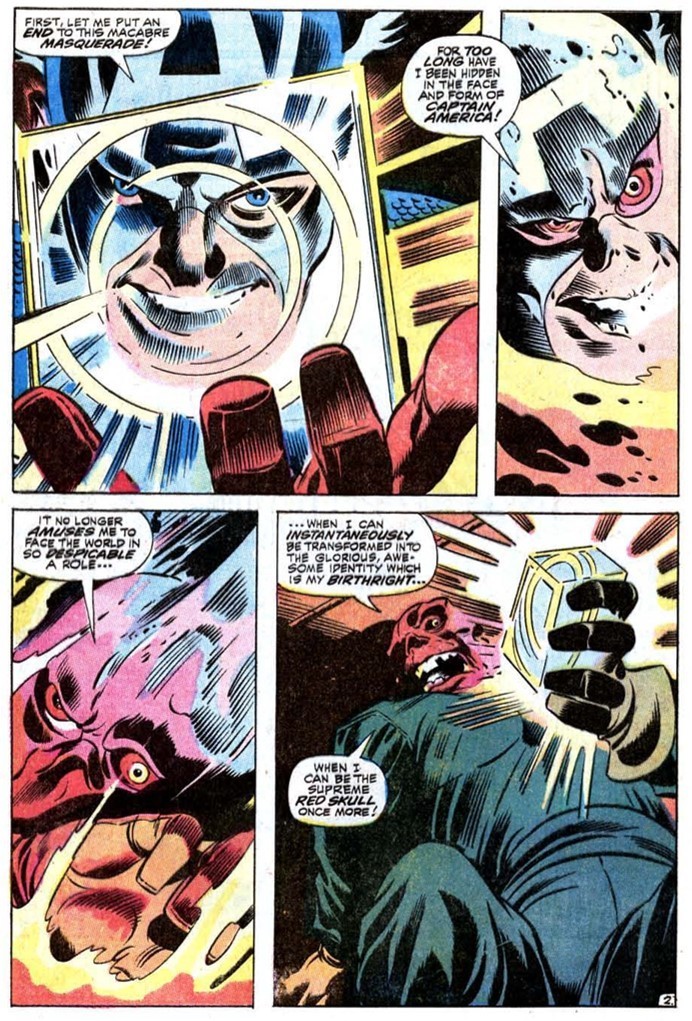
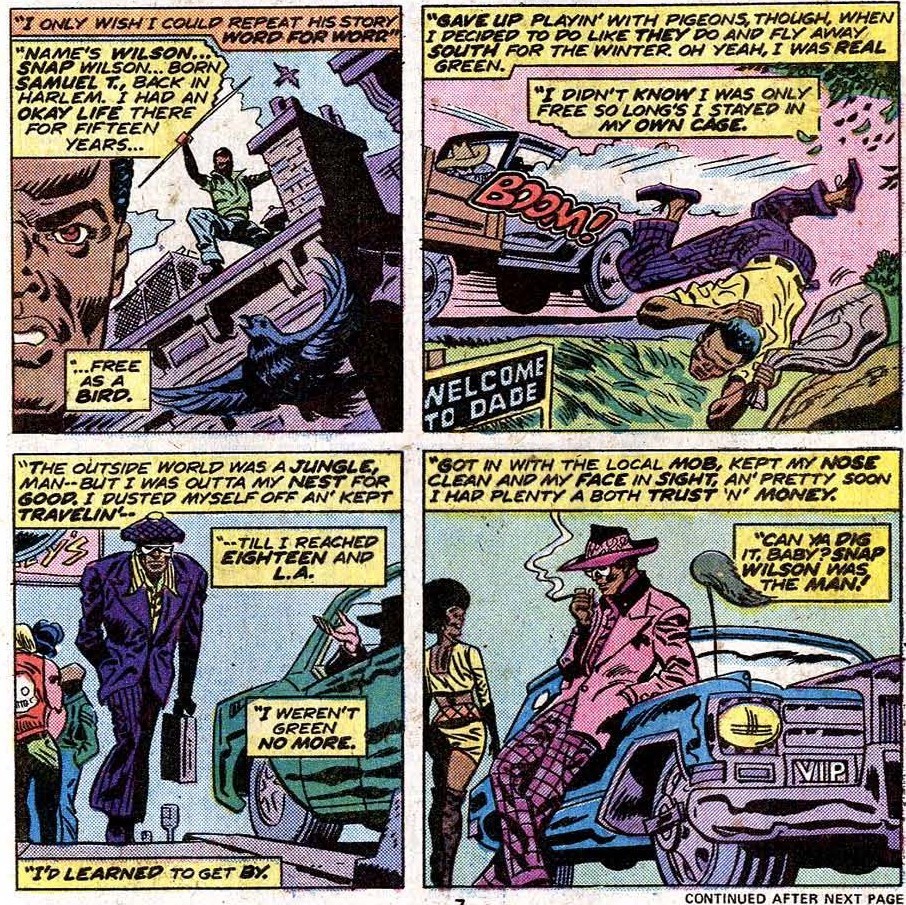
This changes in Captain America and the Falcon #186, where (in a follow-up to the original story that introduced Sam Wilson) the Red Skull reveals that everything we knew about Sam Wilson was a lie:

These four panels are worthy of some in-depth textual analysis. In the first, we see the young and innocent Sam Wilson on the rooftops of Harlem, complete with a thematic association between birds and freedom that we’ll later see embodied in his relationship with his falcon Redwing. (In future issues, this part of his backstory will be retconned to add in tragic violent crime-related deaths for both his mother and father that will inspire his vigilantism.) In the second, we see Wilson heading to Florida (like a lot of New Yorkers in the winter) only to be confronted with the specter of rural bigotry in Dade County, in a scene straight out of the shock ending of Easy Rider. By the third panel, we see that the experience has hardened our hero, and by the time that he gets to Los Angeles he’s learned to “get by” in the worlds of both street crime (as symbolized by the small crowd of black men standing on the corner) and organized crime (as symbolized by the white hand coming out of the car window). In the fourth panel, the transformation of Sam Wilson into “Snap” Wilson is complete – he’s now an L.A-based gangster complete with mob connections, a pimped-out Cadillac with vanity license plates, and some of the 70’s wildest fashions.

As we learn about on the next page, rather than arriving on the island of forbidden love as part of a vacation-turned-resistance-movement, “Snap” Wilson crash-landed on the island after attempting to hijack a small plane containing a “fortune” (presumably of drugs, given that the plane was returning from a trip to Latin America) belonging to the “Big Man,” his L.A-based crime boss.

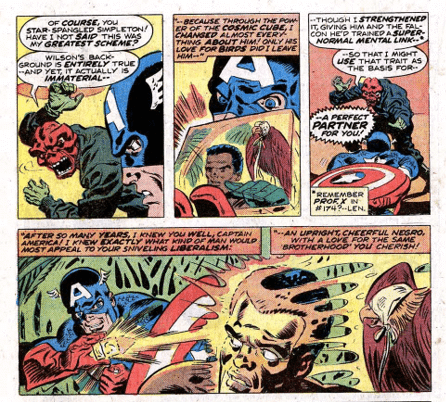
More significantly, we learn that the social Sam Wilson that readers thought they knew was a creation of the Red Skull, a fiction specifically designed to appeal to Steve Rogers’ liberal values:

Steve Englehart, John Warner, and Frank Robbins had to lean heavily on the Cosmic Cube’s, well…cosmic powers here, because this is quite a retcon. Above and beyond the psychological impact on Wilson himself, the creative team had to explain how it was that we’ve seen Sam Wilson at work as a social worker – we’ve even seen his office with clients in it! – and it would be particularly odd for the Cube to somehow have also altered the memories of the entire “Social Admin” Department of New York City so that someone without official hiring paperwork or credentials would be given office space, a salary, and a caseload for several years.

This being a superhero comic, the retcon is then used by the Red Skull (once again using mind control) to pit the Falcon against Captain America in a lose-lose fight to the death. Naturally, Captain America triumphs and destroys the Red Skull’s HYDRA base, only for the Skull himself to flee to fight another day. Rather than resolving neatly in one issue like earlier “Cap goes evil” storylines, the dangling plot thread of “Snap” Wilson and the dueling backstories continues to dominate the book for the next several issues.

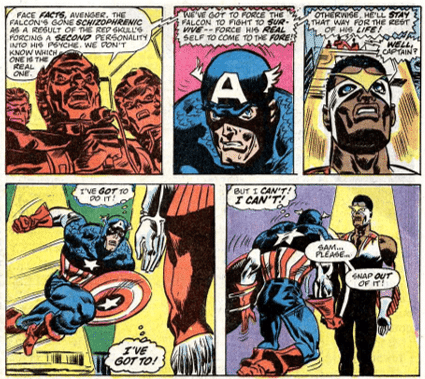
For example, in Captain America and the Falcon #189, Tony Isabella and Frank Robbins have Captain America once more fight Sam Wilson in a dubious SHIELD experiment to prove which is the real personality.

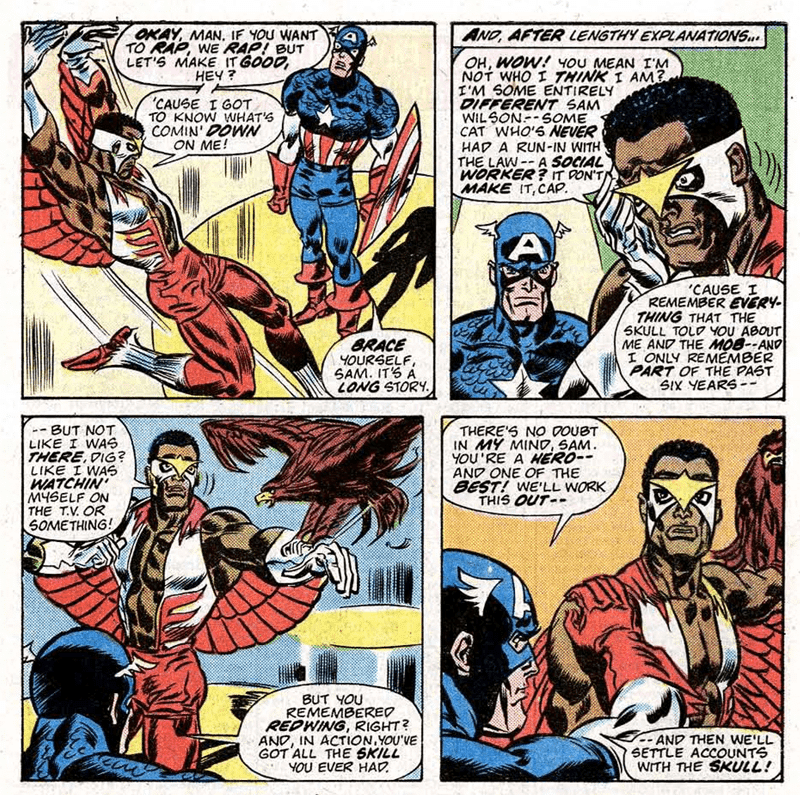
After a bunch of illusionary shenanigans, the Falcon snaps out of his “schizophrenic” state to reveal that, in fact, it is “Snap” Wilson who was the true personality and Sam Wilson who was the fake.

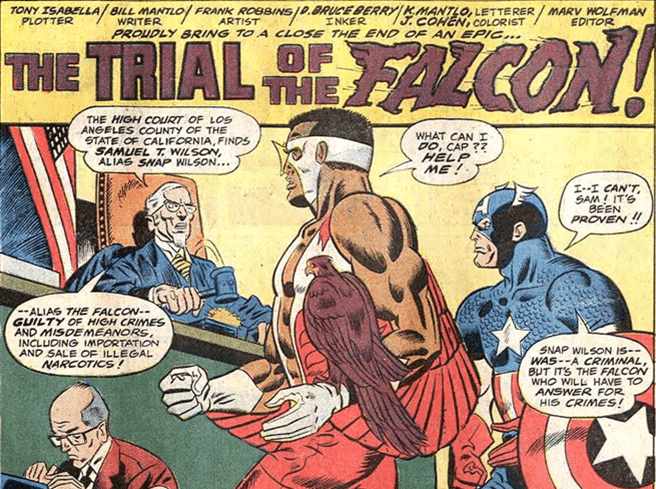
Tony Isabella, Bill Mantlo, and Frank Robbins would return to (and in their own words “bring to a close the end of an epic”) plot in issue #191, in which “Snap” Wilson is put on trial in Los Angeles County Court for the “importation and sale of illegal narcotics”: 

The Falcon is only saved from prison when, in a bid to prevent him from turning state’s witness against his former mob associates, the “Big Man” of Los Angeles hires, of all the many Marvel villains-for-hire, the Stilt-Man to attack the courthouse and assassinate the Falcon before he can testify. As one might guess, the ensuing action allows the Falcon to demonstrate his heroism to the judge, leading to a suspended sentence of parole (with Nick Fury of SHIELD standing in as his parole officer), thus demonstrating the fairness and mercy of the American court system when dealing with black defendants up on drugs charges in the first wave of Nixon’s War on Drugs.

The racial politics of this retcon are bizarre to say the least. The new “Snap” Wilson behaves like a quite different character than the one readers had known for sixty-nine issues: he’s more aggressive and violent both in interpersonal communication and combat, he uses stereotypical “jive” slang, and he’s far more cynical about white America and white institutions – an interesting departure for a character previously given to attempts at “cooling down” racial tensions. One could see it as an extrapolation of the “talker” versus “fighter” dynamic between Sam Wilson, social worker, and the vigilante known as the Falcon, if not for the charged nature of “Snap” Wilson’s gangster origin.

Two potential explanations for this change suggest themselves. The first is that we need to see this in the context of Marvel chasing the trend of blaxploitation, more prominently seen in the creation of the characters Luke Cage and Blade at around the same time. A streetwise gangster simply fits into the rather narrow schema of the blaxploitation genre better than a social worker out of a prestige “problem” film. However, Captain America and the Falcon was an established comic rather than a newer, more speculative venture like Power Man, and more importantly it was the comic of their flagship “flag suit” character, which tends to come with higher visibility and tighter editorial control within the company.

The second explanation, and one that has a certain amount of plausibility given that Cap #186 was authored by noted liberal Steve Englehart (just coming off of having Captain America go up against Richard Nixon), is that the retcon was prompted by a weird white liberal guilt trip that judo-flipped its way into being accidentally racist. Sam Wilson, as originally envisioned by Stan Lee, was an “articulate,” clean-cut, politically moderate black professional. It may have been argued at the time that the character of the Falcon was a paternalistically condescending bit of outreach to the black community from a bunch of white middle aged middle class folks at Marvel.  By contrast, a more “street” character, as we’ve already said more evocative of popular trends in black culture, who challenges the white establishment more consistently than before, may have been seen as a more “authentic” portrait of black masculinity in the 1970s. If so, it’s a very strange train of thought where an attempt to be racially sensitive boomerangs back around to being back-handedly racist.

The problem with this line of political logic is the question of representation. There’s nothing inherently wrong with an individual character having a backstory of coming from the “mean streets” of crime, but when you’re dealing with a situation in which there are very few characters of color in Marvel comics (especially back in the 1970s when the main struggle within Marvel was over introducing racial “firsts”), aspects of those characters become less individualized and more archetypal. When most if not all of Marvel’s black characters at the time came from “the street,” it starts to send a message that, according to Marvel creative and editorial (again, staffed almost entirely by white men), the “street” is where black characters come from. This becomes problematic when it means that having a black character with a different background – like, for example, a professional social worker – is seen as less “realistic” than an ex-hood.

So much for the “epic” of “Snap” Wilson. I know there are going to be some in the fandom who will say that, given the realities of a serial medium produced monthly over the course of almost fifty years by a variety of creative and editorial teams of varying levels of ability and care for the material, you’re going to get some bad stories worked in there. These stories – if left unchecked – can warp characters out of being usable recurring intellectual property, which is why retcons aren’t always a bad thing because they can right a sinking ship in the wake of a particularly ill-thought-out or poorly executed creative turn.

This is why, when we talk about the impact of a given story in comics, we can’t just talk about the aesthetic merit of a given panel or page or comic, but its longevity – did a given story have an enduring impression on the book and the larger Marvel Universe, or was it a flash in the pan that was swiftly cleaned up by the next team to work on the book?

The answer to that question is why the “Snap” Wilson retcon is such a big deal: it lasted for forty years, putting it up there as one of the longest-lasting retcons in Marvel history. It was the status quo when Steve Englehart left the book, it was the status quo when Jack Kirby returned to both write and draw the book (more on that in a future issue), it was the status quo for Mark Gruenwald’s classic run in the 80s, and it was the status quo for Ed Brubaker’s run that set the terms for the MCU Captain America films.

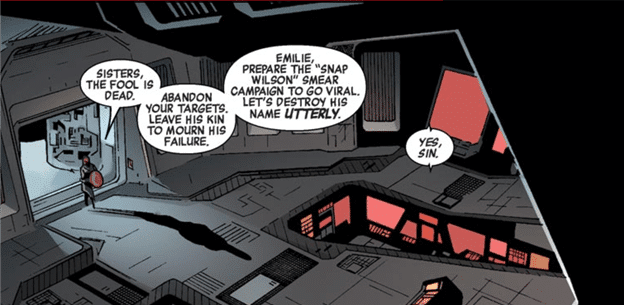
It wouldn’t change until 2015, when as part of the Avengers NOW! event[3] Sam Wilson was promoted to the role of Captain America for the first time (although not the first time that he’d worn the uniform) – a creative and editorial decision that would ultimately give rise to the Disney+ Falcon and Winter Soldier show. In All-New Captain America #3, intending to discredit as well as kill the new Captain America, Sin (the Red Skull’s daughter) and HYDRA engages in information warfare by releasing to the public the sordid details of “Snap” Wilson’s past:

To a significant extent, Remender designs All-New Captain America #3 to be in dialogue with Englehart’s Captain America and the Falcon #186 – no less than three pages out of the book are devoted to a beat-for-beat reproduction of the story of the Red Skull using the Cosmic Cube to re-write Sam Wilson’s backstory, for example. The major difference is that, rather than staying in a mind-controlled silent stupor while Steve Rogers plays the interlocutor to the Red Skull, here Sam Wilson is allowed to speak and he challenges Sin’s characterization of his past as a “liar, thug, and gangster” as “lies.” (Remender does his own editorializing by characterizing the “Snap Wilson” backstory as a “smear campaign” and presenting Sin as clearly an unreliable narrator given to monologuing about the victors rewriting history to suit their interests.)

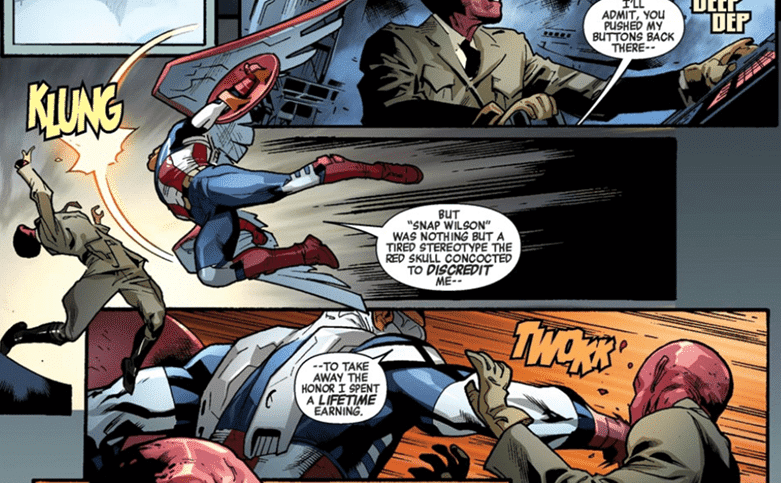
In foiling both Sin’s smear campaign and (somewhat more importantly) her bomb plot, Sam Wilson defiantly asserts a brand-new status quo for his own backstory:

While Rick Remender is a writer whose politics I haven’t always agreed with – only two years before this issue, Remender had written Uncanny Avengers #5, which featured the now-infamous “M word” speech, and then reacted extremely poorly to criticism over how this speech handled the topic of minority identities and the mutant metaphor – I think he was on the right track in this case.

As I’ve suggested above in discussing the question of representation, “ex-gangster from the mean streets” was already something of a “tired stereotype” back in 1975, and it was only more of one in 2015 when you consider the increase in the raw numbers of African-American characters in big two comics, given how many of those new characters had been given “street” backgrounds themselves. By contrast, there is something innovative about a social worker backstory not just from the perspective of African-American characters but superheroes in general: whereas most heroes with secret identities are cops, private detectives, reporters (because those professions involve being “nosy” and thus lend themselves to story hooks involving investigations), or scientists (which lends itself to super-science story hooks), there really aren’t that many heroes who belong to one of the “caring” professions. As we discussed back in Week 18, social workers have a unique perspective on social phenomena, while still giving rise to sixty issues worth of story hooks.

Ultimately, however, the question of whether a given character’s backstory is innovative or stereotypical is rather subjective. Which is why the subjectivity of the creative and editorial teams matters – and why it mattered that for so long that the teams working on Captain America and the Falcon were all-white (as well-meaning as they might have been). Had there been more diversity in the room at the time, black creators might have been able to push back on the “Snap” Wilson retcon from the beginning instead of having to wait forty years for a white creator to decide it wasn’t all right.  


[1] Between Cap #120 and #186, there wasn’t a regular artist on the book on issues covering Sam Wilson as a social worker: artists ranged from Gene Colan on #120 and 134 to John Romita Sr. on #139 to Sal Buscema on #149 to Alan Weiss and John Romita Sr. on #164.

[2] A story notable for being the first but by no means the last time that CapWolf became a part of Marvel Comics. More on that in a future issue of People’s History of the Marvel Universe.

[3] Itself a continuation of the All-New Marvel NOW! event from 2013, which itself was a continuation of Marvel NOW! from 2012, but which shouldn’t be confused with All-New, All-Different Marvel which would launch later in 2015, eventually giving rise to the Secret Empire event. Needless to say, Marvel editorial hasn’t exactly made things easier for comics historians in their naming conventions in recent years.

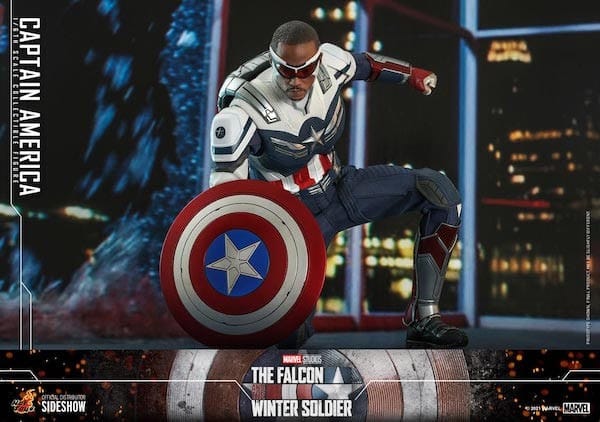
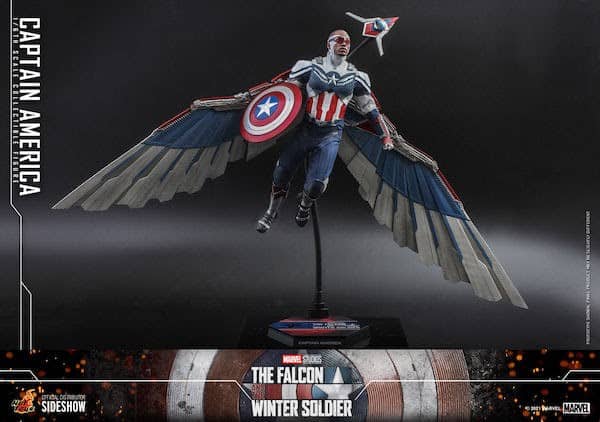
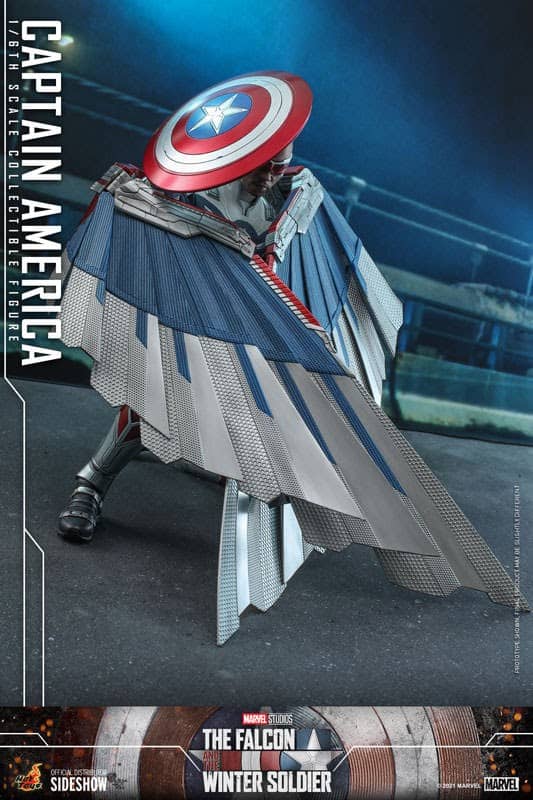
Sam Wilson as Captain America Gets a Hot Toys Figure

Hot Toys have announced an all-new addition to their Television Masterpiece series with a 1/6 scale figure inspired by Sam Wilson as Captain America in the hit Disney+ series from Marvel Studios – The Falcon and the Winter Soldier.
 
Teaming up with Bucky Barnes against the Flag Smashers, Sam Wilson AKA The Falcon suits up in a new outfit, keeping his signature wings, but also carrying the symbolic shield once wielded by Steve Rogers, and the complicated legacy that comes with being the new Captain America.
 
The new Captain America Collectible Figure is here! Don’t miss out on the chance to add this stunning new 1/6 scale figure to your Marvel collection, and pre-order it today via Sideshow.

The 1/6th scale Captain America Collectible Figure features:

  • A hand-painted head sculpt, with highly-detailed likeness of Anthony Mackie as Captain America in The Falcon and the Winter Soldier, complete with goggles and face gaiter
  • An expertly crafted 1/6 scale body with 30 points of articulation 
  • Eight interchangeable gloved hands for multiple posing and display options
  • A tailored tactical suit with embossed pattern and star emblem in chest
  • One pair of embossed patterned pants with fabric coated knee pads
  • One metallic silver and blue belt
  • One pair of metallic silver and red forearm guards
  • One pair of metallic silver and red calf guards
  • One pair of metallic silver boots
  • One flight backpack
  • One Captain America shield 
  • Newly designed wings with multiple points of articulation
  • A Redwing drone
  • A specially designed dynamic figure stand with character nameplate

This site contains affiliate links, which means that if you click on one of the product links and make a purchase, we’ll receive a percentage of the sale. Graphic Policy does purchase items from these sites. Making purchases through these links helps support the site.

A People’s History of the Marvel Universe, Week 15: Cap Meets the Falcon on the Isle of Forbidden Love

The story of this essay is one of my own hubris. In November 2018, I started to write about the importance of Sam Wilson, both to Steve Rogers personally and to Captain America as a concept; the notes for that document ran to 36 pages, and yet the document remained incomplete. Sad to say, given how long the process of clipping panels was taking, I hit a wall and gave up on the endeavor. Clearly, I don’t have quite the same tenacity as Steve Rogers himself.

However, the very length of that outline speaks to the hubris of my initial idea. The reality is that Sam Wilson as a character is far too important to be covered in only one essay. Consider that Sam Wilson’s introduction led to the very title of the comic changing for 88 issues – or 47% of a Claremont – in a row. For more than seven years, then, Captain America was not a solo character but one part of a duo.

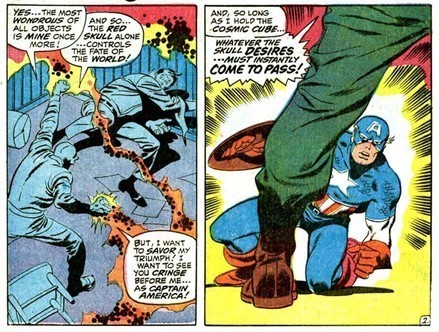
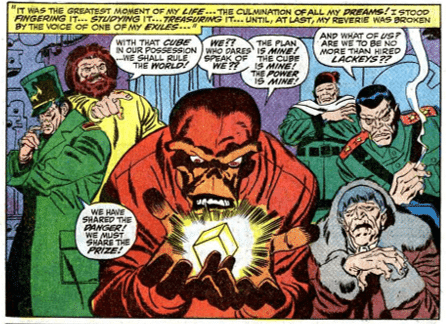
In this essay, I want to begin our examination of Sam Wilson’s role by, appropriately enough, starting from the beginning. The broader context and environment is crucial here, because Sam Wilson enters the narrative at one of the lowest points in Steve Rogers’ life: the Red Skull has regained possession of the Cosmic Cube (which is way more powerful than any mere Tesseract),  which in this story functions as a cross between the literal Demiurge and an infinite wishes genie:

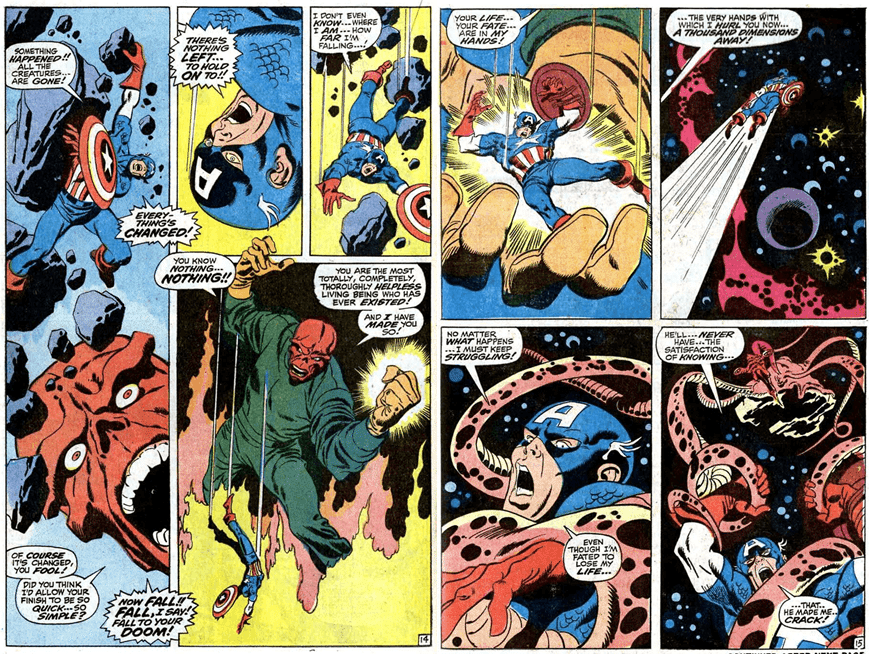
Captain America, being who he is, decides not to “pay homage to your acknowledged master” and instead chooses to fight God barehanded. As one might expect, this doesn’t go so well, but as with most existential struggles, the point is that Cap refuses to give in to an unjust God or to break when subjected to mind-bending Lovecraftian torture:

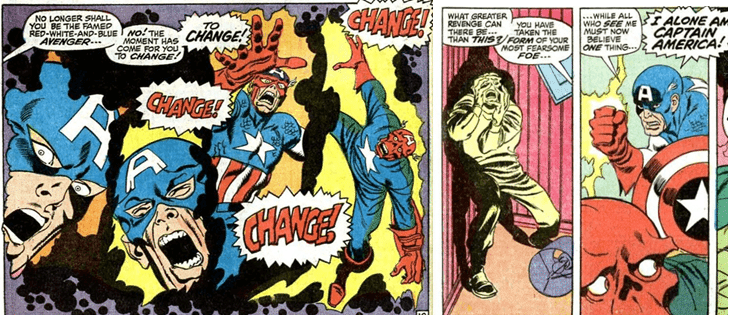
Like the top-quality supervillain he is, the Red Skull isn’t satisfied with the mere physical victory of flinging his opponent “a thousand dimensions away”[1] So in order to finally break Captain America’s indomitable spirit, he hits on the most terrifying torture known to man: identity theft.

For once, this strategy actually makes a lot of sense. As an inherently ideological hero, there is little that Captain America fears more than an attack on his reputation among his fellow citizens. The Red Skull’s Grand Theft Me plan threatens to weaponize that very bond with the common man, turning Cap into a vector for Nazi ideology. Making it all the worse is that Rogers can’t really fight back on the battlefield of public opinion while wearing the Red Skull’s face. (People who made it through Secret Empire will note that this Cap-turns-evil storyline is surprisingly familiar; I would argue that this version is way more meaningful on a psychological and political level than what Nick Spencer put together.)

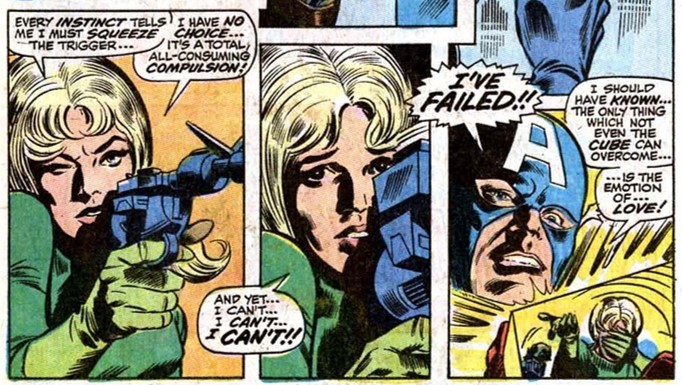
However, the Red Skull is way too much of a vaudevillian villain to start with such a straightforward scheme. Instead, Schmidt’s initial plan is to force Sharon Carter to shoot her lover while Cap is trapped in the body of his hated enemy for maximum drama. (Not the last time that Steve and Sharon’s relationship will involve her pulling a gun on him under some form of “all-consuming compulsion.” If they ever go to a relationship counselor, that poor bastard has their work cut out for them.) In a twist that would surprise precisely no genre fan, the nigh-omnipotent Red Skull is foiled…by the power of love:

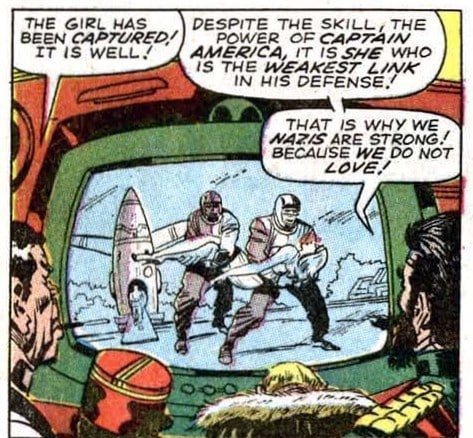
Outraged that he’s been defeated by the equivalent of the Care Bear Stare, the Red Skull banishes his body-swapped nemesis to a Caribbean island that has been conquered and colonized by his Nazi boy band, the Exiles, who are best known for outlawing love:

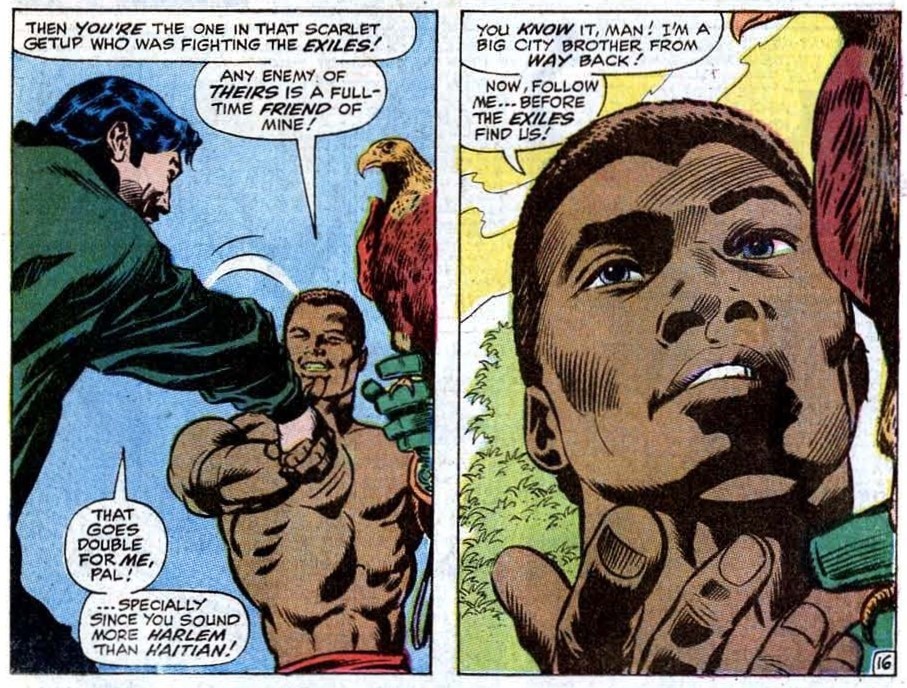
This is the context in which Steve Rogers meets Sam Wilson on the island of forbidden love: as far as he knows, he’s permanently trapped in the Red Skull’s body (for really stupid story reasons, it turns out that the titular cranium is “really just a mask,” allowing Steve to pass as a totally generic white dude, but with black hair) and will never be Captain America again, and suddenly he meets a freedom fighter seeking to liberate black people from Nazi oppression:

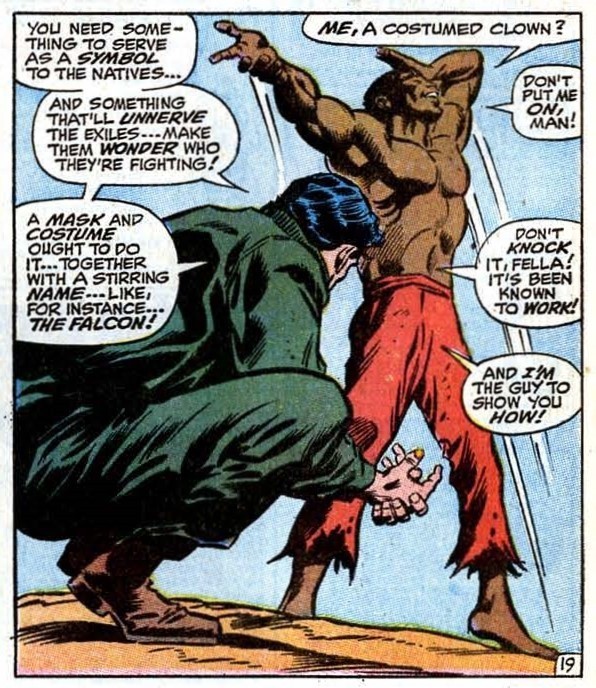
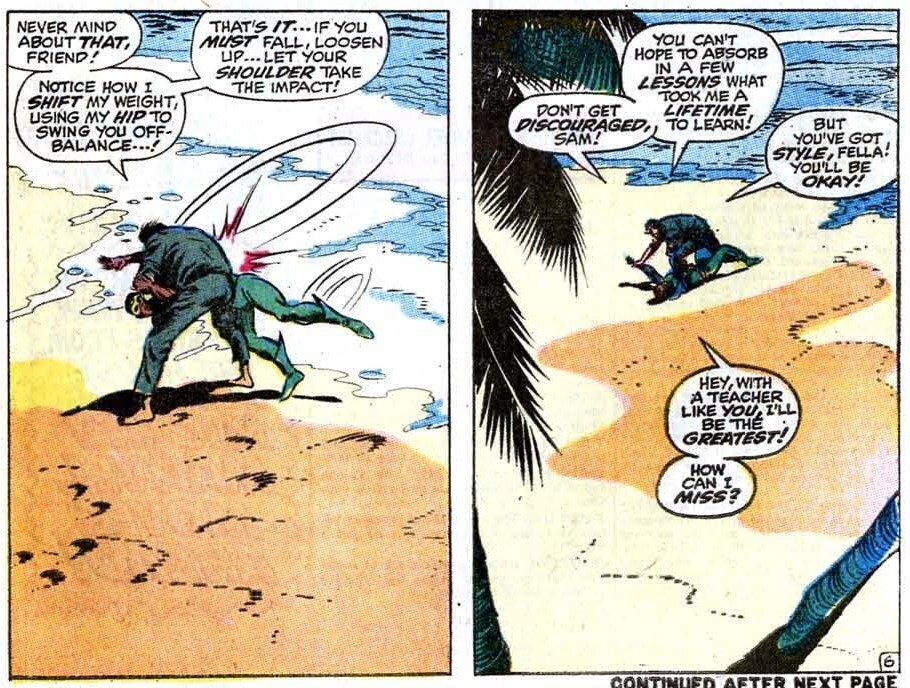
This meeting gives Cap a way out of his identity crisis: because he might not come back, either as Captain America or because he’s lowkey planning to die fighting God, he sees Sam Wilson as his replacement. (For his part, Sam Wilson’s relationship with Steve Rogers is permanently shaped by the fact that, virtually uniquely in the Marvel Universe, because of the body-swap, Sam got to know Steve Rogers the person before he met Captain America, the living legend.) Steve offers on the spot to train Sam to be a super-hero:

If all of this Grecian wrestling on the From Here to Eternity beach strikes you as a bit Tom o’ Finland, you’re not wrong. Whether intended or not, there is a robust queer subtext to Gene Colan’s pencils – from the “camera” angles and framing, to how Sidney Poitiers was the clear inspiration for the portraiture, to the composition of Sam’s frequently shirtless torso – that will only become richer in future installments of A People’s History of the Marvel Universe. Particularly significant for the purposes of this column is the fusion of the romantic with the ideological and super-heroic, as Steve and Sam’s relationship is forged in overthrowing a Nazi regime:

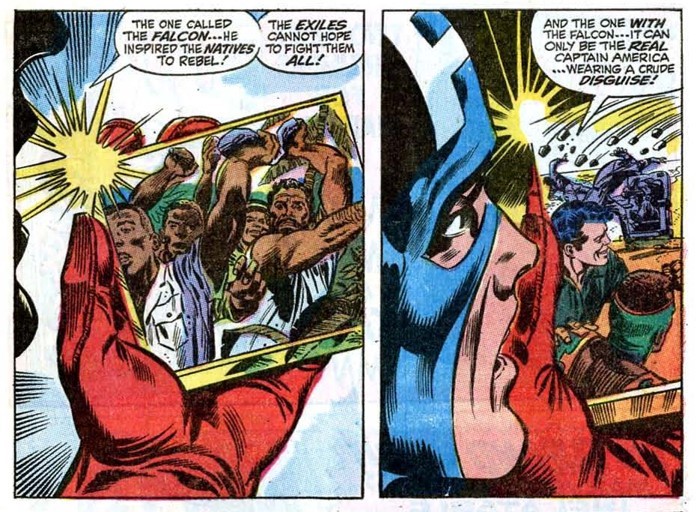
While Sam and Steve re-enact the Haitian Revolution, the Red Skull’s long con plan to destroy Cap’s reputation is undone by the fact that he can’t handle people liking him:

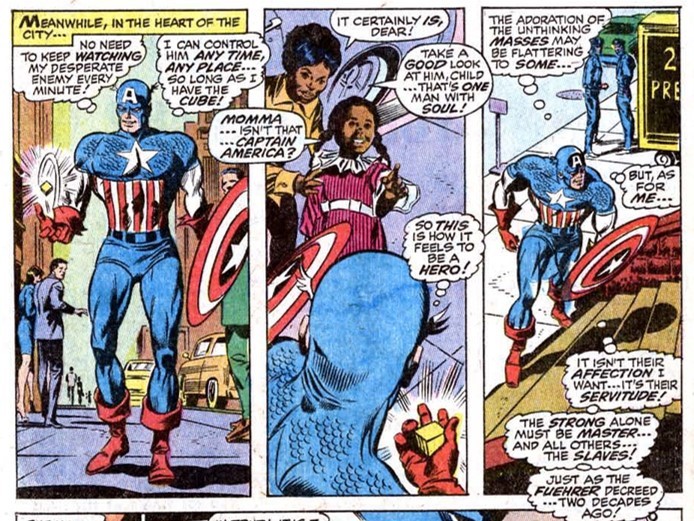
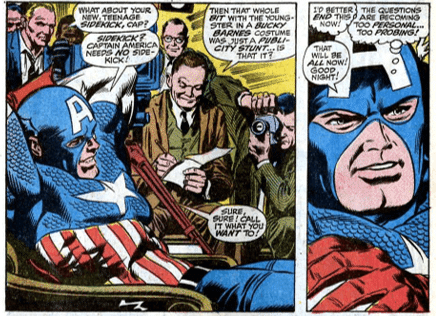
Once again, the Red Skull’s Nazi ideology – in this case, his anti-populist belief in social hierarchy (and no, it’s not an accident that Schmidt recoils from the admiration of a black family[2] and immediately begins reiterating his belief in the subordination of the masses by the master race) – proves to be his undoing, because he can’t deal with ordinary people. First, when Schmidt tries to ruin Cap’s reputation by making him look like a publicity-obsessed gloryhound, he freezes up when the free press asks him the mildest of questions:

Almost thirty years of experience in building doomsday devices and hiding out in volcano bases turns out not to be very good preparation for dealing with public relations. Second, the Red Skull is literally chased out of town by the sheer Beatles-like intensity of Cap’s fanbase:

Once again, the kids are all right. Foiled by a bunch of meddling kids, the Red Skull succumbs to a fit of villainous egoism and decides to use his godlike powers to revert the body-swap, thus giving Cap the ability to fight back:

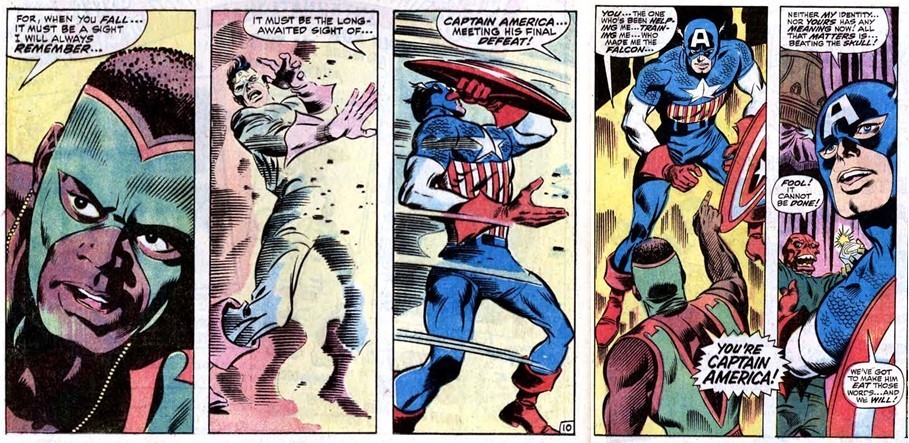
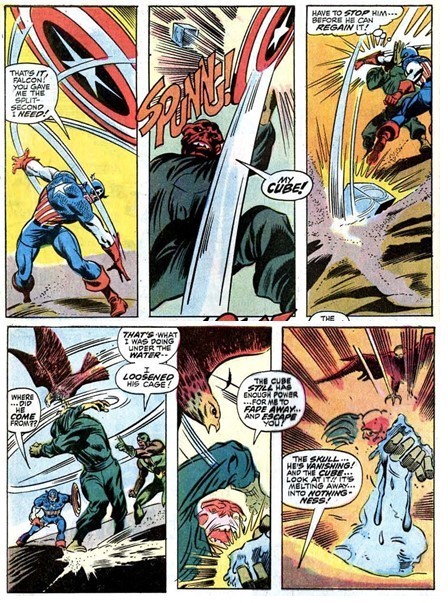
And so where Cap failed on his own, Captain America and the Falcon unite against the psychological torment of the Cosmic Cube, using the power of teamwork – and some unseen assistance from M.O.D.O.K, who doesn’t like the Red Skull biting A.I.M’s style – to confuse and baffle the Red Skull until he bobbles the Cube and goes out like the Wicked Witch of the West:

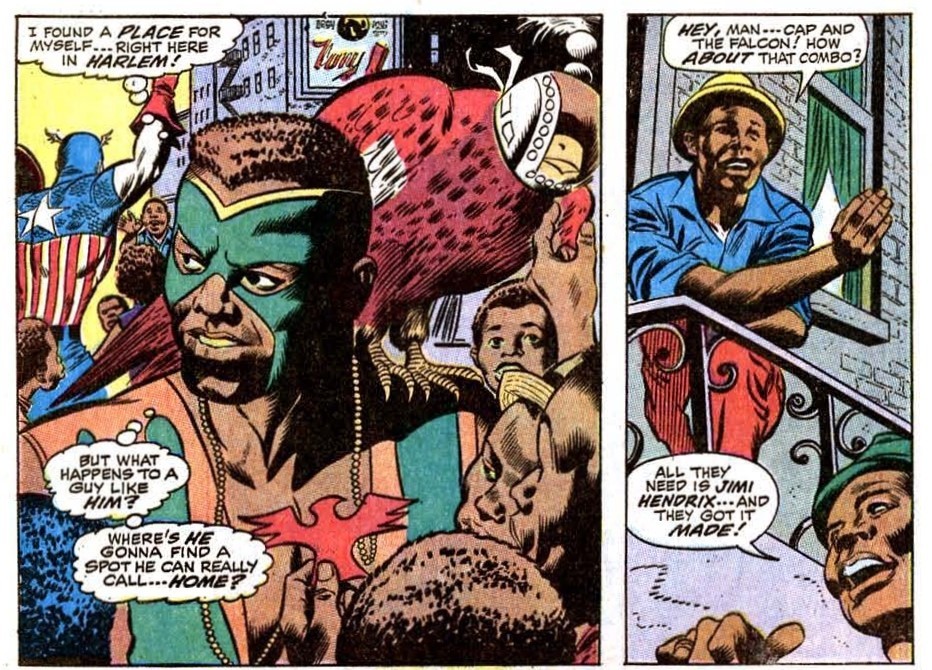
And so, their friendship tempered in the heat of battle, Captain America and the Falcon are anointed as a superhero duo – with the Falcon, officially the first African-American superhero, declared the protector of Harlem and Steve continuing in his role the Man out of Time:

As the presence of the crowd suggests, Captain America and the Falcon’s partnership would be a way for Stan Lee and Gene Colan to Talk About Race in America – for good and ill. But that’s a subject for the next People’s History of the Marvel Universe


[1] Unsurprisingly, Stan Lee confuses dimensions with light-years or galaxies here. 

[2] While Some Anvils Need to Be Dropped, there is a certain awkwardness that comes with two white creators dropping a black character into the narrative for the sole purpose of saying that Steve Rogers is “one man with soul.” One of the running themes of this and succeeding essays about Sam Wilson is going to be the more than occasional awkwardness that comes from two well-meaning white liberal dudes in their mid-to-late 40s opining on race relations in late 60s/early 70s America. See also in this story where Sam Wilson describes himself as a “big city brother” from the “swinging slums of Harlem.”

4th of July Patriots

The 4th of July means different things to many people, as we celebrate the USA’s birthday, I wanted to highlight 5 patriots that aren’t Steve Rogers but wear the colors and are willing to stand or take a knee for their beliefs.


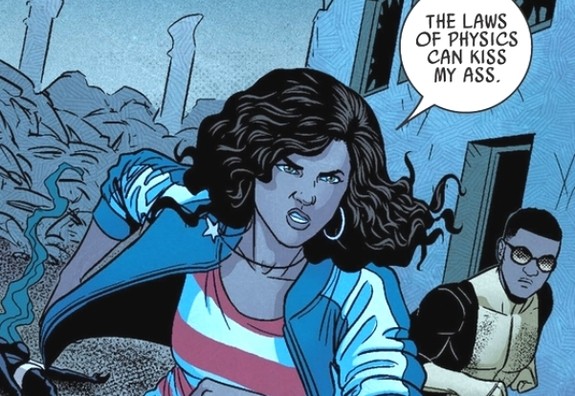
5) America Chavez aka Ms. America – this super-powered young woman is one of the true faces of what America is, a one woman powerhouse, lesbian immigrant from another dimension. As she has settled in the 616 universe, she has worked to improve life as a member of the Ultimates.

America_Chavez


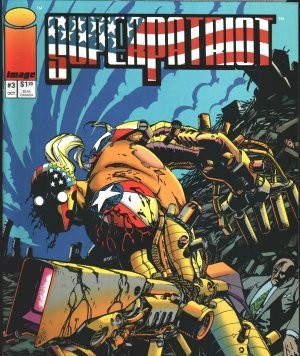
4) Super Patriot – straight from the pages of the Savage Dragon, Johnny Armstrong was a WWII superhero who was viciously beaten by villains in the 90’s resulting in his being turned into a WMD. In this new incarnation Super Patriot continues the never ending battle of good vs. evil.

superpatriotcover3sn.jpg


3) La Borinqueña – makes the list as a symbol of Puerto Rican resilience. As part of the US she uses her elemental powers to uplift and inspire Puerto Ricans on the island and throughout the US in the shared colors of the flag, and make no mistake she is American.

LaBorinquena


2) Sam Wilson aka the Falcon – but forever my Captain, Sam is the Captain we need and he made the role his by incorporating his signature wings and social outlook into the legacy of carrying the shield.


1) Martha Washington – takes the number one spot because she can. This future patriot rose up from the most dangerous housing project in Chicago to become Earth’s literal savior without any powers or enhancements. Her force of will, coupled with her compassion is what makes her the number one patriot of this or any 4th.

13472a85327e8ec9e9b7347e7502f0f9


Why Are Captain America, Falcon, and Black Widow Helping Assad?

In the lead up to their Marvel Studios releases, Marvel Comics publishes two issue “prelude” comics for upcoming films which are then collected into trade paperbacks with extra related material. Leading up to Avengers: Infinity War, Avengers: Infinity War Prelude recently saw its trade release. Written by Will Corona Pilgrim, with art by Tigh Walker, color by Chris O’Halloran, and lettering by VC’s Travis Lanham the two issue story recaps Captain America: Civil War and Infinity War, fills in gaps between the films, and also provides details on the Infinity Stones.

Part of the story follows what Steve Rogers, Sam Wilson, and Natasha Romanoff, (aka Captain AmericaFalcon, and Black Widow) have been up to, and what’s presented is a little head scratching.

The scene has the trio breaking up an arms deal in Syria. That arms deal is weapons being sent by the United States government to Syrian rebels who we can only assume are fighting a civil war against the dictator Bashar Hafez al-Assad. Yes, Captain America, Falcon, and Black Widow are protecting Assad from rebels and interfering in an internal conflict.

What’s stranger is that Black Widow refers to these individuals as “terrorists” which is language that takes the side of Assad’s government. Further strange is that Black Widow has gotten her intel from her KGB contacts (and I’ll ignore the use of KGB and not one of the current intelligence agencies that split up in to after the dissolution of the Russian government in the early 90s). That means she received information to take down these “terrorists” from Russian operatives. The Russian government supports Assad and is in a proxy war with the United States with real world engagement. As presented, these superheroes are being willingly manipulated by the Russian government to take down the Syrian opposition (and their US ally) and prop up a dictator.

When you mix in some of Rogers’ issues with the fictional Sokovian Accords it gets stranger. Rogers vocalized concerns to Tony Stark included being used by individuals to meet their agendas, they lose their right to choose what actions they take. So, in this situation either Rogers, Wilson, and Romanoff have chosen this action and/or they’re being used by the Russian government. Either case, it’s a bad choice as they’re propping up a genocidal dictator who has used chemical weapons against his own people.

Through their actions too they’ve not only denied the weapons to this group, they’ve done so in opposition to the United States government an action that would likely come with further sanctions and at least charges.

Will this be addressed in the upcoming film? We have only until late April to see but as is it muddies the politics of the Marvel Cinematic Universe.

Diamond Select New in Previews: Dark Tower, Alien Covenant, Pirates and Pulp Fiction!

This year is shaping up to be one of the most exciting movie years in recent memory, with new installments in the Marvel, Alien and Pirates of the Caribbean franchises, and Diamond Select Toys is there with the merchandise you need! From Minimates to Vinimates to Gallery PVCs to Select action figures, DST has the gear you’ll want from your soon-to-be-favorite movies, as well as past film favorites, TV shows and comics! Read on to see what hits in fall of 2017, and pre-order through your local comic shop or favorite online retailer!

Aliens Covenant Movie Minimates Series 1 Asst.

A Diamond Select Toys Release! The most anticipated sci-fi film of the year is almost here, and DST is celebrating with a new assortment of Minimates! Springing out of the successful Alien and Aliens Minimates lines, this new assortment for Alien: Covenant will include four different two-packs based on the film, including crew members David, Tennessee, Daniels and a variety of new creatures! Each 2-inch Minimates mini-figure features 14 points of articulation and fully interchangeable parts and accessories. Each two-pack comes packaged on a full-color blister card. (Item # APR172627, SRP: $9.99/ea.)

DC Gallery Deluxe Batman TAS Harley Quinn 25th Anniversary PVC Diorama

A Diamond Select Toys Release! Harley Quinn is turning 25, but you get the present! The first-ever Deluxe DC Gallery PVC Diorama celebrates Harley’s 1992 debut on Batman: The Animated Series with a new diorama of the Joker’s gal pal sitting on top of a gift-wrapped Batman – an anniversary present to Harley from her Puddin’! Measuring almost 10 inches tall, this diorama features detailed sculpting and paint applications and comes packaged in a full-color window box. Sculpted by Varner Studios! (Item # APR172648, SRP: $60.00)

Dark Tower Movie Minimates Series 1 Box Set

A Diamond Select Toys Release! The epic novels by Stephen King are now an epic feature film, and DST is epically excited about it! This all-new box set of four Minimates mini-figures features four characters from the upcoming film – Jake, the Gunslinger, the Man in Black and one top-secret character – each with up to 14 points of articulation and fully interchangeable parts and accessories. All four figures come packaged on a full-color blister card. (Item # APR172628, SRP: $24.99)

Marvel Gallery Captain America Sam Wilson PVC Diorama

A Diamond Select Toys Release! Interest in the Marvel Gallery line of PVC dioramas has gotten so high that DST’s newest offering needs wings! Sam Wilson, the former Falcon and current Captain America, spreads his wings in his modern-day patriotic costume. This highly detailed sculpt features exacting paint details, as well as a removable shield that can be placed on his arm or on his back. In scale to all Gallery and Femme Fatales PVC dioramas, FalCap measures approximately 10 inches tall by 9 inches wide and comes packaged in a full-color window box. Sculpted by Jean St. Jean! (Item # APR172655, SRP: $45.00)

Marvel Gallery Civil War Movie Black Panther PVC Diorama

A Diamond Select Toys Release! The son of T’Chaka stalks his prey in the newest cinematic release in the Marvel Gallery line of PVC dioramas! T’Challa, the Black Panther of Wakanda, wears his distinctive movie outfit from Captain America: Civil War as he crouches on a rubble-strewn street base. Measuring approximately 6 inches tall and 9 inches wide, he is in scale to all Gallery and Femme Fatales PVC dioramas and comes packaged in a full-color window box. Sculpted by Gentle Giant! (Item # APR172656, SRP: $45.00)

Marvel Gallery Netflix TV Daredevil PVC Diorama

A Diamond Select Toys Release! The Netflix-based series of Marvel Gallery PVC dioramas continues with none other than Daredevil himself! Joining Luke Cage and the Punisher, this approximately 11” sculpture depicts the TV version of the horned hero of Hell’s Kitchen in amazing detail. Capturing the likeness and costume of actor Charlie Cox, this diorama sees Matt Murdock standing on a rooftop pedestal, his billy clubs at the ready. Daredevil is in scale to all Gallery and Femme Fatales PVC dioramas, and comes packaged in a full-color window box. (Item # APR172653, SRP: $45.00)

Marvel Netflix Minimates Iron Fist Box Set

A Diamond Select Toys Release! The next Marvel Netflix TV show is powering up, and DST is expanding their Marvel Netflix universe with an all-new Minimates box set capturing the main characters! Based on the upcoming Iron Fist, the four 2-inch mini-figures include Danny Rand, Colleen Wing, Iron Fist and Thunderer. Each 2-inch Minimates mini-figure features 14 points of articulation and fully interchangeable parts. All four figures come packaged in a full-color window box with original Minimates artwork. (Item # APR172654, SRP: $24.99)

Marvel Premier Collection Psylocke Resin Statue

A Diamond Select Toys Release! Hello, ninja! The X-Man Psylocke has been a fan-favorite ever since her 1990s makeover into a psychic ninja, and now DST has created the ultimate Psylocke collectible! This full-size resin statue depicts Betsy Braddock on a burning rooftop, surrounded by ninja arrows. Measuring approximately 12 inches tall, the statue is limted to only 3,000 pieces, and comes packaged with a numbered certificate of authenticity in a full-color, hand-numbered box. Sculpted by Alejandro Pereira! (Item # APR172652, SRP: $150.00)

Nightmare Before Christmas Resin Busts

A Diamond Select Toys Release! Move over, elf – there’s a skeleton and a rag doll on the shelf! These highly detailed resin busts of Jack Skellington and Sally the Rag Doll from Tim Burton’s The Nightmare Before Christmas each measure approximately 6 inches tall and sit atop detailed bases depicting the buildings of Halloween Town. Limited to only 3,000 pieces each, they each come packaged with a numbered certificate of authenticity in a full-color, hand-numbered box. Sculpted by Joe Menna!

Jack Bust (Item # APR172629, SRP: $59.99)

Sally Bust (Item # APR172630, SRP: $59.99)

Nightmare Before Christmas Deluxe Cloth Dolls

A Diamond Select Toys Release! The deluxe cloth Nightmare Before Christmas doll line continues with two new characters! These large-scale dolls of Zero the Ghost Dog and Santa Claus are in scale to the previously released Jack, Sally, Finkelstein and the Mayor, and look like they came straight from the movie! Based on the classic Japanese imports, Santa Claus measures approximately 10 inches tall and features a real cloth costume and multiple points of articulation, while the fully sculpted Zero hovers over a doghouse diorama atop a clear support stand. Each comes packaged in a full-color window box.

Zero (Item # APR172632, SRP: $49.99)

Santa (Item # APR172633, SRP: $49.99)

Nightmare Before Christmas Minimates Series 4 2-Packs Asst.

A Diamond Select Toys Release! It’s a new series of Nightmare Before Christmas Minimates and they’re a dream come true! The cast of creepy characters expands with three new 2-packs: Snowman Jack with glow-in-the-dark Oogie Boogie, the specialty-exclusive Devil and Corpse Boy, and the also-exclusive Saxophonist with Undersea Gal! Each 2-inch Minimates mini-figure features up to 14 points of articulation with fully interchangeable parts, including a removable snowman costume! Each 2-pack comes packaged on a full-color blister card. (Item # APR172631, SRP: $9.99)/ea.

The Nightmare Before Christmas Select Action Figures Series 3 Asst

A Diamond Select Toys Release! Tim Burton’s The Nightmare Before Christmas is the gift that keeps on giving! Three new figure sets are coming your way for Halloween, including the Pumpkin King, Santa Claus, and Lock, Shock and Barrel, each sculpted in an approximately 7-inch scale with character-appropriate articulation. Plus, each figure set includes an exclusive figure or diorama piece – Lock, Shock and Barrel come with their walking bathtub, Santa Claus comes with an Elf and part of the town square diorama, and the Pumpkin King comes with part of the central fountain! Connect the Santa and Pumpkin King bases with other releases to make a larger diorama! Sculpted by Dave Cortes! (Item # APR172634, $149.94 per case)

Pumpkin King (Item # APR172635, SRP: $24.99)

Santa Claus (Item # APR172636, SRP: $24.99)

Lock, Shock & Barrel (Item # APR172637, SRP: $24.99)

Pirates of the Caribbean: Dead Men Tell No Tales Select Action Figures

A Diamond Select Toys Release! Avast, me hearties! Having dazzled audiences for over a decade, the swashbuckling Pirates of the Caribbean film franchise is headed into uncharted waters with the fifth installment, Dead Men Tell No Tales! These 7-inch scale action figures of stars Jack Sparrow and Barbossa are based on the new film and feature each actor’s likeness as well as approximately 16 points of articulation. They also include diorama bases that can combine to build the deck of the famous pirate ship the Black Pearl! Each figure comes packaged in the display-ready Select figure packaging, with spine artwork for shelf reference. Sculpted by Gentle Giant!

Jack Sparrow (Item # APR172650, SRP: $24.99)

Barbossa (Item # APR172651, SRP: $24.99)

Pulp Fiction Select Action Figures Series 1 Asst.

A Diamond Select Toys Release! Bring the coolness of Pulp Fiction home with you! Quentin Tarantino’s 1994 movie masterpiece is now a highly detailed line of 7-inch collectible figures, bringing the film’s cool-as-ice cast to your shelf! The first series includes go-for-broke boxer Butch Coolidge, born-again hitman Jules Winnfield and fearsome mob boss Marsellus Wallace. Each character is 7-inch scale, with detailed paint applications and the actor’s likeness, as well as 16 points of articulation and character-specific accessories. Plus, each comes with a diorama piece: Jules includes the room where the big shootout takes place, and Butch and Marsellus each come with a piece of sidewalk from their chase scene! Packaged in display-ready Select packaging with spine artwork for shelf reference. Assortment includes two of each figure. Sculpted by Gentle Giant! (Item # APR172649, SRP: $24.99/ea.)

Wonder Woman Movie Vinimates Vinyl Figures

A Diamond Select Toys Release! The Vinimates vinyl figure line explodes into the DC Comics cinematic universe with two vinyl figures based on the Wonder Woman movie! With one figure depicting Diana in her training gear, and one in her full Wonder Woman outfit, these two figures will kick off a line that will eventually unite the entire Justice League! Each 4-inch vinyl figure is sculpted in a pose straight from the movies, with an articulated neck to customize each pose. Each comes packaged in a full-color window box.

Wonder Woman Vinyl Figure (Item # APR172646, SRP: $9.99)

Wonder Woman Training Gear Vinyl Figure (Item # APR172647, SRP: $9.99)

SDCC 2015: LEGO’s Exclusive Minifigs Include Falcon Captain America and Roy Harper

LEGO completists had minor strokes this weekend as some details of the company’s exclusive minifigures were revealed. Images of the first figure have been released. Sam Wilson, aka the Falcon, aka the New Captain America will be one of the exclusive figures to be given away. This one has a bit of a Secret Wars spin to it.

It is also rumored that Roy Harper, who was seen on the television show Arrow, will be the DC Comics release for the show.

Traditionally the figures have been given away via lottery at the show with attendees having their badges scanned and randomly chosen.

SDCC Lego Captain America Sam Wilson 1 SDCC Lego Captain America Sam Wilson 2


Updated: Marvel Announces a New Captain America on The Colbert Report

ColbertshieldContinuing their tour of television shows, Marvel has made a stop at The Colbert Report. Tonight, Colbert (referencing the now infamous issue #21) not only caught America up on what’s up with Captain America, but also had an announcement with the help of Joe Quesada…. after some prompting from the audience that Colbert should take over the role.

Quesada, and Colbert actually talked comics for a bit, a great change from some other television appearances, and handled it with humor, and lots of entertainment.

And the big announcement is……

The next Captain America is Sam Wilson, The Falcon! We also got a first look at Wilson as the new Captain America.

But, with that, there’s a void, and a new Falcon is needed. Quesada felt Colbert could fill the role and did up Colbert as the Falcon courtesy of artist Kristafer Anka (who cryptically hinted about the art last night on Twitter).

This isn’t the first African-American Captain America. Isaiah Bradley was introduced into the Marvel universe in 2003 in Truth: Red, White, & Black, in which a Tuskegee like program was created in an attempt to recreate the super serum that turned Steve Rogers into Captain America.

And here’s a look at the new Cap and Colbert as The Falcon!

IMG_20140716_234844874 IMG_20140716_234814469It looks like Wilson’s new uniform will mix Cap’s and his current Falcon one. It does look like wings still in the arm.

All_New_Captain_America_Cover

Update: Here’s Marvel’s official release:

Marvel is excited to announce that beginning in November 2014, the title of Captain America will be passed to Sam Wilson, The Falcon, in the pages of All-New Captain America #1 by series writer Rick Remender (Captain America, Uncanny Avengers) and series artist Stuart Immonen (All-New X-Men).


Announced on “The Colbert Report” by Joe Quesada, “Sam Wilson…The Falcon, is the new Captain America.”


Addressing how Sam Wilson will follow in the footsteps of his predecessor, Steve Rogers, Remender says, “Sam wants to lead by example. To help people see their own selfishness and to turn it around. To build better communities, to never forget the little guy.”  Remender continues, “Sam follows his heart and his belief in what the American dream means and how it belongs to everyone.”


The question remains: what happens with the original Captain America, Steve Rogers? Executive Editor Tom Brevoort says, “Steve’s spirit is as willing as ever, but his body is no longer up to the task of being Captain America. So he’ll employ his skills as the new Cap’s remote strategic advisor, running Cap’s missions from his headquarters in Avengers Mansion and providing Sam with technical support and field information from a distance. He’ll also tutor Sam in how to throw the shield, a skill that’s deceptively difficult for the new Cap to master. So Steve will continue to be a vital part of the series moving ahead.”

The Falcon Arrested in NYC for Alleged Drunken Driving

anthonymackie-falcon-4As reported by TMZ, Anthony Mackie, who will star as Sam Wilson/The Falcon in next year’s Captain America: The Winter Soldier was arrested Saturday morning for drunk driving.

Mackie, who has also appeared in 8 Mile, Hurt Locker and Gangster Squad was driving around New York City at 1:30am when he was pulled over by police for tinted windows. When police approached the driver’s side they smelled booze and saw Mackie’s bloodshot, watery eyes.

Mackie then flunked several sobriety tests and was taken to a police station where he was booked. Mackie refused to submit to a blood-alcohol test and due to that, he’ll have his license automatically suspended.

Mackie flunked several field sobriety tests and was then cuffed and taken to a nearby police station where he was booked.