Tag Archives: jessica drew

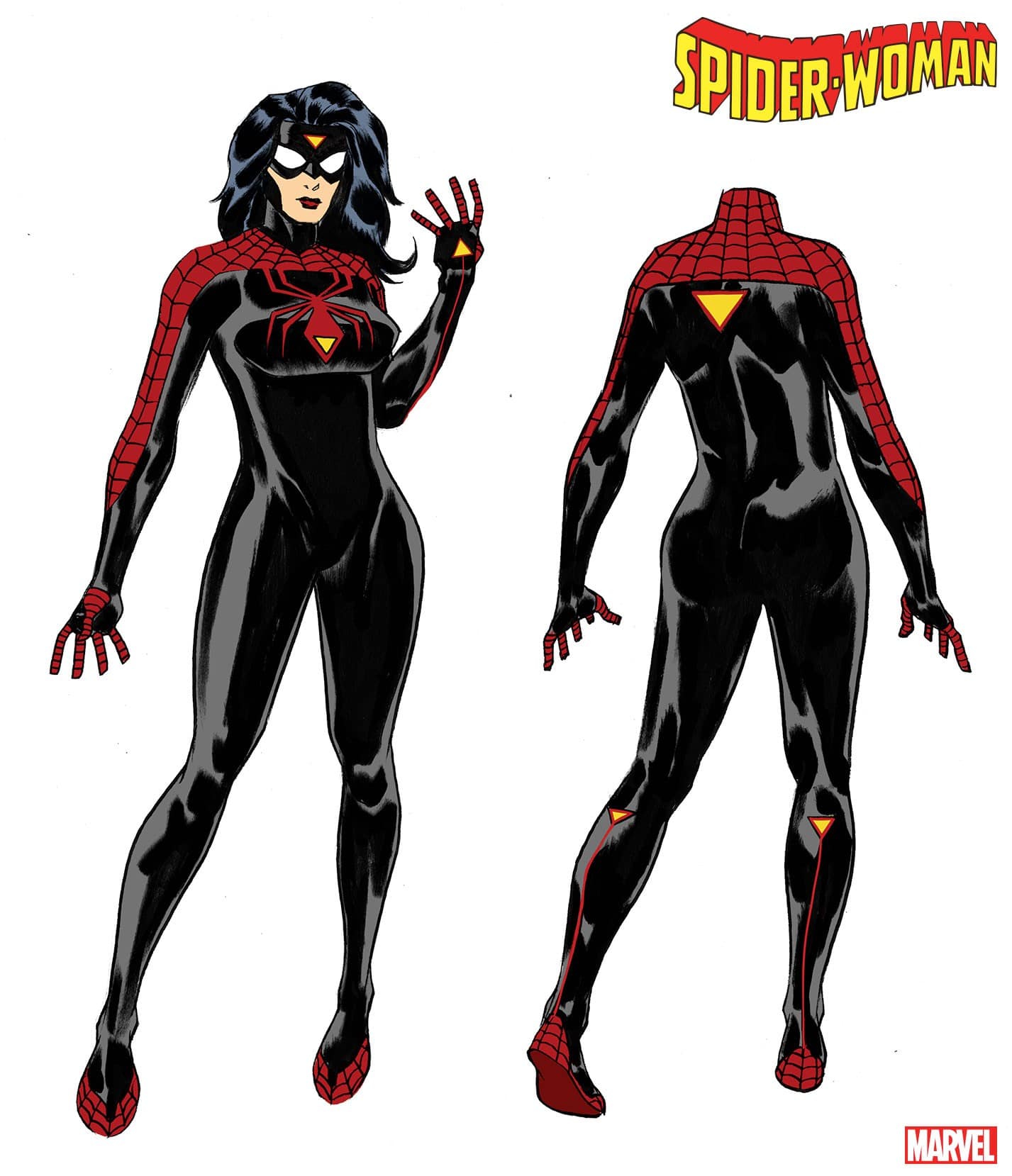
Spider-Woman Gets a New Look in March 2020

Spider-Woman is back and she’s not pulling any punches. This March, Jessica Drew finds tangled in a web of mystery and surrounded by enemies new and old in her brand-new solo series by Karla Pacheco and Pere Pérez. Expect shocking revelations about her origin, characters dropping in from her past, dangerously high stakes, and of course, classic super hero action only Spider-Woman can deliver!

Oh, and did we mention she has a new costume? Check out Spider-Woman’s fresh look, designed by legendary artist Dave Johnson, in Junggeun Yoon’s Spider-Woman #1 cover below. And as previously revealed, the explosive first issue will also be available with a cover depicting Spider-Woman in her classic costume! This is one adventure you won’t want to miss!

Review: Spider-Woman #17

SpiderWoman17CoverI’m going to preface this review by saying that slapstick is the type of comedy I find least funny. It can be great in small, quick doses and definitely is a good fit for the comics medium with artists having unlimited ability to draw all kinds of wacky faces and gestures. However, it doesn’t work well when one gag is the driving force of a comic’s plot, like in the case of Spider-Woman #17, which is about Jessica Drew’s son Gerry getting superpowers and reads like Boss Baby sans Alec Baldwin and plus superheroes.

But Spider-Woman #17 isn’t a total bust. Writer Dennis Hopeless and artist Veronica Fish bring out some choice cattiness in dialogue and facial expressions when Black Widow isn’t impressed by her dating the former Porcupine, Roger Gocking. Their sniping with other superheroes, like Hawkeye and Carol Danvers, playing referee are the most hilarious parts of this issue. Fish gives each hero stylish civilian clothes (Except for Spider-Man, who is still fully in costume.), which highlights the outrageousness of them arguing like middle schoolers. And then Gerry pops out of the house and kicks a lot of them in the face, including Black Widow, whose parkour moves are no match for the Super Gerry Sweeping Swan Kick. (Sadly, no one calls it that in the comic.) Colorist Rachelle Rosenberg gives his energy blasting a distinct gross, yet mysterious green color that resembles Terrigen Cloud vomit, but is visually striking.

In the background and providing the heart of Spider-Woman #17 (and the whole run arguably) is Roger, who finds solace taking care of Gerry away from the silently (Except for Natasha, who is kind of the worst in this issue.) judging superheroes. And even when he gets thrown into a Veronica Fish double page spread featuring Gerry turning into an energy blasting, human equivalent of one of those annoying bouncy balls from the dollar store, Roger is a perfect dad figure, boyfriend, and worthy of both of the monologues that Jessica spouts about him.

WineMomShowdown

The superheroes that Jessica invites to her party represent traditional superhero storytelling where villains are redeemed, but only to serve the story before it’s time to bring them back when an arc gets stale. Hopeless and Fish have subverted this in their run on Spider-Woman where Roger gets to be a friend and close confidant of Jessica Drew and her rock as she balances being a superhero and single mom. Then, after all the build-up and baby/guy in a porcupine suit bonding, he becomes Jessica’s boyfriend. Roger started out as silly villain punching bag, but Hopeless and Fish have given him a personality, sense of humor, and a great relationship with our protagonist.

Too much of Spider-Woman #17’s running time is given to repetitive slapstick shenanigans, but it is nice to see a superhero, like Jessica Drew, who has been through some fairly dark situations since her first appearance in 1977 (See Brian Michael Bendis’ New Avengers run.) find happiness in both her superhero and personal life as a single mom and friend. Dennis Hopeless, Veronica Fish, and Rachelle Rosenberg deserve credit for giving her and Roger fantastic, overall character arcs and also fixing her friendship with Carol Danvers even in the face of Civil War II although this issue isn’t one of the series’ better ones.

 Story: Dennis Hopeless Art: Veronica Fish Colors: Rachelle Rosenberg
Story: 7 Art: 7 Overall: 7 Recommendation: Read

Marvel Comics provided Graphic Policy with a FREE copy for review

Review: Power Man and Iron Fist Sweet Christmas Annual #1

power_man_and_iron_fist__sweet_chriThis is one of the best one-off holiday comics that I have read in a long time. Power Man and Iron Fist Sweet Christmas Annual #1 is like a really fun B-Movie in comic book form. The issue starts innocently enough, Uncle Iron Fist and Luke Cage taking Danielle out to wait in line for hours to grab the hottest toy coming out this Christmas. The cult of consumerism is fertile hunting grounds for this issues big baddie, who is none other than Krampus himself controlling an army of kiddie toys!

Luke Cage has to fight his way through demon infused toys to get to his daughter and Iron Fist has to do battle with Danielle on his back. Hella trim is sort of the good guy and Jessica Drew provides back up! With a very special guest showing up to deliver one hell of a snack down to Krampus! This one-off issue provides more catch phrases, sass, and action than you could hope for and all the awesome that you didn’t think you needed but, you’re hella grateful for.

David F. Walker‘s story is funny, short, sweet and to the point. It’s everything that it needs to be to tell a good story and provide some really good entertainment. Scott Hepburn‘s artwork is tight and Pretty detailed considering how much is going on in all of the frames. Overall there’s a nice mix of story and art. The story has enough human feel good moments to make the fight scenes feel balanced and less jarring. There’s a lot going on but, none of the words or panels are wasted and they all add to the richness of the story.

Sweet Christmas is a good read for what it is. It’s a diversion, nothing too heavy but, it’s not frivolous. It just a good solid read and worth your time.

Story: David F. Walker Art: Scott Hepburn
Story: 8.5 Art : 8.2 Overall: 8.3 Recommendation: Buy

Marvel provided Graphic Policy with a FREE copy for review

Investigating Alias #20-21

Alias_Vol_1_20Investigating Alias is a weekly issue by issue look at the source material that inspired the popular and critically acclaimed Jessica Jones Netflix show.

In this installment of Investigating Alias, I will be covering Alias #20-21(2003) written by Brian Michael Bendis, drawn by Michael Gaydos, and colored by Matt Hollingsworth with dream sequence art from Mark Bagley, Al Vey, and Dean White in Alias #21.

“The Underneath” wraps up in Alias #20-21 as writer Brian Michael Bendis puts the meat of the plot in these issues as well as humanizing J. Jonah Jameson and showing that Jessica Jones can be pretty damn heroic as she has a real connection with Mattie Franklin, the third Spider-Woman, who has been drugged and used as a source of mutant growth hormone (MGH) by her skeezy, wannabe Kingpin boyfriend Denny Haynes. Alias #20 opens up with Jessica Drew going all Emperor Palpatine on Jessica Jones with bio-electric venom blasts, and then our protagonist repays her in kind with a right hook. They bond over the fact that they hate the Avengers and costumes and meet with J. Jonah Jameson and his wife Marla, who formally hire them to find Mattie after an emotional plea. A database search and phone call later, they end up at Denny’s hotel room where another young superhero and former New Warrior Speedball is losing control of his very colorful force field powers. Between this and Civil War where he’s involved in the deaths of hundreds of school children in Stamford, Connecticut, I feel really bad for him.

Alias #21 concludes this arc and starts off with Matt Hollingsworth’s most colorful palette yet with the primary colored energy bursts causing Jessica Jones to lapse in a dream state. This completely silent three page sequence is drawn by Mark Bagley and Al Vey with colors from Dean White and is the first time Killgrave (aka the Purple Man) has appeared in Alias as he is shown kissing and manipulating Jessica before the Defenders led by Doctor Strange show up. It’s a harrowing look at Jessica’s dark past and features many Marvel Universe cameos. After this, Jessica Jones takes out Denny Haynes and with an assist from Jessica Drew and various hotel room furniture dispatches the rude, sexist guy, who was hopped on MGH and beat her up in the club when she was looking for Mattie a couple issues back. They then find out that Speedball has been working with the police to bust Denny’s MGH ring, and Jessica Jones has to fly across New York City with a barely conscious Mattie to avoid Jameson’s enemies using her against him.

The story skips six weeks forward, and a now clean Mattie thanks Jessica Jones for saving her, gives her a newspaper story from J. Jonah Jameson that portrays her as a hero taking down a drug ring, and Marla Jameson says an offer to work as a P.I. for the Daily Bugle is still on the table. Jessica rejects the offer and ends up having an awkward chat/apology with Scott Lang, who hasn’t talked to her in six weeks, but professes his love for her in a manner worthy of a Cameron Crowe film. She reluctantly agrees to another date.

Alias #20 and #21 are pretty big issues in the scope of the series as a whole with the first appearance of Purple Man setting up the series’ final arc featuring his return into Jessica’s life. There is also Jessica having her first kind of “superhero team-up” (in a non-traditional manner) with Jessica Drew, having her longest “flight” yet, and Bendis kind of setting up the sequel series he did to Alias called The Pulse where Jessica worked for a special section of the Daily Bugle focused around superheroes. But beyond these pivotal moments, Bendis and artist Michael Gaydos show the emotional connection that Jessica Jones has created with the Mattie Franklin case because both she and Mattie were young superheroes and orphans, who were manipulated by older, evil men to do things that they didn’t want to.

JessicaJonesEmpathy

This is really captured in the closing of Alias #21 when Jessica is perfectly understanding and empathetic with Mattie. She loves smoking and drinking excessively, being snarky, and punching out her fellow ex-superhero P.I.’s, but also helps Mattie recover from her rape at the hands of Denny Haynes. Visually, Gaydos and Hollingsworth ditch the dark stylized noir of the New York, hotel room, and even earlier office scenes for a neutral palette and a simple nine panel grid as Jessica supports Mattie through the line, “Actually, I know exactly what you mean.” Jessica Jones is truly heroic because she doesn’t just punch out the rapists, but helps the victim recover by listening and just being there for Mattie Franklin

This conversation is followed up by an uncharacteristically positive superhero related story about Jessica Jones and Jessica Drew’s actions from J. Jonah Jameson, who Bendis had given some depth in Alias #20. First off, he has Jameson (through Ben Urich as a go-between) contact Jessica Jones first about helping him find Mattie after threatening her earlier arc, and after she scammed him and used his money to help charities instead of Spider-Man’s secret identity. This is a big step for him, and it’s because he is close to Mattie. Gaydos shows this emotion in his artwork with two close ups of Jameson’s sad face on an uncharacteristically silent page. If you remember, Bendis and Gaydos turned Alias #10 into an illustrated screenplay because Jameson talks so much.

EmotionalJJJ

A quiet J. Jonah Jameson is a big deal, and Bendis and Gaydos show this through the words and facial expressions of Marla Jameson. The scene is framed in the usual little square, big rectangle interview layout that’s been used throughout Alias, but Gaydos continues to zoom into Marla’s face and show how she partially feels responsible for Mattie going missing because of her and Jonah’s busy job. The final close-up shows her fear and the reason why she wants to hire Jessica Jones (and Jessica Drew) because the editor of a newspaper that attacks superheroes having a superhero foster daughter with drug issues could end Jonah’s career and ruin her family’s reputation. But Jonah’s motive isn’t entirely to save his own cigar chomping self, and Marla says that he truly cares for Mattie and wants to be a good father for her to make up for his mistakes with his son, John. Through this conversation and Jonah having to excuse himself earlier, Bendis and Gaydos show a more vulnerable, human side of the tabloid publisher. This is just a man, who wants his daughter to be okay and happens to mistrust masked heroes in an extreme way.

The most fun in Alias #20-21 comes from Jessica Jones and Jessica Drew teaming up. Bendis created Jessica Jones and revived Jessica Drew as a character putting her in the Spider-Woman costume for the first time in over 20 years in New Avengers and giving her own solo book in the Spider-Woman Origin comic in 2005. It’s safe to say he loves both characters and makes them equals in this adventure as they find common ground in their hatred for the Avengers and costumes. Bendis doesn’t have Jessica Drew come up with a huge reason for hanging up the Spider-Woman threads just that it made her “ass look fat”, and this sets up a perfect opportunity for Jessica Jones to quip about the leather The Matrix-inspired costumes that had been proliferating in the Marvel Universe since Ultimate X-Men. They both find a key piece of evidence to the whereabouts of Denny Haynes, and Jessica Drew gives Jessica Jones grief for using the Internet. This is because she doesn’t have an international network like Jessica Drew that pays for month long trips to Istanbul and has to make ends meet any way possible. However, Jessica Drew doesn’t come across as rich and annoying, and her venom blasts are really handy for getting inside locked doors. Hollingsworth uses harsh blue-white coloring for them to make them really jarring against the shadowy backgrounds of the hotels, streets, and apartments that Jessica Drew and Jessica Jones search for Mattie in. She is confident in her abilities, and it seems like Bendis is gunning for Jessica Drew to come back full time as a superhero, which she would two years later in New Avengers. (She was a Skrull though, oops.)

AssFat

Gaydos and Hollingsworth make a rare artistic misstep in the scenes featuring Speedball’s powers towards the end of Alias #20 and at the beginning of Alias #21. The Dippin’ Dots-style colors for his forcefield abilities are really fun, and it’s like he wandered off the set of a kid-friendly Disney Channel show into an HBO drama. However, the yellow, blue, and green balls everywhere obscure the action when Jessica Jones takes out Denny Haynes and his high-on-MGH goon with Jessica Drew and lessens the catharsis of this beatdown. But even if the action is less clear to follow, Gaydos, Hollingsworth, and letterer Cory Petit create an aura of chaos with his powers going everywhere and show that Speedball, who is having problems controlling his powers, is unsuited for this kind of delicate work like secretly infiltrating a drug ring to get MGH of the street. It’s like a darker 21 Jump Street situation, but with superheroes.

EnterKillgrave

Speedball’s colorful abilities do have one visual upside. They create enough of a trippy environment for Jessica Jones to fall into a kind of dream state for three pages, and the brightness of his costume and abilities is kind of a segue between rough hewn noir meets realism of Gaydos and the traditional superhero work of Bagley in the flashback scenes. The first page Bagley draws in a nine panel grid is the most powerful and unsettling as the shrouded, purple form of Killgrave has Jessica (in her Jewel costume) completely under his control. His appearance in the margins of the panel reminds me of early on in the Jessica Jones TV show where he just appeared in Jessica’s head or manipulated people from barely offscreen. His name isn’t mentioned in this issue, and the dream sequence is obscure foreshadowing, like the all-dream episode of Buffy the Vampire Slayer “Restless”. The classic Defenders lineup of Hulk, Silver Surfer, Doctor Strange, Namor, Nighthawk, and Valkyrie showing up casts this dream even more into the realm of the weird. But Bendis and Bagley are wise to not let the cameo overwhelm the sequence and end with a close-up of Jessica Jones in her civilian clothes terrified and wielding some kind of energy weapon. It’s the first real visual taste of Jessica’s past mental manipulation at the hands of Killgrave, and Bendis keeps things extremely mysterious for now.

JessicaFlies

Even though there is an epilogue I mentioned earlier with Jessica Jones comforting Mattie six weeks after her incident and yet enough horrible conversation with Scott Lang, who calls Jessica crazy and then that he loves her, the full page spreads of Jessica flying with Mattie through the air are the true climax of “The Underneath” arc. It’s been mentioned earlier that Jessica can fly, but never figured out landing so it’s an ability she rarely uses. And in keeping with this, Gaydos’ flying pose for Jessica is pretty awkward, and she even crash lands in a random empty room saying the very Jessica Jones one-liner, “The shit I gotta do” before finding a taxi. But the opposite of Superman flying skills aside, this is one of the most heroic things Jessica Jones has done in Alias. She sympathizes with Mattie so much that she uses an ability that she is still uncomfortable with to make sure that Mattie gets home safe without the police and media using her as a tabloid headline. And unlike the beginning of the arc where she hesitates to stop a convenience store robbery, Jessica just jumps out of a window with Mattie. Even though she isn’t particularly inspirational and makes plenty of mistakes, Jessica Jones is a true hero.

Some visual issues with Speedball’s powers aside, Alias #20-21 is a real highlight reel for the series so far. There’s some banter and ass kicking with Jessica Drew and Jessica Jones taking down the men, who have been manipulating, drugging, and raping Mattie Franklin and some character growth as J. Jonah Jameson trusts and writes positively about superheroes who have touched his life personally. Brian Michael Bendis and Mark Bagley also give us our first look at Killgrave and hint at the horrible things in Jessica Jones’ past, which she has used to empathize with Mattie in a powerful way. And finally, we get to see Jessica Jones fly in her own unique way with Michael Gaydos using a full page spread, but rejecting the iconic poses of superheroes in flight for Jessica struggling to carry Mattie. This scene is a real visual climax for the series so far and shows that Jessica Jones is a hero on her own terms and despite her self-doubt and lack of traditional superhero qualities.

Investigating Alias #18-19

18-marvelInvestigating Alias is a weekly issue by issue look at the source material that inspired the popular and critically acclaimed Jessica Jones Netflix show.

In this installment of Investigating Alias, I will be covering Alias #18-19 (2003) written by Brian Michael Bendis, drawn by Michael Gaydos, and colored by Matt Hollingsworth.

In Alias #18, Scott Lang commits relationship suicide by asking Jessica if she was raped after she won’t open up about the past experience that Madame Web saw in the previous issue. After fielding an annoying phone call from her friend Carol Danvers aka Ms. Marvel, Jessica actually goes to her day job as a bodyguard for Matt Murdock, who is afraid that Daredevil’s enemies will come after him after he was outed as Daredevil in the tabloids. With the appearance from Murdock and later mentions of mutant growth hormone (MGH), writer Brian Michael Bendis intertwines “The Underneath” arc of Alias closely with his then current run on Daredevil. After work, her annoying fanboy Malcolm introduces her to Laney, the sister of a wannabe drug lord named Denny Haynes, who is supposedly having sex with Mattie Franklin and likes to party at the charmingly named Club 616. Jessica affects the clothes, makeup, and speaking patterns of a Manhattan socialite, gets into the club, and then sees Denny with Mattie super doped up right beside him.

Alias #19 features some downright pulsating colors from Matt Hollingsworth as Jessica’s attempt to rescue Mattie is foiled by Denny and his friends, who are shooting up MGH taken directly from a wound in her back. It’s a jarring, sickening sight for Jessica, and she tries to grab Mattie, but is actually defeated in a physical fight by some men who are hopped up on MGH. After getting thrown out of the club bleeding and barely conscious, she meets Ben Urich, who says he has been tailing her because J. Jonah Jameson thinks she has Mattie, and gives her important information about MGH. Then, she checks into the hospital, lies to police officers about being mugged, and finally ends up back in her apartment for a much needed rest. However, the issue ends on a real shocker (Pun fully intended) of a cliffhanger as Jessica Drew (formerly Spider-Woman) shows up in her apartment furious about what has happened to Mattie.

In these two middle issues of “The Underneath” arc, Bendis and artist Michael Gaydos go right at the jugular at every day sexism beginning with making Scott Lang a textbook mansplainer in the opening of Alias #18 and flat out asking her if she got raped even though she doesn’t want to talk about her past. And even when Jessica tells him that she’s angry, Scott asks why his unsolicited comments about her theoretical rape offend her. He’s more concerned with coming across as a “good guy” than her feelings with some awkward dialogue about hearing the end of her story about Madame Web from the previous issue. Gaydos’ storytelling is deft as he goes from three intimate panels of Scott and Jessica in bed to quickly having her dress and leave while Scott has the same dumb expression on her face. And then he floods the next few pages with emotions as Jessica’s paranoia returns while she walks around her apartment. Alias is usually a wordy book, but Bendis lets Gaydos have a few almost silent pages to show Jessica drinking to deal with Scott being a terrible person (Carol calling about him doesn’t help.) and collect herself so she can find Mattie Franklin, who appears in a flashback.

The theme of sexism continues (and is called out directly by her) in Jessica’s day job as a bodyguard for Matt JessClubOutfitMurdock, who she respects and empathizes with because his secret identity was compromised without his consent. However, she does throw a little shade his way because he told Luke Cage his secret identity and not her. This is sexist in her opinion and in her own special way, she trolls him by never knocking on his door when she arrives for her bodyguard duties and smoking on his porch because he can sense her with his superpowers. It’s just a friendly reminder, and Matt and Jessica actually have a solid, professional relationship as shown in a Sorkin-esque walk and talk scene where she tells him about how Jameson is pressuring her to find Mattie. Matt promises to help with that situation by doing a “client harassment” call, and Jessica instantly repays the favor by warding off the press, who calls Jessica an “ex-superhero slash private investigator person.” Elevator pitch, much.

The sexism comes to a roaring crescendo towards the end of Alias #18 when Jessica uses gross men’s ideas of female beauty and sexuality to her advantage in getting inside Club 616. After a rude bouncer compares to a cast member of a sequel to The Crow, Jessica puts on makeup, lipstick, a crop top, and short skirt so she can get into the artificial world of the club and save Mattie. She understands the heterosexual male gaze, loathes it, but uses it so she can do the right thing. And her observations about the vapidness of Club 616 are right on point and relatable to any introvert. Hollingsworth creates a digital glare with his colors to simulate the noise of the club, and Gaydos’ art blends together so that the people look just like a clump with no individuals being distinct. And Bendis puts the finishing touches with his sharp as tack inner monologue for Jessica, who sums why noisy clubs are so annoying in one powerful sentence, “These people are the reason I never go anywhere remotely resembling any place like this.”


And then she goes to work mining the bathroom gossip until she finally gets close to Denny Haynes, an evil, wannabe power player, who only sees female superheroes as notches on a belt. We learn about this from Jessica’s chat with his younger sister, who said that he wanted to sleep with a superheroine because a Russian gangster named Ivan used to date Dazzler. (I wasn’t aware this disco themed superhero was ever involved in mob activities.) Also, Denny is more horrible in person as he pressures Jessica into joining his friends, who are doing drugs even when she wants to leave and wait by the entrance to grab Mattie. There is an air of menace about Denny and his private VIP lounge with Gaydos shading his eyes, and Hollingsworth using a purple palette as Denny kisses the barely conscious Mattie before basically smoking parts of her DNA.

JessHitstheClub

Gaydos shows the abominable nature of his activities, and how it affects Jessica by having the panels in the pages where MGH is being used wobble and break perspective. It’s your usual comics panel grid, but freakier. And it gets Jessica angry as she punches a guy with yellow eyes, who then knocks her out. Gaydos uses pitch black panels mixed with blurry ones and close-ups of Jessica’s bloody face to show what a bad state she’s in until she goes to the grey and brown of a New York alleyway to talk with a very angry and foulmouthed Ben Urich, who is justly angry at MGH and its users. He’s also a nice exposition fairy for readers, who haven’t read Daredevil and have no clue what MGH is.

MGHHellofaDrug

Sexism rears its ugly, thematic head one final time as police officers question Jessica about her injuries while she’s recovering in the hospital. Bendis and Gaydos break the fundamental “show, don’t tell” rule of storytelling, but there have already been two major interrogation sequences with Jessica and the police and perhaps they didn’t want to be redundant. And Bendis’ writing is colorful enough as Jessica heads to her department. She calls the cops “fucking power tripping mother fuckers”, who treated her like a little girl and shamed her for being out after dark. They are a part of rape culture, who think that because women walk in certain areas and wear certain things that they were “asking for it”. Jessica’s words lash out at this terrible, invisible, yet very real institution, and Bendis isn’t afraid to expose his male characters’ sexism and biases even the heroic ones like Scott Lang and Matt Murdock. The feminist ideals that pervade Alias #18 and #19 make it so much more than the middle chapters of a trade paperback-length storyline and add a layer of social commentary to Jessica’s own character arc.

But what makes “The Underneath” really work as a story arc so far is Jessica’s personal connection to Mattie Franklin as young female superheroes, who both had to experience horrible things. It’s like her relationship with Hope in the Jessica Jones TV show, but with arachnid themed costumes. She’s doing straight up heroic things, like fighting guys with mutant powers, following leads, and getting beat up and ending up in the hospital just because she genuinely cares about Mattie and doesn’t want yet another female superhero to be manipulated by evil men. But her methods are different from traditional superheroes, and she ends up in hot water with Jessica Drew, who also cares about Mattie and used to mentor her. It will be interesting to see the two ex-superheroes turned P.I.s who share the same name work out their differences and interact in the concluding issues of “The Underneath”.

Alias #18-19 explores casual sexism, objectification of women, and rape culture through Jessica Jones’ continued search for Mattie Franklin, which gets tense and dangerous when she’s in real physical danger for the first time in Alias. These issues also allow Matt Hollingsworth to go wild with his colors from a sultry blue for the club sequences to a threatening purple when Jessica fights the MGH users or a morning shadow for when Jessica shows up for her day of work Matt Murdock. And Brian Michael Bendis continues to write the hell out of Jessica Jones, who is empathy, misanthropy, sadness, paranoia, and sarcasm all rolled into one of the most human characters to inhabit the Marvel Universe.

Review: Spider-Island #1

si001In some ways the entirety of Secret Wars has at times read like a fan fic.  Although there is a strong enough core to the overall story to hold it together, it is equally a relatively fertile ground for creators to let loose in terms of creativity.  Some tie-ins have benefited from this and others have not, and in the case of Spider-Island it is very like the former.  The creative team here has taken the crossover from four summers ago and repurposed it, asking some common fan fic questions like what if the Spider Queen had managed to take over the Avengers?  Or what if Flash Thompson as Venom was the one fighting for the city, not Spider-Man.

The plot here focuses on Flash and his few allies – Jessica Drew, the Vision and Werewolf by Night.  They are fighting a losing battle against the spread of the spider virus, and they are desperate to find something which they can do to counter it.  Werewolf by Night is himself infested but only comes to the side of the heroes when her turns into a wolf at night, and he manages to give Flash the information that he might need to finally stop the spread of the virus.  He launches a covert mission with the Vision, Jessica and himself, but things don’t turn out exactly as planned, though in this case neither for the heroes nor the villains.

The result is a fresh take on the crossover by recasting some of the main characters and by changing the baseline of the setting.  It is a bit grittier than the original, but the reimagining works well as the reader is drawn into the story almost immediately and the pace never lets up.  It is also nice to see the backup feature showing us a slightly older Spider-Girl (now Spider-Woman) from the MC2, which also sort of ties into the Secret Wars crossover.  In the end this is a pretty decent tie-in to Secret Wars, proving once again that those who are willing to push the boundaries that the freedom of the crossover allows, also benefit from those risks, as they have paid off here and elsewhere for these tie-in series.

Story:  Christos Gage, Tom DeFalco and Ron Frenz Art:  Paco Diaz and Sal Buscema 
Story: 8.5 Art: 8.5 Overall: 8.5 Recommendation: Buy

Review: Spider-Woman #5

spiderwoman005covIn the history of new title launches for superheroes at the big two comic publishers, there might not have been as strange of a debut as Spider-Woman underwent to get to what is the now fifth issue of the series.  Before the series was even debuted it underwent a massive amount of well-deserved criticism for the depiction of its main character on one of its variant covers.  For those fans that were not deterred by this they picked up the first issue and found the character somewhat confusingly dropped into the middle of the Spider-Verse crossover.  After five issues, the character is once again rebooted, this time getting her own “Batgirl” treatment, in league with other female characters at the big two that are getting younger, more confident and more up-to-date.

The story follows Jessica Drew as she has thrown off her larger commitments in the superhero community to focus on her life as a “normal” superhero, more focused on the streets than on the skies.  Some parts of this don’t work, for instance as she is depicted as a bit of rookie in her efforts despite her long career, but on the whole the grassroots approach to the character works.  When she is teamed up with Ben Urich, the story starts to kick into a higher gear, as both the reader and the main character realize the importance of heeding Ben’s journalistic instincts.

What is evident about this issue is that the creative team has the potential to pull this together, and only begs the question why they were not allowed to do that in the first place before all the controversy and all the misdirection (in which case Batgirling would be replaced by Spiderwomaning?)  Regardless while this series and this story still has some ground to make up, and despite that some of the previous four issues read well as individual issues, this #5 feels like a #1 and perhaps there is hope yet for Jessica to get some of the attention that is deserved.

Story: Dennis Hopeless Art: Javier Rodriguez
Story: 8.3 Art: 8.3 Overall: 8.3 Recommendation: Read

Spider-Woman Goes Batgirl, Gets a New Look

Out are spandex outfits. In are jackets, leather, leggings, and more realistic costumes. Marvel revealed today a new design for Jessica Drew, aka Spider-Woman. The design by artist Kris Anka, debuts today in the Spider-Man Unlimited mobile game, but will be seen in comics in March, when the Spider-Woman series goes in a new direction (the second issue came out yesterday).

This design is the latest o walk that line between real world and super hero. It also parrots the recent change by DC as far as the look for Batgirl, which breathed new life into the character and series. That redesign too had a more practical feel about it.

The new look debuts in Spider-Woman #5 which finds Jessica focusing on helping people in New York City at a more street-level way. That issue will be drawn by Javier Rodriguez.

Kris Anka's design

Kris Anka’s design

Javrier Rodriguez's take

Javrier Rodriguez’s take