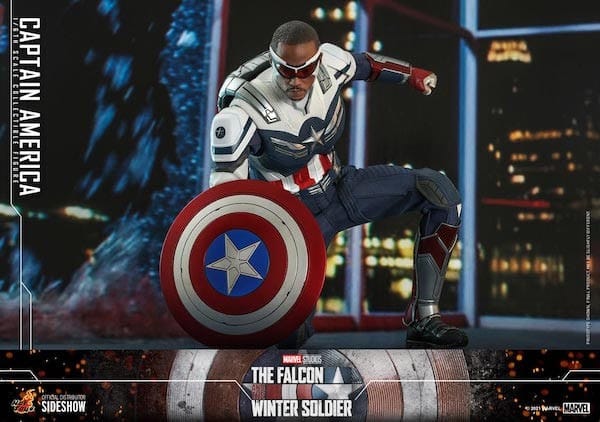
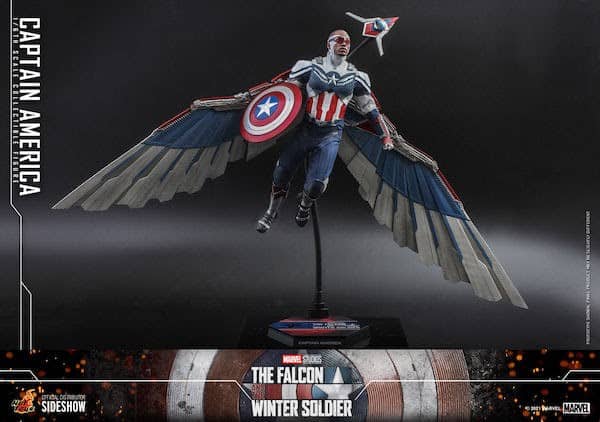
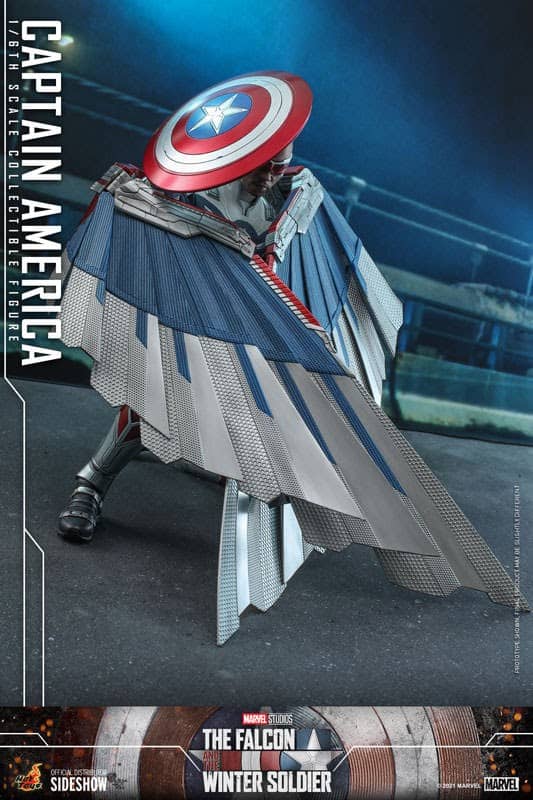
Marvel fans a first look at the Captain America 1/6 Scale Figure by Hot Toys. Marvel Studios’ hit television series The Falcon and The Winter Soldier saw Sam Wilson AKA The Falcon teaming up with Bucky Barnes against the rebel group known as The Flag Smashers. As the show progressed, Sam went on to take up the symbolic shield once wielded by Steve Rogers, and don a new outfit (complete with his signature wings), as the newest Captain America.
Inspired by the thrilling Marvel Studios series The Falcon and The Winter Soldier, the Captain America 1/6 Scale Figure features an incredibly detailed recreation of Sam’s new suit with a wingspan of approx. 31.49” (80 cm) wide. The wings are designed with extended articulation that allow for a great range of motion. The figure has a new hand-painted headsculpt with a detailed likeness of Anthony Mackie as Captain America, and also includes a face gaiter and goggles. Dressed in a newly designed fabric tactical outfit with his signature red, white, and blue color scheme and star emblem, he also comes with the iconic Captain America shield, a flight backpack, and a Redwing drone.
This site contains affiliate links, which means that if you click on one of the product links and make a purchase, we’ll receive a percentage of the sale. Graphic Policy does purchase items from these sites. Making purchases through these links helps support the site.
As discussed last time, starting in Captain America and the Falcon #120, various Marvel writers[1] made a good deal of use out of the Falcon’s secret identity as Sam Wilson, social worker – Stan Lee used it as a vehicle for stories about youth problems, organized crime, and urban unrest (albeit ones that ended with costumed superheroes getting into punch-ups with similarly-attired supervillains), while Steve Englehart and Alan Weiss used it as a pretext to have Captain America and the Falcon investigate abuse in America’s prisons and encounter the Queen of the Werewolves.[2]
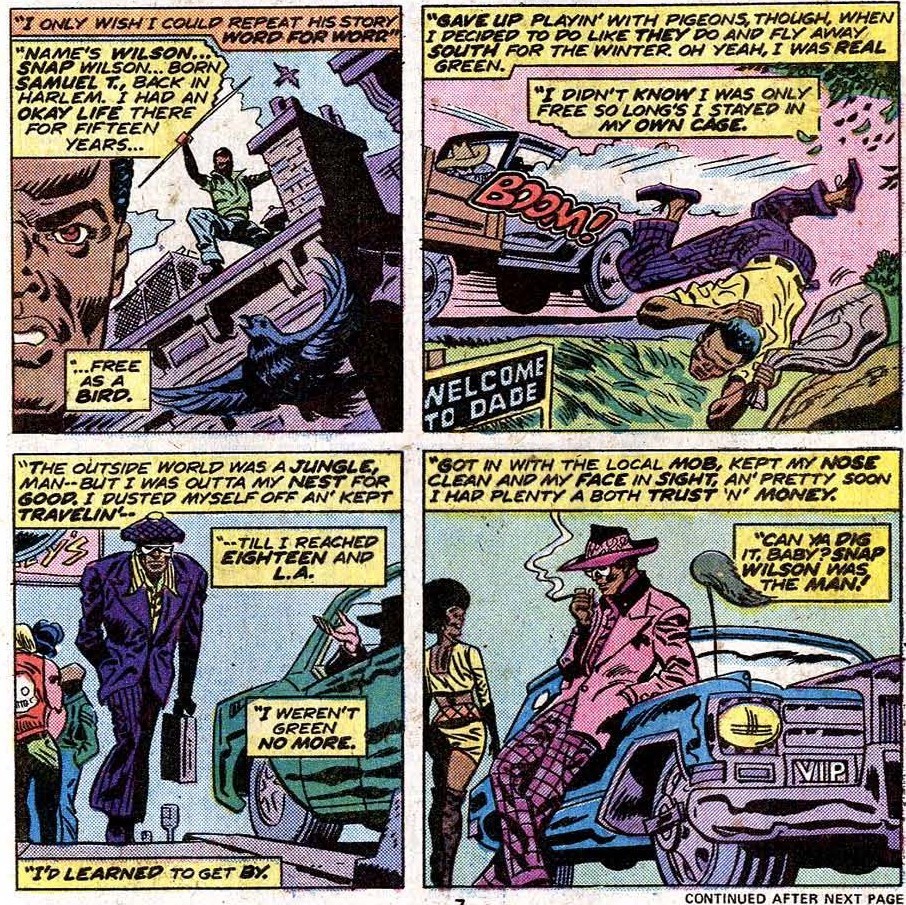
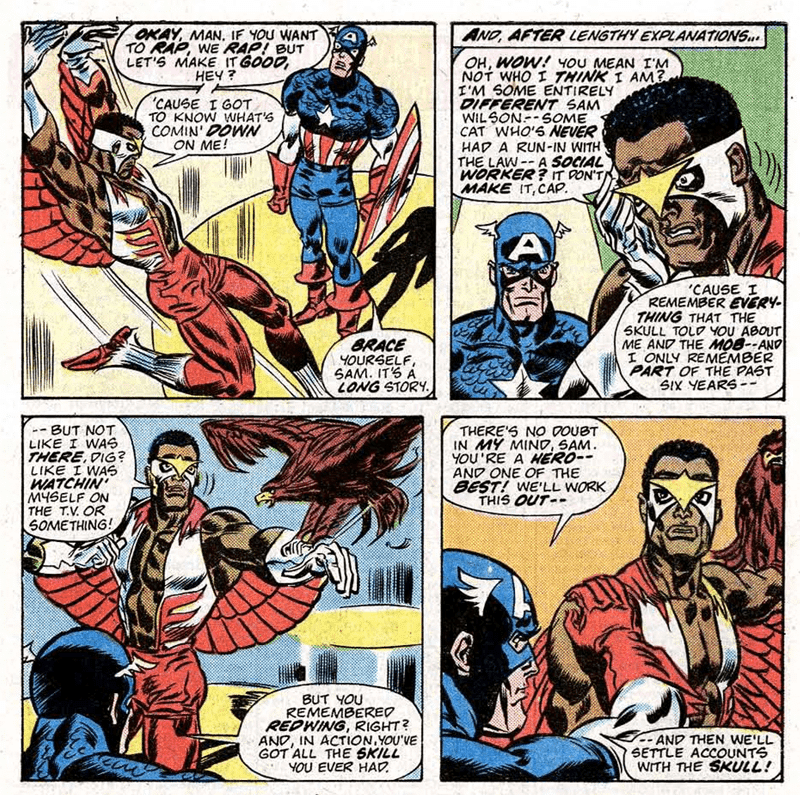
This changes in Captain America and the Falcon #186, where (in a follow-up to the original story that introduced Sam Wilson) the Red Skull reveals that everything we knew about Sam Wilson was a lie:
These four panels are worthy of some in-depth textual analysis. In the first, we see the young and innocent Sam Wilson on the rooftops of Harlem, complete with a thematic association between birds and freedom that we’ll later see embodied in his relationship with his falcon Redwing. (In future issues, this part of his backstory will be retconned to add in tragic violent crime-related deaths for both his mother and father that will inspire his vigilantism.) In the second, we see Wilson heading to Florida (like a lot of New Yorkers in the winter) only to be confronted with the specter of rural bigotry in Dade County, in a scene straight out of the shock ending of Easy Rider. By the third panel, we see that the experience has hardened our hero, and by the time that he gets to Los Angeles he’s learned to “get by” in the worlds of both street crime (as symbolized by the small crowd of black men standing on the corner) and organized crime (as symbolized by the white hand coming out of the car window). In the fourth panel, the transformation of Sam Wilson into “Snap” Wilson is complete – he’s now an L.A-based gangster complete with mob connections, a pimped-out Cadillac with vanity license plates, and some of the 70’s wildest fashions.
As we learn about on the next page, rather than arriving on the island of forbidden love as part of a vacation-turned-resistance-movement, “Snap” Wilson crash-landed on the island after attempting to hijack a small plane containing a “fortune” (presumably of drugs, given that the plane was returning from a trip to Latin America) belonging to the “Big Man,” his L.A-based crime boss.
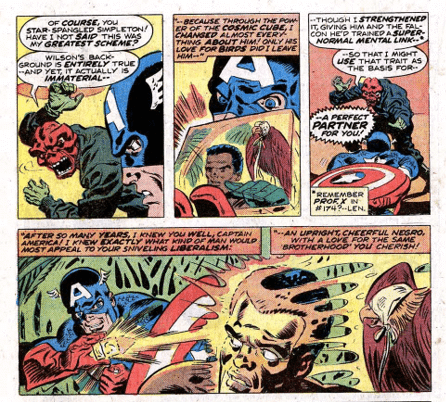
More significantly, we learn that the social Sam Wilson that readers thought they knew was a creation of the Red Skull, a fiction specifically designed to appeal to Steve Rogers’ liberal values:
Steve Englehart, John Warner, and Frank Robbins had to lean heavily on the Cosmic Cube’s, well…cosmic powers here, because this is quite a retcon. Above and beyond the psychological impact on Wilson himself, the creative team had to explain how it was that we’ve seen Sam Wilson at work as a social worker – we’ve even seen his office with clients in it! – and it would be particularly odd for the Cube to somehow have also altered the memories of the entire “Social Admin” Department of New York City so that someone without official hiring paperwork or credentials would be given office space, a salary, and a caseload for several years.
This being a superhero comic, the retcon is then used by the Red Skull (once again using mind control) to pit the Falcon against Captain America in a lose-lose fight to the death. Naturally, Captain America triumphs and destroys the Red Skull’s HYDRA base, only for the Skull himself to flee to fight another day. Rather than resolving neatly in one issue like earlier “Cap goes evil” storylines, the dangling plot thread of “Snap” Wilson and the dueling backstories continues to dominate the book for the next several issues.
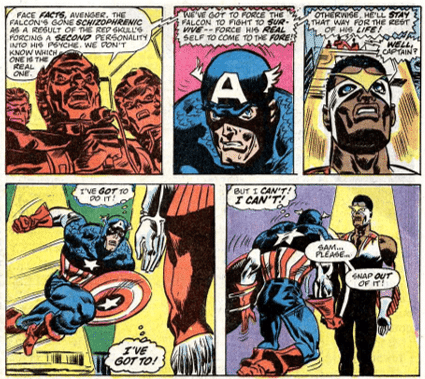
For example, in Captain America and the Falcon #189, Tony Isabella and Frank Robbins have Captain America once more fight Sam Wilson in a dubious SHIELD experiment to prove which is the real personality.
After a bunch of illusionary shenanigans, the Falcon snaps out of his “schizophrenic” state to reveal that, in fact, it is “Snap” Wilson who was the true personality and Sam Wilson who was the fake.
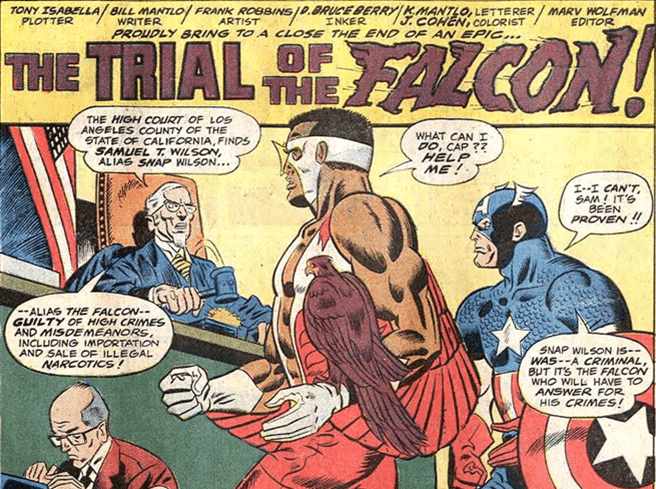
Tony Isabella, Bill Mantlo, and Frank Robbins would return to (and in their own words “bring to a close the end of an epic”) plot in issue #191, in which “Snap” Wilson is put on trial in Los Angeles County Court for the “importation and sale of illegal narcotics”:
The Falcon is only saved from prison when, in a bid to prevent him from turning state’s witness against his former mob associates, the “Big Man” of Los Angeles hires, of all the many Marvel villains-for-hire, the Stilt-Man to attack the courthouse and assassinate the Falcon before he can testify. As one might guess, the ensuing action allows the Falcon to demonstrate his heroism to the judge, leading to a suspended sentence of parole (with Nick Fury of SHIELD standing in as his parole officer), thus demonstrating the fairness and mercy of the American court system when dealing with black defendants up on drugs charges in the first wave of Nixon’s War on Drugs.
The racial politics of this retcon are bizarre to say the least. The new “Snap” Wilson behaves like a quite different character than the one readers had known for sixty-nine issues: he’s more aggressive and violent both in interpersonal communication and combat, he uses stereotypical “jive” slang, and he’s far more cynical about white America and white institutions – an interesting departure for a character previously given to attempts at “cooling down” racial tensions. One could see it as an extrapolation of the “talker” versus “fighter” dynamic between Sam Wilson, social worker, and the vigilante known as the Falcon, if not for the charged nature of “Snap” Wilson’s gangster origin.
Two potential explanations for this change suggest themselves. The first is that we need to see this in the context of Marvel chasing the trend of blaxploitation, more prominently seen in the creation of the characters Luke Cage and Blade at around the same time. A streetwise gangster simply fits into the rather narrow schema of the blaxploitation genre better than a social worker out of a prestige “problem” film. However, Captain America and the Falcon was an established comic rather than a newer, more speculative venture like Power Man, and more importantly it was the comic of their flagship “flag suit” character, which tends to come with higher visibility and tighter editorial control within the company.
The second explanation, and one that has a certain amount of plausibility given that Cap #186 was authored by noted liberal Steve Englehart (just coming off of having Captain America go up against Richard Nixon), is that the retcon was prompted by a weird white liberal guilt trip that judo-flipped its way into being accidentally racist. Sam Wilson, as originally envisioned by Stan Lee, was an “articulate,” clean-cut, politically moderate black professional. It may have been argued at the time that the character of the Falcon was a paternalistically condescending bit of outreach to the black community from a bunch of white middle aged middle class folks at Marvel. By contrast, a more “street” character, as we’ve already said more evocative of popular trends in black culture, who challenges the white establishment more consistently than before, may have been seen as a more “authentic” portrait of black masculinity in the 1970s. If so, it’s a very strange train of thought where an attempt to be racially sensitive boomerangs back around to being back-handedly racist.
The problem with this line of political logic is the question of representation. There’s nothing inherently wrong with an individual character having a backstory of coming from the “mean streets” of crime, but when you’re dealing with a situation in which there are very few characters of color in Marvel comics (especially back in the 1970s when the main struggle within Marvel was over introducing racial “firsts”), aspects of those characters become less individualized and more archetypal. When most if not all of Marvel’s black characters at the time came from “the street,” it starts to send a message that, according to Marvel creative and editorial (again, staffed almost entirely by white men), the “street” is where black characters come from. This becomes problematic when it means that having a black character with a different background – like, for example, a professional social worker – is seen as less “realistic” than an ex-hood.
So much for the “epic” of “Snap” Wilson. I know there are going to be some in the fandom who will say that, given the realities of a serial medium produced monthly over the course of almost fifty years by a variety of creative and editorial teams of varying levels of ability and care for the material, you’re going to get some bad stories worked in there. These stories – if left unchecked – can warp characters out of being usable recurring intellectual property, which is why retcons aren’t always a bad thing because they can right a sinking ship in the wake of a particularly ill-thought-out or poorly executed creative turn.
This is why, when we talk about the impact of a given story in comics, we can’t just talk about the aesthetic merit of a given panel or page or comic, but its longevity – did a given story have an enduring impression on the book and the larger Marvel Universe, or was it a flash in the pan that was swiftly cleaned up by the next team to work on the book?
The answer to that question is why the “Snap” Wilson retcon is such a big deal: it lasted for forty years, putting it up there as one of the longest-lasting retcons in Marvel history. It was the status quo when Steve Englehart left the book, it was the status quo when Jack Kirby returned to both write and draw the book (more on that in a future issue), it was the status quo for Mark Gruenwald’s classic run in the 80s, and it was the status quo for Ed Brubaker’s run that set the terms for the MCU Captain America films.
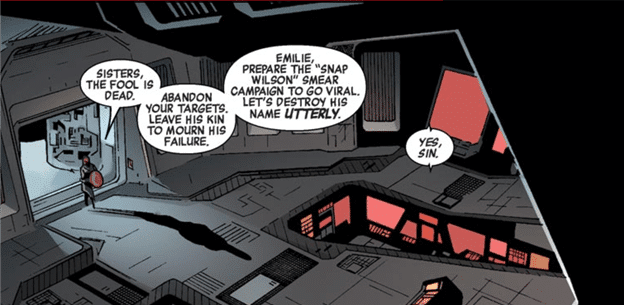
It wouldn’t change until 2015, when as part of the Avengers NOW! event[3] Sam Wilson was promoted to the role of Captain America for the first time (although not the first time that he’d worn the uniform) – a creative and editorial decision that would ultimately give rise to the Disney+Falcon and Winter Soldiershow. In All-New Captain America #3, intending to discredit as well as kill the new Captain America, Sin (the Red Skull’s daughter) and HYDRA engages in information warfare by releasing to the public the sordid details of “Snap” Wilson’s past:
To a significant extent, Remender designs All-New Captain America #3 to be in dialogue with Englehart’s Captain America and the Falcon #186 – no less than three pages out of the book are devoted to a beat-for-beat reproduction of the story of the Red Skull using the Cosmic Cube to re-write Sam Wilson’s backstory, for example. The major difference is that, rather than staying in a mind-controlled silent stupor while Steve Rogers plays the interlocutor to the Red Skull, here Sam Wilson is allowed to speak and he challenges Sin’s characterization of his past as a “liar, thug, and gangster” as “lies.” (Remender does his own editorializing by characterizing the “Snap Wilson” backstory as a “smear campaign” and presenting Sin as clearly an unreliable narrator given to monologuing about the victors rewriting history to suit their interests.)
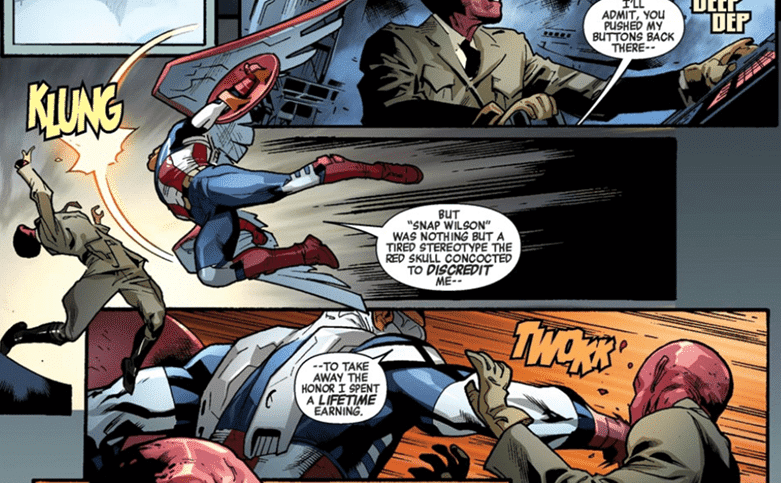
In foiling both Sin’s smear campaign and (somewhat more importantly) her bomb plot, Sam Wilson defiantly asserts a brand-new status quo for his own backstory:
While Rick Remender is a writer whose politics I haven’t always agreed with – only two years before this issue, Remender had writtenUncanny Avengers #5, which featured the now-infamous “M word” speech, and then reacted extremely poorly to criticism over how this speech handled the topic of minority identities and the mutant metaphor – I think he was on the right track in this case.
As I’ve suggested above in discussing the question of representation, “ex-gangster from the mean streets” was already something of a “tired stereotype” back in 1975, and it was only more of one in 2015 when you consider the increase in the raw numbers of African-American characters in big two comics, given how many of those new characters had been given “street” backgrounds themselves. By contrast, there is something innovative about a social worker backstory not just from the perspective of African-American characters but superheroes in general: whereas most heroes with secret identities are cops, private detectives, reporters (because those professions involve being “nosy” and thus lend themselves to story hooks involving investigations), or scientists (which lends itself to super-science story hooks), there really aren’t that many heroes who belong to one of the “caring” professions. As we discussed back in Week 18, social workers have a unique perspective on social phenomena, while still giving rise to sixty issues worth of story hooks.
Ultimately, however, the question of whether a given character’s backstory is innovative or stereotypical is rather subjective. Which is why the subjectivity of the creative and editorial teams matters – and why it mattered that for so long that the teams working on Captain America and the Falcon were all-white (as well-meaning as they might have been). Had there been more diversity in the room at the time, black creators might have been able to push back on the “Snap” Wilson retcon from the beginning instead of having to wait forty years for a white creator to decide it wasn’t all right.
[1] Between Cap #120 and #186, there wasn’t a regular artist on the book on issues covering Sam Wilson as a social worker: artists ranged from Gene Colan on #120 and 134 to John Romita Sr. on #139 to Sal Buscema on #149 to Alan Weiss and John Romita Sr. on #164.
[2] A story notable for being the first but by no means the last time that CapWolf became a part of Marvel Comics. More on that in a future issue of People’s History of the Marvel Universe.
[3] Itself a continuation of the All-New Marvel NOW! event from 2013, which itself was a continuation of Marvel NOW! from 2012, but which shouldn’t be confused with All-New, All-Different Marvel which would launch later in 2015, eventually giving rise to the Secret Empire event. Needless to say, Marvel editorial hasn’t exactly made things easier for comics historians in their naming conventions in recent years.
The 2021 Emmy winners have been announced and after a massive amount of nominations, we now now how all of the “geek” shows did. “Geek” shows were well represented in acting categories, technical, and more.
Below are the categories where shows like WandaVision, The Mandalorian, and more were nominated and how they did! The ones in bold are the winners. The below includes the Creative and Primetime award winners.
Creative Emmy Awards
Outstanding Guest Actor in a Drama Series
Courtney B. Vance as George Freeman on Lovecraft Country (Episode: “Whitey’s on the Moon”) (HBO)
Don Cheadle as Colonel James Rhodes / War Machine on The Falcon and the Winter Soldier (Episode: “New World Order”) (Disney+)
Charles Dance as Lord Mountbatten on The Crown (Episode: “Gold Stick”) (Netflix)
Timothy Olyphant as Cobb Vanth on The Mandalorian (Episode: “Chapter 9: The Marshal”) (Disney+)
Carl Weathers as Greef Karga on The Mandalorian (Episode: “Chapter 12: The Siege”) (Disney+)
Outstanding Casting for a Drama Series
The Crown (Netflix)
Bridgerton (Netflix)
The Handmaid’s Tale (Hulu)
Lovecraft Country (HBO)
The Mandalorian (Disney+)
Outstanding Casting for a Limited or Anthology Series or Movie
The Queen’s Gambit (Netflix)
I May Destroy You (HBO)
Mare of Easttown (HBO)
The Underground Railroad (Prime Video)
WandaVision (Disney+)
Outstanding Choreography for Scripted Programming
Debbie Allen for Dolly Parton’s Christmas on the Square (Netflix)
Dondraico Johnson for Genius: Aretha (Nat Geo)
Brooke Lipton for Lucifer (Netflix)
Mandy Moore and Luther Brown for Zoey’s Extraordinary Playlist (NBC)
Mandy Moore for Zoey’s Extraordinary Playlist (NBC)
Outstanding Cinematography for a Single-Camera Series (Half-Hour)
The Mandalorian – Matthew Jensen (Episode: “Chapter 15: The Believer”) (Disney+)
Grown-ish – Mark Doering-Powell (Episode: “Know Yourself”) (Freeform)
Hacks – Adam Bricker (Episode: “Primm”) (HBO Max)
Made for Love – Nathaniel Goodman (Episode: “User One”) (HBO Max)
LEGO has revealed a new wave of blind bag minifigures that will be available starting September 1st. The figures come from the Marvel Disney+ shows WandaVision, Loki, The Falcon and the Winter Soldier, and What If?.
The 2021 Emmy nominations have been announced and they are packed with shows and actors based on comics. “Geek” shows were well represented in acting categories, technical, and more. You can catch the highlights below and then the full list of nominees below that.
Highlights include:
Paul Bettany (WandaVision) for Lead Actor in a Limited or Anthology Series or Movie
Elizabeth Olsen (WandaVision) for Lead Actress in a Limited or Anthology Series or Movie
Giancarlo Esposito (The Mandalorian) for Supporting Actor in a Drama Series
Kathryn Han (WandaVision) for Outstanding Supporting Actress in a Limited or Anthology Series or Movie
Don Cheadle (The Falcon and Winter Soldier) for Outstanding Guest Actor in a Drama Series
Carl Weathers (The Mandalorian) for Outstanding Guest Actor in a Drama Series
Timothy Olyphant (The Mandalorian) for Outstanding Guest Actor in a Drama Series
WandaVision for Limited or Anthology Series
The Boys for Drama Series
The Mandalorian for Drama Series
The Mandalorian Chapter 13 The Jedi for Outstanding Production Design for a Narrative Period or Fantasy Program (One Hour or More)
WandaVision for Outstanding Production Design for a Narrative Program (Half-Hour)
The Mandalorian for Outstanding Casting for a Drama Series
WandaVision for Outstanding Casting for a Limited or Anthology Series or Movie
Lucifer for Outstanding Choreography for Scripted Programming
The Mandalorian Chapter 15 The Believer for Outstanding Cinematography for a Single-Camera Series (Half-Hour)
The Mandalorian Chapter 13 The Jedi for Outstanding Cinematography for a Single-Camera Series (One Hour)
The Umbrella Academy: Right Back Where We Started for Outstanding Cinematography for a Single-Camera Series (One Hour)
The Mandalorian Chapter 13 The Jedi for Outstanding Fantasy/Sci-Fi Costumes
The Umbrella Academy: The Frankel Footage for Outstanding Fantasy/Sci-Fi Costumes
WandaVision: Filmed Before a Live Studio Audience for Outstanding Fantasy/Sci-Fi Costumes
The Mandalorian Chapter 9 The Marshal for Outstanding Directing for a Drama Series
WandaVision for Outstanding Directing for a Limited or Anthology Series or Movie
The Mandalorian Chapter 11 The Heiress for Outstanding Single-Camera Editing for a Drama Series
The Mandalorian Chapter 13 The Jedi for Outstanding Single-Camera Editing for a Drama Series
The Mandalorian Chapter 15 The Believer for Outstanding Single-Camera Editing for a Drama Series
The Mandalorian Chapter 16 The Rescue for Outstanding Single-Camera Editing for a Drama Series
WandaVision: On a Very Special Episode for Outstanding Single-Cameria Picture Editing for a Limited or Anthology Series or Movie
WandaVision: The Series Finale for Outstanding Single-Cameria Picture Editing for a Limited or Anthology Series or Movie
The Mandalorian Chapter 16 The Rescue for Outstanding Period and/or Character Hairstyling
WandaVision: Don’t Touch That Dial for Outstanding Period and/or Character Hairstyling
WandaVision for Outstanding Main Title Design
Star Trek: Discovery Terra Firma for Outstanding Period and/or Character Makeup (Non-Prosthetic)
WandaVision: Filmed Before a Live Studio Audience for Outstanding Period and/or Character Makeup (Non-Prosthetic)
The Mandalorian Chapter 13 The Jedi for Outstanding Prosthetic Makeup
Star Trek: Discovery: That Hope is You, Part 1 for Outstanding Prosthetic Makeup
The Mandalorian Chapter 16 The Rescue for Outstanding Music Composition for a Series (Original Dramatic Score)
WandaVision: Previously On for Outstanding Music Composition for a Limited or Anthology Series, Movie or Special (Original Dramatic Score)
WandaVision: Breaking the Fourth Wall for Outstanding Original Music and Lyrics
WandaVision for Outstanding Original Main Title Theme Music
WandaVsion: Don’t Touch that Dial for Outstanding Music Supervision
The Falcon and the Winter Soldier: One World, One People for Outstanding Sound Editing for a Comedy or Drama Series (One Hour)
The Mandalorian Chapter 13 The Jedi for Outstanding Sound Editing for a Comedy or Drama Series (One Hour)
Star Trek: Discovery That Hope is You (Part 1) for Outstanding Sound Editing for a Comedy or Drama Series (One Hour)
The Umbrella Academy: The End of Something for Outstanding Sound Editing for a Comedy or Drama Series (One Hour)
Star Trek: Lower Decks No Small Parts for Outstanding Sound Editing for a Comedy or Drama Series (Half-Hour) and Animation
WandaVision: The Series Finale for Outstanding Sound Editing for a Limited or Anthology Series, Movie or Special
The Boys: What I Know for Outstanding Sound Mixing for a Comedy or Drama Series (One Hour)
The Mandalorian Chapter 13 The Jedi for Outstanding Sound Mixing for a Comedy or Drama Series (One Hour)
WandaVision: The Series Finale for Outstanding Sound Mixing for a Limited or Anthology Series or Movie
The Boys for Outstanding Special Visual Effects in a Season or a Movie
The Falcon and the Winter Soldier for Outstanding Special Visual Effects in a Season or a Movie
The Mandalorian for Outstanding Special Visual Effects in a Season or a Movie
WandaVision for Outstanding Special Visual Effects in a Season or a Movie
Star Trek: Discovery Su’kal for Outstanding Special Visual Effects in a Single Episode
The Umbrella Academy: 743 for Outstanding Special Visual Effects in a Single Episode
Doom Patrol for Outstanding Stunt Coordination
The Falcon and the Winter Soldier for Outstanding Stunt Coordination
The Falcon and the Winter Soldier: Truth for Outstanding Stunt Performance
The Mandalorian Chpater 16 The Rescue for Outstanding Stunt Performance
The Boys: What I Know for Outstanding Writing for a Drama Series
The Mandalorian Chapter 13 The Jedi for Outstanding Writing for a Drama Series
The Mandalorian Chapter 16 The Rescue for Outstanding Writing for a Drama Series
WandaVision: All-New Halloween Spooktacular! for Outstanding Writing for a Limited or Anthology Series or Movie
WandaVision: Filmed Before a Live Studio Audience for Outstanding Writing for a Limited or Anthology Series or Movie
WandaVision: Previously On for Outstanding Writing for a Limited or Anthology Series or Movie
Check out below for the list of the main categories and nominations:
Vision: With a wave based entirely on the Disney+ wave of the MCU, the figures need to accurately reflect the look of the show. And I think Vision does particularly well in that regard. The face sculpts in this wave are a big level-up, with you can tell. I also like the choice of making the cape semi-transparent; it’s a very cool look and no other Marvel Legends figure has something quite like it.
Scarlet Witch: I love the WandaVision outfit. It’s a terrific design, and the figure really captures it. In fact, it has a few details packed in that I overlooked on screen. It’s really nice work, but the best thing about the entire figure is that face. This IS Elizabeth Olsen; it’s an incredible likeness. Similarly, that hair is beautifully done. This is a figure where intent, design, poseability, and execution all come together so smoothly. Just a top-flight job all around.
Winter Soldier: I thought it was an interesting choice that, considering the Winter Soldier figures all the way back to that two-pack many years ago, Hasbro opted not to include a weapon with this figure. I kind of like that, especially since weapons weren’t really Bucky’s thing in this series. The detail on the vibranium arm might be my favorite part. I found this to be a good update figure for the MCU, but it’s not particularly distinguished outside of costume detailing.
Zemo: Two heads are definitely better. Again, great face sculpt, but there’s just something a little cooler about the masked version. Maybe it’s because we finally got to see it in live-action in the series. At any rate, excellent job on Zemo’s coat, and the shush/pointing hand is a clever inclusion. Speaking of clever, throwing in the Winter Soldier code book was a great touch. Only negative: the coat sculpt makes the figure a little hard to stand.
U.S. Agent: Yes, I’m aware that the big upset is the lack of white stripes. And yet, this still looks good. The figure really captures the look and attitude of John Walker. For me, the main minus is that there was no additional Cap shield, no black and red Agent shield, or no janky homemade shield. But as a figure itself, it’s well-done.
Captain America: What a terrific job they did on Sam. Great likeness, tremendous realization of the suit, and good poseability. The shield and backpack look great, the paint ops are on the point, and they really nailed the look of the goggles. This is my favorite of the group next to Wanda. Of course, he isn’t really complete without . . .
BAF: Cap’s wings and Redwing: I do get where some fans were upset that the BAF was the wing structure. However, I can see why that is with what they were going for. The wings are great, with additional hinges and moving parts. The addition of a flight stand specifically designed for the figure makes sense, and Redwing is icing. Frankly, I’m pleased that they figured out a way to give us a Sam Cap that looks this great.
Loki: You notice that I keep addressing fandom gripes? Before the show even started to air, discontent mounted over the outfit chosen for Loki. And then . . . it’s exactly what’s he’s been wearing. Seriously, people will demand things as esoteric as Patch Wolverine in a tux, but bitch about TVA Variant Loki? The likeness is there, the costume is show-accurate, and it’s Loki unlike any other we’ve had. Damn it, I like it.
“Zemo is the only character with an ideology” – Brandon Wilson
“A real Captain America looks to the rest of the world like The Joker” – Spencer Ackerman
Talking about Disney’s latest Marvel TV show, The Falcon and The Winter Soldier with two of my favorite Marvel experts.
Spencer Ackerman award-winning national security journalist and author of REIGN OF TERROR: How The 9/11 Era Destabilized America and Produced Trump, out August 10 from Viking. https://twitter.com/attackerman
Brandon Wilson is a filmmaker and lecturer. Brandon has directed two micro-budget features: 2005’s The Man Who Couldn’t… which is on YouTube and Sepulveda from 2016 which is streaming for free on Vimeo. Wilson has taught Film Analysis for Filmmakers, Introduction to Editing and classes on national cinemas, the essay film, and diversity in cinema at UCLA, Columbia College Hollywood and others. https://twitter.com/geniusbastard
Hot Toys have announced an all-new addition to their Television Masterpiece series with a 1/6 scale figureinspired by Sam Wilson as Captain America in the hit Disney+ series from Marvel Studios – The Falcon and the Winter Soldier.
Teaming up with Bucky Barnes against the Flag Smashers, Sam Wilson AKA The Falcon suits up in a new outfit, keeping his signature wings, but also carrying the symbolic shield once wielded by Steve Rogers, and the complicated legacy that comes with being the new Captain America.
The new Captain America Collectible Figure is here! Don’t miss out on the chance to add this stunning new 1/6 scale figure to your Marvel collection, and pre-order it today via Sideshow.
The 1/6th scale Captain America Collectible Figure features:
A hand-painted head sculpt, with highly-detailed likeness of Anthony Mackie as Captain America in The Falcon and the Winter Soldier, complete with goggles and face gaiter
An expertly crafted 1/6 scale body with 30 points of articulation
Eight interchangeable gloved hands for multiple posing and display options
A tailored tactical suit with embossed pattern and star emblem in chest
One pair of embossed patterned pants with fabric coated knee pads
One metallic silver and blue belt
One pair of metallic silver and red forearm guards
One pair of metallic silver and red calf guards
One pair of metallic silver boots
One flight backpack
One Captain America shield
Newly designed wings with multiple points of articulation
A Redwing drone
A specially designed dynamic figure stand with character nameplate
This site contains affiliate links, which means that if you click on one of the product links and make a purchase, we’ll receive a percentage of the sale. Graphic Policy does purchase items from these sites. Making purchases through these links helps support the site.
Alex and Joe talk about their fantasy Marvel Legends Spider-Man wave, followed up by a bit on Falcon And The Winter Soldier and Spider-Man: No Way Home.
As always, Alex and Joe can be found on twitter respectively @karcossa and @jcb_smark if you feel the need to tell them they’re wrong individually, or @those2geeks if you want to yell at them together on twitter, or by email at ItsThose2Geeks@gmail.com.
The world premiere of Marvel’s The Falcon and Winter Soldierwas the most-watched show on Disney+ of all time, and Diamond Select Toys is answering the call for toys! Both Sam Wilson and Bucky Barnes get new outfits over the course of the series, and DST has captured them both in new 7-inch action figures, exclusively at the Disney Store and shopdisney.com!
Sam Wilson, a.k.a. the Falcon, steps into his all-new Captain America uniform at the end of the series, and now that look is a Marvel Select! Capturing the comic-inspired red, white and blue outfit, this 7-inch figure includes detachable wings, a shield, a Redwing drone, and six interchangeable hands. It also features 16 points of articulation!
The Winter Soldier has a rich comic-book history, and now his comic-based 7-inch figure makes a heroic return to the Disney Store! Featuring an all-new paint scheme inspired by the Disney+ TV show, Bucky sports 16 points of articulation and an array of weapons, including a pistol, machine gun and sniper rifle. Plus, he comes with a diorama environment of a sniper’s perch, including a removable Hydra crate!
Both figures come packaged in full-color blister cards with side-panel artwork, and are available now and at select Disney Stores. They join other Disney Store-exclusive Marvel Select action figures like Taskmaster, Carnage, and Venom.