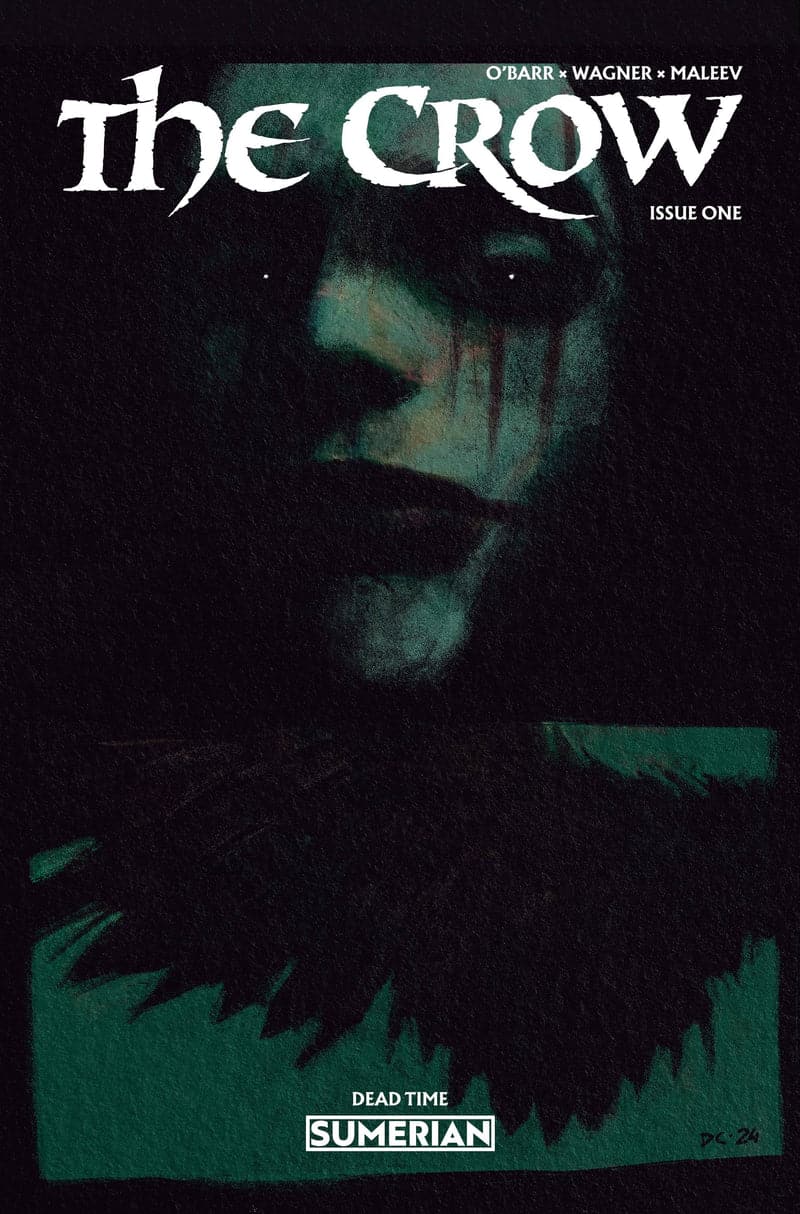
At long last, Sumerian Comics has re-published The Crow: Dead Time, the lesser known 1996 follow-up to James O’Barr‘s The Crow comic that was one of the most successful independent comics of all time and inspired the cult 1994 film starring the late Brandon Lee. O’Barr only has a story credit on the book with Judge Dredd co-creator John Wagner and future art superstar Alex Maleev (Daredevil, Infamous Iron Man) handling the visuals in his first American comic book work. The Crow: Dead Time #1 isn’t an instant classic like its predecessor, but it shows the elasticity of The Crow concept and shows Maleev going from being an O’Barr to developing his own fine arts-meet-film noir style that would earn him two Eisners and make him one of Marvel and DC’s go-to pencillers in the 21st century.
The Crow: Dead Time #1 has a similar concept to the original Crow comic with a man being brought back from the dead to avenge the unjust murders of a loved one and gaining invulnerability thanks to the power of the Crow’s spirit. But, instead of an alternative rocker, James O’Barr, Wagner, and Alex Maleev resurrect a 19th century Native American farmer named Joshua who was killed by Confederate soldiers in the 1860s along with his wife and son and is back to take on a biker gang that bears a resemblance to them. In a bit of an awkward/”you can tell that this comic was written by two well-meaning white men” moment, Joshua is also a member of the Crow tribe. However, the evocation of the injustices done to the indigenous people of North America as well as how the Confederate army treated Black and indigenous folks during the Civil War creates a sense of pathos and multi-layered thirst for revenge. There aren’t song lyrics in Dead Time like there are in The Crow, but the lyrics “Imperalistic house of prayer/Conquistadors who took their share” to “Dead Souls” by Joy Division (Covered by Nine Inch Nails in the film soundtrack) that appeared in that comic definitely apply to this narrative, especially when the soldiers arrive at Joshua’s house to rape and murder his family.
The Crow: Dead Time #1 has a fragmented, dream-like tone that puts you in the shoes of a man whose suspended between the realm of the living and the dead. Wagner’s dialogue comes in starts and stops from the casual racism and cruelty of the bikers and Confederate soldiers to the agony that Joshua feels both in the past and present. This is all tied together by the directions of The Crow that helps Joshua make sense of his new reality and also helps readers get used to the new setting/avatar. I love that Dan Burr doesn’t use tails on his word balloons for the Crow’s speech showing that it’s just a voice inside Joshua’s head that makes the people around think he’s losing his marbles.
The Crow: Dead Time #1 is truly an immersive reading experience with Maleev using two distinct black and white art styles for the 1860s and the present. The present day reminded me a lot of James O’Barr’s artwork on the original Crow with a grindhouse type setting, play of light and shadows, and its protagonist having a muscular Iggy Pop/Peter Murphy type body that is ready for suffering. The 1860s are more like a black and white representation of Alex Maleev’s actual art style with realistic anatomy (Even for the horses!), but not in a stiff way. Maleev simulates motion through classic speed lines, bullet trails (When Joshua’s wife shoots one of the soldiers), Burr’s sound effects, and constantly changing camera angles and panel shapes.
Taking on the role skilled film editors, Alex Maleev, O’Barr, and Wagner splice in scenes from the past and present to make for a pleasing or powerful transition in the story. Probably, the best one is when horses transform into motorcycles, and Maleev uses white space to simulate the blinding headlights’ in the rain. There’s also an almost Gustave Dore-esque shot of Joshua being riddled with bullets juxtaposed with a hippie/Goth drug dealer getting shot to show the senseless nature of violence and might makes right hasn’t changed in the centuries. Not every sequence of scenes work, but cumulatively, they flesh out Joshua’s backstory and set up a cathartic revenge quest in the upcoming two issues.
The Crow: Dead Time #1 shows the power of black and white comics to tell emotionally resonant stories through captivating visuals from Alex Maleev and a serviceable script from John Wagner that brings the pain and grief-stricken vision of creator of James O’Barr to life. Those Lionsgate execs really should have adapted this story for their 2024 The Crow film instead of doing a retread of Eric Draven’s arc.
Story: James O’Barr Script: John Wagner Art: Alexander MaleevLetters: Dan Burr Story: 7.4 Art: 9.4 Overall: 8.4 Recommendation: Buy
The town continues its descent into madness as a diabolical entity from its controversial founding emerges from the Fog to claim the life of one of the survivors… and this new threat is not Captain Blake!
Story: Steve Ekstrom Art: Marco Fodera Color: Emilio Lecce
Get your copy now! To find a comic shop near you, visit http://www.comicshoplocator.com or call 1-888-comicbook or digitally and online with the links below.
This post contains affiliate links, which means that if you click on one of the product links and make a purchase, we’ll receive a percentage of the sale. Graphic Policy does purchase items from this site. Making purchases through these links helps support the site
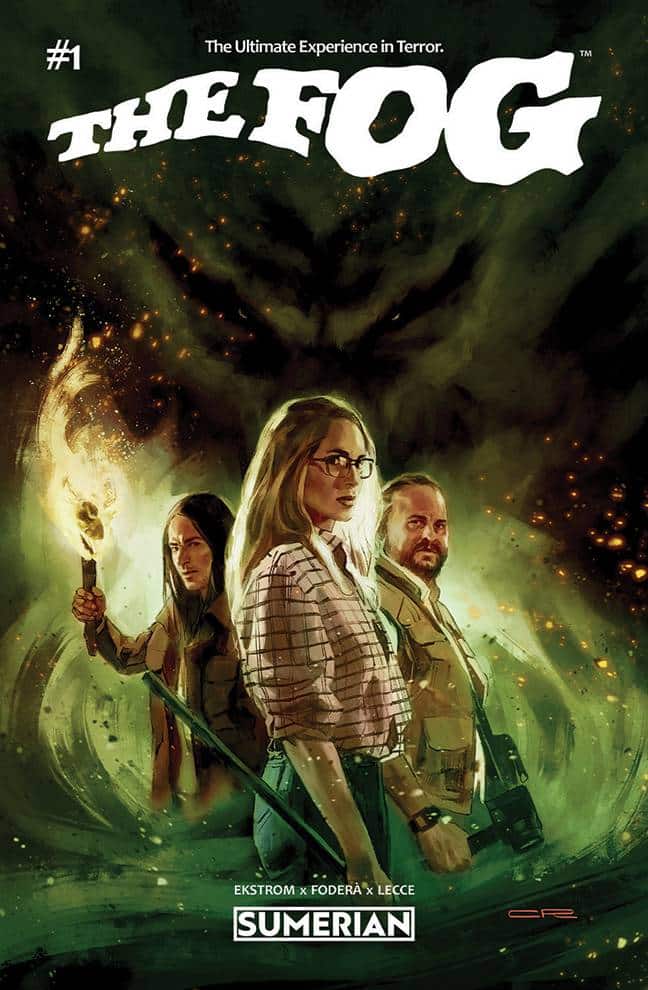
Forty years after the events of The Fog, The Fog #1 kicks off a supernatural horror story that reconnects several surviving characters and/or their descendants from John Carpenter‘s original story to a new series of paranormal events that plague Antonio Bay, a small fishing community turned ghost-hunting tourist destination.
Taking place in 2022, something far more malevolent from Antonio Bay’s dark past is roiling up from the depths of the sea. Writer Steve Ekstrom does a solid job in The Fog #1 making it accessible to fans of the original cult classic film while also allowing new readers to dive in and enjoy the spooky nature within.
I’ll admit, while I’ve seen a lot of the film, I’ve never sat down and watched the whole movie. I’ve seen enough to know the general detail of the film but not enough to know specifics. Even with a lack of knowledge, I found it easy to dive in and just enjoy the build up for the horror to come.
Ekstrom also does an excellent job in the details. 40 years have passed since the event of the film and this comic. Technology is updated and that changes the nature of some things. Much like recent Scream films, the change in technology does have an impact and Ekstrom addresses that in logical ways. But, it’s the build that really stands out. The characters are familiar in ways, ghost hunters/true crime buffs with connections to the town and events past.
Marco Fodera delivers a solid look to the comic. The overall style has a gloomy aspect to it, hinting at what’s to come but not making things too dour. The character designs as well look solid with each look giving you a good idea of their nature and personality. What’s also impressive is how Fodera makes everything at first rather benign and “quiet,” but as the comic progresses, you can feel the dark forces gathering.
The Fog #1 is the start of a nice continuation of a film that has grown in its cult status over the years. It feels like a fresh start but also has deep ties to Carpenter’s classic. A solid return to the beloved horror film.
Story: Steve Ekstrom Art: Marco Fodera Story: 8.0 Art: 7.5 Overall: 7.75 Recommendation: Read
Graphic Policy was provided with a FREE copy for review
Wednesdays (and Tuesdays) are new comic book day! Each week hundreds of comics are released, and that can be pretty daunting to go over and choose what to buy. That’s where we come in
Each week our contributors choose what they can’t wait to read this week or just sounds interesting. In other words, this is what we’re looking forward to and think you should be taking a look at!
Find out what folks think below, and what comics you should be looking out for this week.
The Bat-Man: First Knight #1 (DC Comics/DC Black Label) – Dan Jurgens and Mike Perkins take us to Batman’s earliest days for a retelling of one of his most infamous cases through a modern lense.
Beyond Real #2 (Vault Comics) – The first issue was solid with a Matrix like concept that feels perfect for our AI world.
Dark Souls: The Willow King #2 (Titan Comics) – The first issue was some solid dark fantasy with beautiful art and a great introduction to the characters. We’re excited to explore more of the world.
The Devil That Wears My Face #5 (Mad Cave Studios) – The series has been fun with its over the top moments and embracing its concept of Face/Off meets The Exorcist.
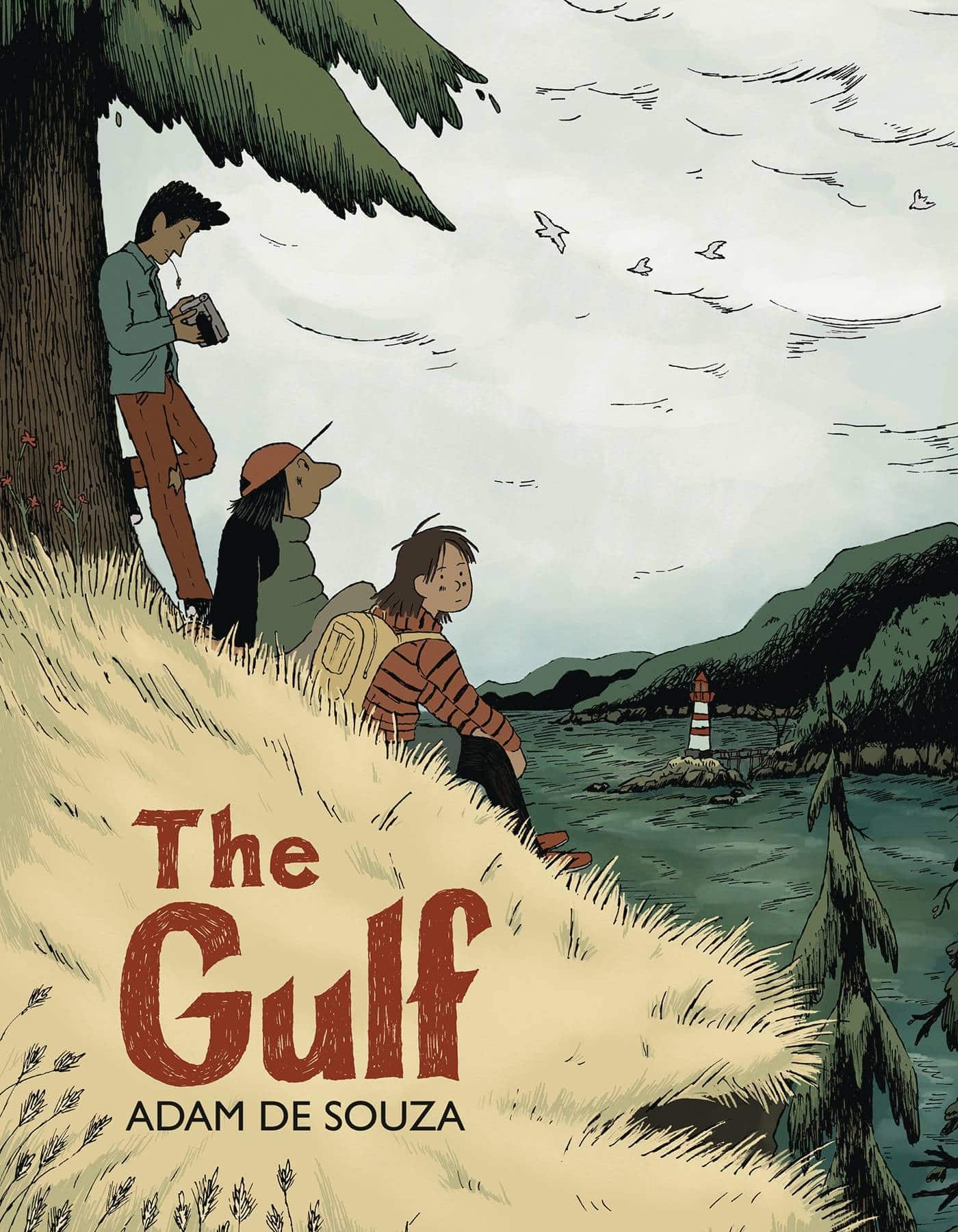
The Gulf (Tundra Books) – The cover for this caught our eye and the story of four kids tring to find their place in the world sounds interesting to us.
Ms. Marvel: Mutant Menace #1 (Marvel) – It’s the next chapter of Ms. Marvel as she learns what it means to be a mutant and X-Man!
Night People #1 (Oni Press) – A pulsating roadmap of the American subconscious, where neon-lit Southern nights give way to lipstick, sweat, and blood, and the odd, the innocent, and the evil are all fellow travelers down an interstate of dark, elusive dreams. Yeah, we’re sold with that description.
Spectacular Spider-Men #1 (Marvel) – Peter Parker and Miles Morales team up in a new series!
Torpedo 1972 #1 (Ablaze Publishing) – In the 1930s, Lucas Torelli, known as “Torpedo”, was a legend of the suburbs of New York. A tough, trigger-happy Sicilian who only knew how to make friends-anyone else is no longer here to say otherwise. Nearly forty years later, the Big Apple has changed quite a bit. Torpedo, not so much. As a persistent journalist prepares to write an article about the Caputo family, the demons of Torpedo’s past resurface, along with his dirty old habits… We’re suckers from crime stories.
Ultimate X-Men #1 (Marvel) – The Ultimate line has been excellent so far. We’re excited to see not just how this series differs than the X-Men we know but what it brings to the new Ultimate U.
Void Rivals #7 (Skybound) – Beyond guest appearances, we really want to know how this series ties into the greater Energon Universe.
Weapon X-Men #1 (Marvel) – This universal spanning series of one-shots debuted with a so-so start but we’re intrigued by the overall concept.
What If.. Aliens #1 (Marvel) – What if Carter Burke had lived? Dude was a corporate weasel. He got what he deserved.
The classic John Carpenter film The Fog returns but to comics written by Steve Ekstrom, art by Marco Foderá, and published by Sumerian! Forty years after the events of The Fog, the comic series tells a supernatural horror story that reconnects several surviving characters and/or their descendants from Carpenter’s original story to a new series of paranormal events that plague Antonio Bay, a small fishing community turned ghost-hunting tourist destination.
Now, in 2022, something far more malevolent from Antonio Bay’s dark past is roiling up from the depths of the sea.
We got to talk to writer Steve Ekstrom about the return of this cult classic.
Graphic Policy: It’s been over 40 years since the original film. How did this series come about and how did you get involved?
Steve Ekstrom: Behemoth had been sold and one of the co-publishers, Nathan Yocum, had contacted me about some possible licensing work for the rebranding to Sumerian Comics. He and I had been talking about movies we liked and worthwhile licenses for adapting or developing for at least two years by then.
Nathan brought up that The Fog was available and I sort of gushed. John Carpenter is easily one of my biggest creative influences outside of comics. I was a kid growing up in the early 80’s who saw the first TV-adapted Halloween as well as The Fog…and I was terrified for life. (laughs) I had literally watched The Fog three nights earlier so I dropped everything I was working on and I pitched a rough one page concept about Andy Wayne (the little boy in the original film) grown up and secretly living with the trauma from the night Captain Blake and his crew sought revenge on Antonio Bay. I wanted to sort of blend this sort of easygoing naturalism you’d find at the heart of Carpenter’s movies with postmodern survivalist themes while keeping the core traditional ghost story of the original movie intact.
GP: What’d you know about The Fog before coming on board?
SE: I think I mentioned this earlier but I’ve been a fan of this movie since I was a little boy. I used to stay with my grandparents a lot and my grandma was one of those old ladies who couldn’t sleep so she naturally sat up watching “Late Late Movies” on local access television and me, being her oldest grandkid, I would get to sit up with her and we’d be terrified together. (laughs)
Ironically, I had never really experienced the movie as a writer and creator of comics until that night three days prior to my conversation with my boss. I had rewatched it with very fresh eyes that now had tools from my education and experiences as a storyteller so I was able to view it in a more technical manner.
It was fun and a little silly because it was a 40 year old horror movie but it really captures, again, Carpenter’s ability to appreciate the human condition and how we recoil when we’re afraid.
GP: Sequel, prequel, requel, reboot, there’s a lot of debate about them, especially in horror. Was it always intended to be a clear sequel and connected to the original?
SE: I pitched it as a follow-up. This series is grounded in the original story. I wanted to add to the mythos of the overall concept by honoring its existence and taking pieces of it that were left available and sort of turning them on their side so readers can digest concepts like supernatural curses and what may or may not happen to restless spirits once their thirst for revenge has been slaked.
The Fog was one of the first movies that I remember seeing where so many people walked away with their lives at the end. That kind of blows your mind after the last 40 years or so of horror movies and all of the body counts that seem to ratchet up as a franchise adds more films to a story.
I really liked the sort of timelessness of the Curse of Antonio Bay and how these guys rolled in during a centennial celebration of the town. But then I asked myself, “Does a ghost keep a scheduled calendar?What if something else, something more malevolent, caused them to stir instead?”
GP: The comic picks up around 40 years after the film by John Carpenter. There’s a lot that has changed technology wise that would impact the story. It seems like that’s something you’ve taken into account with the first issue? How has the world changing impacted this sequel?
SE: Modernity and the cellular phone ruined horror movies for about a decade and then, all of a sudden, people making movies and telling stories started to realize that we fuck up and drop our phones, we travel into areas with bad signal, we leave them places, we don’t charge them…whatever. I take a small moment to address that. There’s a little undercurrent in this story about our human need for technology, weapons, vehicles and how these tools can become a bigger weakness when they fail.
I want the story to feel logical and, again, I want naturalism to guide the story as the supernatural horror aspects of The Fog start to curl into the corners of the frames of the comic.
GP: The original film was about revenge and repressed historical events resurfacing. Carpenter’s films often have commentary about what’s going on. It feels like the original’s theme plays well with events from today. Is that something you thought of when writing it?
SE: I actually used local supernatural lore from around my hometown and outlying counties as the inspiration for a new character from Antonio Bay’s bloody legacy involving Captain Blake and the crew of the Elizabeth Dane.
The story was so compelling that I couldn’t resist. It’s embedded in the extra content in the first issue. Every issue has a two-page component that ties to the meatier parts of the story that needed context without going over the meager budget…and I say that lovingly because I got to tell this story with the remarkably talented Marco Foderá whose work was worth every penny he was paid. He’s such an absolute dynamo who deserves all the recognition and work opportunities at the Big 2. His future is going to be bright in American comics.
Graphic Policy: The comic is a sequel to the original film. As a writer, how do you balance writing for fans of the cult classic while also making it inviting to new readers who might not know it?
SE: It’s a lot easier than you think. I grew up watching soap operas with that same grandma I mentioned earlier so I have a firm grasp on the pacing of serialized entertainment. I think that the core of comics, especially when I was reading them as a kid, was that you could pick up a story and it was open enough that you were always able to enter it and it would guide you enough that you could understand where it was going based on where it came from. This project is no different. I think I’ve front-loaded enough character driven dialogue to reintroduce you to characters like Andrew and Stevie Wayne and, at the same time, introduce you to new characters like Annie Castle, Travis Mathew, and Jamie Machen-Wayne.
I think we buy horror comics because they’re fun and we want to be creeped out or tantalized or both. I think The Fog has a timeless quality and I hope people go watch the original film from 1980 and then pick this book up or vice versa.
There are a couple of scenes throughout the project where I basically reframe scenes from the original movie as new connective tissue for my own story’s framework. I hope that that sort of homage to the original film really drives home how much I care about the readers’ experiences. I want you all to love the original movie and this new story as much as I do by the end. I want you to want more after the fourth issue ends.
GP: The comic feels like it takes inspiration from ghost hunting shoes and true crime podcasts a bit. What influences, beside the original film, helped shape the story?
SE: Oh, I definitely drew from supernatural ghost hunting shows and podcasts. There’s a sort of facade of cocky curiosity with so many of those folks that I hope translates playfully with the new characters I introduce.
I also used some spooky lore from around the edges of my hometown, Valdosta, Georgia. I’m a very healthy skeptic so I also sort of tempered my skepticism with my imagination and what I could sort of envision as something truly horrific involving malevolent paranormal entities as well as spiritual ones.
GP: Horror has shifted a lot since the original was released. Any changes to how you approached this due to that?
SE: Absolutely. I’ve been consuming this sort of content for the last 40 years. One of the things I most admire about Carpenter’s movies like The Fog and Halloween is that these films have minimal gore. I should correct myself…as a 47 year old writer and creator of stuff, I’ve come to admire it more than say something Eli Roth has made in the last 10 to 15 years. There is a place for “torture porn” horror movies because they’re jarring and, in my opinion, even life-affirming, but suspense and existential dread have much more value when a viewer’s imagination fills in the blanks of what they’re experiencing. Our minds are VERY scary places, I hope that this story, which mostly (MOSTLY–haha) honors that sort of minimalist approach, takes your minds to a frightening place.
GP: Part of the original film’s hook is Carpenter’s music and the atmosphere. How do you approach that with a comic?
SE: First and foremost, I wrote 100% of this entire project while listening to Carpenter tracks and nothing else. There is an iconicism and sense of suspenseful urgency that is almost anxiety-inducing when you listen to the theme from The Fog. It’s almost as iconic when you hold it up to the Halloween theme which may be the most iconic score from a horror movie.
Because we can’t hear anything or have pages scored to a beat, I try to control pacing and tempo on pages by giving clearcut moments of rising and falling action that sort of slows down or speeds up the reading experience.
GP: Where can people connect with you online? Anything else you’d like to plug?
SE: I am currently building my own website at http://steveekstrom.rocks and it should be fully operational in the next week or so. You’ll be able to connect with me there, buy books I’ve worked on, check out interviews I’ve done, and you’ll be able to see where I’ll be appearing for signings and conventions in the future.
For now, I have about 50-ish openings on Facebook before I hit the cap and I am on Instagram, Threads and I’m trying to get some traction and followers on Bluesky Social.
I have been a lifelong collector of comics and I know that the chase variant market is an exciting place for a lot of readers and collectors. I will announce here that I will be selling TWO virgin cover chase variants, one standard version, one ultra-rare foil version of The Fog #1 with a new cover by artist, Drew Ragland. There are 150 Copies of the Standard Virgin Variant and 50 Chrome Virgin Variants. Those go on sale on Wednesday. Anyone can contact me through social media and buy them while supplies last.
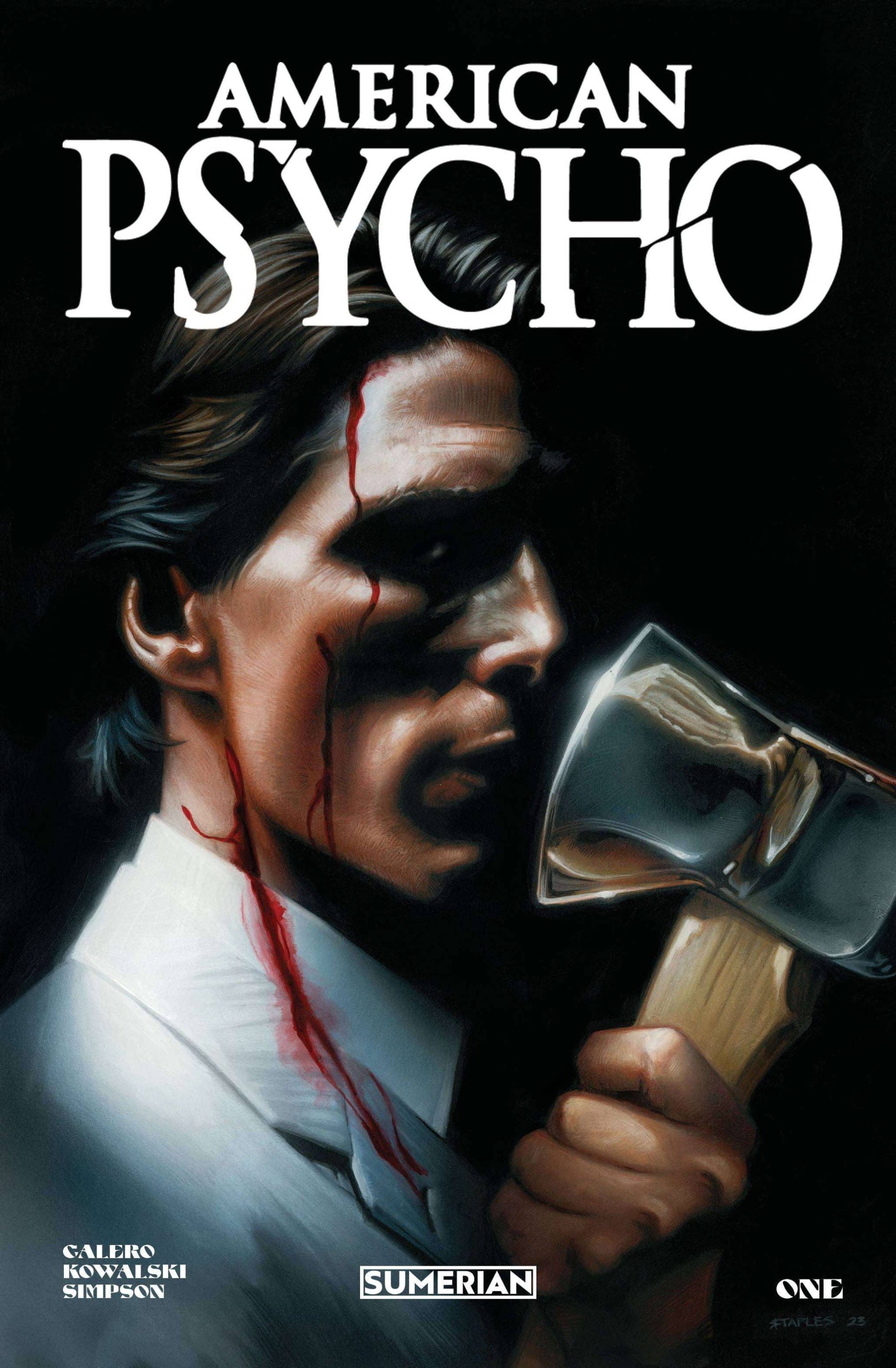
American Psycho #1 is an interesting comic. It’s one I can’t tell what it’s trying to do. Is it just an extension of the original story along with a new story? Or, is it commentary about consumerism and pop culture, like it’s own version of Patrick Bateman’s rants about Huey Lewis and the News. It’s not easy figuring that out after one single issue.
The debut issue features two stories, one set during the time of the original book/film (I’ve only seen the film) and another more modern tale set in 2011.
For the first half, we’re introduced to a new character who delivers a new perspective. Patrick Bateman’s killing spree is just happening and we get to see it all from the new character’s eyes. It’s “new revelations” from the world of American Psycho and I’m not sure if seeing it from a “whole new lens” really adds much… yet. For those who dive in, things might feel a bit off with the new character, like maybe it’s all in Patrick’s head or something but nope, it’s a new psycho with his own issues and then it connects to the original.
So far, it doesn’t really add anything to that story other than New York had a lot of psychos in the 80s. There might be something more profound but it hasn’t delivered that yet.
The second story introduces a new psychopath based in 2011. With the beginning of social media, it should be interesting to see where it all goes but the setup feels more Scream than American Psycho. Like the other story, it’s hard to tell if this will really “say” anything or just be another body count. There’s also an oddity about Patrick Bateman’s killing spree being called “infamous” and it not being brought up in the second story. There really hasn’t been a chance to organically yet, but if one doesn’t mention the other, then it throws a whole lot of questions into the mix.
Writer Michael Calero has a difficult task ahead and I’m intrigued to see where it all goes but the start feels more like the property’s name is slapped on than a real deep dive as to what made the original work. It’s hard to do in one comic since the original material is actually a slow psychotic build. Maybe as a collection or if it were a graphic novel it’d read a bit better. We’ll have to wait and see as releases come out.
The art by Piotr Kowalski is good. It hits the beats and there’s some interesting details thrown in but overall the look is rather generic. It never quite embraces 80s or even 10s New York City. Nothing in the art really stands out to me about the time at all. It’s not bad, it just lacks a personality. Kowalski is joined on color by Brad Simpson and lettering by Micah Myers. Myers lettering does stand out as the narrative is mostly in a journal of the new psycho and there’s something about the lettering that gives us insight into who this person is. It’s both controlled and off at the same time.
American Psycho #1 isn’t a bad comic but it just doesn’t deliver the same witty commentary of its source material. It’s just the first issue though and this is likely going to be a miniseries that’ll have to be judged on the whole and not individual parts.
Story: Michael Calero Art: Piotr Kowalski Color: Brad Simpson Letterer: Micah Myers Story: 7.0 Art: 7.25 Overall: 7.0 Recommendation: Read
Sumerian provided Graphic Policy with a FREE copy for review
Wednesdays (and Tuesdays) are new comic book day! Each week hundreds of comics are released, and that can be pretty daunting to go over and choose what to buy. That’s where we come in
Each week our contributors choose what they can’t wait to read this week or just sounds interesting. In other words, this is what we’re looking forward to and think you should be taking a look at!
Find out what folks think below, and what comics you should be looking out for this week.
A Haunted Girl #1 (Image Comics) – Cleo, an adopted 16-year-old Japanese-American whose depression drove her to near-suicide, is trying unsuccessfully to reintegrate back into her old life. But her struggles are just beginning as she encounters an increasingly terrifying succession of ghosts.
American Psycho #1 (Massive Publishing/Sumerian) – Witness the greatest hits of Patrick’s murderous rampage while exploring new revelations in the world of American Psycho. On that, we’re dubious, but it’s also the journey of an all-new psychopath as social media obsessed millennial. That, we’re more intrigued by.
Batman and Robin #2 (DC Comics) – The first issue did a great job of balancing superheroics and family drama and we’re expecting more!
Batman: City of Madness #1 (DC Comics) – Writer/artist Christian Ward takes on Batman, nuff said.
Capwolf and the Howling Commandos #1 (Marvel) – It’s such a silly concept but perfect for the season.
Destiny Gate #1 (Image Comics/Top Cow Production) – Life, for the most part, is the product of the decisions you make. For some, a “wrong” decision or two (or more) leads to a crossroads on the other side of the Destiny Gate.
Earthdivers #11 (IDW Publishing) – Mission isn’t accomplished so it’s on to 1776 and an attempt to cave out a better future in the Declaration of Independence.
Mech Cadets #3 (BOOM! Studios) – The series has been a fantastic reintroduction to the world that mixes up military/giant robot/alien genres with youthful energy.
Midlife Hero at Fifty #1 (Image Comics) – After 25 years in the LAFD, Ruben’s firmly in the middle of an unremarkable life…until his new wife gets pregnant and a random act of courage reveals that Ruben is FIREPROOF!
Nights #1 (Image Comics) – Supernatural creatures exist among the common folk, and America is comprised of just 31 states. Ok, that’s enough to get us to check this out.
Operation Sunshine #1 (Dark Horse) – A group of young, alienated vampires known as “bugs” plot to steal a magical object from ancient monstrous vampires to turn themselves back to human.
Scarlett Couture: The Munich File #3 (Titan Comics) – Sexy pop spy action!
Superior Spider-Man Returns #1 (Marvel) – We’re fans of the original run with the character and intrigued to see how this return happens.
Wesley Dodds: The Sandman #1 (DC Comics) – The classic Sandman is back and must get his journal with all of the other failed and more deadly gas formulas back.
Diamond Comic Distributors has announced that Massive Publishing, known for its inaugural imprint, Whatnot Publishing, will move into the Deluxe Tier with the June 2023 PREVIEWS catalog. In its first six months of publication, Massive distributed over 800,000 units to shops around the world. Massive has also announced 2 new imprints, the release of Sean Gordon Murphy‘s The Plot Holes, and will be distributing Sumerian Comics to the retail and direct market.
Sean Gordon Murphy’s new comic!
Massive’s first non-imprint series is the long-awaited retail release of The Plot Holes by writer/illustrator, Sean Gordon Murphy. With the release of the mini-series, Murphy makes his return to his creator-owned roots for the first time since building his own groundbreaking Batman universe at DC Comics in 2017.
Murphy, who won an American Library Association award with his first ever creator-owned book Off Road (released by Oni in 2005) will kick-off the MASSIVE flagship line this August, with cover variants by legendary artist such as Walt Simonson, Klaus Janson, Dan Panosian, Matteo Scalera, and more.
Two new imprints!
Massive also will mark its move to the Deluxe Tier category with the launch of multiple new imprints, significantly expanding its publishing footprint. Each new imprint will have its own unique flavor and creative direction spearheaded by a mix of established trailblazers in the industry and up-and-coming voices. They include…
Overlook: Catering to readers with a penchant for the macabre, the horror focused imprint will be helmed by arguably the most prolific horror writer in comics today, Cullen Bunn and Hustle & Heart Films CEO Heath Amodio. The high-end horror brand will also feature a who’s who of show runners and writers from across the Film and TV space alongside comic industry pros.
Kingwood Comics: An imprint focused on Black characters and stories will launch this September with the first retail distribution of the celebrated series Harriet Tubman, Demon Slayer, soon to be a live-action series on Disney +. The books creator, David Crownson will helm the Kingwood imprint as it builds on the legacy of diverse creators in comic books and highlights groundbreaking talent such as Courtland Ellis, Nikolas Draper-Ivey, Caanan White, Khary Randolph,and more.
Sumerian distribution!
Sumerian Comics: The publishing arm of Sumerian Records will join forces with Massive this fall as it shifts its primary publishing focus to licensed TV, Film and Music related properties curated by Co-Publishers Nathan Yocum and Ryan Swanson. Sumerian’s first release will be Bad Omens: Concrete Jungle #1, the comic series inspired by the popular band of the same name.
Wednesdays (and Tuesdays) are new comic book day! Each week hundreds of comics are released, and that can be pretty daunting to go over and choose what to buy. That’s where we come in
Each week our contributors choose what they can’t wait to read this week or just sounds interesting. In other words, this is what we’re looking forward to and think you should be taking a look at!
Find out what folks think below, and what comics you should be looking out for this week.
Abolition of Work (Floating World Comics) – Bob Black’s essay from 1985 gets a graphic adaptation.
All Eight Eyes #1 (Dark Horse) – Jaws meets Arachnophobia in a new vision of creature-feature terror.
Avengers Assemble Omega #1 (Marvel) – It’s the finale to the epic Avengers storyline!
The Boxer Vol. 2 (VIZ Media) – Though the story is about boxing, there’s so much focus on psychology and the characters, boxing is secondary. Watch our review.
Cult of That Wilkin Boy (Archie Comics) – Archie has been putting out some great horror comics and we’re excited to see what this musician gone wrong tale brings.
Darkwing Duck #4 (Dynamite Entertainment) – We’re big fans of the series which picks up on the classic and beloved animated series.
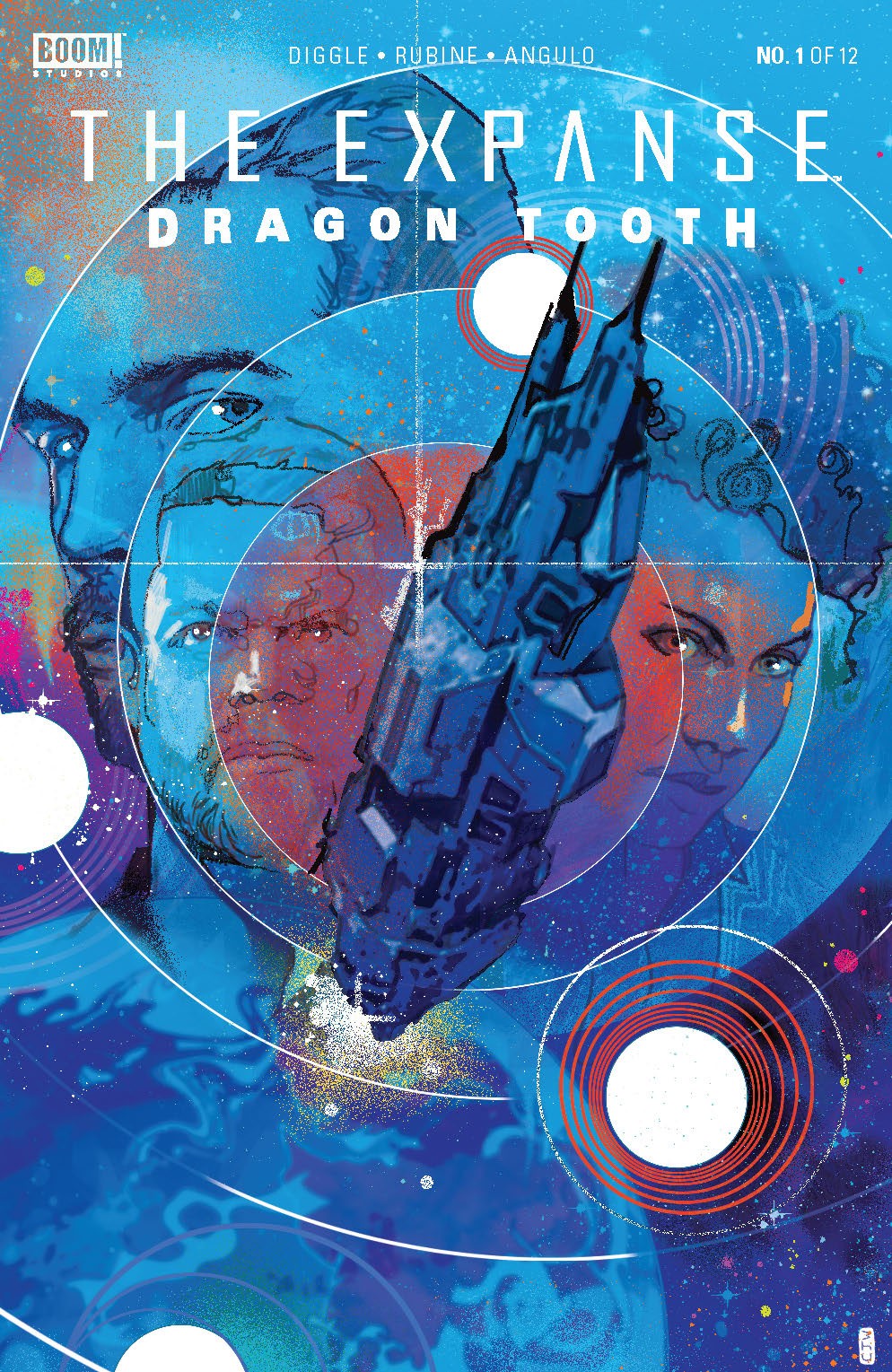
The Expanse: The Dragon Tooth #1 (BOOM! Studios) – Fans of The Expanse won’t want to miss this series which fills in gaps of the television series.
Harrower #3 (BOOM! Studios) – The horror series has been fantastic with a nice mix of modern slasher classics and a modern sensibility and style.
The Mighty Barbarians #1 (Ablaze) – It’s classic fantasy with a modern sensibility about it. Check out our review!
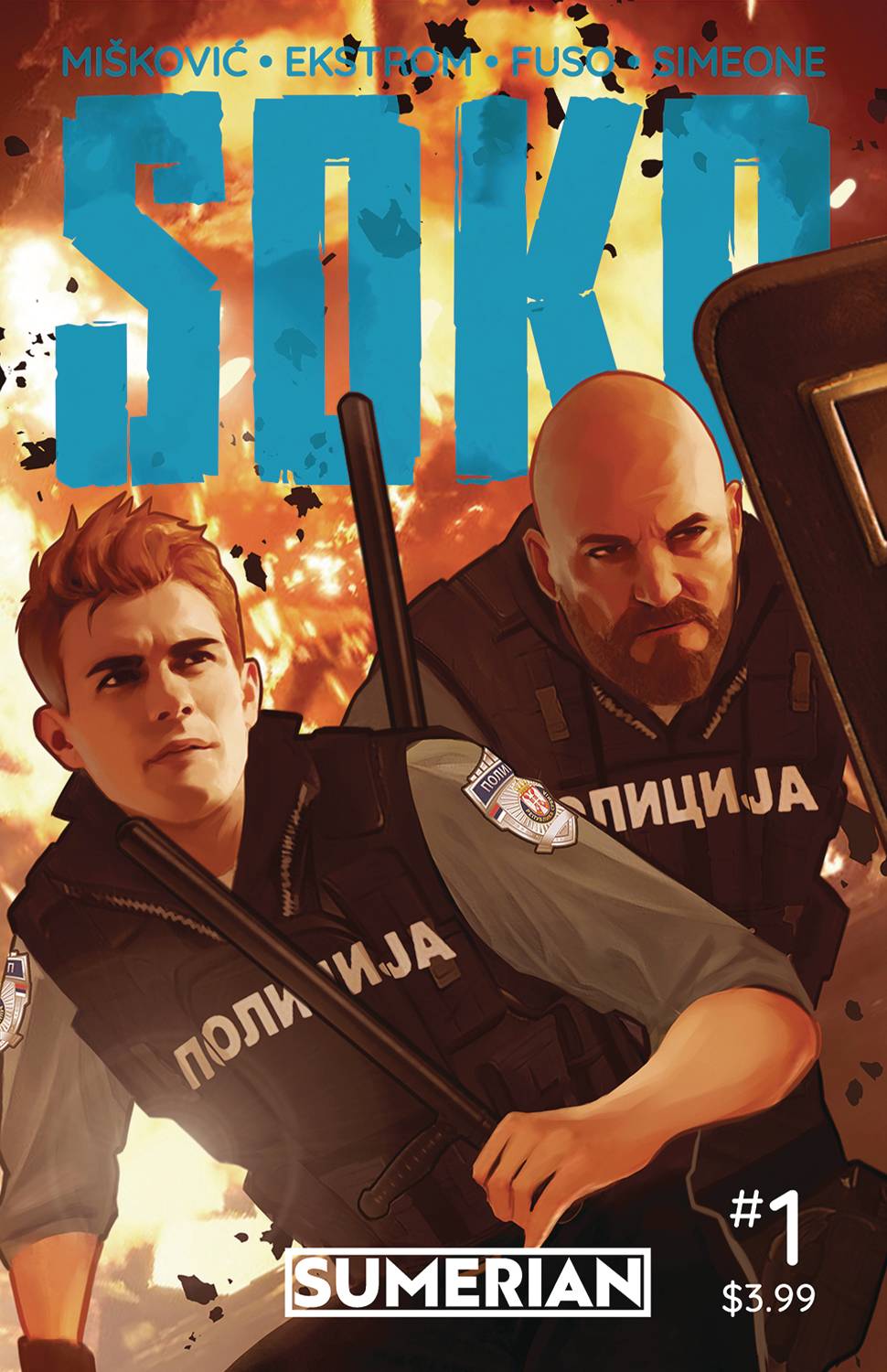
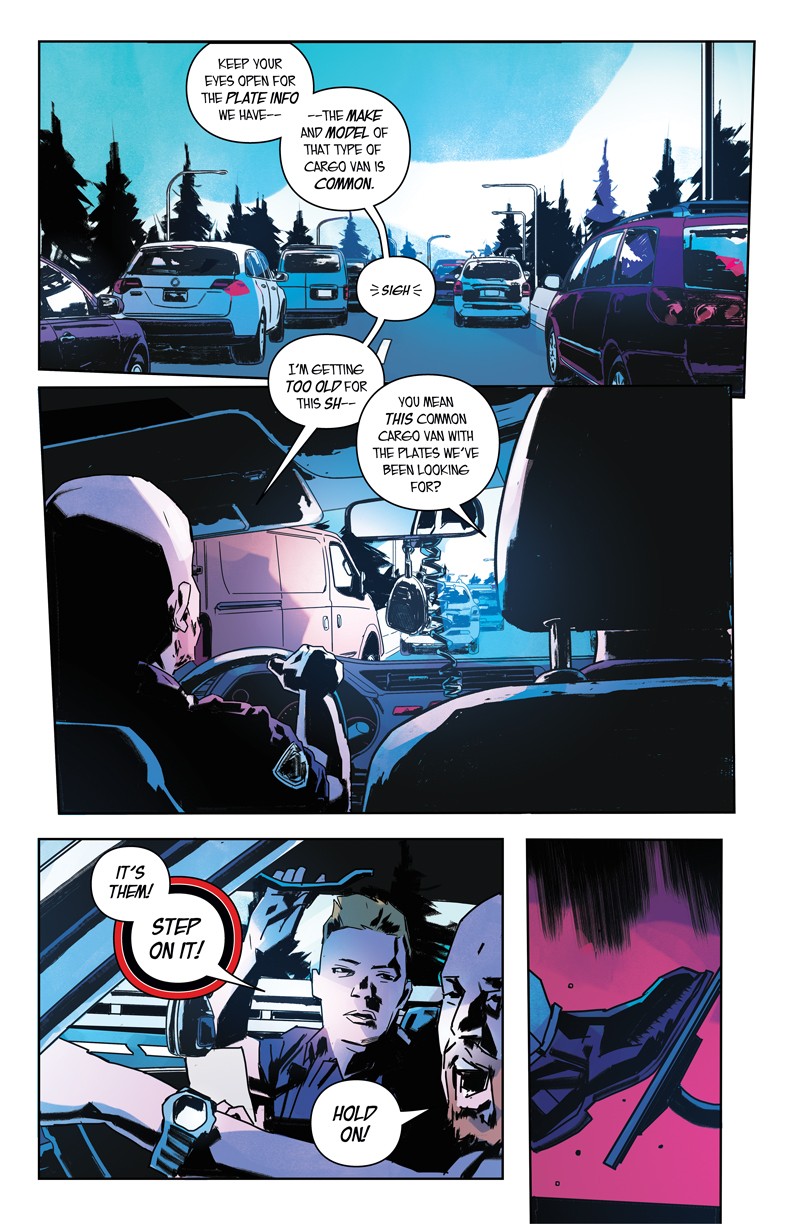
Soko #1 (Sumerian Comics) – A routine traffic stop for two Serbian beat cops quickly descends into corruption and betrayal as a dark trail of evidence leads to the discovery of unimaginable depravity. Sounds like the out of control cop story we enjoy.
Superboy: The Man of Tomorrow #1 (DC Comics) – The Superman family memeber gets the spotlight in this series as Connor heads out on his own.
Terrorwar #1 (Image Comics) – Blue City was the last livable place on Earth. Now it’s crawling with Terrors-creatures that transform into their victims’ worst fears. Humanity’s last hope? Muhammad Cho and his overworked, underpaid crew of freelance Terrorfighters.
Steve Ekstrom made the jump from comics journalism to comics writer. Now at Sumerian Comics, he’s a Senior Editor on the verge of seeing his creator-owned book SOKO, hit stores. We talked to Steve as MegaCon opened.
GRAPHIC POLICY: For the people who haven’t met you yet, please allow you to introduce yourself.
STEVE EKSTROM: Hi, I’m Steve Ekstrom; I’m a Scorpio who likes long walks on the beach… (haha)
I’m a former journalist in the industry who wrote for Newsarama, MTV Geek, FreakSugar and a few other noteworthy websites. I started writing comics in 2007 and I’ve been published by 803 Studios, Image Comics, DC Comics (through the ZUDA webcomic imprint), as well as Top Shelf, Tin Star Studios, Imminent Press, and now Sumerian Comics (formerly Behemoth).
GRAPHIC POLICY: Let’s start with how you got involved with Behemoth Comics first.
EKSTROM: Through a friend of a friend, actually…networking pays off.
I was talking to my friend, Mark Bertolini, and he introduced me to Nathan Yocum during the pandemic. Nathan and I had one of those moments on a phone call that was like the movie Step Brothers where we were like, “Did we just become best friends? Yep.” and everything slowly kind of came together. He’s such a great guy and a good friend. He helped me through a rough patch of time by just talking to me and letting my opinions about these damn pamphlets matter.
I’d take a bullet for that guy.
Gushing aside, I pitched SOKO to him and Behemoth was interested. Over time, I earned the trust of Nathan and Ryan (Swanson) and we started working on the notion of working together full-time. I’m really grateful for everything they’ve entrusted me with so far. The two of them did something almost no one else could…they prospered and grew during the pandemic when everyone else was hurting or shutting down. Their success (at Behemoth) and their graduation into their roles at Sumerian really is a testament to their monstrous work ethic together. They’re like this two-headed beast that you’d think twice about running into on the convention floor…they’re here to succeed and I think they’re going to have prolific careers in this industry.
They’re giving me a “belle of the ball” moment by publishing my first foray into creator-owned indie comics. I couldn’t be happier.
GRAPHIC POLICY: In March of 2022, Sumerian Records & Films acquired Behemoth. Could you give us some insight on that, and why was Behemoth such an attractive acquisition for Sumerian? EKSTROM: It’s really not my story to tell, honestly. I’m definitely a drinker of these guys’ Kool-Aid, though. There are times when you know in your gut that something is going to be “big”…Sumerian Comics is going to be something new and different as the market changes and grows with direct-to-consumer avenues like the globalized online marketplace and, hopefully, as the digital marketplace provides readers with a new way to engage the medium. I think a lot of creators would like to harness the internet more as business models improve and show profitability. Hell, I would…but I digress.
When Nathan told me about Behemoth’s acquisition, I was genuinely excited for them but I didn’t know if I was going to have a place at that table, initially. Nathan and Ryan both were really supportive and they introduced me to Ash Avildsen, the new owner of the company, and he and I clicked as well. There’s something to be said about destiny and when something of substance comes together the way this squad has solidified itself.
Trust me when I say that nothing gets me going more than talking about the business side of comics with these three dudes and, then, you toss in Sumerian Comics’ tenacious Creative Director, Adriana Gough, and you’ve got an unstoppable juggernaut who is just starting to gain momentum.
Adriana’s work ethic makes me feel absolutely inadequate at times and I find myself comforted by the notion that we’re on the same team at the end of the day.
GRAPHIC POLICY: At Sumerian Comics now, you’re Senior Editor. Readers hear all kinds of job and editorial titles, and every one is a little bit different. What does being an editor at Sumerian entail for you?
EKSTROM: Well, like the rest of the industry, when a book does well…the creative team is lauded; however, when a book does poorly…you blame the editor. That still applies (haha).
In all seriousness, I edit the creative work of others. I swing my weight when my opinions are needed for ad materials, covers, layouts, and other technical aspects of the publication process like lettering and making sure our pages meet the specs of the printer.
It’s a lot of work and, dammit, I love it even when I have Ryan breathing down my neck for files that are due.
A really cool part of this job is that I get to talk to other creatives about comic books all damn day and, honestly, it doesn’t get any better than that. Being in an editorial position like this is VERY empowering if you have a creative soul that is passionate about this medium.
Comic books have been a part of my life since I was very young. You know the old adage, “Find something you love and let it kill you…”
If comics don’t kill me, Ryan Swanson will. I kid…but, seriously, watch that kid. He’s got a darkness about him. (haha)
GRAPHIC POLICY: What separates Sumerian from the rest of the comics pack right now?
EKSTROM: I was actually talking about this with Ash (Avildsen) at dinner last night. Nathan and Ryan captured lightning in a bottle when they started Behemoth; they created a very “punk rock” feeling brand that had VERY indie feeling books that, ultimately, connected with a new generation of comic book readers. I really want to continue to foster that sensibility with the content we’re beginning to put together with Sumerian.
We have a great body of indie work shaping up that we’re going to begin to couple with licensed projects that you would have never imagined were going to wind up with fresh comic book content featuring rising stars in the industry.
It all started at Wonder Con when we started rolling out some of our content that will be hitting shelves later this year.
Minds will be blown.
GRAPHIC POLICY: We know that comics fans can be particular about what they choose to check out and why. Do you think that being attached to a successful record label makes it easier to promote a comic (name recognition, etc.) or harder (the way some fans see “outsiders,” etc.), and why?
EKSTROM: I think it’s a double-edged sword, to be frank. It gives us this amazing level-up in terms of having a new platform to promote to a wider audience that boasts bands like BAD OMENS, SLAUGHTER TO PREVAIL, and the SMASHING PUMPKINS.
But that also sets the bar higher for us when you think about it.
You can’t rest on your laurels. You can’t just hope to sell merch and watered down content together. We want to give people comics and reading experiences that they’ll never forget.
We get to do that with synergistic content tied to bands that are chart-topping as we speak. How fucking cool is that?!
Comic books and rock music are counter-culture cousins if anything. It’s a perfect pairing when you consider the challenges of coming up with fresh, innovative content in a constantly evolving consumer marketplace that voraciously devours content.
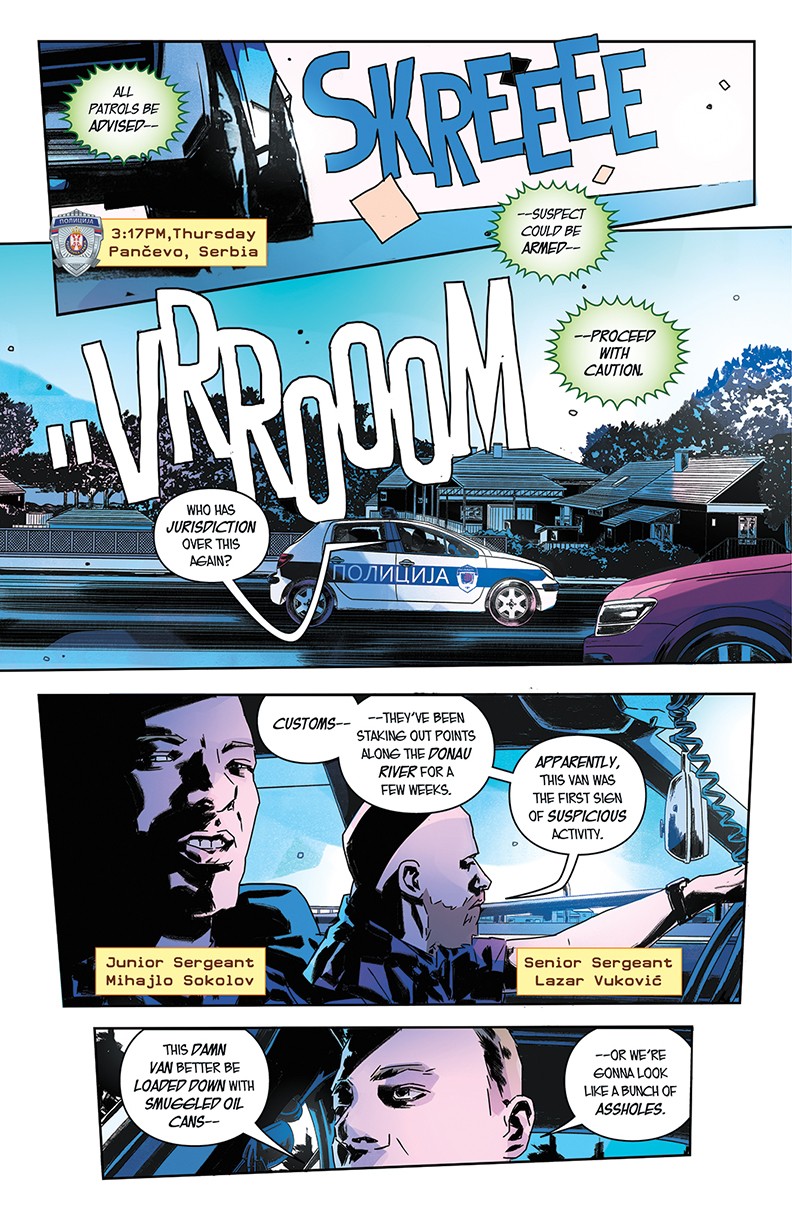
Page from Soko
GRAPHIC POLICY: What is Sumerian’s overall approach to title development? With horror, crime, etc., you’re not just sticking to one genre. What’s the mission statement, and what makes a book uniquely Sumerian?
EKSTROM: I don’t think we have a clear cut “mission statement”, I don’t think that would be very “punk rock” of us, honestly, if you consider the humble origins of Behemoth and, now, Sumerian Comics.
I think what people need to know when they see our brand on a book is that we give a shit about the quality of the entertainment they’re investing in when they pick up our stuff off or a convention table or shelf in a shop. Nathan, Ryan, and Adriana…they all omnivorous consumers of comics. There are stacks of books from other publishers all over our office that we are constantly showing each other and saying, “Hey, I really like this, how can we do this…but better and in our own way.”
I think that’s the most important thing you can do in the modern comic book market now that Millennials have become the primary adult consumers of content: give an actual shit and care about the work as much as your fans care about you.
GRAPHIC POLICY: Your own title, SOKO, is dropping from Sumerian. You’ve had that in development for a while. Now that it’s solicited, how do you feel?
EKSTROM: I keep disassociating when I get in my car…like way too much. Like I don’t know how I haven’t gotten in an accident. It’s surreal to have something this majestic with your name on the cover.
You worry. You’re taking your five year-old to their first day in kindergarten and you drop them off and you wave and you hope the other kids don’t eat your kid alive. You hope your kid doesn’t spend the day eating paste…I can carry this metaphor out to prom but I know for a fact that the five people who have continued to read my blather at this point don’t want any of that smoke.
That’s how it feels to have your first big time comic on the shelves in stores…well, that’s how it’s going to feel on April 12th. I don’t know the pre-order numbers yet. I kinda don’t wanna know because I’ll probably lose my lunch at least once.
Honestly, I’ve never felt more alive. All I’ve ever wanted to do is make comic books. I took the time to learn my craft as a storyteller and then I studied the medium of comics and how to make them. It took me roughly twenty years to get to this point…and I’m just getting warmed up. I wish I could talk about some of the stuff I’m attached to but, unfortunately, I can’t…for now.
SOKO is a wild ride and I’m excited that people like Ross Ritchie, Mark Waid, and Howard Chaykin were kind enough to write glowing endorsements for our book.
Page from Soko
GRAPHIC POLICY: Tell everybody about SOKO and your team.
EKSTROM: SOKO(which translates to “falcon” in Serbian) is a fast-paced police procedural and crime-thriller about two beat cops who uncover a mountain of systemic corruption within the law enforcement system of Serbia that’s deeply connected to the Serbian mob and human trafficking.
The intimal concept was created by my Serbian writing partner, Vanja Miskovic. He’s the heart of this book. We’re very fortunate to be working with veteran artist, Antonio Fuso. Antonio has been on a tear lately with a lot of successful indie projects getting optioned like WYRD at Dark Horse and STARGAZER at Mad Cave. We also have two really talented colorists, Stefano Simeone, artist for MEGA MAN: FULLY CHARGED at Boom! as well as Emilio Lecce who worked on DR1VE for IDW.
I was brought in to initially letter an 8 page short Vanja created. Eventually, I was asked to letter and edit. After that, Vanja was like, “Why don’t you just co-write the project with me…” and the rest is history.
Our cover artist roster is really stacked as well. We have rising stars Francesco Tomaselli who has graduated to doing cover art Todd MacFarlane’s SPAWN and Lorenzo Tammetta over at Marvel killing it on projects like MURDER WORLD: GAME OVER.
But my favorite part is that Serbian artist, R.M. Guera, artist for Vertigo’s SCALPED provided us with a cover for the first issue of SOKO. I couldn’t be more honored. As fan of comics, Scalped is probably my favorite contemporary comic of the 21st Century, hands down.
GRAPHIC POLICY: What’s your big picture view of comics at the moment, and where do you think comics as a whole will be one year from now? What’s going to be the biggest issue, and what’s one important takeaway you want to leave for readers?
EKSTROM: Comics are in a really precarious place where we are expanding and contracting at the same time. There is always someone talking about how the sky is falling and the medium is dying and there’s always someone pointing out the rising profits of print books and graphic novels from the past couple of years.
“It was the best of times, it was the worst of times…” right?
I think we’re still wrestling with a proper method of delivery in terms of digital content and I think that frontier is still rough terrain for publishers because there is no true, clear-cut path to substantial profitability. There is no primary mode of delivery. I think that’s going to be a detriment to the rise of digital content and eventual supplanting of the print market for the foreseeable future…like it has been for the past decade.
Tablets are a luxury item in most homes even though they’re more proliferated than ever. Don’t get me started about attempting to read comics on a phone…I’ll blow a gasket.
We’re consuming more screen-based content than ever, collectively speaking. Comics have to provide something that competes with video games, cartoons, and television programming.
It’s funny to think about when you consider that comics are a cornerstone of the development of those industries in terms of storyboards essentially being simplified comics themselves. It’s like asking an egg to fight a full-grown chicken on steroids. (haha)
Getting books in hands and butts in seats will always be my primary concern no matter if I’m making the comics myself or helping to produce them as an editor for a really great new brand that’s going to be bringing the thunder this year.
I hope that my enthusiasm and the enthusiasm of the crew at Sumerian will inspire you to want to check out our books.
But, seriously, buy more comics, people. See you at MegaCon. Come to the booth and tell Ryan Swanson you think he has a heroic jawline. You’ll have my undying admiration if you do.