My 7 Favorite Phonogram B-Sides
In advance of Kieron Gillen and Caspar Wjingaard’s upcoming comic The Power Fantasy, we’re revisiting some of Gillen’s previous creator-owned work.
As I’ve written before in features and monthly reviews, Phonogram will always be one of my favorite comics and is responsible for roughly 60% of my music taste. For folks who weren’t reading the book 8-18 years ago, Phonogram is a fantasy comic where music is literally magic. The first miniseries Rue Britannia is about protagonist David Kohl trying to find the missing goddess Britannia aka the personification of Britpop music. The follow up The Singles Club is probably still my favorite Kieron Gillen, Jamie McKelvie, and Matthew Wilson collaboration and tells the story of one evening at a Bristol night club from seven different perspectives. Finally, The Immaterial Girl wraps up the series with its focus on it-girl Emily Aster from the previous two volumes of Phonogram dealing with having two identities in a love letter to MTV-era music and videos. The comic does a wonderful job exploring people’s connection to music, and how it affects their identities using a touch of fantasy. It also functions as an engaging piece of pop music criticism. Seriously, I think “retromancer” every time I get an email from a local music venue about an 80s or emo night.
One underrated thing about the Phonogram comics were its B-sides. These were short comics usually by an artist other than McKelvie that fleshed out supporting characters, commented on a music genre, or told a story about David Kohl’s past or future. Initially, you could only find them in the single issues along with a quite-snarky-at-times glossary of terms and bands that I treated as gospel back in college plus other backmatter like record reviews and a letters page. However, they were collected in the Complete Phonogram hardcover, and you can binge them all at once in all their glory, read them after the issue they first appeared in, or even do a fully chronological read of Phonogram. In addition to fleshing out the themes and characters of the series, the B-sides also act as a showcase of some of the best UK indie comics talent of the 2000s/2010s.
Here are 7 of my favorite B-sides from Phonogram: The Singles Club and The Immaterial Girl in the order of the release date of the comic they originally appeared in.
1. “She Who Bleeds for Your Entertainment”
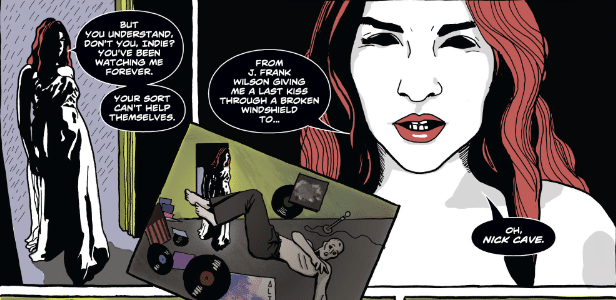
It’s kind of messed up, but Indie Dave is one of the characters I relate to in Phonogram. He’s balding, not great at housekeeping, loves isolation, and is a fan of Joy Division and other artists of early punk/post punk explosion. (You can see Patti Smith, Gang of Four, and Wire posters in his flat in the background of panels in this story.) Gillen could have used him as a cautionary tale in Phonogram, but instead he gets his own arc throughout the B-sides of The Singles Club. This first one, “She Who Bleeds for Your Entertainment”, is an ode to all the women who died in songs from the teenage tragedy tracks of the 1960s to the at-the-time contemporary sad boy tunes of Death Cab for Cutie and Sufjan Stevens. Laurenn McCubbin’s art and colors screams aggressive a la The Morrigan in The Wicked + the Divine as the personification of dead women in songs hurls invectives at him culminating in “emosogynist”. “She Who Bleeds for Your Entertainment” isn’t some kind of moralizing, pop feminist sermon, but a call to consume dark music and its lyrics more mindfully and maybe give some of those female characters agency like Nick Cave did in his tracks with and about PJ Harvey. (They’re my most missed celebrity couple.) There’s room for both Murder Ballads and Boatman’s Call in the world. It’s also a wake up call for Indie Dave to leave his pathetic vinyl-strewn hut and experience real life for once.
2. “Wuthering Heights”
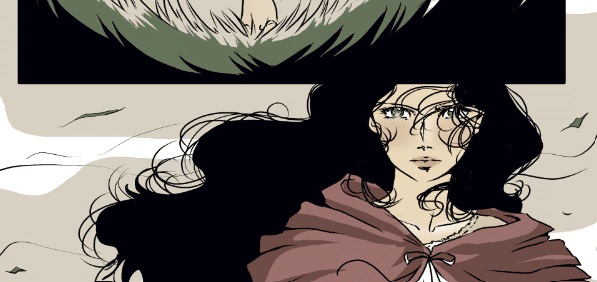
And Indie Dave gets to experience real life almost immediately in the next B-side, “Wuthering Heights”, a beautiful silent comic that is an homage to the Kate Bush song of the same name. Emma Vieceli handles art duties in a style that’s manga meets fantasy landscapes. Unlike the woman in “She Who Bleeds for Your Entertainment”, the female lead of this comic runs, frolics, and dances providing the magical energy for Indie Dave’s journey of self-discovery in the form of a Kate Bush compilation tape. Instead of being cloistered in his room, Indie Dave sets off for the great outdoors with Bush’s ethereal music in his ears and The Dreaming and The Kick Inside in his bag. Indie, artsy music is still his passion and maybe a security blanket, but at least, he’s touching gorgeous Vieceli-colored greensward.
3. “David Kohl: Phonomancer”
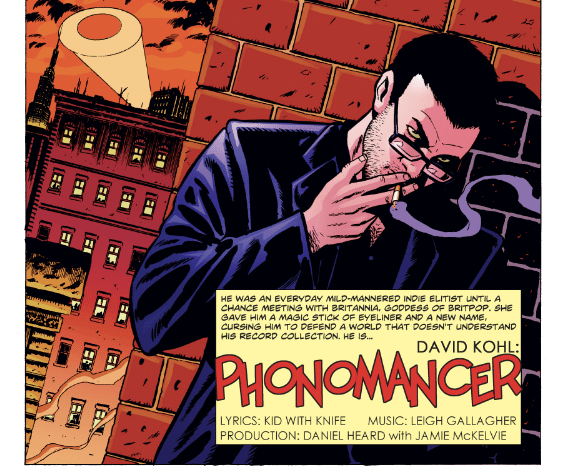
This was one of the first Phonogram B-sides that immediately popped into my mind when I thought about working on this project. “David Kohl: Phonomancer” is a four page parody of Phonogram: Rue Britannia via the Jamie Delano era of Hellblazer. Leigh Gallagher‘s art feels like it should be on newsprint (It’s the wide margin gutters!), and Daniel Heard‘s colors are a dead ringer for Daniel Vozzo’s work on basically every Vertigo/DC Mature Readers title. Kieron Gillen does an amazing job poking fun at the wordiness of old comics/Rue Britannia by having a panel that lays out the main themes of the miniseries with one talking head and blank background. However, the final page is all action and flags, and I definitely detected a little Authority-era Bryan Hitch-meets-Rob Liefeld in the big biceps and guns and Union Jack in the penultimate panel because, of course, action man Kid-with-Knife is the narrator of this yarn. “David Kohl: Phonomancer” is a monument to how clever you have to be to make something seem so dumb.
4. “Your Song”
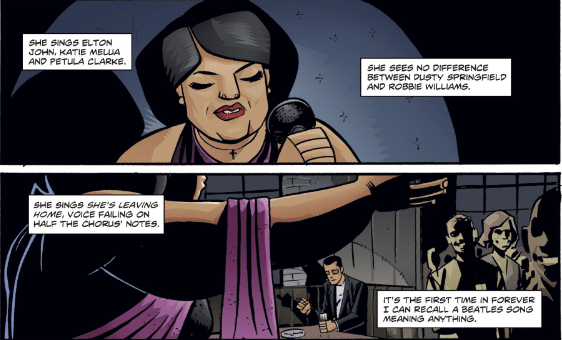
In “Your Song”, Gillen and PJ Holden craft an ode to enjoying your favorite songs while out and about as David Kohl has some drinks at a rural pub while watching a pub singer who’s not very good. However, he ends up being immersed in her performance and realizes that she cares about music as much as him in her own way. Kohl even thinks about cursing a heckler by having her have the same song stuck in her for eternity (A common Phonogram spell.), but realizes that she doesn’t actually care about music so it wouldn’t be a punishment at all. Holden nails the poorly lit interiors and exteriors of the pub while progressively adding lines to Kohl’s face as he warms up to the pub singer, looks at her daughters’ encouragement, and simply finds pleasure in a dance with a stranger. “Your Song” is the perfect sweet and sour B-side beginning with snarky criticism and ending with blissful acceptance as Kohl boogies the night away.
5. “Blurred”
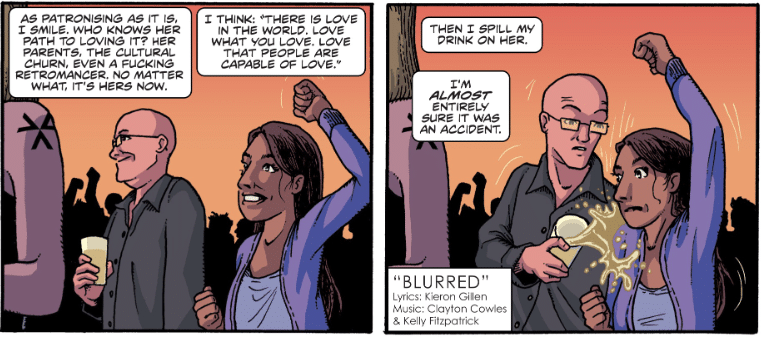
I picked this B-side drawn by Clayton Cowles and colored by Kelly Fitzpatrick as a favorite because I’m totally the girl that David Kohl spills a drink on while comparing a Blur show in 2015 to a Sex Pistols one in 1996. It’s a five panel comic about handing the fandom of a band to another generation. I was a toddler when Parklife came out, and Blur and Oasis battled for the supremacy of Britpop, but you can bet your ass I was on the plane to LA to see them play a warm-up show before Coachella. On the flipside, it’s me at the 7-Eleven chatting with some teenagers/college students/young people (Kohl was right about people under 30 all looking at the same.) about my Paramore shirt when they were toddlers when Riot! came out. It’s cool seeing artists have generations-spanning impact, and gatekeeping that is uncool. I don’t care if they got into Paramore because they opened for Taylor Swift on the Eras tour. I got into them because they said “whore” uncensored on the radio, and Hayley Williams was a ginger from Middle Tennessee like me. Teenagers will probably be listening to The Smiths and “Teenagers” by My Chemical Romance in 2050, mark my words. Gillen and Cowles nail that sentiment while paying homage to the best Brit pop band with a little cheeky Kohl humor on the side.
6. “I Hate Myself”
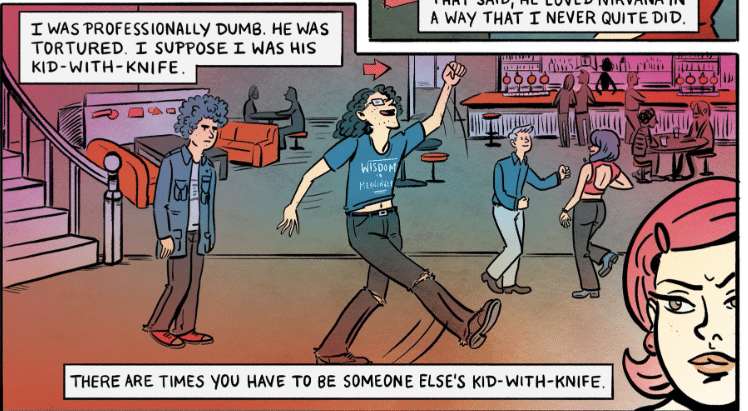
“There are times you have to someone else’s Kid-with-Knife” is a piece of wisdom I think about when I get a little too big for my britches, or the main character syndrome starts to creep up. And I got it from “I Hate Myself”, which was illustrated by Jules Scheele in a lovely, throwback 90s indie comic style combined with a more contemporary approach to color palette. It’s a flashback story of David Kohl in Catholic school with his friend Johnny Panic, who is a huge Nirvana fan, and later confides in Kohl that the band saved his life. In the space of two pages, Gillen and Scheele go through the triumphs, angst (Ecclesiastes quotes on t-shirts!), and dick jokes of adolescence before giving a glimpse of Panic in the future as he dances with shirtless Slovakian men to “Smells like Teen Spirit”. It’s really amusing and cathartic to see a pre-Britannia Kohl fumbling with his identity and following the lead of a more confident, high-energy, and yes, depressed friend illustrating the simple truth that sometimes we’re not always the protagonist.
7. “Modern Love”
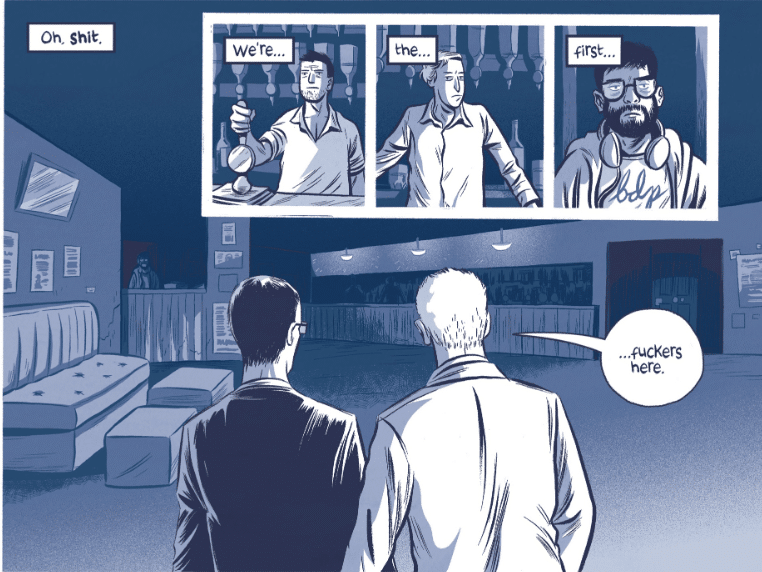
And of course, I had to wrap up this article with the final canonical Phonogram B-side and in-universe story in general, “Modern Love”, which is drawn by Tom Humberstone and is the reason I never turn up early for club nights. (Being “the first fuckers there” is so embarrassing for no discernible reason.) This comic chronicles David Kohl’s bachelor party, which is just him and Kid-with-Knife going to a club, discussing assault weapons, and dancing to The Smiths, Kenickie, and David Bowie aka the songs on Kieron Gillen’s writing playlist. this is funny because the final page of the comic blurs the lines between fiction and autobiography with Gillen pulling a Grant Morrison, facing the audience, and wiping a tear away as he puts this universe to bed. “Modern Love” is a lovely coda to David Kohl’s journey as Humberstone’s pink and blues make memories of club nights rush through his mind, and we get his entire career as a phonomancer in the rush of a page. It’s a beautiful ending to the series and an ode to building friendships, meaning, and creating with the aid of pop bangers like the Bowie track that gives the B-side its name. (I also feel like I lived this comic because I briefly danced with Kieron Gillen to “Modern Love” once upon a time.)