The Consignment Group, which consists of Aspen, Black Mask, DSTLRY, Dynamic Force/Dynamite, Heavy Metal, Magnetic Press, Massive Publishing, Oni-Lion Forge, Panini, Alien Books, Graphic Mundi, Titan, Vault Comics, and Dark Horse, have submitted a response/joinder to the court in support of the Ad Hoc Committee‘s motion for the court to release consigned stock currently held by Diamond.
One of the biggest fights during Diamond’s chapter 11/chapter 7 process has concerned consigned goods provided by publishers and currently held by Diamond and stored by Sparkle Pop. In short, Diamond believes they “own” the product and can sell the goods to help pay off its debts. Of course, the publishers wants their goods back.
In their response/joinder, the Consignment Group argues:
The publishers have a distribution agreement with Diamond for the goods on a consignment basis, but the publishers own the inventory,
If the distribution agreement is terminated, the goods need to be returns,
Diamond currently has a lack of “adequate storage,” has let insurance lapse, and the goods are still being sold unauthorized,
The stock is losing value and publishers aren’t able to distribute the product through other ways which is causing issues with consumers as well as contractual claims,
The distribution agreement has been terminated/rejected and because of that, the goods should be immediately returned,
Some consigned goods were provided after Diamond’s chapter 11 process began, so the trustee doesn’t have claim to that.
They’re asking the judge to grant the Ad Hoc Committee’s relief and release the consigned inventory, as well as any other relief the Court deems just and proper.
One of the biggest fights during Diamond’s chapter 11/chapter 7 process has concerned consigned goods provided by publishers and currently held by Diamond and stored by Sparkle Pop. In short, Diamond believes they “own” the product and can sell the goods to help pay off its debts. Of course, the publishers wants their goods back.
A decision as to who owns the product was put on hold by the court and Diamond was offered the option to sue each individual publisher, which they did. Those lawsuits have played out for over half a year at this point.
One small detail of that fight involves Diamond’s contracts with the publishers which Diamond had to accept or reject during the chapter 11/chapter 7 process. A deadline for that decision came and pass with Diamond making no decision. The publishers have since motioned saying that counts as a rejection, the goods are theirs then, and the adversary proceedings should be dismissed.
Numerous filings were released today setting the date for Diamond and its counsel to respond to that motion to dismiss the adversary proceedings as March 30, 2026.
Publishers included in today’s filings include Aspen, Black Mask Studios, Dark Horse, DSTLRY, Dynamic Forces, Heavy Metal, Magnetic Press, Massive Publishing, Oni Press, Panini, Alien Books, Titan Comics, and Vault Storyworks.
Monday is a big day in Diamond’s Chapter 11 case and will feature discussion of multiple motions that have yet to be decided. One of the bigger motions is Diamond’s motion to approve procedures for sale or other disposition of consigned inventory. In short, Diamond wants to sell inventory from publishers to help pay back it’s loan from the bank. There’s dispute as to who owns that property.
Last minute filings are coming in before the hearing begins.
A group of publishers that includes Aspen, Black Mask Studios, DSTLRY, Dynamic Forces/Dynamite, Heavy Metal Entertainment, Magnetic Press, Massive Publishing, Oni-Lion Forge Publishing Group, Panini UK, Punk Bot Comic Books/Alien Books, The Penn State University/Graphic Mundi, Titan Publishing, Vault Comics, and Dark Horse have submitted a document featuring the “Disclosable Economic Interest in Case.”
What each publisher has in value is listed out. The grand total is over $1.241 million worth of inventory with the most from Titan Publishing with $413,898.17 and least is Heavy Metal Entertainment’s $363.37.
Also, a document that features agreed upon “facts and authenticity of exhibits” between JPMorgan Chase Bank and the Consignment Group has also been released.
It has information like agreements between Diamond and the Publishers and more interesting bits.
Here’s some of the highlights:
“the Consignors and not the Debtors were to pay all personal property taxes on the consigned stock that the Consignors delivered to the Debtors; and that the Debtors sent to the Consignors, on several different occasions, correspondence indicating that the Consignors were responsible for paying personal property taxes to the State of Mississippi and/or DeSoto County, Mississippi, because the Consignors owned the stock delivered to the Debtors.”
“JPM stipulates and agrees that it was aware of the fact that the Diamond Comic Distributors, Inc., debtor (“Distributor”) dealt in consigned goods; and that it had actual knowledge of the Distributor’s participation in consignment transactions during the period from its initial advance of funds to the Debtors through the present.”
The loan documents between JPMorgan and Diamond are all authentic.
The first two points might be important in that the first one indicates it was the publishers who paid taxes on the product, not Diamond, strengthening proof of their ownership. The second point is important in that it shows JPMorgan was aware that Diamond sold consigned goods when it made a loan, a point of contention at various stages.
Writer: Matteo Pizzolo / Artist: Carlos Granda / Colorist: James Offredi / Letterer: DC Hopkins Cover Artists: Luana Vecchio, Duski Loveless, Amancay Nahuelpan, Creees Lee Mature / $4.99 / 36 pages
WHAT IF CALIFORNIA REFUSED TO BE RULED? In CALEXIT, the citizens of the California Sovereign Republic struggle to seize power back from U.S. occupying forces. Jamil, a warzone courier (aka smuggler), and Zora, a young leader in the Mulholland Resistance, fight to escape Occupied Los Angeles — but it’s total war on the streets of Los Angeles as California attempts to seize freedom or die trying.
A group of 13 publishers have filed a response to Diamond‘s attempt to move the hearing regarding its consignment plan. While it was originally scheduled for July 21, Diamond wanted to move it to July 24 or 25. Image Comics weirdly supported the move, even though in their support Image brings up San Diego Comic-Con during that week. The new proposed dates would be smack dab in the middle of SDCC.
The group of publishers have filed a response that they don’t disagree with the move but ask for it to happen some time after San Diego Comic-Con, so after July 27.
They also are asking for that hearing to be an initial, non-evidentiary hearing, instead of deciding if Diamond’s original motion is approved.
Aspen Comics, Black Mask Studios, DSTLRY Media, Dynamic Forces, aka Dynamite Entertainment, Heavy Metal International, Magnetic Press, Massive Publishing, Oni-Lion Forge Publishing Group aka Oni Press, Panini UK Ltd., Punk Bot Comic Books, aka Alien Books, The Penn State University aka Graphic Mundi, Titan Publishing Group, and Vault Storyworks, aka Vault Comics formerly known as Creative Mind Energy have formed like Voltron to form a new team called the “consignment group” entering the legal fight.
The 63 page document starts with what we’d expect stating the publishers own the merchandise, aka consigned goods, and not the property of Diamond Comic Distributors. It then dives into Diamond’s claim that the publishers needed to file a UCC-1 financing statement which would have protected them against this situation. The legal argument says that may not needed as this was a “true consignment” established by the various contracts signed and state law.
This filing is similar to Humanoids’ stating that contested matter needs to be handled by Rule 7001(2) of the Federal Rules of Bankruptcy Procedure and requires an adversary proceeding and emphasizes again that the publishers own the goods, not Diamond. It also states that it was Diamond’s intention to sell the goods this way and that they should have paid the publishers as per the terms of their agreements.
Like Humanoids’ objection, there’s a focus on Bankruptcy Rule 7001(2) requires that says an adversary proceeding has to happen to determine the “validity, priority, or extent of [an] interest in property.” In short, it hasn’t been determined that the consignment product is property of Diamond and that needs to happen before they can sell anything.
Part of Diamond’s initial motion is that no publishers filed a UCC-1 financing statement which would have protected them. But, did they even need to file it? The publisher’s motion calls them “true consignments,” and don’t meet the definition of UCC Section 9.
(A) the merchant: (i) deals in goods of that kind under a name other than the name of the person making the delivery; (ii) is not an auctioneer; and (iii) is not generally known by its creditors to be substantially engaged in selling the goods of others. (B) with respect to each delivery, the aggregate value of the goods is $1,000 or more at the time of delivery; (C) the goods are not consumer goods immediately before delivery; and (D) the transaction does not create a security interest that secures an obligation.
Back to that non-payment. Goods were shipped after Diamond’s January 14 Chapter 11 filing, and the publishers should be paid for them and administrative expense claims such as attorney fees and late penalties.
The rest of the filing includes purchase order agreements, distribution agreements, details of those agreements like discount percentages, and more.
Backer Beware: Crowdfunding projects are not guaranteed to be delivered and/or delivered when promised. We always recommend to do your research before backing.
A new comics anthology curated by the creators of Calexit aims to celebrate the Hollywood Labor Movement’s massive success and also support workers impacted by the dual Strikes as the WGA closes its historic new deal with the studios. General Strike: Calexit and Other Tales of Fighting the Good Fight is a collection of new stories dedicated to the struggle for economic equality is written by WGA members, and publisher Black Mask Studios is matching the writers fees with donations to the Entertainment Community Fund.
With official pre-orders opening today, General Strike is hosted by a brand new comic book heroine (labor organizing badass Gen. Strike) and features stories by a roster of WGA-writers including writer/producer/WGA NBCU Lot Coordinator Judalina Neira, Rodney Barnes, Tamara Becher, Daniel Dominguez, Charley Feldman, Grant Morrison, and Brian Michael Bendis. The project is being run by WGA-member writer and publisher Matteo Pizzolo.
General Strike is an anthology comic of genre stories about characters fighting the good fight against injustice, linked by the theme of confronting economic inequality. All of the stories are written by striking guild members. In addition to paying Marvel/DC-level writers’ rates, Black Mask is also matching the writers’ rates with donations to the Entertainment Community Fund, and the creators retain ownership of the IP to their stories and characters.
Comics’ newest superhero Gen. Strike, a bubblegum-chewing labor organizer, comes to life in a set of covers by comic book artists Tyler Boss, Iolanda Zanfardino, Ben Templesmith, Ramon Villalobos, Creees Lee, Elisa Romboli, Amancay Nahuelpan, and Darick Robertson.
Artists illustrating the General Strike stories include Antonio Fuso, Jamal Igle, Butch Mapa, Tyler Jenkins, and Josh Hood.
General Strike: Calexit and Other Tales of Fighting the Good Fight is available for pre-order now on Kickstarter.
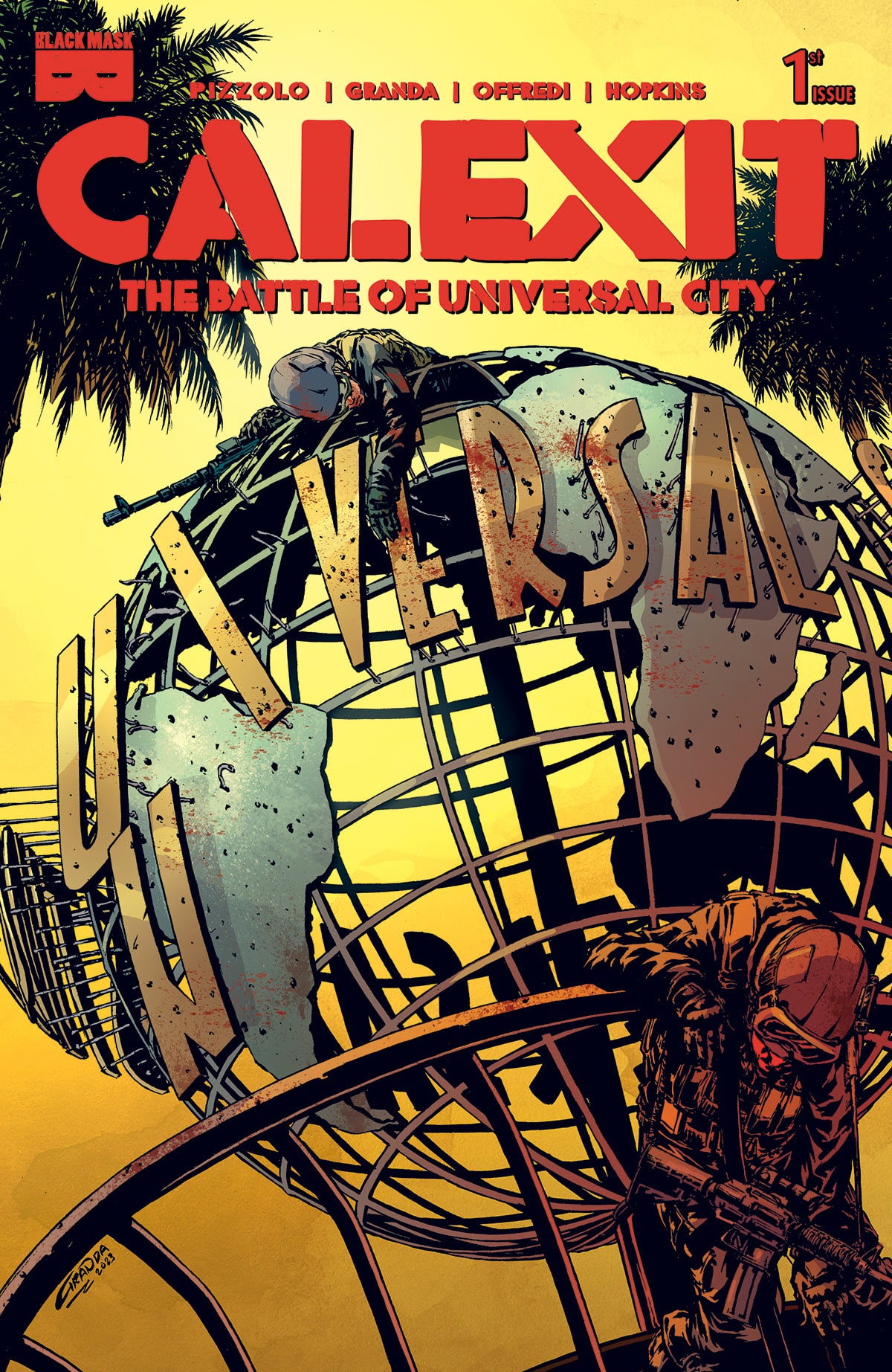
Theme parks have already become political battlegrounds, but what if they became actual battlegrounds? What if the culture wars became actual wars? As mass demonstrations consume Hollywood, the comic book Calexit considers the question: What if California refused to be ruled?
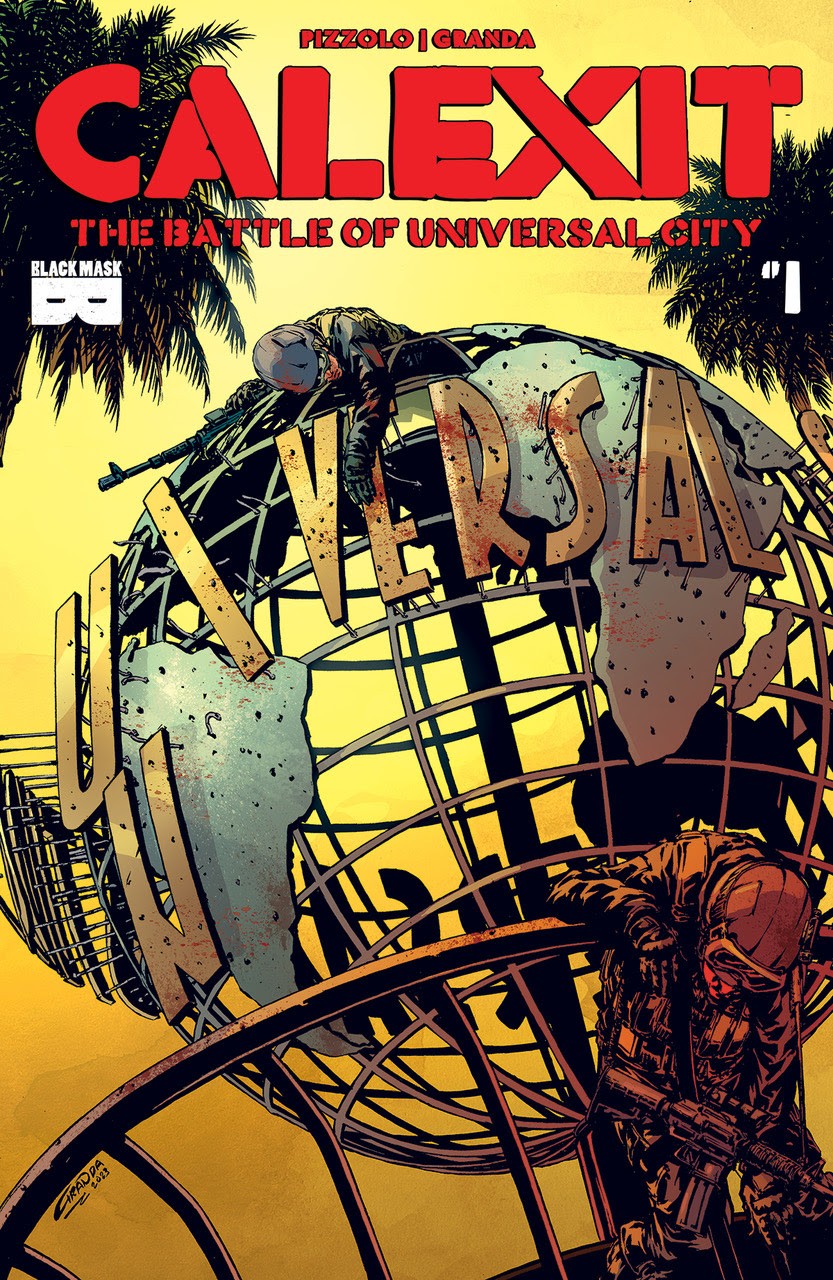
This is the world of Calexit: The Battle of Universal City, the new comic book series launching this July from Black Mask Studios. Together writer Matteo Pizzolo and artist C. Granda, the creators of Rogue State, have created a timely title about young rebels willing to risk it all for freedom of thought.
In Calexit: The Battle of Universal City, it’s total war on the streets of Los Angeles as rebel leader Zora rallies her Mulholland Resistance to seize freedom or die trying. The battle rages all the way to the iconic Hollywood theme park in Universal City where Zora’s Resistance fighters make a last stand against Homeland Security’s Occupying Forces. Warzone courier Jamil has been hired to spirit Zora away from the firefight to a Resistance stronghold, but Zora won’t be dragged to safety without a fight.
The first issue of Calexit: The Battle of Universal City is set for release from Black Mask Studios at Comic Con International, followed directly by your favorite local comic shop.
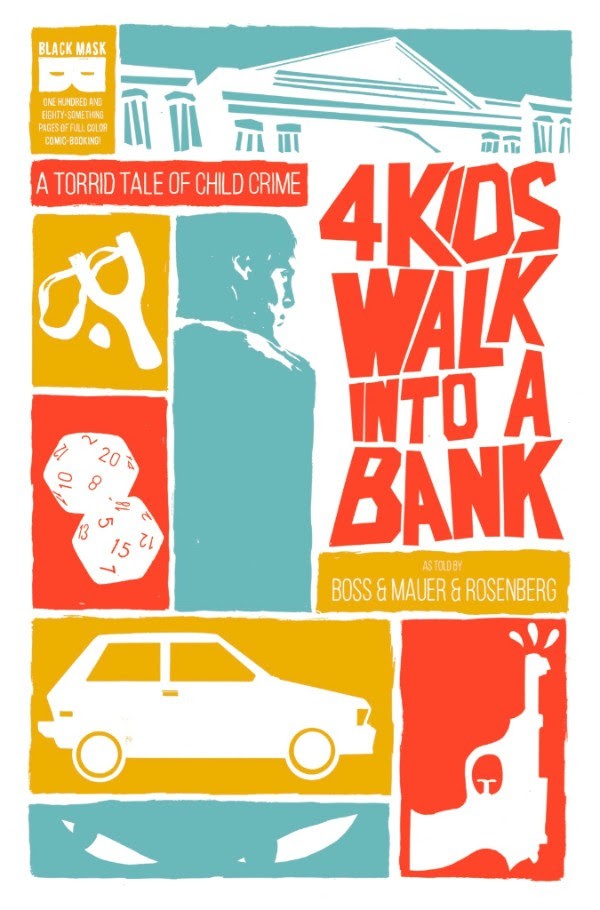
This is a column that focuses on something or some things from the comic book sphere of influence that may not get the credit and recognition it deserves. Whether that’s a list of comic book movies, ongoing comics, or a set of stories featuring a certain character. The columns may take the form of a bullet pointed list, or a slightly longer thinkpiece – there’s really no formula for this other than whether the things being covered are Underrated in some way. This week: 4 Kids Walk Into A Bank
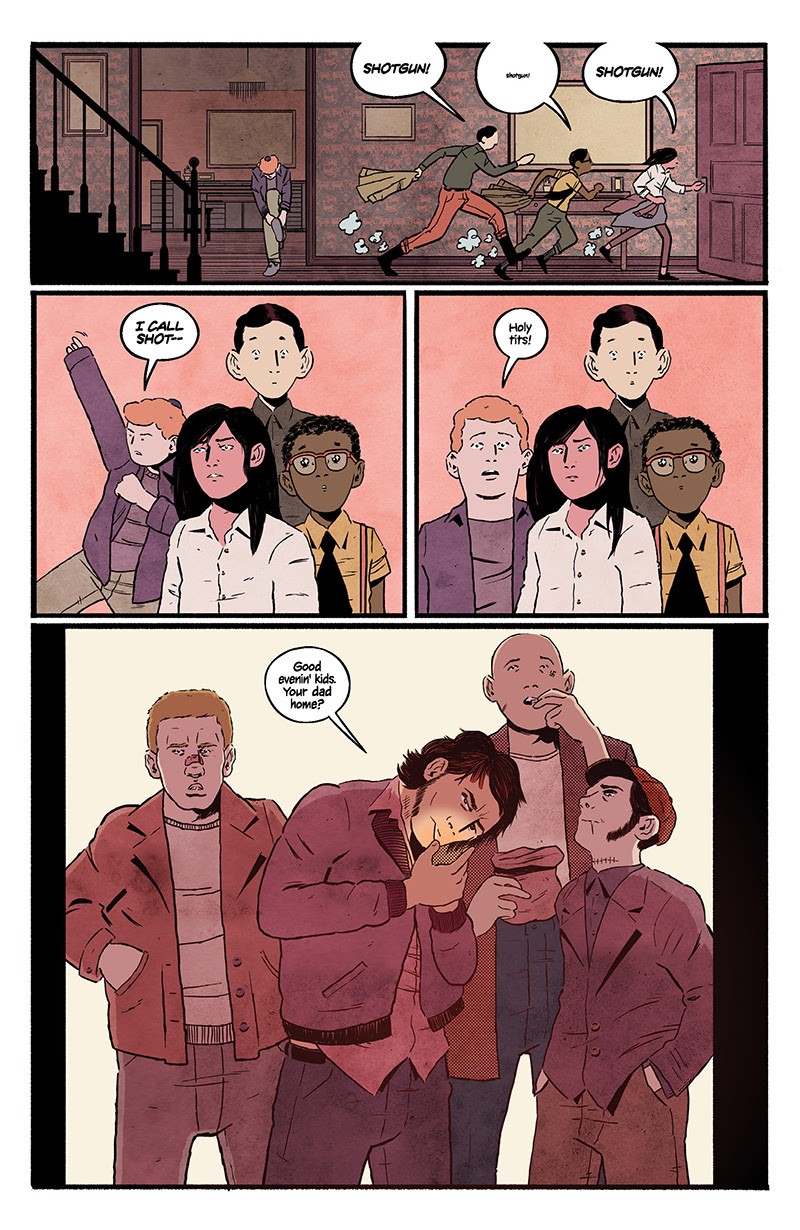
All images will be taken from the first issue preview pages to help alleviate the spoiler hammer.
At some point in the last two years you’ve probably heard somebody talking about the comic 4 Kids Walk Into A Bank. The first of the five issues in the series was released April 2016, but due to a series of delays the fifth issue only hit the physical and digital shelves in September 2017, which unfortunately left some readers less than enthused about the story – not because the quality was lacking, but because the inconsistent release schedule caused momentum and interest in the series to wane.
Personally, after the second delay I had almost forgotten to keep checking for the next issue, so it came as quite a welcome surprise to notice the trade. Finally, I could read the entire story in one sitting (or several but at least I had the full story in hand).
But first, before we talk about 4 Kids Walk Into A Bank, what’s the story about?
Well the book’s synopsis reads: “A fun(ish) crime caper about children! Eleven-year-old Paige and her weirdo friends have a problem: a gang of ex-cons need her dad’s help on a heist… the problem is those ex-cons are morons. If Paige wants to keep her dad out of trouble, she’s going to have to pull off the heist herself. Like Wes Anderson remaking Reservoir Dogs, 4KWIABis a very dark & moderately humorous story about friendship, growing up, D & D, puking, skinheads, grand larceny, and family.“
Before we get to talking a little about the story, when you open the trade and see the comic’s credits you’ll notice that they’re done in alphabetical order; art and design by Tyler Boss, Flatting by Clare Dezutti, Lettering by Thomas Mauer, Wallpaper by Courtney Menard and written by Matthew Rosenberg. Rosenberg was a guest on Graphic Policy Radio last year where he said that he felt it important that each artist who contributes to a comic is recognized (I could be wrong in the exact wording, but I believe the essence of the quote is there), and it was on that episode of the radio show that I first heard the term “flatter.” I hadn’t really come across it before, and consequently had no knowledge of what a flatter did. Thankfully, the ever reliable Wikipedia was there to help;
“A flatter is a colouring specialist within the comic book industry that prepares the inked or sketched comic book page for the colorist with digital art software such as Adobe Photoshop. The specialist does so by selecting the objects on the page and filling them in with a solid color called a “flat”, so that the “flats” can be used by the colorist by way of the “magic wand” tool. In this way, the colorist may select each object during the rendering process-to the exclusion of the other objects on the page-so that the object’s base color may be changed, or to render the colors.”
They sound like a pretty important part of the comic industry, eh?
That’s a subject for another day, however, as today we’re looking at 4 Kids Walk Into A Bank in it’s totality.
Perhaps best likened to somebody throwing the Goonies, a supernatural-less Stranger Things and Reservoir Dogs into a blender and then poured it out over a nice crust of fantastic and baked for several minutes. Served with a side of wry humour and a glass of childhood innocence that may have started to sour a little, if you had started 4 Kids when it first came out but, like me, you’d let the series fall off your radar then you’ll be pleased to know that with the release of the trade you won’t need to put the story down.
I didn’t (well, not intentionally – I did fall asleep while reading but that’s because it was 3 am and I’d been awake more than twenty hours and thus should not be taken as an indication of quality).
4 Kids is one of those stories that really couldn’t work as well in any other medium; this is a story that exemplifies what it means to be a comic book. In an age of endless crossovers and reboots it is beyond refreshing to read a complete story that will take you along by the scruff of the neck as the characters end up going further and further down a rabbit hole – not only do the elements of humour in the comic play off the visuals, but they allow the deeper messages of the story to permeate your brain. Before you know it you’ve noticed that this story is so much more than just four kids walking into a bank (keep an eye out for some great narration bubbles there, too) – this is a story about family, societal debt and the folly of youth.
Rosenberg’s script is witty, the pacing of the story beats are utterly perfect; his writing so sharp I nearly lost a finger. When it comes to Boss’, his art may not be your cup of tea at first, but his command of the page and the characters upon that page couldn’t be better suited to this script. If this was a review rather than an entreaty to pick the trade up (I have despite having a review copy) then I would be giving this top marks across the board. 4 Kids Walk Into A Bank is a comic you must read.
That’s all for this week folks. Join us next week when we talk about something else that falls under the Underrated banner in the comic book world.
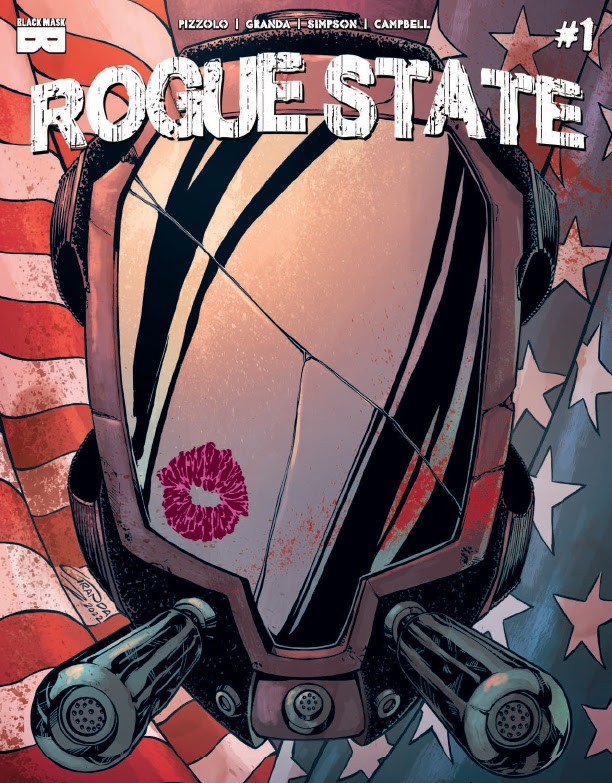
After immediately selling out at both Diamond Comics Distribution and Lunar Distribution, Black Mask is rushing new editions of two of its titles: Rogue State #1 and Godkiller: For Those I Love I Will Sacrifice #1.
Rogue State #1 hit the ground running by selling out of its First Printing on release day last November when it debuted as Black Mask’s all-time top-ordered book, and now both Second Printing covers by Jasmin Darnell have also sold out within days of release. The new Third Printing set for release on February 8th will feature a new cover by series artist C. Granda.
Godkiller: For Those I Love I Will Sacrifice #1 exploded onto shelves last week, with this newest launch from the Godkiller universe selling out immediately on its day of release. Its Second Printing is also planned for a February 8th release, featuring two covers (a standard edition and a bagged-NSFW edition) by Jasmin Darnell.
Rogue State is illustrated by C. Granda, written by Matteo Pizzolo, colored by Brad Simpson, and lettered by Jim Campbell.
Godkiller: For Those I Love I Will Sacrifice is illustrated by Anna Muckcracker, written by Matteo Pizzolo, and lettered by Jim Campbell.