
Despite the Killing Joke‘s place in the history of fridging women in superhero comics, I still have a great fondness for the Alan Moore/Brian Bolland story (in fact, I’ve often thought that the story could have been done without fridging Barbara Gordon at all) and so when I heard that it was going to be turned into an animated movie with Kevin Conroy, Mark Hamill, and Bruce Timm, I was thrilled and I got myself a ticket. (I even accidentally showed up a week early because I forgot which Monday the screening was…)
And then came rumors about the adaptation, and then came SDCC. I felt genuinely torn about whether to go ahead – if it was as bad as it sounded, I didn’t want to support the film; on the other hand, I hadn’t seen the film and wanted to be able to judge from primary evidence. Plus, I’d already bought the ticket and a bunch of my friends were going, so I waffled my way into going.
So is it as bad as people at SDCC thought? In some ways no, and in some ways it’s worse.
WARNING: Spoilers in full for the Killing Joke, which involves violence against women.
The Prologue:
So first let’s talk about the not-as-bad. Some of the reviews and first impressions that have come out suggest that “we meet Barbara Gordon as a young librarian who has started donning the Batgirl costume in order to attract the attention of Batman.” While everyone’s experience of a film is subjective, I think this reading is based on a mis-reading of one particular line.
There’s a scene in the Prologue where Batgirl is arguing with Batman over being taken off a case and she yells at him that she “got into this because of you.” (By the way, all of these quotes from the film should be taken as paraphrase from memory because I didn’t have the opportunity to take notes and there’s no script available) The context of her line is that Batman’s just told her that he doesn’t trust her because costumed crime-fighting is just a game for her, whereas Batgirl is pointing out that she became Batgirl because she was inspired by Batman and he’s been acting as her mentor. The two of them don’t have a sexual relationship at this point nor is Batgirl actively trying to start one, so I find this reading strange because it pushes the (arguably rather sexist) narrative that Batgirl is some sort of crazed groupie.
What might have led people to that conclusion is that after this line, Batgirl and Batman have sex. Now, I don’t necessarily have a problem with this in the abstract. While some might feel that “Batman has had a primarily parental relationship with Barbara, which makes this scene problematic for many fans on its most basic level,” I don’t agree. Having watched a lot of the Adam West show where Batgirl was substantially older than Robin and Batman would go into these rhapsodies about the perfume of this mystery woman, the idea isn’t without precedent.
However, the handling of this plotline is horrible, in ways that do minor damage to Barbara’s character, but arguably way more damage to Batman’s character. It’s bad enough that there is this framing of Barbara being hot for her yoga teacher, although her line that she has “a man in her life” is as much to try to fend off her camp gay coworker who might as well have stepped out of Patton Oswalt’s sketch on the “Gay Best Friend” as it is a statement of her interest. But what’s much worse is that the act itself is a horrible cliche slap-slap-kiss moment, where Batgirl is fighting Batman on a roof because she’s hit her limit with Batman’s bullshit, judo-flips him into the ground, and then pins him, and then they fuck. While a gargoyle watches.

(Poor guys can’t even close their eyes…)
In the sold-out screening I was in, this was a moment where the entire audience erupted in groans and laughter, because it was such a cheesy scene and didn’t fit Barbara Gordon’s character at all. The rooftops location, the fight-fight-kiss dynamic, the costumes – this is a Catwoman scene and it’s a played-out Catwoman scene at that.
Is what follows accurately described as her “using sex and then pining for Bruce,” as Jeremy Konrad said in that now-infamous Comic-Con panel? No. In fact, it’s kind of the reverse (and this is why I said the Prologue does more damage to Batman than Batgirl). Batgirl handles the event like an adult, telling Batman that “it’s just sex, it doesn’t have to be a thing,” rather than trying to manipulate him in any way. It’s Batman who acts like an immature asshole, refusing to work with her or take her calls, and generally acting like a remote, emotionally-stunted jackass.
All of which reinforces the basic problem with Batman in the Prologue: he’s a giant control freak who literally tells Batgirl that she has to do everything he says, who orders her “off the case” like some grizzled police captain in an 80s buddy-cop film, and who tells Batgirl he doesn’t trust her because she hasn’t stared into “the abyss… where all hope dies.” (which is a really hoary 90′s grimdark anti-hero trope, lands with a thud in the moment, and arguably contradicts the thematic thrust of Moore’s story), and who literally mansplains objectification to Batgirl. (Yes, at some level he’s explaining it for the audience, but it’s still fucked up that it’s him doing it rather than Barbara, who as a grown woman knows far better than he what being objectified by a man is like.)

Needless to say, this doesn’t fit the Batman of the Killing Joke, who’s in an unusually introspective, empathetic, and contemplative mood – meeting with Joker in Arkham Asylum because he’s worried he’s going to end up killing him, rushing to comfort Jim Gordon, offering to rehabilitate the Joker. More on this when we get to that part of the movie. So there’s a really weird disconnection between the two halves of the movie, as we’re really getting two Batman, one written by Brian Azzarello and Bruce Timm and one written by Alan Moore, and the two don’t feel like they’re the same person.
Speaking of Azzarello and Timm, we have to talk about the source of the conflict between Batgirl and Batman, the main bad guy of the Prologue. He’s a brand-new villain named Perry Franz (mon dieu), a would-be high-tech crime-boss who becomes obsessed with Batgirl (to the point of hiring a sex worker to wear a Batgirl mask while they have sex) when she foils an armored-truck robbery. This guy is clearly meant to be a parallel to the Joker – he’s got the whole Xanatos Gambit thing going, he plays this cat-and-mouse game where he’s leaving messages for Batgirl with the cops and taunts her over the phone, and so on. Batman argues that Batgirl is letting Perry get to her and she’s underestimating him, and she rightfully takes this as Batman thinking she’s not up to the task.
However, Perry is just not that impressive, ultimately nothing more than the shallow “punk” Batgirl pegs him as when they first meet. In addition to the thing with the sex worker and the messages, his go-to move when they first fight is to roofie her (it’s not just a knockout gas, he talks about having “fun” with her after she passes out, although thankfully Batgirl manages to save herself). When you get right down to it, he’s a date rapist whose master crime come down to a failed bank robbery and stealing his uncle’s online banking password.
Now, I disagree with those who’ve argued that, in the film, “the damnable part is that Batman is proven right” about Barbara not being ready. In the final clash, Batman is the one who underestimates Perry, who hits the Batmobile with a couple RPGs, wounding him and forcing him into a desperate struggle to survive against machine-gun wielding thugs. Batgirl is the one who saves him with a motorcycle-and-steverdore’s hook combo, and she’s the one who takes down Perry. This is probably where Azzarello and Timm were coming from with the “she’s a strong character” argument.
But where they fall short is the follow-through. Even though Batgirl saves Batman, we don’t get a scene where he thanks her or admits that he was wrong and learned a lesson – the “strong female character” stuff that Azzarello and Timm argued they were doing isn’t incorporated into the text. Instead, Batgirl beats the living shit out of Perry because “you ruined everything” – and this, rather than the scene where she has sex with Batman on the roof is where she sounds like a crazied groupie – and this is her moment of staring into the abyss. Because she loses her temper and administers a beating far less egregious than many that Batman has handed out (which I think is what Timm was gesturing to with his comment about “pining over the violence”) because of this penny-ante and flimsy one-shot villain, she decides to hang up the cowl and stop being Batgirl. (Which again, kind of works against the Killing Joke’s story..)
It’s far too inconsequential and disconnected from any core elements of Barbara’s character – her family or friends, her motives for fighting crime, a more established villain with a stronger personal connection – to carry the weight of what should be a momentous decision. And that, rather than the fact that she has sex with Batman, is what weakens Batgirl as a character.
The Killing Joke:
What makes all of these creative choices so strange is that it’s not like the controversy over the Killing Joke was news to anyone involved. Everyone on the creative team knew very well that the problem with the Killing Joke is the Joker shooting and paralyzing Barbara Gordon in order to motivate Jim Gordon and Batman. It’s a classic case of fridging, and the gendered nature of the event is further emphasized by the Joker taking nude photos of Barbara to use in his haunted house ride.
No matter whether you think that Barbara becoming Oracle was an important moment for the representation of the disabled or whether you prefer the New 52 or Batgirl of Burnside as a reclamation of the character, the moment is still ugly, feeding into the worst aspects of 90s comics, and is ultimately unnecessary. There’s quite a few ways to make the story work without that scene, and it oddly contradicts the moment at the end of the comic where the Joker turns the joke-flag gun on Batman.
So you think they would have approached the adaptation with that in mind. Instead, as I’ve already suggested, the two halves clash. Given that in the comics, Barbara’s paralyzing was the moment where she had to stop being Batgirl and become Oracle instead, the Prologue has her retired when she’s attacked. Likewise, given that Batman’s had a much closer relationship with her than he did at this point in the comic, the fact that they decided to do the comic essentially page-for-page makes Batman’s very limited interactions with Barbara and muted emotional response both to the physical damage done to her and the Joker’s sexualization of the attack read like a non-response to what should be a huge deal. Moreover, it conflicts with Batman’s major arc in the story – his attempt to reach out to the Joker, even in the end, makes him seem completely uncaring about his former lover.

And of course, there’s the moment itself, which you’d think the creators of the film would treat with heightened sensitivity. Instead, the moment is intensified (in what is otherwise a very faithful adaptation of the comic) in two ways: first, the “shot” is held on what is the second-to-last panel on the right, with the Joker slowly moving his hand down Barbara’s chest and then the “camera” showing us Barbara’s opened shirt and bra. Second, later on when Batman is canvassing the city for the Joker, there’s an elaboration of a single panel where Batman’s interviewing a group of sex workers where we learn that the first thing that the Joker does when he gets out is to make use of their services, but this time he hasn’t and maybe he’s found a new girl. Now, you can argue that the Joker hasn’t come by because he’s busy with his quasi-suicidal mission to break Gordon and Batman, but the text leaves itself open to the interpretation that Joker did something more than just photograph Barbara.
As I’ve said above, the above page is my least favorite part of the comic, and even the people who don’t have a problem with that section will generally agree that the heart of the comic is in the hypothetical backstory for the Joker, his argument to Jim Gordon that madness is the only rational response to an irrational and random universe, his attempt to prove that any ordinary person is capable of turning into the Joker as a result of “one bad day,” Jim Gordon’s defiant hold on his sanity and his belief in the capacity of human beings to create meaning through institutions like the law, and Batman’s attempt to reach out to the Joker. So how does the film handle that?

The answer is that it does only an okay job, there’s a few moments where it becomes something special (I especially love this shot of the Joker watching the carnival lights come on, because it has some energy that’s often missing), but nothing near good enough to make up for everything it gets wrong that we’ve already talked about. Kevin Conroy is fine, Mark Hamill puts in a great vocal performance, but the art and direction fall short of what Moore and Bolland and John Higgins (the colorist) accomplished on the page. For example, let’s take the famous last page of the comic, shown above. There’s a lot that can and has been said about these nine panels – the use of the palette of reds and purples and oranges and yellows that runs throughout the comic, the way that the headlights turn into the flashlight beam from the joke (which Moore has already set up from the scene where Batman goes to the lunatic asylum, which he further emphasizes with the use of repeating dialogue), the ambiguity of the laughter and the siren that convinced Grant Morrison that Batman killed the Joker, and on and on.
In the movie? It’s just a shot of a puddle. No beam of light, no paralleling, nothing of what made this comic special in the first place. Maybe Alan Moore was right – there are some things comics can do that movies can’t.

 It was new comic book day yesterday. What’d you get? What’d you like? What’d you dislike? Sound off the comments below.


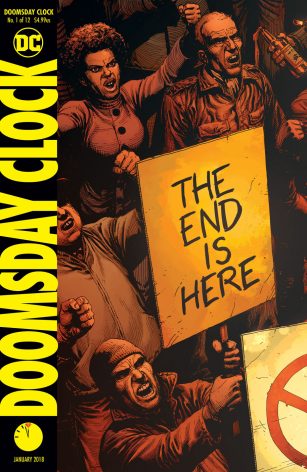 To put it bluntly, Doomsday Clock #1 is what many comic book fans (And Alan Moore wherever he is.) have feared: a direct sequel to Watchmen. The story is set in an alternate version of 1992 about five years after the events of the original series. An actor (Robert Redford) is president, the world is on the brink of nuclear war, Ozymandias is a fugitive and pariah, Dr. Manhattan is missing, Nite Owl and Silk Spectre are still happily retired and don’t appeared, and the book focuses on the new Rorschach in town. With the exception of the final scene, Doomsday Clock #1 isn’t so much a crossover, but Watchmen II. It takes its times and gives readers a flavor of Moore and Dave Gibbons’ even more dystopian universe and kicks the plot into gear in a way similar to the back half of the original series than the initial investigation into the Comedian’s death. (Edward Blake would probably appreciate the opening riot scene though.)
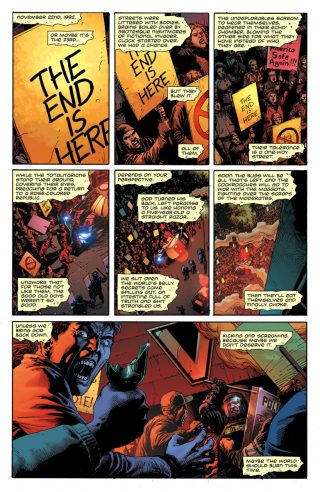 part, colorist Brad Anderson stays out of his way and lets his pencils shine. Anderson does have a couple tricks up his sleeve like color coding some panels to different characters, such as brown for Rorschach, gold for Ozymandias, and alarm red any time there’s a nuclear threat.


 After an epic seventeen-year journey through the entirety of human culture – the biggest cross-continuity ‘universe’ that is conceivable – Alan Moore and Kevin O’Neill will conclude both their legendary League of Extraordinary Gentlemen and their equally legendary comic-book careers with the series’ spectacular fourth and final volume, The Tempest.


