Tag Archives: WicDiv

Review: The Wicked + the Divine #34

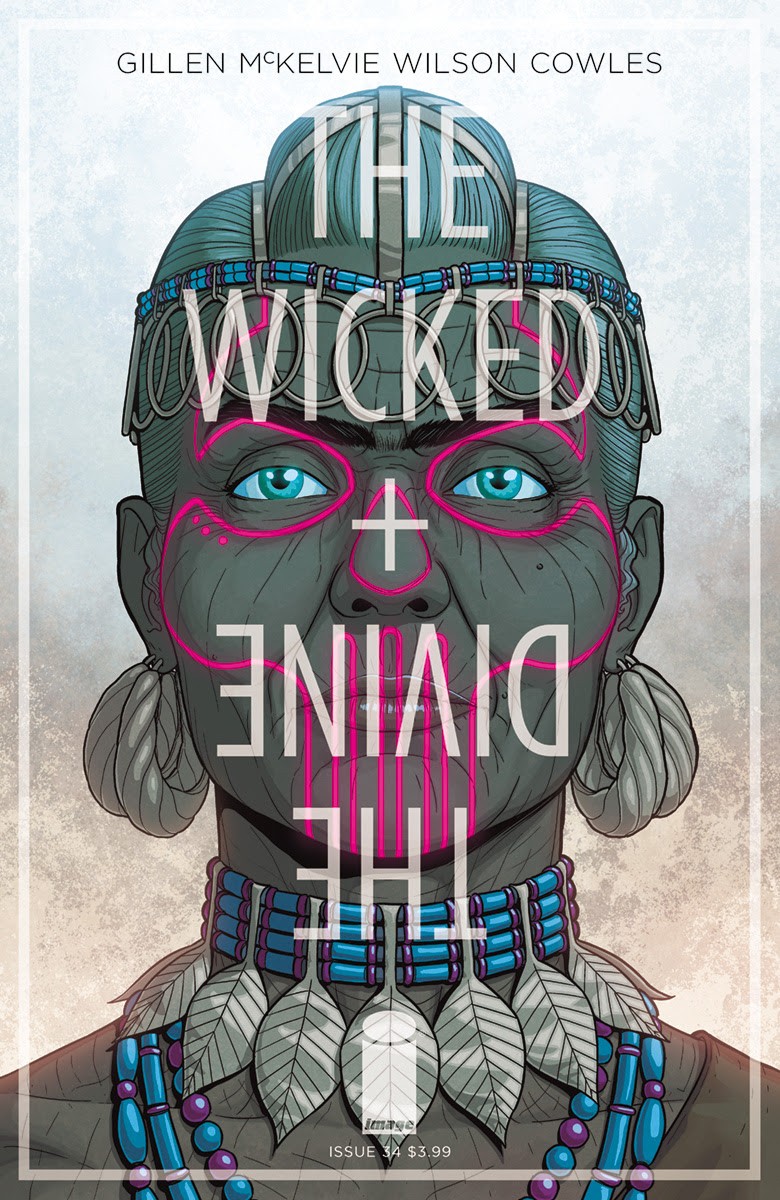
Wow, there’s a lot to unpack in The Wicked + the Divine #34. Kieron Gillen, Jamie McKelvie, and Matthew Wilson kick things off with an extended trip back in time to the first Pantheon where the rules are made, gods created, and children killed in the name of necessity. It’s a violent tone poem with a dying light palette from Wilson and a rhythmic grid layout from McKelvie, who depict the original Ananke and her sister with age lines from love and war. These sequence is also the proverbial face has launched a thousand fan theories. Until the final series of juxtaposed images (A comic within a comic, hmm.), nothing in the issue quite reaches the heights of WicDiv #34, and that’s okay as Gillen is engaged in a game of putting the pieces scattered across the board together for one last battle royale a la the finale of this series.

From what I’ve put together, it seems like the opening scene is a Seventh Seal chess game between Ananke and the Destroyer, or Persephone. (Minerva aka the new Ananke might be involved as well, and even if she doesn’t appear in the comic, her presence affects the present day scenes greatly.) On a metafictional level, it could also be read as Gillen and McKelvie setting up the rules, themes, and characters for their new world and then murdering their new creations in brutal full page manner with cool magical effects from Wilson. To get a little less mythical and a little more political, this conversation represents aging conservatives consumed by greed and doing whatever they can to prolong their lives and comfort at the expense of future generations. It is a fantastic sequence craft-wise especially with different effects and hues that Matthew Wilson pulls off in his color palette and acts as a creation myth for WicDiv, its own Music of the Ainur.

Most of the present is Persephone, Urdr (Who has stripped her fellow Norns of their power because she is easily the Beyonce to their Kelly and Michelle in a great gag from Gillen.), and Jon trying to sort out their current situation and by extension, the current status quo in the series. Gillen and McKelvie also use this time to let readers know a little more about the Jon, the poor erudite boy whose abilities were used and abused by his father in the ultimate stage parent move. He is fairly chilled out and erudite with dialogue like “Change is just change. It’s neither good nor bad. It simply is” that definitely needed a beat panel of Persephone and Urdr scratching their heads after it. Jon is also there to deliver the exposition about the talking god heads and Luci’s murder, and everything is all messed up and extremely awkward between Persephone and Urdr.

Kieron Gillen seems to be writing Persephone a lot like Laura in WicDiv #34 with her fangirl side all but eroded thanks to events of the series general. Unlike the situation with her and Sakhmet, Persephone is a straight shooter and tells Urdr that she thinks something is off with Minerva even if the journalist-turned-face palming, former triplicate goddess doesn’t act on this. The enclosed space has turned her more honest and kind, and McKelvie even shows a subtle trace of nostalgia on her face when she thinks about Luci being a talking head and beyond a shadow of a doubt not being a murderer. Maybe, she will end up being the flawed heroine we deserve, or maybe I’m just being a naive fan.

With a symphonic prologue, WicDiv #34 cascades to its endgame, and Kieron Gillen, Jamie McKelvie, and Matthew Wilson place the series in sharp, big picture contrast before starting to unravel an overarching plot that is entering year four (Oh god, I’ve been writing about this book for almost four years.) But, along the way, they never lose sight of their flawed, well-sketched characters, or Persephone and Urdr in this case.

Story: Kieron Gillen Art: Jamie McKelvie Colors: Matthew Wilson
Story: 7.7 Art: 9.0 Overall: 8.3  Recommendation: Buy 

Image Comics provided Graphic Policy with a FREE copy for review

The Wicked + The Divine’s New Arc Will Provide Key Answers to Mysteries Surrounding the Gods

Kieron Gillen and Jamie McKelvie are back at it with an all-new mind-blowing story arc of the bestselling series The Wicked + The Divine which kicks off in issue #34. It will be available in stores on Wednesday, March 7th.

This penultimate story arc to The Wicked + The Divine series will answer long-asked questions about the gods and will unveil key events from Ananke’s history in the past.

The end approaches, but it’s not too late.

The Wicked + The Divine #34 Cover A by McKelvie & Wilson (Diamond Code JAN180652), Cover B by Johnson & Spicer (Diamond JAN180653), Cover C virgin wraparound cover (Diamond JAN180654) will be available on Wednesday, March 7th. The final order cutoff for retailers is Monday, February 12th.

Review: The Wicked + the Divine 1923 AD Special

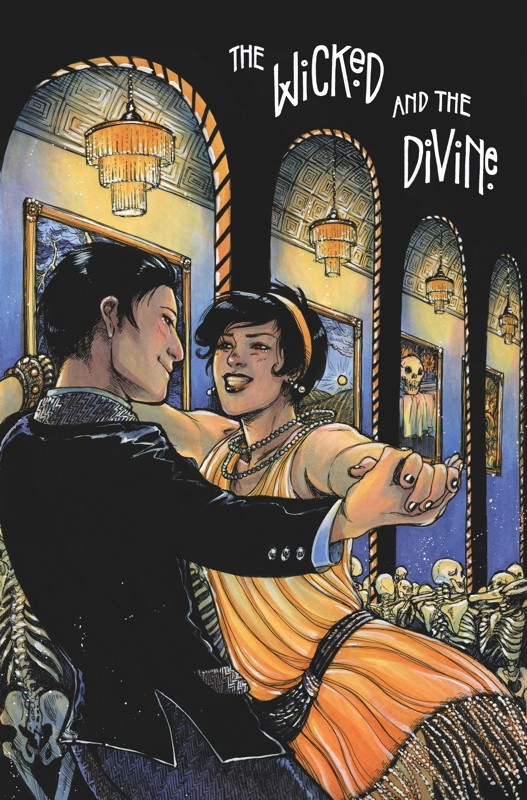
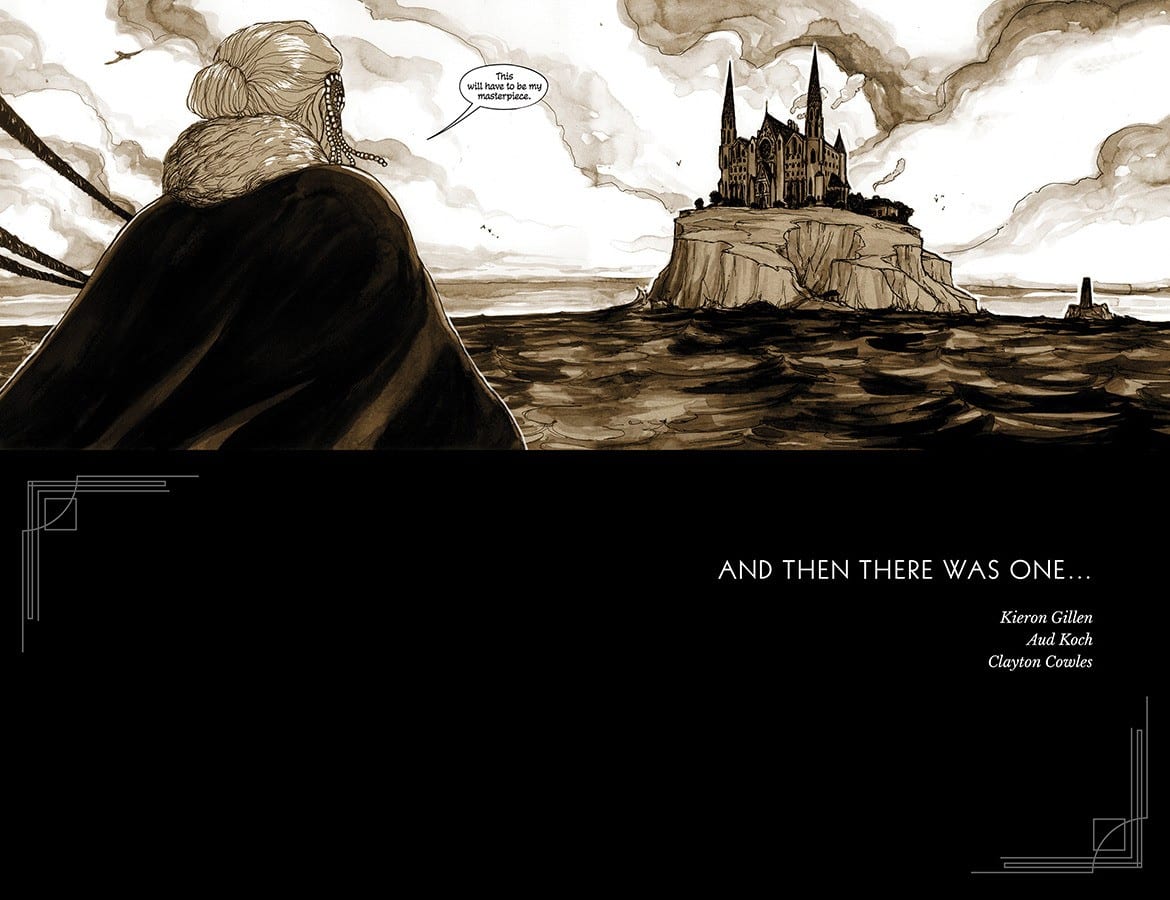
WicDiv1923CoverAs The Wicked + the Divine starts to round its final bend, writer Kieron Gillen and guest artist Aud Koch (America) return to the literal beginning, namely, the Pantheon of 1923 that graced the first pages of WicDiv #1. In keeping with the modernist mood of the time period, Gillen and Koch experiment and tell a 56 page Agatha Christie (Ananke may or may not be a stand-in for her.) drawing room mystery featuring all of the Pantheon members, who have all stayed alive to this point. There’s also a lighthouse. Most of the comic book is Gillen’s prose, which is purple-y, atmospheric, and channels several of the great modern writers, including Ernest Hemingway, Virginia Woolf, James Joyce, possibly Langston Hughes, and T.S. Eliot, who is racist and pretentious as hell. Large sections of text are broken up by fantastic art from Koch showing the murders is  better than telling us about them and end in a fine, kinetic tribute to one of the first motion pictures.

The issue is a meditation on the conflict between regression and progression, so-called high art and low art (Poetry and film in this case, and possibly by extension, prose and comics.), and there is a driving angst about the possibility of yet another world rending war that isn’t helped by Nazi with a German Expressionist aesthetic, Woden’s pronouncements. And beneath the lofty themes, it’s one hell of a murder mystery. WicDiv #1923 AD is technically a standalone story, but Gillen and Koch make it into a period piece remake of “The Faust Act”  and potentially the whole series complete with a whodunit about the exploding head murder of Lucifer as well as a framing narrative leading directly into WicDiv. It’s a multi-layered showcase for the prose stylings of Gillen and Koch’s ability to tell a visually arresting story in a few powerful panels or pages.

The extended length of the book allows Gillen and Koch more than adequate time to explore the personalities and even some of the personal journeys of the different Pantheon members. Lucifer dies fairly early, and his living form only appears in the drawing of the dramatis personae on the first page, but he’s perfectly Fitzgerald/Gatsby. Lucifer is very new money trying to impress blue bloods like Baal, who’s an American trying too hard to be British like a certain limp wristed anti-Semitic bank clerk, and Set, who gets a sharp, sexy design similar to Desire from Sandman and the prose of Virginia Woolf. He tries to be profound, but is all fluff just like Fitzgerald’s novels. But there’s nothing wrong with having a little cotton candy, now and then.

lighthouse

My personal favorite member of the 1923 Pantheon is Morrigan, who is obviously James Joyce with his free indirect discourse, rapid shifts from omniscient narrator to third person limited, and affinity for Guinness. Gillen uses him as a kind of loner oracle that some Pantheon members find amusing, and most find annoying. But he speaks what’s on everyone’s mind and describes everything around him in great detail letting a little truth shine in the artifice of light dancing, purple prose, and Neptune’s speech, which is the opposite of purple prose. And Koch’s drawing of his death scene is the epitome of modern art with a bleak color palette He’s too much of a wild card like modern Morrigan so Ananke had to take him off the table. This is all in the service and to ensure events run on the smooth side rather than the artsy, mass murdering side because even if she’s less of a killer than modern Ananke, the immortal Agatha Christie will do whatever it takes for the next Recurrence to occur, the Great Darkness to be staved off, and for inspiration to continue. This involves tragic sacrifices, light shows, and silent film title cards because hey, this is the Roaring Twenties, and a little party never killed anybody.

The WicDiv 1923 Special, especially the parts where Set and Baal were extolling the supremacy of poetry (And, by extension, poetry by white people.) while blasting dance and silent film aficionadoes Susanoo and Amaterasu reminded me of my second year at university, circa 2013. That was the year I switched from writing mainly poetry to mainly pop culture and to be honest, mainly comics, criticism all thanks to a professor, who enjoyed ripping student poems to shreds and uncritically banned writing “genre fiction” in our short story unit. (I included as many references to Spawn and Nintendo 64 games in my story as possible to tick her off.) In WicDiv 1923, Set and Baal are angry that the “common people” have access to art via the new medium of film and want things to go back to the good ol’ days when books were chained to desks in monasteries. (They don’t mention monks and vows of silence, but it’s implied in other words.)

This is just like the poets and reviewers of poets I knew who, for all their attempts at populism, were just writing for a small, “elite” group of other poets. But, when I write about Star Wars or Superman or even WicDiv, more people can connect to the themes and ideas in what has unfairly been called “low culture” in the past. There’s nothing wrong with making art that actually reaches people and connects to them. That’s truly how you connect and inspire people just like Amaterasu’s dancing and film, which were inspired by style and film icon, Louise Brooks. (No brooks, no bob hairstyle.)  She has a selfless, democratic approach to art while Baal and Set want to keep theirs inaccessible like the top of the lighthouse, and this is where their connection to the totalitarian Woden comes in even though they sneer at his cheap monster movies, which were super influential on modern film. Who doesn’t love German expressionism? Especially the woodcuts of Frans Masereel, who could be considered as an early comic book creator with his 1919 work Passionate Journey. Nazis should all be punched though.  This is all serves to show that art is subjective and should be for everyone and not trapped in canons and hierarchies and all those stuffy, boring old things.

In WicDiv 1923 ADKieron Gillen and Aud Koch use the setting of the 1920s and the angst of modernism and the world between the World Wars to tell a riveting murder mystery, a wonderful homage to silent film, and a kind of ars poetica for WicDiv. Koch’s ability to shift from cubism to chiaroscuro-lit expressionism and even classic compositions are unprecedented, and all her pages from this comic deserve a MoMA exhibit and eventually a retrospective. All in all, this is a comic that everyone from wannabe flappers and pretentious poets to action junkies and mystery readers can enjoy and probably spend the rest of 2018 unpacking.

Story: Kieron Gillen Art: Aud Koch
Story: 10 Art: 10 Overall: 10 Recommendation: Buy 

Image Comics provided Graphic Policy with a FREE copy for review

Logan’s Favorite Comics of 2017

In 2017, I found it increasingly difficult to keep up with all the new comics releases because of personal stuff etc.. There was also the sheer hatred and bigotry of some comic book fans, who foamed at the mouth every time a character that wasn’t a straight white male starred in their own book or if female characters weren’t drawn in an early 90s Image male gaze-y way. Creators and companies weren’t exempt from this either from Howard Chaykin’s transphobia and Islamophobia in his low selling Image book Divided States of Hysteria to the revelation that new Marvel Editor-in-Chief C.B. Cebulski lied about writing comics under the Japanese pseudonym Akira Yoshida for years and suffered little to no consequences for it.

However, there was a lot to love about the comic books of 2017, and I found solace, entertainment, and inspiration in many books from (becoming) old favorites about godly pop stars and dark knights to intriguing new titles about all girl fight clubs and young people experimented on by the government.
 

  1. Batman #14-37 (DC)

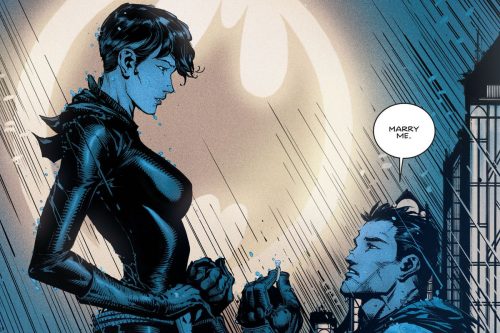
In 2017, writer Tom King and a crack team of artists including David Finch, Clay Mann, Mitch Gerads, Mikel Janin, Joelle Jones, and Jordie Bellaire explored almost every nook and cranny of the Dark Knight’s world in their work on Batman. Sure, there were epic arcs featuring one on one battles with Bane, a yearlong gang war with the Joker and Riddler, and a little family reunion in the “Button” crossover. But what Batman resonate as a comic book was the standalone and two part stories from King and Gerads showing the sweetness of the relationship between Batman and Catwoman to the emotional tale of Kite Man (Hell yes). King has a real knack for telling O. Henry-esque stories of ideas that humanize iconic characters none more so than “Superfriends” where Batman and Superman go on a double date with Catwoman and Lois Lane. An artistic highlight of the book was Joelle Jones’ beautiful, savage, and a little bit sexy depiction of Batman and Catwoman fighting for their love against the most evil of exes.
  1. Josie and the Pussycats #4-9 (Archie)

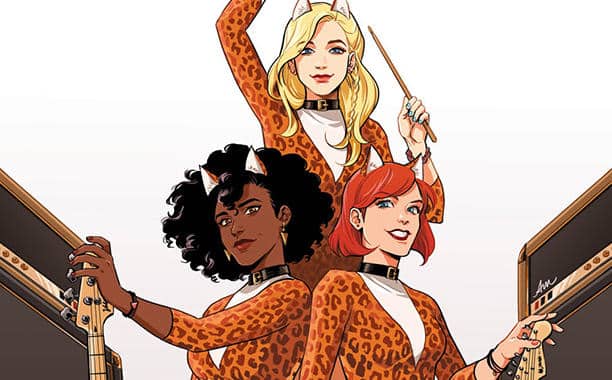
Josie and the Pussycats is a gorgeous, funny book that ended much too soon although it is nice to see artist Audrey Mok working on the main Archie title. Writers Cameron DeOrdio and Marguerite Bennett craft the rare Archie book that looks at both romantic and platonic relationships from the POV of young adults, not teenagers. They, artist Mok, and colorist Kelly Fitzpatrick imbue the title with a Saturday Morning cartoon zaniness, including high speed boat and motorcycle chases, kidnappings, and jokes about the polar bears from The Golden Compass. Yes, DeOrdio and Bennett overload all kinds of pop culture references and allusions in Josie, but it adds to the book’s energetic feel along with Mok’s fantastic fashion designs and Fitzpatrick’s bold colors. Josie and the Pussycats has some real heart to it with characters having all kinds of intense conversations about love, friendship, and fame between the over-the-top setpieces.
  1. Heavenly Blues #1-4 (Scout)

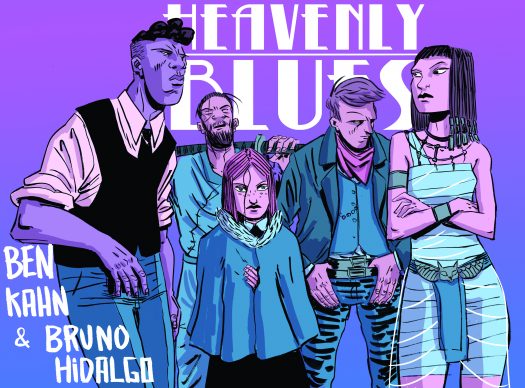
Writer Ben Kahn and artist Bruno Hidalgo’s Heavenly Blues blends the cosmology and philosophical and theological themes of Vertigo classics like Sandman and Lucifer with a quick and dirty heist thriller as a band of criminals, including a Great Depression Era thief, a girl who was sentenced to burn during the Salem Witch Trials, and a bisexual cowboy team up to break into heaven and steal something you may have heard of. Witty writing from Kahn and rhythmic art from Hidalgo that flows from the building of the Great Pyramids to the Old West and even an angel lounging in sweatpants keeps the story on its toes with flashback to each thief’s past life create an emotional connection to them. This is the perfect comic for folks who like to think about the nature of evil or the possibility of an afterlife while also watching Oceans 11 or Logan Lucky with a whiskey on the rocks.
 

  1. Shade the Changing Girl #4-12 (DC/Young Animal)

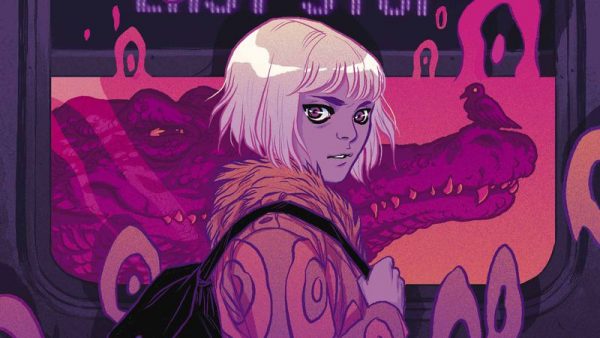
The crown jewel of DC’s Young Animal imprint, Shade: The Changing Girl is a beautiful, meditative look at identity and humanity from the perspective of a bird alien Metan girl named Loma Shade, who has possessed the body of teenage girl bully. Cecil Castellucci, Marley Zarcone, and Kelly Fitzpatrick’s story really took off when Shade decides to hit the road first for Gotham and eventually to meet her idol, Honey Rich, the aging star of a 1950s sitcom that was popular all over the galaxy. Zarcone’s artwork is extremely fluid and complements Shade’s reaction to the influx of stimulus all around her that is humanity as she begins to understand concepts like nostalgia and of course the big ones: life and death. Shade the Changing Girl is more poem than sci-fi thriller/mindbender, and Castellucci’s poetic captions, Zarcone’s sincere facial expressions, and Fitzpatrick’s, well, groovy colors bypass the critical part of the brain and go straight for the emotional center. It is an empathetic study into how humans communicate and navigate this complex world from a visitor from an equally as complex society so hence conflict.

  1. Generation Gone #1-5 (Image)

Comics’ enfant terrible Ales Kot makes his triumphant return with Generation Gone, which is one of his most accessible works that still takes shots at the kyriarchy and patriarchy through the lens of the “superhero” origin story. Artist Andre Araujo and colorist Chris O’Halloran provide equal parts majestic, disgusting, and triumphant wide screen visuals throughout the series from bodies being stripped down to bone, muscles, and organs to flying in the sunset. The way that the three main kids Elena, Baldwin, and Nick is a little bit of techno-organic body horror like Scanners filtered through 2017. Kot avoids typical superhero team up tropes and has them constantly at each other’s throats that all really boils down to toxic masculinity, especially Nick, who is like Max Landis with a healing factor. Generation Gone is an epic and visceral story with all kinds of carnage and big explosions that is ably balanced by Ales Kot’s nuanced characterization. There’s some decent world building, but it takes a backseat to Elena, Baldwin, and Nick’s journey and squabbles along the way.
  1. The Wicked + the Divine #25-33, 455 AD, Christmas Special (Image)

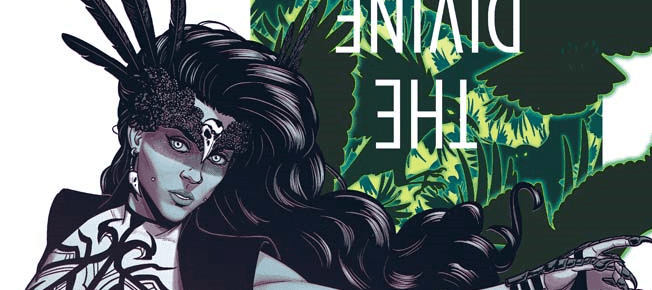
In its fourth year (Or “Imperial Phase”) as a title, Kieron Gillen, Jamie McKelvie, and Matthew Wilson’s The Wicked + the Divine became both more self-indulgent and introspective before the ending the year with more emotional destruction and much needed side dish of pure fanservice. The main focus is on the relationships of the Pantheon from Dionysus’ truly soulful friendship with Baphomet (They spend most of an issue talking in the dark, and it’s lovely.) to the intense connection between Persephone and Sakhmet and the older brother/little sister Baal and Minerva that takes a big turn for the disquieting. Even though McKelvie’s figures and fashion decisions are still flawless as usual, WicDiv uncovers every metaphorical wrinkle or mole on the Pantheon members by the time “Imperial Phase” ends in a truly soul crushing manner like the slow build in “In the Air Tonight” before the epic drums. And after it’s over, Gillen and a host of talented guest artists deliver a comic that is sexy, thoughtful, and filled to the brim of feels showing what the Pantheon were like when they were young and less dead. The Kris Anka and Jen Bartel Baal/Inanna short is most definitely the hottest thing I read in 2017.
 

  1. Kim and Kim: Love is A Battlefield #1-4 (Black Mask)

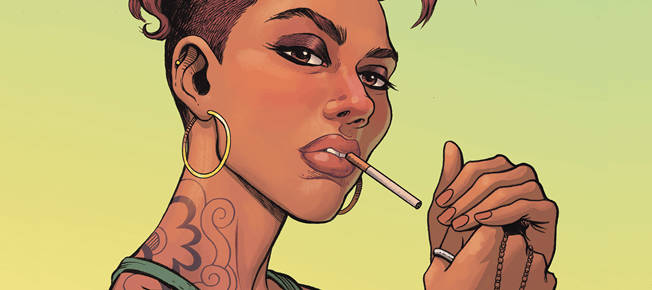
Shifting the focus from Kim Q to Kim D in this fantastic sequel to the Eisner nominated miniseries Kim and Kim, Mags Visaggio, Eva Cabrera, and Claudia Aguirre confidently tell the story of a woman trying to get over an ex that she really cared for, but wasn’t good for her. There are also mech suits, space battles, basses being used as a blunt instrument, and all kinds of space bounty hunter shenanigans. The rift and reunion between the Fighting Kim’s is super relatable as who hasn’t been disappointed in a friend for returning to the same, not cool ex over and over again. However, Visaggio gives the Kim’s great growth as friends and in their chosen career as bounty hunters by the time the miniseries wraps. On the visual front, Eva Cabrera can choreograph the hell out of a fight scene, and there is still plenty of pink from Claudia Aguirre. Kim and Kim: Love is a Battlefield is a smorgasbord of quips, fun sci-fi worldbuilding, and real friend talk and improves on its already pretty awesome predecessor.
 

  1. Mister Miracle #1-5 (DC)

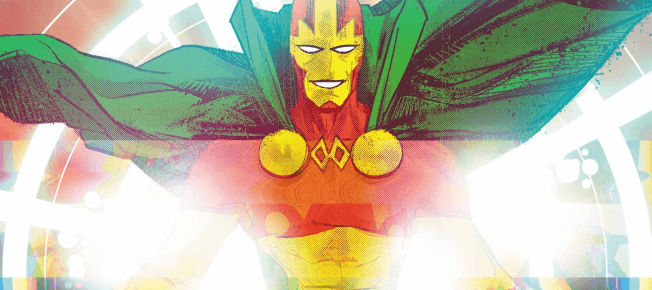
Jack Kirby would have turned 100 in 2017, and there was arguably no better tribute to his imaginative work as an artist and writer than Tom King and Mitch Gerads’ Mister Miracle comic. I know I’m double dipping with King comics on the list, but he’s just that good. In his art, Gerads teaches the old dog of the nine panel grid some new tricks and uses it for everything from a tender love scene between Mister Miracle and Big Barda to him getting repeatedly beaten by his older brother Orion, who plays an antagonistic role in the series. The bar-like grid of the comic book he stars in is the one prison Mister Miracle can’t escape from. (Wow, that got meta.) Gerads uses a trippy, almost television fuzz effect to show Scott’s tattered psyche as he faces death with his escape artistry, goes to war against Apokolips, and is sentenced to execution. King’s gift of writing both the mundane and utterly cosmic comes in handy in Mister Miracle whose most memorable scenes are Scott and Barda cuddling and joking around, not the big battle scenes. Again, he and Mitch Gerads find the human and the epic, which is definitely something the King would be proud of. (Big Barda was patterned off his beloved wife Roz.)

  1. Giant Days #22-33, 2017 Special (BOOM!)

Although the facial expressions that Max Sarin and Liz Fleming draw are truly outrageous at times, Giant Days is a fairly naturally plotted comic with the friendships, relationships, and life statuses of Esther, Susan, and Daisy ebbing and flowing like normal university students. They begin the year as BFFs for life, but start to drift apart towards the end of the year as Susan and Daisy’s relationships with McGraw and Ingrid move onto the next level. Esther is kind of stuck in the lurch as her penchant for drama bombs starts to backfire. Giant Days nails the constantly evolving fluid thingamajig that is relationships as a young adult.  As an added bonus, we also get to see how the girls act and feel differently around their family versus friends as Susan’s way too big and complicated family makes quite the impression. And, of course, Giant Days is very funny, and John Allison, Max Sarin, and Liz Fleming mine the comedy out of everything from the deliciousness of home cooking, the grossness of nerd dorm food concoctions, and even a video game wedding. (Poor Dean.)
  1. Heavy Vinyl #1-4 (BOOM!)

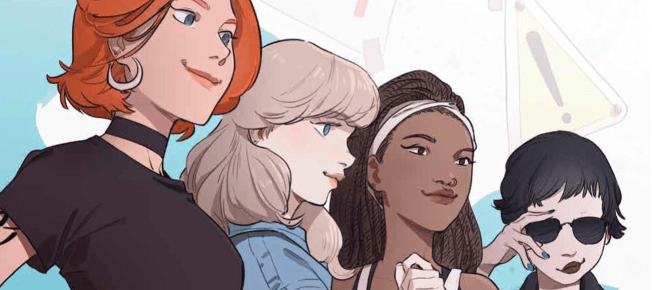
Reading Carly Usdin, Nina Vakeuva, Irene Flores, and Rebecca Palty’s Heavy Vinyl is like the comic book equivalent of relaxing in a hot tub, but the hot tub is either cupcakes or adorable Corgi puppies. (Take your pick.) It’s about a teenage girl named Chris in 1998, who has just gotten her dream job at a record store and her first big crush on Maggie, her co-worker, who is drawn like a shoujo manga protagonist. But then she’s inducted into a top secret vigilante fight club and has to rescue the frontwoman of her favorite band. It’s high concept and slice of life just like Vakueva’s art is comedic, beautiful, and a little badass. Carly Usdin does a good job in just four issues of giving each member of the fight club their own distinct personalities and relationships while doubling down on the cuteness and awkwardness of Chris and Maggie’s budding romance. But what makes Heavy Vinyl  the best comic of 2017 is its belief in the power of women and music to change the world…

Review: The Wicked + the Divine #33

“Are you a demon or a fucked up girl?” is the question posed by Urdr to Persephone in a pivotal scene in The Wicked + the Divine #33, and in true WicDiv/real life fashion, there is no clear answer to this query. The “Imperial Phase” comes to a close in with a flashback/plot twist, a harrowing conversation that doubles as a character defining moment for both Urdr and Persephone, and let’s just say, one hell of an ending. Visually, Jamie McKelvie and Matthew Wilson continue to embrace the shadows and show another Pantheon transformation sequence with an eight bit twist. In his writing, Kieron Gillen does a “Once more we return” and dives into the connection between fans, artists, and fame with a healthy helping of death and sacrifice
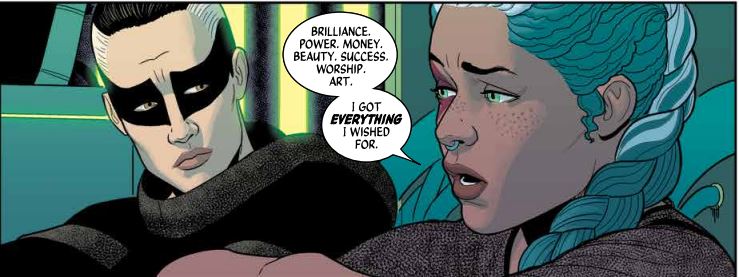
Unlike certain formerly-known-as-prestige TV shows, Gillen connects both his twists and character deaths to WicDiv‘s overall themes. David Blake is one of the few non-Pantheon members, who has stuck around/lived throughout the series, and it makes so much sense that he has been Woden all along.  He is also the ultimate fanboy of the Pantheon and willing to do whatever it takes to be connected to that power including his own, honestly super nice and curious son as both a free labor force and a power battery. There are shades of manipulative stage parents, like Joe Jackson, Joe Simpson, and in the sports world, Lavar Ball, in the way that Woden is disappointed in Jon while using him to have the kind of power and fame to be in a very exclusive club that he’s always wanted to be in. Gillen goes deep cut with Norse mythology and makes Jon, Mimir, a god whose head that Odin carries around to see other realms and get wisdom. Mimir’s Well is located by the World Tree Yggdrasil so hence the weird connection between Urdr and Woden.

The fan/artist/power conflict also extends to Persephone whose conversation with Urdr while Jon is basically hanging is the heart of WicDiv #33. Persephone has been all action, recklessness, and rebellion in year 3 of WicDiv and in some ways is trying to forcibly be the Destroyer. But she’s really wracked with guilt about her family’s death, which she blames on her desire to get anything to be in the Pantheon. Jamie McKelvie’s talents as an artist of empathy and character acting comes in handy during this sequence. He depicts Persephone from the side holding her knees as she tries to process what has happened to her during the past few arcs and uses a lot of close-ups in subsequent panels. McKelvie’s take on Urdr has a lot of anxiety as she swings from being afraid of the possibly Destroyer, Persephone and trying to be a good friend to the young fangirl, Laura. This is WicDiv so their conversation doesn’t end in hugs and reunions, but with an aphorism type line from Urdr and a little side head turn from Persephone. It’s a real of point of no return moment when Urdr calls her Persephone and not Laura, which results in tears and a tense beat panel.

In the context of the whole series, Gillen, McKelvie, and Wilson codify sacrifice again as a big theme of WicDiv. Instead of the old preying on the young like Ananke killing Luci, Inanna, and Tara in previous issues or more recently, Woden completely draining Dionysus: a young person is the one making the sacrifices. Minerva has been through some shit throughout “Rising Action” and “Imperial Phase”, and her new role as the head removing Ananke is sad, yet wonderful payoff for her character as she looks to take a more active role in the series going into its fourth year. She understands the idea of “necessity” in warding off the Great Darkness even if that means the death of someone close to her. But it is incredibly sad to see the one, real innocent member of the Pantheon be corrupted like this.

In the spirit of Urdr, Kieron Gillen, Jamie McKelvie, and Matthew Wilson get to the truth about who Woden is and the Great Darkness in WicDiv #33 using the shadows and claustrophobic spaces of Valhalla with splashes of eight bit menace to provide an emotionally draining reading experience. There are a decent amount of cards still on the table, but the chess board has turned into a pit of hot lava lorded over by an entitled abusive fanboy as Gillen and McKelvie cross the proverbial Rubicon and make Woden the literal patriarchy.

Story: Kieron Gillen Art: Jamie McKelvie Colors: Matthew Wilson
Story: 9.2 Art: 9.5 Overall: 9.3  Recommendation: Buy 

Image Comics provided Graphic Policy with a FREE copy for review

Review: The Wicked + the Divine #32

Kieron Gillen, Jamie McKelvie, and Matthew Wilson continue to sometimes literally slice and dice The Wicked + the Divine’s status quo in the last few issues of “Imperial Phase Part 2”, and issue 32 is certainly no exception. The comic manages to pack Dio’s last stand, Woden’s (thankfully premature) moment of Kanye quoting glory, Sakhmet vs. the world, and even Minerva crossing a line. All the while, Persephone plays the punch pulling, sometimes carelessly cruel wild card and gets confronted for this fact by Urdr, who still cares about Laura and even gets to kick it critic style for a little bit. All the gods appear in WicDiv #32, which gives McKelvie and Wilson a veritable playground of styles to throw at the reader with some subtle visual callbacks to big scenes in the series like WicDiv #8’s rave issue, the “superhero” style battles of Rising Action” and at the end of “Faust Act”, and an unexpected character playing the role of Ananke the mercy killer.
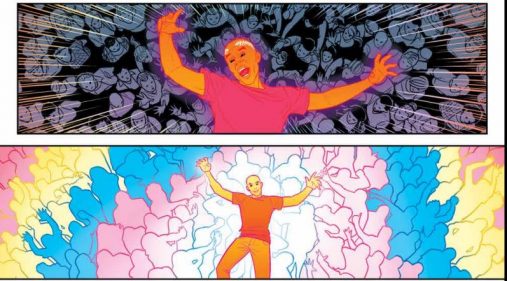
If you’ve read my reviews of WicDiv up to this point, you know that I love both the character of Dionysus, the original Greek god, and forgiving one’s cares on the dance floor. That is why I was glad that Dio got one last rave in WicDiv #32 with symmetrical layouts from McKelvie, heroic sentiment caption boxes from Gillen, and of course, color palettes to end all color palettes from Wilson and his flatter Dee Cunniffe. And it all starts out with an icky lime green color for Woden’s mind control that Dionysus fights back against in the “rave” panels. He takes a beating, but persists because he truly cares about every individual on the dance floor even if it means sacrificing his own life. For the most part, McKelvie draws flexible, silhouette figures before occasionally going for more detail to show how much of a beating Dio has taken after the whole thing where he sat in the dark with Baphomet and then promptly got his hive mind powers stolen. It is definitely sad to see the most decent member of the Pantheon take a curtain call, but Gillen, McKelvie, and Wilson truly collaborate to give him a perfect, empathetic ending with intense colors, blazing speed lines, and the repeated line “One more time” like bass line of “Blue Monday”.

Along with Dio, Woden, and the revenge of the Norns (Matt Wilson makes Urdr’s black and white scheme look very frightening as she charges at Woden and the Valkyries.), Gillen and McKelvie also put the seal on Sakhmet’s storyline beginning with the first page where she and Persephone take the murder of someone considered to be a friend quite casually. But, of course, Persephone is a super secret agent for Baal and Minerva, and the look of betrayal on Sakhmet’s face is quite painful even if she is a killer. Persephone’s flat was a sanctuary for her restless, ravenous soul, and now it is yet another battleground. McKelvie and Wilson go big and bombastic with Persephone, Baal, and Sakhmet’s powers with exploding greens and purples everywhere before toning down the color mix and flailing bodies and going for sheer emotion at the fight’s conclusion. A silent panel is a great way to wrap up these pretty noisy scenes, and the poses and space between the remaining characters nails their attitudes toward and relationships with each other. Also, during the fight, Gillen does some masterful multi-plotting and sets up a possible vine tendriling, crow pecking showdown between Persephone and Morrigan in the “Imperial Phase Part 2” finale with a quiet conversational scene between the fisticuffs.

Urdr is the bridge between Sakhmet/Dionysus last stand storylines along with being the only character who now gives a shit about the Woden machine/MacGuffin plot in WicDiv #32. Gillen and McKelvie show her range, and she slips into a variety of roles, including the ultimate critic, vengeful goddess, extremely disappointed friend, and maybe even grieving lover. Gillen crafts some of his most incisive dialogue, and McKelvie draws some intense as Urdr speaks for a good portion of the WicDiv fanbase when she says that Persephone was better of being Laura. And she can’t help but still be a critic and call Persephone’s shows “middlebrow”. This leads to some hurling of unkind words, an almost fight, and an ambiguous ending. It also reminds readers that Laura wanted to be a goddess during the first two storylines of WicDiv and has done nothing really inspirational with her divine powers. That could change as the colossal story developments and rocking of the proverbial Pantheon boat hints at Persephone totally being more of the Destroyer than an ascended fangirl.

WicDiv #32 is a true companion to the universe shattering, plot demolishing WicDiv #31, but Kieron Gillen either tapers off or adds elements to character arcs to go with Jamie McKelvie and Matthew Wilson’s fireworks or quiet artistic moments. With the deaths of Dionysus and Sakhmet, a lot of rage and serenity has exited the building along with WicDiv‘s respective superego and id, but my excitement for the “Imperial Phase Part 2” conclusion has definitely increased.

Story: Kieron Gillen Art: Jamie McKelvie Colors: Matthew Wilson
Story: 9 Art: 9.8 Overall: 9.4  Recommendation: Buy 

Image Comics provided Graphic Policy with a FREE copy for review

Review: The Wicked + the Divine #31

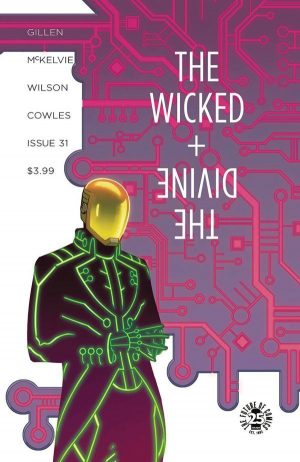
The Wicked + the Divine #31 is the best the series has been in a long time as writer Kieron Gillen, artist Jamie McKelvie, and colorist Matthew Wilson hit a sorrowful groove as “Imperial Phase Part II” draws to a close. This is a memorable issue that will be dissected, oohed and aahed at, sobbed over, and yes, screamed at just like WicDiv #5, #8, #11, #13, and #18, which have been my favorite regular issues of the series to date. With these superlatives out of the way, WicDiv #31 features momentous events, like the Norns, Woden, and Dionysus finally turning on Ananke’s machine to the tune of a glorious Wilson color palette, Persephone coming clean, and some sort of real talk about Dio and Urdr’s feelings for each other. Plus a tragic twist.
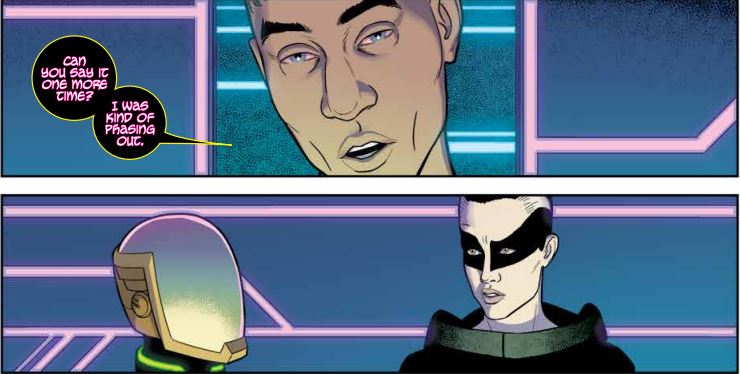
I am really enjoying Gillen, McKelvie, and Wilson’s focus on the character of Dionysus throughout “Imperial Phase Part II”, and WicDiv #31 is no exception. In his first appearance, McKelvie draws lines on Dio’s usual smooth face and gives his eyes a hazy spaced out look, which is to be expected after he spent all of the previous issue sitting in the dark and pleading with Baphomet to leave his abusive relationship with Morrigan. McKelvie depicts Dionysus as a husk of his rave inducing self with basically bad selfie lighting from Wilson, but his wholesome spirit hasn’t faded.

He has a conversation with Urdr, who is a little on edge about the turning on Ananke’s machine thing because Woden is sketchy and Dionysus is tired, plus there’s the whole crush thing. But, even though Urdr and Dionysus don’t directly talk about their feelings for each other, Dio kind of nails how relationships and friendships should work. He basically says that emotions, especially love are important, but they shouldn’t get in the way of caring and supporting a friendship. This is really freaking selfless and par for the course for a man, who admits that his key motivation in life is making other people happy. Dionysus’ smiling face or crowd surfing body should definitely be in the dictionary next to mudita, a kind of happiness that comes from other people’s happiness. However, this ends up being his downfall as Woden uses his abilities in a more toxic way turning a happy party into a hive mind, worship into a cult. But, before everything gets fuzzy, Gillen and McKelvie give us a character defining moment of Urdr looking up and perhaps for the first time, realizing the effect the Pantheon has on other people and admiring those Eisner winning Matthew Wilson colors.

But Woden’s hijacking of Dio’s power isn’t just a simple “Dionysus is a cinnamon roll too good for this world” plot point, it actually takes WicDiv #31 back into the musical realm. Woden and Dionysus’ actions at Valhalla support my theory that, in the end, there are two kinds of dance floors: one filled with light, energy, fantastic music, and camaraderie and another one that is crowded, filled with groping straight men, and plays the Chainsmokers. Dionysus represents the first as evidenced by the immortal WicDiv #8, and Woden represents the second with misogyny, objectification of women, and general fuckboy attitude and spinelessness. Dionysus is about people having a good time and forgetting their troubles for a night and maybe having fond memories of waving their arms and dancing to “Total Eclipse of the Heart” with gods while sitting in their poorly lit cubicles. Woden is all about metaphorically (and probably) getting off the power of the patriarchy to rob women (And people in general in this issue) of their agency. It’s selfishness versus selflessness, and unfortunately, it looks like selfishness has the upper hand in 2017. But Dionysus’ nice little grape Pantheon icon isn’t a skull just yet so there might still be some hope for this beautiful, emotionally honest, and soulful man. I’m probably the naive one in this case.

Dio, Urdr, Woden, Amaterasu, and Sakhmet play the “active” roles in WicDiv #31, but Gillen and McKelvie don’t neglect their heroine, Persephone, who finally kind of does the right thing by telling Baal and the Outsiders that Sakhmet is lurking at one of her favorite haunts: the Egyptian wing of the British Museum. When Sakhmet is out, Persephone starts by lounging in her deliciously foreshadow-y skull and rose pattern leggings with McKelvie nailing her apathy before swinging into a bit of anger when she talks to her ex Baal on the phone. Plotwise, Gillen has her as a wild card, but that’s likely to change after she learns Amaterasu’s fate. Annoying problematicness aside, an Amaterasu gig back in WicDiv #1 was Persephone’s entry to the world of the Pantheon so it should have a major effect on her demeanor going forward. This issue also shows that Persephone has a bit of a conscience and is starting to maybe realize that chaos wasn’t the best decision.

Yes, chaos ends up in death: the death of Amaterasu to be particular as she goes to the British Museum to soothe the sharp teeth and claw toes of Sakhmet with her abilities instead of calling Baal for some muscle like he provided against Luci in the first arc. Amaterasu has a “nice” personality, but is supremely self-absorbed, and her little monologue about the glories of the British Empire’s treasures in the British Museum and family causes her to drop her guard around Sakhmet. It’s also a final nod towards her cultural appropriation as she has turned the Japanese Shinto faith into her own white girl ShinTwo cult, and sad, if poetic that she dies destroying the artifacts that the U.K. took from their old colony of Egypt. McKelvie frames it like a slasher flick with plenty of gore and killer/victim juxtaposition shot although this death feels earned and is also a product of stupid decisions. One thing I love about WicDiv on a macro level is that characters who make not-the-smartest-decisions like going against a bloodthirsty murderer without backup or teaming up with Woden get consequences. It’s like the early seasons of Game of Thrones where behaving nobly, yet stupidly led to death or negative consequences versus the current one starring Jon Snow of House Plot Armor.

WicDiv #31 is a smorgasbord of visual storytelling delights, like Matthew Wilson’s color palette for Dionysus’ (hopefully not) final performance) and Amaterasu’s last foray as a superpower or the weathering on Dio’s face from Jamie McKelvie, and quotable insights about friendships and relationships and even asexuality and aromanticism from Kieron Gillen via Dionysus, but it’s a big downer moment for the series even if Urdr gets her most uplifting panel yet. After the conversations, arguments, and tiptoeing around, this is the plunge after the deep breath. WicDiv #31 is the guns a-blazing after the Mexican standoff or conversations about Bible passages and American hamburgers in Paris.

To not end this review on a glib Pulp Fiction reference, WicDiv #31 (Especially the Amaterasu scenes) pairs nicely with “Rabbit Heart” by Florence + the Machine , which is one of the first tracks on Kieron Gillen’s The Wicked + the Divine playlist. It’ll break your ginger sun goddess loving heart.

Story: Kieron Gillen Art: Jamie McKelvie Colors: Matthew Wilson
Story: 10 Art: 10 Overall: 10  Recommendation: Buy 

Image Comics provided Graphic Policy with a FREE copy for review

Review: The Wicked + the Divine #30

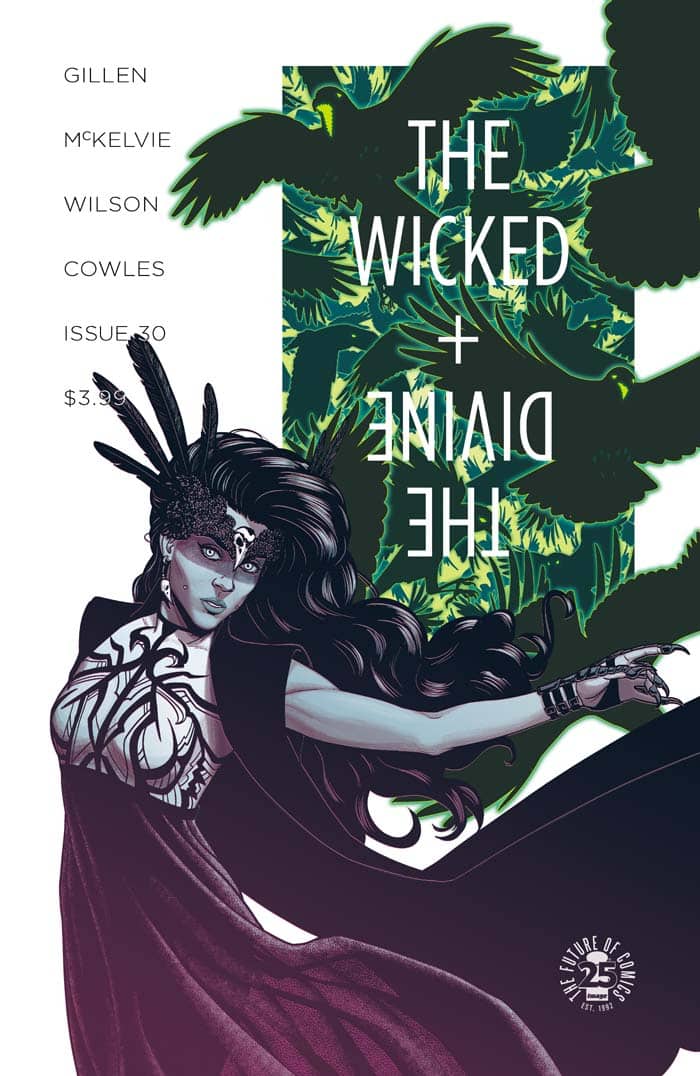
WicDiv30CoverThe Wicked + the Divine #30 is definitely a setting up the pieces on the game board issue from Kieron Gillen, Jamie McKelvie, and Matthew Wilson with unlikely allies Woden and Cassandra putting the finishing touches on their literal plot moving machine. However, most of WicDiv #30 is dedicated to Dionysus, Baphomet (finally), Morrigan, and other members of the Pantheon talking out their feelings. Gillen, McKelvie, and Wilson have built up these characters over several years, and it’s novel and nice to see new sides of them before all hell breaks loose.
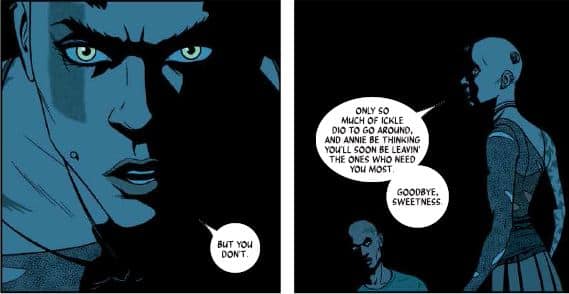
One of the coolest parts of WicDiv #30 is that the entire power trio of the Morrigan appears, including the violent Badb and the underutilized Gentle Annie. The trade off between sweet and sad, harsh and loud, and something crazy in-between reminded me a lot of a three piece femme punk band I recently called The Coathangers where the lead guitarist does melodic vocals and the drummer does growls. (She would probably shoot off crows if she was a WicDiv character.) Even though Gentle Annie is the one who finally relents and let Dio and Baphomet chat, she is creepy as hell and basically predicts Dio’s death with a kind smile. He is the most decent member of a very corrupt Pantheon, is starting to have feelings for Urdr, and was torn to pieces by the Titans in classical mythology so it seems like his demise is imminent. Like Gentle Annie says, “Only so much of ickle Dio to go around.”

Luckily, before his possible death, Dionysus gets to be the most supportive friend ever and try to talk Baphomet through the fact that he is part of an abusive relationship although Baph wards off any serious talk with quips and bad puns about British political parties. His evasion is fleshed out visually by McKelvie, who draws him with sunglasses in stark contrast to Dio’s open, honest eyes in the midst of negative space. Baphomet is closed off and too bonded to Morrigan, who has been manipulating him ever since she made him into a member of the Pantheon instead of just a Goth fuckboy version of the Valkyries. The flashback to him joining the Pantheon is just plain tragic along with his almost nihilist resignation to his current fate. Gillen and McKelvie handle Baphomet’s relationship situation in a thoughtful manner and focus on his pain, how he is sadly deflecting it, and not the sexy Goth-ness of him and Morrigan.

IckleDio

While Dio and Baphomet are having a heart to heart in the Underground, McKelvie and Wilson make a two page sort of return to the superhero genre when Baal and Amaterasu accidentally “bust” Sakhmet, who is actually a fangirl. This little scene provides some comic relief in the middle of a pretty tough and foreboding WicDiv #30 with a close-up reaction shot of Minerva, who is the Oracle to Baal’s Batman, freaking out taking the cake. The sequence also show that the sky gods are still a little bit delusional and think that everything can be fixed by capturing Sakhmet and Woden’s big ol’ machine, which definitely has its red flags like being powered by a physically and emotionally wounded Dionysus and Woden installing high tech spy cams on the other Pantheon members’ bling.

WicDiv #30 shows that even right before an impending apocalyptic event, Kieron Gillen, Jamie McKelvie, and Matthew Wilson still take time to have readers listen and empathize with the Pantheon members’ emotions and problems. They also continue to use the highly stylized trappings of the Pantheon to shed light on real world problems, like abusive relationships. Even though they’re fictional, I care about Dionysus and Baphomet like they are real people and hope for the best for them. But, knowing WicDiv‘s past approach to characters with softer edges (RIP Fangirl Laura and Inanna) that won’t likely be the case.

Story: Kieron Gillen Art: Jamie McKelvie Colors: Matthew Wilson
Story: 8.5 Art: 8 Overall: 8.2  Recommendation: Buy 

Image Comics provided Graphic Policy with a FREE copy for review

Review: The Wicked + the Divine #29

WicDiv29CoverDysfunctional relationships are the bread and butter of The Wicked + The Div ine#29, which kicks off “Imperial Phase Part 2” in cringeworthy fashion with Persephone waking up next to a Luci look-alike. Jamie McKelvie‘s art is sultry, and colorist Matthew Wilson trots out a dusky palette for the underworld goddess, but then writer Kieron Gillen’s dialogue fills in the awkwardness that Persephone feels and the total embarrassment of the moment. It’s also a little tragic and toxic too, which is the tone of WicDiv as a series and much of issue 29, which manages to be relationship driven while driving the arc’s plot ahead in the hunt for Sakhmet.

The most intoxicating thing about WicDiv #29 are the pairings and groupings of Pantheon members that Gillen and McKelvie put on display throughout the issue that evoke various emotions. There’s the cut from Laura fangirling at a Baal gig back in the halcyon days of 2013 (or the first arc of WicDiv) to Baal training Minerva to be a killer. He fits into the Pantheon dad role very well giving everyone (Except Persephone) nicknames and coordinating everyone from Persephone to Woden. Baal seems like more of a general than a pop star, and his regimented training exercises and walk and talk style are the complete opposite of the raw energy of the flashback with its pixelated colors from Matthew Wilson and the easy swagger of his movements drawn by Jamie McKelvie. However, no one can really control Persephone as a London cop remarks after he asks her some questions about Sakhmet’s disappearance.

BaalPersephoneFail

Persephone slinks into her destined Destroyer role throughout WicDiv #29 mostly through lying to everyone and using her abilities to presumably cover up these lies. The big reveal of the issue is that Sakhmet is holed up in Persephone’s flat yet she lies to the police, Baal, and Urdr about the kitten themed murderer’s whereabouts and throws in yet another deception to Urdr when she says she’s going home, but then gets a sad club montage. The reason for sheltering Sakhmet is pretty evident: Persephone loves her. In a conversation with Urdr, she even says that Sakhmet was her girlfriend. In this panel, McKelvie lifts the hard, chthonic goddess facade, and Persephone is Laura again pining over the woman she cares about and happens to make terrible decisions. Love definitely makes you do the wacky, including harboring fugitives, and Gillen gets this out in some of the dialogue where Persephone flat out tells Baal that she can’t fight Sakhmet.

Visually, the scene stealer of WicDiv #29 is Morrigan as Persephone, Urdr, and Dionysus return to the Underground. Because of Baphomet’s affair with Persephone, Dionysus ends up taking point and getting an audience with the goddess, who McKelvie and Wilson imbue with a dark majesty. There is only light in the Underground because Morrigan wills it, and McKelvie and Wilson obscure a lot of the characters’ faces and bodies in this scene. With Persephone taking more of an antagonistic role by helping Sakhmet, Morrigan is the new wild card. She knows that Sakhmet is a threat to everyone, including herself, and says so in her usual, flowery dialogue. However, she isn’t a fan of the Pantheon prying into her abusive relationship with Baphomet, especially Dionysus, who stays in the Underground until he sees Baphomet. Dionysus using his empathy and kind heart more actively has been one of the highlights of both parts of “Imperial Phase” although I fear that Badb may rip the dance floor god to pieces down the road.

morrigan

Toxic relationships are the main theme of WicDiv #29, and “Imperial Phase 2” starting out. At this point, Persephone isn’t a physical Destroyer, but a metaphorical one to her former friendships. Baal can barely look at her and walks away after he’s sent her on a mission to the Underground. She is dealing with Sakhmet’s actions by sleeping with someone who looks like her first “bad girl” crush Luci and lying to everyone. It’s tough to see this bright eyed fangirl become such a trainwreck, and Gillen, McKelvie, and Wilson rub salt in the wound by including that flashback of her at Baal and Sakhmet’s first gig.

With a dollop of dark energy and pinch of sadness in Jamie McKelvie’s art and Matthew Wilson’s colors, WicDiv #29 continues to chronicle Persephone’s development into the Destroyer as Kieron Gillen throws away the seemingly beautiful apple that was the Pantheon’s relationships and exposes its rotten core, black as Morrigan’s wardrobe.

Story: Kieron Gillen Art: Jamie McKelvie Colors: Matthew Wilson
Story: 9 Art: 8.5 Overall: 8.8  Recommendation: Buy 

Image Comics provided Graphic Policy with a FREE copy for review

Review: The Wicked + the Divine 455 AD

Using an even more twisted version of Lucifer from the Pantheon as an object lesson, writer Kieron Gillen, guest artist Andre Araujo (Avengers A.I.), and colorist Matthew Wilson tell the story of Rome in a single narrative that begins with a glorious literal burst of triumph before denigrating into senseless, violence, hubris, and death. The story is set in 455 AD, and the Roman Empire is on its last legs as Geiseric and the Vandals threaten to destroy Rome once and for all. But Lucifer casts aside his name and takes on the mantle of “Julius Caesar” because he thinks he can save the Roman Empire all by himself and not be the 5th century version of Caligula or Nero. He and his boyfriend, Bacchus (The Roman version of Dionysus) get decidedly mixed results from this little escapade.

Andre Araujo and Matthew Wilson are the perfect art team for capturing the gorgeous heights and the farcical lows of the Roman Empire in WicDiv #455. Araujo can handle the detailed crowd shots like Lucifer’s “triumph” and the flame and gore filled environs of his fall into becoming an imitation of Nero, but he also is a wonderful artist of gestures and facial expressions. Ananke is a hated character in the main WicDiv series, but Araujo makes her a vulnerable, almost pathetic figure, who pleads for her life before a power hungry Lucifer. She’s not necessity or the creator of the Pantheon in that situation, but just an old woman. However, there’s a glimpse of the Ananke we know and hate at the end as she makes jokes about Vandals and covers world history’s collective asses. Wilson’s colors accents Lucifer’s powers with red and golds worthy of an emperor as he shuns the slave saying “Memento mori” and rides into the Forum like a wannabe Julius Caesar even though he’s just won a relatively minor victory.

On a deeper level, Gillen and Araujo show that the Pantheon being their era’s version of pop stars might not lead to them being worshiped and treated like celebrities In Rome, actors were seen as immoral, and homophobic slurs were often hurled at them. (There was a reason that Ovid was exiled, and Augustus was deified.) Sure, everyone went to see Plautus’ comedies, occasionally Seneca’s dark tragedies, and of course, the gladiator games, but these people didn’t have the greatest reputations. Gillen and Araujo riff off on this idea through speeches about Nero being ridiculed for being interested in music and poetry instead of being a statesman, and then images of Lucifer literally playing the bodies of senators like a harp instead of using them to help him rule Rome. But there are even more layers to this provocative image, like the inevitability of the Roman republic’s turn to authoritarianism or the parade of weak, adolescent emperors from Caligula to Elagabalus and beyond. Lucifer should be a metaphorical intern or have an entry level position at the most and not be the “CEO” of one of the world’s greatest empires.

Lucifer/Caesar’s key character trait in WicDiv 455 is childishness, which is honestly one she shared with her present day Pantheon counterpart, who enjoyed mouthing off to government officials and chain smoking. (She would have mocked the actual Chainsmokers though if she was alive to see them.) The 455 version of Lucifer is pretty fucking petulant and doesn’t have 2014’s gift for song quote or barbed one-liners. Gillen and Araujo get the macabre humor beneath his classic Rome fanboy veneer from the opening pages where the genre quickly switches from pastoral to epic, and Wilson’s palette goes from green to red. Lucifer could have had a nice life cuddling with his boyfriend Dionysus and playing songs in fields, but that would be a pretty dull story. Lucifer sees himself as the hero of an epic, but he’s really just a fifth act victim in one of Seneca’s overlong tragedies that Shakespeare and Marlowe added more wordplay and energy to while keeping the body count. And Andre Araujo makes him pull the silliest of faces while attempting to kill Ananke or lecturing to the Senate that wouldn’t be out of place in A Funny Thing Happened on the Way to the Forum (Or a grim and gritty reboot of Asterix and Obelix.) if it wasn’t for the serious tone of the story and the general use of red in the background.

WicDiv 455 melds the trashy, lavish, and violent aesthetic of the late period Roman Empire with the thought and creativity of the Augustan Age, and there’s (maybe) no possibility of it being used as propaganda like the Aeneid. Like a passage from the Satyricon, Kieron Gillen, Andre Araujo, and Matthew Wilson meld humanity’s basest desires for sex and violence with our highest urges for glory and legacy into a comic book feast that will have you begging for seconds and looking up Emperor Tiberius’ recipe for roasted dormouse on Pinterest between rereads.

Story: Kieron Gillen Art: Andre Araujo Colors: Matthew Wilson
Story: 9.5  Art: 10 Overall: 9.8  Recommendation: Buy 

Image Comics provided Graphic Policy with a FREE copy for review

« Older Entries Recent Entries »