Tag Archives: mother

Don’t Worry, Mommy’s Here: 5 of the best moms in horror cinema

When I was just a wee baby (as in barely a few months old), my mom decided to take me to the movie theater with her to see The Lost Boys (released in July, 1987). Jerry Rees’s The Brave Little Toaster was also playing. My mom apparently weighed her options and decided The Lost Boys would have more of an impact in my early development than a toaster with a smile.

I cried during the entire movie. If you’ve never seen it (and if you haven’t, you should), the vampire make-up effects by artist Greg Cannom were terrifying. The vamps kept their human forms, but their faces transformed into something resembling very angry bats. And then there’s the vamp feeding scene at a punk bonfire. Fangs sunk into skulls and blood flew over the fire as the bikers went into a frenzy.
mother

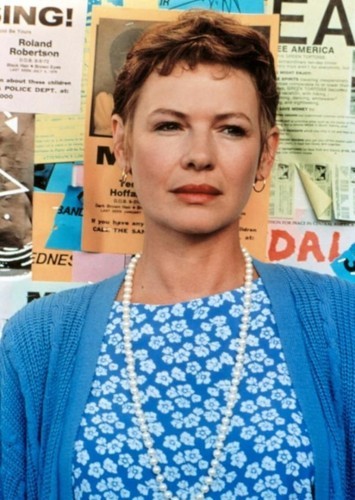
Years later, still a kid, I watched the movie again and managed to get through it without crying out of pure fear, but what stood out this time was how important the movie’s mother figure, Diane Weist‘s Lucy Emerson, was to the story and how much tension and terror the movie extracts from her as we watch one of her sons worry over her safety thinking she was dating a vampire. It left an impression. What if my mom got targeted by a vampire all of a sudden? Could I kill it on my own or did I need my own Frog Brothers to stake the bloodsucker?

It was easy to empathize with Lucy. She was a single parent moving in with her father at a time when her two kids were at their most rebellious in a new place she later learns is infested with vampires. She becomes a calming presence that could’ve helped more if her kids had let her in on the troubles of Santa Carla and the people they hung out with. One thing I admired was how brave she came off as in a place director Joel Schumacher went lengths to portray as dirty, dangerous, and forgotten. She was strong and she proved it in the final moments of the film, taking a decision for the sake of her family’s safety that jeopardized hers. All of this to say, Lucy Emerson was my first horror mom and she’s remained a favorite ever since.

It goes without saying by now, but my appreciation of horror, and The Lost Boys in particular, started getting nurtured the moment my mom decided to lightly traumatize me as a baby by taking me to the movies to see biker vampires on a big screen. So, in honor of the work mothers do from the moment we’re born, here’s a list of 5 horror movie moms that either scare, take care, or bring chaos to their kids. In other words, the kind of moms that keep steering future generations into horror.

Enjoy, and Happy (belated) Mother’s Day!
mother

1. Ellen Burstyn as Chris MacNeil in The Exorcist (dir. William Friedkin, 1975)

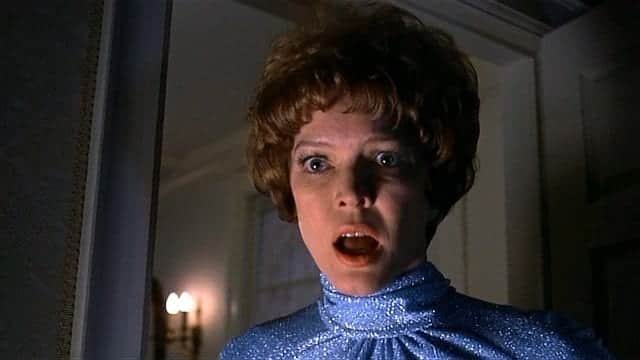
As frightening as the possessed Regan MacNeil is, none of it would’ve worked to the extent it did if the audience couldn’t channel their horror through her mom. Ellen Burstyn made this possible with a spectacular performance as Chris MacNeil, a mom that embodied both the fear of living with a child tormented by something unfathomable and the strength that’s required to fight a battle that initially looked unwinnable.

Burstyn dug deep to portray a mother that had her entire reality flung out the window and yet still managed to hold out hope as a demon tore apart her kid from the inside. Her facial expressions should be studied by anyone interested in capturing what true fear looks like, but also what anger and frustration look like in a supernatural setting. Each one of Chris MacNeil’s screams is a gut punch that makes you reel, heightening the horror of the possession and the idea of what it means to share a household with a sinister entity hellbent on corrupting an innocent soul.
mother

2. Hitomi Kuroki as Yoshimi Matsubara in Dark Water (dir. Hideo Nakata, 2002)

Mothers have a strange and complicated relationship with child ghosts in horror. In movies where the mother is grieving the loss of a daughter, for instance, the ghost becomes a metaphor for loss and denial in the face of death.

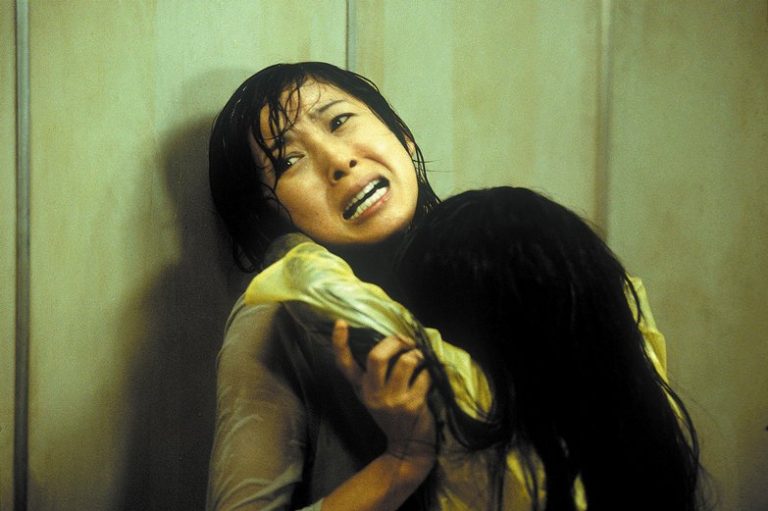
In Hideo Nakata’s Dark Water, though, the connection becomes something different. The story’s mother character, Yoshimi Matsubara, isn’t mourning the loss of a child. She’s getting consumed by the fear of losing hers, all of which stems from the ghost of a little girl that died in the apartment building they live in.

Actress Hitomi Kuroki plays Yoshimi like a tragic beacon of light that lonely ghosts can find a mother in. Her performance captures both the terrors that motherhood brings to the fore and what being a parent represents in the grander scheme of things. Kuroki channels the energy of a haunted house in human form, reluctantly accepting her role despite the consequences of potentially becoming mom to a ghost.
mother

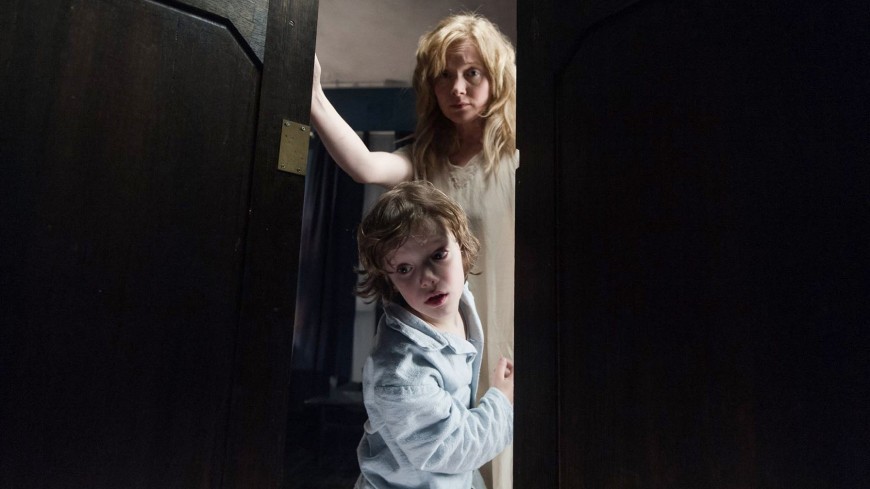
3. Essie Davis as Amelia in The Babadook (dir. Jennifer Kent, 2014)

Perhaps the most influential horror mom in recent times, Essie Davis’ Amelia landed on the scene with a force that reminded viewers how brutal the experience of motherhood can be. The Babadook runs on her intensity, on her up-close and uncomfortably personal pain.

Amelia is a single mom taking care of her high-energy kid, called Samuel. Her life has essentially halted, fully, just because Samuel and his behavior take up so much of her existence, every inch of it, in fact. When the titular demon comes into their home, it finds Amelia ripe for murderous possession.

Director Jennifer Kent managed to paint a rage-filled portrait of a mother that was dealt an extremely bad hand. Essie Davis leans into Amelia’s frustrations and makes a compelling argument against becoming a mom, but only in certain moments. At others, she manages to flip the horror of the Babadook to show how incredibly beautiful it can be to take care of a life you created.

Bates Motel

4. Vera Farmiga as Norma Bates in Bates Motel (TV series developed by Carlton Cuse, Kerry Ehrin, and Anthony Cipriano, 2013-2017)

I’m going to cheat here really quick and go for a horror TV series instead of a movie because this example is just too good, and it should be discussed more as a whole. Vera Farmiga’s interpretation of the iconic Norma Bates in Bates Motel is one of the most fascinating takes on the role in the history of the moms in horror.

The series modernizes the Norman Bates story by making the motel he shares with his mother part of a larger ecosystem and by having Norma be very much alive. Drugs, late night rendezvous, and dangerous relationships form in their place of business, and Norma has a hand in everything in one shape or another. And yet, nothing with her is predictable. She can turn a bad situation worse or offer comfort in times when those closest to her are in need.

What’s impressive is how the show interweaves outside influences with the peculiar intricacies of Norma’s relationship and outright manipulation of Norman. Farmiga switches with ease between scheming and selfish to loving and nurturing. She’s a source of torment one episode and a pillar of stability in another. She’s both what Norman needs as a mother and what he desperately needs to run away from. Farmiga puts on a show for the ages as Norma Bates. Her contribution to horror should not be overlooked.

huesera

5. Natalia Solán as Valeria in Huesera: The Bone Woman (dir. Michelle Garza Cervera, 2022)

A baby can be a terrifying thing, especially as it grows inside you. It can either be a great source of happiness or a force of existential oppression that can shatter a parent’s identity. Add the fear of some foreign entity shaping and corrupting the life you’re carrying and things can get scarier fast.

Michelle Garza Cervera’s Huesera indulges in this kind of fear, asking what a child is supposed to mean to a mother and whether they should submit to whatever the answer is. It places the mom-to-be, Natalia Solán’s Valeria, at the center of the story as a kind of victim of pregnancy, someone who went along with social expectations only to open the doors for something sinister to latch onto her baby.

Solán approaches Valeria as a ticking time bomb-type of character that suffers quietly at first, but is then forced to face the entity and the prospect of becoming a mother in the worst ways possible. Watching Valeria unravel is tough, but it comes with the development of a different point of view regarding a mother’s obligations and whether it’s okay to resist them. The very meaning of personal sacrifice is explored here, and it leads to an urgent question more people should ask themselves: is the parent’s life, their dreams and desires, less important than that of the child’s? The answer, Huesera would argue, is not so simple.

The Worst Movies of 2017

Welcome to the Worst. 

There’s a lot to celebrate in 2017 that was awful. One of them, however, wasn’t movies (or tv, or video games). So I hesitate to put out a list of the worst of 2017 without a little bit of context.

First, no easy slams. Sure, there were your Monster Trucks and Geostormsbut those films were always kind of destined to be cringy and terrible.

Second, I’m not going to fall for the trap of mistaking something that wasn’t made for me with something being objectively terrible. I actually kind of liked The My Little Pony movie (its strong anti-Trump themes were incredibly refreshing), and while by the end of 50 Shades Darker I really just wanted Christian Grey to have died in that helicopter crash, I recognize there are people who love this story and these characters. And I’m not going to crap all over them just because something isn’t to my taste. And in the year of The Disaster Artistwe can hopefully celebrate the weirdos who put out strange independent films because of their passion.

Third, besides, there are much worse things. And so I’ve tried to concentrate on them– collecting 10 “films” that should’ve “worked” for me. Several of these are big budget movies or done by experienced filmmakers who should know better. Others are by directors capable of much better. In fact, if there’s one common theme for these, it’s the “Spider-Man Rule” of movies– “with great filmmaking power comes great filmmaking responsibility.” So I’m going to hold these people to higher standards, especially if their efforts were backed by hundreds of millions of dollars of budget.

Let’s be clear that what gets produced in Hollywood is a zero-sum game: the money put behind any of these films is money that didn’t go to un-produced films.  And while I’m glad the streaming outlets are putting resources behind great films, let’s also recognize that giving money to Woody Allen or David Ayer (#9 and 10 on this list) is money that didn’t go someplace else to someone more deserving. I can at least give props to someone like David Lowery who put the money he made from Pete’s Dragon into making his passion project (#8 on this list). I only wish it had turned out better for him.

So, then, here you are: the worst of 2017:

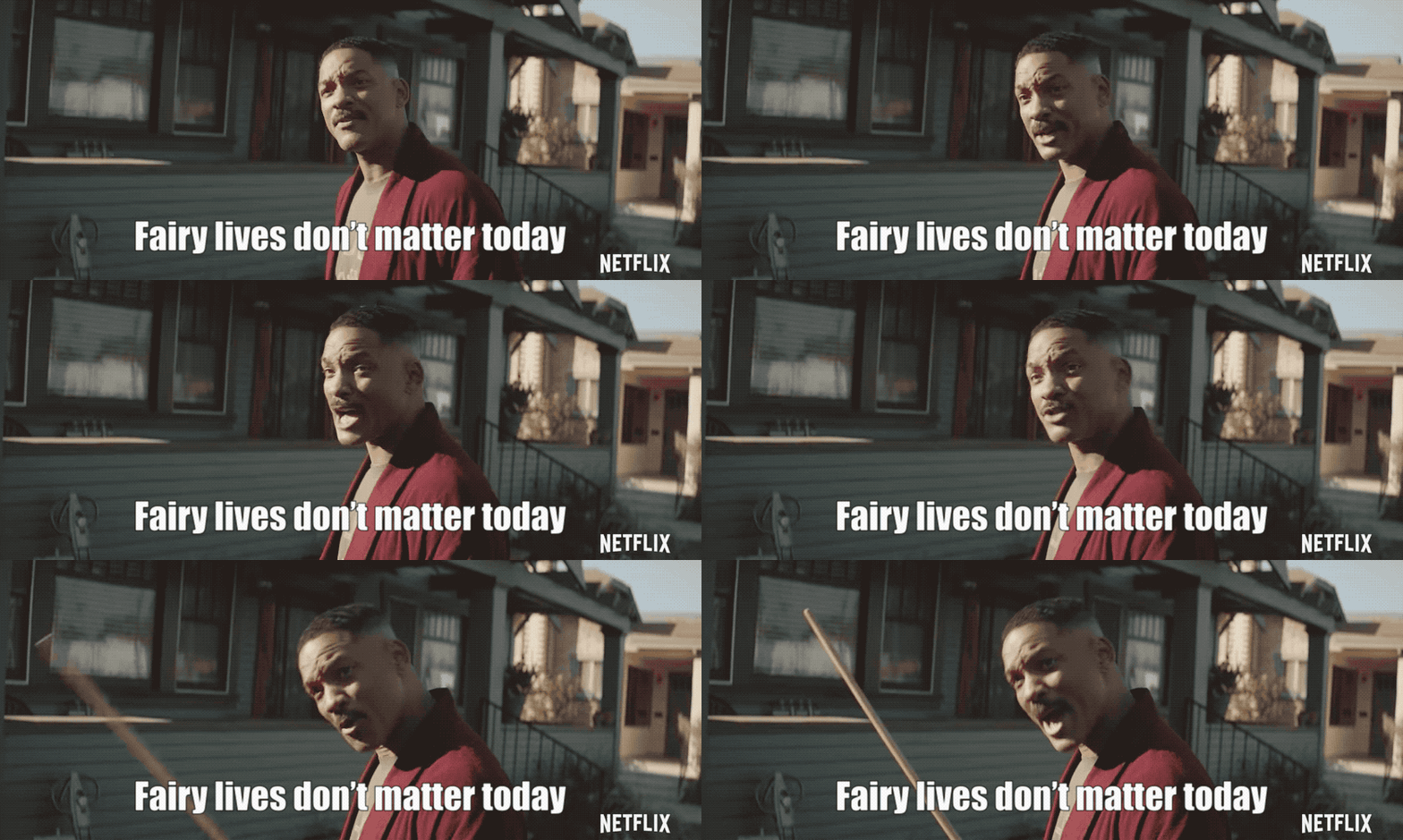
10. Bright – Yes, I’m including streaming movies on here (they’re in my best-of list, too, so it’s only fair), especially since this was a BFD that Netflix was making this blockbuster-type movie. I just don’t know what went wrong here, but this is almost incomprehensible. I like the idea of mixing high fantasy and gritty urban, but this was not the way to do it. The attempts at social commentary fall so flat they’re almost laughable. Will Smith, how do you keep ending up releasing movies in December that end up in my worst of lists? You’re on notice for 2018.

wonder wheel9. Wonder Wheel – It’s like Woody Allen is inviting us to say, “Hey, maybe it’s time we talked about how this filmmaker treats his female characters.” Not a good time for this conversation for you, Mr. Allen. And Jim Belushi and Justin Timberlake. I’m just left flabbergasted. And if this ended up on your best of list, I’m even more flabbergasted. Just go read this.

8. A Ghost Story – A piece of pretentious nonsense that decides to put its “message” in the mouth of its most abrasive character, a know-it-all drunk hipster, and beat you over the head with it in a ridiculous monologue. Also, that didn’t need to be Casey Affleck under that sheet. It could’ve been literally anyone. And while I didn’t know about the allegations about his treatment of women before I reviewed Manchester By the Sea, I did know about them here. And it’s baffling to me this ends up on anyone’s best of list. Oh, except that scene where Rooney Mara grief-eats a whole pie was legit.
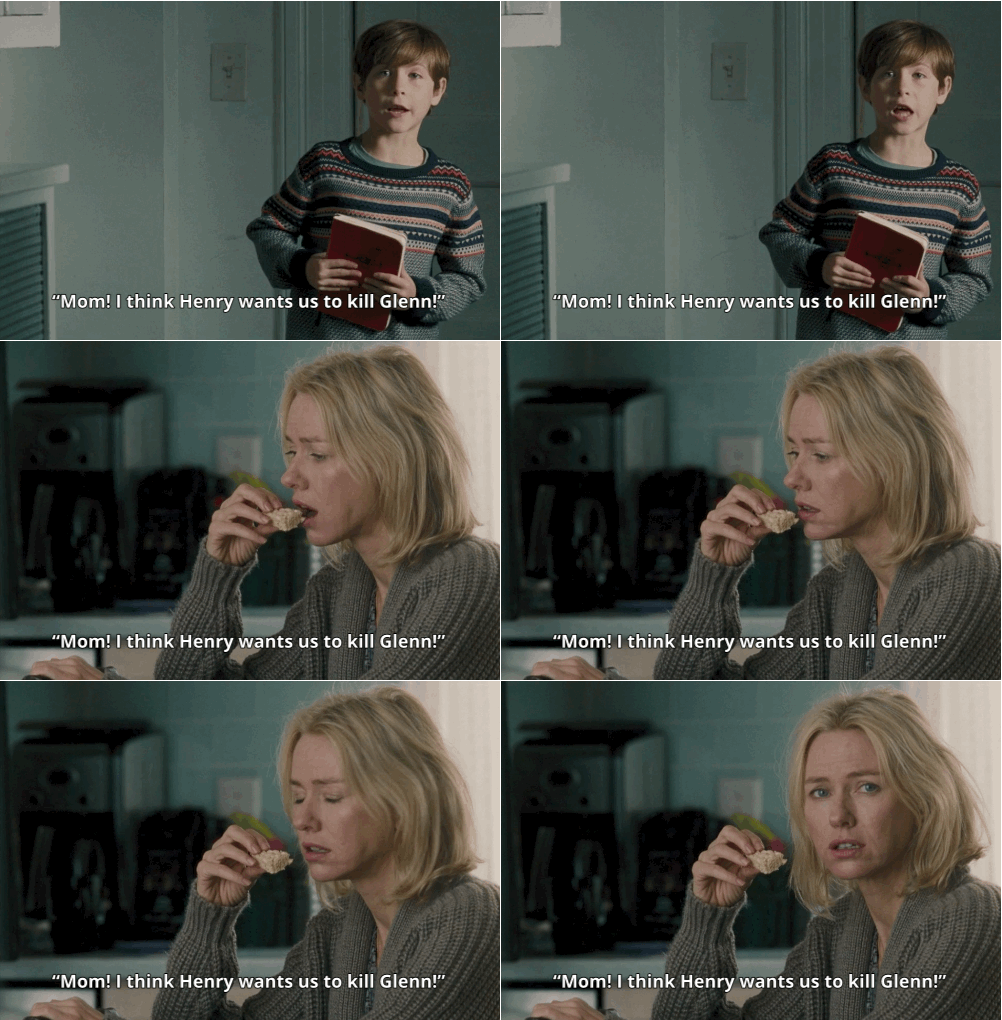
7. The Book of Henry – What the hell was this?!?! This is apparently the movie that got Colin Trevorrow fired from making the next Star Wars, and after seeing it, I don’t blame anyone for making that call. And inexplicable turn takes this from tearjerker over death of savant child to. . . dead child walking his grieving mother through how to kill their abusive next door neighbor and get away with it. Wow. Just wow.

6. Transformers: The Last Knight – We don’t expect much from Michael Bay and his Transformers movies, and this reaffirmed that. We had Grimlock, King of the Dinobots, review the movie for us, and his summary was, “Grimlock small dinobot brain, but even Grimlock know that super dumb.”

Snowman-Poster5. The Snowman – Why, Mister Police? We Gave You All The Clues. When the audience laughs at what are supposed to be tense moments, you know you have a problem. This was supposed to be Zodiac meets Let the Right One In and instead is more Manos, the Hands of Fate.

4. The Emoji Movie – Still unclear why this movie got made, except that somehow it managed to beat the far superior Atomic Blonde (in my top 10) at the box office its first week in release. America, this is why we can’t have nice things. My daughter (the target demo for the movie) texted her friends she’s never cringed so much in a movie. Smart kid.

3. Downsizing – Small review: this movie was b.s. You can read the rest here.

2. Split – This set the bar for bad movies all year long. It was so bad, it actively ruined several other movies for me, specifically in its attempts to tie itself to Shyamalan’s Unbreakable. I don’t expect much from him, but I don’t expect it to be this bad.

1. mother! – throughout this list I’ve gone after a lot of hacks: Bay, Shyamalan, Trevorrow, Ayer. But Darren Aronofsky should know better. This was impeccably shot and put together by a filmmaker who knows what he’s doing. But what he’s doing here is 100% bad.

And there it is. A load of terrible movies.

Agree? Disagree? Did I miss something egregious? Let us know what you think, and may 2018 give us better than these ten sorry flicks.

It Repeats at #1 at the Weekend Box Office Setting a September Record

It has broken records in just eight days with a second weekend haul of $60 million for close to $220 million in ten days domestically. The cume of $218.7 million in ten days is the largest September release ever beating Crocodile Dundee‘s $174.8 million back in 1986. That’s not adjusted for inflation, which when happens, still puts the film in the top ten. It’s just $14.2 million shy of becoming the largest R-rated horror movie of all time.

The film also opened in ten more overseas markets for a total of 56. It grossed an estimated $60.3 million for an international total of $152.6 million bringing the global total to $370 million.

In second place was the new film American Assassin which brought in an estimated $14.8 million. That beat some forecasts and the film received a “B+” CinemaScore from an opening day audience that was 55% male and 45% female with 29% under the age of 35. The film also grossed an estimated $6.2 million internationally.

Darren Aronofsky’s mother! was the talk of the weekend in third place. The film received an “F” CinemaScore, one of only 19 films to ever receive that score. The movie earned an estimated $7.5 million from an audience that was 44% male and 56% female with 18% under the age of 25. Th efilm also earned $6 million internationally for what is a failure all around. Don’t expect this one to last in theaters long, but expect it to become a cult classic in its own way.

Fourth place was held by Home Again which added $5.3 million to its domestic total to bring that to $17.1 million.

Rounding out the top five was The Hitman’s Bodyguard which earned an estimated $3.6 million to its domestic total to bring it to $70.4 million.

When it comes to comic adaptations domestically….

Spider-Man: Homecoming slipped a couple of spots to come in at #9 adding $1.9 million to its total and bring its domestic gross to $330.3 million.

At #25 was Atomic Blonde which added $167,000 to its total to bring it to $51.3 million domestically.

Finally, Guardians of the Galaxy Vol. 2 was #44 adding $28,000 to its domestic total to bring that to $389.8 million.

This coming weekend sees the opening of the next comic adaptation, Kingsman: The Golden Circle which will have stiff competition from The LEGO Ninjago Movie. We’ll have a deeper dive into this year’s comic adaptations in an hour.

Movie Review: mother!

mother posterI have another name for this movie.

Yes, it starts with mother! But it ends with a word you can’t say on television that Samuel L. Jackson likes. A lot.

This is one of the most astoundingly ponderous and pretentious films I’ve seen in years. Director Darren Aronofsky can be hit or miss, and this is perhaps his biggest miss ever. It’s like he took the reactions to Noah, in which critics and audiences did not like his retelling of the story of the biblical flood, and said, “Oh, you hated that? Great, well now I’m going to do it to THE ENTIRE BIBLE.”

This is incredibly unfortunate, for a movie that is spectacularly acted and meticulously filmed. The film follows Jennifer Lawrencemarried to Javier Bardem, a poet suffering from writers’ block. When unexpected houseguests Ed Harris and Michelle Pfeiffer arrive, they begin to cause problems, as do their children, played by siblings Domhnall  and Brian Gleeson. But Bardem’s poet can’t get enough of the attention they lavish on him for his talent, and despite his wife’s protestations to send the guests away and the damage they do to their house, more and more guests arrive. There is supposedly a metaphor in here for the biblical Genesis story, which eventually muddles through the arrival of a Messianic child and an eventual apocalypse, but it’s too ponderous and clumsily told that the metaphor collapses under its own weight.

Even the title mother! is pretentious and offputting. It literally shouts at us with its exclamation mark. And then emphasizes its lower-case m so we know this is a Very Serious Important Move about Very Serious Things, like a college sophomore who decides their name shouldn’t be capitalized so they can stand out in the crowd and show off how self-effacing they are.

This film is the textbook definition of laying it on too thick, with a steaming side of heavy hands. And, astoundingly, at the same time, it is hella confusing for the first two-thirds of the film! As an audience member coming in, you’re left wondering exactly what is going on or what you’re supposed to be taking away from this.

The themes are all over the place. Is this movie about the erasure of the divine feminine from Christianity? Is it about the lack of respect for women and the creative, nurturing force? Is this about the environment and Mother Earth / Gaia? Is this about the creative process and the relationship between artist and audience? Is it a horror movie? Are the events depicted on screen actually happening, metaphor, or some sort of surrealistic nightmare?

Apparently the answer to all of these is yes. And no. To quote Janeane Garofalo in the cult classic Mystery Men, You’re not well-liked. You’re abrasive and off-putting. You try and say pithy things, but your wit is a hindrance and so, therefore nothing is provocative.It’s just mixed metaphors.”

When you take a classic, beautifully woven epic with multiple themes like Les Miserables or Anna Karenina or The Godfather, whether the medium is the page, the stage, or the screen, the skilled autuer will fully develop those themes and make them accessible at multiple levels.

With mother!, Aronofsky doesn’t fully develop any of them, and so the film in trying to say everything, in fact, says nothing. This leaves even the most ardent lover of film confused is not a sign of brilliance. It is a sign of failure.   

And where the film really strikes out is in its attempts to have a message of feminism, it mostly just ends up glorifying violence towards and erasure of women. I’m sorry, but you can’t be a feminist movie if you can’t even pass the Bechdel Test. It’s a fairly low bar, and they didn’t even manage to get over that.

Even more creepy is the way the camera follows Jennifer Lawrence throughout the movie. Wearing an incredibly sheer nightgown and no underwear for much of the film, she is intentionally lit to repeatedly show off her nipples. The camera follows her from behind with more shots of her butt than a Michael Bay movie. (And can we point out that the movie would be 40 minutes shorter if it didn’t incessantly follow her movement throughout the house, padding an already ponderous picture?)

And then in the final climax of the film, she is brutally attacked, her clothing ripped, exposing her bare breasts. . .  in a rape scene. No. No. No. No. NO.

Aronofsky has publicly stated that we have been destroying our mother earth with our presence– message received. But to take it a step further to depict it on screen as an actual rape contributes to rape culture by not only seemingly glorifying/fetishizing the moment but also by lessening the impact of the epidemic of sexual assault in our country. I even bristle at the too-easy-to-make metaphor of pollution, climate change, etc “raping Mother Earth.” It doesn’t elevate a call to action, but it does lessen the impact of actual sexual assault. That being said, mother!’s final fiery apocalypse fueled by combusting oil and coal is a metaphor worth exploring– it’s just unfortunate that it is too glibly conflated with violence towards women that its impact is lessened.

It’s arguable that mother! wants to teach us something about the important place for women, but all we’re left with is a glorification of her erasure, abuse, and ultimate place as an adjunct to the man. And [spoiler alert, but IDGAF] at the end of the film, we also find out that her special, sacred role is ultimately replaceable, and she can be consumed in apocalyptic destruction and the ultimate in self-effacement and annihilation, and just as easily replaced by another woman.

Nice job, Darren Aronofsky. You took a movie about women, put your girlfriend in it, and made it all about you– the ultimate in white male “feminism.” And you bet those quotation marks are ironic.

And if you were trying to make a message about the environment, you absolutely failed– showing that our earth is completely replaceable. It isn’t. As an environmentalist myself, that implication goes beyond being problematic to dangerous.

What’s most infuriating is I really really really wanted to like this movie. It has some amazing elements in it that, if properly developed, could have made something cool. The environmental message is absolutely necessary and poignant, especially given the events of the last few weeks. A message about art and audience would have been cool. Something that was actually feminist would have been amazing. And Aronofsky’s visual sense is right on point here. He masterfully uses his setting to create an emotional response. I can name only a handful of other films that came out this year as competently shot/composed as this. (Detroit, Your Name, Get Out, Dunkirk) But someone needed to sit him down and tell him he was being self-indulgent and an idiot.

This is that Jerry Seinfeld joke that the original title for Tolstoy’s novel was War: What is it Good For? If Tolstoy had published that joke draft instead of War and Peace, we would laugh about how terrible that book is. mother! is that underdeveloped potential with an epic that deserves to be told in a more cogent fashion.

1 out of 5 stars

ECCC 2016: DC Comics Announces DC’s Young Animal and Gerard Way on Doom Patrol

The DC All Access panel at Emerald City Comicon was crashed by none other than Gerard Way, Eisner Award-winning writer of The Umbrella Academy and former vocalist and co-founder of the alternative rock band My Chemical Romance. Way announced that he will be curating DC’s Young Animal, a new mature reader pop-up imprint of DC Comics that will consist of four series and feature his creative direction.

The flagship title for this monthly lineup is Doom Patrol, written by Way, which will set the tone for the other titles in the series, described by Way as “comics for dangerous humans.”

The lineup includes:

DOOM PATROL – This September, in the spirit of Grant Morrison’s legendary run on the series, along with other classic incarnations of the characters, writer Gerard Way and artist Nick Derington will put their unique stamp on the world’s strangest heroes taking on the universe’s strangest villains.

SHADE, THE CHANGING GIRL – An alien takes over the body of a 16-year-old bully and must face the challenges of being a stranger in a foreign land, plus the consequences of a life she didn’t live. Star Wars’ Moving Target writer Cecil Castellucci and artist Marley Zarcone explore themes of madness, alienation, and the bizarre in this sci-fi thriller, with covers by Becky Cloonan. The new series hits shelves in October.

CAVE CARSON HAS A CYBERNETIC EYE – Writers Gerard Way and Jon Rivera, along with artist Michael Avon Oeming take readers on a strange adventure with DC Comics’ Silver Age character Cave Carson, his cybernetic eye and his college–age daughter as they travel to dark places deep in the earth and mind. Catch this new series in October.

MOTHER PANIC – Meet Violet Paige, a celebrity heiress by day and brutal vigilante by night as she takes on the underbelly of Gotham City’s high society. Hitting shelves in November, the series is written by Gerard Way and Jody Houser with art by Tommy Lee Edwards.

Sounds like a Vertigo-like imprint with superheroes and we’ve seen Way can deliver!