Alex and Joe explore which other non-Marvel fictional characters could lift Thor’s hammer. There’s theoretically some semblance of a planned topic, but this is much more of a free flowing discussion with tangents. So business as normal.
As always, Alex and Joe can be found on Twitter respectively @karcossa and @jcb_smark if you feel the need to tell them they’re wrong individually, or @those2geeks if you want to yell at them together on twitter, or by email at ItsThose2Geeks@gmail.com.
There’s a lot of emotion wrapped up in Daniel Warren Johnson’s new Beta Ray Billmini-series. In fact, it’s what stands out despite a giant set-piece fight in Asgard against a Fin Fang Foom bearing the mark of the King in Black. What’s at the heart of this comic is a very aesthetically charged look at beauty and self-worth, one that takes place amidst perfectly chiseled Vikings and Norse gods.
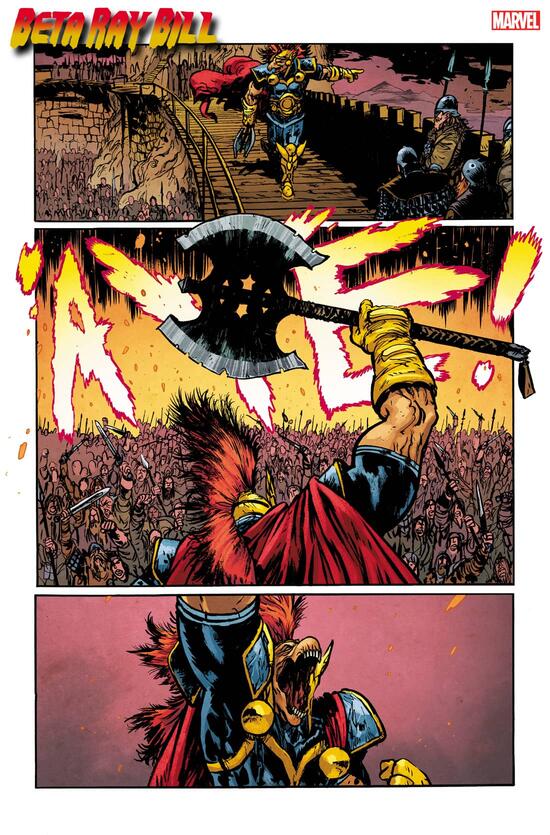
Beta Ray Bill #1 is basically a character study of the titular Korbinite (whose origin story sees the character transformed into the cybernetic creature he is today after the destruction of the Burning Galaxy by the hands of Surtur). Set within the events of The King in Black, Beta Ray Bill is tasked with protecting Asgard as its Master of War, wielding every weapon available to him except Stormbreaker, his iconic hammer. Thor broke Stormbreaker during a disagreement with Bill.
The story is adamant on getting to Bill’s insecurities and frustrations quick. Without spoiling much, his battle with Foom doesn’t go all that well and he’s upstaged by Thor. Bill thinks he’s at a disadvantage in these cosmic battles given Stormbreaker isn’t available to him, which makes him feel somewhat unprepared, inadequate even, to uphold the title given to him by Thor.
Daniel Warren Johnson, who also scripted the comic, portrays Bill like an exposed nerve, a powerful being that—regardless of being considered one of the strongest heroes in the galaxy—is still destined to lead the life of an outsider based on the way he looks. Johnson takes full advantage of this characterization to set him almost completely apart from the Asgardians, all of which are gloriously sculpted to physically embody the very concept godhood. Bill, on the other hand, looks uncomfortable in his own skin, self-aware. The comic points to making this type of self-perception the crux of its narrative, seemingly with the intent to challenge it.
Along with Mike Spicer on colors, Johnson’s art is outstanding. The energy he brings to all his stories have a deeply metal feel to it, almost as if you could hear Iron Maiden or Dio blasting in the background as the story unfolds. Beta Ray Bill is no exception. If anything, the book forms a certain kinship with another of Johnson’s books: Murder Falcon.
Beta Ray Bill #1
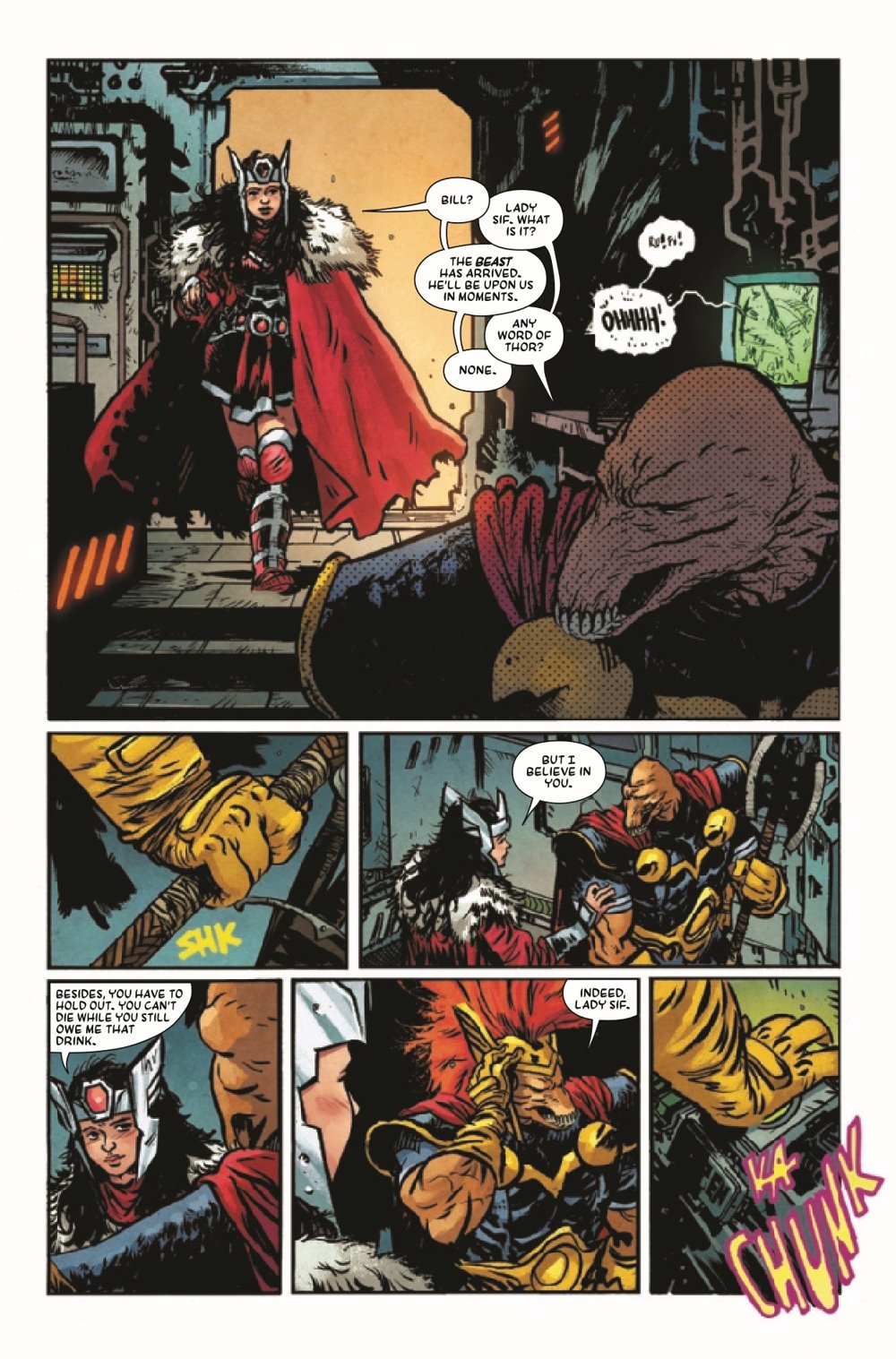
In Murder Falcon, heavy metal and giant monsters clash in a story that’s also about the emotional composition of a person’s sense of self, about how people feel in terms of regret, time, and death. That story’s approach to raw emotion seems to carry over somewhat to Beta Ray Bill, as does its contemplation on relationships and how they can be both restorative and destructive. For Bill, this aspect comes up with through his relationship with Lady Sif.
This is where the comic finds its most heart-wrenching moments. The degree of honesty behind them result in a series of emotionally harrowing sequences that make Bill questions his feelings as to his place in Asgard, among those he’s either befriended or expressed a more intimate kind of love to. By the end of my first read of this first issue, I felt my heart give a heavy pound or two as certain intimate things came to the fore. It’s a testament to how well-crafted Johnson’s script is and how good he is at capturing emotions in his comics.
Beta Ray Bill #1 is primed to be an emotional adventure with a mind to keep things cosmic both inside and outside its main character. To say that it’s exceptionally illustrated and colored is to state the obvious. Johnson and Spicer are a formidable storytelling team and if there’s one guarantee in all this is that the comic’s visuals will settle for nothing less than unforgettable. While that is special in itself, it’s the story’s heart where new narrative possibilities spring forth to entice readers. Expect this journey to tap into your entire emotional spectrum and remember to take your time enjoying each panel. Wondrous things abound in every one of them.
Script/Art by Daniel Warren Johnson Colors by Mike Spicer Story: 9.0 Art: 9.0 Overall: 9.0 Recommendation: Buy and keep a box of Kleenex close by.
Marvel provided Graphic Policy with a FREE copy for review
There are still assuredly holdouts among readers of the medium who refuse to accept this new Thor, but after the events of the previous four issues, it is hard to understand why. The relaunch of Thor into this new character is one which came with much fanfare and controversy, over who is the new Thor, and how a woman can be Thor. When stripped down of all the questions and the controversy, this story has been engaging and is approachable by old and new fans alike (provided that the old fans allow themselves to have a little fun.) This new series thus far works as a standalone series, one that would be interesting in any format. That Thor has decades of precedent in the storytelling to make this all the more relevant only adds to the recipe.
As promised in the last issue and from the cover, this story deals with a battle unlike what fans could have thought of a year ago, that of Thor versus Thor. Before diving straight into the battle there are a few pages of back story explaining how the original Thor got to be where he is, so soon after being disarmed (literally) by the Frost Giants. This gives the necessary explanation for how he can be back into fighting form so soon, but so too does it add fuel to the fire that is the mystery identity of this new Thor. The battle proceeds almost as one might expect, but it does end in an outcome which is at least a logical way to explain the new Thor. As the character says herself, she is Thor but she is a goddess, just as the writer has been explaining all along. Those fans hoping for some kind of divine intervention from Thor to take back his name will find mostly the opposite. With the character introduced and accepted, she heads off for further adventures, her identity still a secret, but one which leaves only a few options left for the character.
The first four issues of this series have done everything that could be expected of it and more. The story has been engaging, the action intense, and the new direction has breathed new life into characters that sometimes had grown stagnant from their long publication histories. The writer has even been smart enough in this endeavor to keep old Thor and new Thor together in the same universe, and old Thor is still around ready to spring into action wherever may be needed. Clearly this is no mere stunt, as the series is already among the best that Marvel has to offer.
Story: Jason Aaron Art: Russell Dauterman Story: 8.5 Art: 8.5 Overall: 8.5 Recommendation: Buy
This week sees a changing of the guard as Marvel‘s Thor sees a new wielder of the mythical hammer Mjolnir. It just so happens that new wielder is a woman. With the discussion of gender in comics, both the characters and who reads comics, I thought it’d be interesting to release the first benchmark to see where Thor is now when it comes to gender demographics, and then check again in a few months to see what has changed, if anything. To get this data I looked into Facebook’s data with each line representing a specific term.
I previously looked at Thor’s demographics back in November 2013 when Thor 2 opened in theaters. Using similar terms, back then women accounted for 36.5% of the population. In the almost year since, the female population has increased, now accounting for 37.31% for all the Thor related terms.
Here are the latest stats:
That 37.31% is below the 45% women that make up the general comic fandom. It is better than Marvel’s general 36.84%, but just barely. We’ll track this though and see over the next year how this might shift with a woman wielding the hammer.
Allegedly formed from the core of a dying star, Mjölnir is best known as Thor’s hammer. This Vsauce video that explores the science behind the weight of Mjölnir and why accidentally dropping it would cause global destruction.
Every other Monday, master swordsmith Tony Swatton forges your favorite weapons from video games, movies, and television. This week, he tackles Mjölnir, Thor‘s Hammer featured in the upcoming film Thor: The Dark World.