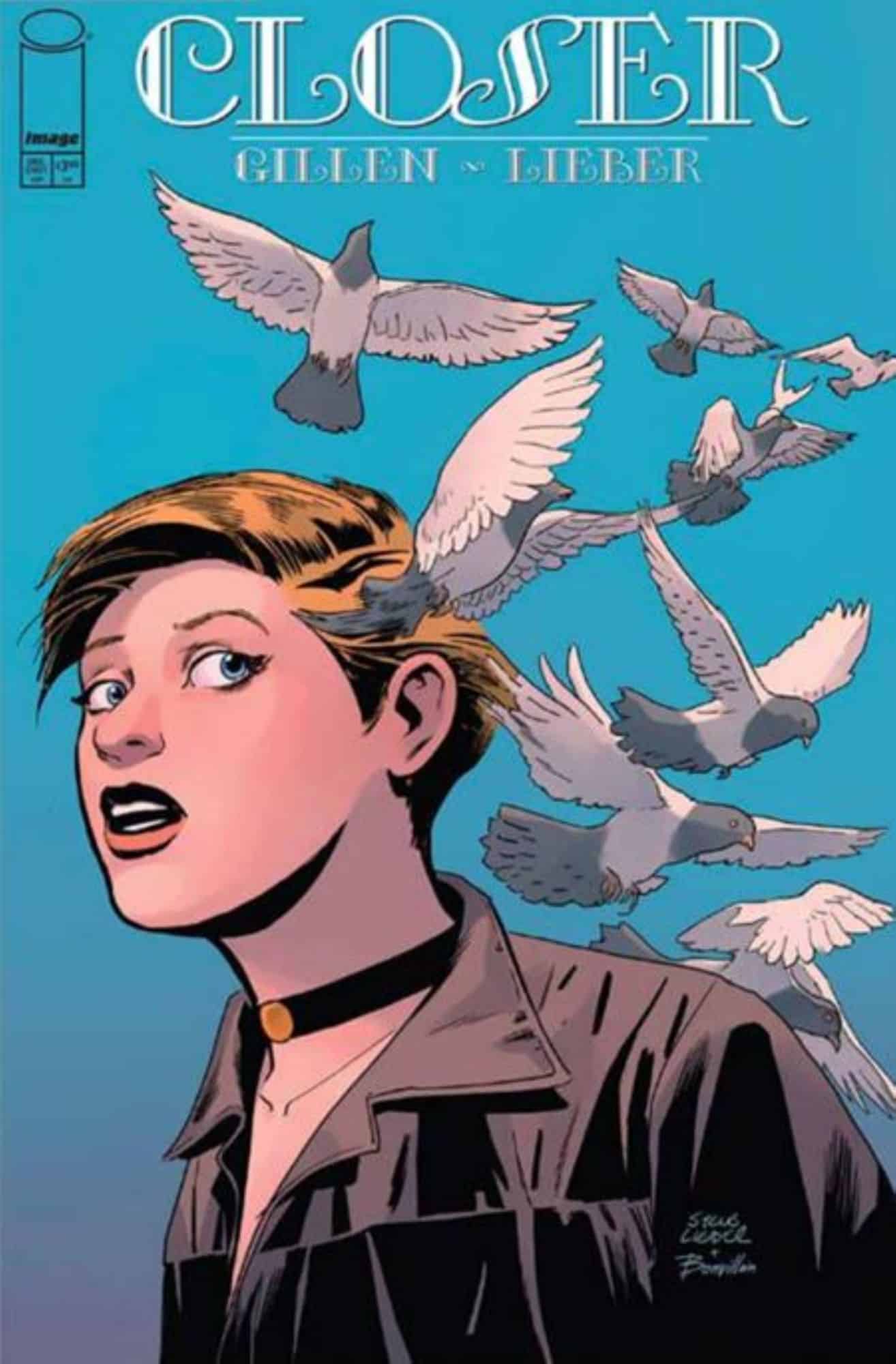
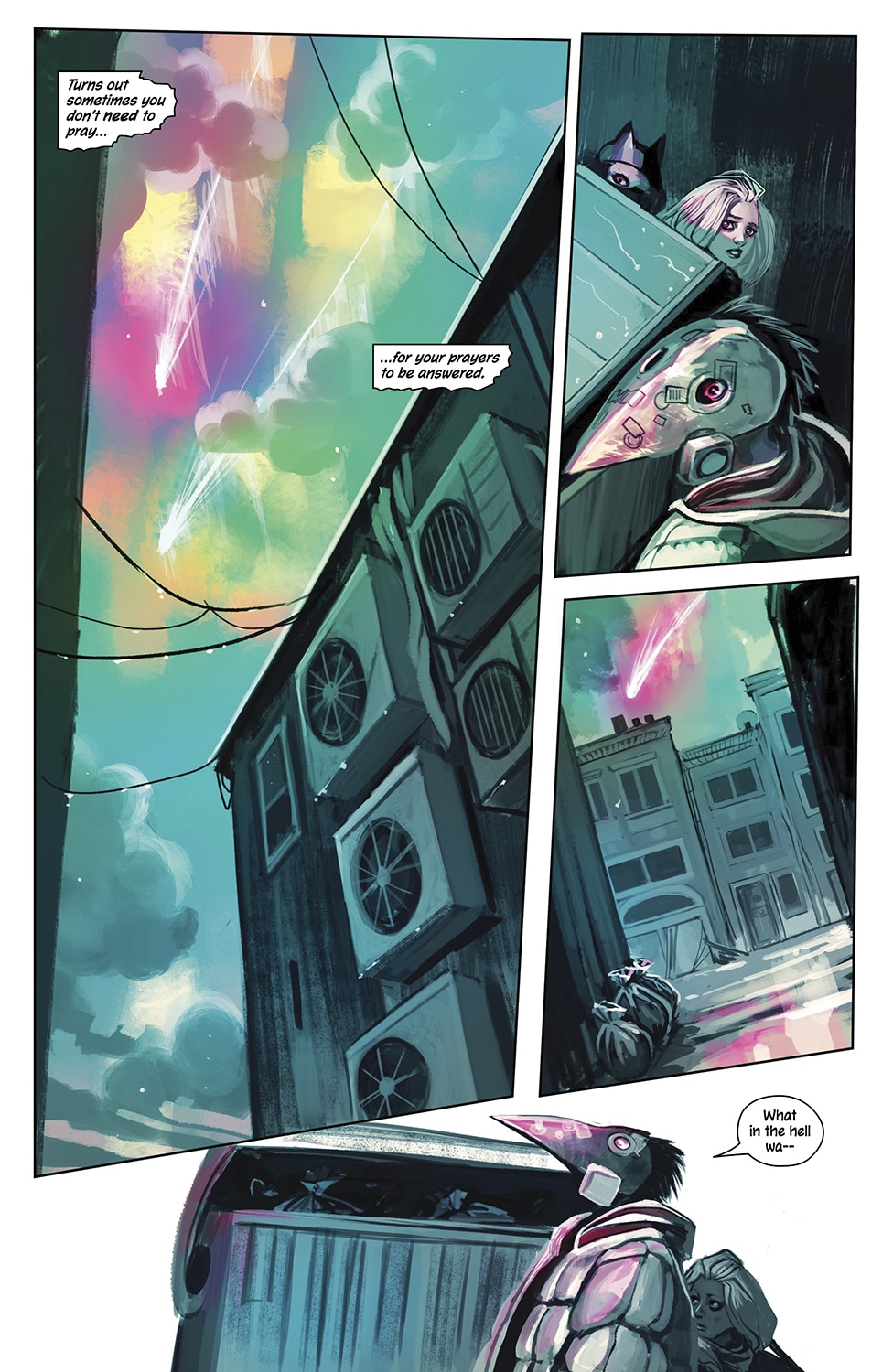
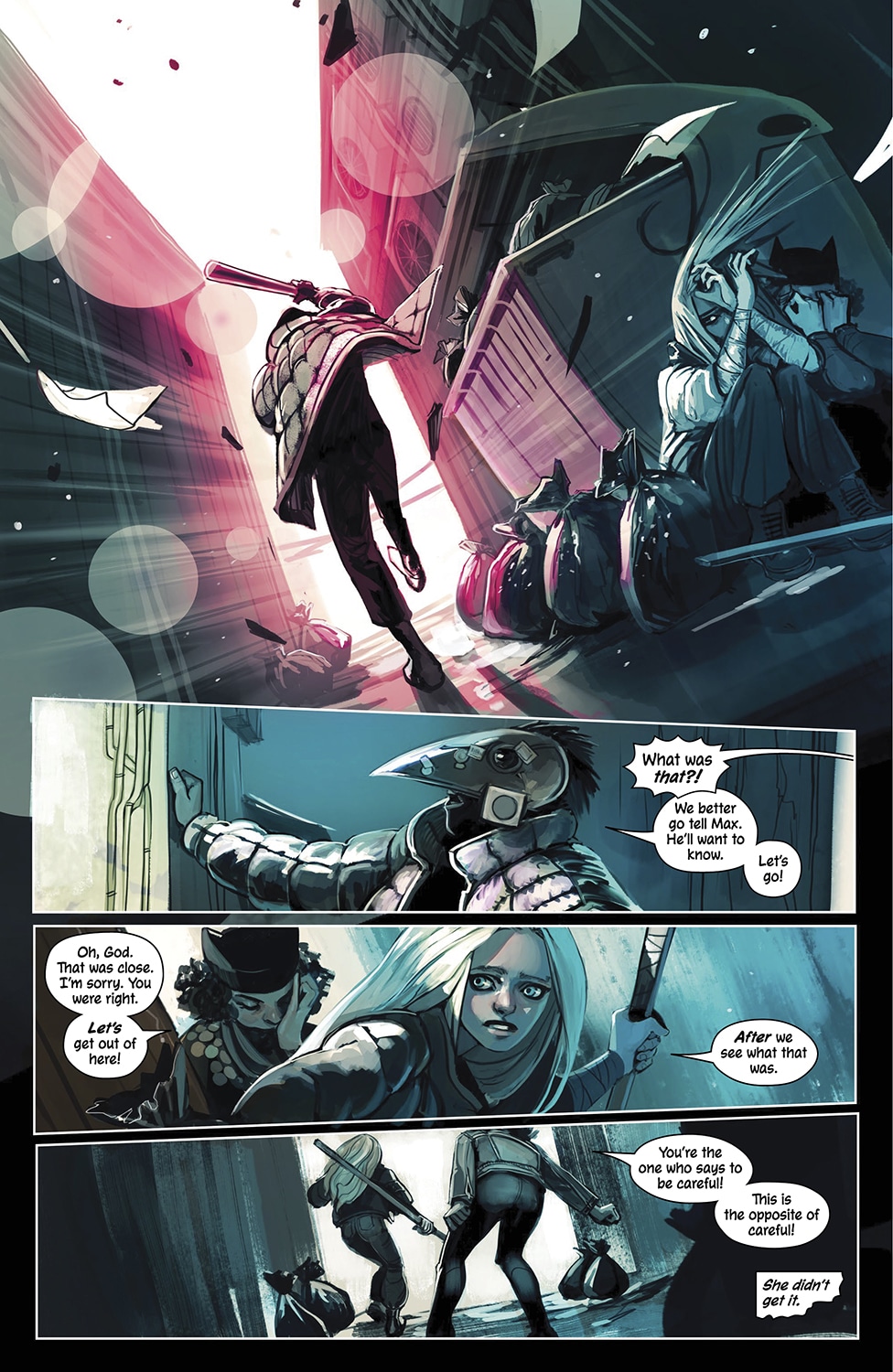
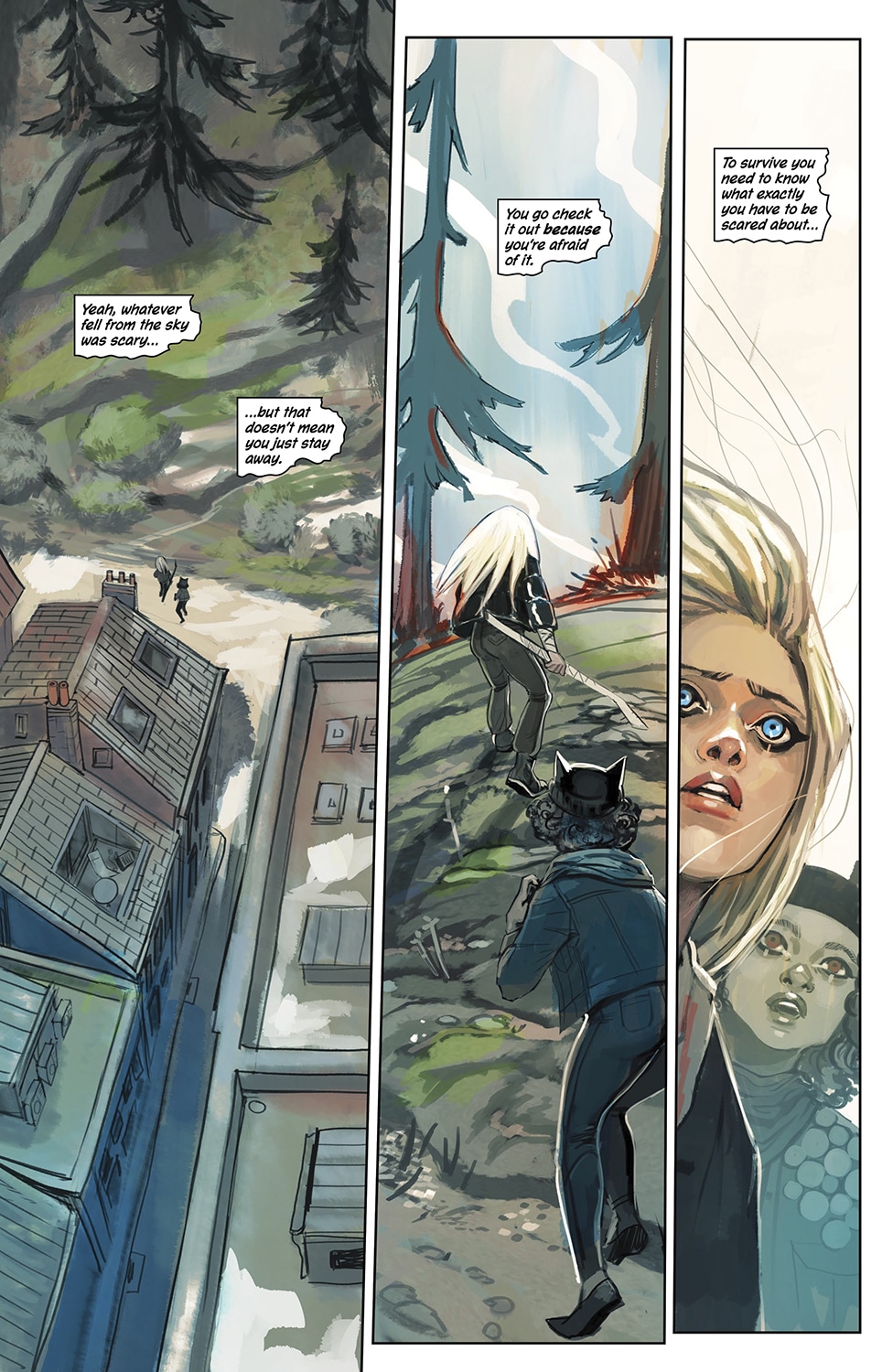
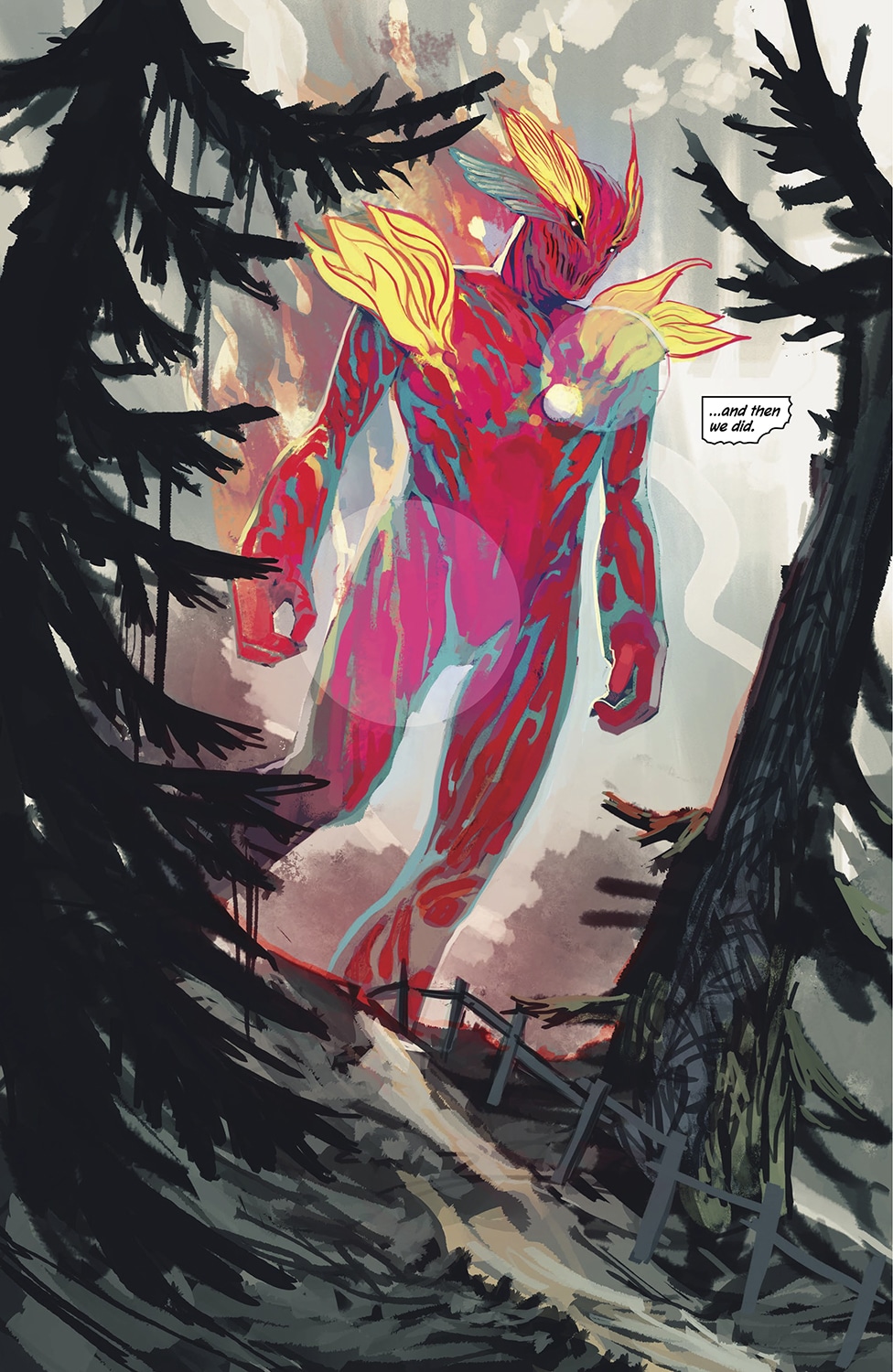
Writer Kieron Gillen teams up with fan-favorite Steve Lieber and colorist extraordinaire Tamra Bonvillain, and letterer Clayton Cowles to bring readers, Closer. This one-shot collects the story of cosmic horror first serialized in the Image! Anthology issues #7-9.
It starts with birds materializing. It’ll end with the death of the heavens. Closer is a story of terror you can dance to in a one-off apocalypse romance.
Closer (Lunar Code 0725IM293) will be available at comic book shops on Wednesday, September 3.
“Tried to tell you about no control But now I really don’t know And then you told me how bad you had to suffer Is that really all you have to offer?”- Bad Religion “21st Century (Digital Boy)”
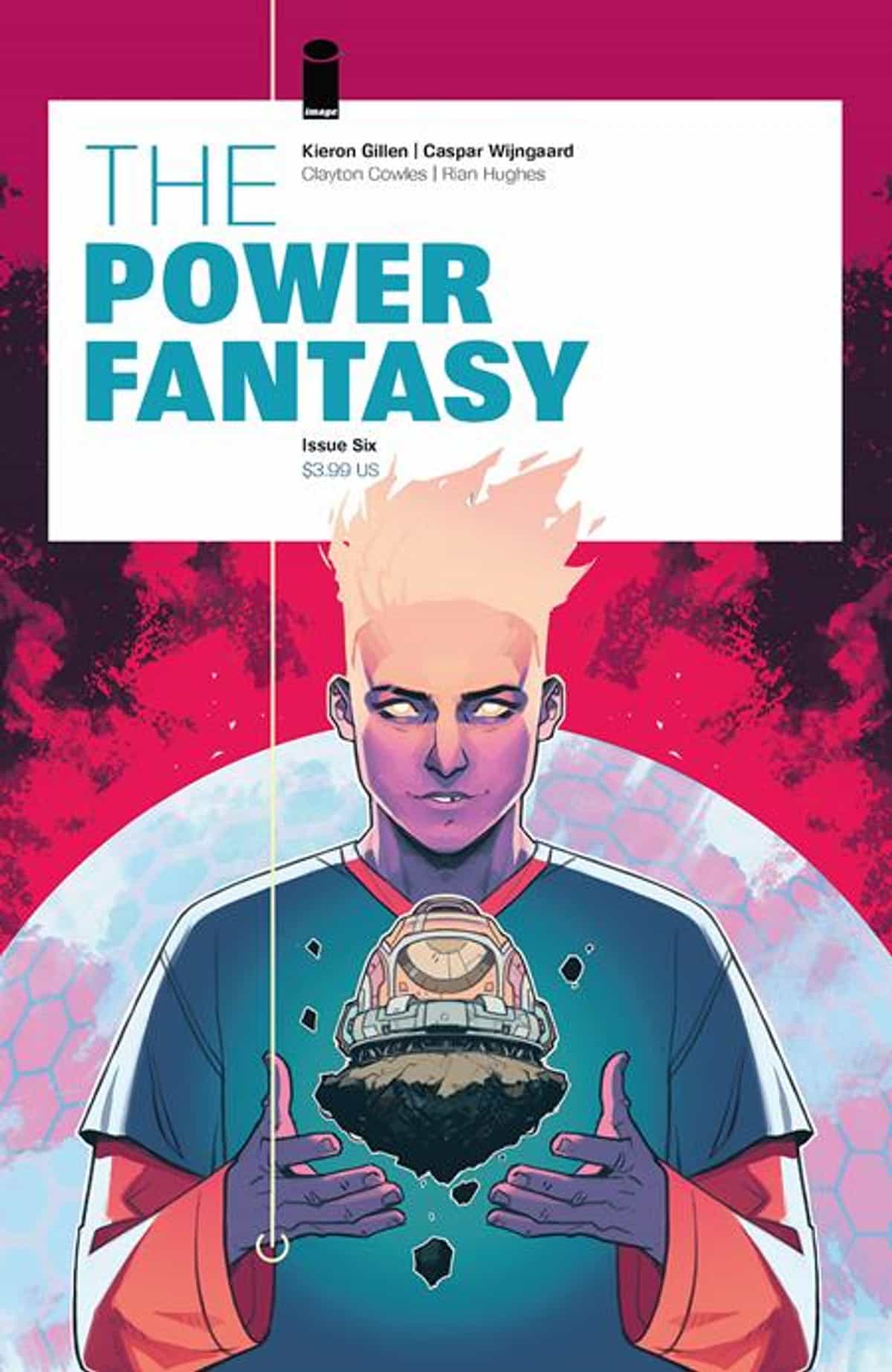
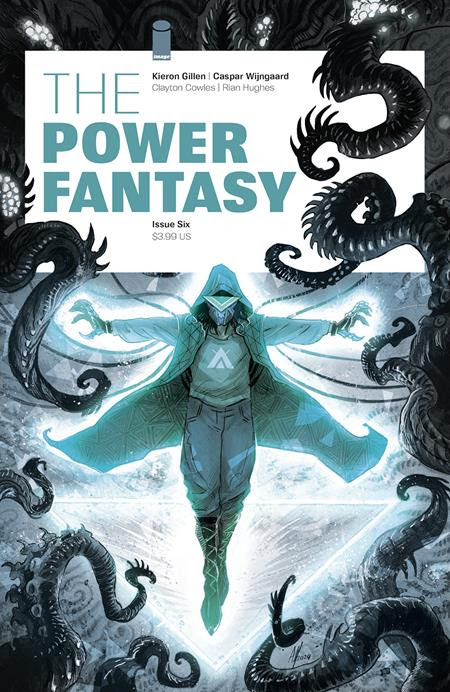
The fragile alliances of the Superpowers stand even more on the brink as Heavy’s secret plan unfolds. With the future reveal of Kid Ignition as a secret seventh superpower to the world, the potential doomsday quickly draws closer and threatens the safeguards Lux placed. Mixed with Magus directly arming the United States as the new Secretary of Magic, the remaining Superpowers need to tread lightly before it quickly goes up pear-shaped. If the beginning of the world started in a big bang, then the potential end arrived from another one in Kieron Gillen and Caspar Wijngaard’s The Power Fantasy #6.
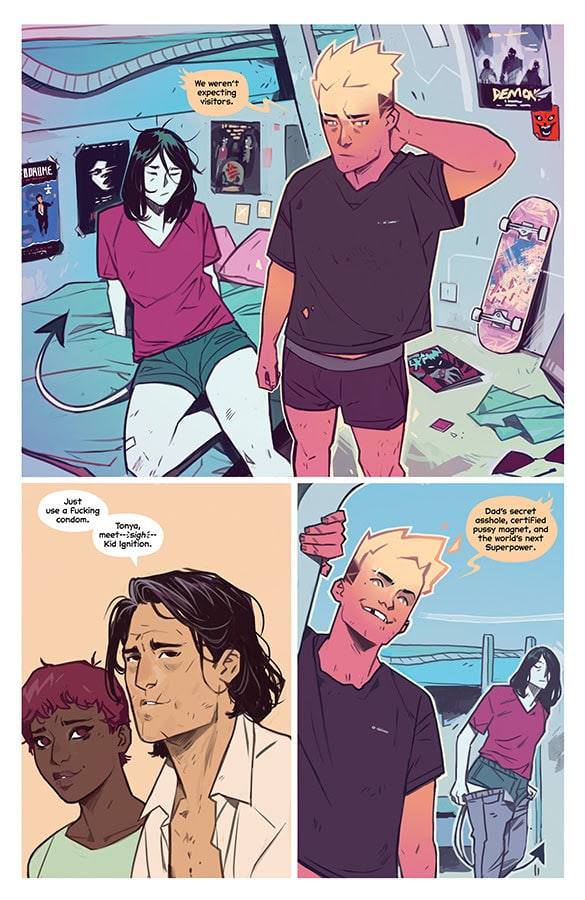
Teased as the “teenage Limp Bizkit fan who could destroy the world,” Kid Ignition embodies not only the typical bravado of a seventeen-year-old concerned with sex, horror movies, and skateboarding mixed with the destructive power of an atomic bomb thanks to Gillen’s writing and Wijngaard’s art. The combination of youthful relatability with potentially destroying the world adds to the darker layers of the character. He has some concept of normalcy but cannot be genuinely normal due to his status as a Superpower. He cannot be a regular kid. If the adult Superpowers can barely keep it together, then a teenage version could do it even less successfully.
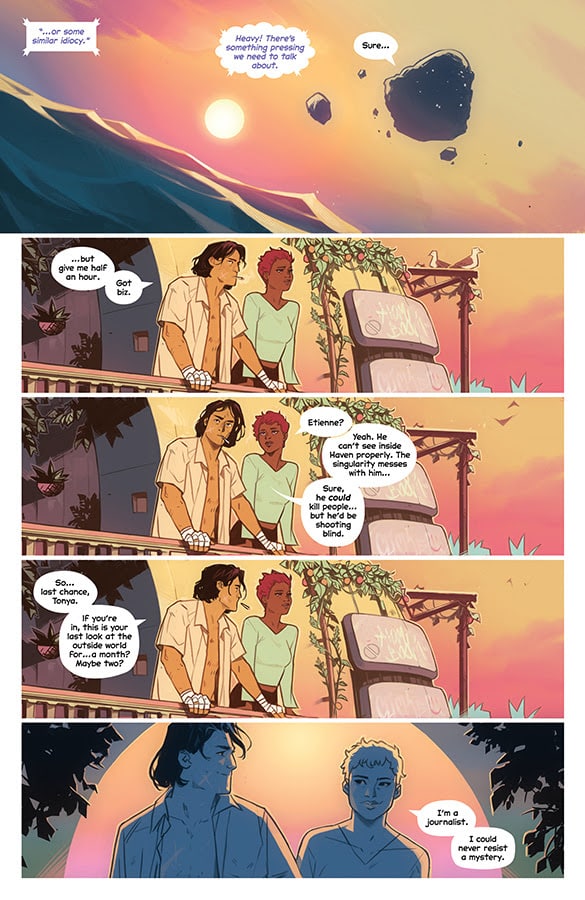
We also get three aspects of attempting control and holding power with Heavy, Lux, and Magus. Because of Kid Ignition, Heavy has an ace up his sleeve, and if anyone tried to attack him or Haven, then his son’s threat of retaliation prevented it. Lux, through Tonya, gains information about Heavy’s plans to keep the various alliances in check. Then comes Magus, hoping to transform the military into an extension of his pyramid to gain more power to combat the others. They all believe they know what’s best for the world and want to jockey for control over each other. As they get closer to the brink, all that matters will be who pulls the trigger.
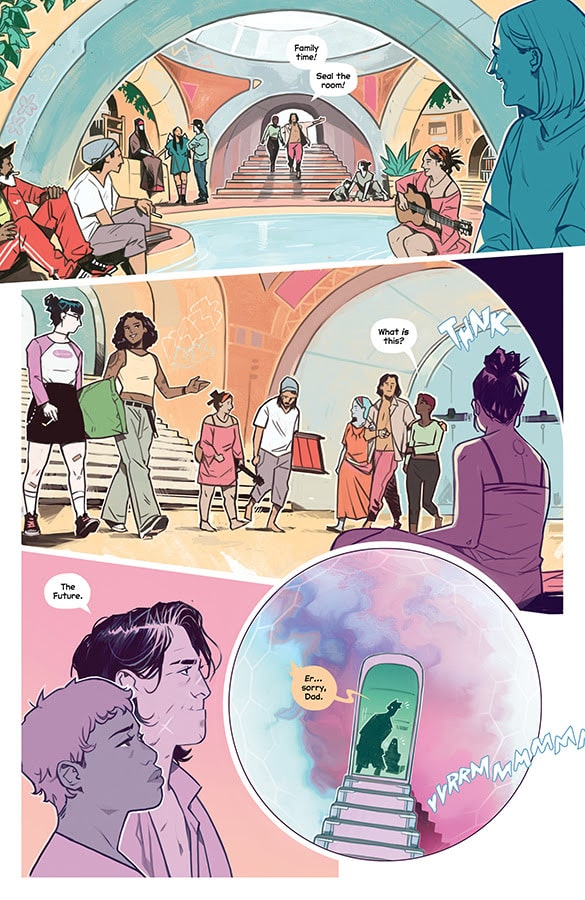
The Power Fantasy #6 also reinforces its meditations on the fears of the future with Heavy and Kid Ignition. Prophesied by an atomic that his son would be a Superpower, Heavy founded Haven to hide his future child and raise him. Stating his desire to raise Kid Ignition to protect him, the line blurs between parental and political due to Heavy viewing him as a chess piece on the board. Especially with not having the choice of being a superpower but existing due to Heavy’s wishes, Kid Ignition is akin to a weapon instead of a person. Even being trapped in the orb on Haven, away from any outside prying eyes, robs him of a potential childhood and only knowledge of the world around the Family. Heavy will do whatever it takes to protect Atomics’ future and use his child to secure it.
Wijngaard’s linework, paneling, and coloring, combined with Clayton Cowles’s lettering, make it another exquisite and striking issue. Wijngaard knows how to build tension through body language, timing, and emotion. Nothing is truly wasted in the art department. The Power Fantasy #6 begins the new arc and accelerates the potential end of the world thanks in part to a hormonally charged teenager.
The chart-topping The Power Fantasy series by multiple award winning writer Kieron Gillen and fan-favorite artist Caspar Wijngaard will kick off a pulse-pounding new story arc with issue #6 next month.
InThe Power Fantasy #6, the stakes are raised as Magus and Heavy’s 18-years-in-the-making plans for world-domination are revealed.
The Power Fantasy #6 will be available at comic book shops on Wednesday, February 19:
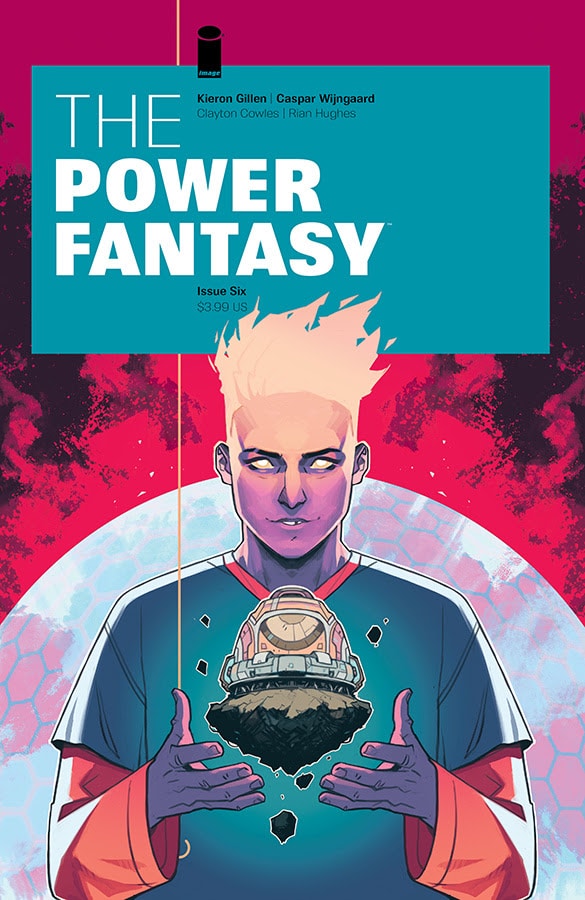
Cover A by Caspar Wijngaard – Lunar Code 1224IM239
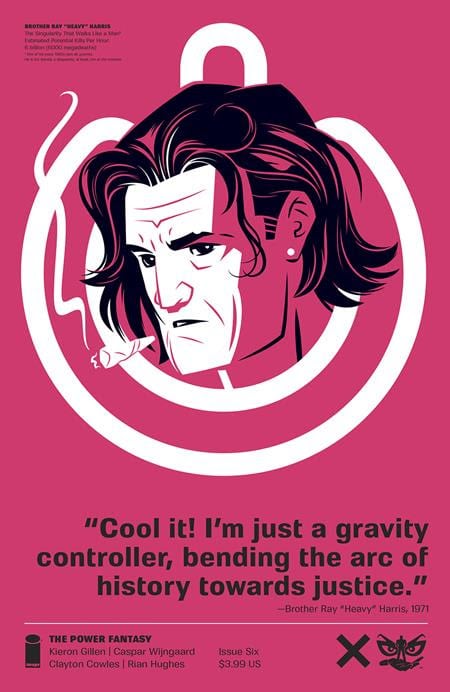
Cover B by Abigail Jill Harding – Lunar Code 1224IM240
Cover C 1:50 copy incentive by Rian Hughes Pantone Color PMS 806 – Lunar Code 1224IM240
With the long-awaited release of Gladiator IIthis week coupled with the continued decline of a current empire, ancient Rome is back in the cultural conversation. (Plus there was the whole “your Roman empire” TikTok phenomenon in 2023.) There have been many successful films, TV shows (Spartacus is my personal fave.), and video games about an empire that had such an impact on human civilization that I was studying their “dead” language for college credit in the mid-2010s. In addition to this, there are many wonderful comics where the Roman Empire is the main setting, including one of the most popular comics ever. In my research for this article, I discovered that there was a whole manga series called Plinivus about the life of Roman polymath and victim of the Mt. Vesuvius volcanic eruption, Pliny the Elder, but unfortunately, there’s no English translation so it just missed the cut.
However, here are five comic books set in ancient Rome for you to check out while you wait between Gladiator sequels.
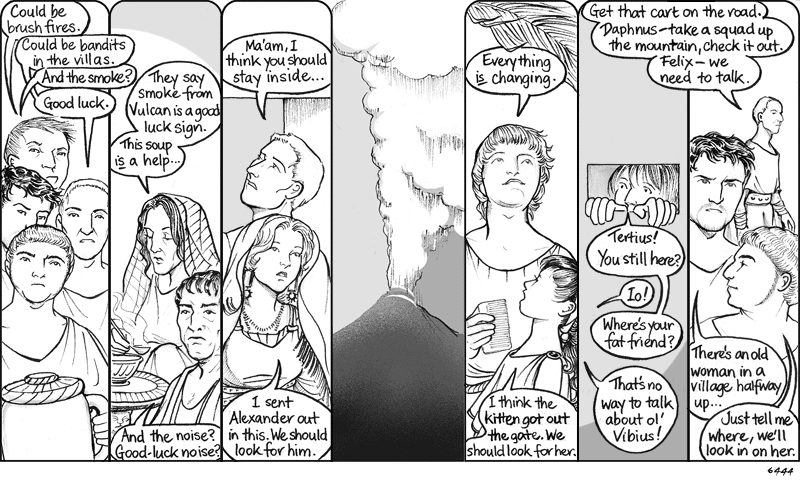
Lots of fiction and book about ancient Rome focuses on men with the honorific “Caesar”, the wars and battles of legions, or the political intrigue of a city that makes Washington, DC look like Mayberry. However, Carol Burrell’s SPQR Blueswebcomic takes an opposite tack focusing on daily life in Herculaneum before the eruption of Vesuvius during the reign of Emperor Titus. The series follows the ups and downs of the life of former Roman soldier Marcus Felix as he settles down in Herculaneum and runs into his old friend Mus. As the series progresses, there is more intrigue (and murder), and figures from Roman history like future emperor Domitian make appearances. Also, it’s rewarding to see how Burrell’s art style shifts throughout the series going from looser to tighter pencils and more complex backgrounds. Her hand-lettered dialogue is also a continual treat. SPQR Blues is an ancient Roman soap opera with a sprawling cast that really picks up in its second chapter when Carol Burrell elucidates Felix’s backstory.
4. Britannia (Valiant, 2016-2018, 2024)
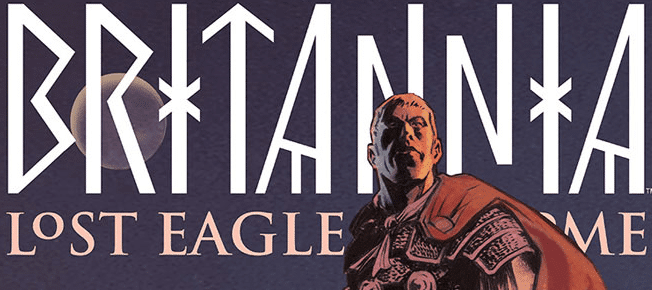
Written by Peter Milligan with art by Jose Juan Ryp, Robert Gill, and Alvaro Papagiani, Britannia is a supernaturally-tinged detective series set during the reign of Emperor Nero in the first century CE. Its protagonist is Antonius Axia aka the Detectioner, who faced down the monster Orkus in southern Italy and was revived by the Vestal Virgins with special abilities, including the powers of deductive reasoning. Axia’s missions send him all across the Roman Empire beginning in the titular frontier of Britannia to the wilds of Germania and, of course, to Rome itself in a gladiator-centric story called Britannia: We Who Are About To Die. A common thread in the story is the conflict between reason and superstition with Axia representing logic, and his British slave Bran (He’s refused freedom for tax purposes.) representing a belief in the supernatural. Each story has dynamic visuals from artists like Ryp and Gill who have gone on to draw X-Books for Marvel capturing the sex, blood, and rock’n’roll of this period in Roman history. As an added bonus, Britannia came back after a six year hiatus in the one-shot The Great Fire of Rome where Axia must find out the cause of the Great Fire of Rome while, for better or worse, the series becomes part of the greater tapestry of the Valiant Universe.
3. The Wicked + the Divine 455 AD (Image, 2017)
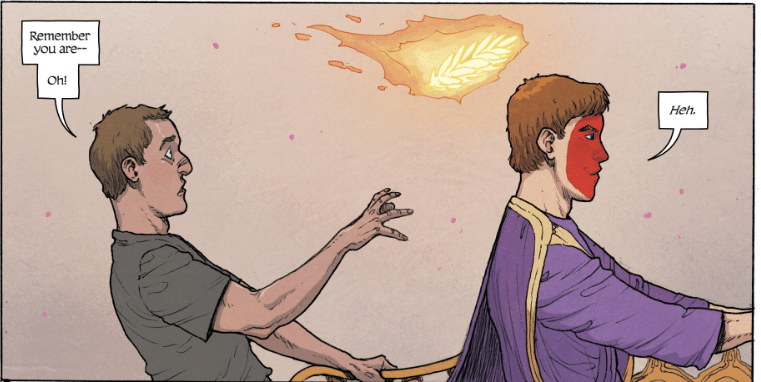
In popular culture, the main eras of Roman history that appear are usually the 1st century BCE, the 1st century CE, and the 2nd century CE because it features such heavy hitters as Julius Caesar, Augustus Caesar, and Marcus Aurelius as well as infamous figures like Nero, Caligula, and Commodus. The latter years, or the “decline and fall” of the Roman Empire, don’t get as much love unless figures like Attila the Hun, or by skin of their teeth, King Arthur. However, in this flashback one-shot as part of the modern classic The Wicked + the Divine series, Kieron Gillen, Andre Lima Araujo, and Matthew Wilson nail the decadence and depravity of the final days of Rome as an ancient Roman incarnation of Lucifer takes on the mantle of Julius Caesar, routs the invading Vandals, and refuses to accept his fate as a member of the Pantheon. This comic features one of the most intense and literal portrayals of burnout ever as Lucifer simply can’t accept a world where Rome doesn’t rule the world, but he also wants to be an actor and musician. As the only living member of the Pantheon, he gets to play off Ananke a lot, who wants to keep history traditional, Christian, masculine, and heterosexual instead of queer and rebellious. WicDiv 455 AD is a fun bit of hyperviolent melodrama, especially through the lavish visuals of Araujo Wilson. (Seriously, Lucifer playing one of his senator’s rib cage like a harp has stuck with me for the past seven years.)
2. Asterix (Various, 1959-present)
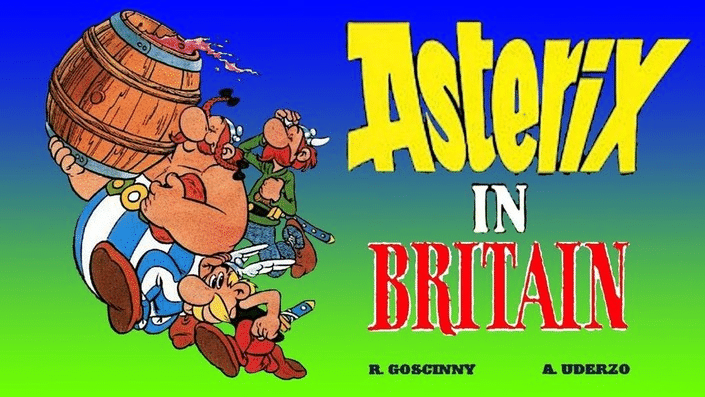
Of course, Asterixis on this list and not just to throw a bone to our site’s Francophone readers. Set in and around 50 BCE or thereabouts, Asterix follows the adventures of its titular character, who is a wise warrior and a member of the last Gallic village to resist Julius Caesar’s invasion. He and his not-as-bright, bigger giant monument-carrying friend Obelix defend their village from the Romans while also traveling to a variety of places like Germany, Egypt, Belgium, and even North America on various quests, involving puns, fisticuffs, food, drink, and of course, French stereotypes for other countries during the publication of the book. Although, some of the earlier books are dated at best and racist at worst, creators Rene Goscinny and Albert Uderzo bring a manic, mischievous sense of humor and an anarchic energy to both visuals and wordplay that makes these books highly entertaining reads even in 2024. (My personal favorite volume is Asterix in Britain) Asterix comics could definitely be considered one of France’s finest cultural imports (A close third to Daft Punk and Victor Wembanyama.), and there’s even an Asterix themed amusement park in Picardy with some seriously gnarly coasters. However, the books themselves still hold up (and are still being published) and are definitely worth checking out in 2024 with the caveat that they reflect traditional French stereotypes about the world around them through the lens of ancient Rome.
1. “Dirty Job” from Our Army at War #241 (DC Comics, 1972)
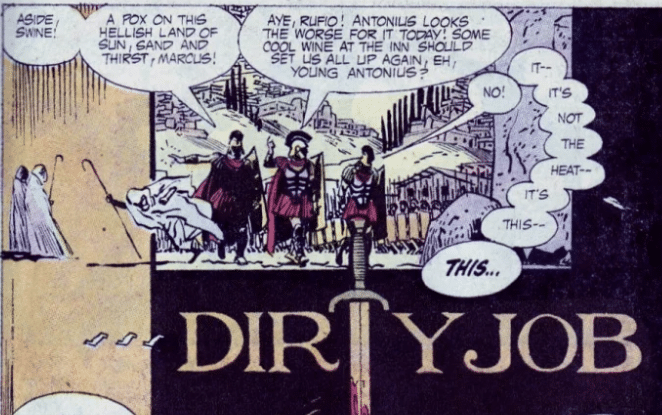
My favorite comic story set in ancient Rome is a four page backup story from a long-running DC war comic written by Teen Titans co-creator Bob Haney and drawn by the legendary Alex Toth. It’s about three Roman centurions drinking in a bar after a crucifixion and is one of the most touching anti-war, anti-imperialism, and yes, pro-Christian comic books of all time with Toth’s final page being a silhouette of the crosses on which Jesus of Nazareth and the two thieves hung from the New Testament story. I love the furrows that Toth draws in the face of the conscience-stricken young soldier Antonius, and the way he draws the careless movements of his compatriot, who paws and gropes at the serving women and other workers at the tavern. His layouts also show convey the oppression of the Romans towards the areas that they’ve conquered, and how trapped the centurions feel in following orders and having to do the “dirty work” of executions while their leaders recline in luxury. “Dirty Job” is a masterpiece of the comic book short story form, and its message resonates while empires continue to mistreat innocent people in Palestine on a daily basis.
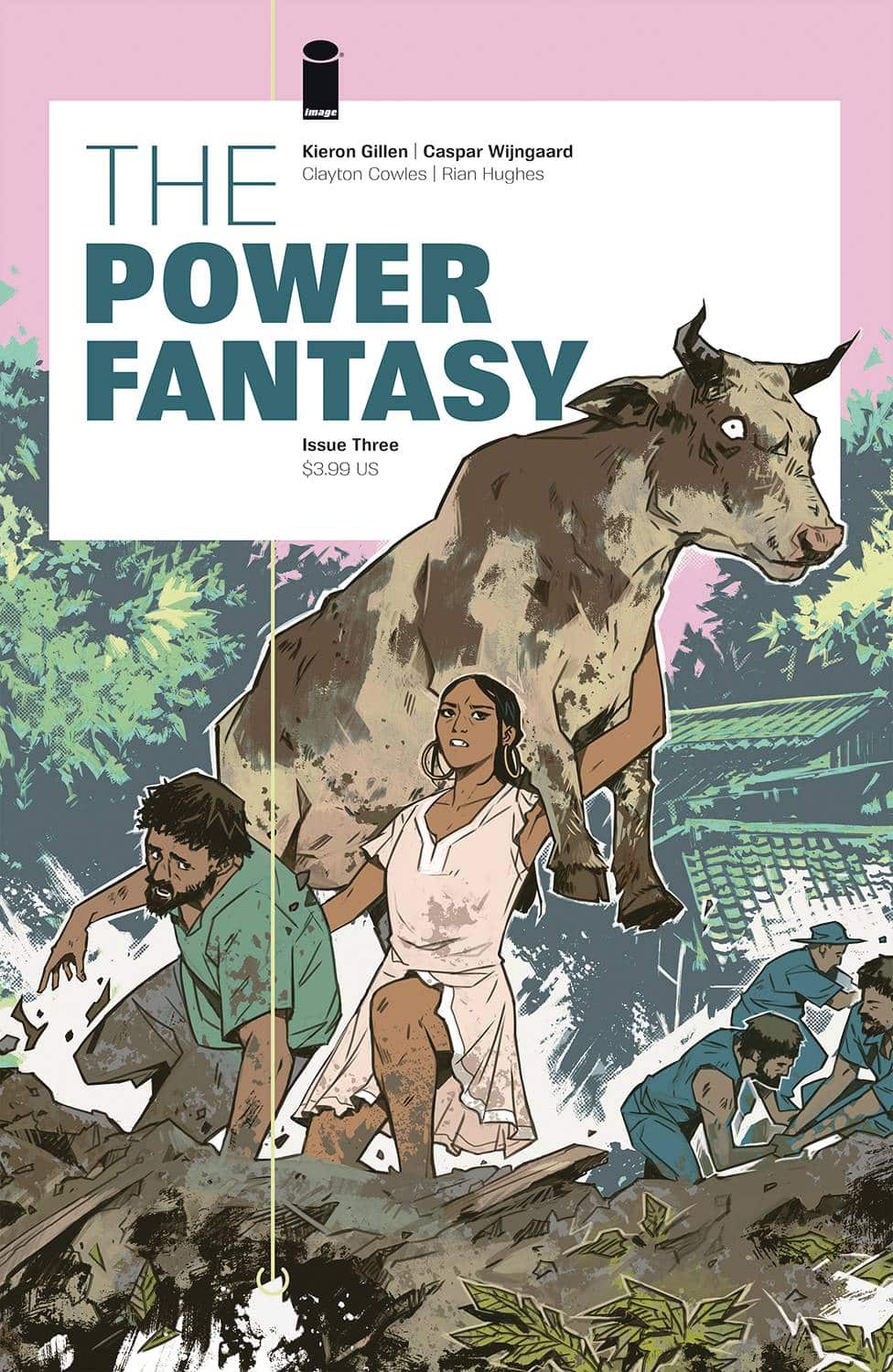
Right when the United States tested the atomic bomb, Santa Valentina was born to the world. The beginning of potential death and destruction signaled an angelic being arriving on Earth. Wanting to protect the music of the future, Valentina did what she believed would bring and maintain peace on Earth. She desired an end to all wars that would backfire horrifically and scar the Earth. With the fragile alliance of Atomics constantly tested, Kieron Gillen and Caspar Wijngaard peel back more layers of history and Valentina’s life in The Power Fantasy #3.
“I dreamed I saw a mighty room
The room was filled with men
And the paper they were signing said
They’d never fight again”
Going back millennia, angels were presented as having a terrifying presence that humans could not comprehend until recently when the notion of an angel refers to a human with wings. Gillen and Wijngaard refer to the older interpretation where Valentina appears human until she reveals her angelic presence to a select few. Although we never get confirmation of divine beings or even what the afterlife is, the presence of both her and Eliza refers to some potential heaven and hell. But they are not presented as opposites, i.e. purely good and evil, but along a similar spectrum or quadrant. Gillen is not interested in strictly binary alignments where, despite being considered “good,” Valentina’s actions still create destruction.
“And when the papers all were signed
And a million copies made
They all joined hands and bowed their heads
And grateful prayers were prayed”
A vital moment of the issue lies in Jackie laying out the difference between Valentina and Lux: “I think you’re good. You’re moral. He’s ethical. That doesn’t mean you’re on the same side.” Although a bit on the nose, Valentina and Lux have been playing on the same team to keep Earth intact for different reasons. Lux firmly believes in the ethical notion of the planet’s survival, while she thinks she has a divine and moral duty to protect humanity. The series’ struggle lies in what the Atomics believe would be the best course of action for the planet. Valentina destroying all of the nukes might be moral but it would result in the mass deaths of innocent lives by the United States trying to kill her in 1969. Despite being blamed for their actions, she still desires to protect humanity and its future.
“And the people in the streets below
Were dancing round and round
And guns and swords and uniforms
Were scattered on the ground”
The concept of “the music of the future” is referenced a lot throughout the issue. Not surprisingly, like his past work, Gillen’s engagement and fascination with music and the concepts surrounding it play a significant role in this story. This notion refers to a pamphlet written by Richard Wagner, but also in a more metaphorical sense, protecting the world for the future to arrive and for humanity to grow, learn, and move on from the past. The record that inspires Valentina with its music is “Telstar” by The Tornadoes, which refers to the satellite of the same name launched into space in 1962. Indeed, sounding alien and from a future generation compared to similar music of that period signals a change in the direction of where music and the world might go. An angel originally from the heavens being inspired by a sci-fi rock song aside from the standard heavenly harp.
“Last night I had the strangest dream
I ever dreamed before
I dreamed the world had all agreed
To put an end to war”- Ed McCurdy “Last Night I Had the Strangest Dream”
I am still amazed by Wigngaard’s art and colors as he travels through various periods in this issue. Each moment has a distinct visual look and style that calls to mind and makes them almost snapshots reminiscent of the memories that Valentina holds onto. Clayton Cowles’s impeccable lettering conveys the necessary emotions and tones that occur in the issue. Overall, The Power Fantasy #3 provides essential insight into the character of Valentina while further developing the immersive and fascinating world-building.
(W) Kieron Gillen (A/CA) Stephanie Hans In Shops: Oct 30, 2024 SRP: $19.99
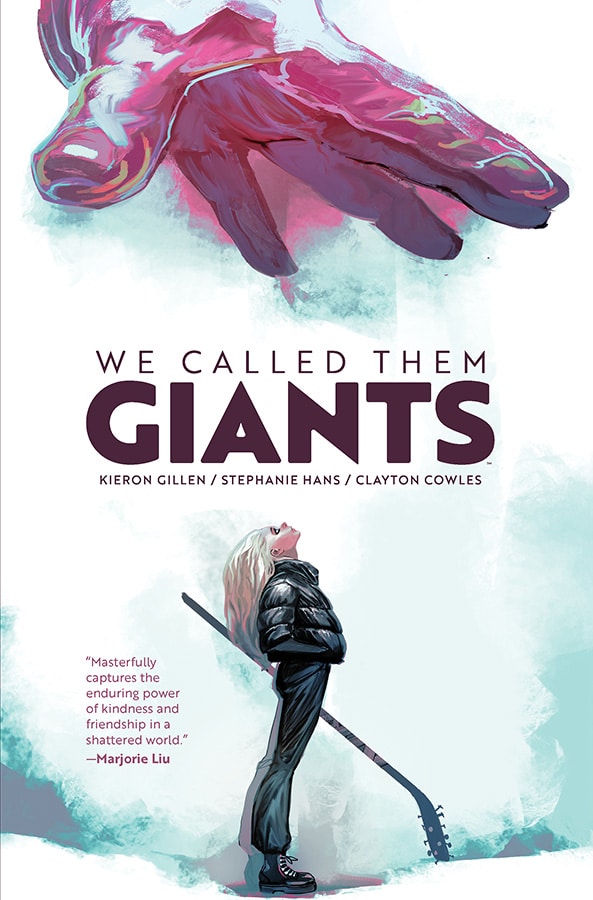
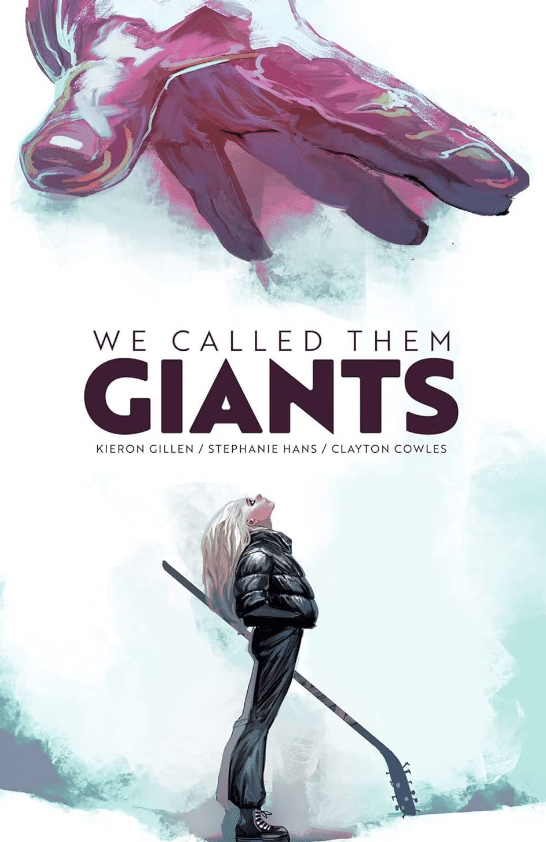
We Called Them Giants is a story of communication across a chasm at the end of the world. Lori wakes to find the streets empty. Everyone has gone. Or at least, nearly everyone. She’s thrown into a world where she has to scrape by in the ruins of civilization, nearly starving, hiding from gangs when… They arrive. The award-winning team behind dark fantasy smash Die release their first standalone original graphic novel.
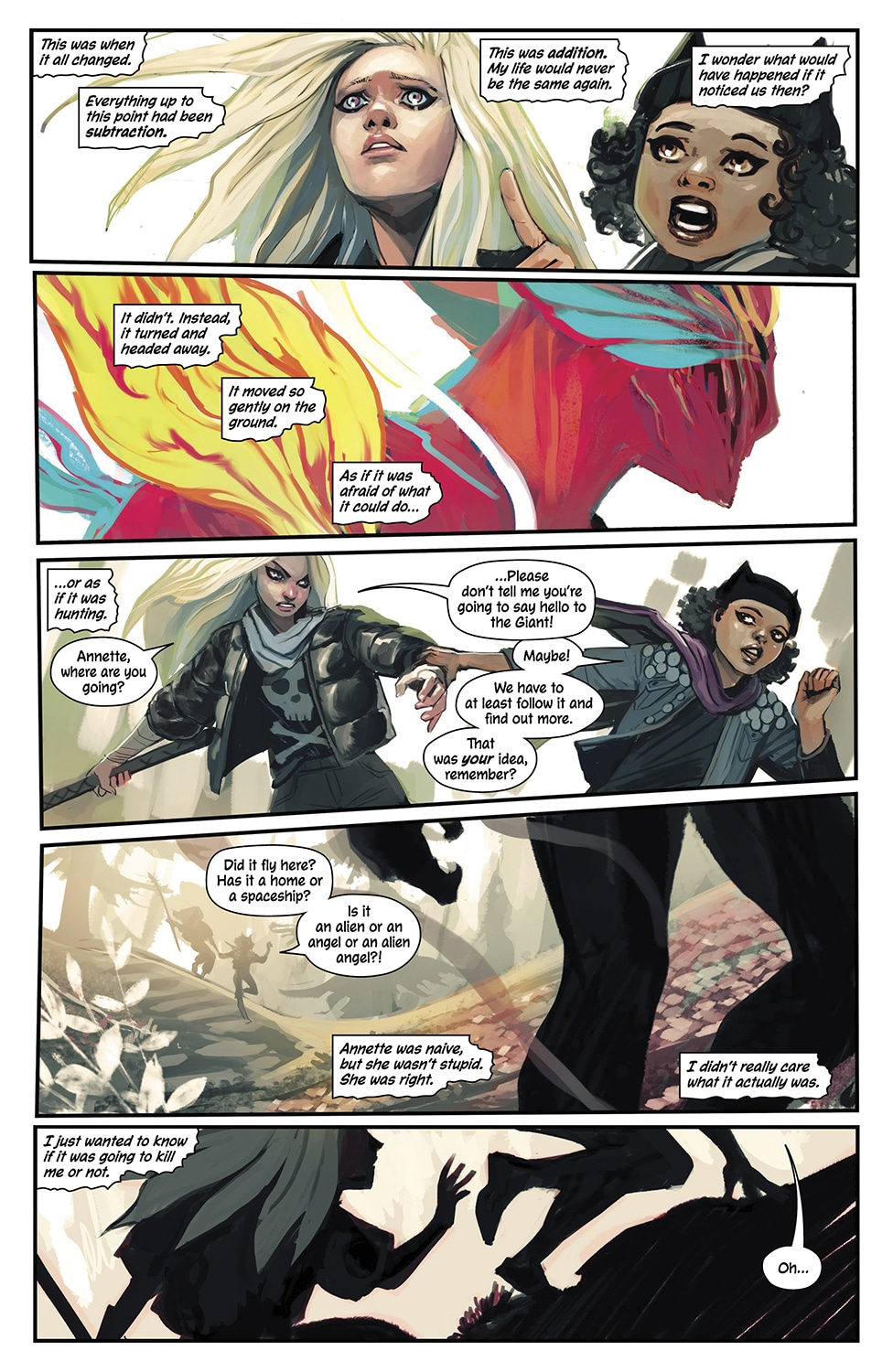
A young girl named Lori wakes up on her birthday to see that her adoptive parents (Who promised her a kitten as a gift) are missing. She wanders the streets of her neighborhood to see that most everyone is missing except for her cheery, optimistic Annette are missing as well. What follows is We Called Them Giants, a dark fantasy tale of survival, unlikely friendship, bird mask wearing gangs, wolves, and of course, giants from Kieron Gillen, Stephanie Hans, and Clayton Cowles. There’s lots of 80s dark fantasy in the comic’s DNA with its menacing, yet kid-friendly tone along with some Iron Giant and, of course, classic post-apocalyptic fiction like Cormac McCarthy’s The Road. Gillen and Hans take a minimalist approach to world-building focusing on the relationship between Lori, Annette, and some of the survivors they meet as well as their feelings about the giants that tower over what is left of civilization.
On the art side, Stephanie Hans captures the tension of trying to find food and shelter in a confusing, dangerous landscape with plenty of close-ups of Lori and Annette freaking out, or of Lori just trying to channel Eeyore her way out of a jam. However, once the giants appear, Hans breaks out a more colorful palette that paired with some gnarly word balloons and letters from Cowles show just how alien they are compared to the remaining humans and animals. In the initial appearance of the ruby giant, Gillen and Hans uses tall and skinny panels to expand the story from two young girls trying to get food while avoiding a gang to something more epic in scope. Throughout the graphic novel, the giants are treated like powerful, unknowable beings that are definitely dangerous, but also have a bit of altruism in them too. In her designs for them, Stephanie Hans eschews the usual fairy tale or monster film cliches and instead makes them a bit otherworldly and high tech in an organic way. They remind me of the giant sculptures in the woods close to where I went to grad school in Kentucky, but swap out forest for something a little more Electric Forest.
I love how Kieron Gillen writes We Called Them Giants’ protagonist, Lori. (And not just because she has the same name as my mom.) From page one, he and Hans immediately unpack the reason why she’s distrustful and thinks that nothing good will happen to her as she’s recently been adopted, and before that, went from foster parent to foster parent. Early on, Lori says “Everyone will leave you”, and there’s immediately a Stephanie Hans splash of her crying to an empty street. She is more cautious than Annette who still believes in things like God and (early on) her parents returning and has impeccable survival instincts as evidenced by various panels where she sneaks (Or skulks) around the giants and gang members. However, once she lays eyes on that first giant, her life is irrevocably changed. Lori’s journey is beautiful and organic as she doesn’t make a full 180 as the book progresses, but she has several emotional realizations that made me connect to her and love her more as the main character.
Even though it’s a fantasy story, We Called Them Giants is different from much of Gillen’s previous output. There’s not a single pop culture or musical reference with most of the intertextuality coming from the Bible or mythology. (The Giants definitely have angelic energy whether that’s the Book of Genesis of Neon Genesis Evangelion.) Also, even though he’s written a lot of young adult-starring comics, Lori and Annette are a bit younger than the kids from WicDiv and Young Avengers and honestly the giants, wolves, and play of dark and garish colors are all metaphors for the melodrama of adolescence. All in all, We Called Them Giants is an expansive, yet intimate story about finding friends and families at the end of the world with career best art from Stephanie Hans.
(W) Kieron Gillen (A/CA) Stephanie Hans In Shops: Oct 30, 2024 SRP: $19.99
We Called Them Giants is a story of communication across a chasm at the end of the world. Lori wakes to find the streets empty. Everyone has gone. Or at least, nearly everyone. She’s thrown into a world where she has to scrape by in the ruins of civilization, nearly starving, hiding from gangs when… They arrive. The award-winning team behind dark fantasy smash Die release their first standalone original graphic novel.
Marvel Comics’ ventures into Star Wars storytelling stretch back to the very beginning of the franchise in 1977, and in 2015, a new era in their incredible history together kicked off with Jason Aaron and John Cassaday’s Star Wars #1, which sold a record-breaking one million copies. To celebrate the milestone 10th anniversary of Star Wars (2015) #1, Star Wars: A New Legacy, a new one-shot releasing in January, will feature all-new stories by some of the most impactful Star Wars comic creators of the decade! Join Charles Soule, Jason Aaron, Kieron Gillen, and more as they return to the galaxy far, far away and spotlight iconic Star Wars characters that made their debut in a Marvel comic!
Here’s what readers can look forward to:
From Darth Vader to Grand Moff Tarkin, the Empire’s most powerful gather on Alderaan to honor Emperor Palpatine in a thrilling story from New York Times best-selling Star Wars author Charles Soule and acclaimed Star Wars artist Ramon Rosanas! During this lavish Imperial event, Doctor Aphra and Sana Starros stage a daring heist, not knowing that Valance is hot on the trail! And a Sith artifact threatens to spoil the party for everyone! It’s a collision course of comics-originating characters including Darth Momin, Chanath Cha, Rik Duel, Commander Zahra, the Tagges, and many more, from the fan-favorite to obscure!
What ever happened to Scar Squadron? Also known as Task Force 99, this elite group of stormtroopers led by Sergeant Kreel answered directly to Darth Vader and were among the deadliest threats Luke, Leia, and the Rebellion faced throughout Jason Aaron’s pivotal run. Discover where their dark path led as Aaron revisits them alongside fellow Star Wars superstar Leonard Kirk.
Kieron Gillen returns to the dark side with a story set during his acclaimed run of Darth Vader where he introduced breakout star Doctor Aphra! Joined by Salva Espin, enjoy Vader and Aphra’s troubled dynamic once more and gasp at a perilous game between Aphra’s old crew: 0-0-0, BT-1 and Krrsantan!
Check out a trio of stunning covers from superstar artists Steve McNiven, Leinil Francis Yu, and Kyle Hotz, and preorder Star Wars: A New Legacy #1 at your local comic shop today!
A young girl named Lori wakes up on her birthday to see that her adoptive parents (Who promised her a kitten as a gift) are missing. She wanders the streets of her neighborhood to see that most everyone is missing except for her cheery, optimistic Annette are missing as well. What follows is We Called Them Giants, a dark fantasy tale of survival, unlikely friendship, bird mask wearing gangs, wolves, and of course, giants from Kieron Gillen, Stephanie Hans, and Clayton Cowles. There’s lots of 80s dark fantasy in the comic’s DNA with its menacing, yet kid-friendly tone along with some Iron Giant and, of course, classic post-apocalyptic fiction like Cormac McCarthy’s The Road. Gillen and Hans take a minimalist approach to world-building focusing on the relationship between Lori, Annette, and some of the survivors they meet as well as their feelings about the giants that tower over what is left of civilization.
On the art side, Stephanie Hans captures the tension of trying to find food and shelter in a confusing, dangerous landscape with plenty of close-ups of Lori and Annette freaking out, or of Lori just trying to channel Eeyore her way out of a jam. However, once the giants appear, Hans breaks out a more colorful palette that paired with some gnarly word balloons and letters from Cowles show just how alien they are compared to the remaining humans and animals. In the initial appearance of the ruby giant, Gillen and Hans uses tall and skinny panels to expand the story from two young girls trying to get food while avoiding a gang to something more epic in scope. Throughout the graphic novel, the giants are treated like powerful, unknowable beings that are definitely dangerous, but also have a bit of altruism in them too. In her designs for them, Stephanie Hans eschews the usual fairy tale or monster film cliches and instead makes them a bit otherworldly and high tech in an organic way. They remind me of the giant sculptures in the woods close to where I went to grad school in Kentucky, but swap out forest for something a little more Electric Forest.
I love how Kieron Gillen writes We Called Them Giants’ protagonist, Lori. (And not just because she has the same name as my mom.) From page one, he and Hans immediately unpack the reason why she’s distrustful and thinks that nothing good will happen to her as she’s recently been adopted, and before that, went from foster parent to foster parent. Early on, Lori says “Everyone will leave you”, and there’s immediately a Stephanie Hans splash of her crying to an empty street. She is more cautious than Annette who still believes in things like God and (early on) her parents returning and has impeccable survival instincts as evidenced by various panels where she sneaks (Or skulks) around the giants and gang members. However, once she lays eyes on that first giant, her life is irrevocably changed. Lori’s journey is beautiful and organic as she doesn’t make a full 180 as the book progresses, but she has several emotional realizations that made me connect to her and love her more as the main character.
Even though it’s a fantasy story, We Called Them Giants is different from much of Gillen’s previous output. There’s not a single pop culture or musical reference with most of the intertextuality coming from the Bible or mythology. (The Giants definitely have angelic energy whether that’s the Book of Genesis of Neon Genesis Evangelion.) Also, even though he’s written a lot of young adult-starring comics, Lori and Annette are a bit younger than the kids from WicDiv and Young Avengers and honestly the giants, wolves, and play of dark and garish colors are all metaphors for the melodrama of adolescence. All in all, We Called Them Giants is an expansive, yet intimate story about finding friends and families at the end of the world with career best art from Stephanie Hans.