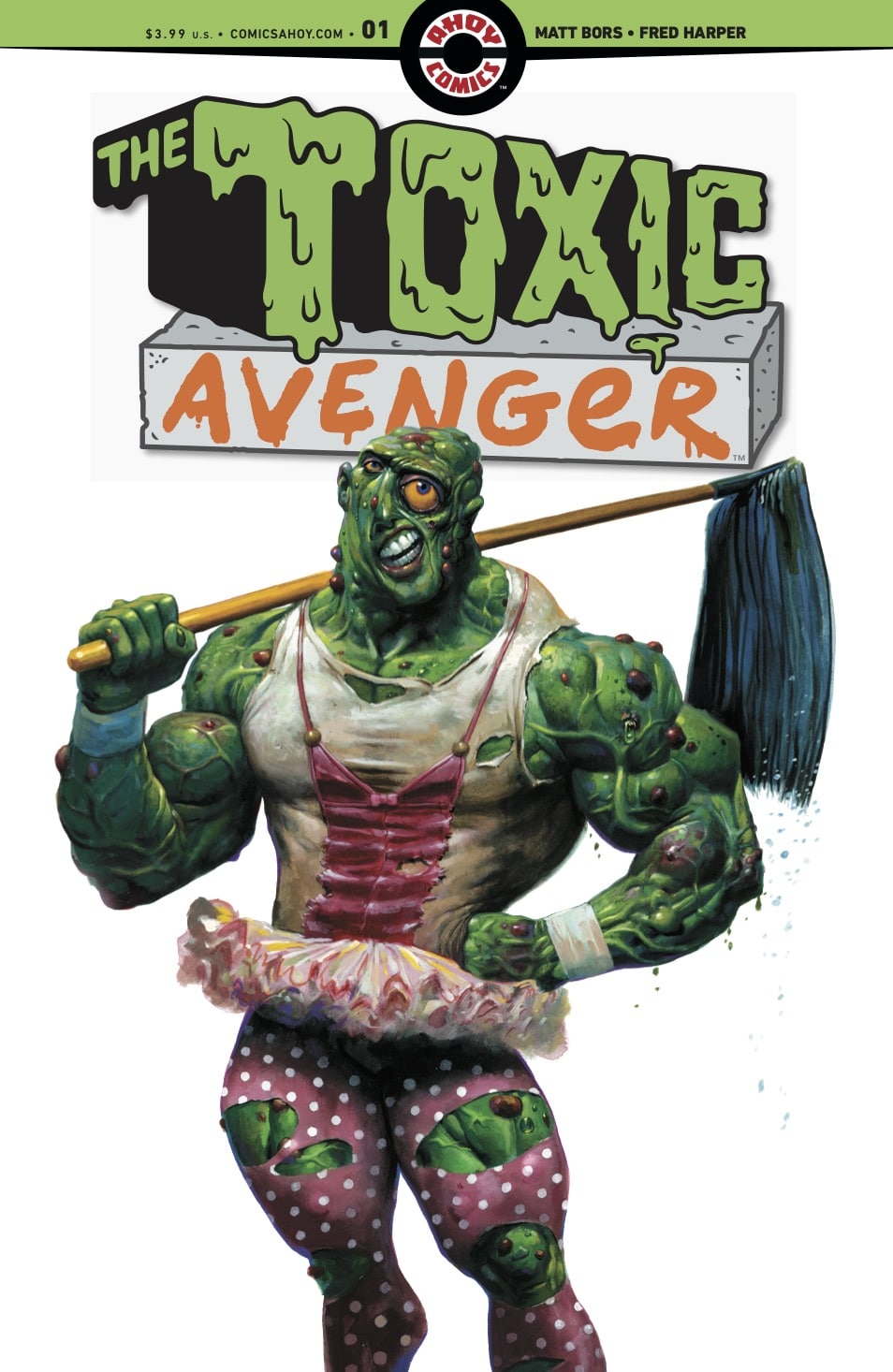
AHOY Comics will be getting toxic at San Diego Comic-Con with a panel featuring author and legendary director Lloyd Kaufman, comic creators Matt Bors, Mark Russell, Tyrone Finch, Melissa F. Olson, Juan Castro, and writer/AHOY Ops guy Stuart Moore. The panel, which takes place on Friday July 26 from 5–6 pm in Room 28DE, will also feature an ashcan comic giveaway that shows readers a first look at The Toxic Avenger, Pulitzer finalist Matt Bors and artist Fred Harper’s take on the satirical superhero that spawned five films, a cartoon, action figures, a musical, and a Marvel comic book series.
In the lead up to the convention, we have an exclusive interview between director Lloyd Kaufman and AHOY’s Hart Seely discussing the movie industry and The Toxic Avenger!
Lloyd Kaufman is the iconic director, producer, screenwriter, actor and co-founder of Troma Entertainment. With partner Michael Herz, Kaufman has pursued the company’s motto, “Fifty Years of Disrupting Media,” these days through its streaming channel Troma Now. But you may know him best as creator of THE TOXIC AVENGER (1984.) He recently spoke with AHOY…
A: Let’s get to it. What makes a great film?
LK: A movie is a balancing act between business and art, and the art should always overpower the business. The best movies reflect a filmmaker’s brain, heart and soul, in the same way of a great painting or, for that matter, music, writing or any art form.
A: These days, is the art overcoming the business? Or is the movie industry moving in the other direction?
LK: The industry is certainly going in the other direction, but thanks to our good friend, digital technology, thousands of young people are making their own damn movies. Most are trying to imitate what’s de rigueur in contemporary industry, but there are hundreds making movies they believe in, which reflect their heart, soul, and brain. And they’re making them for under $25,000.
I’m producing a number of those films, and I’ve found that young people are incredibly able to multitask. Many of them write and perform their own music, so their movies are very personal, and not just an imitation of what the majors are doing. It’s a yin and yang thing. The “yin” is that it’s great that more people are making art. But the “yang” is that they can’t make a living off it. To do that is very difficult.
A: So, you’re optimistic for the future?
LK: Talent will always stick, but there are tremendous roadblocks. Even if some young, new talent creates something original, how do they get it to a big enough public? And when I say “original,” I mean entertaining and personal. How do they get it to the public?
Trey Parker and Matt Stone’s first movie, Cannibal the Musical, which Troma helped them finish, was rejected by every movie company, period. They had come to Troma first, because they were fans. We told them we couldn’t give a big advance because we didn’t have the money, but we loved the film. We suggested they go to companies with big money, but none of those companies could see that Cannibal the Musical was brilliant and that Trey Parker and Matt Stone are geniuses.
A: Two hard-to-miss geniuses.
LK: Sure are. And they came back to us. We were their first and last stops on the train. Now, whenever I have meetings with the mainstream – which is not very often – “the suits,” or whatever you want to call them, they’ll say, “Gee, I really loved that film, I wanted to acquire it, but blah, blah, blah,” But they never really got it. They were too frightened about losing their jobs. They didn’t want to take any risk.
A: With Toxic Avenger, you took a risk. When did you know it had paid off? And were you surprised?
LK: Every time Michael Herz and I make a movie, we believe it’s a great film. But in every case, it takes time for the word of mouth to get out. That’s the only weapon we have to counter the $200 million advertising budgets for the big movies.
Terror Firmer is a very personal film I directed. It was made in 1999, and it’s only now selling like crazy in the Blu-ray form. Many of our fans have discovered it recently. The Toxic Avenger caught on earlier, but at first, none of the theaters would play it, because they didn’t understand that it is a satire. It’s not a horror film, it’s not scary. It may be disturbing in parts, but it’s a Cuisinart of gore, and slapstick comedy – and politics, and sex and everything, all mixed together. But it’s basically, satire.
A: So how did you get it out?
LK: Well, finally, one New York City theater agreed to play it. The Bleecker Street Cinema, owned or run by one of (Andy) Warhol’s associates. And when The Toxic Avenger opened, somehow, there was a line around the block, for a midnight show.
A: Was that the first time you had seen such a moment?
LK: We had some great successes. With Squeeze Play (1979), we hit it because multiplex cinemas were coming into vogue, and we’d made a raunchy comedy – well before (the movie) Porky’s. Squeeze Play was about a woman’s softball team, but it basically concerned the Equal Rights Amendment. We had a sneak preview in Norfolk, Virginia, with a movie called The In-Laws, with Peter Falk and Alan Arkin. The audience loved it, and the next Monday, American Multi-Cinema asked us for 100 prints. Of course, we only had one. The movie ran for about seven weeks in that theater. Slowly, but surely, we built up revenue to make more prints.
Then we took The Toxic Avenger to the Cannes Film Festival. It laid an egg, but then the following year, it suddenly it took off. It did well in England, France, Germany, Italy, Australia, pretty much all the free world. We did well in the theaters.
Part of it was also the videocassette boom, with companies eager to fill their shelves. So, we got lucky. Since there had been theatrical successes, we promoted the movie as if it was a theatrical release. We believed in it. It wasn’t just a sausage.
Distributors actually came to the screenings and enjoyed the movie for what it was, rather than trying to cram it into some category. And that was the beginning of people realizing that Troma was something different.
A: Are politics necessary in a movie?
LK: No, but there should be something in there that isn’t just Prosecco, you know? You want to entertain the public, but you also want to give them something to think about. It can be something like Enchantment (1948) with Teresa Wright and David Niven. It’s a romantic movie that deals with real human passion and love, but it’s also a beautiful period piece. You know, even Hitchcock had certain themes. He always made fun of the police. He always put satire in his movies.
A: I should tell you that wife and I saw Toxic Avenger back when we were dating. A great memory.
LK: Movies bring memories in different ways. There’s something about art that plugs right into people.
A: These days, some critics are down on Marvel and DC movies, suggesting the superhero genre has run its course. Do you agree?
LK: I think the big money has been playing it too safe. Directors and writers have been forced by the suits to add various ingredients, like in a recipe. But then I think of Superman being done by James Gunn. He’s going to make a movie that reinvigorates the whole area. He’s the hope. And, of course, he started with us. One of our best movies is his Tromeo and Juliet (1996).
He’s a true artist. He’s good with people and an awfully nice guy. His Superman will be terrific.
A: These big names, who started with Troma, do they stay in touch?
LK: Trey and Matt put me in two of their movies. James Gunn put me in Suicide Squad and Guardians of the Galaxy. If I get the call about Superman, I’ll go.
A: You once said, “Troma may let you down when it comes to a lot of things, but never ever will we fuck you over when it comes to a crushed skull.” Great line. But is that the essence of Troma? How much of it is true?
LK: That’s from a book I wrote a long time ago. We combine a lot of elements, satirical and graphic. And for 20 years now, just about every movie has had a crushed skull. In that regard, we’ve been running ahead of the mainstream. You know, I hear Spielberg has a full head-crushing in Schindler’s List, Part II!
For our half-century anniversary, Michael Herz came up with a slogan that I love: “Fifty Years of Disrupting Media.”
A: So, what disruptions are next?
LK: I’ve been producing movies by young people. Most recently, Kill Dolly Kill (2023) by Heidi Moore – a transvestite comedy musical horror film. Very influenced by Troma. And Liam Regan, a British dude who, a long time ago at age 16, took a bus attend my master class at Oxford. I produced his latest, which is called Eating Miss Campbel (2022). A very Troma movie.
These are movies with budgets mostly under $50,000. Maybe one is $75,000. There’s Curse of the Weredeer (2023), an anti-hunting movie, by Ben Johnson, not to be confused with the British philosopher. He’s from Tennessee. He’s producing a film in pre-production, which I will direct, loosely based on Crime and Punishment. That will be a bit different from what I’ve been doing. But it deals with many issues. People, you know, can’t live today. They can’t pay the rent. Their groceries are exorbitant – all these things closing in on the character of Raskolnikov.
Then there’s The Power of Positive Murder is from a script by Martin Murray, who, oddly enough, was mentored by Steve Martin. He worked for us briefly, and I gave him a shot at writing this. I think it’s great. We’re starting to look for locations and cast. We hope to shoot late July, early August. My wife and I will pay for it. I can’t ask people to invest in it.
A: Why not?
LK: Because it’s impossible to make money – especially on a $400,000 or $500,000 budget, unless you just have incredible luck.
A: What’s the trick to making an inexpensive movie?
LK: Well, it’s young people. Today, they can do everything themselves. A lot of parts – like color correction and mixing sound and shooting – they do it themselves. Ergo, they can make a really good-looking movie, very entertaining, for $50,000.
Many of these are on Troma (streaming video) now. The ones I do cost about $400,000, $500,000. I’m a little bit like Orson Welles in that, when he did movies like Touch of Evil (1958), people basically worked for him for nothing. I’ve been able to get underground stars. I can’t shoot SAG (Screen Actors Guild) actors, so I can’t get big stars, even though many would like to work for us.
I can get underground names, but people aren’t necessarily going to buy tickets, unless a miracle happens. If I direct a movie, I think I can get it in about 200 theaters. But except for New York and LA, they’ll only be up for a weekend or one night. Maybe if it does well, we’ll get two weeks.
A: Does word of mouth still work?
LK: Yes, it still works. But it might take 25 years. Terror Firma turned a profit, but it took about that long to do so. It’s profitable because Blu-rays, and word of mouth are still big enough, and there are enough generations out there who love Troma.
Troma may be the only streaming service that is profitable, right now, because we own or control most of the films. We don’t have to pay.
A: What’s the trick in balancing humor and horror?
LK: Good question. In our movies, most of the horror is slapstick, cartoon horror. For example, (actor Joseph) Fleishaker, our 400-pound action hero, gets eaten by an escalator. Just the idea of a 400-pound guy falling down the escalator is funny. Then this mysterious woman chops him up with an axe, which just happens to be there – no reason – it’s just hanging on the escalator. So, he gets chopped up and eaten up by the escalator. And believe it or not, it’s funny.
I know, to some people, it’s also disgusting. But right after that, Lemmy (Ian Kilmister) from (the iconic British rock band) Motorhead – of all people – plays a reporter. It’s so random, so full of surprises. By the way, Lemmy’s a sweet guy. He’s like Stan Lee, appearing in about eight or ten of our movies.
A: What do you hope to be remembered for?
LK: Hm-mm. The movies will live on. If nothing else, The Toxic Avenger.