I’m reading every Fantastic Four comic and posting four thoughts on each. The concept of articles about the Fantastic Four was invented by Rich Johnston. No infringement is intended.
Today it’s…
Spider-Man #90
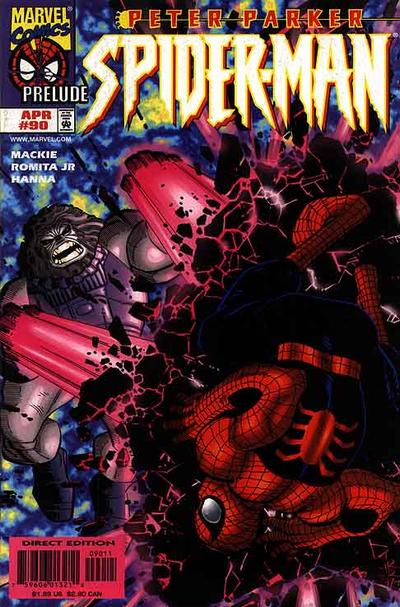
… from April 1998. A Spider-Man/Fantastic Four team-up with a difference.
Written by Howard Mackie. Penciled by John Romita Jr. Inked by Scott Hanna. Coloured by Gregory Wright. Lettered by Kiff Scholl. Edited by Ralph Macchio.
ONE
This issue is a prelude to an event called ‘Identity Crisis’ which….WAIT! STOP! COME BACK! It’s alright. It’s alright. Different ‘Identity Crisis.’ This one’s a bit of harmless fluff about Spider-Man dressing up in four different costumes as part of an elaborate plan to beat a murder rap. It’s bags of fun. Fun which I’m over-simplifying it a little, as Spidey doesn’t just adopt four new costumes but four new names, four new personae, four new fighting styles, and three new speech patterns. The costumes are what matters here though, as this issue is the origin of one of them.
The ‘Hornet’ costume he gets given by a friend, the ‘Ricochet’ costume Mary Jane puts together in a charity shop, the ‘Prodigy’ costume he and MJ design together, and the ‘Dusk’ costume is inherited from the figurehead of a revolutionary uprising within a universe of antimatter. Only that last costume is thought to need a whole introductory issue rather than a brief introductory flashback, which probably sounds fair enough until you know that the look the spider-spouses collaborated on is the one that involves Peter slathering himself in gold body paint and gluing on a big fake nose. My opinion on how entertaining their marriage is to read about could be completely reversed by twenty pages of them workshopping that. Trying on different noses. Brilliant.
But this issue is about introducing the Dusk costume, so let’s try concentrate on that. Which won’t be easy because the issue doesn’t. Before it gets to Dusk it introduces another new costume that’s got nothing to do with any of this. Another new costume that serves no narrative function whatsoever and which only gets referenced once in the text. “A little costume change,” notes Peter as he takes stock of the effects of being converted into anti-matter and crash-landing on an alien world. After that no more is said about it. Not much is shown of it either. Three pages pass between Peter noticing that he’s wearing something different and us getting a proper look at what it is he is wearing.
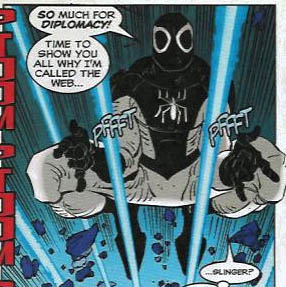
That one panel, bunched up at the top right of a page, is as good as it gets for full-length looks at this outfit, which is then just shown in head shots, long shots and ass shots for another four pages before he changes out of it and into into the Dusk clobber. There is an implicit rationale for the design – Peter has been gifted part of the Dark Force of a vigilante called SHOC and this get-up shares some features with SHOC’s costume to the extent that it’s monochrome and John Romita JR-ish – but it’s still incredibly eccentric. We’re given a new costume for Spider-Man that isn’t talked about or shown off, and we’re given it in an issue whose purpose is to introduce a different costume for Spider-Man. What’s going on there?
I’ve got two guesses! Maybe you could look this up somewhere, but guessing is fun. One is that Romita Jr designed this costume for the ‘Identity Crisis’ event without it having been explained to him that the concept wasn’t ‘four different Spider-Mans’ but ‘Spider-Man dressed up as four different people who aren’t Spider-Man.’ The mix-up having left him with a spare spider-look, he decided to get some use out of it here whether the story called for it or not. Does that sound plausible? I don’t blame him at all if that’s how it went. This costume really is pretty cool. Monochrome Spider-Man outfits are almost always onto a winner – the symbiote costume, the Future Foundation costume – and this is no exception.
My other guess would be that JRJR was maybe just trying to put off drawing the Dusk costume for as long as possible because it’s a bit shit. It’s a featureless silhouette, such as could only be of any possible interest as a move in the Anish Kapoor/Stuart Semple artwar, and it’s got those stupid flying squirrel wings that join your arms to your legs. You know the things – Banshee has them sometimes and Spider-Man threatens to go that way whenever his armpit webs are getting out of hand. Here they’re even worse than usual. Take a silhouette, join its arms to its legs by big flaps of material, and put it in an action pose and all you’ve got’s a big ol’ blob. Monochrome Spider-Man outfits are almost always onto a winner and this is the exception.
I might hate the Dusk blob but it means a lot to the people of Tarsuu, the planet within the Negative Zone where all this is going on. There’s a heroic rebellion against an evil empire underway round those parts and Dusk was its inspirational leader until he went missing and a second Dusk took on the identity. That second Dusk gets wounded in this story and passes the identity to Peter. At this point you’ve probably got suspicious that this is all a bit like the Dread Pirate Roberts from The Princess Bride and that there’s no single individual who is the authentic ‘Dusk’, just a myth and a lineage. Doesn’t seem to be the case though. The leader of the evil empire understands his opponent to be a singular, recognisable individual and the later Dusks to be imposters. The second Dusk believes that the first is out there somewhere, that he’s just keeping his seat warm, and his final words are an unheard repetition of his plea that Peter find the true Dusk.
So becoming Dusk, as it’s explained to Peter, doesn’t mean that you actually become Dusk. Just that you take on his responsibilities and the further responsibility of having a look round to see where the original’s gone. Which I think makes what he does next a little bit rude.
He deals a big blow to the evil empire, which is helpful. Then he gives a speech to the grateful rebels about how Dusk will always be with them when their need is greatest, which is a big fib but also probably helpful. Then he vamooses back to Earth, which is fair enough as it would have been a big ask for “Dusk fights an endless war across the Negative Zone” to be the new status quo of the Spider-Man titles, but the least he could have done is leave the costume behind for a fourth Dusk to stick on. The very least! What’s he need it for back on Earth? He can get new identities just by rummaging around charity shops and gluing on comedy noses, while these beleaguered rebels are short a mythic figurehead now he’s run off with their vantablack pyjamas! What a dick.
Look at what goes through his mind regarding the Dusk role. As he leaves Tarsuu everyone’s cheering him and he’s loving it. As, still dressed as Dusk, he returns to New York with some rescued kids then everyone there is cheering him and he’s loving that too. “I don’t mind basking in a little hero worship for a change,” he tells SHOC. Peter ends this issue thinking about how much he likes being Dusk because everyone likes Dusk. But once ‘Identity Crisis’ starts then he’ll opt to play Dusk as a sinister crook and disgust himself so much that he’ll start showering excessively. Starting to suspect this boy doesn’t want to be happy.
Someone else inherits this identity after Peter, so maybe she eventually returns to Tarsuu, finds the original Dusk and sorts it all out. Looking her up, it seems like she falls off a roof and dies in her first appearance so it doesn’t sound too promising.
TWO
There’s a lot of overlap between the world of Spider-Man and the world of the Fantastic Four and many team-up stories explore that, but there’s another sort of Spidey/FF adventure that works by putting Spider-Man in the parts of their world that are not part of his. Often those stories are written by Dan Slott and often they’re my favourites.
I’m thinking of things like that abortive trip to ‘a weird dimension’ from Spider-Man/Human Torch #2 or the two different jaunts to the Macroverse we see in Amazing Spider-Man #590-1. Stories that have the Fantastic Four going about their most generic day to day work of travelling to new realities with different laws of physics and finding themselves in circumstances where they have to decide the fate of entire alien civilisations, some of which will probably be some kind of techno-barbarians who’ve glued canons to big lizards. The sort of FF stories that can become very overfamiliar, but defamiliarised by having Peter Parker along to be freaked out by it all.
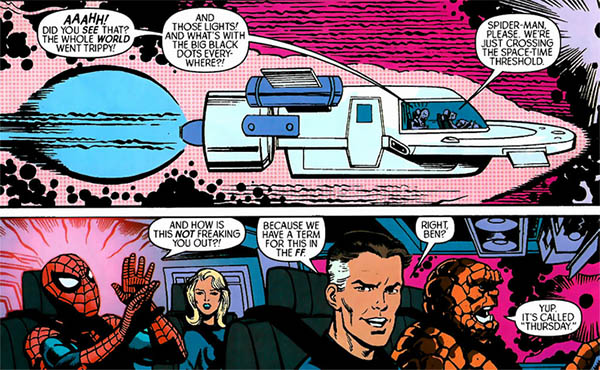
Beyond having Spider-Man be alarmed and refreshed by the technobabble and the Kirby dots, stories that contrast his life with the Fantastic Four’s tend to want us to notice two big differences; Scale and integration. Swapping jobs for a day in that Spider-Man/Human Torch issue then Peter wishes Johnny good luck with saving the city and Johnny tells him he’ll need good luck with saving the universe. We’ll investigate scale below, but the basic idea of having Spider-Man visit somewhere called ‘the macroverse’ is obviously to put forward the idea that he’s stepping into a bigger world.
Integration’s where the real emotional stakes are in contrasting Spider-Man’s life with theirs. His life is defined by a harsh separation of its components and by the horrors that arise from his struggles and failures to keep those walls up. The Fantastic Four’s lives are defined by the absence of those walls. Being adventurers and being a family are the same thing for the FF, family is the word for the adventure they’re on, and so there’s a real poignancy in seeing Peter Parker on a Fantastic Four adventure. They’re inviting him into their family, where they all have reasons to want him, and there are limits to the extent to which he’s capable of accepting. Limits set by his inability to imagine living one life where the pieces fit together. Imagining being five different people is easier for him than that.
Spider-Man #90 has almost all the features of a story in which Spidey tags along on an FF romp. We open on Yancy Street, part of their New York, not his. Mary Jane immediately understands that they’ve stepped out of their personal story space and opens the issue with the words, “I told you we shouldn’t have gone walking in this part of town.” Sure enough, this part of town soon leads us to the Distortion Field, and the Negative Zone, and Blastaar the Living Bomb-Burst and having to decide the fate of entire alien civilisations, and everything short of techno-barbarians gluing canons to big lizards. As soon as he swings down on to Yancy Street then, other than a brief appearance by SHOC, everything he encounters originates from, or is typical of, the Fantastic Four mythos. Spider-Man spends none of this issue in a Spider-Man story.
One odd thing though. The Fantastic Four aren’t in this comic anywhere.
That’s annoyingly disruptive for the rules I’ve chosen for what this project is and isn’t supposed to cover, but really interesting in terms of what it reveals. How does Spider-Man cope with a Fantastic Four crossover to which only he’s shown up?
The answer is “Um…kind of…better?” Or at least with much more comfort and confidence. Part of that is because they’re with him in spirit as a knowledge base; He can remember what Reed once told him about surviving the Distortion Area. He can remember what Johnny once told him about fighting Blastaar. With all these facts in his head he breezes through this issue with aplomb, leaping between worlds and toppling empires without breaking a sweat. He has a lovely time and everyone’s very pleased with him.
If Spider-Man’s life contrasts with the Fantastic Four’s in terms of scale and integration then it’s clearly not the scale part that spins him out. He ignites flames of revolution that burn from world to world without really stopping to reflect that this is an unusual day’s work for him. When it does register then it’s with mild approval. “This is cool! I get to fly… and have an entire world singing my praises!” is as reflective as he gets.
Spider-Man can step out of his life and into the Fantastic Four’s and it doesn’t rattle him at all. As long as they’re not there. As long as there’s nothing to remind him that the parts of one’s life are parts of a whole.
THREE
In Onslaught/Heroes Reborn, as I find myself summarising most weeks, the Fantastic Four and the Avengers died, only to be somehow transferred across to a new universe of Franklin’s creation. A lot of things happened and then they sailed back to their original lives in a big space boat.
I am fascinated by every trivial detail surrounding the journey in that big space boat. It feels to me like such a strange and poetic move between the physical and the metaphysical. The heroes who Franklin initially shunted over into his world have different bodies and minds to those that died in their own, so if we grant that he really did save anyone then he can only have done so as an essence distinct from both physicality and consciousness. Those who entered Franklin’s world did so as souls. Then they left it by all physically getting on a big space boat.
How they reenter their original universe is not consistent. The boat explodes and the heroes return home at different times, in different places, with different mental health problems and with differing levels of memory regarding the alternate lives they’ve just lived. Nobody just passes from one world to another as a stable object; They’re run through Google Translate and then run back through it again the other way.
This comic is unusual in that it addresses Spider-Man having been on that boat.
Spider-Man didn’t die in Onslaught, nor did he get reborn in Heroes Reborn. He was kind of just along for the ride. Heroes Reborn: The Return saw him accidentally dragged into Franklin’s universe because he was holding the Hulk’s hair while the Hulk was being accidentally dragged in. Once there he performed his plot function of being an independent witness who could confirm to the Avengers and Fantastic Four that a bigger world existed and they were all from it. Then he stood politely in the background as he caught a lift home. He was with the Avengers and the Fantastic Four as they returned. He was on the boat when it exploded in the gulf between realities.
Then next we see him, in relation to these events, is in Marvel Team-Up #6, where it’s still the night of the Heroes return but now Peter is sat at home learning about it with Mary Jane. She’s keen for details and he’s not really got any to give, unable to recall what Franklin’s universe was, how anyone got there in the first place, or who made it back. The most he can manage is to say that it was “Weird. Very weird.” We don’t know how he got from that inter-reality explosion to that sofa, but the process seems to have left him with less than perfect recall of the details. Then, in Amazing Spider-Man #360, we see him swinging about shouting “They’re alive! They’re really alive!” as if this is information which he’s either only just learned or only just been convinced of. Everything suggests that, for Spider-Man, his late game involvement with Heroes Reborn has been left as a bit of a blur.
Here, however, he seems well appraised of the specifics. Passing through the Distortion Area, he thinks to himself, “I recognise [this] place. Made a trip through it not too long ago… during the return of the heroes from that strange universe. I think I heard Reed Richards call this the Distortion Field. A Portion of subspace where matter is converted into anti-matter and vice versa.”
What’s interesting about this isn’t the inconsistency but rather the consistency with how Heroes Reborn frames the Negative Zone. In Heroes Reborn it’s the place you go to remember things that happened to you outside of your life. The Reborn Fantastic Four visited there from inside Franklin’s universe, met Blastaar the Living Bomb-Burst, and received visions of their lives in their previous continuity. These visions changed Sue, who would continue to dream of a son she’d met but never had. Later, Reed proves to Tony Stark that their lives aren’t what they thought they were by getting him to carbon date some old rock; dating it within the world showed it to be a sensible age for some old rock to be, but taking it outside of the world and into the Negative Zone to run the test showed it to be less than a year old.
If the logic of Heroes Reborn positions the Negative Zone as a figurative space between the Fantastic Four’s two lives, the logic of the boat trip home goes further, making it the literal gulf between the two realities in a complex multidimensional geography that brings in the Distortion Area and the literal boundaries of Franklin’s imagination and invokes the Microverse. All these bits of what Sandman calls “psychic real estate” are rezoned as places to be traversed in the act of translating yourself from one person to another. The Negative Zone is established as a space between who you are and who you aren’t. As places to acquire a new identity go, it’s at least as good as the rubber nose factory.
FOUR
Some things become absurd when you try and systematise them (I’m reading every Fantastic Four comic and posting four thoughts on each). ComicVine’s summary of Fantastic Four #29, for example, lists the issue as featuring four different ‘teams’; The Fantastic Four, the Yancy Street Gang, Super-Apes, and Communists.
That FF issue is titled ‘It Started on Yancy Street…’ while this Spider-Man issue is titled ‘It Started on Yancy Street…Again!” but what event is recurring? Can’t find any Super-Apes or Communists round here.
They’re all over Fantastic Four #29 though. Especially the letters page, the story pages serving almost as a prequel to its debate over how Fantastic Four should address the Red Menace. Alex Nicholson from Nashville wants to see the FF continue to be pitted “against the forces of Communism, which is a much bigger threat to our nation than crime is” while Jim Gibson from Santa Rosa reckons that the book “should quit cutting down the Soviet Socialistic Republic’s leaders.” Jim is concerned that Fantastic Four might start to look a little like propaganda. Surely not!
As ever, the story itself has no interest in considering or discussing Communism as anything other than a Foreign Threat. It likes the idea that it’s Totalitarian, because that’s a bit like Nazis, but that’s about as concerned as it gets with any ideological critique. But the story is very interested in puzzling through questions such as those raised by Nicholson from Nashville’s letter. Who should the Fantastic Four be fighting? Nicholson’s approach to answering the question is to consider various real world threats (“Crime! The Commies!”) and rank them in order of danger, with the FF best advised to direct their efforts against the most severe. That’s fine as far as it goes, but is sod all help in working out how they should prioritise time travelling Pharaohs and pranksters from the planet Poppup. Where do they fit on your national threat scale, eh Nicholson?
As Superman says in JLA Classified #3, superheroes live in a complex world. Comicvine has it right; Fantastic Four #29 has the Fantastic Four, a street gang, communists and super apes. It has all those things and a real interest in sussing out how they fit together. Does Spider-Man #90 have similar interests, or it it happier to live in the desert of the toybox? Let’s play both stories out alongside each other.
The Spider-Man of Ninety Ninety-Eight visits Yancy Street to investigate some Algerian cuisine he’s read about. The Fantastic Four of Nineteen Sixty-Four visit there to investigate a drastic rise in crime they’ve read about. One is under the impression that they’re someone who gets to go out for a nice meal and the other under the impression that they’re suited to investigating urban crime. Both are swiftly disabused of these notions, Spider-Man by witnessing some teenagers being dragged into another reality and the Fantastic Four by having some cabbages and things thrown at them. Spider-Man throws himself into the portal and the Fantastic Four just go home to have a think.
It starts on Yancy Street for both of them , but it leads them to very different places. On arriving in the Negative Zone, Peter clocks the space war that’s going on around him and thinks, “A good old-fashioned, George Lucas inspired, rebels versus the evil empire rebellion is taking place.” He’s keen to pitch in but unable to tell which side’s which. “Oops! Problem solved!” he says a panel later, “The bad guys would be the ones blasting the buildings with women and children.” His conclusions are shown to be uncannily correct, right down to the rebels being called ‘The Rebels’ and the empire being called ‘The Empire.’
Peter’s journey has two stops; from Yancy Street to the Negative Zone. The Fantastic Four’s has several. From Yancy Street back home to look up who might be behind all this in their Big Book of Baddies, then back to Yancy Street to fight Super-Apes, then to the Moon, then to the Watcher’s home. Each move comes with an escalation of scale; our first visit to Yancy Street deals with spiralling crime so petty that it would be truer to say the area has seen an alarming rise in the prevalence of pranks, our second visit deals with a Communist plot enacted with the help of super-apes, and from there the sky’s the limit.
“Let me warn you that this ship works on magnetic power and can be controlled only by my orangutan!” cautions the Red Ghost, and you’re not going to read a better sentence than that today. Magnets and monkeys lift us off to the moon, where our concerns eventually move beyond the solar system as the Watcher shows off his treasures from other galaxies and our dastardly communist foe falls through one of them and off into infinity.
That’s a move from the criminal, to the super-criminal, to global politics, to the solar system, to intergalactic space, to a vastness beyond knowing; Fantastic Four #29 but every time it gets faster. What’s remarkable though is, as we shift scales, everything remains in play. There’s a little of this in the Spider-Man comic. Peter found himself in the Negative Zone because of his attempt to rescue those teenagers and so, when the rebel leader asks him what he’s doing there, he answers “the protection of innocents” and the rebel leader concludes they are in the same line of work. But other than the endorsement of this uncontroversial principle, there’s no interpolation of the two worlds. Peter is not left with any impetus to fight crime on Tarsuu or incite revolutions on Earth. It starts on Yancy Street, but it will not continue there.
The Fantastic Four issue is the very opposite, in that story then everything is part of everything. Supervillainous microdrones buzz unnoticed around Yancy Street. Familial proximity to supervillains forces Ben to reevaluate his love life. The Russian space program begets super-apes. Super-apes fund street crime. The Fantastic Four may operate more effectively at certain scales, as they abandon their efforts at community policing Johnny comments that he hopes Spider-Man never hears of it, but once again it’s less a matter of scale than of integration. Because what happens on this one New York street happens because of Space Gods and the Cold War and what happens to Space Gods and in the Cold War happens because of one New York street. It starts on Yancy Street and it never leaves.

 Jack Kirby fans like myself have been waiting with baited breath to see the return of our beloved escape artist superhero Scott Free, aka Mister Miracle and his possibly even more beloved mighty wife, Big Barda.
  I love what artist Mitch Gerads does with the characters’ faces. The older Scott we see here is exactly the right combination of handsome and weary, even when smiling at the camera in panel #1. I want to give him a hug. Barda is so very tall and strong, using her superior size to envelop her husband protectively or intimidate others when needed. She is one of the few female characters in comics who’s allowed to be physically larger than men and have visible muscles. Scott’s assistant Oberon has never looked more like Jack Kirby himself than he does here.


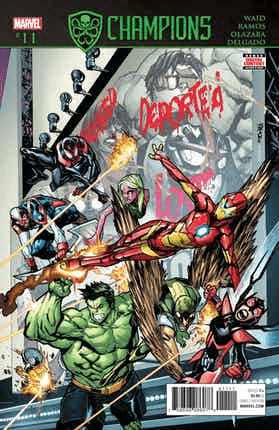 Broken up and dispersed all across the U.S. In Champions #11 the team still fights the good fight. If they can’t pull together soon, everything they stand for will turn to ash!
 Kathryn Bigelow‘s newest shows off her impressive talent as a director capable of creating relentless tension, but her cast and the social message are the real stars here. This is, unfortunately, one of those great movies that all the people who really need to see it and understand it never will. (See also: Fruitvale Station)
 Matthew and Arlene Daley’s Not-So Secret Society promises an adventure appropriate of all ages, crafted by its creators’ background as parents and educators. In
  As I read on, it became clear that the Daleys were driving toward that exact point with their story. The Society’s involvement in a city-wide science fair, a rivalry with fellow scientist team The 5Zs, and the revelation that their “living candy” experiment all quickly swerves the work toward science fiction rather than science fact, and left me wondering about the classroom application of the work as a whole – that is, until I stopped reading the work as a testament to the joys of hard science and started to appreciate it for what it was: an extremely well-crafted work about the importance of ethics and morality in the S.T.E.M. fields. While there is a little light science mixed in here and there, the bulk of the narrative seems far more interested in the why and how rather than the what – a unique angle that’s both far more essential and much more engaging.
 Taken as a comic book, The Not-So Secret Society does a great deal to make itself visually as well as conceptually appealing. Wook Jin Clark’s art style is reminiscent of the Saturday morning cartoons I grew up on with a bit of a manga flare thrown in for good measure (note the exaggerated “shock” lines when a character is taken by surprise, or the phantom limbs that mark where arms and legs were when a character makes a quick gesture). The paneling that makes up most pages is clean and easy to follow, frequently broken up by splash pages that do a wonderful job of setting the tone and scope of the Society’s world while making exceptional use of Elonora Bruni’s immensely varied color palette. The world of the Society looks expansive, vibrant, and alive, the perfect mix for the enthusiasm that the Society (and the Daleys) bring to the story.
 Hadrian’s Wall #8 (Image)** – Having wrapped up the “whodunnit?” portion of their story in this series’ penultimate issue, Kyle Higgins, Alec Siegel, and Bill Sienkiew — sorry, Rod Reis — focus on the personal side of things for their highly satisfying, lavishly-illustrated conclusion. The result? A comic that definitely exits on a very high note indeed. Overall: 9 Recommendation: Buy
 Shean
Shean Sex Criminals #20 (Image)** – Even when they don’t succeed, Fraction & Zdarsky are always trying something. But I think two things are getting in my way these days: their formal experiments and their plotting. I have the feeling that both of these things are being laid on top of what are very strong and interesting characters and a very necessary theme. What Dr. Kincaid says is, I think, true of this book as well: the creators are spending so much time chasing a “that” when all I really want is for it to be about “us”. When Matt and Chip just spend time with the actual human beings in the book, they are really brilliant. But they can’t seem to resist undercutting their own humanity with corny jokes and their need for “plot” and “action”. Overall: 7.5 Recommendation: Read
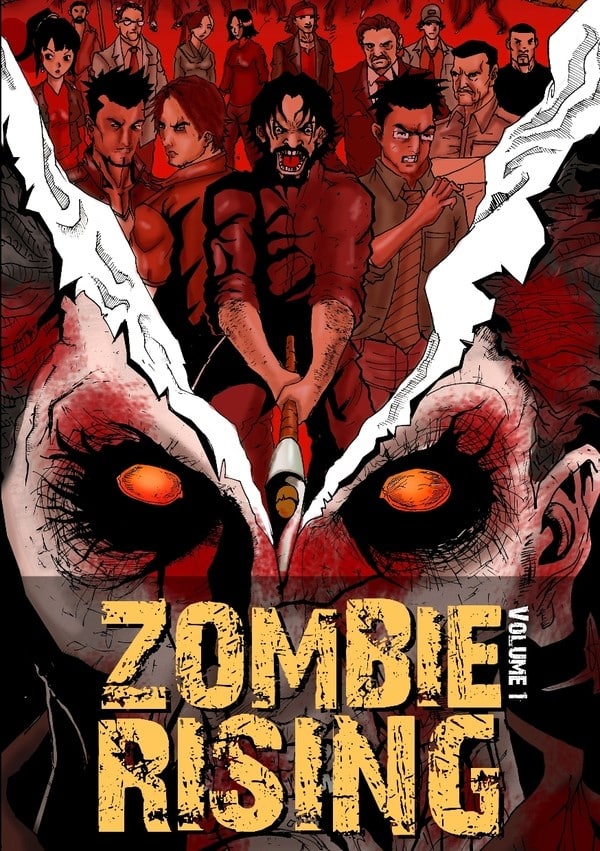 The recent passing of George Romero, has left huge hole in the movie industry. The invention of the “zombie”, reaches as far back as French occupied Haiti, but Romero, is the one person who made the Zombie famous. In the Night of The Living Dead, his classic movie, he made zombies scary. He would go no to make more than few movies about zombies, and every one of them added to the canon.
 The 1980s were fertile ground for filmmakers, as some of the best films ever made was during this era. Yes, there were a ton of movies, that were just plain cheesy and doesn’t hold up today, no matter how many viewings. To me, that was part of their charm, their innocuous disregard for anything that makes sense, as Honest Trailers would have a field day with any number of movies. This was also one of the very last times, that a movie star’s name was enough to guarantee ticket sales.
 Fear of technology is one of those themes that Isaac Asimov, mastered in his time. In I Robot, the dangers of artificial intelligence are explored and also how it affects human life. Daniel Wilson, also explores the capacity of robots and how fearful we should be of artificial intelligence in Robocalypse. Both stories, makes one question how much we need technology and just how smart do we need artificial intelligence to be.