Tag Archives: kelly sue deconnick

Marvel Weekly Graphic Novel Review: Captain Marvel, Guardians of the Galaxy, and Wolverine

It’s Wednesday which means new comic book day with new releases hitting shelves, both physical and digital, all across the world. We’ve got three more volumes from Marvel covering a wide range of characters and years.

Captain Marvel Vol. 3: Earth’s Mightiest Hero collecting issues #1-11 from 2014 by Kelly Sue Deconnick, David Lopez, Marcio Takara, Laura Braga, and Lee Loughridge.

Guardians of the Galaxy Vol. 3: Civil War II collect Guardians of the Galaxy (2105) #11-14 and material from Free Comic Book Day 2016 Civil War II #1 by Brian Michael Bendis, Valerio Schiti, Kevin Maguire, Jim Cheung, John Dell, Richard Isanove, and Justin Ponsor.

Wolverine: Prehistory collecting Wolverine (2003) #32, Logan: Path of the Warlord, Shadow Society, Wolverine: Agent of Atlas #1-3, First X-Men #1-5, Wolverine: Hunger, Wolverine (1988) #1, Before the Fantastic Four: Ben Grimm & Logan #1-3, Wolverine/Cable, Material from Marvel Comics Presents (1988) #93-98, Wolverine: The Amazing Immortal Man & Other Blood Tales, and Wolverine (2010) #1000 by various writers and artists.

Find out what each trade has in store and whether you should grab yourself a copy. You can find all three in comic stores February 15 and bookstores February 28.

Get your copies now. To find a comic shop near you, visit http://www.comicshoplocator.com or call 1-888-comicbook or digitally and online with the links below.

Captain Marvel Vol. 3: Earth’s Mightiest Hero
Amazon/Kindle/comiXology or TFAW

Guardians of the Galaxy Vol. 3: Civil War II
Amazon/Kindle/comiXology or TFAW

Wolverine: Prehistory
Amazon/Kindle/comiXology or TFAW


Marvel provided Graphic Policy with FREE copies for review
This post contains affiliate links, which means that if you click on one of the product links and make a purchase, we’ll receive a percentage of the sale. Graphic Policy does purchase items from this site. Making purchases through these links helps support the site.

If/Then: If You Liked Hidden Figures Then Check Out These Comics!

When it comes to suggesting comics for individuals to check out, it’s often good to start with what they like in other media like television, movies, books, or video games. Enter If/Then, where we’ll throw out suggestions for you to check out! First up, the film Hidden Figures which opens in wide release this coming weekend!

Hidden Figures is the incredible untold story of Katherine G. Johnson (Taraji P. Henson), Dorothy Vaughan (Octavia Spencer) and Mary Jackson (Janelle Monáe)-brilliant African-American women working at NASA, who served as the brains behind one of the greatest operations in history: the launch of astronaut John Glenn into orbit, a stunning achievement that restored the nation’s confidence, turned around the Space Race, and galvanized the world. The visionary trio crossed all gender and race lines to inspire generations to dream big.

If you enjoyed the film, or interested by the subject matter, here’s five comics for you to check out and why!


marchMarch – The celebrated and award-winning graphic novel by Congressman John Lewis, Andrew Aydin, and Nate Powell recounts Cong. Lewis’ experiences during the Civil Rights Movement. A first-hand account of pivotal history brought to life through graphic art, the graphic novels consist of three volumes taking you through the turbulent times and delivering an educational and emotional read.

Each volume seems to improve on the next not just taking you through history, but is presented in such a fashion that’ll leave you speechless as you ride through the emotional roller coaster within.

This is a prime example of the power of comics and graphic novels in helping preserve and teach history.

Buy it Now! Digitally Vol. 1 Vol. 2 Vol. 3 | Physical


shechangedcomics-1CBLDF Presents: She Changed Comics – If you want to learn some history about women in comics, check out CBLDF Presents: She Changed Comics which was put together by the Comic Book Legal Defense Fund.

She Changed Comics is the definitive history of the women who changed free expression in comics, with profiles of more than 60 groundbreaking female professionals and interviews with the women who are changing today’s medium, including Raina Telgemeier, Noelle Stevenson, G. Willow Wilson, and more! She Changed Comics also examines the plights of women imprisoned and threatened for making comics and explores the work of women whose work is being banned here in the United States.

The Comic Book Legal Defense Fund has also put together a web page as a resource where you can find out more about women in the comic book history.

Buy it Now! Digitally Digitally | Physical


the_unstoppable_wasp__1The Unstoppable Wasp #1 – A superhero comic might feel like an odd choice for this one, but hear me out as to why. Written by Jeremy Whitley with art by Elsa Charretier, the comic features the newest Wasp, Nadia Pym, as she attempts to find her way in the superhero world.

What makes this comic make the list is the focus on STEM, women in science, and smashing the patriarchy. The comic has Nadia finding her role and throws it out there that until recently the Marvel Universe was dominated by men (and mostly white men) until recently and it’s time to get some women recognized when it comes to the smartest people in the Marvel Universe.

What’s also great is each issue will feature real women who work in STEM fields in real life through a Q&A. The comic not only entertains but also hopefully will encourage more women to enter this world for a career.

Read our review and our ten reasons to get the first issue.

Buy it Now! Digitally Digitally | Physical Physical


cmpursuitcoverCaptain Marvel Vol. 1: In Pursuit of Flight – Ace pilot. Legendary Avenger. One hundred percent pure bad-^&*. Carol Danvers has a new name, a new mission – and all the power she needs to make her own life a living hell. As the new Captain Marvel, Carol is forging from a challenge from her past! It’s a firefight in the sky as the Banshee Squadron debut – but who are the Prowlers, and where has Carol seen them before? And how does secret NASA training program Mercury 13 fit in? Witness Captain Marvel in blazing battlefield action that just may change the course of history! Avengers Time Travel Protocols: engage!

Written by Kelly Sue Deconnick with art by Dexter Soy and Emma Rios, the story is fun action, but also explores the little known history of the women who attempted to join the Apollo program.

Buy it Now! Digitally | Physical


laika_bookcover1Laika – Laika was the abandoned puppy destined to become Earth’s first space traveler. This is her journey.

Nick Abadzis masterfully blends fiction and fact in the intertwined stories of three compelling lives. Along with Laika, there is Korolev, once a political prisoner, now a driven engineer at the top of the Soviet space program, and Yelena, the lab technician responsible for Laika’s health and life. This intense triangle is rendered with the pitch-perfect emotionality of classics like Because of Winn Dixie, Shiloh, and Old Yeller.

Abadzis gives life to a pivotal moment in modern history, casting light on the hidden moments of deep humanity behind history.

While the graphic novel isn’t perfect when it comes to the history it’s a great introduction to this part of history of space flight and great for kids who may be interested in learning about it and being entertained.

Buy it Now! Digitally | Physical


What did we miss in our suggestions? What would you suggest? Add yours in the comments!


This post contains affiliate links, which means that if you click on one of the product links and make a purchase, we’ll receive a percentage of the sale. Graphic Policy does purchase items from this site. Making purchases through these links helps support the site.

Madison’s Favorite Comics of 2016

Last year I prioritized cutting back on cape books and diversifying the publishers and stories that I read. Though many of the comics I read weren’t published in 2016 (especially ones I read during Women’s History Month) I still found it hard to narrow down the list of ongoing series I particularly loved throughout the year.

Here are ten comics I couldn’t put down in 2016:

goldie vance #1 featured

10. Goldie Vance by Hope Larson and Brittney Williams

This is a series I would have loved as a child. Goldie is the perfect mix of Nancy Drew and Eloise (of Plaza fame). Goldie Vance is great for a younger audience but doesn’t shy away from emotionally complex stories. Goldie and her friends are well-rounded characters with a wide range of interests who readers–young and not-young alike–will be able to relate to.

elasticator #1 featured

9. Elasticator by Alan C. Medina and Kevin Shah

Elasticator is the kind of smart, political superhero comic I wish was more prevalent. The writing is fresh and interesting and Shah’s art is lively and animated with great colors from Ross A. Campbell.

Snotgirl

8. Snotgirl by Bryan Lee O’Malley and Leslie Hung

Lottie Person is just about as far away from Scott Pilgrim as you could get, though they do, at times, share a similar self-absorption. Snotgirl quickly became one of my favorite series of the year, because while not many people can say they’re successful fashion bloggers, they can likely relate to Lottie’s personal problems. Leslie Hung and Mickey Quinn provide gorgeous, vibrant visuals and the best wardrobe in comics, to boot.

welcome back 1 featured

7. We(l)come Back by Christopher Sebela and Claire Roe

Reincarnation? Check. Assassins? Check. Shadowy organizations? Check. A+ fashion choices? Check. Reincarnated assassins in love running from other assassins who are trying to assassinate them? …Also check. What more can you want from a story?

shutter #18 featured

6. Shutter by Joe Keatinge and Leila del Duca

Shutter is one of Image’s most underrated titles. The story follows Kate Kristopher, the daughter of legendary explorer Chris Kristopher, and her discovery of some little-known family history. The comic is consistently interesting not only because of its plot, but because del Duca and colorist Owen Gieni are constantly experimenting with narrative structure and using different techniques to influence how the story is read.

clean room 1 featured

5. Clean Room by Gail Simone and Jon Davis-Hunt

Clean Room is a creepy psychological horror comic about journalist Chloe Pierce’s investigation of self-help master Astrid Mueller, who Pierce suspects is more cult leader than anything else. Or is she? Mueller is a fascinating character, and the unknowable question of which side she’s actually on only adds to the story’s suspense.

the-wicked-the-divine-24-featured

4. The Wicked + The Divine by Kieron Gillen and Jamie McKelvie

What if you could be a god, but you’d die within two years? Consistently equal parts entertaining and heartbreaking with consistently incredible art and color from Jamie McKelvie and Matt Wilson. You’ve probably heard of this one.

mockingbirdyas

3. Mockingbird by Chelsea Cain, Kate Niemczyk, Sean Parsons, and Ibrahim Moustafa

One of the few superhero comics I read this year, Mockingbird was one of my absolute favorites. Cain writes Bobbi Morse as confident and smart, and the result was a fun mystery thriller with gorgeous art. The series also featured some of my favorite colors and covers this year, by Rachelle Rosenberg and Joelle Jones.

By the time I write my 2017 list, I might be over Mockingbird’s cancellation.

bitch planet 2 b

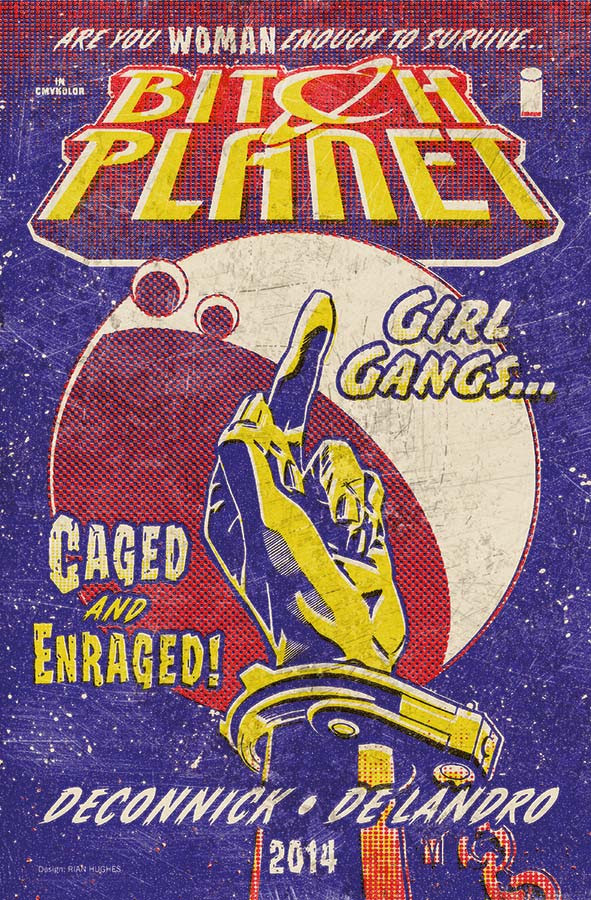
2. Bitch Planet by Kelly Sue DeConnick and Val DeLandro

2016 was light on Bitch Planet–only four issues were released throughout the year–but continued to provide insightful and relevant commentary in what turned out to be a period of rapid change in the real-life political landscape.

monstress-7-featured

1. Monstress by Marjorie Liu and Sana Takeda

Monstress started strong in 2015 and only got better. The main character, Maika, is a teenage girl living with a monster inside, something she learns to live with and use to her advantage as the plot develops. Monstress is full of unrepentant female characters set in a stunningly rendered fantasy world.

Limerence Press Announces Small Favors: The Definitive Girly Porno Collection by Colleen Coover

Limerence Press will publish Small Favors: The Definitive Girly Porno Collection, by Colleen Coover.

Small Favors is the critically-acclaimed, girly porno comic by Eisner award-winning cartoonist Colleen Coover. Often taught in college courses, Small Favors is a landmark work of comic book porno that completely re-defined the genre by portraying sexuality in a friendly, silly, and approachable light.

This deluxe hardcover edition includes volumes one and two of Small Favors, the never-before-collected color special, behind-the-scenes materials, and a brand-new introduction from Kelly Sue DeConnick.

Small Favors: The Definitive Girly Porno Collection hits store shelves April, 2017.

small-favors-the-definitive-girly-porno-collection

Ms. Monster

bitch planetDuring my undergraduate study, I spent an enlightening semester learning entirely about women writers and how they write women and girls. It’s something I’ve carried with me, especially in reading comics. While it is now less rare for women to occupy a central role in comics, the field is still overwhelmingly male-dominated and male character-centric. This often leaves female characters in a space that is Other, or separate from the norm.

With creator-owned comics on the rise, women are now able to carve spaces in which to tell their own stories. Two stories in particular, Kelly Sue DeConnick and Valentine DeLandro’s Bitch Planet and Marjorie Liu and Sana Takeda’s Monstress, challenge the Othering of femininity by exploiting the connection of femininity to monstrosity and allowing characters to reclaim this aspect of their identities by embracing the monstrous.

It is possible to understand this reclamation of identity by using Julia Kristeva’s theory of abjection as a lens. Kristeva is a Bulgarian-French philosopher, psychoanalyst, and feminist whose work spans multiple disciplines but is prominent in structuralism and poststructuralism.

Powers of Horror: An Essay on Abjection outlines Kristeva’s theory of abjection in a very French and somewhat complex way. The abject, by definition, is a “non-object” that lingers in a person’s psyche as a consequence of repression. The abject disturbs system, identity, and order. To abject something is to other it from the “I,” pushing it away from the self to maintain personal boundaries.

Monstress01_CoverA simple example of this sort of behavior is food loathing. This is a common behavior, especially in children, but the dissonance between something that is supposed to nourish and the unpleasant taste or nauseous feeling causes abjection. If you hated broccoli as a kid or avoid a certain food after eating something and getting sick, this is a basic form of abjection.

Abjection can also exist among people, so when discussing abjection it is important to make a distinction between subject, object, and abject. The subject is “I.” (When you, reader, speak about yourself, your thoughts, you say “I.” You’re subject.) Now table that thought for a moment. The difference between object and abject is contingent on one point. Objects hold weight and meaning. The abject is not an object because it does not hold weight. The only “object” quality the abject possesses is that it opposes the “I.”

One example Kristeva uses to distinguish each definition is that of a corpse. Kristeva says corpses are simultaneously subject, object, and abject–the body was once a person, a subject, but became object after death. Corpses are also abject because they force us to consider the uncomfortable truth of our inevitable deaths.

What both the food loathing and corpse examples have in common is the idea that they are improper or unclean. People and bodies will abject things they deem “incorrect,” but what is unclean, gross, or incorrect doesn’t directly cause abjection; they create a disruption of a person’s system, identity, and order and that causes abjection. Disruption of the boundaries demonstrates their fragility.

Abjection of people is driven by a failure of one member of a group to recognize its kin. This same lack of recognition drives fear of what has been deemed Other. A person possessing some quality that has been deemed “incorrect” on a larger social scale causes a lack of recognition, which is perpetuated on an individual level. This creates a cycle of fear and rejection by engendering disgust for the “not normal” or “not human.” Social constructs are upheld and continue to oppress the abject.

BitchPlanet02_CoverAccording to Kristeva, one natural reaction to abjection is religion, which is an attempt to create order where the abject has disturbed it. Using this reasoning, the formation of governing bodies–including the Cumaea in Monstress and the male-led government in Bitch Planet—are an attempt to control the abject.

Kristeva says another natural reaction to the abject is to create art. Using comics to explore the abject allows both readers and creators to approach the subject in worlds both fictional and real. The settings of the comics discussed here (an off-world prison and an alternate version of early 20th century Asia) allow writers and artists to discuss issues present in real life. The main characters of both comics are monstrous women, all of whom are attempting to create their own space in the world. Comics give these creators a space to both examine the abject and criticize the social systems that oppress the abject in a fictional world, as well as in our real one. (Bitch Planet also accomplishes this by including essays in the backmatter of single issues.)

In Kelly Sue DeConnick and Valentine DeLandro’s Bitch Planet, women who are determined “non-compliant” are shipped to an off-world prison. Non-compliance in women is determined by any number of “crimes,” including being “aesthetically offensive,” obese, or transgender. In Bitch Planet, misogyny is taken to an extreme level. Women who fall outside of a narrow box of acceptable gender behavior and presentation and individuals who don’t conform to traditional binary standards are punished for existing. It’s a harsh critique of the standards women are held to in real life–both behaviorally and aesthetically.

Monstress, by Marjorie Liu and Sana Takeda, combines a number of fantasy elements that make up an alternate Asia, which plays home to Maika, an Arcanic teen. The Arcanics’ magic makes them highly desired by the Cumaea, a religious order that uses Arcanic Lilium to enhance the powers of its members. Arcanics are regarded as a lowly sub-human class, which allows the story to explore themes of racism and slavery. Since it is told from Maika’s perspective, much of the story also focuses on her strength (inner and outer) as she resists the oppressive force of the Cumaea.

Monstress05_CoverThough they take place in vastly different worlds, Bitch Planet and Monstress feature protagonists who have been Othered in some way. The characters readers are meant to root for and maybe even identify with are seen as non-human because they disrupt established social structures and system, identity, and order.

Inmates of the Auxiliary Compliance Outpost are abject for any number of reasons, from not being feminine enough to “driving” their husbands to infidelity. They are treated inhumanely, used only as an example for other women and bodies in sport. The women find a sense of community with each other, bound by their monstrous qualities.

Maika of Monstress is introduced as a slave, immediately establishing her as abject and Other. This is only furthered when readers learn of her powerful psychic connection to a literal monster that she refers to as her “hunger.” Maika is considered a monster even before she embraces this title.

The pathologization of women’s behavior in Bitch Planet and demonization of Arcanics mean that these characters are considered monsters regardless of whether their behavior reflects that designation. Neither comic is subtle about its connection of femininity to the monstrous, and both take care to show that women’s experiences with society intersect differently based on race and sexuality.

The metaphor of the monstrous is accessible in Bitch Planet, where the particularly relevant issue three focuses on how women are punished for attempting to conform to social standards (taking part in harmful diets and beauty rituals) and for living outside these standards (in which case they are made social outcasts). The metaphor is equally accessible in Monstress, where Maika quite literally lives with a murderous monster called Monstrum inside of her. The Monstrum, though dangerous, helps Maika to defend herself against threats and to withstand constant dehumanization.

These works are important because they bring to light issues that some readers may not experience because of their social or economic privileges. By forcing readers to interact with abject concepts, these stories also force readers to consider perspectives they otherwise wouldn’t because readers themselves wish to escape the uncomfortableness of the topic. These stories also examine institutions which have been founded on oppressive platforms whose original intent was to protect the privileged from the abject.

Despite being considered monstrous, the characters in either comic embrace this aspect of their identity. Inmates in Bitch Planet use their strengths as non-compliant women (both physical and mental) to fight for their freedom. While Maika’s goal is to find answers about her mother’s death, she also uses her monstrousness to protect other Arcanics and fight the Cumaean order. This is a way to claw back at the systems that have rejected and othered them and to reclaim their identities and their rights to live a free and happy life.

Characters pushing back against oppressive systems reflect the real-life struggle for equality between the abject and those who have abjected them. These characters want to be seen as an “object” rather than Other in the sense that this would allow them to be recognized by their peers as non-abject and human.

Though Bitch Planet and Monstress explore vastly different worlds, they both offer a unique approach to examining the abject. And as female characters fight for and claw out their own space in their worlds, their creators do the same in ours.

This paper was originally presented as part of the 2016 Comics and Popular Arts Conference in Atlanta, Georgia.

Review: Pretty Deadly #10

PrettyDeadly_10-1A young man dies. A war ends. The moon waxes full. And where does it all land? Well, it turns out that this ending is neither good nor bad. It just is.

Pretty Deadly #10 opens with Ginny at war with herself after being run through by Fear and War. Bones Bunny narrates to Butterfly as she comes to, watching from a distance in The World Garden. War does not keep Ginny down for long though. He just makes her angry.

Where the past couple of issues of Pretty Deadly have been all about action, this issue is about resolution. About necessary ends and times of peace. It’s easily the most emotional issue of the series so far, especially when we return to Verine and Clara by Sarah’s bedside. While it won’t last forever, the way Kelly Sue Deconnick writes this time of peace is moving and serene in a strange way. Like this is a well earned rest at the end of a hard road.

Emma Ríos and Jordie Bellaire knock it out of the park on art again, this time with less focus on brutality and more on ghostly images. The way the human reapers are drawn, dark and celestial against the soft moonlight or daylight of the trenches, is especially stark and lovely. Not as much though as when the Reaper of Courage stands with Fear and Grace to deliver Sarah to The World Garden as the sun rises. That might just be the most beautiful scene yet.

At the end of the book, Deconnick talks about how one must embrace their fear in order to be brave, and that seems like the overall arc of this particular story. It especially comes through in this issue, with the extra nail being a young nurse declaring “God bless the cowards” as she recovers the bodies of our fallen heroes. Pretty Deadly has always been a book about facing fears, but #10 is a reminder that courage does not exist without fear and to have the former, you must embrace the latter.

Between the beautiful art and the bittersweetly serene story, Pretty Deadly #10 is a masterful conclusion to a brutal and emotional arc. This final chapter of “The Bear” shows just how far the story has come and evolved, how the story has come to stand on it’s own in individual issues, and makes me even more excited for where the story will go when we meet up with Clara in the early days of Hollywood in the third arc.

Story: Kelly Sue Deconnick Art: Emma Ríos and Jordie Bellaire
Story: 9.0 Art: 10 Overall: 9.5 Recommendation: Buy

Image Comics provided Graphic Policy with a FREE copy for review

Review: Pretty Deadly #9

PrettyDeadly_09-1Pretty Deadly #9 picks up where the previous issue left off with the same question on everyone’s tongue. “Good luck? Bad luck?”

Cyrus is dead, with dear Melvin and Theo not far behind, for that is the way of war. Alice faces off with Johnny Coyote and Ginny’s battle with the Reaper of War doesn’t seem to be going in her favor. In fact, it seems as if none of our reapers except War might make it out of this alive.

Emma Ríos and Jordie Bellaire stand out in this issue once again as the atmosphere takes a more grey tone as the action begins to die down on the battlefield. The red of War is still overwhelming and Bellaire does an amazing job in immersing the world in his color, but also finding subtle ways to tone it down from the last issue, mixing it in with grey and white as the revelation of the nature of the Reaper of War comes to light. The most striking part of this issue though is how Ríos uses the eastern tiger swallowtail butterflies that make up Big Alice to frame panels, and how even a mass of butterflies feels so incredibly detailed. That, and the way Bones Bunny and Butterfly act as shadow puppets in the beginning of the issue as Bunny retells the story of The Lucky Farner.

This issue in pace seems to move a lot faster than the issues before it. I’m not certain if it’s because of the story beats Kelly Sue Deconnick hits in this issue or because there’s a lot less battlefield movement this time, but it seems that #9 is zipping along to the inevitable conclusions of #10. It doesn’t mean that there still isn’t weight behind the actions though, especially when Cyrus’s soul confronts Fear right in the face, or as Alice and Ginny face their own mortality. It just seems like the story isn’t content to rest there too long. As it shouldn’t, since there’s still one issue left to finish the story.

Have our heroes hit a string of bad luck? Or has everything that happened here been a blessing in disguise? It’s hard to say now, but the penultimate issue of Pretty Deadly’s second arc doesn’t rest long to answer the question, but rather chooses to let the action play out. Whether fortune or folly, it’s all set up to go down here.

Story: Kelly Sue Deconnick Art: Emma Ríos and Jordie Bellaire
Story: 7.5 Art: 9.0 Overall: 8.25 Recommendation: Read

Image Comics provided Graphic Policy with a FREE copy for review

Image Comics Announces Creators for Creators

Creators for CreatorsAt Image Comics‘ Image Expo it wasn’t just new products that were announced, they also announced a new non-profit, Creators for Creators. The goal of the organization is to “encourage, support, and promote original works through grants and education.”

The program will be a combination of financial backing and mentorship. The plan is to give $30,000 to a single cartoonist or a wrister/artist duo to support their creation of original work of between sixty-four and one hundred pages over a single year. A committee will decide the recipient.

The mentorship mentioned will be beyond creation and will cover all aspects of the comic-creating experience to help create a firm foundation when it comes to the creative, business, legal, and financial aspects of the business.

Recipients will retain rights to their works and will not just be supported by Image, but also Iron Circus Comics. The long term goal is to also make the website a resource to educate creators.

Applicants must be at least 18 years old and you have until May 1, 2016 to apply. You can learn more here.

The Creators for Creators grant was founded by Charlie Adlard, Jordie Bellaire, David Brothers, Kelly Sue DeConnick, Nick Dragotta, Leila del Duca, Matt Fraction, Kieron Gillen, Jonathan Hickman, Joe Keatinge, Robert Kirkman, Jamie McKelvie, Rick Remender, Declan Shalvey, Fiona Staples, Eric Stephenson, C. Spike Trotman, and Brian K. Vaughan.

Comics Herstory: Kelly Sue DeConnick

bitchplanet_01-1It’s difficult to say what Kelly Sue DeConnick is most known for: her iconic run on Marvel’s Captain Marvel book, which pushed Carol Danvers to achieve higher, further, faster, more, or Bitch Planet, which took comic fans by storm and popularized a feminist message of noncompliance among its readers. Perhaps it’s Pretty Deadly, a gorgeous story DeConnick and artist Emma Rios created about death and love. She has also written for, DC, BOOM! Studios, and Dark Horse, and was the first female comic writer to pen an ongoing Avengers series with Avengers Assemble.

Currently, Pretty Deadly and Bitch Planet are ongoing, and both are notable for the ways in which they subvert tropes of masculinity and femininity. Some context that is useful in understanding part of the message of these works is feminist scholar Julie Kristeva’s theory of abjection. Essentially, abjection means “othering” something from oneself in order to maintain the self. DeConnick’s characters are othered because they disturb the systems and order of their respective worlds to maintain their senses of self.

In Bitch Planet especially, the otherness makes a point about how women are demonized for their very existence, and that this is rooted in misogyny. Bitch Planet is unabashedly feminist, premised on a world where patriarchal control is taken to an extreme. The book also includes essays on feminism in the backmatter, and, in addition to letters, there have also been numerous photos of people who have gotten the noncompliant symbol tattooed. Though it’s only seven issues in, it has become incredibly significant in those seven issues, and has cultivated a  community around the book’s central theme of noncompliance.

prettydeadly-01Pretty Deadly’s appeal is enormous, in both art and writing. Simply put, it’s a stunning book. Thematically, it deals with both love and death, two inevitable parts of life. Pretty Deadly is the story of Sissy, Fox, and Deathface Ginny, and is a unique twist on the usual narrative. Having taken up Death’s mantle at the end of the first arc, Sissy, a child, isn’t the type of character usually cast as Death. Pretty Deadly works to subvert a number of tropes. Fox is the antithesis of the typical masculinity present in a Western story–for example, by the time the reader meets Fox, he is in the role of Sissy’s protector and caretaker. Now in its second arc, Pretty Deadly is very much worth reading for its beautifully crafted story and artwork.

In addition to writing comics, DeConnick and her husband, Matt Fraction, head the Milkfed Criminal Masterminds production company, and last year revealed that they will be developing Fraction’s Sex Criminals for TV. Readers can keep up with all of this information by signing up for Milkfed Criminal Mastermind newsletters, as well as motivational “Bitches Get Shit Done” texts from DeConnick. (Or follow #bgsd or #bgsdlist on Twitter.)

Review: Bitch Planet #7

STK696468Bitch Planet returned from its break this week and from the first page, disposability seems to be the name of the game for the Fathers in this arc titled “President Bitch.” If you ever doubted how much this book hurts with its more true to life aspects, the first page is a security guard allowing an AI to open fire on three young black children trying to make a shortcut because they “look sketchy.”

With the Fathers making the decision to keep Meiko’s death a secret from her father, much of the issue revolves around the beginning work on the Megaton stadium with Makoto arriving to supervise the building and the NCs being the one to start digging. The divide between the NCs and the men in charge becomes apparent, with the men being greeted with warm towels and tea versus the cattle call of women prisoners opened the very first issue back in December 2014. As our omnipresent security guards point out though, the “power of man is fickle as hell” since this stadium and the guests in charge of the creation comes at the expense of other much needed repairs to the ACO. Coming from a city that is a year out from opening a new football stadium, I find myself in agreeance with the two for the first time.

Even in death, Meiko’s influence on the the ACO is still felt. Instead of dealing with him directly, the wardens assign a Model program to be Makoto’s aide, which makes the inevibility of him discovering Meiko’s death even worse. On the flipside of this, the wardens decide that instead of charging the man responsible for Meiko’s death, Whitney will take the blame and be charged for her death as well as any other charges involving guard injuries in the incident. It really is a stark reminder that even when a woman seems to benefit directly from the patriarchy, she is just as easily on the chopping block for it when the time comes. As much as Whitney has worked against the NCs up until this point, it is impossible to take joy in her fall from power when it is made clear that she is the scapegoat for the irresponsibility of the guards.

The most powerful scene in this issue though happens between Kam and Penny though. Kelly Sue Deconnick has always had a knack for more quiet scenes where a lot is said without saying too much at all. In it, Penny sits in the shower, feeling guilty for Meiko’s death and wishing that she would wash away into the drain. Kam takes a seat beside her, reminding her that there really wasn’t much she could do and that sometimes “strong ain’t strong enough.” The essay from Angelica Jade Bastién in the backmatter elaborates more on what this scene is going for, but in the pages itself, it’s a gorgeous piece of synchronicity between story and art, where so much can be said in two panels of handholding.

Speaking of art, this is the second issue where Kelly Fitzpatrick is on colors. Her style is a bit more shaded and toned down that previous colorist Cris Peter, but it works. The story’s tone has taken a bit of a turn since Meiko’s death, so the slightly saturated hue works well for the book. Don’t worry, the sense of over the top color is still there. The orange in the Megaton site and the stormclouds in Whitney’s room are particularly well done in this regard.

With the start of a new arc, Bitch Planet is showing no signs of slowing down any time soon. Even in an issue setting up the building blocks for the rest of the arc, it still feels like a gut punch as the fallout from Meiko’s death takes center stage. I would hope that it doesn’t take anyone else in the process, but that would be tempting fate just a bit too much in a book where the ones in charge of the world it exists in see lives as disposable when they don’t fit into the neat boxes prescribed for existence.

Correction: A previous version of this review stated that this was Kelly Fitzpatrick’s first issue when it was her second.

Story: Kelly Sue Deconnick Art: Valentine Delandro and Kelly Fitzpatrick
Story: 9.0 Art: 9.5 Overall: 9.25 Recommendation: Buy

Image Comics provided Graphic Policy with a FREE copy for review

« Older Entries Recent Entries »