
Ms. Monster
 During my undergraduate study, I spent an enlightening semester learning entirely about women writers and how they write women and girls. It’s something I’ve carried with me, especially in reading comics. While it is now less rare for women to occupy a central role in comics, the field is still overwhelmingly male-dominated and male character-centric. This often leaves female characters in a space that is Other, or separate from the norm.
With creator-owned comics on the rise, women are now able to carve spaces in which to tell their own stories. Two stories in particular, Kelly Sue DeConnick and Valentine DeLandro’s Bitch Planet and Marjorie Liu and Sana Takeda’s Monstress, challenge the Othering of femininity by exploiting the connection of femininity to monstrosity and allowing characters to reclaim this aspect of their identities by embracing the monstrous.
It is possible to understand this reclamation of identity by using Julia Kristeva’s theory of abjection as a lens. Kristeva is a Bulgarian-French philosopher, psychoanalyst, and feminist whose work spans multiple disciplines but is prominent in structuralism and poststructuralism.
Powers of Horror: An Essay on Abjection outlines Kristeva’s theory of abjection in a very French and somewhat complex way. The abject, by definition, is a “non-object” that lingers in a person’s psyche as a consequence of repression. The abject disturbs system, identity, and order. To abject something is to other it from the “I,” pushing it away from the self to maintain personal boundaries.
 A simple example of this sort of behavior is food loathing. This is a common behavior, especially in children, but the dissonance between something that is supposed to nourish and the unpleasant taste or nauseous feeling causes abjection. If you hated broccoli as a kid or avoid a certain food after eating something and getting sick, this is a basic form of abjection.
Abjection can also exist among people, so when discussing abjection it is important to make a distinction between subject, object, and abject. The subject is “I.” (When you, reader, speak about yourself, your thoughts, you say “I.” You’re subject.) Now table that thought for a moment. The difference between object and abject is contingent on one point. Objects hold weight and meaning. The abject is not an object because it does not hold weight. The only “object” quality the abject possesses is that it opposes the “I.”
One example Kristeva uses to distinguish each definition is that of a corpse. Kristeva says corpses are simultaneously subject, object, and abject–the body was once a person, a subject, but became object after death. Corpses are also abject because they force us to consider the uncomfortable truth of our inevitable deaths.
What both the food loathing and corpse examples have in common is the idea that they are improper or unclean. People and bodies will abject things they deem “incorrect,” but what is unclean, gross, or incorrect doesn’t directly cause abjection; they create a disruption of a person’s system, identity, and order and that causes abjection. Disruption of the boundaries demonstrates their fragility.
Abjection of people is driven by a failure of one member of a group to recognize its kin. This same lack of recognition drives fear of what has been deemed Other. A person possessing some quality that has been deemed “incorrect” on a larger social scale causes a lack of recognition, which is perpetuated on an individual level. This creates a cycle of fear and rejection by engendering disgust for the “not normal” or “not human.” Social constructs are upheld and continue to oppress the abject.
 According to Kristeva, one natural reaction to abjection is religion, which is an attempt to create order where the abject has disturbed it. Using this reasoning, the formation of governing bodies–including the Cumaea in Monstress and the male-led government in Bitch Planet—are an attempt to control the abject.
Kristeva says another natural reaction to the abject is to create art. Using comics to explore the abject allows both readers and creators to approach the subject in worlds both fictional and real. The settings of the comics discussed here (an off-world prison and an alternate version of early 20th century Asia) allow writers and artists to discuss issues present in real life. The main characters of both comics are monstrous women, all of whom are attempting to create their own space in the world. Comics give these creators a space to both examine the abject and criticize the social systems that oppress the abject in a fictional world, as well as in our real one. (Bitch Planet also accomplishes this by including essays in the backmatter of single issues.)
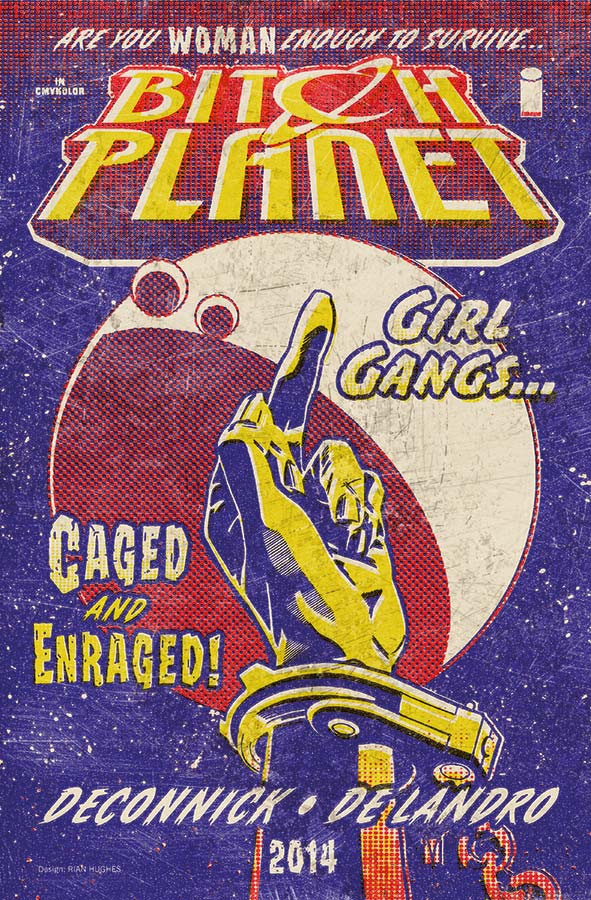
In Kelly Sue DeConnick and Valentine DeLandro’s Bitch Planet, women who are determined “non-compliant” are shipped to an off-world prison. Non-compliance in women is determined by any number of “crimes,” including being “aesthetically offensive,” obese, or transgender. In Bitch Planet, misogyny is taken to an extreme level. Women who fall outside of a narrow box of acceptable gender behavior and presentation and individuals who don’t conform to traditional binary standards are punished for existing. It’s a harsh critique of the standards women are held to in real life–both behaviorally and aesthetically.
Monstress, by Marjorie Liu and Sana Takeda, combines a number of fantasy elements that make up an alternate Asia, which plays home to Maika, an Arcanic teen. The Arcanics’ magic makes them highly desired by the Cumaea, a religious order that uses Arcanic Lilium to enhance the powers of its members. Arcanics are regarded as a lowly sub-human class, which allows the story to explore themes of racism and slavery. Since it is told from Maika’s perspective, much of the story also focuses on her strength (inner and outer) as she resists the oppressive force of the Cumaea.
 Though they take place in vastly different worlds, Bitch Planet and Monstress feature protagonists who have been Othered in some way. The characters readers are meant to root for and maybe even identify with are seen as non-human because they disrupt established social structures and system, identity, and order.
Inmates of the Auxiliary Compliance Outpost are abject for any number of reasons, from not being feminine enough to “driving” their husbands to infidelity. They are treated inhumanely, used only as an example for other women and bodies in sport. The women find a sense of community with each other, bound by their monstrous qualities.
Maika of Monstress is introduced as a slave, immediately establishing her as abject and Other. This is only furthered when readers learn of her powerful psychic connection to a literal monster that she refers to as her “hunger.” Maika is considered a monster even before she embraces this title.
The pathologization of women’s behavior in Bitch Planet and demonization of Arcanics mean that these characters are considered monsters regardless of whether their behavior reflects that designation. Neither comic is subtle about its connection of femininity to the monstrous, and both take care to show that women’s experiences with society intersect differently based on race and sexuality.
The metaphor of the monstrous is accessible in Bitch Planet, where the particularly relevant issue three focuses on how women are punished for attempting to conform to social standards (taking part in harmful diets and beauty rituals) and for living outside these standards (in which case they are made social outcasts). The metaphor is equally accessible in Monstress, where Maika quite literally lives with a murderous monster called Monstrum inside of her. The Monstrum, though dangerous, helps Maika to defend herself against threats and to withstand constant dehumanization.
These works are important because they bring to light issues that some readers may not experience because of their social or economic privileges. By forcing readers to interact with abject concepts, these stories also force readers to consider perspectives they otherwise wouldn’t because readers themselves wish to escape the uncomfortableness of the topic. These stories also examine institutions which have been founded on oppressive platforms whose original intent was to protect the privileged from the abject.
Despite being considered monstrous, the characters in either comic embrace this aspect of their identity. Inmates in Bitch Planet use their strengths as non-compliant women (both physical and mental) to fight for their freedom. While Maika’s goal is to find answers about her mother’s death, she also uses her monstrousness to protect other Arcanics and fight the Cumaean order. This is a way to claw back at the systems that have rejected and othered them and to reclaim their identities and their rights to live a free and happy life.
Characters pushing back against oppressive systems reflect the real-life struggle for equality between the abject and those who have abjected them. These characters want to be seen as an “object” rather than Other in the sense that this would allow them to be recognized by their peers as non-abject and human.
Though Bitch Planet and Monstress explore vastly different worlds, they both offer a unique approach to examining the abject. And as female characters fight for and claw out their own space in their worlds, their creators do the same in ours.
This paper was originally presented as part of the 2016 Comics and Popular Arts Conference in Atlanta, Georgia.
Discover more from Graphic Policy
Subscribe to get the latest posts sent to your email.

I am so glad you shared this here. What a damn insightful essay and perfect deployment of Kristeva. And I love those comics.
Thank you so much!! These are two of my absolute favorite comics. There’s so much to unpack with both.