Tag Archives: w. haden blackman

Echolands #2 Heads Back to Print

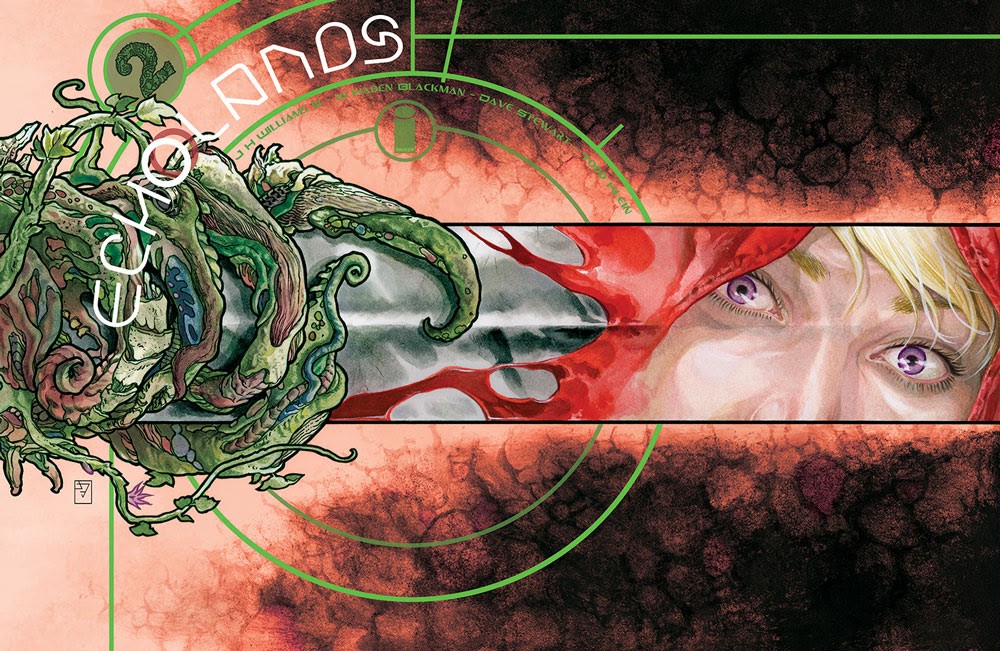
The eye popping new release to hit shelves—Echolands #2 by J.H. Williams III, W. Haden Blackman, colorist Dave Stewart, and letterer Todd Klein—has hit big with readers and sold out completely at the distributor level. Image will fast-track the issue for a reprint in order to keep up with growing customer demand.

In Echolands #2, Hope Redhood and her companions, Cor, Caniff, Castrum, Dena, Rabbit, and Rosa, are on the run from the Wizard, Teros Demond, and his terrifying daughter. Why is the Wizard willing to kill to regain his stolen gem? Can Hope and her crew escape the strange robots lurking in the tunnels beneath San Francisco? And will they survive a betrayal by the pirate captain, Bloody Gums?

This breathtaking series defies comic book medium expectations and provides an unforgettable feast-for-the-eyes in a sprawling landscape format. Each spread page expertly showcases the artwork and the unique reading experience instantly sent fans abuzz with excitement for its mesmerizing story.

Set in a bizarre future world that has forgotten its history, Echolands follows reckless thief Hope Redhood. Hope holds the key to excavating a strange, dark past—but only if she and her crew can escape a tyrannical wizard and his unstoppable daughter. But fate will send them all on a path leading to a war between worlds.

Echolands is a mythic fiction epic where anything is possible; a fast-paced genre mashup adventure that combines everything from horror movie vampires to classic mobsters and cyborg elves, to Roman demigods and retro rocket ships. It’s going to be a helluva ride!

Echolands #2, second printing Cover A (Diamond Code AUG218991) and Echolands #2, second printing Cover B 1:25 copy incentive (Diamond Code AUG218992) will be available at comic book shops on Wednesday, November 17.

J.H. Williams III, W. Haden Blackman, Dave Stewart, and Todd Klein Launch Echolands in August

Image has revealed the anticipated Echolands series by J.H. Williams III, W. Haden Blackman, colorist Dave Stewart, and letterer Todd Klein. This long-awaited comic book event from the multiple award-winning Batwoman creative team will launch from Image Comics in August and push the boundaries of storytelling to its limits.

The new series will present a sprawling, eye-popping tale and feature lush, career-defining artwork and a mesmerizing story in a unique landscape format. Each issue of the series will offer a Raw Cut edition, featuring the art from J.H. Williams III as it looked when leaving his work studio.

Set in a bizarre future world that has forgotten its history, Echolands follows a reckless thief Hope Redhood. Hope holds the key to excavating a strange, dark past—but only if she and her crew can escape a tyrannical wizard and his unstoppable daughter. But fate will send them all on a path leading to a war between worlds. 

Echolands is a mythic fiction epic where anything is possible; a fast-paced genre mashup adventure that combines everything from horror movie vampires to classic mobsters and cyborg elves, to Roman demigods and retro rocket ships. It’s going to be a helluva ride!

Echolands #1 Cover A (Diamond Code JUN210009) and Echolands #1 Cover B (Diamond Code JUN210010) will be available at comic book shops on Wednesday, August 25.

Holy Matrimony, Batman!

Guest commentary post from Emma Houxbois. Emma is a queer blogger for hire out of Vancouver, BC most recently attached to Girls Read Comics. You can follow her on Twitter @emmahouxbois.

batwomanIn the wake of J.H. Williams III and W. Haden Blackman stepping down from writing duties on Batwoman, a common thread among the title’s fanbase is the despondent proclamation that Macklemore didn’t free the gays for this. Only Macklemore himself can answer the question of why he freed us and likewise, only Dan Didio can speak for why he chose to uphold the veto on Kate Kane and Maggie Sawyer’s relationship progressing beyond an engagement (which he has done on Facebook of all places) so allow me to speak as a queer woman on why I’m glad Kate Kane won’t be getting married anytime soon.

Since, for better or worse, the situation has become a referendum on letting fictional homosexuals marry, there really does have to be a more considered and nuanced evaluation of whether or not marriage is something that actually needs to be pushed for. The irony of the current debate, and the point at which I begin to depart from what seems to be the fandom consensus, is that feminist literary criticism was born to challenge the reality that women’s stories end in either death or marriage. Decades of informed criticism and measured responses to the portrayal of marriage in popular fiction seem to have somehow sailed out the window as soon as the concept of same sex marriage (which has since oozed itself into the highly suspect terminology “marriage equality”) gained traction within the mainstream. While there certainly is significant merit to awarding same sex couples the same rights as their heterosexual peers and the broken institution of marriage is the most expedient vehicle to accomplish that in reality, the same does not necessarily hold true in fiction. Northstar’s wedding was valuable and important because it extended a long Marvel tradition of event weddings to a character whose publication history has embodied the full scope of the growing pains that the company underwent in becoming comfortable with portraying a gay character. Marvel was creating a new covenant with it’s readership just as much as Jean-Paul was with his boyfriend. By contrast, the wedding between Luke Cage and Jessica Jones could and should have been subjected to far more criticism than it did as it didn’t seem to accomplish much more than further the notion that matrimony is the necessary culmination of a romance and ostensibly the only context in which to raise a child. At the end of the day, the more progressive and meaningful approach to Luke and Jessica’s relationship would have been a recognition that a couple could- as many do in real life- remain unmarried and raise their daughter in a perfectly healthy environment.

Likewise, I just do not see the value in insisting that the only queer superhero with their own solo title get married. It reeks of marriage’s forceful domination of the discourse around LBGT rights and ignores the fundamental reality that the central dispute over whether or not these women should marry in a comic book is controlled on both sides by men because such is the poor state of superhero comics that the only creators with the clout and drive to push the genre’s only queer female protagonist into publication are men. That’s fucked up, and it’s infinitely more fucked up than the actual question of whether or not these two characters should get married. Williams is a phenomenal talent- the best living artist in comics- who has participated in two of the biggest victories for queer female representation in superhero fiction (Promethea and his Batwoman work dating back to Greg Rucka’s Detective Comics run) and Blackman deserves a great deal of respect for stepping up to the plate and lasting a whole two years under the strain of what seems to have been a deeply troubled book from it’s inception, but there is still something truly and fundamentally wrong with the situation, especially when the only female creator to participate on the title to date was only able to contribute a horrifyingly rushed product that only conveyed a quarter of her true talent. This is of course a pattern repeated across most of comics where female lead/majority titles like X-Men, FF, Fearless Defenders, and Wonder Woman have entirely male creative teams with Kelly Sue Deconnick’s Captain Marvel and Gail Simone’s Batgirl essentially being the lone prancing rainbow maned unicorns of major female characters actually being written by women.

I don’t believe that marriage is the compulsory or even necessarily the best culmination of any romance, and that is a position deeply informed by my identity as a queer woman. Furthermore, I don’t see where marriage has any real place in Kate Kane’s narrative. A look back at Maggie Sawyer’s pre-Flashpoint publication history shows that she was one of the earliest lesbian characters in superhero comics, first appearing in Metropolis under Dan Turpin. Maggie was definitely a direct precursor to both Renee Montoya and Kate Kane, who was first brought from Metropolis to Gotham by Ed Brubacker and Greg Rucka to appear alongside Renee Montoya in Gotham Central and then threaded into Kate’s narrative through her stint leading Detective Comics so it’s quite possible that this marriage was part of Rucka’s long game that Williams and Blackman committed themselves to following through in Batwoman, but it still seems directly contradictory to Kate’s story up to this point and Rucka’s wider body of work. Seen from Maggie’s perspective, it follows a very similar trajectory to Northstar barring the facts that until her first encounter with Kate she’d been most recently seen in a stable relationship of her own and that the comic is called Batwoman, not Gotham Central.

As I put forward in my last appearance on the podcast, the strongest common thread that links Greg Rucka’s most significant comic work is the central theme of women navigating the institutions responsible for meting out state sanctioned violence. The responses crafted for Renee Montoya and Kate Kane in the pages of 52 were that the institutions they represented- the police and military respectively- would ultimately reject and destroy them, necessitating that they move outside those institutions to achieve their higher callings (ultimately manifesting in the Question and Batwoman personas). What made Rucka’s Gotham based work so successful was his recognition that institutional failure and identification with The Other are the cornerstones of that fictional space created in the image of Bruce Wayne and his ability to push those sensibilities forward into contemporary concerns. To that end, it seems bizarre and wrongheaded that Kate Kane, who literally gave up a ring because she was unwilling to lie about who she was would turn around and put her faith in another ring whose backing institution has the very same history of marginalizing her identity. She found a way to serve outside of the mainstream, so it only really follows that she would find and embrace a way to love that also sits outside of the mainstream. Finding empowerment and self expression outside the normative is what made Kate a truly different, truly queer character and dictating that she express love and intimacy in the most banal, normative way possible is a fundamental violation of the Kate Kane that gave me the strength to assert my own queer identity. The Kate Kane whose nautical star I had tattooed between my shoulder blades.

Dan DiDio Addresses “The Batwoman Issue” on Facebook & I Agree with Him

Today, the team behind Batwoman quit the book in a public blog post that caused the internet to meltdown. Though most blogs, and many commentators, focused on the creator’s wanting to “gay marry” two characters and DC Comic‘s nixing of the plan, it was greater editorial issues that caused the departure, not this one thing. JH Williams III and WH Blackman in a joint blog post clearly stated:

Unfortunately, in recent months, DC has asked us to alter or completely discard many long-standing storylines in ways that we feel compromise the character and the series. We were told to ditch plans for Killer Croc’s origins; forced to drastically alter the original ending of our current arc, which would have defined Batwoman’s heroic future in bold new ways; and, most crushingly, prohibited from ever showing Kate and Maggie actually getting married. All of these editorial decisions came at the last minute, and always after a year or more of planning and plotting on our end.

That isn’t one issue, that’s many things leading up to this and causing a public, ugly meltdown.

Much of the internet’s backlash was directed at DC Comics’ Co-publisher Dan DiDio. Many seem to have focused on him, blaming him for recent issues with high-profile creator departures. Those creators often point to editors as to the cause of the creative issues at the company that lead to those departures.

While the comic publisher has been having issues dealing with the public when it comes to these public changes, DiDio took to Facebook directly addressing the issue in a way that not only defended the company well, but explains the company’s position.

Many took this announcement as a sign that DC does not support gay marriage or gay characters. But DiDio defended the company, as an example in this exchange from Facebook.

2013-09-05_2133

You could make an argument that Marvel has had more gay characters, and shown more progressive relationships, that publisher doesn’t have a gay character headlining a comic series or one for so long. While Kate Kane/Batwoman might be the highest profile gay character in the DC universe, the company has had a long history of inclusion of gay characters including Renee Montoya, a fan favorite character, who was also the Question in pre-52 continuity. Recently the company introduced a transgender character in the pages of Batgirl and that’s after their high-profile push of Alan Scott as the first gay Green Lantern. The company also shelved, after an online outcry, a Superman story that was to be written by Orson Scott Card who has voiced anti-gay sentiment in the past.

It’s not gays or gay marriage that seems to be the issue at DC Comics, but marriage in general. DiDio in another post on Facebook:

2013-09-05_2135There is the possibility that the planned marriage storyline for Batwoman just didn’t jive with DC’s long-term plans. The company in its New-52 reboot broke up Clark Kent/Superman and Lois Lane, not only ending their marriage, but ending their relationship. A reason given was the ability to explore other storylines and relationships with the characters by doing so. Superman/Clark is now dating Wonder Woman.

In the new-DCU it’s been five years or so, these are new heroes still settling into their roles. The engagement between Batwoman/Kate Kane and her love Maggie Sawyer has only been for a few issues. To have them marry so quickly just doesn’t make sense and also destroys the possibility of exploring their relationship as a couple while dating. As a whole, the engagement feels rushed to me. It’s not so rushed when you see the series as a continuation of the 2006 beginning, which Williams was a part of. But, all that came before the new-52 is no longer relevant (I think, it’s all so confusing really).

Here, I agree with DiDio. In this particular case it looks like the creative team was rushing things when it comes to the characters and moving things along. As an editor I would have stepped in too, in an attempt to stop it. When it comes to plot and story, I agree with DC.

The bigger issue is how this was handled by the DC Comics team internally as well as other previous changes. Were decisions and changes last-minute? Were decisions made only then to be changed? That, none of us know, we weren’t there, we didn’t have those conversations. Before people blow this situation up more, it seems the only thing DC is guilty of is poor communication.


Updated: Williams and Blackman Walk Off Batwoman Citing Editorial Interference & Gay Marriage Flap

3175940-batwoman+01I woke up to rather shocking news, but the team of JH Williams III and WH Blackman have walked off DC ComicsBatwoman citing editorial interference. This past year numerous similar stories have come forth of upset creators clashing with editors, but this is the highest profile team yet to quit their book.

Williams explains on his blog:

Dear Batwoman readers -From the moment DC asked us to write Batwoman — a dream project for both of us — we were committed to the unofficial tagline “No Status Quo.” We felt that the series and characters should always be moving forward, to keep changing and evolving. In order to live up to our mantra and ensure that each arc took Batwoman in new directions, we carefully planned plotlines and story beats for at least the first five arcs well before we ever wrote a single issue. We’ve been executing on that plan ever since, making changes whenever we’ve come up with a better idea, but in general remaining consistent to our core vision.

Unfortunately, in recent months, DC has asked us to alter or completely discard many long-standing storylines in ways that we feel compromise the character and the series. We were told to ditch plans for Killer Croc’s origins; forced to drastically alter the original ending of our current arc, which would have defined Batwoman’s heroic future in bold new ways; and, most crushingly, prohibited from ever showing Kate and Maggie actually getting married. All of these editorial decisions came at the last minute, and always after a year or more of planning and plotting on our end.

We’ve always understood that, as much as we love the character, Batwoman ultimately belongs to DC. However, the eleventh-hour nature of these changes left us frustrated and angry — because they prevent us from telling the best stories we can. So, after a lot of soul-searching, we’ve decided to leave the book after Issue 26.

We’re both heartbroken over leaving, but we feel strongly that you all deserve stories that push the character and the series forward. We can’t reliably do our best work if our plans are scrapped at the last minute, so we’re stepping aside. We are committed to bringing our run to a satisfying conclusion and we think that Issue 26 will leave a lasting impression.

We are extremely thankful for the opportunity to work on Batwoman. It’s been one of the most challenging and rewarding projects of our careers. We’ll always be grateful to everyone who helped us realize 26 issues: Mike Siglain, who brought us onto the project originally; Greg Rucka for inspirationally setting the stage; our amazing artists Amy Reeder, Trevor McCarthy, Pere Perez, Rob Hunter, Walden Wong, Sandu Florea, Richard Friend, Francesco Francavilla, Guy Major, Dave Stewart, and Todd Klein; Larry Ganem, for listening in tough times; and editors Mike Marts, Harvey Richards, Rickey Purdin, and Darren Shan.

And most of all, a huge thank you to everyone who read the book. Hearing your voices, your reactions, your enthusiasm every month was such a joy, so humbling, so rewarding. You guys rock! Because so many of you embraced the series, we were able to complete four arcs, and your passion for Batwoman encouraged us to push ourselves to do our best work with each and every issue.

Thank you for loving Batwoman as much as we do.

Goodbye for now,

Haden & J H

Batwoman has been a nationally recognized book for its portrayal of the main protagonist, a gay woman. It’s won two GLAAD Awards for its portrayal of gay characters. Recently two characters of the same-sex got engaged with little promotion or fanfare by DC Comics.

We’ve spoken to numerous former and current DC creators and editors and all paint a picture of a chaotic scene with issues on every side. Senior decisions impacting editors impacting creators, creators whose egos have gotten to them and editors run amok. It’ll take a long time to set this train straight.

Williams has gone to Twitter to further clarify on the gay marriage issue:

I’m guessing there won’t be a third GLAAD Award in the future….

Update: DC has Tweeted a response:

Review: Batwoman #22

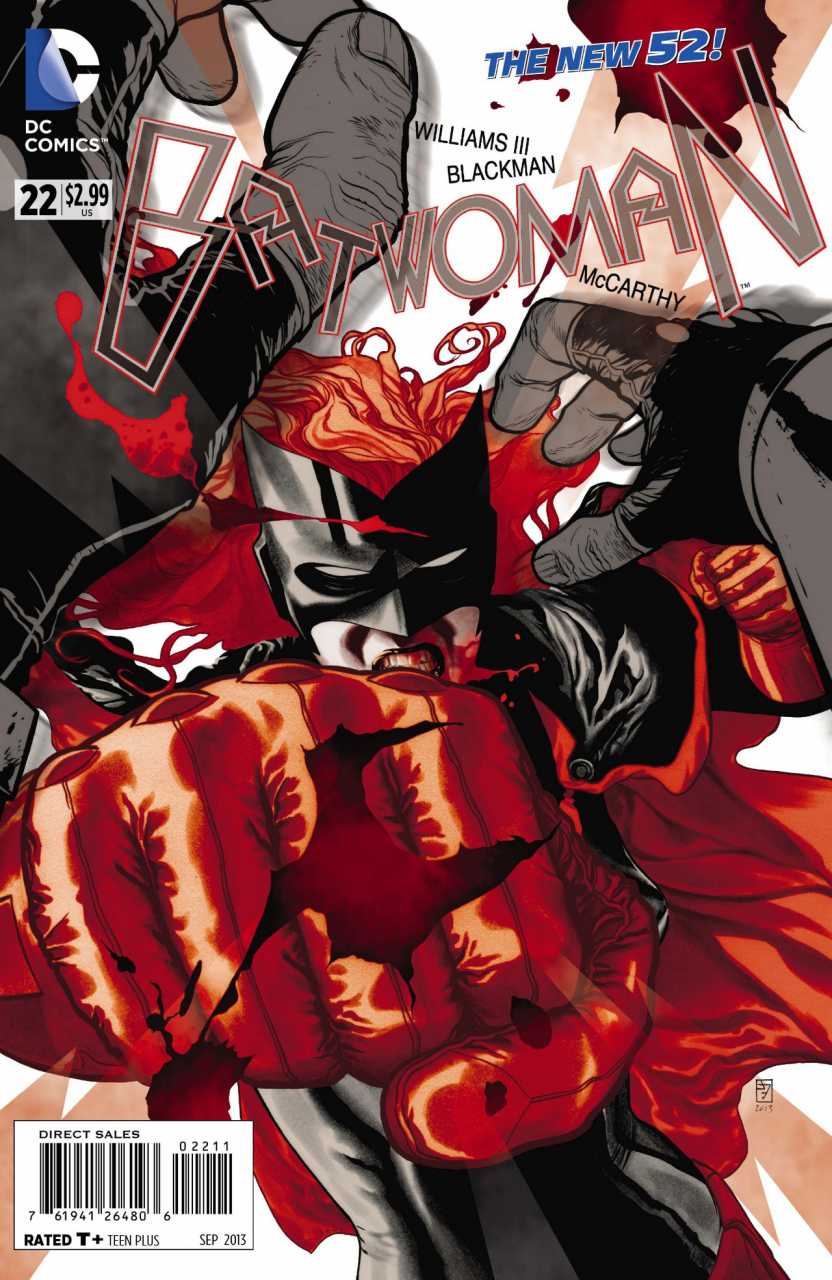
3175940-batwoman+01I want to love Batwoman so badly. I really do. Every month it’s one of my most anticipated books, and each month I’m left a little disappointed. It’s not bad, of course, and it has some of the most striking designs that DC produces (particularly when J.H. Williams III is on art duty), but the story just never measures up. Maybe I’m just remembering Greg Rucka’s amazing Batwoman storyline during his run on Detective Comics, I don’t know. It’s hard to live up to Rucka.

(SPOILERS) That being said, J.H. Williams III and W. Haden Blackman haven’t plotted out a boring story, but it just never seems to live up to its potential. Issue 22 comes right in the middle of an arc that’s supposedly going to set Batman and Batwoman against each other, which is a fight I’m very interested in seeing. Plus, we’ve recently learned that Kate’s sister Beth (aka villain Alice from Rucka’s run) is actually alive and being held by the DEO as a way of blackmailing Kate. All of that seems great. But, what actually happened in this issue?

Nothing, is pretty much the answer to that question. Kate, as Batwoman, and Bette, as Hawkfire (ugh, what a name) track down Bane for some reason, ostensibly to learn how to defeat Batman, as Bane has been the only man to do so. I didn’t even realize that still counted (Thanks, messed up New 52 continuity!). Then of course, we learn that Agent Chase of the DEO wanted to cut some kind of deal with Bane, the details to which we don’t learn. Surprise, right? Bane’s advice to Batwoman was so inane and unhelpful, she should have seen straight through the ruse. But she didn’t. Apparently she’s stupid now.

The final half of the book had to do with introducing a new mercenary team called Murder of Crows, somehow led by Colonel Jacob Kane (Kate’s father), even though he’s active duty military . . . We’ll just skip how ridiculous that is. We have pages of Bette as Hawkfire fighting and besting this group, all of whom are introduced with a caption box dedicated to their strengths and personalities, none of which I remember. We don’t see them do anything. We don’t see them in action. We see them all telling Jacob Kane how great Bette is. Boring. (Also, when did Bette become such a bad ass? Wasn’t she just screwing things up?)

All of what I’ve written above sound scattered and nonsensical, and that’s because it is. Nothing really happens. Scenes are lumped together with no sense of narrative flow, and the issue ends very abruptly, as they frequently do. Also, there’s not nearly enough Kate Kane/Batwoman. Bette is just not interesting to me. Hopefully the storyline picks up next issue.

Whenever J.H. Williams III is on art for this book, it’s undoubtedly the best looking comic DC publishes every month. However, while Williams is off doing Sandman: Overture, art duties have fallen to Trevor McCarthy. And that’s all right. He’s moved away from trying to replicate Williams’ ridiculous sense of design and begun to make the book his own: less detail, more cartoony, with pages that are a little less subtle. I personally like the style. It adds a boldness and aggression to the characters, which is something Williams didn’t frequently bring to the table.

Granted, I had a little trouble following the fight scene with Bane (One panel had Batwoman sneaking up behind Bane, and the next was a close up of Batwoman getting punched in the face. How did we get there?), but most of the action was kinetic and agile. The fight scenes with Bette and the Murder of Crows at the end fared worse, as McCarthy didn’t have the opportunity to actually stage a fight scene. He could only draw single panels unconnected with anything else.

As for the colors, I don’t know. I honestly can’t make up my mind. Guy Major’s choices at the beginning of the issue were great (during the fight with Bane). The snow was crystalline with a hint of light blue, which played against the dark of the forest very nicely. The bright orange and red of Hawkfire’s and Batwoman’s costumes, respectively, added another, deeper dimension. Unfortunately, and again I’m going to harp on the back half of the book, the pseudo-fight scenes with Hawkfire and the Murder of Crows were awash in dark blues, greens, and blacks, making everything sort of run together. Even the bright orange of Hawkfire’s costume became a dull copper. Nothing stood out, and everything seemed very one dimensional.

I love everything about Kate Kane/Batwoman as a character, and the art on this book is some of the best. It’s too bad #22 is such a let down. Here’s hoping next month’s issue will be much better.

Story: JH Williams III and W Haden Blackman Art: Trevor McCarthy

Story: 5 Art: 7.5 Overall: 6.5 Recommendation: Read

Review: Batwoman #21

Batwoman 21J.H. Williams III’s and W. Haden Blackman’s Batwoman is probably one of the strangest books on the market—complex, grim, filled with unique art, and though it’s technically part of DC’s New 52 Bat-Family, it seems to exist in a niche entirely its own. It’s an enigma really, but one that always surprises me. In fact, I always forget it’s on my pull-list; I walk in day of its release, my local comic-bookshop owner Roman hands me my stack, and there’s another white-black-and-red Batwoman cover! And this month’s issue was a sweet surprise.

Batwoman #21 is all about Killer Croc—though I think he prefers Waylon—and takes places after the Medusa incident. Williams III and Blackman show their literary dexterity with this issue, entitled “Interlude III,” penning great internal monologue for Killer Croc and showing us the inside of the were-cult he belongs to. At least until exeunt. I do love when authors write in the voice of the character, and Croc’s monologue is filled with all the spelling errors and ingrammaticalities a poor sewer croc like him is bound to have.

Moreover, the story features Croc as a shrewd leader, usurping his place and making decision for the betterment of himself (duh) and his new love, Claire (who seems to be with were-child). Oh yeah, and there’s a battle with Batwoman and Maggie, but it’s sort of sideline to Croc’s revelatory destiny.

If Williams III and Blackman deliver great writing and an engaging story, it’s made three to fifteen times better accompanied with Francesco Francavilla’s artistry. While Batwoman has seen the hands of talented artists before, Francavilla really does her best, and though he won’t be continuing in future issues, boy do I wish this were his regular gig…

Open up Batwoman #21 without context, and you’ll think you just bought yourself some sketchbook for a lizard demonomicon. It’s all the noir and fantastica this book needed, and Francavilla juxtaposes the more sketched-style lines of Killer Croc and the weres with the solid beauty he brings to Maggie and Kate.

Williams III and Blackman present the tragic story of yet another villain who may not be all-bad, but might have something below the layer of green, sketchbook Francavilla art that just hasn’t been apparent in past stories (he’s too busy getting the crap beat out of him by the Bat-Family). Batwoman #21 shines a sensitive spotlight on a villain much in need of depth, and deserving of such horror-comic-esque art. This is the rightful home for Croc.

Story: J.H. Williams III and W. Haden Blackman  Art: Francesco Francavilla
Story: 8  Art: 8.5  Overall: 8.5  Recommendation: Buy

23rd Annual GLAAD Media Awards Comics Nominations Announced

The comic book nominees for the 23rd Annual GLAAD Media Awards have been announced.  The award is for series that portray LGBT characters in a positive way.  This years nominees are:

Outstanding Comic Book
• Avengers: The Children’s Crusade by Allan Heinberg, Marvel
• Batwoman by J.H. Williams III and W. Haden Blackman, DC Comics
• Secret Six by Gail Simone, DC Comics
• Veronica Presents: Kevin Keller by Dan Parent, Archie Comics
• X-Factor by Peter David, Marvel Comics

All are great examples of the progressive nature of comics and how this is being portrayed in mainstream comics.  I do also encourage folks to check out Prism Comics and Northwest Press (two examples of many) that primarily produce LGBT comics.  Congrats to all the nominees, all of which I’d be happy to win.