Small Press Expo has announced the next group of Special Guests for SPX 2025. The show takes place on Saturday, September 13, and Sunday, September 14, with programming and workshops about the amazing world of independent comics as well as an exhibitor floor featuring over 500 creators.
SPX 2025 is honored to have the following creators as Special Guests to this year’s show:
Caroline Cash
Caroline Cash will debut a brand new self-published zine, entitled Zine: It’s Short For Magazine at SPX, as well as promote her new Adventure Time Bubbline One Shot (published by Oni Press).
She will also have copies of the new Kuš anthology that will come out later this Summer.
Caroline is currently working on her Eisner and Ignatz award winning series PeePeePooPoo, as well as a graphic novel about dyke drama. She is a Capricorn Sun, Virgo Moon, and Leo Rising.
Ann Telnaes
A two-time Pulitzer winner, Ann Telnaes worked as an editorial cartoonist at The Washington Post for over sixteen years. She resigned after a cartoon she submitted was rejected because it criticized billionaire tech and media executives, including the Post’s owner Jeff Bezos, for trying to curry favor with President Trump. Her resignation, which was posted on her Substack, went viral worldwide.
Peter Kuper
Award winning cartoonist Peter Kuper will be signing his latest graphic novel, Insectopolis: A Natural History (W.W.Norton) as well as debuting his upcoming Wish We Weren’t Here (Fantagraphic Books). He’ll have original art from Spy vs. Spy that he has written and drawn for Mad magazine since 1997 and his cartoon and illustration original art from The New Yorker, The Nation and Charlie Hebdo. Co-founder of the political anthology World War 3 illustrated, he’ll have the latest issue and many of his other books at his table.
Laura Terry
When Jinx and her mom move to an unfamiliar apartment, her life is turned upside down when a neighbor gives Jinx a magical crystal that brings a mischievous band of woodland creatures into her life. The Adorables are messy, distracting, adventurous and Jinx just wants to be left alone… until she meets her nerdy new neighbor Robyn and develops a crush. Getting rid of the Adorables turns out to be harder than expected, but this might just help Jinx find her way back to happiness in this middlegrade fantasy graphic novel published by Scholastic.
Anders Nilsen
Nilsen will be presenting his book Tongues, an epic retelling of the Greek myth of Prometheus, set in the present day and intertwoven with an orphan’s adventure story and ruminations on humanity’s fraught present moment. With exquisite full-color artwork to match its epic scope, Tongues has been called “Momentous” (Alexander Chee), “F#&%ing Amazing.” (Charles Burns), and “Momentous.” (Leela Corman). Max Porter called the book “A landmark book not only in the history of the graphic novel, but in the history of mythic storytelling.”
Julia Gfrörer
We are thrilled to announce that Julia Gfrörer will be at SPX and signing copies of her incredible new collection, World Within the World: Collected Minicomix & Short Works 2010-2022. Deemed “the Norton Anthology of Violence” by The New York Times, this collection stretches over 20,000 years from the Stone Age to the apocalypse. The tales within speak of desire, despair, and the universal need for connection and span centuries, continents, and cultures from prehistoric teenagers in love to Christian martyrs in the making to modern-day vampires on the make.
Paige Hender
Paige Hender (she/her) is a Canadian-born, Louisiana-raised, Hell-spawned cartoonist currently living in Shreveport with her cat Chaplin. The Confessional is Hender’s compelling debut horror graphic novel about a newly turned vampire yearning for salvation in the arms of the priest who uncovers her secret. This is her first time to be invited to a convention. She will be signing at the Silver Sprocket table all weekend. Please be nice to her.
Check put the panel “American (Jewish) Splendor: Celebrating Harvey Pekar and Joyce Brabner” from JewCE 2024.
Harvey Pekar (1939-2010) created and wrote American Splendor comics, which inspired a whole branch of memoir comics (not to mention the 2003 American Splendor movie), which Harvey produced with Robert Crumb and other notable artists. With his wife and creative partner, Joyce Brabner, who passed away in August, Pekar created a singular body of work, much of it Jewish-themed. On her own, Joyce wrote significant graphic novels. Harvey would have been 85 years old this past October 8. His and Joyce’s influence on comics remains strong.
Talking about Harvey and Joyce at this panel are two of Harvey’s artistic partners, Dean Haspiel (The Quitter; Billy Dogma) and Josh Neufeld (A.D.: New Orleans After the Deluge; The Influencing Machine) as well as Jeff Newelt (editor of The Pekar Project); JewCE award-winning cartoonist Peter Kuper (Stop Forgetting to Remember; Ruins), who knew Harvey in ‘70s Cleveland; historian Arie Kaplan (From Krakow to Krypton; Encyclopedia of Epic Myths and Legends), and writer Danny Fingeroth (author of Jack Ruby: The Many Faces of Oswald’s Assassin), who hosted Harvey at a 2009 event with YIVO.
Small Press Expo has announced the first Special Guests for SPX 2024. The show takes place on Saturday September 14 and Sunday September 15 with programming and workshops about the amazing world of independent comics and an exhibitor floor with over 500 creators.
Additional Special Guests will be announced over the next few weeks.
Tillie Walden
Tillie Walden will be signing copies of Clementine Book 1 and Book 2, as well as Junior High, a graphic novel made in collaboration with Tegan and Sara Quin. Also at the show there will be copies of her sketchbook compilation and never-before-seen zines! Her other work will be available as well, including her earliest work with Avery Hill Publishing. She will be giving the SPX Lecture at the Library of Congress at Noon, September 13.
Carol Lay
We are so honored to have Carol Lay as a Special Guest at SPX! She’s been creating art for decades and has an incredible body of work. Her new book, My Time Machine from Fantagraphics, is serious and funny, a sly cautionary political satire, and a rollicking time travel story full of puzzling paradoxes, edge-of-your-seat suspense, breezy badinage, and a deeply felt wonder at the universe.
Peter Kuper
Peter Kuper is a multi-award-winning cartoonist and illustrator who is frequently featured in The New Yorker, The Nation, and Mad. In 1979 he co-founded the political comix magazine World War 3 Illustrated, and has produced over two dozen books during his career. Peter has lectured and exhibited his work extensively throughout the world and teaches Harvard University’s first class dedicated to graphic novels. Among other awards, in 2016 his graphic novel Ruins won the Eisner Award for Best Graphic Album. He is currently working on a graphic novel on the history of insects and the people who study them. He will be signing copies of the paperback edition of Ruins published by SelfMadeHero
Dash Shaw
In his latest offering, Dash Shaw wrestles with the murky indeterminacy of life. Blurry, from the New York Review of Books, asks that readers sit in—try to enjoy, even—that place of doubt and indecision, where the future is uncertain, identity is unsettled, and chance encounters intrude. Sometimes making a choice is so damn hard. And who knows what will be the consequences of one’s action? In Blurry, Shaw creates a cast of characters who tell their stories of those pivotal moments of decision and what came after.
Christi Furnas
Christi Furnas’ graphic novel Crazy Like a Fox from Street Noise Books tells an autobiographically-inspired story about leaving home, figuring out life, being diagnosed with schizophrenia, and navigating the mental health system. Publishers Weekly says, “Furnas skewers the mental healthcare system in her sharp-edged graphic novel debut. . . . This surreal work reflects the disorientation of mental breakdown.”
About the book, Christi says, “I want Crazy Like a Fox to lift some of the fear and stigma around talking about psychotic illness, and offer hope. I’m happy and thriving.”
Christi will be talking about her graphic novel and mental health, and signing books at the show.
George Wylesol
George Wylesol is the author of the graphic novels 2120 and Curses, debuting at SPX from Avery Hill. He will be at SPX to talk about horror and the internet age, as well as signing books. His brightly-colored, experimental work ranges from short stories to choose-your-own-adventure style narratives that emphasize the weirdness of the world around us all and the prevalence of computers in our society today.
“His cartooning is economical, effective in a lunging sort of way. . . . the sensory experience of looking overpowers most everything else. His cartooning is economical, effective in a lunging sort of way,” says The Comics Journal about Curses.
The Simpsons Treehouse of Horror Ominous Omnibus Vol. 2 Deadtime Stories for Boos & Ghouls delivers laughs and scares just like the cartoons
The second of three volumes collecting the complete Simpsons Treehouse of Horror comics by creator Matt Groening-packaged in a deluxe, die-cut slipcase that glows in the dark
Collected for the first time in a deluxe hardcover slipcase with an all-new die-cut cover.
Story: Kyle Baker, James W. Bates, Ian Boothby, Max Davison, Chuck Dixon, Gerry Duggan, Glenn Fabry, Pia Guerra, John Kerschnbaum, Peter Kuper, Carol Lay, Ted May, Jesse Leon McCann, Gary Spencer Millidge, Terry Moore, Steve Niles, Troy Nixey, Brian Posehn, Dean Rankine, James Robinson, Scott Shaw!, Gene Simmons, Will Sweeney, Matthew Thurber, Jim Valentino, Jon Vermilyea, Len Wein, Shannon Wheeler, Jane Wiedlin, Jim Woodring, Chris Yambar, Neil Alsip, Tony Di Gerolamo
Art: Max Badger, Kyle Baker, Hilary Barta, Dan Brereton, John Delaney, Glenn Fabry, Pia Guerra, Sammy Harkham, Tom Hodges, Kevin Huizenga, John Kerschbaum, Peter Kruper, Carol Lay, James Lloyd, Nina Matsumoto, Gary Specer Millidge, Terry Moore, Bill Morrison, Troy Nixey, Phil Ortiz, Dean Rankine, Tone Rodriguez, Scott Shaw!, Will Sweeney, Jim Valentino, Jon Vermilyea, Jim Woodring, John Adams, Norm Auble, Bryan Francis, Christianna Lang, Abel Lacamana, William Mahoney, Istvan Majoros, Scott McRae, Kevin M. Newman, Joey Nilges, Robert Oliver, Ryan Rivette, Aaron Rozenfeld, Horacio Sandoval, Alberto Santiago
Layouts: Chris Roman
Ink: Terry Austin, Tim Bavington, Tom Hodges, Phyllis Novin, Andrew Pepoy, Mike Rote
Color: Nathan Hamill, Nathan Kane, Joey Mason, Ted May, Rick Reese, Robert Stanley, Dave Stewart, Christopher Ungar, Art Villanueva
Letterer: Karen Bates, Gary Spencer Millidge, Mike Sakamoto, Christopher Ungar
Editor: Sammy Harkham, Nathan Kane, Bill Morrison
Get your copy now! To find a comic shop near you, visit http://www.comicshoplocator.com or call 1-888-comicbook or digitally and online with the links below.
Abrams Comicarts provided Graphic Policy with a FREE copy for review This post contains affiliate links, which means that if you click on one of the product links and make a purchase, we’ll receive a percentage of the sale. Graphic Policy does purchase items from this site. Making purchases through these links helps support the site
The Simpsons Treehouse of Horror Ominous Omnibus Vol. 2 Deadtime Stories for Boos & Ghouls delivers laughs and scares just like the cartoons
The second of three volumes collecting the complete Simpsons Treehouse of Horror comics by creator Matt Groening-packaged in a deluxe, die-cut slipcase that glows in the dark
Collected for the first time in a deluxe hardcover slipcase with an all-new die-cut cover.
Story: Kyle Baker, James W. Bates, Ian Boothby, Max Davison, Chuck Dixon, Gerry Duggan, Glenn Fabry, Pia Guerra, John Kerschnbaum, Peter Kuper, Carol Lay, Ted May, Jesse Leon McCann, Gary Spencer Millidge, Terry Moore, Steve Niles, Troy Nixey, Brian Posehn, Dean Rankine, James Robinson, Scott Shaw!, Gene Simmons, Will Sweeney, Matthew Thurber, Jim Valentino, Jon Vermilyea, Len Wein, Shannon Wheeler, Jane Wiedlin, Jim Woodring, Chris Yambar, Neil Alsip, Tony Di Gerolamo
Art: Max Badger, Kyle Baker, Hilary Barta, Dan Brereton, John Delaney, Glenn Fabry, Pia Guerra, Sammy Harkham, Tom Hodges, Kevin Huizenga, John Kerschbaum, Peter Kruper, Carol Lay, James Lloyd, Nina Matsumoto, Gary Specer Millidge, Terry Moore, Bill Morrison, Troy Nixey, Phil Ortiz, Dean Rankine, Tone Rodriguez, Scott Shaw!, Will Sweeney, Jim Valentino, Jon Vermilyea, Jim Woodring, John Adams, Norm Auble, Bryan Francis, Christianna Lang, Abel Lacamana, William Mahoney, Istvan Majoros, Scott McRae, Kevin M. Newman, Joey Nilges, Robert Oliver, Ryan Rivette, Aaron Rozenfeld, Horacio Sandoval, Alberto Santiago
Layouts: Chris Roman
Ink: Terry Austin, Tim Bavington, Tom Hodges, Phyllis Novin, Andrew Pepoy, Mike Rote
Color: Nathan Hamill, Nathan Kane, Joey Mason, Ted May, Rick Reese, Robert Stanley, Dave Stewart, Christopher Ungar, Art Villanueva
Letterer: Karen Bates, Gary Spencer Millidge, Mike Sakamoto, Christopher Ungar
Editor: Sammy Harkham, Nathan Kane, Bill Morrison
Get your copy now! To find a comic shop near you, visit http://www.comicshoplocator.com or call 1-888-comicbook or digitally and online with the links below.
Abrams Comicarts provided Graphic Policy with a FREE copy for review This post contains affiliate links, which means that if you click on one of the product links and make a purchase, we’ll receive a percentage of the sale. Graphic Policy does purchase items from this site. Making purchases through these links helps support the site
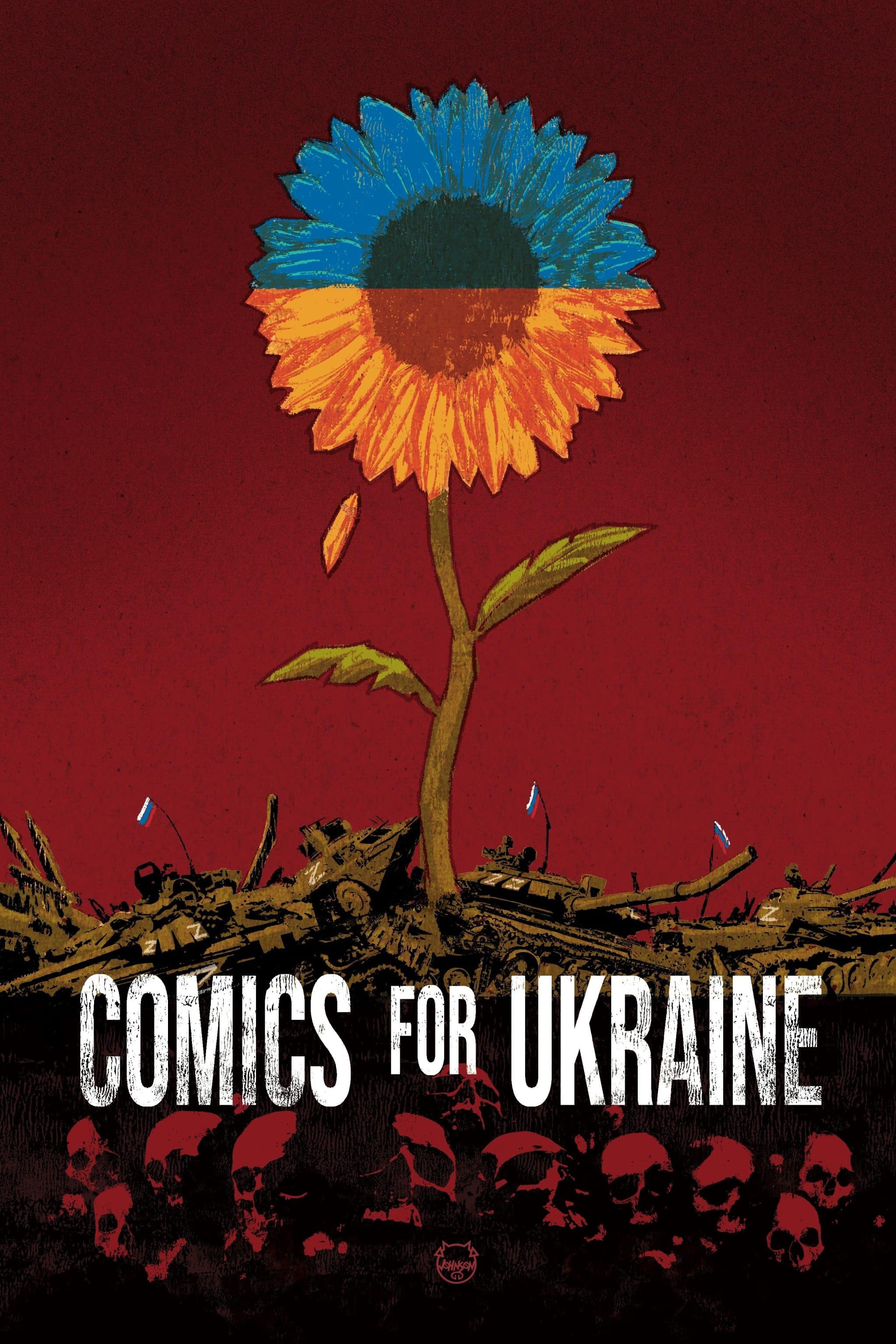
Last week, more than three dozen comic-book writers, artists, colorists, letterers, designers, and editors announced a collection of all-new comic-book stories to raise money to aid refugees in Ukraine. Comics for Ukraine: Sunflower Seeds, the benefit anthology edited by Scott Dunbier, with all proceeds going to Operation USA, surpassed an initial $35,000 funding goal just twelve hours after the campaign launched, with over $113,000 from over 900 contributors raised to date. The book will be full-color, 96 pages, 8 x 12 inches, and available in both hardcover and softcover editions, with hundreds of supporters on day one. As the campaign enters a second week of funding, it is announced that Eisner Award-winner Colleen Doran, legendary illustrator Greg Hildebrandt, and celebrated cover artist Joe Jusko have joined the project.
These three creators join the incredible roster of comics talent assembled for Comics for Ukraine: Sunflower Seeds; united under the mission of providing relief to a war-torn Ukraine, which has suffered attacks from neighboring Russia since late February. There will be multiple versions available: a hardcover with a painted cover by Alex Ross, and softcover versions by Arthur Adams, Dave Johnson, and Bill Sienkiewicz. At press time, stories will be created by a virtual who’s who of writers and artists, including Brent Anderson, Sergio Aragones, June Brigman, Kurt Busiek, Howard Chaykin, Joshua Dysart, Mark Evanier, Emil Ferris, Dave Gibbons, Rob Guillory, John Layman, Gabriel Rodriguez, Stan Sakai, Louise Simonson, Walter Simonson, Chris Sprouse, Jill Thompson, Matt Wagner, Mark Waid, and more.
Apart from hard costs (printing, credit-card fees, marketing, etc.) all of the funds raised by Comics for Ukraine: Sunflower Seeds will benefit the relief efforts in Ukraine in partnership with Operation USA, so while the initial funding goal has been met, continued support will maximize the impact on the lives of those deeply affected by the ongoing war—improving conditions for Ukrainian refugees in neighboring countries via the provision of emergency grants and in-kind material aid.
Operation USA supports health and education programs to help children and families at home and abroad recover and thrive in the wake of disasters, disease, violence and endemic poverty. Every day, they strive to meet the needs of under-served and overlooked populations so that future generations may have the tools they need to create meaningful change in their own communities and lives. Working with partners around the world, they empower communities to recover, build resiliency and thrive in the face of pervasive obstacles during a time of unprecedented global need. Since 1979, OpUSA has delivered $450 million in aid to 101 countries.
Disclosure: The site founder is a part of this project handling some of the marketing for Zoop
More than three dozen comic-book writers, artists, colorists, letterers, designers, and editors have announced a collection of all-new comic-book stories to raise money to aid refugees in Ukraine. Comics for Ukraine: Sunflower Seeds is a benefit anthology edited by Scott Dunbier, with all proceeds going to Operation USA. The 96 page graphic anthology will available in both hardcover and softcover editions with multiple cover choices.
The Comics for Ukraine: Sunflower Seeds anthology features an incredible roster of comics talent united under the mission of providing relief to the war-torn Ukraine, which has suffered attacks from neighboring Russia since late February. There will be multiple versions available.
Covers:
Alex Ross
Arthur Adams
Dave Johnson
Bill Sienkiewicz
Stories:
Kurt Busiek, Brent Anderson, Wade Von Grawbadger, Alex Sinclair, Richard Starkings – New Astro City
John Layman, Rob Guillory – New Chew
Walter Simonson, Laura Martin, John Workman – New and Exclusive Star Slammers
Howard Chaykin, Nitro Yen, Ken Bruzenak – New and Exclusive American Flagg
Stan Sakai, Hi-Fi – New and Exclusive Usagi Yojimbo
Matt Wagner, Brennan Wagner – New and Exclusive Grendel
Mark Evanier, Sergio Aragones, Stan Sakai – New and Exclusive Groo
Jill Thompson – New and Exclusive Scary Godmother
Louise Simonson, June Brigman, Roy Richardson, Dave Stewart, John Workman – New and Exclusive short story “The Cost of War“
Dave Gibbons, Chris Sprouse, Kevin Nowlan, Laura Martin, Todd Klein – New and Exclusive short story “Hardrada“
Mark Waid, Gabriel Rodriguez, Dave Stewart, Todd Klein – A new and exclusive short story
Emil Ferris – New and Exclusive short story “Bombings“
Additional material by:
Joshua Dysart
Pia Guerra
Peter Kuper
With the exception of hard costs (printing, credit-card fees, marketing, etc.) all of the funds raised by Comics for Ukraine: Sunflower Seeds will benefit the relief efforts in Ukraine in partnership with Operation USA.
Operation USA supports health and education programs to help children and families at home and abroad recover and thrive in the wake of disasters, disease, violence and endemic poverty. Every day, we strive to meet the needs of under-served and overlooked populations so that future generations may have the tools they need to create meaningful change in their own communities and lives. Working with partners around the world, we empower communities to recover, build resiliency and thrive in the face of pervasive obstacles during a time of unprecedented global need. Since 1979, OpUSA has delivered $450 million in aid to 101 countries.
Check out the cover by Alex Ross below.
Disclosure: I am a part of this project and act as the marketing director for Zoop.
CONTENT WARNING: This graphic novel covers the human rights violations of migrants imprisoned in ICE detention centers. This includes scenes abuse, starvation, neglect, physical violence, and racial slurs, many of which involve children.
SPOILER WARNING: There are spoilers minor and major ahead.
DISCLOSURE: A copy of BORDERX was provided for by a contributor.
Publisher: BORDERX Publishing Editor and Producer: Mauricio Alberto Cordero Project Assistance: Roel Torres Design Assistance: Adriana Cordero Story & Art: Various Artists
Comics can be more than just escapist entertainment. I don’t just mean the dark, gritty “comics aren’t just for kids anymore” kind of stuff, although I do enjoy a good bit of sex and violence in my panels. Increasingly, the medium has been used to tell real stories about real people. Whether it’s autobiographical comics such as Spinning and Fun Home, or historical comics like Maus or Big Black: Stand At Attica. Many of the latter aren’t just good stories. They provide context to important moments in history and can inspire a sense of urgency to continue on the good fight against racism, homophobia, police brutality, and so much more.
BORDERX is a charity anthology about the current crisis of the injustices against migrants here in the U.S. The goal as stated by publisher and editor-in-chief Mauricio Alberto Cordero is to educate readers about the border crisis and raise money for charity. Not only that, but Cordero hopes to make the focus on the migrants themselves, paint a human picture of them that reminds everyone that these are people–not criminals–who deserve rights and respect.
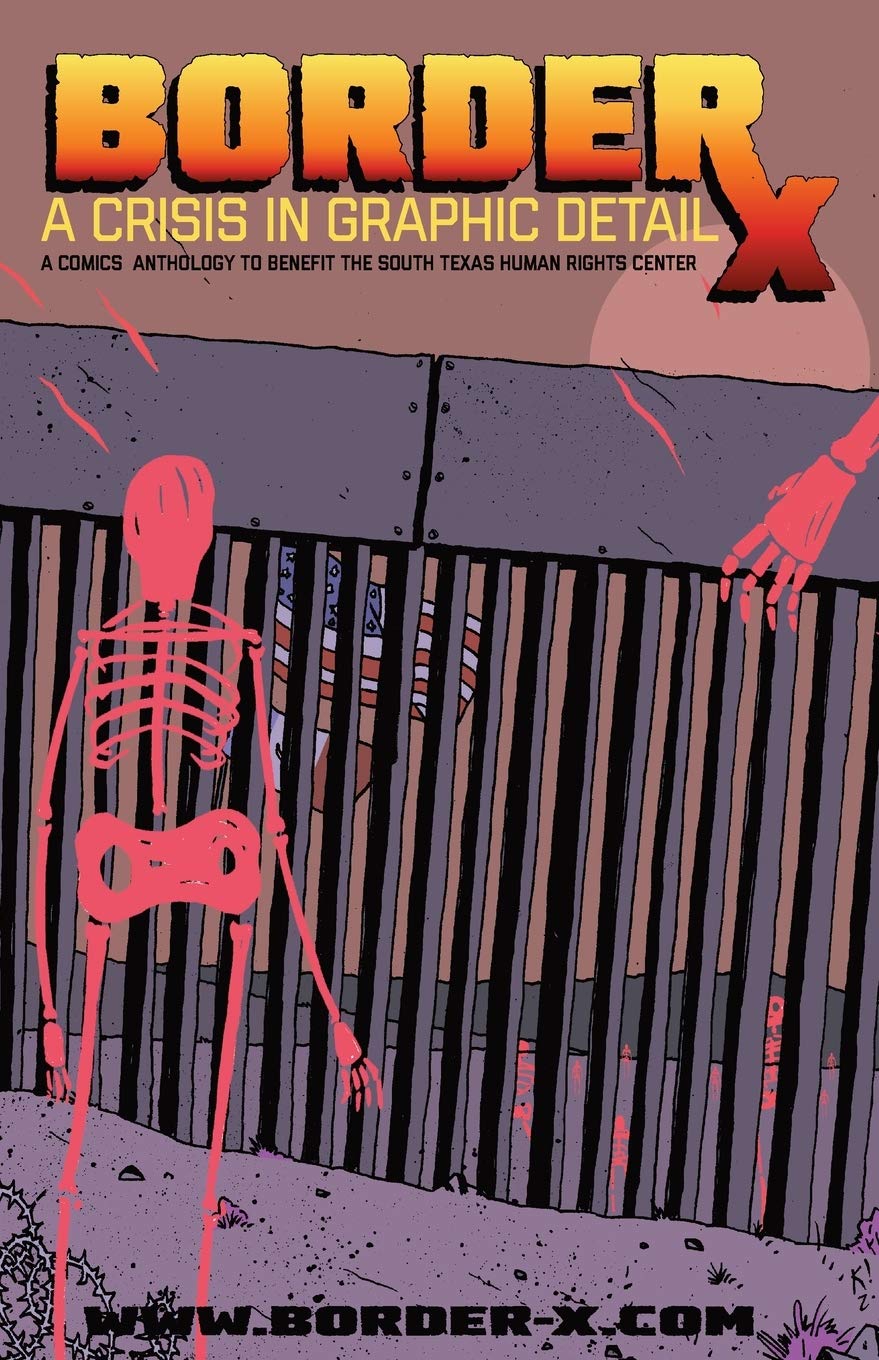
The cover to this anthology shows a red skeleton approaching a border. This should make it clear the position the anthology has on the crisis. The contributors are not fans of ICE, the Border patrol, or the American government. These groups are clearly placed in the wrong, sometimes artists interpreting agents as vicious dogs or eldritch abominations. If you’re coming into this book hoping for a pro-ICE stance or “both sides” deal, well I suggest you look elsewhere, preferably here:
However, I must comment that the cover does not set a clear tone. The design here induces dark feelings. It’s a forewarning to content that will be unsettling. Certainly, it is. I would argue though that a cover should clearly match the tone of its content. In that regard, BORDERX is a mix of both darkness and light, something the cover fails to capture. Yes, there are stories in here about horrible human rights abuses, but it also includes hopeful and educational ones as well. Having a cover that reflects only half of your content is insufficient.
I appreciate the anthology’s clearness of intent. There are no meaningless apolitical platitudes found here. It also provides important context to the reader. Introductions by Senator Jeffrey A. Merkley,Warren Binford, and Michael Garcia Bochenak describe the poor conditions migrants experience in the ICE detention centers, the brutal and traumatizing practice of separating families, and the subsequent public responses. From there Cordero chimes in to layout how the anthology addresses the crisis, namely through 5 segments, each with their own purpose:
The Exhibits — views on the border
The Responses — profiles of people and organizations helping migrants
The Context — personal accounts of people whose lives have been touched in various ways by the border crisis
The Ruminations — fictional allegories and satire
The Posters — art pieces
BORDERX is clearly an anthology with lofty goals, clear intent, and what looks like a well thought out plan. Unfortunately, I found the execution to be mixed. Starting with the Exhibits section, there is a conflict between Cordero’s stated intent and the content provided. When he described this segment as “views on the border”, I imagined it would be a series of experts giving their thoughts. Instead, it’s a collection of comics illustrating various accounts from migrants in the detention center. This is not a bad thing. These stories are the meat and potatoes of the anthology. However, it is disappointing that Cordero wrongly stated what the Exhibits would be about when he started off with such a clear plan in mind. I know this is nitpicking, but a work like this tackling such a serious subject matter cannot afford muddling its intent.
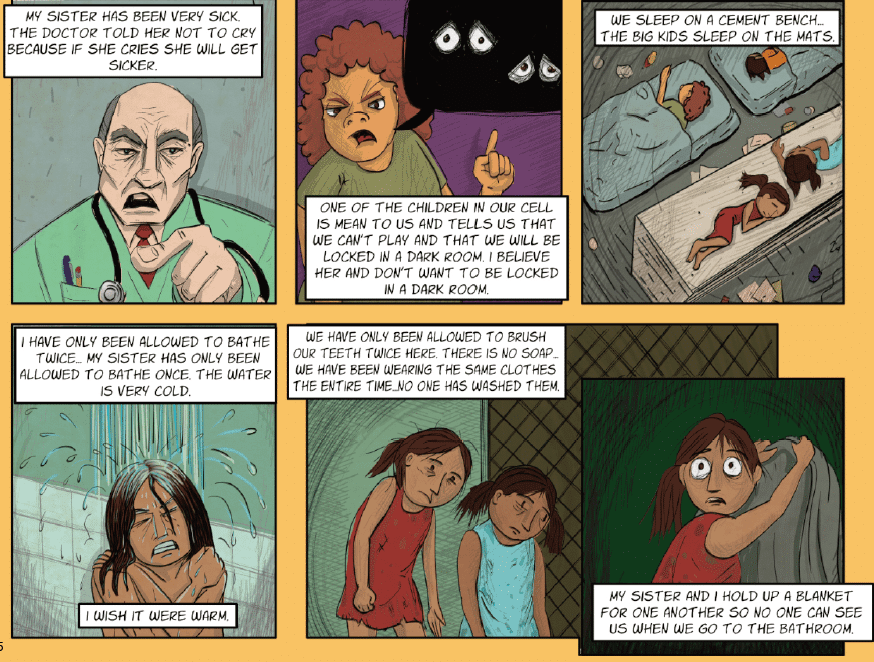
As for the comics themselves, these are easily the best in the anthology. Each of the stories are real life declarations from detainees provided by Project Amplify, an organization dedicated to collecting and making their stories available to the public. The creative teams do a fantastic job of transferring the declarations into the comics medium. They all follow the usual formula of filling panels with images and narration captions that correlate with one another. The visuals all vary, ranging from presentational to expressionistic, realism to surrealism. There are even styles that resemble children’s cartoons, no doubt a purposeful subversion to highlight just how horrible these events are. I can’t say that every comic is a work of art, but each one does accomplish its goal of bringing to life the detainees and what they went or still are going through.
The Exhibits is also the most difficult part of BORDERX to read. The stories are brutal. The detainees live in freezing cold buildings, locked up in cages. There are insufficient supplies, terrible food, not enough beds and blankets, insufficient medical care, limited if any times to bath or brush teeth, sickness, abuse and neglect from ICE staff, lights kept on all day and night, and the detainees have no idea what their rights are or what will happen to them. All of these accounts are from children, including newly born babes. Just imagine being separated from your parents and forced to live in these conditions, constantly treated like dirt. These aren’t even all the stories, or even the worse ones.
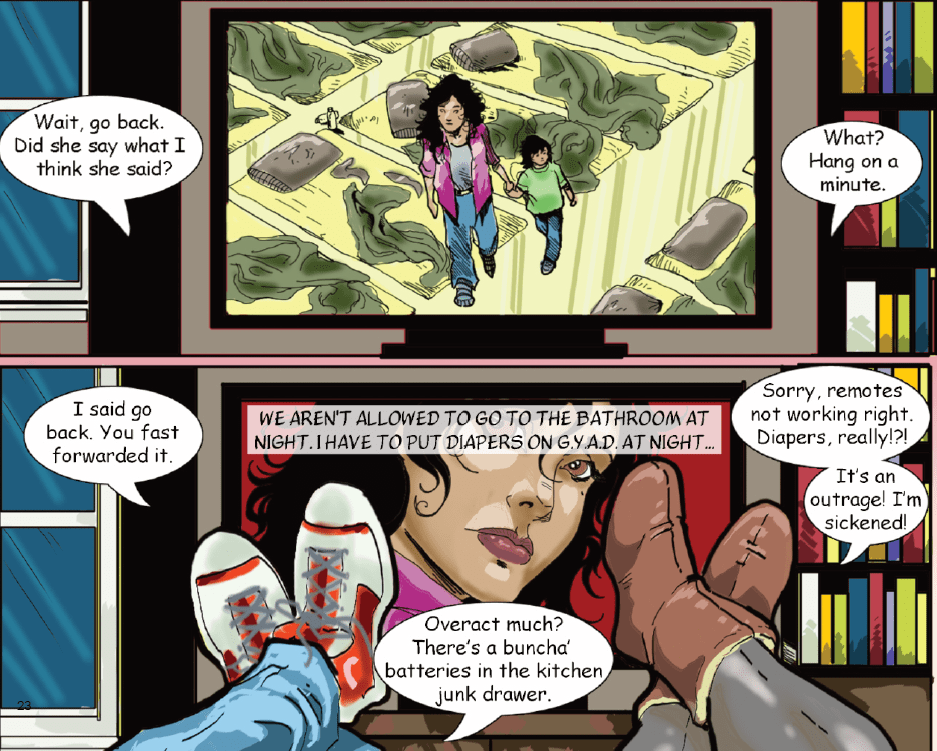
Reading the Exhibits boiled my blood. An anger that lay dormant from when I, like most Americans, learned about these abuses rose in me, tenfold this time now that I had faces to associate to all those poor children. Which is a good thing. This visceral reaction I experienced should be the end goal of illustrating these stories. Probably the best piece is “Eisegeis” by Lee A. Gooden, Rod Jacobsen, and Dan Demille. It interrupts the regular flow for scenes of two roommates watching the story being told from a T.V. It’s in the point-of-view of the more sympathetic viewer, and a meta challenge to the reader not to forget what is happening here. Outrage and empathy is not enough. Those feelings must fuel action.
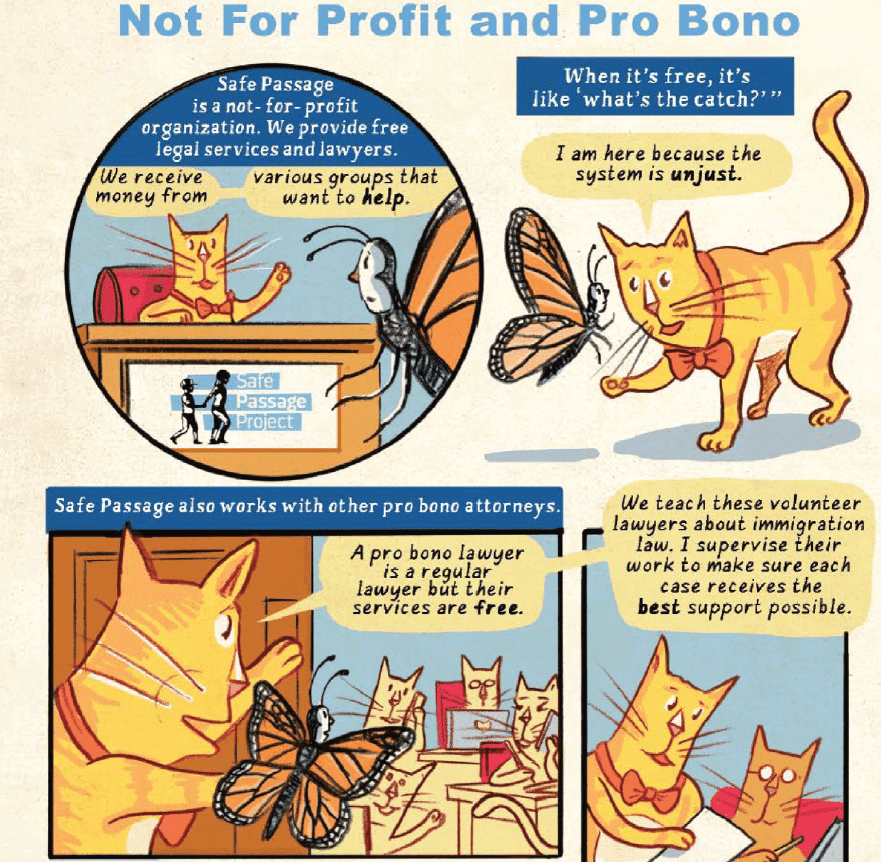
The Responses is the shortest segment of BORDERX, and the most consistently educational. We learn about important individuals and organizations supporting migrants. I was surprised to see Peter Kuper in here. For those of you who don’t know, Kuper is a critical-acclaimed indie comics artist, probably most known for his work on MAD Magazine’s “Spy vs. Spy”. He is easily the best artist in his anthology, and I couldn’t help but experience delight as his cartoon animals explained migration law.
Throughout the Responses, I learned about organizations like Safe Passage Project and the Southern Texas Human Rights center, how they help migrants in various ways. I found this not only educational, but also uplifting. After reading about all the abuse in the previous segment, it was important to know about people actually helping immigrants. Links to these organization’s websites are also provided, which is a great way to encourage readers to continue educating themselves long after they’re done reading.
As much respect as I have for this segment, there are deeply flawed pieces. “Crisis in Clint” is about Warren Binford, an activist who helped Project Amplify collect declarations from detainees. It’s an inspiring story, but one told with choppy progression that left me feeling like there was information lost. I get a strong feeling that the creative team struggled to decompress her story properly. I can’t imagine that it was an issue of page limit. Kuper‘s comic gave a clear picture of the Safe Passage Project with 15 pages, and there pieces that tell their narratives with as little as 4. Another piece, “Anime Blue” by Paolo Massagli, is not very educational despite being about Open Arms. It’s an NGO (non-governmental organization) dedicated to search and rescue at sea. I didn’t learn any of that until I googled them. The only thing you learn about them is their name alone.
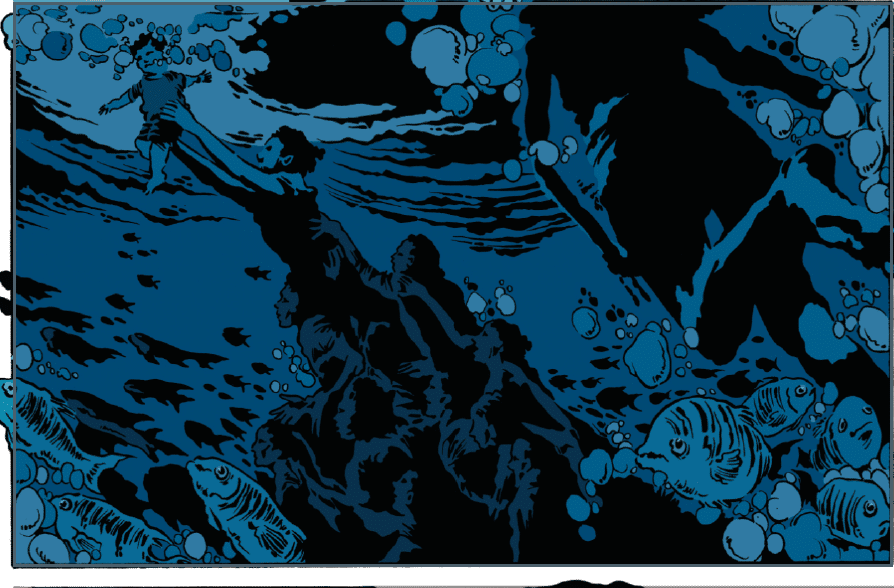
It’s a shame because the comic itself is amazing, a work of goddamn art I would even argue. It’s a wordless tale about a drowning baby that is lifted to the safety of the surface by the spirits of dead migrants. The visuals are profound in both their beauty and melancholy. I had quite the emotional reaction, tears of both grief and joy running down my facee.
Issues with the anthology continue onto the Context segment, not so much of quality as organization. These are supposed be personal accounts from people whose lives have been touched in various ways by the border crisis. The pieces I read are split between autobiographical and historical. Yes, they do give context to the border crisis, but not in a way completely accurate to Cordero’s statement.
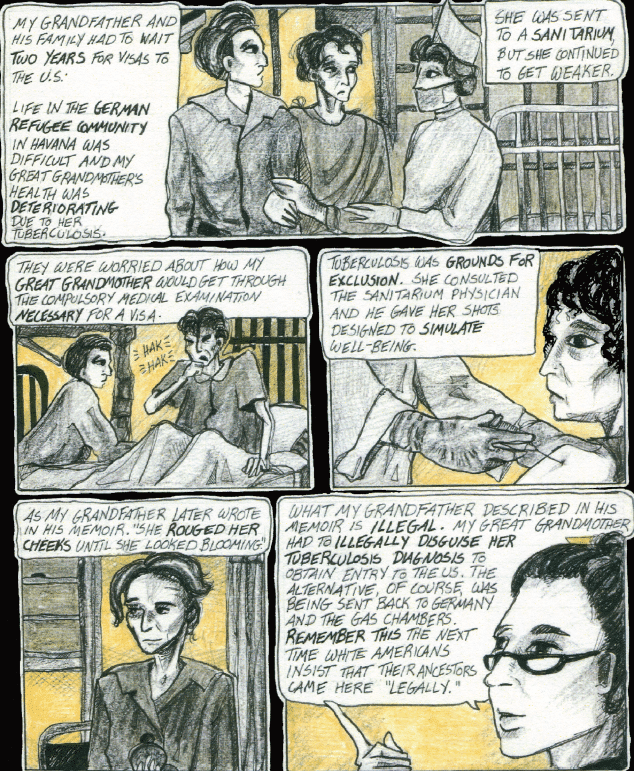
Let me just start off by saying that these pieces are fantastic. “As Long As They Come Here Legally” by Phoebe Cohen and “Cynthia” by Roel Torres tell the stories of how their families immigrated to the U.S. under legally dubious circumstances. If they didn’t, they would have been dead, something they hold in common with many migrants in those horrible ICE detention centers. These pieces challenge the reader to think about their own families. Many were immigrants as well, and probably had to do what was necessary.
The historical pieces talk about various immigrant crises throughout American history. “…But It Does Rhyme” by Paul Axel, Craig Florence, Alvon Ortiz, and Jerome Gagnon features a different atrocity committed against migrants and indigenous people by the American government and our military. The Trail of Tears, Japanese-American internment camps during WW2, the list goes on. Each and every one of them shows how we were tied to a migration crises, and how we only made it worse by responding not with compassion but violence. What is going on at the ICE detention centers is violence, cold and sadistic. And the sad part? It seems to have always been that way.
Other pieces in this segment don’t seem to fit at all. “Dora”, for example, reads more like the stories from the Exhibits. It’s also the worst written. For some reason, the writer tried mixing English and Spanish together, which makes for a reading experience that is choppy and often bewildering. Actually, to be quite frank, the entire organization of the Context is messy. Even the good pieces I find should have been put in different categories from each other. It would have made the segment much stronger.
The Ruminations is by far the worst part of BORDERX. The comics here approach the border crisis by using genre fiction as an allegory, kind of like The Twilight Zone. Despite me liking a lot of the art, the stories are mostly half-baked ideas with mediocre writing. For example, there’s one story that tries to take the monkey’s paw concept into a new direction, only for it to be a confusing, repetitive slog. Given how much the editing in previous segments was superior, I do wonder if time was running out on the deadline and the publisher had to make do. Cordero does mention all the contributors worked on a tight schedule.
That doesn’t mean there aren’t good pieces. “Rose Colored Glass” by Sal Fitzgerald and Raymond Griffith is a post-apocalyptic scenario where apparently there are certain people in America denied the permission to breathe oxygen, so they must wear these helmets that look like old scuba gear and not take them off or their heads explode. The world-building is vague and the whole concept in of itself is ridiculous, but it’s the most successful in using genre fiction as an allegory for immigration.
The most irritating of them all is “Sink?” by Tom Hart. It’s stylized as a newspaper comic strip, starting off with a guy going on an incoherent rant, then the whole thing cuts to a bunch of guys on boats. They rant as well, but are more coherent, mostly just about how unhappy they are with their marriages and jobs. Every now and then, a scene of war, floods, and other horrible events interrupts the rambling. This whole comic is a ham-fisted attempt at tut-tutting first world problems while the real problems are happening elsewhere. It’s not righteous or supportive. It’s cynical and condescending. Yes, it’s framed as a bunch of privileged men acting like their privilege is the worse thing ever, but I too often see people with ADHD, depression, and anxiety get swept under the same vague umbrella. It’s not about actually caring about real issues, but smugly showing off a sense of moral superiority.
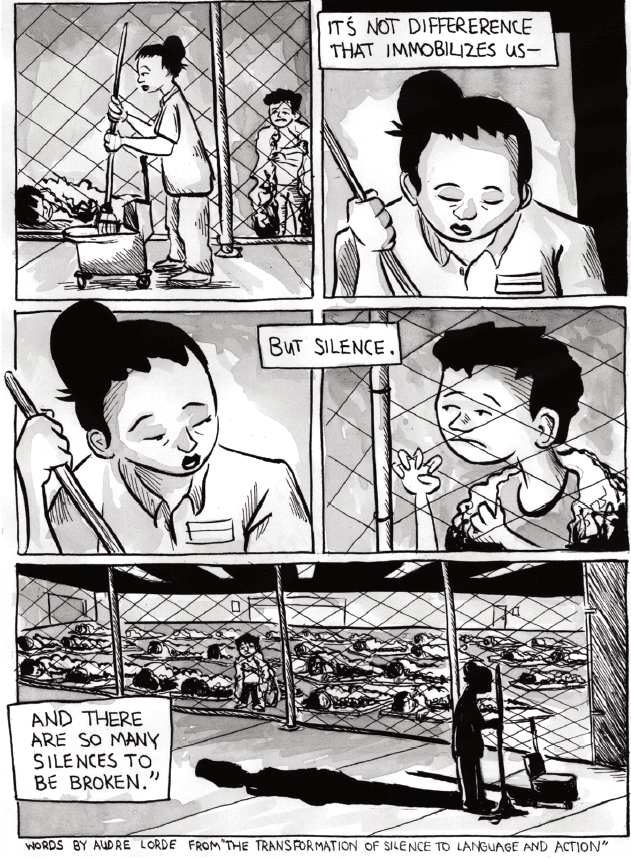
The best piece is “Silence” by Dean Westerfield. The art style is an underground, black-and-white style without much of the stylistic grandeur as other comics in the Ruminations. However, it also has the most impact. It’s dialogue-less and interlaced with passages from Audre Lorde’s “The Transformation of Silence to Language and Action”. A woman wakes up early, tired and old. After getting her kids off to school (no father in sight) she has to work, her facial expression growing increasingly melancholic. Turns out she is a janitor at one of the ICE centers. She cleans up while passing by all those cages full of children sleeping on floors. At the end of the story, the Audre Lorde passage ends with this observation:
There is so much you can observe about this comic. Are we to judge her for not speaking up, or should we consider there are reasons she can’t? After all, we don’t know much about her other than being a mother of two small children and working a janitorial job. That’s not someone with a lot of options to rebel. She could be an immigrant herself and scared to speak up. The message about silence being deadlier than indifferences rings true while not judging her coldly, and I appreciate that. It should say something that the most effective piece of fiction in the Ruminations doesn’t rely on genre as an allegory.
Which isn’t me saying genre fiction can’t work as an allegory. Classic works such as The Twilight Zone, 1984, and Aesop’s Fables proves that it can. The problem is that if you put those allegories in the same book as the real life atrocities, they will always pale in comparison. Personally, I would have taken the material at hand and done two separate anthologies. The first would be the real life stories from the Exhibits, the Responses, and the Context; the second could be the allegorical stories in the Ruminations, and in both you could give the contributors more room to make their stories better.
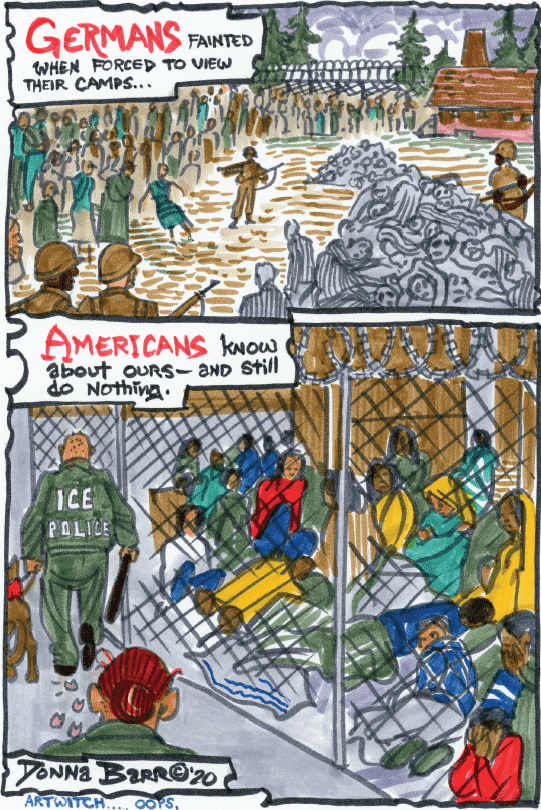
The Posters is the last segment, and it’s top quality! The point here is to use the artform of posters to make commentary, much like the WPA era. This commentary ranges from the strength and beauty of migrants to ICE brutality to satire. Some of these posters are one page comics, a particularly brutal one by Donna Barr that shows the different reactions between Germans learning about the concentration camps and Americans finding out about the detention centers. It is incredibly chilling.
All in all, BORDERX is a mixed reading experience. On one hand, its lofty goals are muddled by issues of organization and quality control. It should have been either shorter or split in two. With that said, it does succeed in educating the reader about the border crisis. Most importantly, it recognizes the humanity of the detainees, reminding me that this is an issue that I and every American have to continue fighting for. We can’t be so naive as to think that just because Donald Trump is out of office, we can rely on his Democratic replacement to fix it. After all, this is an issue the American government on all sides has been contributing to for centuries.
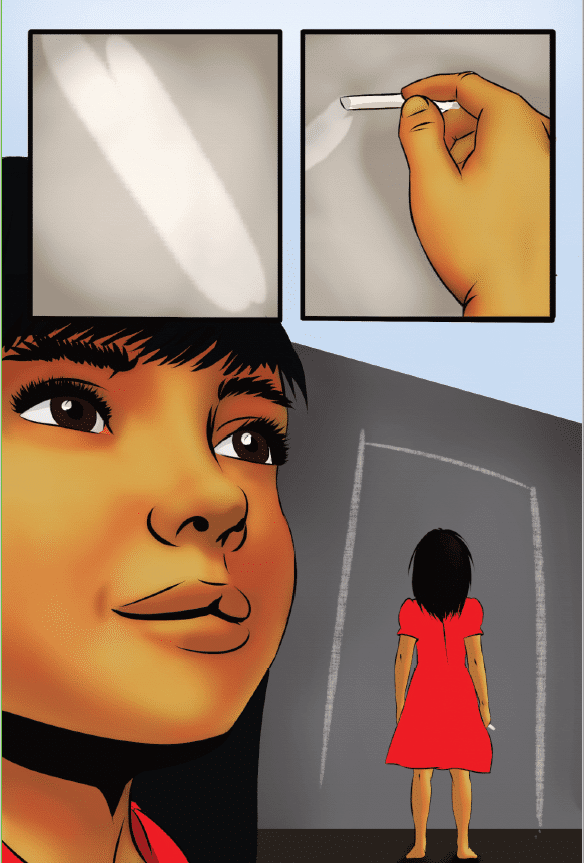
The electronic PDF version includes bonus material, which I do encourage you to get because it’s all spectacular. Probably the best piece is this one:
This is the future we should be fighting for, even when we’re not at our best.
NOTE FROM REVIEWER: I apologize for not being able to talk about all the contributors to the anthology. Whatever my opinion of each individual work is, I recognize and respect how hard you all worked on your comics.
Ah, the pleasures of having Labor Day off to celebrate work. It’s a contradiction as old as time, where honoring work means taking a (well-deserved and utterly necessary) break from it. After all, most workers have jobs that go year-round and the daily grind does take a toll. A day off is the least that can be afforded to them.
Recognition is the other thing we should doling out in industrial quantities during this federal holiday. As such, comic books are filled with stories about the fruits of labor, both in a literal and a politically figurative sense. Be it by actually exploring the hardships of being a worker to acknowledging the monumental task that is organizing movements in support of them, labor is central to the motivations behind some of comic’s best stories.
Here’s a short list of comics that either directly or indirectly showcase the roles workers play in keeping life and society functional. These comics dive headfirst into the specifics of what ‘putting in the work’ means, recognizing that everything that’s done in the service of others usually rests on human struggles both painful and exhausting. The comics below give workers their time in the spotlight so we can appreciate just how much it takes to go out and keep the world turning.
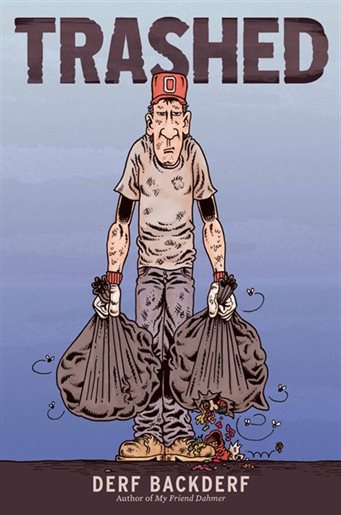
Trashed
1.Trashed, written and illustrated by Derf Backderf
This book can best be described as a sobering love letter to one of the most underappreciated and openly repudiated jobs known to humankind: garbage collection. Following Backderf’s critically-acclaimed My Best Friend Dahmer, Trashed is based on the author’s time as a sanitation worker himself, surrounded by other workers just as enthused about collecting trash as he was (which wasn’t a whole lot). The inner workings of sanitation are presented through a combination of autobiographical anecdotes and well-researched facts and data that reveal just how complex, dangerous, and even clumsy picking up and storing trash can be. It’s a funny but scary look at how sanitation can save the world while also turn it into a ticking time bomb.
Damage Control
2. Damage Control, originally created by Dwayne McDuffie (W) and Ernie Colón (A)
A superhero’s job is to save the day, crumbling infrastructure be damned. With them, though, comes a unique concern for property damage, mostly focused on the inevitability of mass destruction. In comes a company solely dedicated to cleaning up after extinction-level battles and then putting the pieces back together called Damage Control. In essence, this Marvel comic is about unsung heroes. It’s about doing essential work knowing there’s no glory waiting at the end of it (much like Trashed, in some respects). McDuffie’s scripts are a masterclass on chaos and property politics, but it’s Colón’s attention to detail amidst the chaos that sets this story apart. The original series (there are a total of 4 series published) takes to a kind of MAD Magazine-style approach to comedy with visual gags and crude humor leading the charge, but it’s all well-orchestrated and it makes for reading that rewards those who scan comics pages whole multiple times.
She-Hulk
3. She-Hulk: Law and Disorder, written by Charles Soule and illustrated by Javier Pulido
At a glance, Soule and Pulido’s She-Hulk gives the impression of being a kind of ‘slice of life’ story about a superhero that chooses law as her preferred battleground. The book, however, is about so much more, and it might have more in common with Damage Control than an actual legal drama. She-Hulk takes the anger-filled superhero and turns her into a working-class woman that’s trying (and struggling) to make her own legal services business work. She puts it all together from the ground up but is immediately confronted with the hardships of balancing work, heroics, and the semblance of a personal life on an even keel. One of the greatest, and most entertaining, aspects of the comic lies in the formation of the character’s legal practice and how at odds it can be being both a superhero and a normal person with other interests. It dives deep into the complications of working multiple jobs, but it shows an appreciation for those who lead their lives under that predicament. Soule and Pulido create a story that supports and applauds those who undertake the task of holding several jobs at once, honoring the sacrifice it requires of one’s self to survive it.
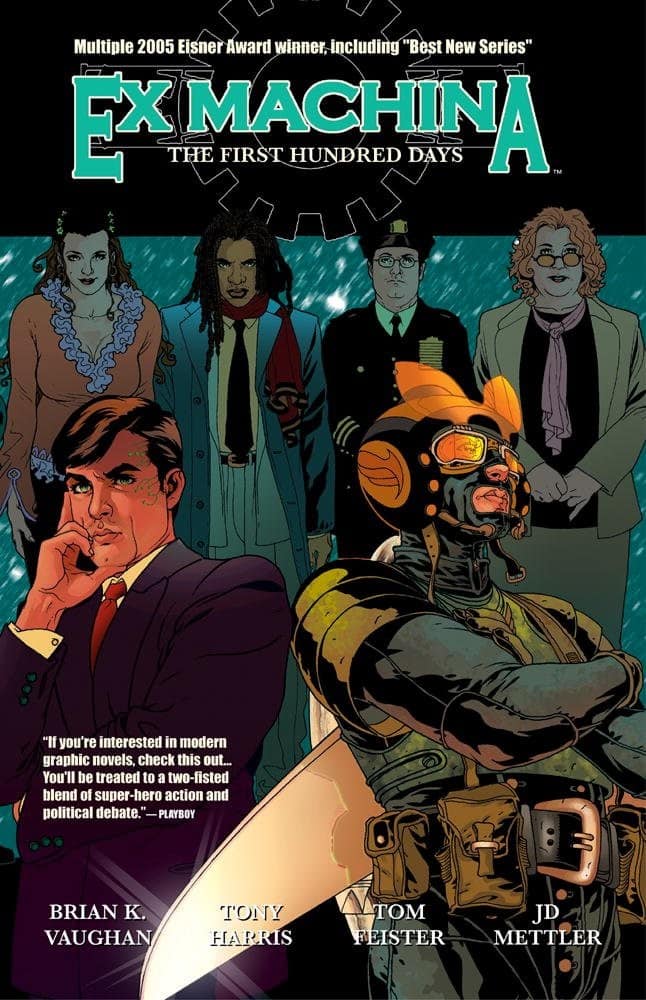
Ex Machina
4. Ex Machina, written by Brian K. Vaughan and illustrated by Tony Harris
While aggressively political and metaphorical, Ex Machina does something few other stories on governmental responsibility manage to achieve: make the role of an elected official look and feel like a real job. The story follows Mitchel Hundred, a man that renounces his superhero persona to become mayor of New York city. After only managing to save one of the Twin Towers during the 9/11 terrorist attacks, Hundred realizes he can do more good as an elected official rather than as a superhero. Vaughan and Harris take full advantage of this setup to go beyond political speeches and discourse to get Hundred’s hands dirty with the real act of running a government. Hundred has to address the legality of surveillance in times of crisis, protocols for public demonstrations, controversial content in city museums, infrastructure, and police freedoms all while controlling the urge to use his still functioning superpowers to speed the process up. As is the case in She-Hulk, Hundred also attempts (with few successes) to balance his personal life with the job. Problem is, the job demands too much of his time, hence the temptation to use his powers. Ex Machina is a stark reminder that being an elected official actually means holding down a job with real consequences attached to it, something many politicians seem to have lost sight of.
Gotham Central
5.Gotham Central: In the Line of Duty, written by Ed Brubaker & Greg Rucka and illustrated by Michael Lark
The profession of law enforcement is under serious scrutiny at the present moment, and rightfully so, but it’s still a job certain men and women take on despite the complexities of outdated and dysfunctional practices that are in desperate need of revision. And that’s on top of the racial problems that have shaped its many, many systems. However, there are those who do take the job seriously and work hard to ‘protect and serve’ with the best of intentions under the law. Gotham Central prioritizes this viewpoint, focusing the cops and detectives that work in Batman’s Gotham City. Without the resources or the exceptions afforded to the Dark Knight, the GCPD is still tasked with responding to criminal activity, regardless of whether it’s of the supervillain type or not. Main characters René Montoya, Crispus Allen, Marcus Driver, and “Josie Mac” MacDonald, among others, are divided into day and night shifts in a city that is in a constant flux of crime. The job takes its toll on a personal level and there’s an emphasis on how much one gives in the line of duty, but there’s also an appreciation of honest cops walking the line in the face of overwhelming police corruption and abuse. It’s a complicated and sometimes contradictory read, but it makes no excuses while confronting the damning inconsistencies of the job.
Wooblies!: A Graphic History of the Industrial Workers of the World
6. Wooblies! A Graphic History of the Industrial Workers of the World, edited by Peter Buhle & Nicole Schulman
The Industrial Workers of the World, or IWW, has a wild and exuberant history, to say the least, which makes it the ideal subject for comic book storytelling. The IWW was created in Chicago, Illinois in 1905 as a union for marginalized workers led by Marxist principles. Miners, lumber workers, immigrant workers, indigenous workers, non-white workers, severely underrepresented female workers, and workers all over that had no rights or protections saw in the IWW as the means to fight towards better working conditions. Wooblies! (alluding to the nickname given to the members of the union) enlists the talents of cartoonists such as Peter Kuper, Harvey Pekar, Trina Robbins, Sharon Rudahl, Sue Coe, Carlos Cortez, among others to tell the story of how forgotten and underrepresented workers rose up against the odds to gain the rights and respect owed to them. The anthology has a very underground ‘comix’ feel to it, but it’s allegorical and metaphorical inclinations do a better job of capturing labor struggles better than a traditional story ever could. This might be the quintessential Labor Day reading right here.
Workers, laborers, holders of jobs, these comics honor your contributions, your efforts, and the near impossible feats you pull off. Read and relax, but overall, enjoy your hard-earned Labor Day holiday.
CONVENTION DEBUTS INCLUDE CLOWES’ S&N THE DEATH-RAY, BEATON’S S&N HARK! A VAGRANT, RALPH’S DAYBREAK & NILSEN’S BIG QUESTIONS
LIMITED NUMBER OF PRESS-POP’S DEATH-RAY DOLL ON SALE
CHESTER BROWN, BRIAN RALPH & ANDERS NILSEN SIGNING
If you are attending Comic-con Interntional in San Diego from July 20-24th, stop by Drawn & Quarterly Booth #1629 to see our three attending authors: Chester Brown (special guest, kind courtesy of the festival), Brian Ralph and Anders Nilsen (also a special guest). We will be debuting Ralph’s September Daybreak & Nilsen’s August Big Questions at the show, and have plenty of the year’s most talked about graphic novel, Paying For It, on hand. Chester will be signing every day, so if you have questions about the Gospels, Ed The Happy Clown, or anything else, come to booth #1629 and ask away. Anders & Brian will be signing every day, too
Oh and what else will be debuting at the show….Hmmmmm….just a signed and numbered debut of the October book Daniel Clowes‘ The Death-Ray!!!!! And to make this debut even more special, our kind friends at Press Pop are sending a handful of the The Death-Ray action figure for us to sell. Seriously people if you want either of these, get to booth 1629 ASAP! We will be releasing more Death-Ray news next week, so keep your eyes open!
And what else are we debuting? Only a signed and numbered debut of the September Kate Beaton book HARK! A VAGRANT !!!
Here is our signing and programming schedule!
Wednesday, July 20
Chester Brown signs
Thursday, July 21
12:00-3:00 Chester Brown signing at D+Q booth 1629
1:00-5:00 Anders Nilse & Brian Ralph signing at D+Q booth 1629
3:30-4:30 True Stories— Chester Brown (Paying for It), Tom Devlin (creative director of D&Q),Peter Kuper (Stop Forgetting to Remember), Leland Myrick (Feynman), and Thomas LeBien (publisher of Hill & Wang’s Novel Graphics line) discuss the ins and outs of nonfiction graphic novel stories. What are the lines between truth and fiction when images are involved in a story? Moderated by Scott McCloud (Understanding Comics). Room 26AB
5:00-6:00 Epic Literary Adventures— Jeff Smith (RASL, Bone), Anders Nilsen (Big Questions), Brian Ralph (Daybreak & SCAD professor), and moderator Tom Devlin (Drawn & Quarterly creative director) discuss the overlap between literary and fantasy, the science and art of creating an imaginary world, building a story that is serialized over several years, and carving a unique fantastical niche in an industry mostly known for either autobio or superhero. Room 9
5:00-7:00 Chester Brown signing at D+Q booth 1629
Friday, July 22
11:00-1:00 Chester Brown signing at D+Q booth 1629
12:00-3:00 Brian Ralph & Anders Nilsen signing at D+Q booth 1629
1:30-2:30 Spotlight on Chester Brown— Louis Riel, Yummy Fur, and Ed The Happy Clown cartoonist — and Comic-Con special guest — Chester Brown has been one of the most influential and acclaimed alternative cartoonists for the past 20 years. His 2011 graphic novel Paying for It: A Comic-Strip Memoir About Being a John is easily the most talked about book of the year and was praised in the New York Times. Join him on his panel as he performs his acclaimed slideshow, reading from his North American book tour for Paying for It. The slideshow will be followed by a Q&A. Ask anything you wanted to know about the most controversial book of the year. Room 8
4:00-7:00 Chester Brown signing at D+Q booth 1629
5:00-7:00 Brian Ralph & Anders Nilsen signing at D+Q booth 1629
Saturday, July 23
11:00-2:00 Chester Brown signing at D+Q booth 1629
1:00-2:00 Spotlight on Anders Nilsen— Comic-Con special guest Anders Nilsen debuts his magnum opus, the 800+-pageBig Questions, which he began self-publishing over 10 years ago and which quickly placed Nilsen at the forefront of alternative cartoonists. He is part of the Chicago comics collective The Holy Consumption with Jeffrey Brown, John Hankiewicz, and Paul Hornscheimer and was recently featured in the Museum of Contemporary Art in Chicago. Join him as he presents a slideshow of his work from his haunting postmodern fable. Room 4
2:30-6:30 Anders Nilsen & Brian Ralph sign at D+Q booth 1629
2:30-3:30 The Art of the Graphic Novel— Andrew Farago (curator, Cartoon Art Museum) talks with graphic novelists Chester Brown (Paying for It), Seymour Chwast (Dante’s Divine Comedy), Eric Drooker (Blood Song), Joyce Farmer (Special Exits, A Memoir), Joëlle Jones (Troublemaker), Jason Shiga (Empire State: A Love Story (Or Not)), and Craig Thompson (Habibi) about their work in the genre that has elevated comics to mainstream bookstores all over the world. Room 24ABC
3:30-5:30 Chester Brown signing at D+Q booth 1629
5:30-6:30 Everyone’s Favorite Red Head, Little Orphan Annie— No, not Archie, but Annie! Famed cartoonist Chester Brown, Dean Mullaney (creative director, The Library of American Comics), Brian Doherty (senior editor of Reason magazine and author of Radicals for Capitalism), and Tom Devlin (Drawn & Quarterly creative director) discuss the importance of the legendary comics strip Little Orphan Annie and the profound influence and life of the strip’s creator, cartoonist Harold Gray. Room
Sunday, July 24th
10:00-12:00 Brian Ralph signing at booth 1629
11:00-2:00 PM Chester Brown & Anders Nilsen signing at booth 1629