
Tag Archives: hart seely

Exclusive: Hart Seely talks new comic series Archaic with writer Melissa F. Olson
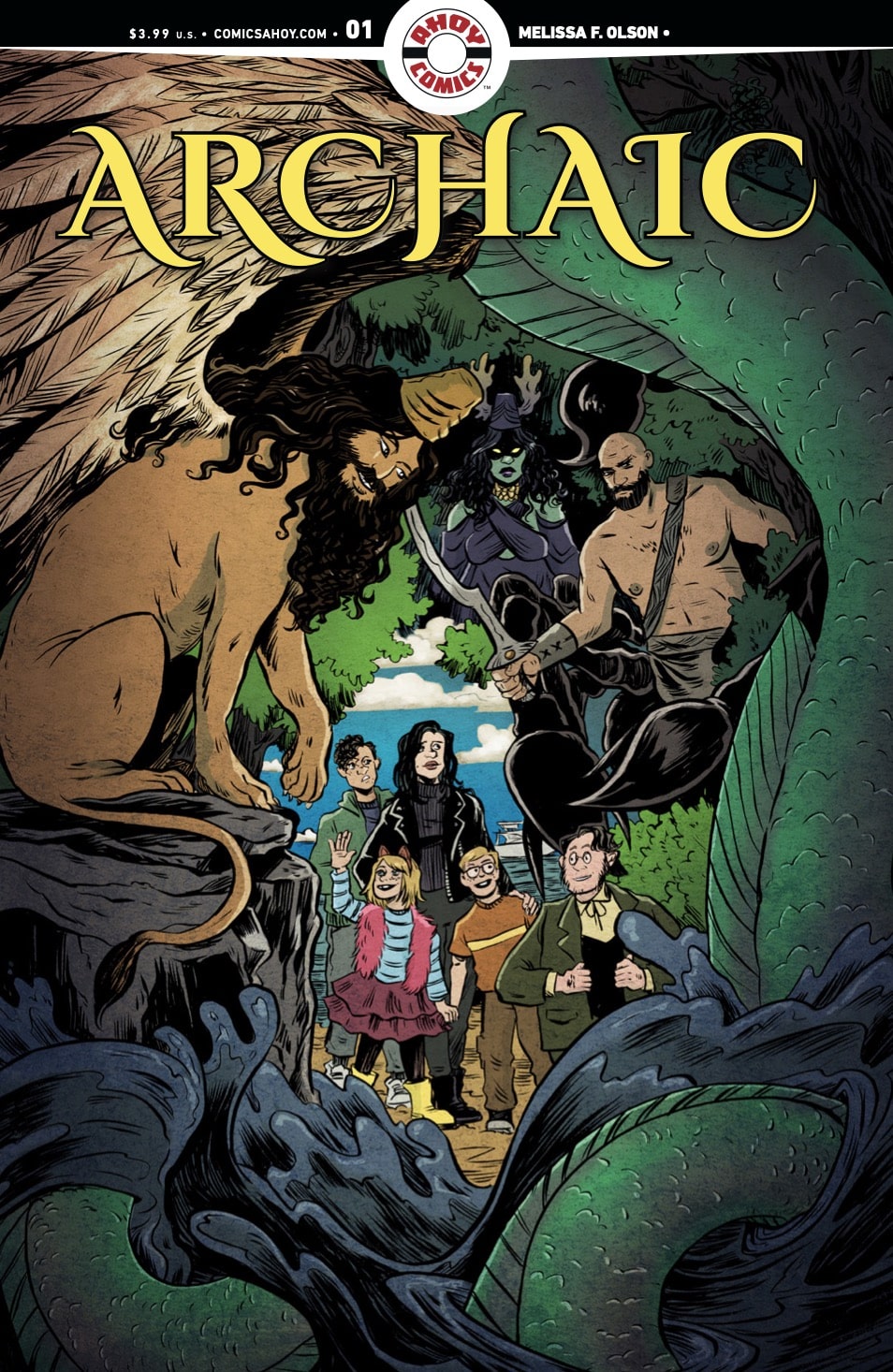
Archaic #1

This December, AHOY Comics releases a bold new series, Archaic. This modern-day action-adventure follows the newest residents of a sentient island populated by the gods and monsters of dead civilizations: a harried single mom and her three kids. From writer Melissa F. Olson, artist Sally Cantirino, and colorist Gab Contreras, the fast-paced mystery explores what happens to legends once the world no longer has use for them. Archaic #1 features a main cover by Cantirino, as well as variant covers from Liana Kangas and Emma Vieceli

Melissa F. Olson bounced from a small town to a big film school and wound up writing a successful series of urban fantasy novels. Now, after twenty-four books, her first comic book series, Archaic, is coming out December 4th. She spoke to AHOY publisher Hart Seely about her origin story, the inspiration for ARCHAIC, and being a mom, and we have the exclusive interview!

AHOY: Now that you’re in comics, let’s talk origin stories. How does one go from the University of Southern California film school to writing novels in Wisconsin?

OLSON: I actually started with a pretty typical post-film school trajectory: After graduation I was hired as an assistant at NBC-Universal, in TV development for the cable channels USA and SYFY. I’d been an unpaid intern in that department my last year of school, so it was great to finally collect a paycheck and be on the first rung of the studio ladder. Then, three weeks later, my entire department got laid off and my trajectory went off the rails.

Archaic #1

AHOY: That must have been tough.

OLSON: At the time, it was so hard for me to wrap my head around the idea that sometimes a professional outcome will be completely separate from the time you put in, how hard you work, how talented you are. As a writer in my forties, I know that lesson well, but at 23-year-old me was pretty crushed. I think that’s part of why I ended up writing fiction. To write a novel, you don’t have to depend on anyone but yourself.

AHOY: But writing comics does require a team. How has that transition been?

OLSON: It’s still strange to have creative, brilliant, experienced people working on a thing from inside my brain. And of course, the result isn’t always a perfect match — sometimes Sally draws a character and I have to stop myself from going, “No, no, no, I imagined her hairdo differently.”

Sally and Sarah Litt, our editor, had a lot of patience with me — especially in the first couple of scripts, when I was figuring out how to write the script so I was adequately describing what needed to be there for character or story reasons, but still giving Sally the space to have fun with the visual language.

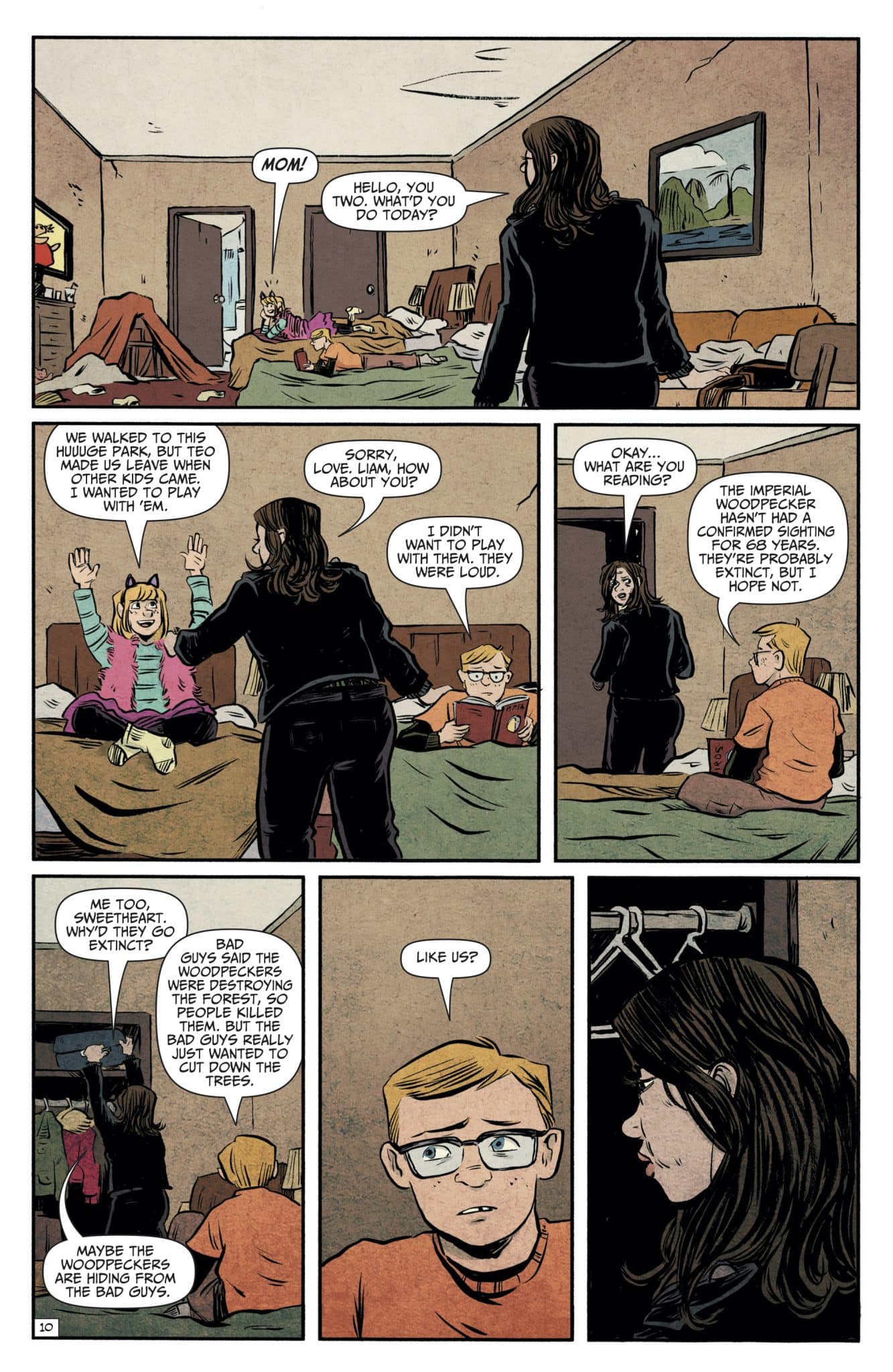
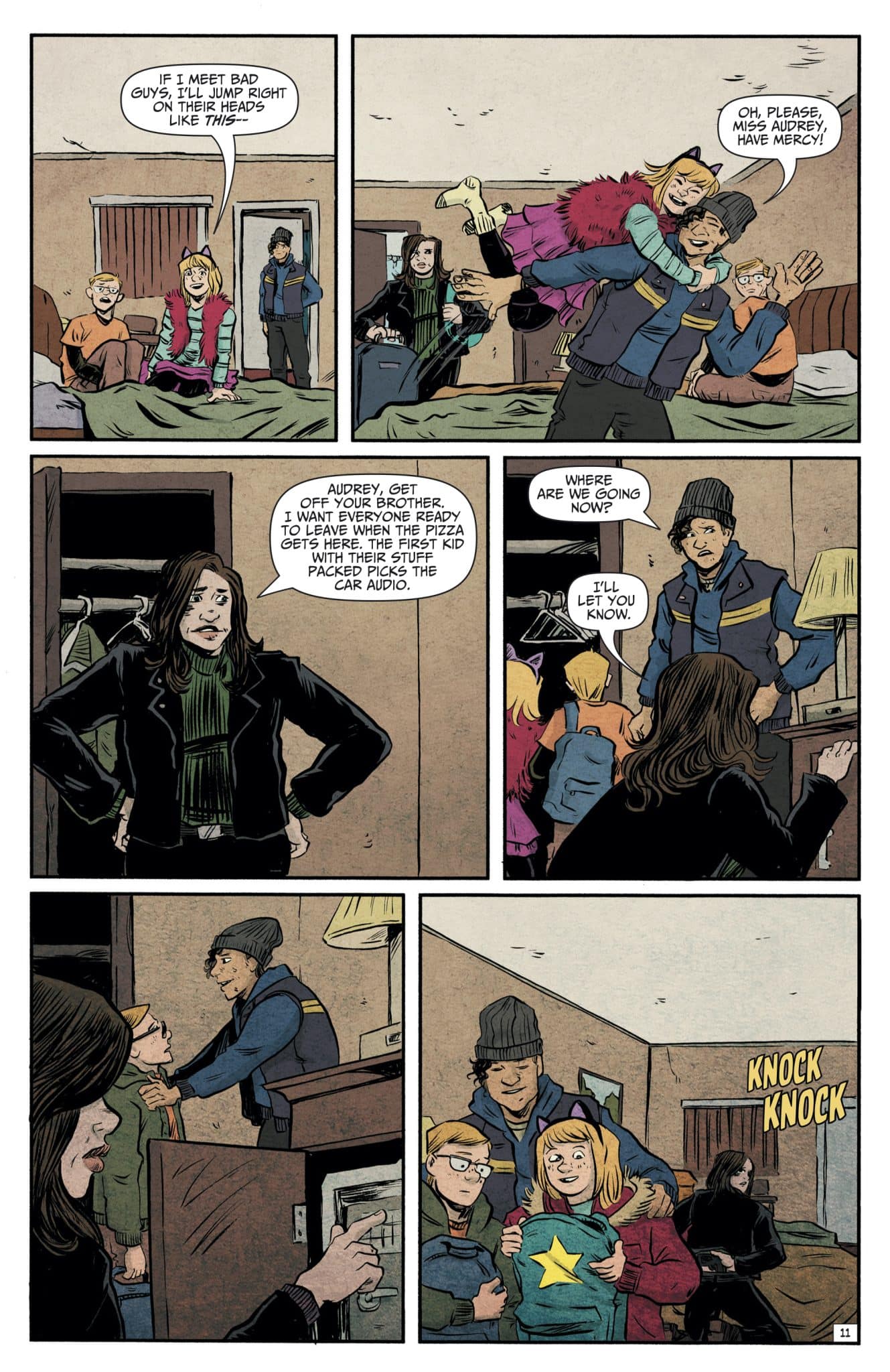
For example, there’s a birdwatching nine-year-old named Liam in ARCHAIC. Him being a birdwatcher matters to the story, because he applies some of his identification skills to the creatures on the island. In early drafts of the first script, I might write something like, “Liam (age 9) is a birdwatcher.” Sally would draw a little boy in a T-shirt and shorts, and I wouldn’t know what it was missing.

What I needed to do was write something like “Liam (age 9) has glasses and usually wears a khaki explorer-style vest. One pocket is just the right size for the birding guide that’s ALWAYS with him.” The first version describes the character, but the second version describes the image that communicates the character to readers.
Archaic #1

AHOY:  Which brings us to ARCHAIC. What’s this book about?

OLSON: ARCHAIC is the story of a sentient island that functions as a sort of game preserve for the gods and monsters of dead cultures. They don’t really know why they’re on the island, Demonde, but they all try to stay on her good side (Demonde uses she/her pronouns). She can change her landscape, her weather, her structures, so she’s very godlike herself. If you’re on the island, you’re definitely subject to her will.

Demonde communicates a lot, but she doesn’t use verbal language, so she needs a human caretaker to be the go-between with the human world and resolve disputes on the island. There’s one family that always inherits the role, and that family gets a lot of perks, like all the money they can dream of and safety as long as they’re on the island….okay, there’s definitely some single mom wish fulfillment stuff going on there. 

This system has been in place for centuries, but in the opening pages of the first issue, the current caretaker, Phillip, is killed by something on the island—which should be literally impossible. The new caretaker is his adult daughter, Tess, a single mom who never met Phillip and doesn’t know about any of this. So Tess, our hero, is really walking into this complex magical situation and a murder mystery. I do not take it easy on Tess.
Archaic #1

Where did you get the idea to write about an island of castoff gods and monsters?

OLSON: I started thinking about the idea back in 2021, during Covid lockdown. Everybody was kind of re-examining their roles in the world, as you probably remember, and I was not in a good place. My publisher had dropped my urban fantasy series, the novel my agent was shopping hadn’t found a publisher, and I was going through a divorce. For the first time, my children were away from me for periods to stay with their dad, and I was alone in the house with no one to take care of. I started thinking, “what is the point of me?” For so long, it was to be a mom and write books, and suddenly I’d lost my compass. That’s a scary feeling.

At the same time, I was reading about phantom islands — places that show up in stories and testimonies, but no one can ever find later. That seemed like the perfect place to stash things that are no longer valued — gods, monsters, legends, a single mom.

AHOY: And it’s a comic book. Were you always a big comics reader?

OLSON: To be honest…no. I didn’t grow up as a comics person, which I know is not a cool thing to admit. I was very into Kevin Smith movies as a teenager —I wrote about Clerks for my application to film school — but they always positioned comic books as exclusive to the sort of geek elite. I felt like I would have to read the entire sixty years’ worth of comics issues to be part of that insider club, and my hometown didn’t even have a comics store.

So I didn’t really read much in the genre until college, and even then I was introduced to them from an intellectual standpoint – their position in culture. I read a lot of the landmark works: BATMAN YEAR ONE, THE DARK KNIGHT RETURNS, KINGDOM COME, WATCHMEN. I went through the full Alan Moore phase. But I didn’t start reading regular issues until THE NEW 52 relaunch in 2011.

Archaic #1

Suddenly everything had been reset, and comics, or at least some of them, felt like an even playing field. I got hooked. I remember going to the comic book store the day the first issues were released, and picking a bunch of different titles to follow. For months, I was in the store most Wednesdays getting my New 52  titles. I felt like I was part of it.

Then they introduced the first crossover event, the COURT OF OWLS, and suddenly, if you wanted to understand what was happening in Batman, you had to buy 17 other titles that you were already behind on.  It felt commercial and exploitative to me, like the story was in service of the money. It took a long time for me to find independent comics, where the storytelling is just as good, and which don’t require 75 years of exposition and purchasing 17 issues.

AHOY: What comic made you want to write comics?

OLSON: Ooh, that’s a great question, but the answer isn’t even a book. It would have to be BATMAN, THE ANIMATED SERIES.

AHOY: Great series. Fantastic.

OLSON: As a kid I would rush home to watch it every day after school. I saw every episode so many times. I knew the Rogue’s Gallery; I knew the opening sequence by heart. There’s this moment somebody punches Batman, and he can’t duck like a normal person, so his head curves. I loved that image. That show was my real introduction to comic book storytelling, the aesthetics and homages and the sense of history. I only own one piece of “real” art in my house, and it’s an animation cel from that show.

Archaic #1

AHOY: So, which did you love most, the heroes or the villains?

OLSON: At my core, I’m a heroes guy, and that version of Batman is probably my all-time favorite. But I have to say, that show had the best villains. In many ways they were surprisingly sympathetic and three-dimensional.

AHOY: A lot of writers hope their books get made into movies. Ever see yourself going back to LA someday?

OLSON: To visit, definitely. I love visiting LA. But I can’t see myself in permanent residence there again. There are people who can live in Los Angeles, work in Hollywood, and keep their core values without losing their minds. I am not one of those people. The permanent LA lifestyle is not good for my brain, although I’d love another try at developing my work into a show from a distance.

AHOY: What hopes do you have for ARCHAIC?

OLSON: I hope parents and older kids read it together. I grew up on PG-13 action-adventure movies like JURASSIC PARK and THE MUMMY; I’m very much a Spielberg kid. Those stories are designed to be really entertaining for adults and just tame enough for older kids to enjoy. I haven’t found a lot of that sweet spot in comic books. When I wrote this book, I was thinking of my 11-year-old nephew, and my dad, and other single moms. I wanted to write a book that would interest us all equally.
SDCC 2024 Exclusive: Legendary director Lloyd Kaufman and AHOY’s Hart Seely talk Toxic Avenger

The Toxic Avenger

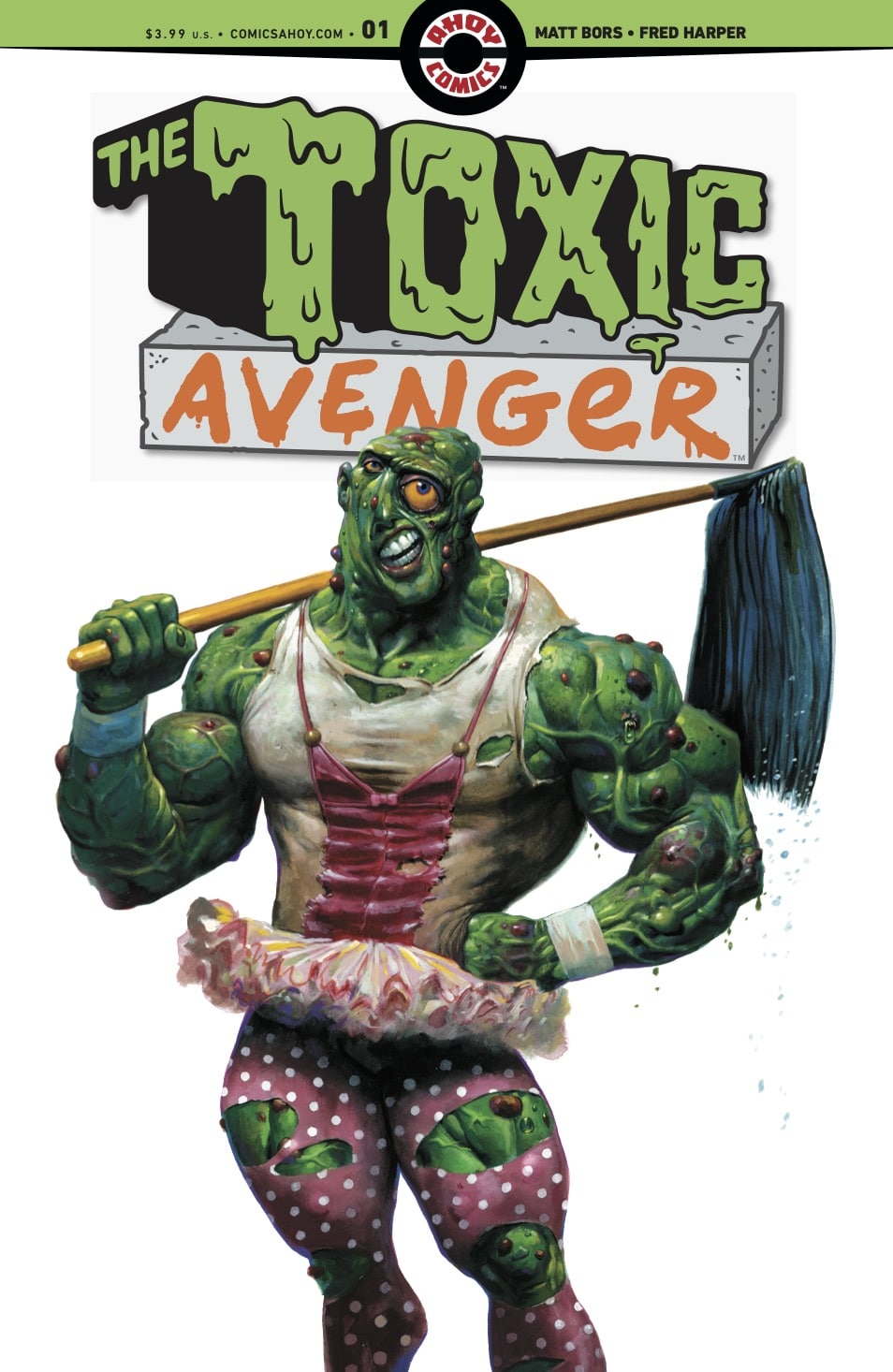
AHOY Comics will be getting toxic at San Diego Comic-Con with a panel featuring author and legendary director Lloyd Kaufman, comic creators Matt BorsMark RussellTyrone FinchMelissa F. OlsonJuan Castro, and writer/AHOY Ops guy Stuart Moore. The panel, which takes place on Friday July 26 from 5–6 pm in Room 28DE, will also feature an ashcan comic giveaway that shows readers a first look at The Toxic Avenger, Pulitzer finalist Matt Bors and artist Fred Harper’s take on the satirical superhero that spawned five films, a cartoon, action figures, a musical, and a Marvel comic book series.

In the lead up to the convention, we have an exclusive interview between director Lloyd Kaufman and AHOY’s Hart Seely discussing the movie industry and The Toxic Avenger!

Lloyd Kaufman is the iconic director, producer, screenwriter, actor and co-founder of Troma Entertainment. With partner Michael Herz, Kaufman has pursued the company’s motto, “Fifty Years of Disrupting Media,” these days through its streaming channel Troma Now. But you may know him best as creator of THE TOXIC AVENGER (1984.) He recently spoke with AHOY…

A: Let’s get to it. What makes a great film? 

LK: A movie is a balancing act between business and art, and the art should always overpower the business. The best movies reflect a filmmaker’s brain, heart and soul, in the same way of a great painting or, for that matter, music, writing or any art form.

A: These days, is the art overcoming the business? Or is the movie industry moving in the other direction?

LK: The industry is certainly going in the other direction, but thanks to our good friend, digital technology, thousands of young people are making their own damn movies. Most are trying to imitate what’s de rigueur in contemporary industry, but there are hundreds making movies they believe in, which reflect their heart, soul, and brain. And they’re making them for under $25,000.

I’m producing a number of those films, and I’ve found that young people are incredibly able to multitask. Many of them write and perform their own music, so their movies are very personal, and not just an imitation of what the majors are doing. It’s a yin and yang thing. The “yin” is that it’s great that more people are making art. But the “yang” is that they can’t make a living off it. To do that is very difficult.

A: So, you’re optimistic for the future?

LK: Talent will always stick, but there are tremendous roadblocks. Even if some young, new talent creates something original, how do they get it to a big enough public? And when I say “original,” I mean entertaining and personal. How do they get it to the public?

Trey Parker and Matt Stone’s first movie, Cannibal the Musical, which Troma helped them finish, was rejected by every movie company, period. They had come to Troma first, because they were fans. We told them we couldn’t give a big advance because we didn’t have the money, but we loved the film. We suggested they go to companies with big money, but none of those companies could see that Cannibal the Musical was brilliant and that Trey Parker and Matt Stone are geniuses.

A: Two hard-to-miss geniuses.

LK: Sure are. And they came back to us. We were their first and last stops on the train. Now, whenever I have meetings with the mainstream – which is not very often – “the suits,” or whatever you want to call them, they’ll say, “Gee, I really loved that film, I wanted to acquire it, but blah, blah, blah,” But they never really got it. They were too frightened about losing their jobs. They didn’t want to take any risk.

A: With Toxic Avenger, you took a risk. When did you know it had paid off? And were you surprised?

LK: Every time Michael Herz and I make a movie, we believe it’s a great film. But in every case, it takes time for the word of mouth to get out. That’s the only weapon we have to counter the $200 million advertising budgets for the big movies.

Terror Firmer is a very personal film I directed. It was made in 1999, and it’s only now selling like crazy in the Blu-ray form. Many of our fans have discovered it recently. The Toxic Avenger caught on earlier, but at first, none of the theaters would play it, because they didn’t understand that it is a satire. It’s not a horror film, it’s not scary. It may be disturbing in parts, but it’s a Cuisinart of gore, and slapstick comedy – and politics, and sex and everything, all mixed together. But it’s basically, satire.

A: So how did you get it out?

LK: Well, finally, one New York City theater agreed to play it. The Bleecker Street Cinema, owned or run by one of (Andy) Warhol’s associates. And when The Toxic Avenger opened, somehow, there was a line around the block, for a midnight show.

A: Was that the first time you had seen such a moment?

LK: We had some great successes. With Squeeze Play (1979), we hit it because multiplex cinemas were coming into vogue, and we’d made a raunchy comedy – well before (the movie) Porky’s. Squeeze Play was about a woman’s softball team, but it basically concerned the Equal Rights Amendment. We had a sneak preview in Norfolk, Virginia, with a movie called The In-Laws, with Peter Falk and Alan Arkin. The audience loved it, and the next Monday, American Multi-Cinema asked us for 100 prints. Of course, we only had one. The movie ran for about seven weeks in that theater. Slowly, but surely, we built up revenue to make more prints.

Then we took The Toxic Avenger to the Cannes Film Festival. It laid an egg, but then the following year, it suddenly it took off. It did well in England, France, Germany, Italy, Australia, pretty much all the free world. We did well in the theaters.

Part of it was also the videocassette boom, with companies eager to fill their shelves. So, we got lucky. Since there had been theatrical successes, we promoted the movie as if it was a theatrical release. We believed in it. It wasn’t just a sausage.

Distributors actually came to the screenings and enjoyed the movie for what it was, rather than trying to cram it into some category. And that was the beginning of people realizing that Troma was something different.

A: Are politics necessary in a movie?

LK: No, but there should be something in there that isn’t just Prosecco, you know? You want to entertain the public, but you also want to give them something to think about. It can be something like Enchantment (1948) with Teresa Wright and David Niven. It’s a romantic movie that deals with real human passion and love, but it’s also a beautiful period piece. You know, even Hitchcock had certain themes. He always made fun of the police. He always put satire in his movies.

A: I should tell you that wife and I saw Toxic Avenger back when we were dating. A great memory.

LK: Movies bring memories in different ways. There’s something about art that plugs right into people.

A: These days, some critics are down on Marvel and DC movies, suggesting the superhero genre has run its course. Do you agree?

LK: I think the big money has been playing it too safe. Directors and writers have been forced by the suits to add various ingredients, like in a recipe. But then I think of Superman being done by James Gunn. He’s going to make a movie that reinvigorates the whole area. He’s the hope. And, of course, he started with us. One of our best movies is his Tromeo and Juliet (1996).

He’s a true artist. He’s good with people and an awfully nice guy. His Superman will be terrific.

A: These big names, who started with Troma, do they stay in touch?

LK: Trey and Matt put me in two of their movies. James Gunn put me in Suicide Squad and Guardians of the Galaxy. If I get the call about Superman, I’ll go.

A: You once said, “Troma may let you down when it comes to a lot of things, but never ever will we fuck you over when it comes to a crushed skull.” Great line. But is that the essence of Troma? How much of it is true?

LK: That’s from a book I wrote a long time ago. We combine a lot of elements, satirical and graphic. And for 20 years now, just about every movie has had a crushed skull. In that regard, we’ve been running ahead of the mainstream. You know, I hear Spielberg has a full head-crushing in Schindler’s List, Part II!

For our half-century anniversary, Michael Herz came up with a slogan that I love: “Fifty Years of Disrupting Media.”

A: So, what disruptions are next?

LK: I’ve been producing movies by young people. Most recently, Kill Dolly Kill (2023) by Heidi Moore – a transvestite comedy musical horror film. Very influenced by Troma. And Liam Regan, a British dude who, a long time ago at age 16, took a bus attend my master class at Oxford. I produced his latest, which is called Eating Miss Campbel (2022). A very Troma movie.

These are movies with budgets mostly under $50,000. Maybe one is $75,000. There’s Curse of the Weredeer (2023), an anti-hunting movie, by Ben Johnson, not to be confused with the British philosopher. He’s from Tennessee. He’s producing a film in pre-production, which I will direct, loosely based on Crime and Punishment. That will be a bit different from what I’ve been doing. But it deals with many issues. People, you know, can’t live today. They can’t pay the rent. Their groceries are exorbitant – all these things closing in on the character of Raskolnikov.

Then there’s The Power of Positive Murder is from a script by Martin Murray, who, oddly enough, was mentored by Steve Martin. He worked for us briefly, and I gave him a shot at writing this. I think it’s great. We’re starting to look for locations and cast. We hope to shoot late July, early August. My wife and I will pay for it. I can’t ask people to invest in it.

A: Why not?

LK: Because it’s impossible to make money – especially on a $400,000 or $500,000 budget, unless you just have incredible luck.

A: What’s the trick to making an inexpensive movie?

LK: Well, it’s young people. Today, they can do everything themselves. A lot of parts – like color correction and mixing sound and shooting – they do it themselves. Ergo, they can make a really good-looking movie, very entertaining, for $50,000.

Many of these are on Troma (streaming video) now. The ones I do cost about $400,000, $500,000. I’m a little bit like Orson Welles in that, when he did movies like Touch of Evil (1958), people basically worked for him for nothing. I’ve been able to get underground stars. I can’t shoot SAG (Screen Actors Guild) actors, so I can’t get big stars, even though many would like to work for us.

I can get underground names, but people aren’t necessarily going to buy tickets, unless a miracle happens. If I direct a movie, I think I can get it in about 200 theaters. But except for New York and LA, they’ll only be up for a weekend or one night. Maybe if it does well, we’ll get two weeks.

A: Does word of mouth still work?

LK: Yes, it still works. But it might take 25 years. Terror Firma turned a profit, but it took about that long to do so. It’s profitable because Blu-rays, and word of mouth are still big enough, and there are enough generations out there who love Troma.

Troma may be the only streaming service that is profitable, right now,  because we own or control most of the films. We don’t have to pay.

A: What’s the trick in balancing humor and horror?

LK: Good question. In our movies, most of the horror is slapstick, cartoon horror. For example, (actor Joseph) Fleishaker, our 400-pound action hero, gets eaten by an escalator. Just the idea of a 400-pound guy falling down the escalator is funny. Then this mysterious woman chops him up with an axe, which just happens to be there – no reason – it’s just hanging on the escalator. So, he gets chopped up and eaten up by the escalator. And believe it or not, it’s funny.

I know, to some people, it’s also disgusting. But right after that, Lemmy (Ian Kilmister) from (the iconic British rock band) Motorhead – of all people – plays a reporter. It’s so random, so full of surprises. By the way, Lemmy’s a sweet guy. He’s like Stan Lee, appearing in about eight or ten of our movies.

A: What do you hope to be remembered for?

LK: Hm-mm. The movies will live on. If nothing else, The Toxic Avenger.

Ithacon announces Return Favorites and New Faces for Ithacon 45

Ithacon

ITHACON 45 has announced the guest list for the upcoming ITHACON convention. The long-running convention will be live this year April 23 and 24th.

Local hero Will Dennis returns to his alma mater –  he is graduate of the Roy H. Park School of Communication at Ithaca College. He was an editor at Vertigo/DC Entertainment for more than fifteen years, specializing in genre fiction comics and graphic novels. His award-winning titles include 100 Bullets, Y: The Last Man, Scalped, DMZ, Joker and many more. Since then, he has worked as a freelance editor for Image Comics, comiXology, and DC Entertainment. He was the editor for the Eisner nominated Where We Live, A Benefit for the Survivors in Las Vegas. Dennis is currently spearheading Scott Snyder’s ComiXology Originals Clear, Night of the Ghoul and We Have Demons.

AHOY Comics’ publisher, Hart Seely returns to ITHACON this year.  As an author, Seely has written numerous books, including THE JUJU RULES: A MEMOIR OF A FAN OBSESSED (Houghton Mifflin Harcourt, 2012) and MRS. GOOSE GOES TO WASHINGTON (Simon & Schuster, 2007) He also edited several books of “found poetry,” including O HOLY COW: The Selected Verse of Phil Rizzuto (ECCO/Harpers, 1993) and PIECES OF INTELLIGENCE, the Existential Poetry of Donald Rumsfeld (Simon & Schuster, 2003). His works have appeared in The New Yorker, The New York Times, Slate, and on National Public Radio. He is now publisher and co-founder of AHOY Comics, which has been creating innovative comics since 2019.

Frank Cammuso is the author/illustrator for THE MISADVENTURES OF SALEM HYDE series (Amulet Books, 2013). Cammuso also created the graphic novel series called KNIGHTS OF THE LUNCH TABLE (Graphix/Scholastic, 2009). Frank also wrote and illustrated the Eisner nominated MAX HAMM FAIRYTALE DETECTIVE. Frank Cammuso is a former award-winning political cartoonist for The Post-Standard newspaper in Syracuse, N.Y. He has collaborated with Hart Seely in a number of projects. Together, their work appeared in The New Yorker, The New York Times, The Village Voice, Slate, and on National Public Radio.  Cammuso currently splits his time between creating graphic novels, AHOY Comics and teaching at Syracuse University.

Nick Parisi is the author of the definitive, Rod Serling: His Life, Work, and Imagination, Parisi serves as president of the Rod Serling Memorial Foundation, a charitable organization dedicated to preserving and promoting the creative genius’ legacy.  

Ithacon is proud to welcome Don Simpson, the creator of the satirical superhero series Megaton Man for Kitchen Sink Press and Image Comics, the science fiction saga Border Worlds (collected by Dover in 2017), and DC’s Wasteland. A veteran of the 80s-90s indie movement, Don worked for every major comic book imprint in the late twentieth century including Mirage Studios (Teenage Mutant Ninja Turtles), Image Comics (Splitting Image, The Savage Dragon vs. Megaton Man, 1963), Fantagraphics (King Kong), and DC (Wasteland, Secret Origins, Action Comics Weekly). Under his Fiasco Comics imprint, Don self-published 17 issues of Bizarre Heroes, a universe of characters surrounding the cast of Megaton Man. More recently, Don has been authoring his weekly prose novel, The Ms. Megaton Man Maxi-Series, at msmegatonman.blogspot.com, a sober but wry sci-fi take on his imaginative universe. Most recently, Don teamed up with William Messner Loebs, Jason Moore, and Tom Orzechowski on Victory Folks—The Golden Age Public Domain Supergroup in the newly-released YEET! Presents #50 in 2022.

It’s Dragonfly & Dragonflyman from AHOY Comics for Free Comic Book Day timed for The Wrong Earth Vol. 1

AHOY Comics—the startup publisher that pledged for readers to “expect more” from its line of comic book magazines in 2018— will publish its inaugural Free Comic Book Day issue in 2019. From the pages of the breakout hit comic book magazine The Wrong Earth by writer Tom Peyer and artists Jamal Igle and Juan Castro, comes Dragonfly & Dragonflyman by Peyer, artist Russ Braun and colorist Andy Troy. On gritty Earth-Omega, Dragonfly prowls the darkness for his evil prey; on sun-splashed Earth-Alpha, Dragonflyman protects the status quo. Dragonfly & Dragonflymanwill be available at participating comic book stores on Free Comic Book Day, Saturday May 4th, 2019.

Like all AHOY Comics Book Magazines, Dragonfly & Dragonflyman will feature an assortment of extras, including:

  • An early adventure of space hero Captain Ginger… from when he was a kitten, by writer Stuart Moore (Deadpool the Duck, Batman: Noir Alley) artist June Brigman (Power Pack), inker Roy Richardson and colorist Veronica Gandini;
  • A a brand new cartoon by Hunt Emerson, in which Edgar Allan Poe battles his nemesis, the Black Cat;
  • A new prose piece by Hart Seely;
  • A cover by Wrong Earth artist Jamal Igle.

Timed to the release of Dragonfly & Dragonflyman #1, AHOY Comics will publish The Wrong Earth Volume 1 Trade Paperback, collecting the critically acclaimed lead stories, all the original back-features featuring Stinger, Dragonflyman and Dragonfly, plus a generous selection of AHOY text-feature extras, including a prose story by comics legend Grant Morrison: ‘HUD’ HORNET’S HOLIDAY IN HELL, illustrated by best-selling artist Rob Steen, and a cartoon by Shannon Wheeler. The Wrong Earth Volume 1 Trade Paperback will be available in comic book stores on May 1, 2019 and in bookstores later that month.

Free Comic Book Day Dragonfly & Dragonflyman

Review: High Heaven #2

What’s worse than being sentenced to Hell? For self-pitying David Feathers, it’s an eternity in Paradise, where he runs afoul of a monstrous angel.

Well that’s unexpected. The first issue of High Heaven was a nice send-up of those person goes to Heaven types of stories giving us a miserable lead and a Heaven that reminds us more of Eastern Europe under Communism. Writer Tom Peyer peels back the clouds in High Heaven #2 to reveal those things that didn’t quite seem right in the first issue. Heaven? Yeah, there’s more to it.

David Feathers is still a miserable lead but the second issue shows there’s some truth to his kvetching. Heaven as presented to him does suck but it’s not like he deserves what’s revealed. The world as presented is an interesting one with clear class delineations and austerity has hit where David has been placed. Is there better? Is there worse? Well, we now know the answer to that and that there is indeed some place to escape to.

What’s interesting is the theme of being happy with what you’re given and how we should shut up about it. Even in Heaven this seems to exist and makes for an interesting debate about the meaning of it all and theological implications.

The art by Greg Scott with color by Andy Troy and lettering by Rob Steen is really solid. There’s some big jumps in locations in this issue and some very different designs and feels to some characters but the team makes it all work and flow easily as one world. There’s nothing that seems out of place. It all is rather quick but each panel of what’s revealed had me linger to see what details I could see that adds to the world and story.

That’d be enough to make this a buy….

The surly science-heroes of Hashtag: Danger adopt an alien pet! Yes, there’s a backup comic too also written by Peyer with art by Chris Giarrusso. It’s a twisted story that had me laughing and the weirdness of it all betrays Giarrusso’s style. Think, a real messed up Archie and you get a better idea of what’s presented.

And that’s not all!

There’s prose and Q&As from Carol Lay, Hart Seely, Kek-W, Austin Wilson, and featuring art by Lay, Rick Geary, and Elliott Mattice. All of it is bonus to what’s already a great issue of comics.

It’s another solid issue that feels like it’s even better than the first and has me super excited to see what’s next. AHOY Comics has something special here not just delivering solid main stories but packing so much into each issue that they really feel like you’re getting your money’s worth. Another must get from this upstart publisher.

Story: Tom Peyer, Carol Lay, Hart Seely, Kek-W, Austin Wilson
Art: Greg Scott, Chris Giarrusso, Carol Lay, Rick Geary, Elliott Mattice

Color: Andy Troy Lettering: Rob Steen
Story: 10 Art: 10 Overall: 10 Recommendation: Buy

AHOY Comics provided Graphic Policy with a FREE copy for review

Should We Expect More from Comics? New Publisher AHOY Promises Exactly That.

This falls sees the launch of a brand new comic publisher AHOY Comics who already boasts an impressive lineup of creators involved. Founded by journalist Hart Seely, the publisher already has landed Grant Morrison, Mark Russell, Jamal Igle, and more. Tom Peyer is the Editor-in-Chief and will also be contributing a series and Stuart Moore is described as AHOY’s “dark ops” manager. AHOY stands for Abundance (more pages per issue), Humor, Originality and Yes (Yes to comics, more pages, collected editions, meaningful design, dramatic art, shipping on schedule, enjoyment, etc).

Seely said the releases aren’t so much issues as “comic book magazines” which will feature a full-length lead story and back-up material including cartoons, prose, and poetry from mainstream and indie creators, as well as journalists, prose writers, and New Yorker cartoonists. Seely is an award-winning reporter for the Syracuse Post-Standard. His humor and satire have appeared in The New Yorker, The New York Times, Los Angeles Times, National Lampoon, and on National Public Radio. He is the editor of Pieces of Intelligence: The Existential Poetry of Donald H. Rumsfeld and coeditor (with Tom Peyer) of O Holy Cow! The Selected Verse of Phil Rizzuto.

The publisher launches this September with two series. The Wrong Earth is a six-issue miniseries by Tom Peyer and Jamal Igle. In it, two heroes — one an adventure-loving crimefighter with a kid sidekick, the other a ruthless vigilante — trade places and find themselves trapped in worlds they never made. In High Heaven, a five-issue mini-series aimed at mature readers, Tom Peyer and Greg Scott debut a chronic malcontent who finds himself in an afterlife where everyone hates a complainer. The Wrong Earth debuts September 12.

Both of those series launch with 40 page first issues. The Wrong Earth features a prose story by Grant Morrison along with material from Shannon Wheeler, Paul Constant, and Frank CammusoHigh Heaven features another prose story from Morrison, with another cartoon from Wheeler and a back-up strip from Peyer and artist Chris Giarrusso.

In October AHOY launches two additional titles: Edgar Allan Poe’s Snifter of Terror, a six-issue anthology described as a “cross between Drunk History and Tales from the Crypt . That 40 page first issue features material by Peyer, Mark Russell and cartoonist Hunt Emerson. Captain Ginger is a four-issue series about a spaceship piloted by cats after the human race has died out, by Stuart Moore and June Brigman. That first issue will include a prose story by Morrison, illustrated by Phil Hester, and a cartoon from Shannon Wheeler.

Future creators involved include Peter Milligan, Mariah McCourt, Rachel Pollack, Gary Erskine, and Roger Stern.