Tag Archives: feminism

TV Review: Broad City S4E6 Witches

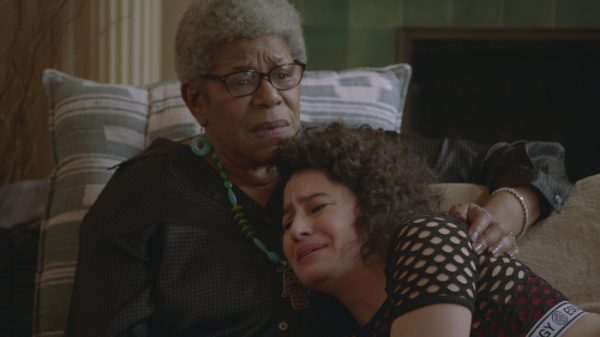
In “Witches”, director/co-star Abbi Jacobson and writer Gabe Liedman expertly blend magical realism and super harsh realism in an episode that is a sex positive celebration of women and sisterhood of all ages and ethnicities and also a comedic slug to Donald Trump and Mike Pence’s hypocritical, misogynistic, unworthy to be president and vice president’s chests. They go for another separate and then converging amazingly plot lines featuring Abbi and Ilana. Abbi finds her first grey hair and then sells her art outside the Met and starts to think she’s a witch that isn’t helped by her new BFF, Margo (Classic SNL actor Jane Curtin) . While this is going on, Ilana is talking to a sex therapist and has a giant epiphany that she hasn’t had an orgasm since November 8, 2016.

November 8 is the fateful day that Donald Trump was elected president (And I drank half a case of Modelo.), and saying the numbers 2016 (and 2017) became synonymous with terrible, shitty thing we don’t want to think about. However, unlike some comedies, Liedman, Jacobson, and Broad City go full tilt about how terrible he is, and how his election has had a real effect on the mental (and sexual) health of many Americans, including women. And they do it an sexy, slapstick-y, montage way with Ilana using her vibrator in front of the therapist and trying to think about happy things, like “average sized dicks” or even Abbi, but then shuddering about Mike Pence or Trump’s hot mic comments to Billy Bush. It’s done in an awkwardly humorous manner, but Broad City takes the fight to the Trump regime in “Witches”, and with a glorious montage of historical and contemporary women from Jacobson, becomes Comedy Central’s true leader of the resistance putting the South Park kids and Trevor Noah to shame.

Unity between women is definitely the through-line in “Witches”, which culminates in a dream-like gathering of rad women of all ages in a part of Central Park that Abbi and Ilana have never been to. During her plotline, Abbi bonds with fellow artist Margo, who seems to have all the same interests as Abbi, even though she’s decades older and with a dermatologist Dr. Fuller (Played by Inside Amy Schumer‘s Greta Lee.), who offers her chemical solutions to her aging problem after she finds one grey hair. Gabe Liedman could have used this scene between Dr. Fuller and Abbi to poke fun at women who do these kind of treatments, but instead, they end up bonding, and towards the end of the episode, Ilana has a non-judgmental attitude towards women, who do things like skin peels and Botox during one of her many post-montage orgasms.

Continuing a major part of her character arc in Season 4, Abbi runs into one of her exes, Jeremy, a neighbor she had a crush on and then pegged in the memorable episode “Knockoffs”. However, he was a huge hipster snob and hasn’t been seen on the show in a while. In Season 4, he is a “co-parenting” an adopted black child with an extra from Garden State and really seems to have his life together after throwing down a crisp $100 dollar bill  on the “struggling artist” Abbi. It’s kind of nauseating and makes Abbi sad that she doesn’t have a job and hasn’t really done much with her life except for get her first grey hair. But she does get to howl at the moon with some amazing ladies and not have to worry about those unemployment/quarter life crisis fears for at least one night as Liedman and Jacobson go for the magical side of the realism coin to close out “Witches”.

In “Witches”, Abbi, Ilana, and their new friends show that women are awesome, and that powerful, abusive, misogynistic men like Trump suck and are a burden on society. Down with the patriarchy, and long live the covens. It’s also very nice to see older women get to be funny, insightful, and cut loose a little bit on a show that is usually about people in their twenties so it’s fitting that Golden Girls is the last image in the “amazing women” montage before Jacobson cuts to black.

Overall: 8.0

Around the Tubes

The weekend is almost here! What geeky things are folks doing this weekend?

While you decide on that, here’s some comic related news from around the web in our morning roundup.

Around the Tubes

Mirror – This MP did an interview in front of a stack of graphic novels and everyone’s freaking out  – And the comic geeks continue to take over politics.

The Rainbow Hub – It’s Canon, Not Stucky That Needs to Go  – An interesting post on canon and shipping.

The Beat – Chip Zdarsky auctions rare Vader Down variant for Syrian refugees – Awesome to see.

Comic Vine – Donate to Comics for Soldiers – Help out with some charity.

The Nation – Finally, a Comic Series As Ridiculous as the 2016 GOP Field – Cool to see this series get some higher profile notice.

Arizona Sonora News – Feminism lost in comic books – An interesting read on women in comics.


Around the Tubes Reviews

The Rainbow Hub – Alias #11-12

The Rainbow Hub – All-New X-Men #1

CBR – Robin War #1

The Rainbow Hub – Rocket Girl #7

CBR – Sheriff of Babylon #1

CBR – Spidey #1

Talking Comics – The Totally Awesome Hulk #1

Review: She Makes Comics

she-makes-comicsAs a literary critic and cultural historian with both feminist and queer-ally persuasions, I am often frustrated by the type of historical revisionism that provides the history of a marginalized group by telling their story as adjunct or incidental to “mainstream” or “normative” history. Such scholarship marginalizes the narratives of oppressed groups in the very attempt to recover their histories.

I was thankfully relieved, then, to enjoy the hour-plus-long documentary She Makes Comics, directed by Marisa Stotter and made by Sequart Organization in association with Respect! Films. This documentary does what very little of comics scholarship (and journalism) has been able to achieve: it narrates the story of women comics creators, editors, and readers through dozens of personal interviews (see a list of interviewees below), incorporating them as central to the history of the comics industry while highlighting individual creators’ push toward greater inclusion and respectability in a medium largely controlled by men.

She Makes Comics begins with an opening montage of interviews in which creators Kelly Sue DeConnick, Chondra Echert, Wendy Pini, Gail Simone, and others speak to the importance of the comics medium for female creators and readers. Particularly powerful is DeConnick’s declaration that “representation in comics is absolutely vital,” followed by the injunction that “we need to celebrate the women who work in comics and who have always worked in comics, and we need to go back and find their stories and bring them to the fore” (00:55-01:07). DeConnick bring an absolute necessity to the project of reclaiming the history of women in comics.

DeConnick’s spirited call drives Stotter’s She Makes Comics as it traverses the editorial bull-pens, creator biographies, convention floors, retail spaces, and four-color universes that make up the world(s) of comics. The documentary begins by establishing the medium’s long history of female readership in comics strips of the late 19th century and the early 20th century, pointing at the same time to the generous number of female comics strip creators, including Jackie Ormes and Nell Brinkley. Trina Robbins reminds us that “nobody at that time thought, ‘Oh how unusual! She draws comics!'” Despite the comparative preponderance of women in comics in the early 20th century, a cultural moment that abounded in strong women heroes and adventurers (and with a 55% female readership!), the “comics crusade” of the early 1950s began by Frederic Wertham resulted in the Comics Code Authority. The CCA significantly reduced the type and quality of comics produced, and the documentary makes the very brief argument that the “sanitization” of comics led to a boom in the masculinity-celebrating superhero genre and a subsequent decline in female readership.

The documentary then tracks the work of Ramona Fradon at DC and of Marie Severin at Marvel in the 1960s, transitioning rather quickly to the misogynist, cliquey underground comix scene of the 1960s and 1970s, where creators such as Trina Robbins and Joyce Farmer carved out a feminist space for comics. As Robbins recalls, “if you wanted to do underground comix [with the male creators] you had to do comics in which women were raped and tortured. You know, horrible things!” But in the pages of feminist comix and zines creators were allowed the freedom to depict women from women’s point of view—points of view that occasionally had legal repercussions.

The remainder of She Makes Comics focuses heavily on the history of women creators in comics from the mid-1970s to the present, owing both to the interviewees’ considerable experiences in the period following the late 1970s and to the growing visibility of female readers and creators. Particular highlights include the description of early comic book conventions and the fan scene, which Paul Levitz describes as 90/10 men/women. Creators and fans like Jill Thompson and Wendy Pini bring their personal fan and creator experiences to bear on this unique moment in comics fandom history. Wendy Pini’s entrance into fandom via her (in)famous Red Sonja cosplaying is historicized and linked directly to her entrance into the comics industry as writer and, later, creator of Elfquest. For those with an interest in cosplay, Pini’s Sonja is marked as the beginning of an opening up of convention competitions to women, and the documentary subsequently details the critical importance of cosplay to fandom, to female fans, and to creators.

The documentary also gives considerable attention to Chris Claremont’s run on Uncanny X-Men, uniquely noting the considerable influence of Louise Simonson and Ann Nocenti as Claremont’s editors on one of the most famous runs in comic book history. Interviews by female fans, creators, editors, and retailers highlight the importance that Claremont’s X-Men saga had to marginalized groups, with a number of interviewees describing the “mutant metaphor” as particularizable to women’s experiences in geek culture.

The documentary also gives attention to particular auteurs such as Kelly Sue DeConnick and Gail Simone, as well as the editor Karen Berger, who founded DC’s Vertigo imprint at a fairly young age in the early 1990s. She Makes Comics points especially to the rise of the independent comics scene in the 1990s and its boom in the contemporary moment, especially in the form of Image’s new-found success, as a meter for the rising prominence of women comics creators and a female (but also queer and non-white) comics readership. Anyone who reads Image comics regularly knows that its creators do not shy away from feminist themes even while Wonder Women is avowedly “not feminist.”

She Makes Comics ultimately signifies that a change in the comics industry has occurred, albeit slowly, in favor of greater inclusion and representation of women and other oppressed minorities. Despite this, the documentary comes dangerously close to assuming that all the good that needs doing, has been done, asserting a stance that suggests a triumphant growth of women in comics (or as readers) as a victory over patriarchy. While I do agree that strides have been made, as my articles on Wonder Woman and Neko Case show, I don’t think we can ever be complacent. She Makes Comics reifies “women” as a singular, almost non-intersectional category and in doing so creates a narrative of emerging possibilities for that monolithic category without discussing the many and complex factors that continue to challenge, harangue, and complicate both women’s participation in comics and women’s representation. There is, in fairness, a brief moment in which Marjorie Liu speaks about using her position to empower women of color, though its importance is overshadowed by its anecdotal treatment.

She Makes Comics has very few shortcomings and is ultimately a treasure trove of information that is otherwise spread across thousands of online or print media articles, books, and interviews. Marissa Stotter and her crew, in collaborations with a riot (isn’t that what mainstream media calls a gathering of political dissenters?) of talented creators and fans, have made a unique contribution to the history of women in comics. I challenge academics and journalist, myself included, to heed Kelly Sue DeConnick’s introductory injunction with a critical eye to the politics of representation. If we could get a few books about gender politics in comics that aren’t solely about masculinity, that’d be a start.

Interviewees listed in the order that I happened to write them down (after I realized it would be good to write them all down): Marjorie Liu, Nancy GoldsteinTrina Robbins, Ramona Fradon, Janelle Asselin, Heidi MacDonald, Paul Levitz, Michelle Nolan, Alan Kistler, Karen Green, Ann Nocenti, Chris Claremont, Colleen Doran, Joyce Farmer, Wendy Pini, Jackie Estrada, Jill Thompson, Lauren Bergman, Team Unicorn, Chondra Echert, Jill Pantozzi, Kelly Sue DeConnick, Gail Simone, Colleen Coover, Holly Interlandi, Blair Butler, Louise Simonson, Jenna Busch, Amy Dallen, G. Willow Wilson, Tiffany Smith, Jenette Kahn, Shelly Bond, Karen Berger, Joan of Dark, Brea Grant, Joan Hilty, Lea Hernandez, Christina Blanch, Liz Schiller (former Friends of Lulu Board of Directors member), Andrea Tsurumi, Miss Lasko-Gross, Molly Ostertag, Hope Larson, Amy Chu, Nancy Collins, Ariel Schrag, Raina Telgemeier, Miriam Katin, Felicia Henderson, Carla Speed McNeil, Shannon Watters, Jennifer Cruté, Nicole Perlman, Kate Leth, Portlyn Polston (owner of Brave New World Comics), Autumn Glading (employee of Brave New World Comics), and Zoe Chevat.

You can purchase She Makes Comics on Sequart’s website for as low as $9.99. If you ask me, it’s a fantastic deal.

Sequart Organization provided Graphic Policy with a free copy for review.

Diversity in 2014 Comic Books

By Matt Petras

A crowd-funded comic book by the title of Toe Tag Riot featured zombies who attack the likes of the Westboro Baptist Church. Frequent writer for modern Batman comics James Tynion IV wrote a comic with intimate depictions of gay romance. Major publishers DC and Marvel stepped up their game on demographic representation.

The comic book industry in 2014 did not stick to telling stories about carefully chosen, lowest-denominator demographics, but various walks of life.

“Why on Earth wouldn’t we want our work to feel inclusive to more people?” said Toe Tag Riot writer Matt Miner in an email interview. “I mean, don’t we want larger audiences?  Don’t we want as many people reading comics as possible?”

Image from Black Mask

Image from Black Mask

“Toe Tag Riot” is a comic book written by Miner drawn by artist Sean Von Gorman, and now published by Black Mask that sells itself on a diverse cast of characters who attack in action-packed sequences against bigoted antagonists. It was crowd-funded on Kickstarter, raising $510 over its $19,000 goal. Andrew Hurley of the band Fall Out Boy supported this project; because of this, Hurley and the creators of Toe Tag Riot teamed up to give backers who pledged at least $50 a signed variant cover of the first issue with a zombified Hurley on the cover.

“The response to Toe Tag Riot from the LGBT community has been the most incredible and heartwarming,” said Miner.

It’s not just gay characters who make up the cast of Toe Tag Riot, but also people of different walks of life who aren’t always featured in fiction, like people of color and the disabled. “[W]e’ve been thanked by people with disabilities for creating Evie, a visibly disabled woman of color who finds empowerment in her disability,” said Miner.

In another avenue of the comic book industry, Boom! Studios has been publishing a comic book series called The Woods since May 7, 2014; it is a high school drama mixed with light-horror and fantasy. It features a cast of characters of varying ethnicities and sexual orientations. James Tynion IV, known for his work on multiple Batman series for DC Comics, writes this book along with artist Michael Dialynas.

“[The Woods] doesn’t imply stereotypes; it’s just a human story,” said Dialynas in a Skype interview.

In issue #7 of this series, which released in early Nov., the often-hinted upon gay tension between characters Ben and Isaac was finally revealed in a kiss. Ben is a heavy-set black boy who struggles with the common belief that he should play football when he doesn’t want to.

“They’re just two characters in the woods who happen to have a nice moment together,” said Dialynas.

The process Dialynas goes through to craft the characters of The Woods with Tynion is unique. Dialynas asked Tynion for a write-up that supplied him with the media tastes of the characters. When Dialynas was in school, the video game, movie, and music preferences of his classmates tended to say a lot about their character, he explained.

One character, for example, was given a skull on his shirt whenever Dialnyas was told the character likes metal, he further explained.

Telling stories about characters with mental illnesses has also been a part of comic books in 2014. This year saw the return of comic book series Li’l Depressed Boy, relaunched at #1 with the additional subtitle of “Supposed to be There Too.” Li’l Depressed Boy, which began being published by major comics publisher Image Comics in Feb. of 2011, is a comic written by Shaun Steven Struble and drawn by Sine Grace about a character’s struggles with romance and the clinical depression that is intertwined with it.

Image from Image Comics

Image from Image Comics

Struble suffers from clinical depression himself, Struble said in an email interview. The storylines of Li’l Depressed Boy are “thinly-veiled autobiography,” he also said.

The book has a cycle of jumping from different experiences the protagonist as with love interests, along with the symptoms of clinical depression that follow.

“The book is about relationships in general.  One of those is LDB’s relationship with his chemically imballanced brain,” Struble said.

The main character, Li’l Depressed Boy, often referred to as simply LDB by characters in the comic, is a rag doll living amongst regular human beings. Creating a sort of surreal atmosphere, this is never acknowledged in the story.

“I’m lucky that the fact that I write about ragdoll [means] lots of people can see themselves in the main character,” said Struble.

The audience for the book spans greatly across genders, races and locations, according to Struble.

“There are certain aspects of the experience [of depression] that remain the same [despite severity], and we can see each other in ourselves,” said Struble.

Children can also find themselves represented in 2014 comics, both in characters and in demographic targeting. One comic, written by former IGN Comics editor Joey Esposito and Ben Bailey, who still occasionally writes for comic book press/criticism publications, and drawn by Boy Akkerman, is the all-ages Captain Ultimate, published by digital-only Monkeybrain Comics. “All-ages” is a term in the comic book community to refer to books that appeal to every age demographic; the purpose of this term is to rid of any stigma that books that appeal to children are solely for children.

“Kids can tell if they’re being talked down to,” Esposito said in a Skype interview. The only difference between the writing process on an all-ages comic and a more adult focused story for Esposito is checking to be sure there aren’t any bad words in the script, Esposito said with a laugh.

Esposito found himself disappointed in the lack of all-ages comics, which filled him with a passion to do Captain Ultimate, he said. Captain Ultimate is a superhero comic with commentary on the contrast between the morally-wholesome and fun-filled comics of days past and the dark and gritty comics of today.

Esposito has worked on other comic books that aren’t for an “all-ages” audience, such as this year’s Pawn Shop. This comic is about a small store in a big city that unites people of different walks of life, making a statement about the interconnectivity of life. To Esposito, diversity in this cast was essential to getting across the message of the book, he said.

“I started thinking about the kind of people I know,” he said.

The big two in comics, DC and Marvel, have also done things for diversity in the industry this year.

DC Comics put a new creative team on the series Batgirl, featuring a new costume design and a female artist by the name of Babs Tarr. This new direction for the series brought in new gay and female characters.

DC also announced a string of films to release in the coming years, including Justice League films that feature characters like Cyborg, who is black, and Wonder Woman, who is female; both of those characters are also primed to receive films featuring them.

Marvel made mainstream news for shifts in their comic book stories multiple times throughout the year, including their new directions for Captain America and Thor. The person inside the costume for both characters was changed in 2014, Steve Rogers being replaced by black character Sam Wilson (who was previously a superhero named Falcon, a character featured in the 2014 film Captain America: The Winter Soldier) as Captain America, and a new female character taking the title of Thor from the previous hero.

Marvel also started a new series called Ms. Marvel, starring a new character named Kamala Kahn. Kahn is a young, female person of color of the Muslim faith who gains powers and takes the mantle of Ms. Marvel. The book is written by G. Willow Wilson, who is also a Muslim.

Matching DC, Marvel announced movies starring more diverse characters and cast members. Two scheduled films are Black Panther, which stars Chadwick Boseman of 42 fame, and Captain Marvel. Captain Marvel stars a female character that is confirmed to be based off the newest Captain Marvel storylines in the comics, written by Kelly Sue DeConnick.

“A woman creator took a woman character and made fans SO passionate about her that the studio couldn’t help but notice. So wonderful,” said popular feminist comic book critic and former editor for DC Comcis Janelle Asselin.

Despite any kind of progress there are still noteworthy important problems in the industry, according to Asselin.

Among her critiques is a lack of hiring female creators from Marvel and further sexual objectification of women, she said. On Apr. 11, 2014, Asselin penned a guest piece for leading comics site Comic Book Resources harshly critiquing the cover of the first issue of this year’s Teen Titans relaunch, largely for objectifying an underage girl front-and-center.

One big news story in the industry this year was the controversial variant cover for the new Spiderwoman series, featuring the titular character donning an extremely tightly-fitting costume in a sexually suggestive pose with exaggerated body parts.

comicsdiversity manera

Image from Marvel Comics

“[This] cover was a problem, in my opinion, not because it was a sexy cover at all, but because it was an objectifying cover for a book that Marvel had been touting as a book for women and starring a strong female character,” said Asselin.

There were other events this year that casted a negative outlook for diverse representation in comics, including reviews criticizing the new direction of writer Meredith Finch and husband David Finch on art, on the Wonder Woman comic series. Despite being written by female writer Meredith Finch, comic book critics like Jesse Schedeen have criticized the depiction of the protagonist in this new direction. “Diana comes across as weak, whiny, and childish – basically everything she wasn’t under [the previous writer’s] hand,” he said in a review for IGN.

Noting issues with something doesn’t completely demonize it. “Overall, it was a year of positive change,” said Asselin.

Fiction provides creative people with the opportunity to tell stories that represent whatever kinds of people they want to see represented.

“Anything that you want to see that you don’t, make it,” said Esposito.
The Truth About Gamergate

SimAnt_SNES_boxYou might have heard about Gamergate. Its been in the news quite a bit lately, getting a lot of coverage from the mainstream media. But, those articles overlook the history of the term, which actually traces back to 1983, and was used in literature in 1984.

The term “gamergate” didn’t begin with Adam Baldwin’s Tweet about Quinnspiracy two months ago. The term didn’t begin two years ago concerning Rhode Island and 38 Studios either. Actually the term is a scientific term having to do with ants. Yes, ants.

In 1983 geneticist William L. Brown coined the term, and first appeared in scientific literature used by entomologists. The term actual means:

mated, egg-laying worker

The term is derived from the Greek words γάμος (gámos) and ἐργάτης (ergátēs) and means “married worker.” Say what?

Yes, gamergate is a term having to do with female worker ants that are reproductively viable. When an ant colony lacks a queen, what’s a colony to do? Well, this. A gamergate is a female ant that helps as a reproducer for their colony.

It’s about specific types of colonies of ants, some of which are actually queenless. Instead one worker, or a group of them, have active ovaries. Yup, for the colony to survive, the ant colony must rely upon the female ants.

This gamergate also has controversy attached to it. Some feel that the term “worker” should be applied to only ants that are part of the non-reproductive caste, while “queen” should be applied to all reproductively viable female ants.

It’s actually pretty fascinating stuff, and you can learn more here or the many scientific papers on the subject.

What does this have to do with this site? Absolutely nothing, I just learned all this last night, and found it a pretty fascinating look at a matriarchal society.

“These Aren’t the Droids” Really Is A Droid that Nerd Feminism Is Looking For

Before an hour ago, I didn’t know who Neko Case was, nor did I know about Ellie Kemper or Kelly Hogan. But it would seem I’ve been missing out on a whole realm of awesome music and comedy, as a recent post by The Mary Sue introduced me to a new music video called “These Aren’t the Droids,” with vocals by Neko Case and Ellie Kemper, and lyrics by Rachel Axler, Tamara Federici, Neko Case, and Kelly Hogan. Give their video a listen first, then we’ll talk:

We’re dealing with comedy music at its finest: socially critical, humorous, and artistic. This video and the music were done for a charity music album called 2766, produced by the Levinson Brothers and Rob Kutner, a writer for The Daily Show. The album is being sold to raise money for the charity One Kid One World, and is given the following synopsis:

The year is 2776, and on the thousandth birthday of America, an evil Alien (Martha Plimpton) threatens to destroy the nation, unless the President (Will Forte) and his Secret Service agent (Aubrey Plaza) can convince her it’s worth saving. Together with a cranky George Washington (Paul F. Tompkins) they travel through our nation’s history—past AND future, taking on everything American — immigration, religion, the media, sports, politics, sex, droids, and rock n’ roll. Along the way they meet notable Americans, from God (Patton Oswalt) to the Common Cold (Aimee Mann). Can America be saved? Kind of. It’s complicated.

Despite its quality, humor, and message, The Mary Sue didn’t exactly appreciate the video, and instead stated that:

Neko Case knows there are female superheroes, right? And that women and girls are actually a huge part of the geek sphere, and have been for decades? Please, someone, show her the light. Because her music video with Kelly Hogan for “These Aren’t the Droids” would’ve been really cool—Ellie Kemper is saved by science! Feminist utopia! That rocking Leia/Spock outfit! And it’s for charity!—if not for the part where geekery is explicitly stated as being the realm of immature manboys.

Meanwhile, io9 seemed quite confused about the video as well, summing up the confusion by saying:

It’s hard to tell exactly what Case and Hogan are trying to say here, because a lot of this is just them goofing around. But they are very clear about one thing: they think geek culture is for 13-year-old boys, and that women have no place in it. They sing about a feminist future where geek culture is replaced by girl power and kittens, which is frankly weaksauce. Why not just join the geek girl revolution that has been going on for — oh, ten years or so? Still, the video also features a woman (Ellie Kemper) who is liberated by science, so I’m honestly not sure what the hell Case and Hogan are trying to say.

I have to say, frankly, that I’m surprised at these reactions. Very much so. These reactions commit a complete misinterpretation of the video that results from a not so careful reading, as it were, of the lyrics. Case and Hogan do not explicitly state that nerd culture is the realm of immature manboys, or, to use their words “teenage guys.”

Instead they argue that “the future was designed by teenage guys.” And what they have to say, if attended to with more than a casual listen, is pretty damn feminist. And funny. I took some time to write out the lyrics; granted, I missed some words here and there, and I’m not sure if my line breaks are ideal, but I think reading the lyrics while listening to the song another time through is worthwhile.

The future (the future!): It seems so exciting. It looks so inviting.

Space-drinks,space clothes, space silver jumpsuits, space world harmony,

space silver moon boots (so much silver!).

But we didn’t realize: the future was designed by teenage guy-uy-uys!

So now we’re here in 2091 and it looks like a permanent comicon.

There’s robots and aliens from every realm

And all the dudes are psyked but we’re kind of underwhelmed.

These aren’t the droids, these aren’t the droids I was looking for. Designed by boys for [word?] boys.

Welcome to the future, ladies! Booooooring.

There’s Aquamans and Supermans and Spider-Mans,

Ant-Mans, Batmans, and Wing-mans, Y the Last Mans.

There’s a man of ice who can freeze himself.

[Something about a map to Mars or Venus?] Where’s our Shackleton?!

Baseballs and basketballs and tennis balls and footballs and eyeballs and guy balls and

balls, balls, balls, balls.

Three-boobed aliens on stripper poles who want shiny sex-bots with only holes.

So that’s [something, something, something] ’cause, hey, we love a Wookiee, but I mean, come on!

It’s way past time for a revolution to your hairless post-apocalyptic constitution,

Which is, let’s face it, basically Maxim, mixed with MAD and Cracked…it’s Craxim!

If we designed the future, it’d smell so much better.

There would be no war, just some Greco-Roman wrestling (hairy dudes in singlets!)

And we’d still have guns, but they’d shoot feee-eeelii-iii-iii-ii-iii-iings.

No waxing! No shaving! Everybody’d have more hair!

A fundamental appreciation of literacy but less shades of grey;

There’d be an entire section of government devoted to inventing no [poodle shapes?].

Girl power would be an actual fuel source with zero carbon footprint.

(Made of actual girls?

Huh?

Ah, you know what I mean!)

Kittens everywhere! Yeah, baskets of them, everywhere.

In restaurants! (Yeah!) In bathtubs! (Yeah!) In the Senate! (Yeah!) On the moon!

And when our clocks start tickin’, we just point to a dude’s body anywhere,

And that’s where the baby grows, and kittens and puppies come out.

And a cougar is an animal. An animal that eats you whole and poops you out on a rock.

Yeah, and we’re finally gonna get equal pay, but no one’s gonna work, so who cares anyway?

But don’t worry, guys, we’ll keep some same stuff like before, like actions figures still in their packages

Because, duh, they’re worth more!

These aren’t the droids, these aren’t the droids, these aren’t the droids I was looking for.

[Something about noise?] These aren’t the droids I was looking for.

We’re gonna own 2091 with reading and crossbows and way more fun!

It’s gonna rule!

Come join us, dudes, but if you don’t dig it well that’s still cool.

We’ll just grow our own custom dudes.

Hydroponic dudes. Hairy dudes with pubes. Dudes with boobs. Yeah, dudes with boobs!

Growin’ in tuuuuuuuuuuubes.

Case and Hogan present the argument that nerd culture is made by dudes for dudes, in a nut shell. And while some online commentators have critiqued the music video, saying that it seems to be ignoring what progress has been made, Case and Hogan are asking they’re viewers not to take pittances and minor allowances for widespread, industry or society-wide change in gender inequality.

Pittances. “These are the droids I was looking for.” Social change in geekery and nerdom will not come about because half-a-dozen female comic book creators were hired at DC, or because Marvel has half-a-dozen female-lead series. Compared to the hundreds of comics that come out every week, these are pittance.

And whether humorously for humor’s sake, or humorously to mask the sad fact that the industry diversifies greatly below the rate of an expanding market that demands, quite angrily, books about us (women, PoC, LGBTQ, etc.), the point made by Case and Hogan is a powerful one.

Yes, my daughter, who is two and a half, will grow up in a nerd culture that knows (at least right now) a very diverse cast of comic book, video game, and science fiction/fantasy characters. Some well written, others shells of faux feminism or icons of the “we need a black character because, well, they sell” persuasion.

But this doesn’t change the fact that the people making these decision, by and large, are men. The titans of nerd culture, the bastions of ungodly power who decide what games we’ll get to play and what comics we’ll get to read, are largely men.

And while The Mary Sue is as fantastic and as useful a source on feminist nerd culture that there is, I’m disheartened to see their response to this video. Especially because what Case and Hogan are arguing is that the centers of power and authority in nerd culture are not in the hands of women (or, to push it further, though they don’t say so, people of color, LGBTQ, individuals with varied ability, etc.). This is a fact that nerd feminism is acutely aware of, since the past decade, and especially the last five years, have witnessed an arduous uphill battle just to get the pittances currently available!

And yet: rape threats, online gaming harassment, rampant sexism and violence against women in comics, and a general inability to handle even iconic female characters, like Wonder Woman, well (read my discussion of the Finches here) persist. Otherwise, we wouldn’t be in a fury about a new screwed up thing that happened to backtrack the fight for equality in nerd culture ever few weeks!

“These Aren’t the Droids” shouldn’t be confusing. It shouldn’t be ambiguous or difficult to parse. It’s full of jokes about men birthing kittens and guns that shoot emotions because the people involved and the project that it belongs to is comedic in origin.

We comic book lovers don’t shy away from masks, and certainly we don’t shrink from the challenge of unmasking heroes or villains or industry “secrets,” so why is the Internet collectively failing to unmask the clear messages of this song and music video?

“These Aren’t the Droids” challenges and mocks and overturns, albeit in a funny and non-threatening way, patriarchy and misogyny-ridden nerd culture, and demands a nerd culture dominated by Kelly Sue DeConnicks, Ursula K. LeGuins, Anita Sarkeesians, Wonder Womans, and Gail Simoneses.

If even light-hearted, humorous attempt to point out the need for change can’t be interpreted as politically motivated and endowed with a will to make change, then how can we hope to enact change through and in comics?

What’s at Stake: Wonder Woman and the “F” Word

wwbestofrest13It’s been less than a week and the announcement that comics writer Meredith Finch and artist-husband David Finch are taking over as Wonder Woman‘s new creative team with issue #36 is still an open sore, the constant media reminder of which continue to drive me into a fury. On the one hand, because half of the commentators hardly care or don’t see any harm in the creative change; on the other hand, because savvy writers who do get it are just as outraged.

Some might think “outrage” and “fury” are harsh, maybe even over-reactive descriptors. But consider for a moment our collective comic book fandom outrage when Orson Scott Card, homophobe extraordinaire, was slated to write 2013’s Adventures of Superman. Comics fandom won a major battle with help of media coverage, the artist Chris Sprouse, a petition by AllOut.org, and comic shop owners who refused to stock a comic written by Card. (This was not unlike the response to Gail Simone’s firing from DC’s Batgirl that got her quickly rehired.)

Recalling these moments in recent comic book history (hmm, both having to do with DC’s creative choices…), imagine now that Orson Scott Card had been asked to write a well-known gay or lesbian character, and that he had stated in interviews his desire to make the character decidedly “not that gay” or generally uninterested in the narrative purposes put to the creation of an LGBTQ comic book hero. We’d be burning down DC’s boors and firing Dan DiDio! (We should anyway after this.)julyww32

So why aren’t we now? To put my and other commentator’s frustration into context, let’s consider the facts of the Wonder Woman creative team change. On June 30th USA Today announced that Meredith and David Finch, a wife-and-husband duo, would take over Wonder Woman, signaling the end of the three-year and 36-issue-long era of Brian Azzarello, Cliff Chiang, and to a lesser extent Goran Sužuka and Tony Akins. While this team defined an entirely new Wonder Woman steeped in the mythos of a redesigned Greek pantheon of hipster gods, badass goddesses, and an as yet unbeatable First Born, all good comic book runs must come to an end.

Alone, this announcement was a disappointment: Meredith Finch is an almost unheard of writer, unless of course you’ve read Zenescope Entertainment’s Grimm Fairy Tales Presents: Tales from Oz, a series of one-shots. Bleeding Cool, who wrote several articles based on “informed sources” starting in February 2014 about the potential for David Finch to take over drawing Wonder Woman and the suspicion that his wife, Meredith, would write, decided to take a look at one M. Finch’s oeuvre, reviewing it in view of the possibility that she might write the Amazon princess’ monthly. The reviewer, who badly needed a copyeditor, concluded that despite an abundance of sexist imagery, the comic displayed “a definite awareness of feminine stereotypes,” and, ultimately, was about warriors being warriors, “which is probably what you might want for Wonder Woman.”

oz10-600x922Zenescope Entertainment is essentially the Playboy of the comics industry, a company whose income is derived solely from comics based on public domain fairy tale and fantasy narratives that are populated with scantily-clad, huge breasted women and the warriorest of warrior men. Their “warrior women” usually look something like the image to the left, with dialogue by M. Finch. All of this said, it is exciting to see a new female creator come on board at DC, though her politics seem to accord generally with the “we’re not feminists” stance of DC’s creative heads.

WonWoman

“Hey, there, stud. I’m not a man-hater, just a strong woman.”

Turning away from Meredith’s inexperience, her husband, David Finch, is not the greatest artist for female characters, and the art he supplied for the “big reveal” is atrocious, unrefined, and cookie-cutter. His is a Wonder Woman who looks like she works at a strip club in order to show how empowered women are by showing their skin. In other words, a “strong female character” made for men, like basically everything else. For a discussion of some of the problems with the strong female character trope, see Shana Mlawski’s poignant article.

These were just my thoughts from the night of June 30th. Then came July 1st and the Comic Book Resources interview with M. and D. Finch. Some highlights of the interview include David Finch’s curt “No.” to the question “Have the two of you collaborated on a creative project together, either in comics or outside of it?” and the quick follow-up by Meredith, in which she points out that, in fact, she’s helped him on plotting and layouts for years. Finch then came up with a brilliant save by pointing out that he probably ignored any advice she gave, complete with “[Laughter].” What a guy!

When asked what direction the team will take, either following Azzarello’s mythos or not, Meredith responds that, “we’re definitely going to steer the book a little more into a more mainstream — I guess I’d say there will be some superhero stuff in it. It really will still be a very character-driven book, though.” The desire not to tread on Azzarello’s heels in understandable, especially for a complete newcomer to superhero comics writing. But, for me and many other readers, Wonder Woman of the New 52 has been defined by Azzarello’s reluctance to bring the book into the larger DCU, especially his resistance to incorporating Superman as a love interest. As noted in their interview, M. and D. Finch fully intend to bring in Superman.

WonderWomanV5

“I’m not a feminist! Just strong! And sexy…”

Thus far in the interview we’ve seen variations on viewpoints regarding the type of character Wonder Woman is and should be, the genre of narratives she should be engaged in, and her level of involvement in the DCU. Azzarello’s reluctance to bring Wonder Woman into the DCU is, of course, a point of frustration for many readers, and though I highly admire his Wonder Woman run and would love to see it continue for a hundred issues, the character’s critical presence is lacking from the DCU in a major way that Superman and Batman, who have multiple books to themselves, are not. Eric Diaz at Nerdist has some solid thoughts about Wonder Woman and her current place in the New 52 line-up.

The interview ends with a question about what aspects of Wonder Woman the team hopes to play out in their opening issues of their run. M. Finch wants to write a Wonder Woman of the 1970s, a female icon of power and strength. D. Finch wants to draw “a strong — I don’t want to say feminist, but a strong character. Beautiful, but strong.” With these closing words, D. Finch articulates the central concern of this creative team change. With his final lines he highlights the greatest challenges for female characters across all media today:

  1. Strong women aren’t by default feminist because
  2. Feminist isn’t something we want to label female figures of authority
  3. There is an inherent and contradictory relationship between attractiveness and strength
  4. Superheroines must be overcome this contradictory relationship by being beautiful and strong, resulting all too often in hypersexualizations like Power Girl

I’m not the first to voice my objections: Susana Polo at The Mary Sue offers a summary of the issue, Janelle Asselin at Comics Alliance gives a short background to Wonder Woman’s entirely obvious feminist legacy, and Jenna McLaughlin at Mother Jones provides some insight from the director of the documentary Wonder Women! The Untold Story of American Superheroines.

Whether commentators and Internet trolls like it or not, Wonder Woman has had obvious feminist deployments by comics writers and in the feminist movement in general, and her origin in William Moulton Marston’s bondage and male-dominance stories of the 1940s hearkens to a history of radical writers, mostly female, suggesting that the patriarchy get a taste of their own medicine. Wonder Woman’s Themyscira was an updated, superheroic version of Charlotte Perkins Gilman’s feminist utopian Herland (1915). Utopian visions of female-only worlds abound in the history of science fiction and fantasy literature.

9780415966320_p0_v1_s260x420I do not mean to suggest that feminism advocates for a replacement of the patriarchy by a matriarchy, one in which women rule over and enslave men. Rather, these examples serve the point that, like it or not, Wonder Woman is a feminist icon. However, as Lillian S. Robinson warns in Wonder Women: Feminisms and Superheroes, we should not confuse her iconic status in the history of women’s rights and the feminist movement for feminism in general. As Shana Mlawski points out, strong female characters on their own, can harm the fight for equality for women by using scantily-clad, sexy, but strong kick-ass women to cover up the lack of social equality or justice outside of the comics, movies, and films populated by Xenas, Buffys, and Wonder Womans.

Moreover, “feminism” is a continuously evolving, often overlapping, and sometimes contradictory set of individualized, group-specific, and differently-theorized feminisms. Feminism is not a monolith, but a nexus of ideas about social justice and equality. Characters like Wonder Woman may stand as an icon, but they are far from descriptive of feminism as a whole; they describe particular feminisms. Janelle Asselin at Comics Alliance, for example, offers a critique of the current Azzarello and Chiang run, arguing that the retconning of Wonder Woman’s born-of-clay origin and the revelation that she has a father, namely Zeus, was a negative change for the character. Her biological attachment to Zeus undermined her self-made status.

Sensation-WW-1-537676042a9e82-07339885-3496f

Sensation Comics Featuring Wonder Woman #1

What’s at stake, then, in denying Wonder Woman the feminist title is not necessarily denying that she can be analyzed as a feminist character or, even, that she will cease to be used as a feminist icon in the ways that she has been for 74 years. It is instead a misogynist attempt to rein in positive social change in the mainstream comics industry, to deny readers’ desire for characters that bring about social and ideological change not just in the DCU or the Marvel Universe, but in our world as well. It’s also a slap in the face to common sense: there’s just no humane reason not to be feminist.

We want heroes who make change, and heroes cannot make change if they are denied identities that advocate for social justice. We want a Wonder Woman who’s not afraid of the “F” word and a creative team who understands that.

At the very least, come August we’ll have a new Wonder Woman comic to turn to: Sensation Comics Featuring Wonder Woman.

Around the Tubes

Lots of articles today and there’s tons of previews and reviews throughout the day.  Enjoy all the news and here’s yesterday’s you might have missed.

Around the Blogs:

CBS News – In Archie, cancer appears, so does helping, tooIt’d be great if this raised the profile for comics, but more importantly I hope it raises a lot of money for the cause.

CBLDF – It’s Banned Books Week!I’ll be sporting my CBLDF t-shirt!

Think Progress – Should Feminists Give Up On Comics? – A good take on the DC “women” problem.

Con Coverage:

Spandexless – SPX Pulls: I Read Banned Comics Shirt

Spandexless – SPX Talks: Charles Brownstein, Executive Director, CBLDF

Spandexless – SPX Talks: Homeless Comics

Spandexless – SPX Talks: Darryl Ayo

Spandexless – SPX Talks: Domitille Collardey

Around the Tubes Reviews:

CBR – Captain America #3

Comics Alliance – Holy Terror

CBR – New Teen Titans: Games

MTV Geek – Dark Horse Advance Reviews: Fear Agent #31, Axe Cop: Bad Guy Earth