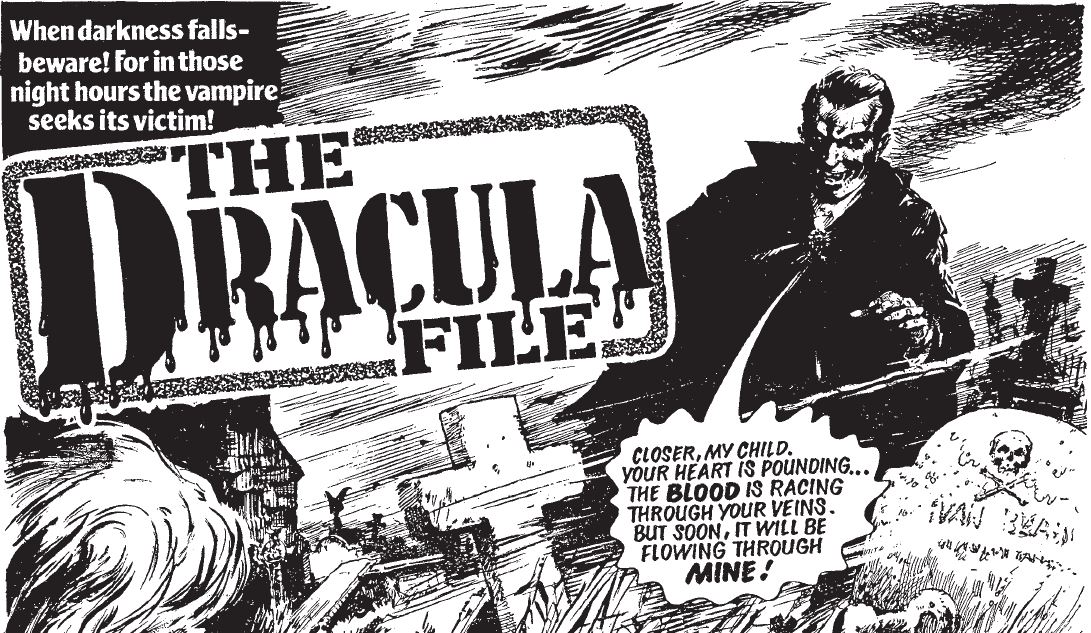
Horror in the 1980’s had a particularly sinister bite to it, especially if it came from across the pond, from England. While the Cold War was still haunting geopolitics during that decade, the collective imagination was no longer hung up on the 1950’s and 1960’s brand of communist fears and paranoia. In comes a British comics magazine called Scream!, a weekly horror anthology that ran for 15 issues in 1984. With it came one of the most unique vampire tales ever to have graced the comic book page: The Dracula File.
The Dracula File
Mainly written by Gerry Finley-Day, one of the minds behind Rogue Trooper, and illustrated by Eric Bradbury, The Dracula File took Bram Stoker’s iconic vamp, dropped him right in the middle of 1984, and then had him come out of the Iron Curtain and into Western Europe for his nightly feedings. Perhaps Soviet blood just wasn’t as fulfilling anymore.
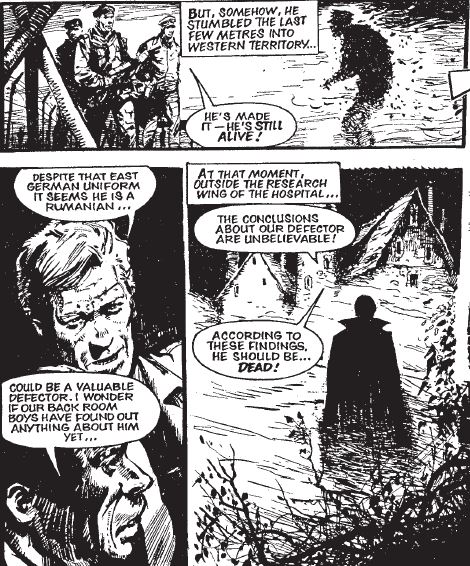
Finley-Day and Bradbury take every opportunity to indulge in the Cold War setting to portray Dracula’s horror as a natural fit within the world of spies, secrets, and the constant threat of nuclear war. In fact, the story’s first entry opens with a scene involving a vampire crossing the ‘death strip’ (the distance that had to be run to reach the West over the Berlin Wall) to escape East Germany.
As was the case for those who actually attempted to escape East Germany, the vampire is met with machine gun fire and all manner of death traps that were supposed to deter people from trying their hand at it. After the vampire makes it to the other side, The Dracula File makes an unexpected shift into a genre not commonly associated with the famed bloodsucker: spy fiction.
The Dracula File
Given the history of British horror, one could be tempted to assume the story would take much of its inspiration from the classic Hammer films. While there is a fair bit of Hammer in it, especially in terms of ambiance and monster designs (there are parts where the vampire shows a passing resemblance to Christopher Lee’s Dracula), The Dracula File owes more to the spy novels of John le Carré, Graham Greene, and John Deighton.
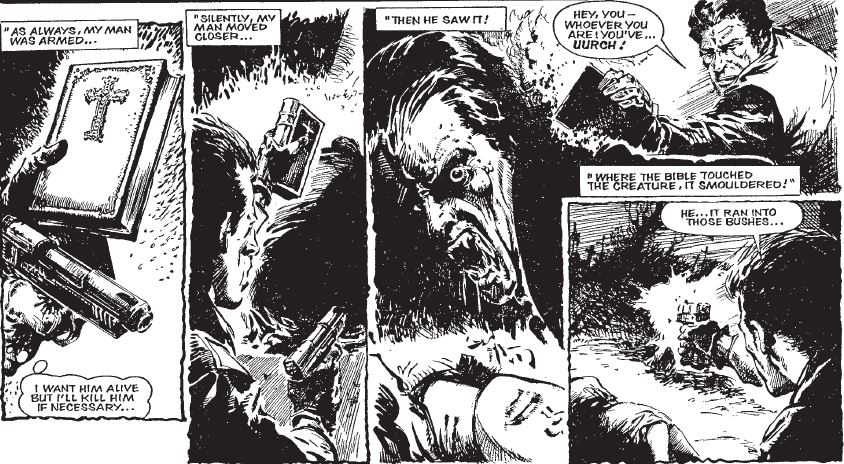
The first parts of the overall story carry the pacing and tone of a spy thriller. Reports of someone who survived the jump to the West are shrouded in secrecy due to the circumstances of the escape while supernatural incidents are studied methodically to account for the unexplained things that accompany the new development. Later, mysterious deaths lead to investigations that keep to dark alleys and backchannels, whispered among a select few. Finley-Day and Bradbury go lengths to present Dracula as a legitimate Cold War threat and a national security problem. And then they have spies and government agents become the natural evolution of the Van Helsing character.
The script and the art never let the spy elements overwhelm the horror in the story. Dracula File never stops being a horror story, but the underlying intrigue that comes with treating vampires as another threat under the umbrella of the Cold War gives it an identity all its own. Heavy mist still hangs over scenes where a vampire attack is imminent and the supernatural permeates throughout the entire story, but the spy thriller elements frame Dracula as a kind of provocateur without any real allegiance to any side other than his own. His cause is one of blood and it poses a threat to the order of things in the world of secrets the Cold War created.
The Dracula File
The Dracula File is a different kind of vampire story, a rare one, in fact. To insert vampires into the spy game and still honor the more classic elements of spy fiction is truly a feat and begs further reading. It’s a great addition to anyone’s Halloween reading list and it’s a refreshing break from tradition.
While I was reading Strange Adventures #1, or Tom King, Mitch Gerads, and Evan Shaner’s latest comic on King’s military service and his regrets and feelings about working for the CIA as well as how much he loves his wife starring a DC Comics B-list character, I had the sneaking suspicion I’d read a better version of this comic. That comic was Dare: The Controversial Memoir of Dan Dareby Grant Morrison and Rian Hughes that was serialized in the UK comics magazines Revolverand Crisisin 1990-1991 before being reprinted by both Fantagraphics‘ Monster Comics imprint and Image Comics.
Before going into the whole anything Tom King/Scott Snyder/Geoff Johns has done, a British Invasion writer like Alan Moore or Grant Morrison has done better (And decades before.), I’ll look at the surface similarities between Strange Adventures and Dare. Created in 1958 and 1950 respectively, Adam Strange and Dan Dare have the same Space Age DNA and were influenced by previous sci-fi action heroes, Flash Gordon and Buck Rogers. In his early stories, Adam Strange was accidentally transported from an archaeology dig to the planet Rann where he protected the planet from invaders and fell in love with their princess, Alanna. Dan Dare’s stories were set in the “future” of the 1990s, and he was a pilot in the Interplanet Space Fleet, who explored other planets and protected Earth from the invasions of the villainous Treen.
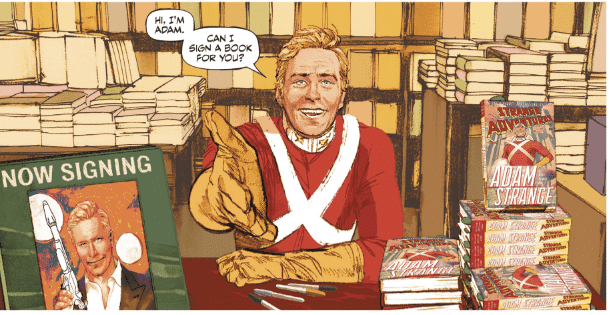
Strange Adventures and Dare show both Adam Strange and Dan Dare as way past their prime with Dare having a little more satirical bite. The framing narrative of Strange Adventures is Adam Strange going on a book tour where he gets asked questions some friendly, some antagonistic about his actions in Rann, and this ramps up when one of his critics is found with a laser blast in his head. In Dare, Dan Dare is disabled, living off a military pension, and struggling writing his memoirs when Gloria Monday (A stand-in for Margaret Thatcher.) asks him to be the symbol of her re-election campaign even as he begins to find out that her government may have been responsible for the death of his old ally, Dr. Jocelyn Peabody.
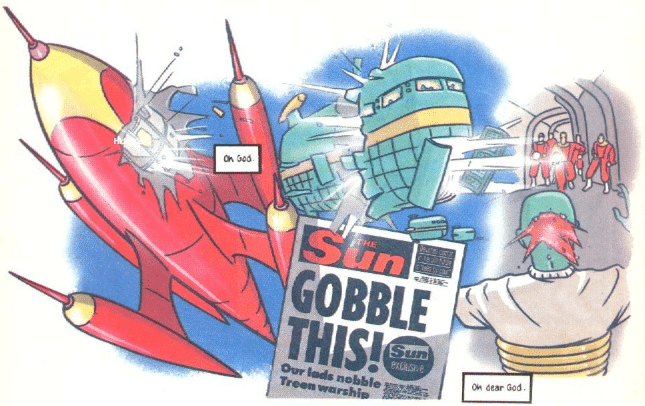
Strange Adventures and Dare use the Pykkt Empire (Created for the series) and the Treen respectively as stand-in’s for the “other”. Strange Adventures seems to be using the Pykkt as a commentary on American interventionism in the Middle East (Which is where Tom King served.) with Shaner staging the Adam Strange flashbacks on a desert planet with him fighting a solider with a head and face covering. Dare uses the Treen as a general metaphor for the rebirth of British imperialism, but especially the Falklands War with Hughes’ clever parodies of the Sun‘s violent, xenophobic headlines and the connection between that war and Gloria Monday, er, Margaret Thatcher’s reelection in 1983.
I will throw up a quick disclaimer that Dare is a completed work while Strange Adventures has eleven more issues to tell its story. However, Dare is the stronger work of satire while King seems to be too close to the material he’s writing about to go from his personal experience to something more universal other than a fairly banal “Who is telling the truth?” Grant Morrison and Rian Hughes introducing Dan Dare as a pathetic figure drinking and popping painkillers in front of his fireplace looking more like Morrissey than a “boy’s own comic” hero, who can’t even write his memoirs properly. This desperation and need for money is why he basically sells his soul to the devil and lets Monday use his image for her reelection campaign in the midst of strikes and food shortages that were the reality in the U.K. when Thatcher was prime minister and have not gone away even with fancy things like interplanetary space travel.
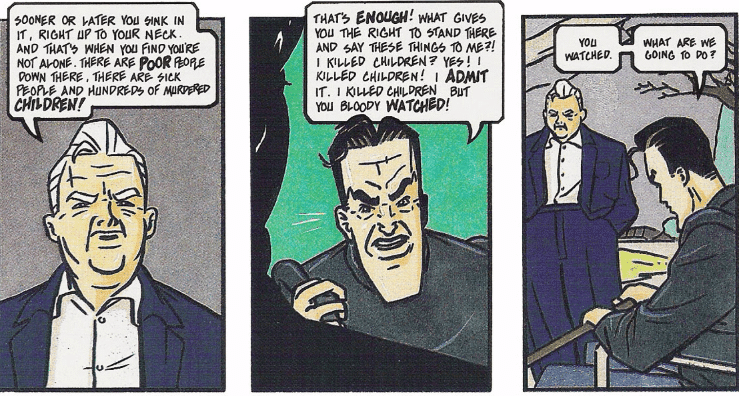
In all aspects, Dare is an excellent work of social commentary that uses the iconic British comic strip character to skewer imperialism, racism, and Tory/Conservative policies that have persisted to 2020 with the government of Boris Johnson in the U.K. and Donald Trump in the United States. Towards the end of the second issue, Morrison and Hughes have Dare’s old batman (A military officer’s personal servant aka hooray for class tension.) , Digby with which he has a strained relationship, confront him for killing Treen children in his last space battle. Instead of making Dare contrite or remorseful, he is portrayed as defensive while still having the good point that Digby watched him gun down the Treen children when they revolted after being treated by both their own leader, Mekon, and Earth as a slave labor force. Dare’s disability, his addictions, and money issues make him a sympathetic figure, but Morrison and Hughes aren’t afraid to call him out on his actions and make a character created to inspire young boys to serve God and the British Empire look weak and morally compromised.
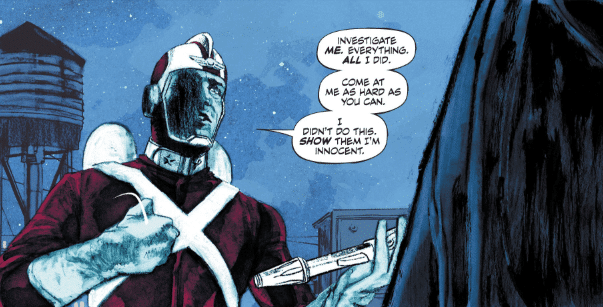
On the other hand, Strange Adventures #1 seems less concerned with broader social commentary and more about Tom King using yet another DC character to deal with how he personally feels about being in the CIA, albeit, with better visuals and less line-wide impact than Heroes in Crisis. The dialogue that Strange uses is telling as he implores Batman to “show them I’m innocent” in a dark-draped panel drawn by Mitch Gerads. Unlike Dare, which casts a skeptical eye on British pop iconography, and by extension, politics and foreign policy, Strange Adventures is about vindication.
Adam Strange has to be the exposition spouting hero drawn in a clean pulp style by Evan Shaner, and this tension between him and Mr. Terrific’s investigation looks like the driving force behind the series. He has to be the hero and have the big redeeming moment while Dare is impotent, can barely walk, and his imagery is used to uphold a government that is okay with turning “undesirable” humans into food called Manna in cahoots with the Treen leader, Mekon, that Dare fought so many years ago. For now, King seems content with self-involvement via superheroes instead of looking at larger systems of control like Grant Morrison and Rian Hughes did in Dare.
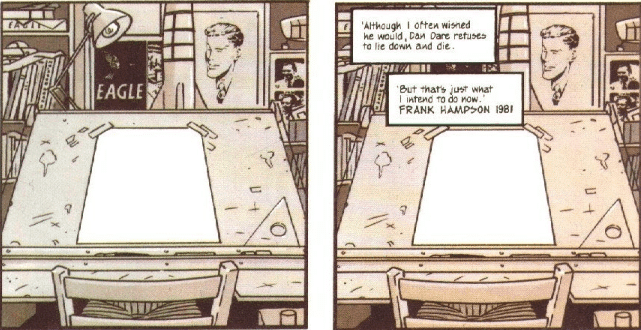
Dare ends with a bomb that Dare set in his old spaceship, Anastasia, going off and wiping out London, including Mekon, who was there celebrating Gloria Monday’s election as well as the protagonist himself before cutting to a blank drawing board in almost a similar manner to the way the ending of Animal Man showed Grant Morrison meeting his creation. It’s a stark, six panel reminder that Dan Dare’s creator, Frank Hampson, signed away the rights to his creation just like Jerry Siegel and Joe Shuster did with Superman under predatory, work for hire contract.
Dare may have been a cheerful, heroic figure, but his creator, Hampson, did not reap a financial reward commensurate with his fame. Morrison and Hughes are using an iconic British character to basically flip off the comics establishment a couple years before the founding of Image Comics in a kind of metafiction and create a revolutionary story. It is highly unlikely that King, Gerads, and Shaner will do that to DC Comics/Warner Bros/A T and T, and at its best, Strange Adventures will be an attempt at pastiche and a dark deconstruction of a Silver Age space hero.
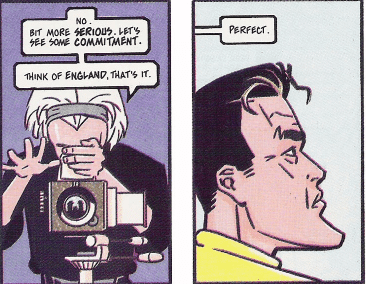
And the fact that Grant Morrison and Rian Hughes use an iconic figure in British pop culture instead of a character that rarely has his own title to tell their story of heroism being used to serve the predatory establishment instead of fighting for truth, justice, and all that stuff makes Dare a stronger story than Strange Adventures. This is despite the comic not being as well-known as Grant Morrison’s other work during that time period, including Zenith, Arkham Asylum, Animal Man, and Doom Patrol. And along with being a compelling work of satire, Dare has some wonderful flourishes like Rian Hughes’ brutalist approach to future architecture and world-building with a character remarking that Art Deco didn’t leave much room for places to live and shop and a cheeky sense of deadpan humor. (See any photoshoot scene featuring Dan Dare.)
If you’re looking for a story where so-called paragons of heroism are powerless to shake the bonds of systems of control, then Grant Morrison and Rian Hughes’ Dare is a comic worth reading. Instead of gazing at its own navel (Albeit in a visually interesting way by Mitch Gerads and Evan Shaner) like Strange Adventures, Dare offers up a portrait of a society crumbling due to conservative social policies and choosing power over decency through the lens of a spaceman’s salad days.
Coming this May, Titan Comics launches Best Of British month, celebrating cutting edge talent and supporting bold new visions! Starring Si Spurrier, PJ Holden, Rob Williams, D’Israeli, Alan Martin, Monty Nero and many more!
Best Of British month will be supported with promotions, events and press throughout May, kicking off with Free Comic Book Day.
Coming this May, Titan Comics will celebrate the best of British talent. While details are scant as to what their “Best of British” campaign entails right now, more details are coming soon.