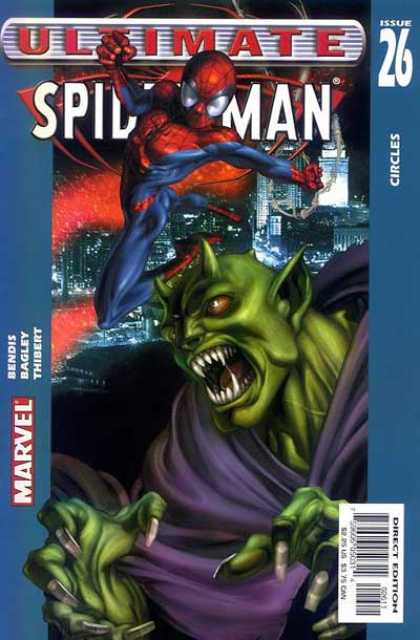
 Back to School is a weekly issue by issue look at the beloved superhero teen comic Ultimate Spider-Man. In this week’s installment, I will be covering Ultimate Spider-Man #26-27 (2002) written by Brian Michael Bendis, penciled by Mark Bagley, inked by Art Thibert, and colored by Digital Transparency.
Ultimate Spider-Man #26 starts by showing the fight between Spider-Man and Green Goblin from SHIELD’s POV where Nick Fury gives the order to fire on the Goblin after Mary Jane is dropped. Then, it cuts to Mary Jane waking up in Peter’s arms where he tells her go to an abandoned warehouse to be safe while he and the SHIELD helicopters battle the Green Goblin. Spider-Man is holding back at all against the Green Goblin, and he is a little freaked out between trying to balance, dodge helicopter gunshots, and fight the physically stronger Green Goblin. However, the Goblin’s Oz formula is starting to wear off so he returns to the penthouse for a cocktail of injections and runs into his son, Harry. The Green Goblin makes Harry pass out by saying the trigger word “cellar door” and then become veinier and Hulk-ier and throws Spider-Man through a window. The comic ends with Harry slowly waking up and seeing the Green Goblin clutching an unmasked Spider-Man while there are SHIELD helicopters outside. Someone has some splainin’ to do.
Ultimate Spider-Man #27 opens from Harry’s POV, and he realizes that his father is the Green Goblin and Peter Parker is Spider-Man. Green Goblin is about to squeeze Spidey to death, but he has enough energy for one last kick before webbing a piece of debris as the Green Goblin takes the fight outside to the civilians. Spider-Man pleads with him to keep the fight contained before Harry unexpectedly impales him with a piece of rebar presumably killing him as the Green Goblin reverts back to Norman Osborn. Finally, Nick Fury and SHIELD agents come to clean up and collect both Osborns. Nick Fury tells Peter that he did an okay job and shouldn’t confide so much of his life as Spider-Man to Mary-Jane, who is confirmed to be safe. Then, he says that as an “illegal genetic mutation” that Peter will become a property of the U.S. government and SHIELD, which he’s obviously not a big fan of. Furious, Spider-Man swings away, which Fury is cool with after he dropped that bombshell. The issue ends with Peter and Mary Jane embracing, and then Mary Jane telling that he didn’t do a good job communicating his problems with the Osborn. Mark Bagley and Art Thibert draw them seated apart on the final, silent page showing that their relationship is now strained, the complete opposite of their total adoration in Ultimate Spider-Man #13.
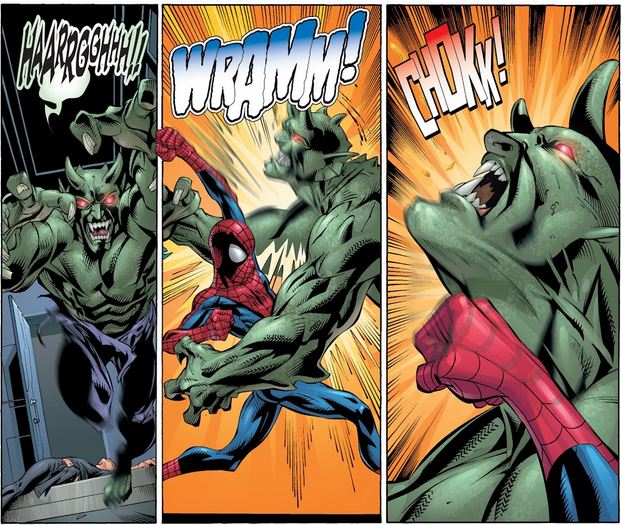
In the final two issues of the “Legacy” arc, writer Brian Michael Bendis takes a step back for a bit and lets Bagley and Thibert flex their action chops and draw a Spider-Man, who isn’t holding back one bit after Mary-Jane almost died. The speed lines come fast and furious as Spidey tries to beat the crap out of a physically stronger opponent in the Green Goblin and even makes the presumably jaded agents of SHIELD shudder a little bit. With the exception of some cluttered panels, Bendis, Bagley, Thibert, and the colorists at Digital Transparency Studios bring in Goblin’s drug addiction, Spider-Man’s fear and anger at his family being threatened, and SHIELD non-interference interference into play during several extended action sequences. The more Oz he takes, the dumber and stronger the Green Goblin gets. I’m more of a fan of the smarter, conniving Osborn a la Dark Reign so it’s refreshing to get dumb Goblin for only a few pages versus a couple issues in the first arc of Ultimate Spider-Man.
There is a real sense of danger in the battle between Spider-Man and the Green Goblin in Ultimate Spider-Man #26-27. For the most part, he’s substituted strategy for rage and emptying his web cartridges, and Bendis’ clipped, freaked out inner monologue plays off this feeling along with him losing his costume yet again. He’s had his share of victories, but Spidey is still kind of winging at a superhero. Trying to avoid bullets and Goblin fireballs, holding onto a building, and stopping civilians from being crushed by debris is tougher than it looks. This is why Bagley and Thibert draw Spider-Man constantly on edge trying to contort his body and stay one step ahead of the Green Goblin. He’s still just a kid.
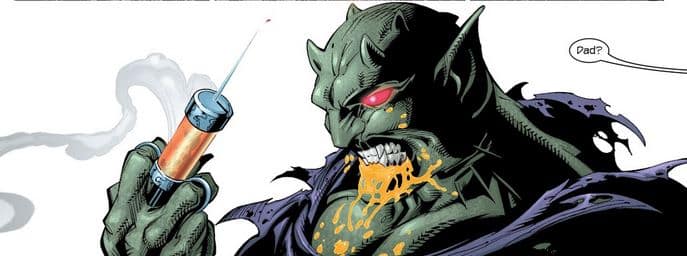
I wouldn’t say that the Green Goblin is scary per se in Ultimate Spider-Man #26-27, but Bagley leans on some horror influences and draws him super grotesquely. Throughout both issues and even when he’s verbal, the Green Goblin is always slobbering some disgusting green mixture that is either like an animal foaming at the mouth or an addict vomiting during an overdose. To be honest, it looks like the ooze that gave the Teenage Mutant Ninja Turtles their abilities, but Digital Transparency uses the most unappealing shade of green so that pizzas and underground lairs are the last thing on your mind. It complements his hellish red eyes and shows how inhuman Norman Osborn has become in his quest for power. Like a rabid dog, maybe it’s time for him to be put down.
Even though he doesn’t explicitly call Peter “son” like he did in Ultimate Spider-Man #25, the father/son dynamic between Norman and Peter and Harry plays a crucial role in the conclusion of the “Legacy” arc, and by extension, two years of Ultimate Spider-Man stories with long breaks for Kingpin and reality show contestants. However, Norman’s attention switches to Harry in Ultimate Spider-Man #26 and #27 when he accidentally sees him slavering and taking the Oz drugs. Unlike Spider-Man, who he wants to groom as an ally and possible heir apparent to his genetic mutation “throne”, Harry is just an afterthought. He’s an embarrassment to Norman, who wants him to know as little as possible about his real work. That ends in an intense six panel grid of Harry realizing what’s going on before Norman puts that hypnotherapy to work and uses a kind of killswitch to make him faint.
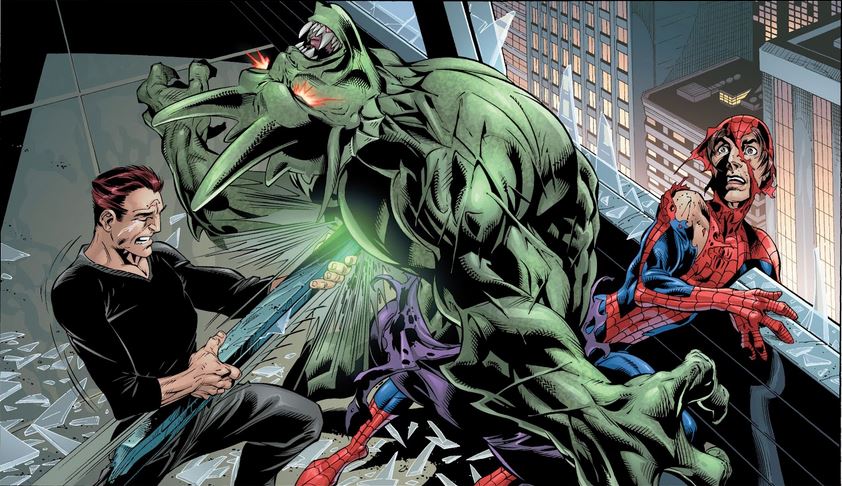
But Harry isn’t just an innocent victim, who gets saved by Spider-Man. He has been inducted into a world of superhumans and mutations that he has witnessed with his own, two, heavily medicated, yet still human eyes. And, in Ultimate Spider-Man #27, he actively joins the narrative when he kills the Green Goblin with a sharp piece of wood to stop his friend Peter from being crushed to death by his father. Bagley goes full epic with his art during this moment surrounding the page with reaction shots of Peter, SHIELD Agent Quartermain, and even the Goblin himself while Harry is the picture of remorse on his face. In this moment, he goes from being a side character with little or no agency to a double for Spider-Man. Peter Parker was partially responsible for the death of his father figure, Uncle Ben, and now Harry Osborn is solely responsible for his own father’s death because he wanted to save his friend and hero. Except he doesn’t get catharsis or any kind of , but gets shuffled off by SHIELD
SHIELD in Ultimate Spider-Man #26-27 reminds me of the military in Doctor Who. They are reactive, mostly ineffectual, and then bulldoze in and take all the credit for everything. At least, their leader looks like Samuel L. Jackson. The opening of Ultimate Spider-Man #26 shows that SHIELD almost got Mary Jane killed, and their job for most of the issue is to piss off the Green Goblin by constant helicopter gunship and sniper fire. It’s the tactical equivalent of using guns to fight the Hulk. SHIELD really only gets their act together after the Green Goblin has been taken down and proves that they’re basically a more expensive, less discreet version of Mike Ehrmentraut from Breaking Bad with plasma shields and anti-grav boots.
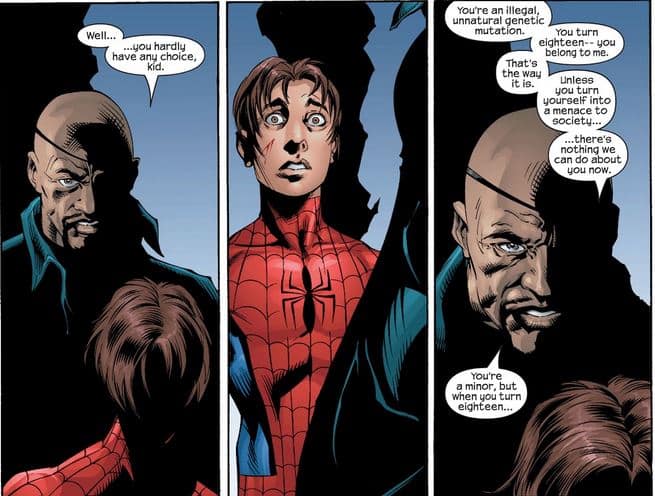
Nick Fury and SHIELD reach peak dickishness in Ultimate Spider-Man #27 when Fury drops the bomb that Peter Parker is government property once he’s of voting and cigarette smoking age. This makes sense with the whole Superhuman Test Ban mentioned in Ultimates, which considers him to be a WMD. And Bagley and Thibert draw Peter like only someone whose freedom is going to be taken away in a few years with his face a mix of sadness, anger, and the feeling that he wants to do to Nick Fury what he just did to the Green Goblin. This is yet another instance of the Parker luck as Spider-Man only has a limited time to be a friendly neighbor superhero before Fury puts him on a superhuman black ops team with the murderers Hawkeye and Black Widow and the incestuous, ex-terrorists Quicksilver and Scarlet Witch. At least, he makes one hell of an exit, swinging through a window, and scoffing at Fury’s “big boy’s club” aka superheroes, who do George W. Bush’s dirty work.

Instead of ending with a teaser for the next villain or an epic superhero battle, Brian Michael Bendis and Mark Bagley close out the “Legacy” arc with a character moment. Peter and Mary Jane’s relationship has hit some snags in this past arc, and Peter/Bendis finally let her speak and confront Peter for not telling her anything about Norman Osborn’s abilities and plans. When he told her his secret identity back in issue 13, Peter was supposed to be open about his life as Spider-Man and confide in her. But he has shut her out, and this didn’t make her safe, but put her in danger. And Peter is still pretty reticent to talk about what happened to Harry, and thus we get our final page of Peter and Mary Jane spaced apart and not speaking. It’s not a breakup, but Peter’s double life as Spider-Man has hurt their relationship. This issue is kind of like a sad version of Ultimate Spider-Man #13, which was when they grew closer in attraction and being honest about their feelings plus Peter’s life as Spider-Man.
Some of the panels in the action scenes are a little busy, but Brian Michael Bendis, Mark Bagley, and Art Thibert end the rematch between Spider-Man in a grotesque, slightly unexpected way that still riffs off the “father/son” theme they have building since Ultimate Spider-Man #1 and gives Ultimate Harry Osborn his big moment for better or worse. Plus there’s bonus satire of SHIELD and Mark Millar’s take on the Ultimate Universe in general, and Bendis and Bagley show the consequences of Peter Parker’s life as Spider-Man on his closest friend and lover, Mary Jane Watson and don’t hold back at all.
P.S.: “Back to School” is going on hiatus because I have returned to (graduate) school, but it will return…
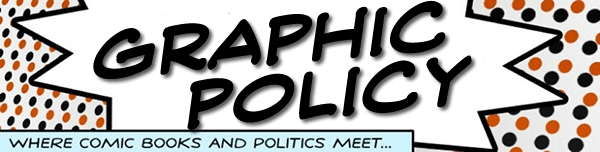
 “The final battle for life itself has arrived! As Babel makes its last assault on the heavenly realm beyond the Deadside, a band of Earth’s most dangerous heroes – Ninjak, Shadowman, Punk Mambo, and Tama the Geomancer – must halt its eons-old campaign once and for all…or face a global disaster of biblical proportions! Plus, at the center of it all: The undiscovered truth about Shadowman that will change the Valiant Universe forever!”
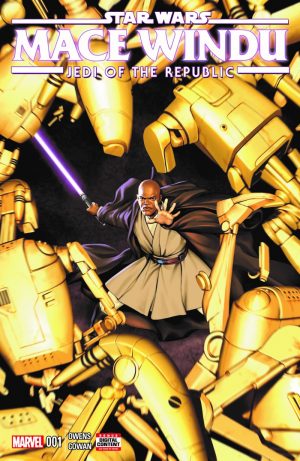 As a Star Wars fan who grew up in the Prequel Era, the purple lightsaber wielding Jedi as played by Samuel L. Jackson, Mace Windu, has always been one of my favorite characters. He gets his own solo miniseries in Star Wars: Jedi of the Republic – Mace Windu #1, and Matt Owens’ comic isn’t a breakaway hit with a generic mission to a Separatist planet called Hissrich with a small band of Jedi yadda yadda. The planet is supposed to have a hostile natural environment, but the only threats so far are a platoon of battle droids and sort of intriguing, sort of underwhelming Big Bad. His writing for the characters themselves isn’t bad with the usual confident Master Windu doubting himself after so many Jedi lost their lives at the Geonosis, and Ki-Adi-Mundi and Yoda providing supporting in the early council scenes. He’s not bad at banter either with the blind, mostly pacifist Prosset providing some dry one-liners as comic relief to go with his ass kicking.
 Faith Herbert and Neela Sethi, Timewalker’s first attempt at saving time from being unwritten has failed…which means it’s time to rewind the clocks and start all over again! But this time, Faith is taking a new approach with a whole new team of heroes to help save the day! But will these new recruits be the key to saving all of time from a calculating A.I. foe, or is history doomed to repeat itself with a failure of incalculable proportions?
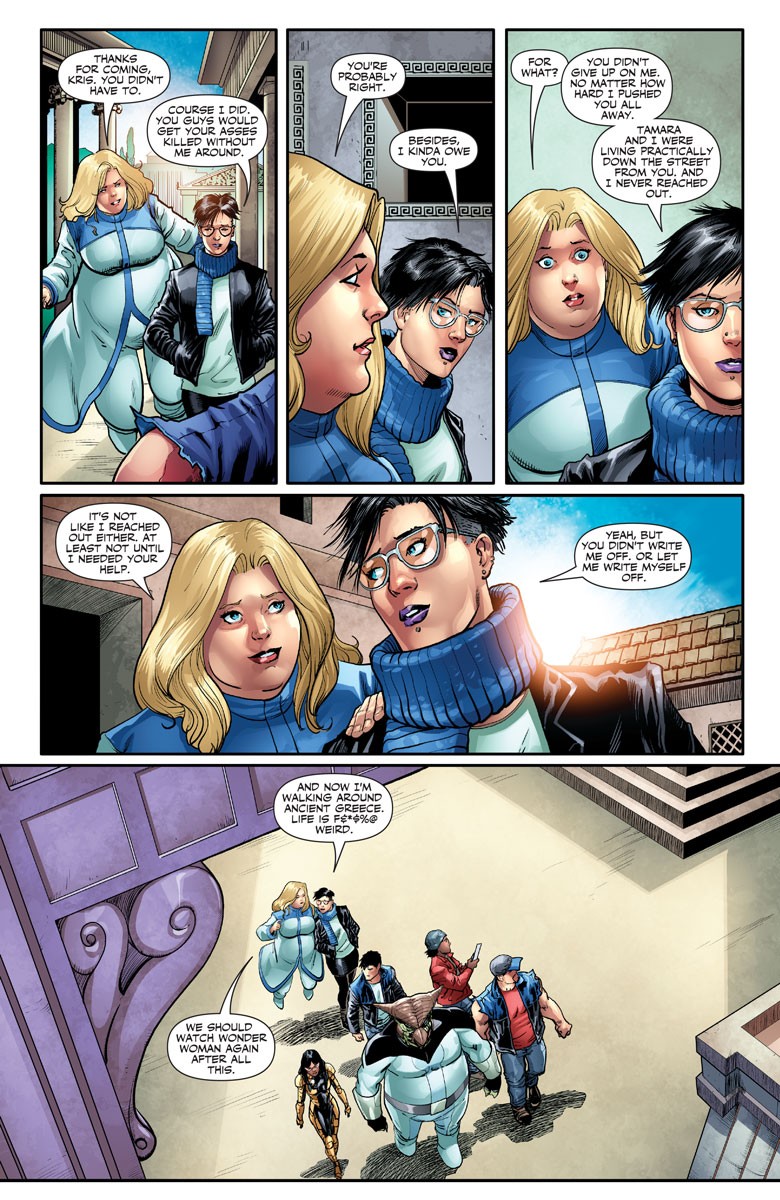 As far as time travel style comics go, this is an enjoyable diversion from your daily life for however long it takes you to read it, whether that’s ten or fifteen minutes… Faith and the Future Force #2 carries on from the previous issue in all the right ways. Faith is still the embodiment of every comic fan and nerd in how she reacts to the world around her, and the introduction of the Renegades only brings more great little moments to the fore.
 Can there be any redemption for Captain America as the Secret Empire starts to crumble?
 Batman and Harley Quinn finds Poison Ivy and Jason Woodrue (a.k.a. The Floronic Man) embarking on an ecological quest to save the planet – and, unfortunately, eliminate most of humankind along the way. To save humanity, Batman and Nightwing are forced to enlist Harley Quinn to catch Poison Ivy, Harley’s BFF and frequent partner-in-crime. But Batman’s patience is put to the test by the unpredictable and untrustworthy Harley during the twists and turns the reluctant companions face during their bumpy road trip.
 There’s a scene where Harley may or may not rape Nightwing (I guess he consented?), winks and nods to vibrators, a few jokes about Batman and Nightwing being physically into each other, and a hell lot more and the humor and talk within left my jaw agape at times as to what was presented. A scene involving Harley hot boxing the Batmobile to force a bathroom stop is rather puerile humor. Now, I know BTAS wasn’t always for the kids but a lot of this movie is clearly not… like it feels about half. It’s weird in that sense like the creators were aiming for a grown up audience but at the same time didn’t totally commit and threw a little in for kids.
 The voice cast led by Kevin Conroy (Batman: The Animated Series) reprising his role as the Dark Knight, alongside Melissa Rauch (The Big Bang Theory) making her debut as the irrepressible Harley Quinn. Loren Lester, the voice of Robin in Batman: The Animated Series, returns as Nightwing. Paget Brewster (Criminal Minds) and Kevin Michael Richardson (The Cleveland Show) provide the voices of the villainous duo Poison Ivy & Jason Woodrue, respectively.


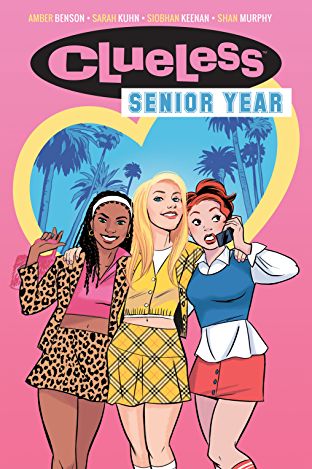 22 years after the fantastic teen comedy that forever changed American slang and one of the best Jane Austen adaptations period was released, writer Amber Benson and Sarah Kuhn, artist Siobhan Keenan, and colorist Shan Murphy return to the world of Amy Heckerling’s Clueless in the Senior Year graphic novel. The book kicks off with Cher having a huge existential crisis thanks to a yearlong class assignment about who she wants to be during her senior year. She tries on a bunch of different outfits (Including one possibly inspired by Alicia Silverstone’s current career as a tree hugger.) and personalities and is out of commission as a queen bee for most of the story.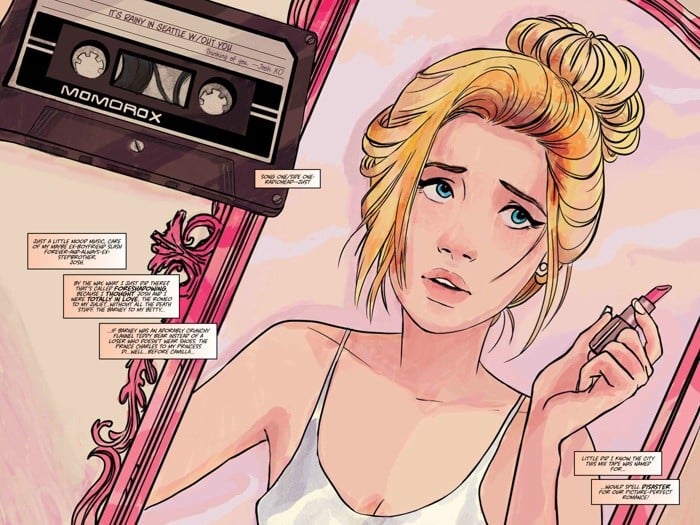

 As long as I can remember, the world has been obsessed with games and game systems. I remember having one of the few Colecovisions on my block and everyone watching over my shoulder as I played Donkey Kong. Eventually Atari, became the next rage of game systems, and even more games came out. Few years later, Atari went away, and Sega and Nintendo became the systems that dominated every household in America.