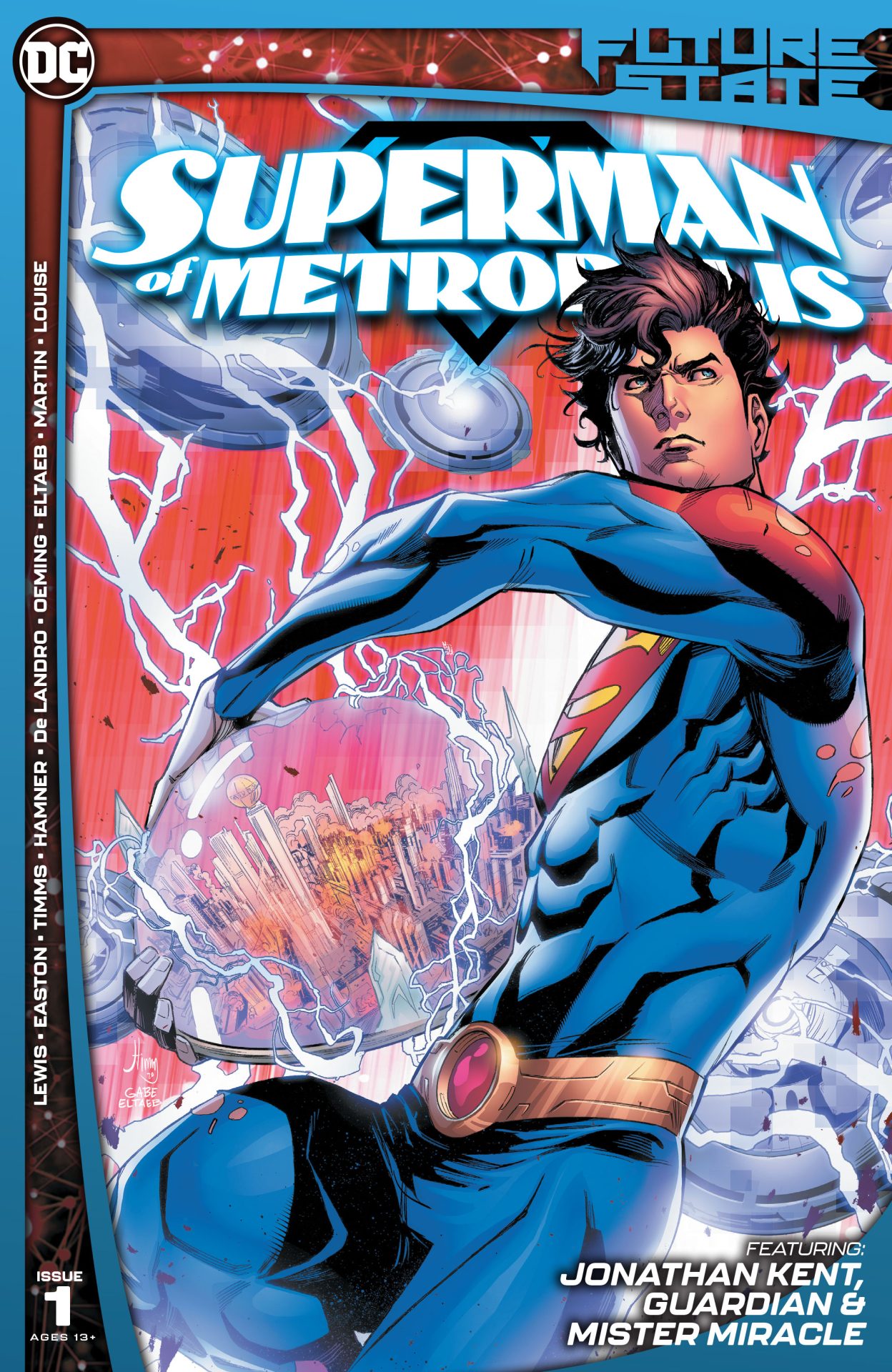
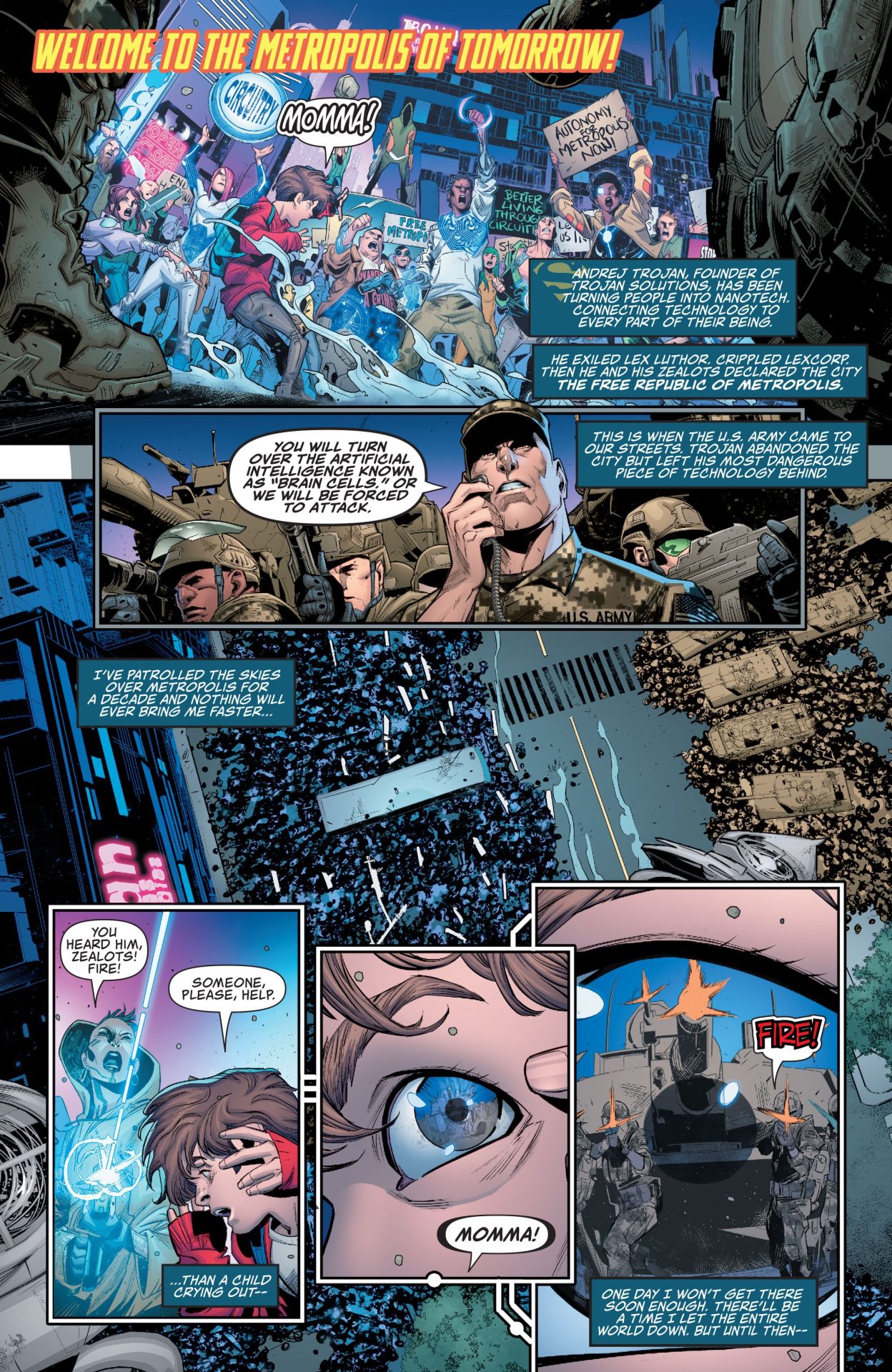
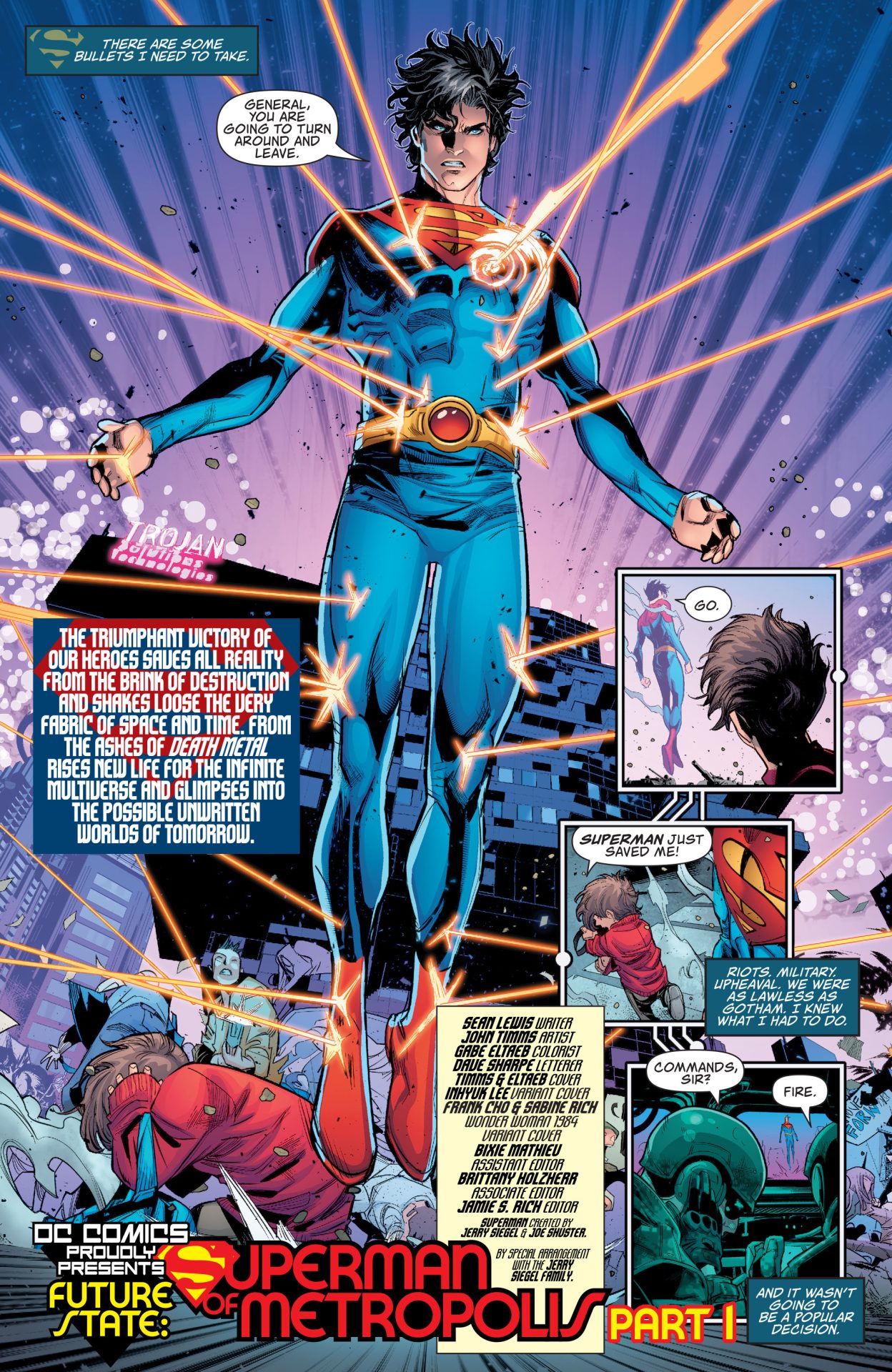
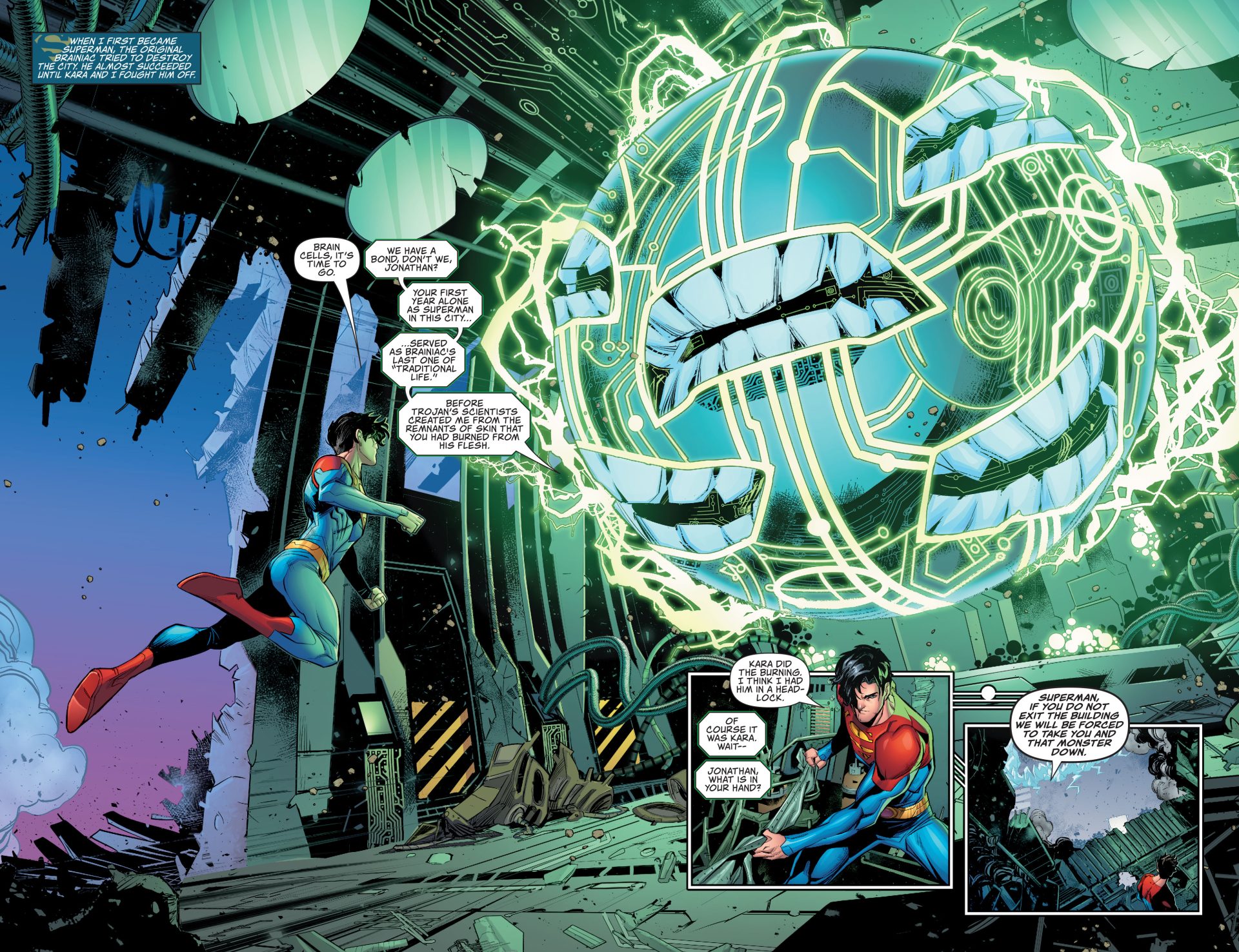
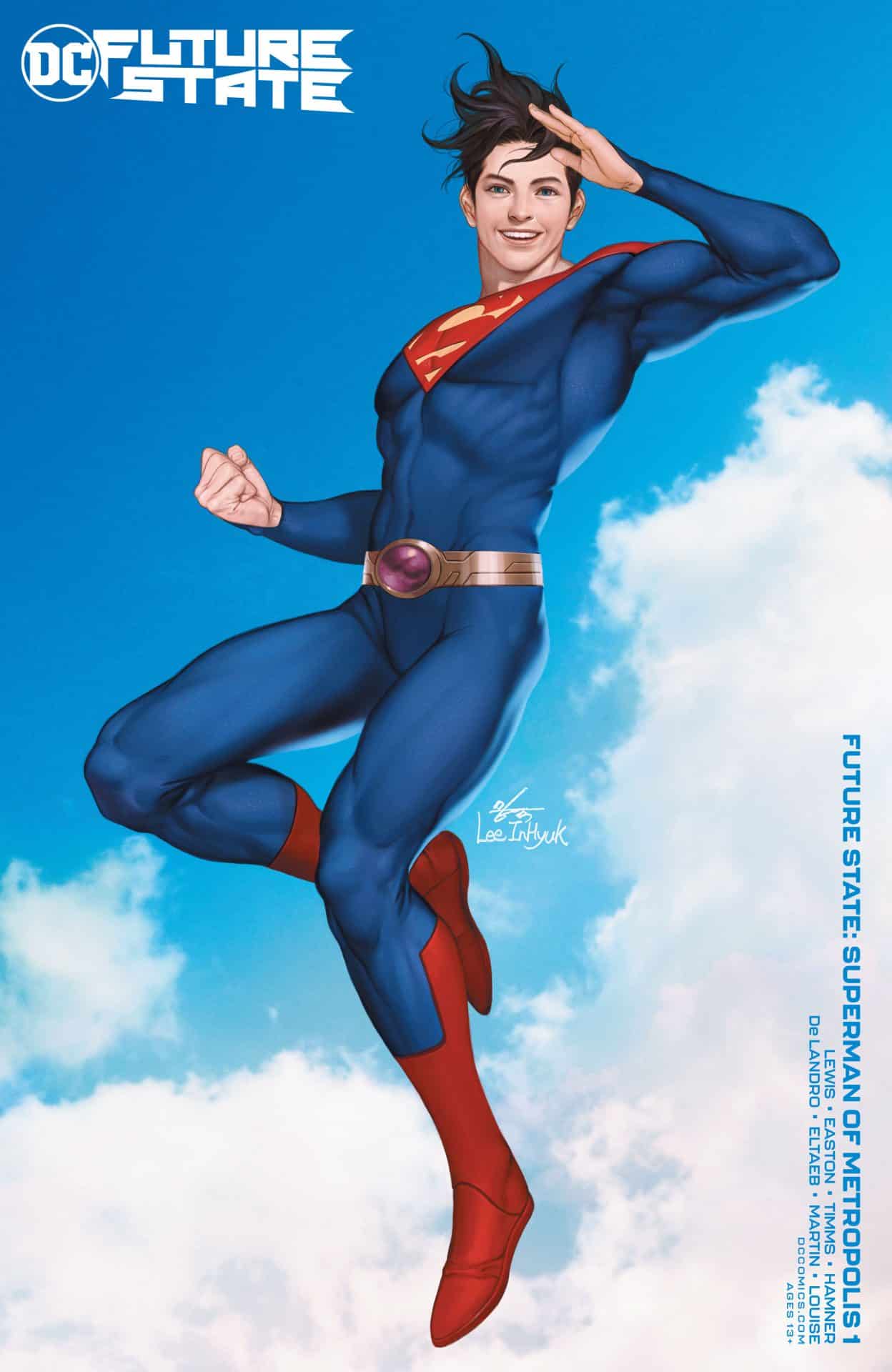
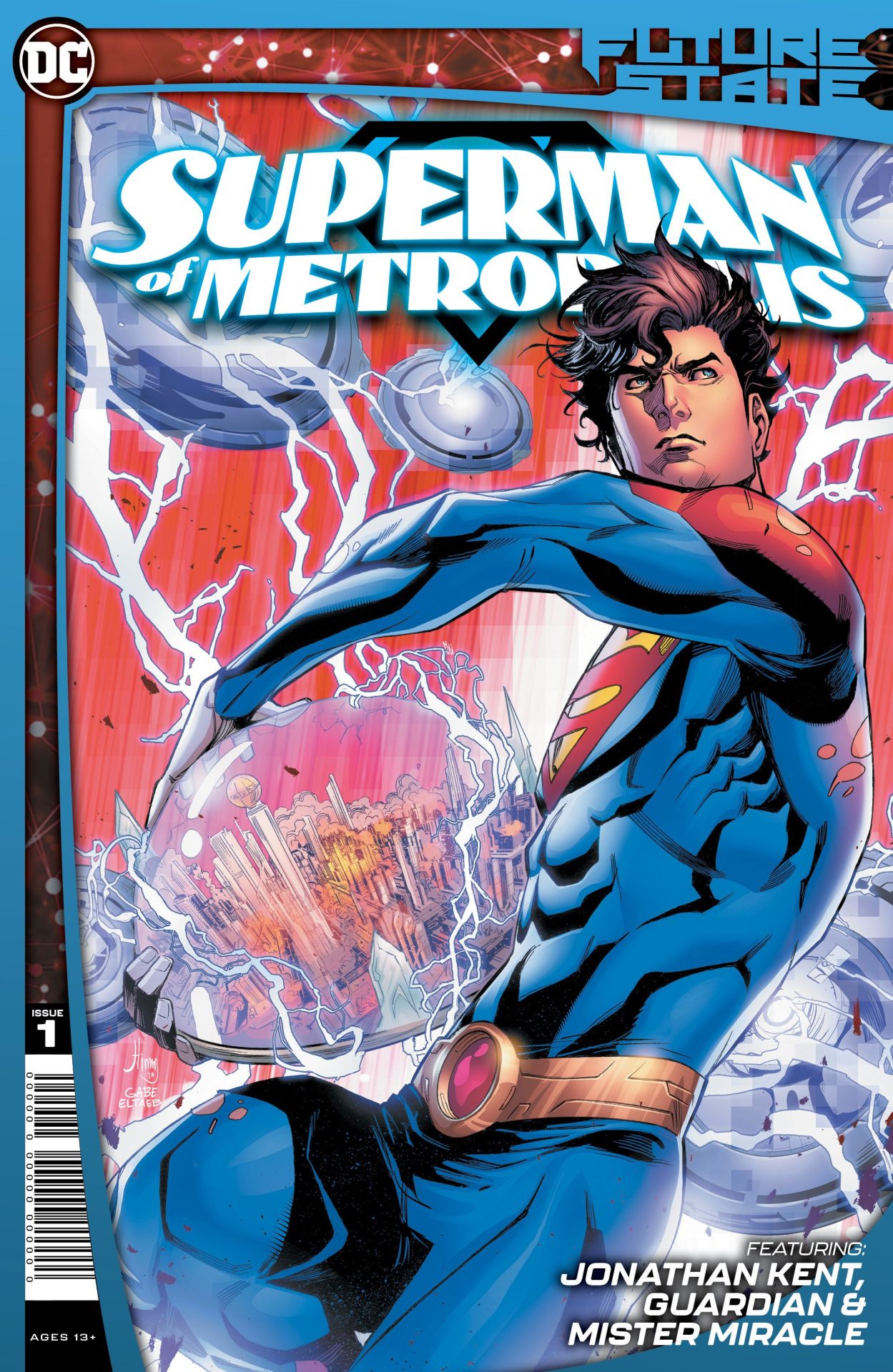
One of the extended “Future State” issues, Future State: Superman of Metropolis #1 takes us to a future Metropolis protected by a new Superman, Jonathan Kent. His father is off somewhere (we’ll get that in another story) and it’s up to Jon to fill in the gap. Joining him is Supergirl who spends the issue mostly as an obstacle for this new Superman to battle.
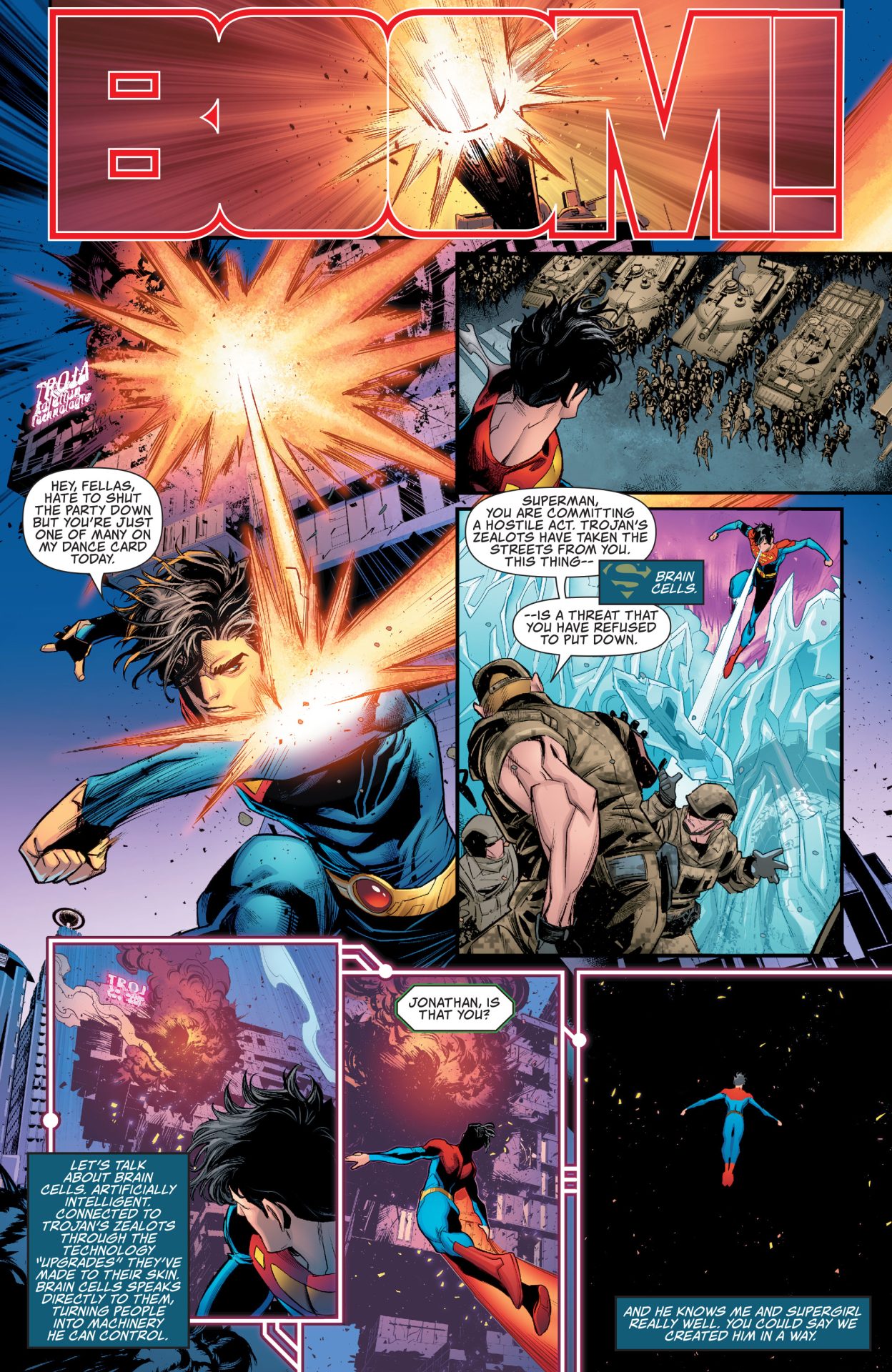
In this Metropolis a tech company has low-jacked individuals with technology built from Brainiac. In the story, the villain, Brain Cells, are using the people for something leaving Jonathan to make a difficult decision to save the city and its people and attempt to not escalate things further. Which of course escalates things.
Writer Sean Lewis gives us a nice take on the character and world putting Jonathan in a difficult situation. The idea of a fairly new hero who’s not getting it right is a good spin to it all. It’s a hero who makes mistakes and whose decisions might have good intentions but the process to get there isn’t the best. It’s a hero who isn’t quite trusted, a rookie who makes mistakes. This is a Superman who has powers and fumbles something can ponder what would likely happen if any of us were to gain similar powers with similar responsibilites. It’s easier to relate to the character in this way.
The art by John Timms with color by Gabe Eltaeb, and lettering by Dave Sharpe is fantastic. The designs are really interesting though at times it takes a bit to make out exactly what everything is. There is a dynamic aspect to it all though and the battles and confrontations are full of excitement and tension. Sharpe’s lettering especially stands out with his take on Brain Cells’ unique world balloons. It’s a small detail that adds so much to the character.
The issue features so much more…
“The Metropolis Menagerie” is written by Brandon Easton with art by Valentine de Landro, colors by Marissa Louise, and lettering by Sharpe. Shilo Norman is Mister Miracle in a fairly straightforward tale of a hero battling against odds and their powered suit failing. There’s something rather interesting and charming about it all. There’s a pulp sense about it all with the concept feeling like it’s something out of the era of Flash Gordon.
“The Guardian in Future State” is also written by Lewis with art by Cully Hamner and Michael Avon Oeming, color by Laura Martin, and lettering by AndWorld Design. We get to see a bit of a different aspect to the main story. The story focuses on The Guardian and some of the impact of Jonathan/Superman’s decision. It’s an interesting idea of having a shorter story that ties into the main one but I wish it was a bit clearer this was the case and maybe have taken a slightly different aspect with it all. I’m trying to not spoil it but showing more of the impact of Jonathan’s decision or the moments after would have possibly made for a more engaging story. The use of Hamner and Oeming is also a noticeable shift as the two style don’t quite match enough creating a jarring experience for the reader.
Future State: Superman of Metropolis #1 is a decent read but doesn’t quite have the excitement I was hoping for. As an arc for an ongoing series, it’d all be very interesting but as a two issue story it feels like we’re dropped into something well underway.
Story: Sean Lewis, Brandon Easton Art: John Timms, Valentine de Landro, Cully Hamner, Michael Avon Oeming Color: Gabe Eltaeb, Marissa Louise, Laura Martin Letter: Dave Sharpe, AndWorld Design Story: 7.0 Art: 7.95 Overall: 7.0 Recommendation: Read
DC Comics provided Graphic Policy with a FREE copy for review
Written by: Brandon Easton, Sean Lewis Art by: Valentine De Landro, Cully Hamner, John Timms, Michael Avon Oeming
Before leaving for parts unknown, Clark Kent entrusted Earth’s safety to his son. Now, Jonathan Kent is Superman! Top priority for this new Superman: to protect Metropolis. When a new version of Brainiac attacks, Jon takes drastic measures-which result in the Bottle City of Metropolis! But watch out, Jon, because Supergirl is on her way, and she is not happy with your decision. Meanwhile, in the new bottle city, a new hero has risen. Jake Jordan, the former Manhattan Guardian, came to the City of Tomorrow to start over. But he’s not the only one who wants a new beginning. An anarchist calling herself Honest Mary sees this time of trouble as an opportunity for rebirth-and she’ll tear down the entire city to prove her point. Does Jake have what it takes to save his new home from disasters both inside and out of the bottle? Superman’s former pal Jimmy Olsen is going to make sure he does! Finally, the current Mister Miracle, Shilo Norman, is also in the bottle, and he’s looking for a way out! He’d better be careful, though, or he may end up someplace unexpected. It’s a story that continues in Superman: Worlds of War #1!
Writer Phillip Kennedy Johnson flies from DC’s Future State event in January and February back to the present DCU in March to join artists Phil Hester and Eric Gapstur for a two-part story that spans both Supermanand Action Comics!
In “The Golden Age” part one on March 9 (Superman #29), Jonathan Kent is back from the 31st Century and fighting cosmic threats alongside his legendary father. But when an interdimensional breach opens near Earth, Jon recognizes the creatures that emerge: the cosmic leviathans that the Legion of Superheroes credit with the DEATH OF SUPERMAN!
And in the new backup series “Tales of Metropolis” story in the same issue, writer Sean Lewis and artist Sami Basri follow Jimmy Olsen on a quest to meet of some of the city’s more colorful denizens, beginning with Bibbo Bibbowski!
Then in “The Golden Age” part two on March 24 (Action Comics #1029), as Superboy desperately tries to save Superman’s life from the leviathans of the Breach, Superman discovers the Breach’s shocking origins. But with his powers mysteriously fading, he is utterly outmatched. Can Superboy change the course of history and save his father’s life? Don’t miss this prelude to DC’s MASSIVE Superman event!
Plus, in another all-new backup “Tale of Metropolis” story, writers Becky Cloonan and Michael W. Conrad join forces with Michael Avon Oeming to continue the Midnighter story that Cloonan and Conrad started in DC Future State. But is the DC Universe ready for Trojan Industries?
In the months following “The Golden Age” two-part crossover, Phillip Kennedy Johnson will continue writing both Superman and Action Comics with artists Scott Godlewski (on Superman) and Daniel Sampere (on Action Comics) before reuniting with Future State: Superman: Worlds of War co-creator Mikel Janín on a special Superman project—still to be announced!
DC Comics is kicking off 2021 with a look into the future with DC Future State. The rumored line-wide event has been revealed today. It kicks off in January 2021 and goes through 2021. DC Future State features a combination of monthly and twice-monthly oversize anthologies, as we well as a miniseries and one-shots,
DC Future State spotlights the World’s Greatest Super Heroes in fresh new roles, with all-new characters taking up their iconic mantles. DC Future State features an incredible array of creative talent, combining award-winning writers and artists with new voices from the worlds of TV, movies, and animation. In March 2021, the regular DC title lineup resumes, continuing existing storylines from 2020 and introducing new arcs for the year.
In DC Future State, the Multiverse has been saved from the brink of destruction, but the triumph of DC’s heroes has shaken loose the very fabric of time and space! The final chapter of Dark Nights: Death Metal (on sale January 5, 2021) brings new life to DC’s Multiverse, kicking off this glimpse into the unwritten worlds of DC’s future!
A stellar array of writers and artists are on hand to deliver this unique look at beloved DC characters, including fan favorites such as Mariko Tamaki, Brian Michael Bendis, Gene Luen Yang, Joëlle Jones, Joshua Williamson, Nicola Scott, Cully Hamner, and John Timms, along with new voices such as award-winning screenwriter John Ridley (12 Years A Slave), Brandon Vietti (Young Justice), Meghan Fitzmartin (Supernatural, DC Super Hero Girls), Brandon Easton (Thundercats, Transformers: War for Cybertron), Alitha Martinez (REPRESENT! It’s A Bird!), L.L. McKinney (Nubia: Real One), Paula Sevenbergen (Stargirl), and Siya Oum (Lola XOXO), among others.
Check out below to see what the future beholds!
Batman Family
In this future, Gotham City is controlled by the Magistrate. This villainous regime has taken control of the city, now under constant surveillance. All masked vigilantes have been outlawed and Batman has been killed. But led by an all-new Batman, a new assembly of Gotham’s guardians rise to give hope to all of those who lost it!
Oversized Comics:
Future State: The Next Batman #1-4
The Next Batman, by John Ridley, Nick Derington and Laura Braga
Outsiders, by Brandon Thomas and Sumit Kumar
Arkham Knights, by Paul Jenkins and Jack Herbert
Batgirls, by Vita Ayala and Aneke
Gotham City Sirens, by Paula Sevenbergen and Emanuela Lupacchino
Future State: Dark Detective #1-4
Dark Detective, by Mariko Tamaki and Dan Mora
Grifters, by Matthew Rosenberg and Carmine di Giandomenico
Red Hood, by Joshua Williamson and Giannis Milonogiannis
Monthly Miniseries:
Future State: Batman/Superman, by Gene Luen Yang and Ben Oliver
Future State: Catwoman, by Ram V and Otto Schmidt
Future State: Harley Quinn, by Stephanie Phillips and Simone Di Meo
Future State: Nightwing, by Andrew Constant and Nicola Scott
Future State: Robin Eternal, by Meghan Fitzmartin and Eddy Barrows
Superman Family
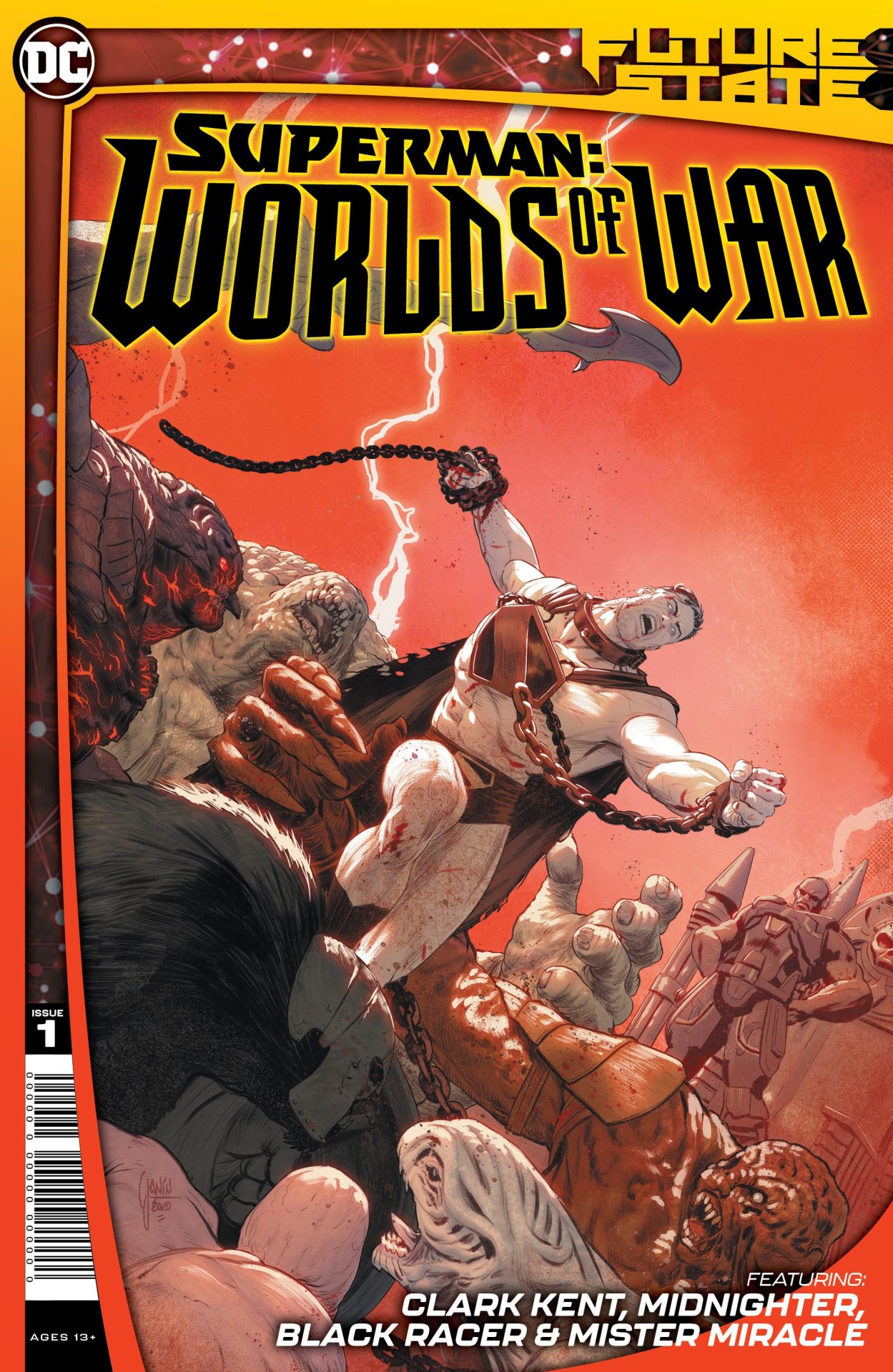
Due to his involvement in an international crisis happening in the near future, Clark Kent has been rejected by Earth, causing him to focus his lifesaving efforts outside his adopted home. He travels to Warworld to rise through the ranks of gladiatorial combat in order to defeat Mongul with the help of some unlikely heroes. Back in Metropolis, Clark’s son Jon has taken on the mantle of Superman. After seeing the horrors that befell Gotham, he bottles Metropolis in order to keep it safe, putting him at odds with Supergirl.
Connecting the two oversized Future State: Superman titles, Shilo Norman, the man known as Mister Miracle, finds himself caught between the city he grew up in and the battle-torn planet that could be his downfall.
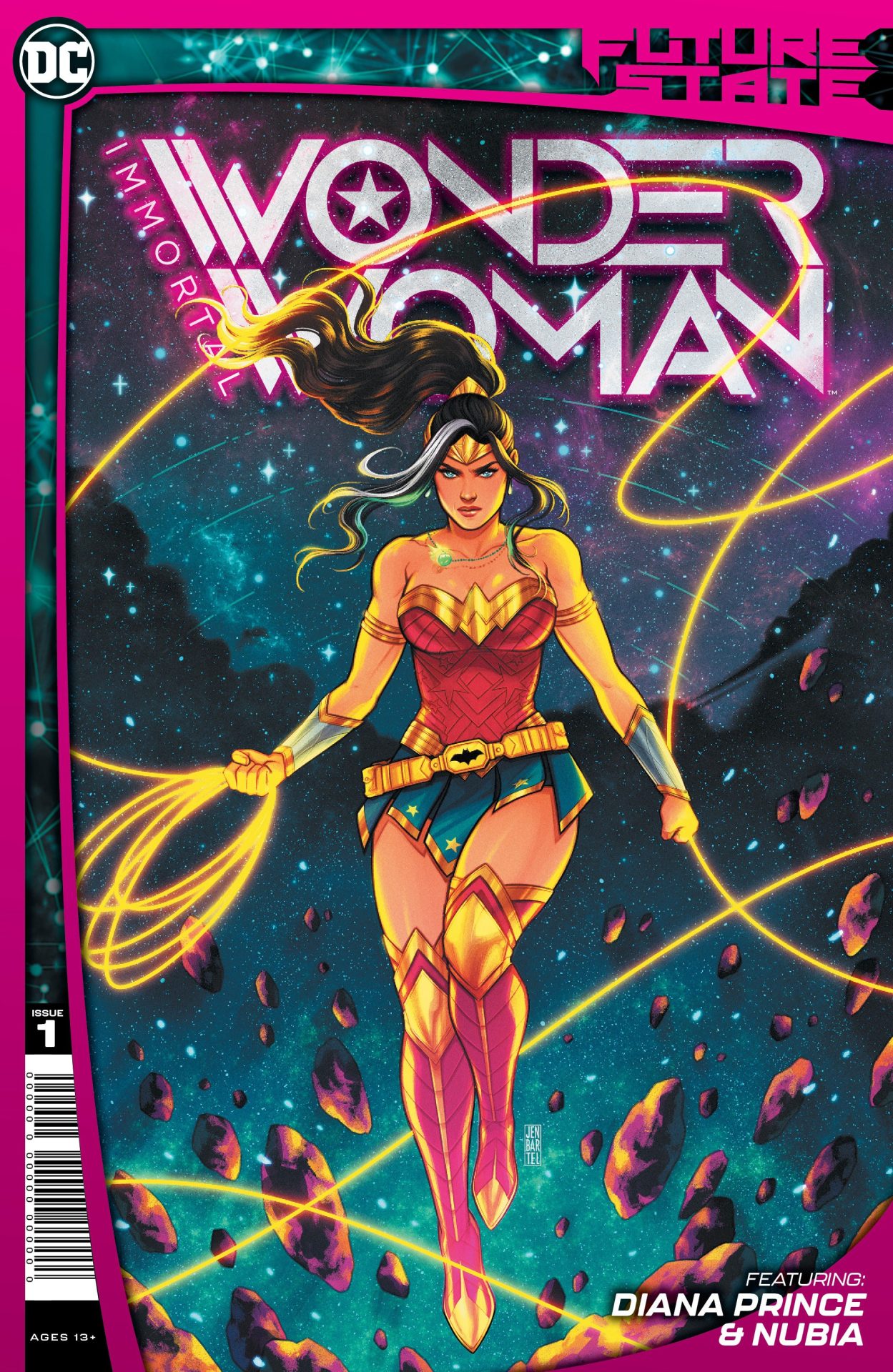
Meanwhile in the Amazon rainforest, Yara Flor is chosen to be the new Wonder Woman. Years later, the new Superman and Wonder Woman join forces to save their cities in a new superhero team-up the likes of which the world has never seen.
Oversized Comics:
Future State: Superman of Metropolis #1-2
Superman of Metropolis, by Sean Lewis and John Timms
The Guardian, by Sean Lewis and Cully Hamner
Mister Miracle, by Brandon Easton and Valentine De Landro
Future State: Superman: Worlds of War #1-4
Superman: Worlds of War, by Phillip Kennedy Johnson and Mikel Janin
Midnighter, by Becky Cloonan, Michael W. Conrad and Gleb Melnikov
Black Racer, by Jeremy Adams and Siya Oum
Mister Miracle, by Brandon Easton and Valentine De Landro
Future State: Immortal Wonder Woman #1-2
Immortal Wonder Woman, by Becky Cloonan, Michael W. Conrad and Jen Bartel
Nubia, by L.L. McKinney, Alitha E. Martinez and Mark Morales
Monthly Miniseries and One-Shots
Future State: House of El, by Phillip Kennedy Johnson and Scott Godlewski (one-shot on sale February)
Future State: Kara Zor-El, Superwoman, by Marguerite Bennett and Marguerite Sauvage
Future State: Legion of Super-Heroes, by Brian Michael Bendis and Riley Rossmo
Future State: Superman/Wonder Woman, by Dan Watters and Leila del Duca
Future State: Superman vs. Imperious Lex, by Mark Russell and Steve Pugh (3-issue series ending March 2021)
Future State: Wonder Woman, by Joëlle Jones
Justice League Family
A thread of great change runs through the Justice League heroes: a new League is built upon secret identities (even from each other), but an old and evolved enemy will use these secrets to try and overthrow the world. For the supernatural heroes of Justice League Dark, the very fabric of reality has shifted, and heroes are being hunted.
For Flash, Shazam, and the Teen Titans, it all begins when the four Riders of the Apocalypse unleash hell in a battle at Titans Academy, Barry Allen is cut off from the Speed Force, a Famine-controlled Wally West may be beyond saving, and Billy Batson makes a deal with the devil that will change Shazam forever. Off-world, John Stewart and the remaining Green Lanterns are stranded in the shadow of a dead power battery; Jackson Hyde and Andy Curry are separated across the galaxy; and Amanda Waller executes her ultimate plan with a new but terrifyingly familiar Suicide Squad on Earth-3.
At the end of time, Swamp Thing reveals its true intention, ruling supreme until a remnant of humanity launches a rebellion, and Black Adam looks to the past as the only way to save the future of the Multiverse.
Oversized Comics:
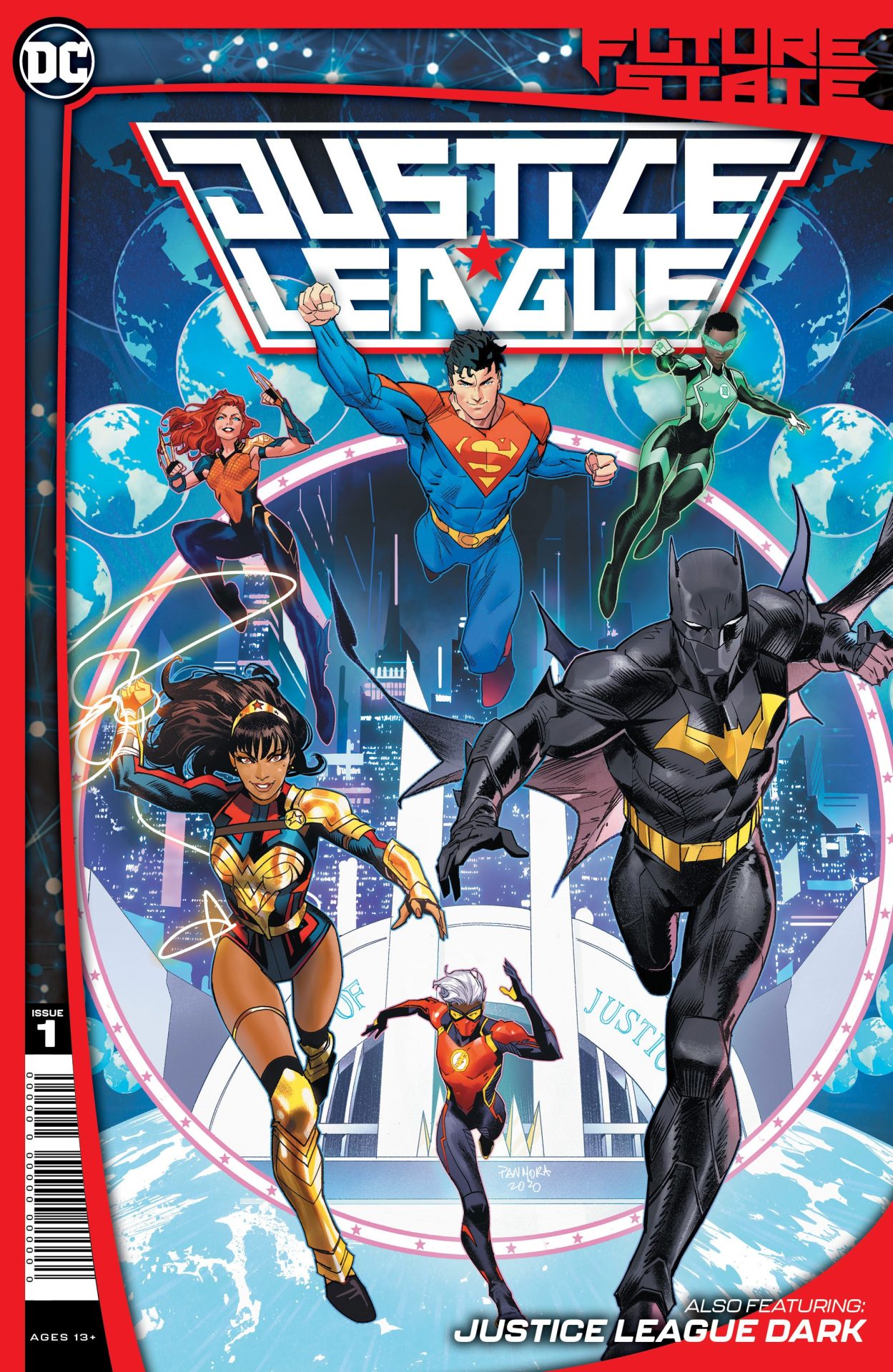
Future State: Justice League #1-2
Justice League, by Joshua Williamson and Robson Rocha
Justice League Dark, by Ram V and Marcio Takara
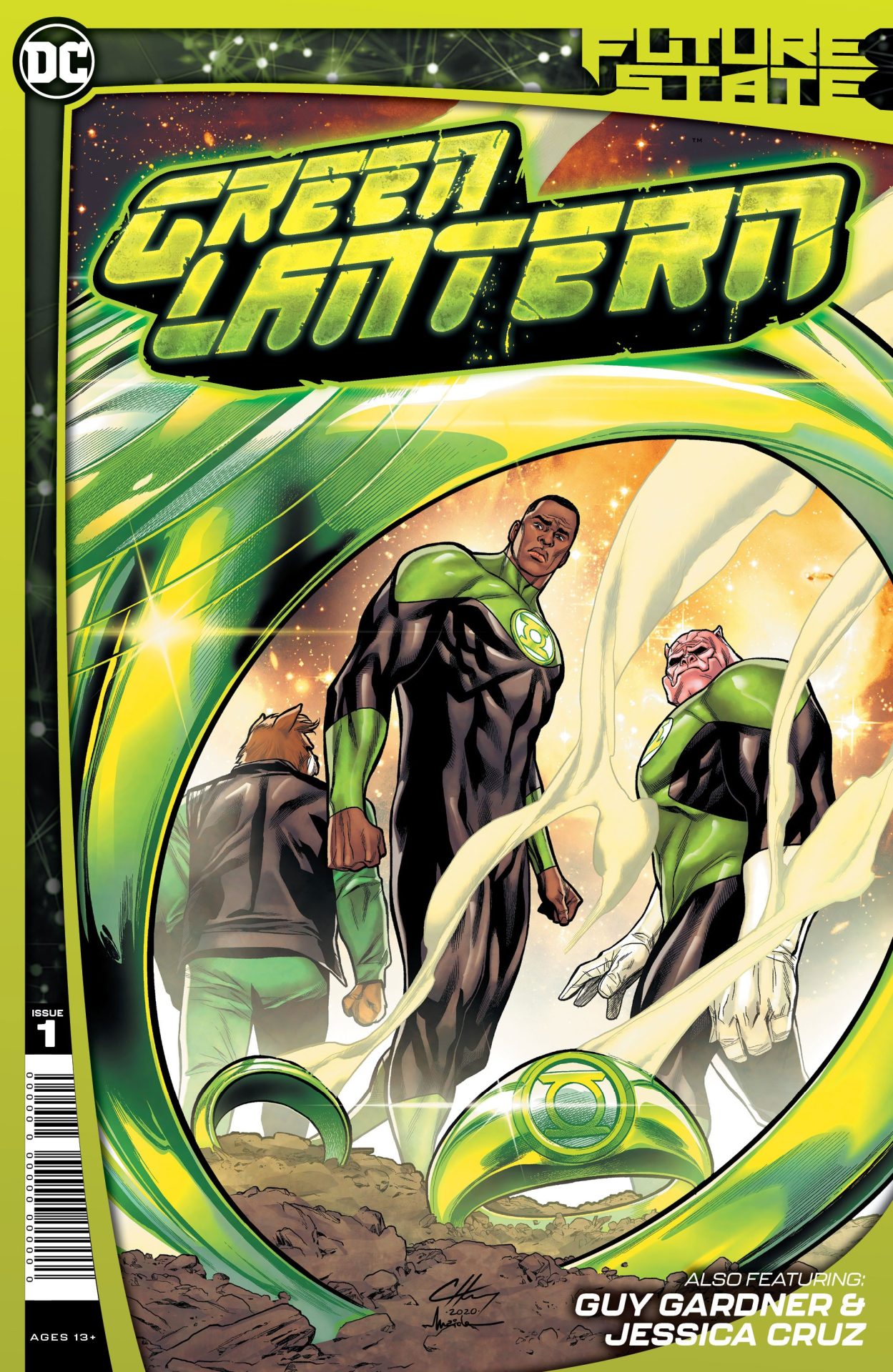
Future State: Green Lantern #1-2
Last Lanterns, by Geoffrey Thorne and Tom Raney
Tales of the Green Lantern Corps, by Josie Campbell, Ryan Cady and Ernie Altbacker, with Sami Basri and Clayton Henry
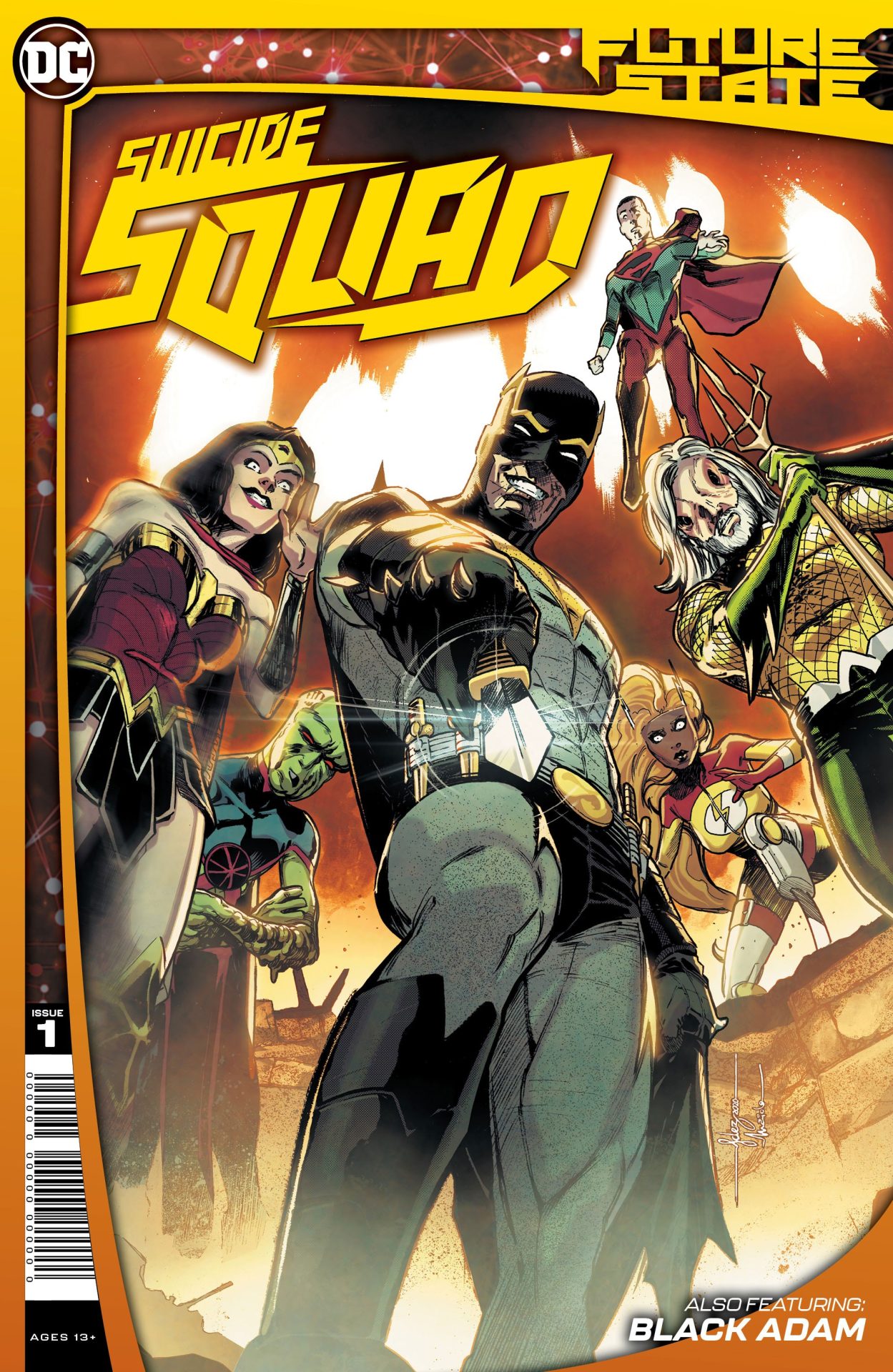
Future State: Suicide Squad #1-2
Suicide Squad, by Robbie Thompson and Javi Fernandez
Black Adam, by Jeremy Adams and Fernando Pasarin
Monthly Miniseries:
Future State: Aquaman, by Brandon Thomas and Daniel Sampere
Future State: The Flash, by Brandon Vietti and Dale Eaglesham
Future State: Teen Titans, by Tim Sheridan and Rafa Sandoval
Future State: SHAZAM!, by Tim Sheridan and Eduardo Pansica
Future State: Swamp Thing, by Ram V and Mike Perkins
So, Bliss #1 acted as an introductory issue. You met the main characters, you got to know the setting of Feral City, and that Lethe, Greek Goddess of Oblivion, plays a huge role. Although, issue one mostly focused on the villain hero, Benton O’Hara, and his backstory. Our narrator is his son, Perry, desperately urging a courtroom full of people who, rightfully, want Benton dead for murdering their loved ones. The central theme of Bliss is Forgiveness, and I felt that was a hard sell given both the lack of information and heavily biased viewpoint. I concluded my review on a positive hope, expressing hope that future issues would complicated both whether Benton deserves forgiveness and the Lethe mythos which were only slightly mentioned.
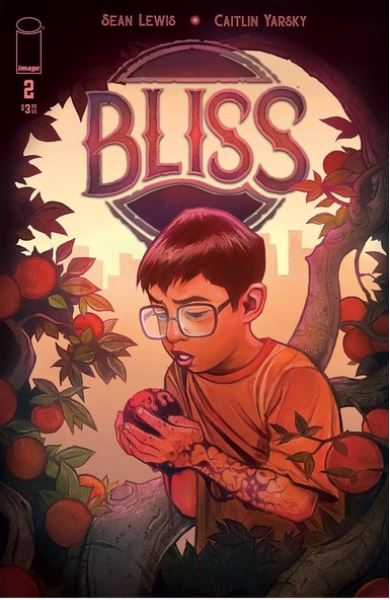
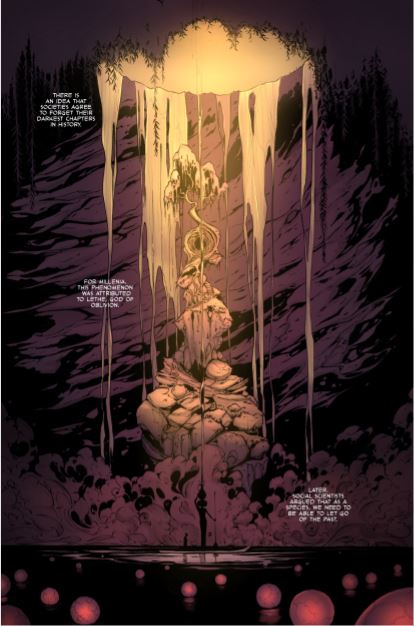
I’m happy to report thatBliss#2 does succeed, mostly, on the former while dropping more hints on the latter. First though, let me talk about Caitlin Yarsky’s art. If you read my previous review, it should come as no surprise how excellent it is. The trademarks are all on display: A detailed gothic aesthetic, fluid motion, unique character designs, invocative body language and facial expression, and ornamented panel layouts that effortlessly decompress the narrative. I think all of Yarsky’s best qualities can be summarized by the very first page.
Just marvel at how the oasis is both extremely detailed, yet maintains organic fluidity. The color choice invokes a deep supernatural feeling, its radiancy both alluring and intimidating. The silhouetted figures below are placed in a way where they aren’t overlooked, yet still show just how massive this structure is. This image alone should convince you of the overall quality of the art.
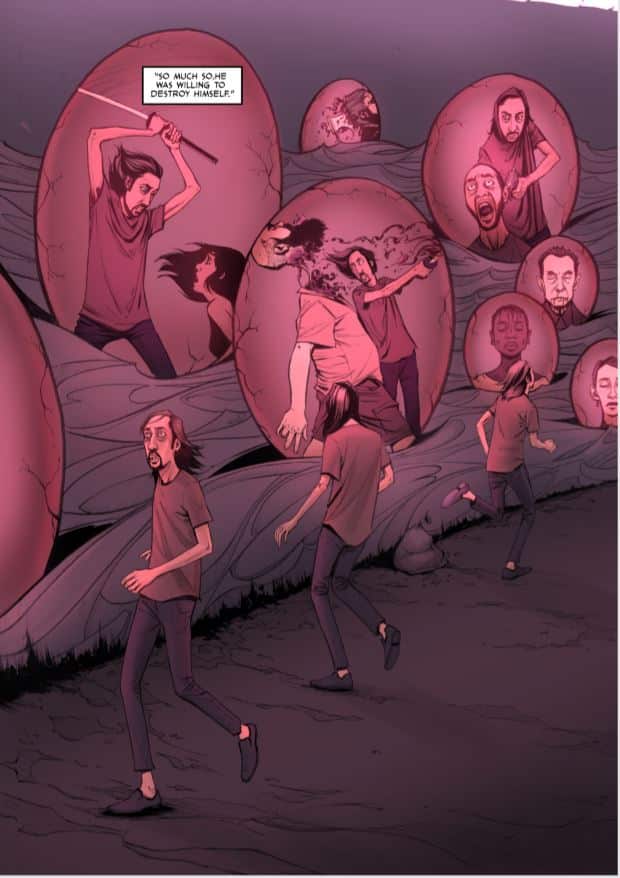
Even with the familiar hallmarks, Yarsky still manages a few new surprises in her bag of tricks. In one scene, for example, Benton is waking through a tunnel and starts having visions. They start sweet and idyllic, him and his family together, happy. This is Benton’s guiding light, a reminder of the greater good he’s sacrificing his humanity for; a point made more explicit by Perry’s narration. But the visions soon turn dark. They become memories of all the people Benton’s killed. No matter how far he runs, every monstrous act he’s committed follows him. The nightmare doesn’t stop until he drinks more Bliss.
Interestingly, these memories are presented as emerging from eggs similar in color to the orbs from issue #1, and just as grotesque. I’m not sure what the shape of an egg is supposed to symbolize, but it sure does look cool and shows without telling that Benton is haunted by guilt. This also suggests that, perhaps, the effects of Bliis are not permanent. In the story, Bliss is supposed to be a drug that wipes away dark memories. The three reptilian humanods whom serve Lethe utilize this drug for witnesses or, in Benton’s case, to keep his mind at ease. It’s how they keep Feral City under their control. Ignorance is bliss, right? Or maybe not so much.
It’s a nice way of visual world-building strong enough to imply without spelling it out. Clearly, the storytellers trust the reader to come to their own intrepretations. It’s now a matter of keeping an eye on how this develops, whether or not it has bigger implications later down the road.
The images of this scene are so strong, they are enough to communicate to the reader how Benton feels guilty. This doesn’t make Perry’s narration unnecessary though. What better way to argue that his father wasn’t a heartless? It’s certainly significant to the main theme of Forgiveness, but I’ll save that discussion for later.
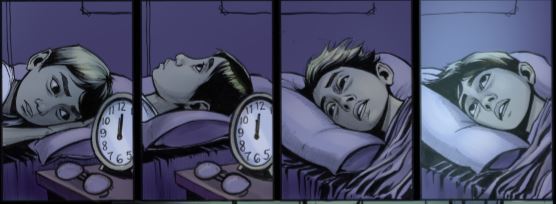
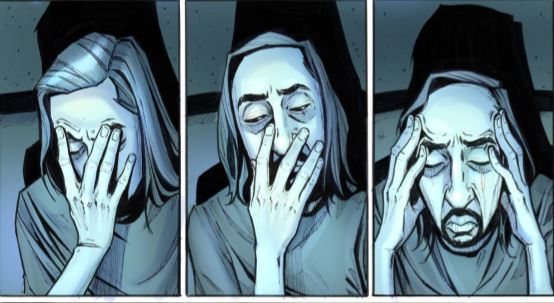
Another neat trick that Yarsky pulls, one that I hope doesn’t go unnoticed, is her use of micro sequentials. There’s probably a better term for that, but what I mean is decompressing seemingly simple actions that, as a result, makes movement appear gradual. Usually, these are done with 3-4 panels and put a lot of emphasis on seemingly mundane actions, yet because of their gradualness it builds up a strong emotion behind them. Whether that be happiness or guilt, the impact is felt, not like a ton of bricks but more of a gentle wave. I think how it’s formatted into a page, as smaller panels comparative to the rest, is what makes it so deceivingly effective. It just goes to show how the small moments matter as much as the big ones.
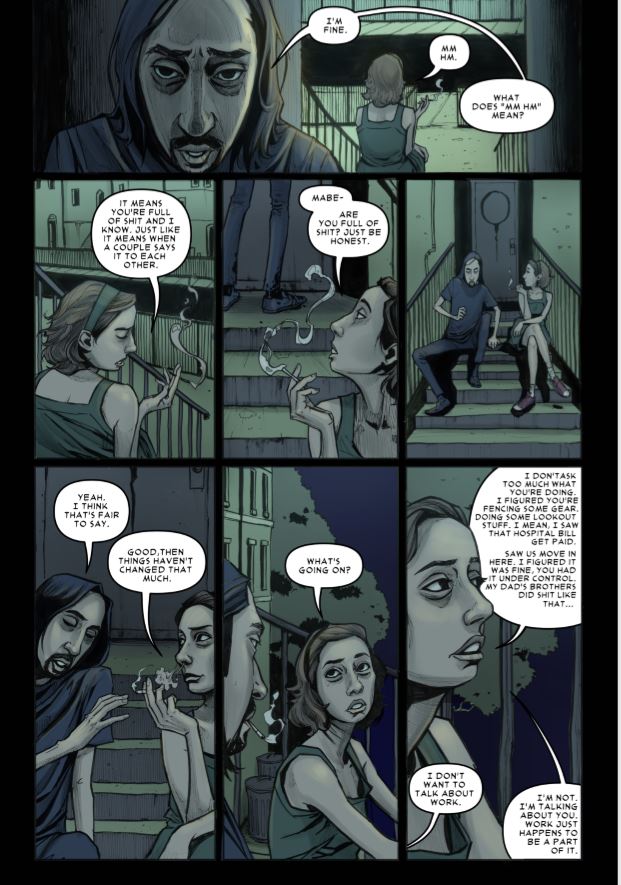
With that, it’s time to talk about Sean Lewis’s writing. First off, I want to address how one of the major criticisms I had for issue #1 is not just improved, but also the best part! When Mable O’Hara, Benton’s wife and Perry’s mother, was first introduced, I initially felt disappointed because my expectations were high given Lewis and Yarsky’s previous series, Coyotes. However, in this issue, Mabel becomes a fully-fledged, active character. It all starts with an argument between her and Benton.
Benton comes home after another assignment and, while talking to Perry, has a mental breakdown, and he runs off. A little later, he comes home and Mabel is waiting outside for him. She is pissed off. It’s not because of him running off though. Mabel knows Benton is hiding something from her and wants to know what. The way she delivers this interrogation, still loving Benton while not having his bullshit, is simply badass! Lewis’s writing is so poignant, and Yarsky’s body language equally so, that if Mabel were an actor, this would be an Oscar-winning performance. By the time she delivers her ultimatum, I was fist-pumping the air. This is my favorite scene in Bliss #2 and, honestly, I would rank it highly based off of this scene alone.
The only criticism I have is that there are minor formatting errors. For example, there is a balloon where the dialogue is slightly off to the right instead of the center. It’s easily overlooked though, certainly not the massive eyesore I’ve seen in some comics with regards to lettering.
God, I get a panic attack just looking at that page.
Anyway, for the most part, the characters are all very well-written and consistent. Benton is the conflicted murderer that just wants to provide for his family. Perry is still the faithful son trying to save his father’s life. There is an outstanding side character, one of Benton’s victims. Despite her brief existence, she is a fleshed out character, an activist risking everything to bring down the corruption in Feral City. I couldn’t help but feel so compelled by the gusto this woman had even in the face of death. It just goes to show you how memorable a side character can be.
So, technically, everything is all well and done, right? That’s great, but the real meat of Bliss #2 is the theme of Forgetting. Going back to the opening image of a bizarre tree, Perry narrates how all human societies have a tendency to forget the darkest chapters of their history. There are scientific explanations, but also mythical ones such as Lethe. Next page, Perry continues on his speech, transitioning to how forgetting the past allows us to survive.
We see an image of a family at Thanksgiving, yelling at each other; pedestrians walking on a street, passing by a homeless man and his dog; people minding their own business on a subway, ignoring a woman begging for change; a group of boys living in squalor, yet they find time to enjoy a ball game. What all of these scenes show is the conflicting reality of Forgetting. On one hand, forgetting can allow us to continue enjoying life. On the other, ignoring the past can cause us to become oblivious of the injustice around us. In Benton O’Hara’s case, it can effect personal relationships too.
Benton can drink all the Bliss he wants, but it’s not permanent. His crimes re-emerge as haunting visions, which leads to drinking even more Bliss, and I’m guessing that’s definitely not going to be good later on. Worse yet is how this affects his home life. I already talked about his argument with Mable, but it’s also create distance between him and Perry. He may not be abusive, but his sporadic behavior and refusal to tell the truth is still hurting them. It also affects Benton’s relationship with the reader. We want to be sympathetic because we know the circumstances of why he is a murderer. At the same time, though, the aftermath of Benton’s actions make that sympathy uncomfortable if not completely burnt away.
Another major criticism in my review of issue #1 was how the narrative is seemingly biased toward Benton, not giving the other side of the equation–that of the victims–as proper representation as Perry’s. It made the central theme of Forgiveness seem too one-sided. However, issue #2 complicates this by making Forgetting complicated as well. We are shown one of Benton’s victims, we get to know her; we see how his actions affect his family, and how self-destructive he has become. Yes, you can make the argument that Benton is enslaved to servants of Lethe, but that doesn’t mean he is guiltless either.
Whether or not Forgiveness is completely out of the question, Bliss #2 makes the answer uncertain. We can forget the past, but that doesn’t make the atrocities go away. We cannot just ignore their consequences. Eventually, they come back, repeat themselves, and nothing gets better. We do not forgive. We do not move on.
Sean Lewis flawlessly explores this theme of Forgetting in such a riveting way that doesn’t feel forced. It comes out naturally, allowing the story to be entertaining and trusts the reader to ponder the deeper implications. I mean, that is what I did just now. Maybe it is all gibberish, but the fact I had such profound thoughts should proof how Bliss, much like all of Lewis’s comics, inspire me to think critically. This is the kind of comic I want to read.
The last thing to bring up is the world building. Much like the first issue, Bliss #2 has sprinklings of it, mostly visual, mostly visual ones. The suggestion that the effects of Bliss aren’t permanent, how Bliss is a known drug throughout Feral City, that the servants of Lethe fully control, and, to a larger extent, use it to control the city itself. There isn’t much else concrete until a twist at the end, which I’m not going to give away because it completely turns the tables of the story. All I will say is that things are about to rev up pass eleven.
Much like the previous issue, this one is more focused on Benton and his family. The larger threat of Lethe and why Feral City is such a big part of her plot to destroy the world, is still just finally boiling up. As much as I enjoyed issue Bliss #2, that the barrel needs to go off on this powder keg. We understand enough about our main character, let’s have something happen. Let us explore the interesting ways the mythology of Lethe is implemented into the narrative.
Bliss #2 manages to be a terrific follow up to an audacious debut, expanding upon every element introduced previously. Where this goes in the next issue, I have no idea, which is exciting. If the ending is any indication, Hell is coming to Feral City, and no one will remain blissfully ignorant for long.
Story: Sean Lewis Art: Caitlin Yarsky Publisher: Image Comics Purchase: comiXology – Kindle – Amazon
WARNING: SPOILERS AHEAD! IF YOU DO NOT LIKE SPOILERS, GO ELSEWHERE!
CONTENT WARNING: There is a lot of discussion of some heavy topics in this review, including suicide, mass murder, and abuse. You’ve been warned.
After being disowned by their families, Benton O’Hara and his pregnant wife Mable move to Feral City. The metropolis lives up to its name with rampant crime and corruption. The last place you would dream of raising a child, and yet the young couple make it work. That is until their son, Perry, falls ill. Unable to pay the exorbitant medical bill, Benton turns to working for three reptilian humanoids who control Feral City. They make him into a hitman, easing him of the guilt with a drug called Bliss that wipes away unpleasant memories. Years later, Benton’s crimes have caught up with him. The families of his victims want retribution, but Perry, now a young man, is desperately trying to change their mind. Lethe, Goddess of Oblivion, is coming, and only Benton can stop her.
Okay, full disclosure, I was very excited that Sean and Caitlin were collabing again. Their last book, Coyotes (which is also from Image) is one of my favorite series of all time. It criss-crossed feminism, lycanthrope mythos, and body horror in a glorious grindhouse story full of action and gothic art. It’s like a hybrid of From Dusk ‘Til Dawn and Buffy The Vampire Slayer. So, I have to admit a little bit of fanboy bias on my part, but I’m still a professional critic. Out of respect for Sean and Caitlin, I’m going to be completely honest about their new baby, both the pros and cons. So, without further ado, here are my thoughts on Bliss #1.
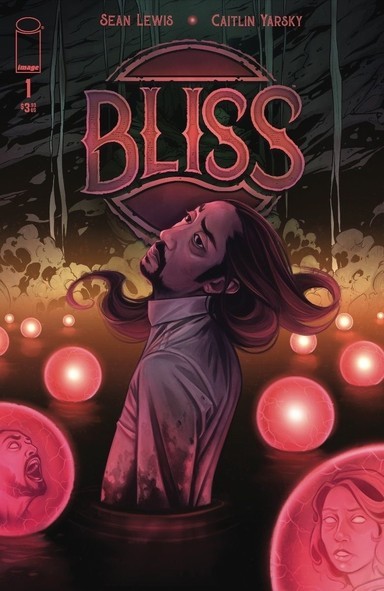
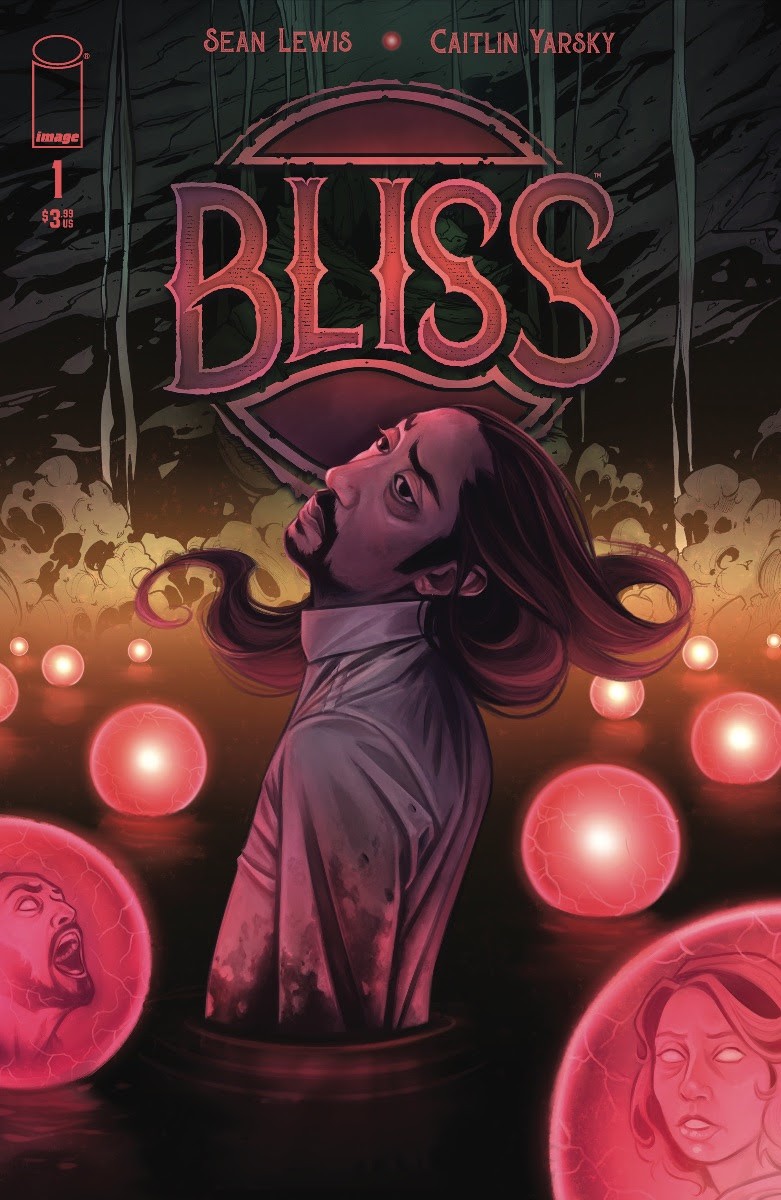
The first thing that drew me straight into Bliss #1 is the cover. I mean, look at it. That’s how you make a freaking comic book! More specifically, I love how everything is composed. Benton O’Hara dead center in the foreground, his eyes full of woe, back to the reader except for his head turned toward them. It’s almost kind of sensual in a way. I can easily see our boy here modeling for an Irish Spring ad.
Then there is the title raised just slightly above his head. Big ups to Caitlin for creating such a bold and striking letter design. Also, there’s a myriad of interesting details around Benton. The lake of black liquid he’s submerged in (which I assume is Bliss); the red orbs floating around him that, honestly, are unsettling given human heads are in them. As for the background, well I honestly don’t know what’s happening there. It looks like a huge dust cloud, so I’m guessing something’s either crumbling or exploding.
Looking at this cover overall, I get strong feelings of both sorrow and Armageddon. It’s like the cover is warning me that a cataclysm is coming. Don’t know why I feel that, except maybe the fact the main antagonist is the goddess of oblivion. Whatever the case, this cover does an excellent job of wowing me into reading the book. A-freaking-plus!
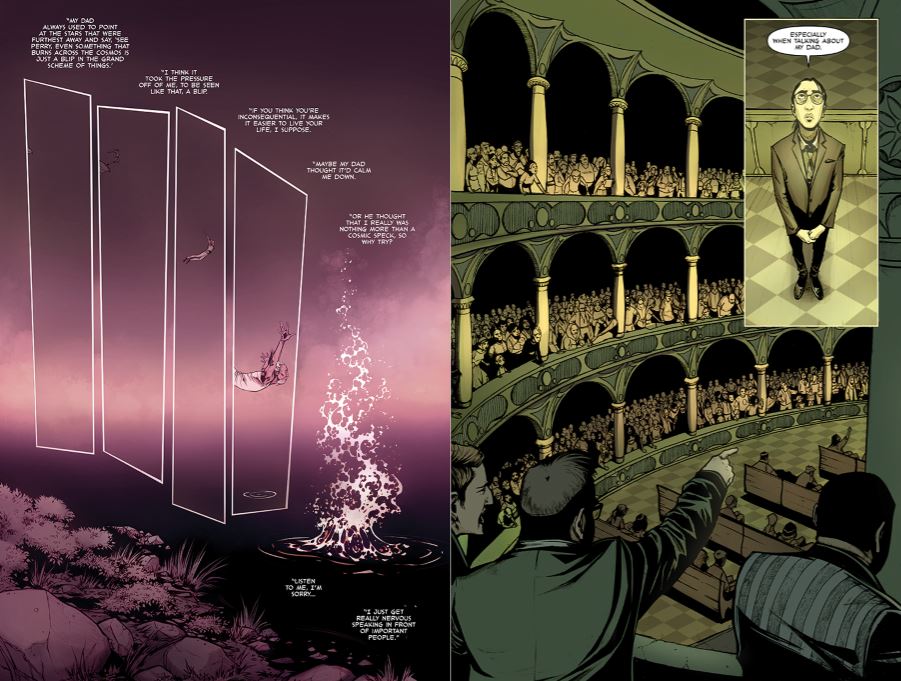
The issue opens up to a scene of Benton, old and looking like Yosemite Sam, belly-flopping into a large body of black liquid. It’s more than likely a suicide. Did I mention those content warnings? Anyway, I can’t praise this page enough. I love how the four white-bordered panels in the center create the illusion of movement in an otherwise static landscape. I also love the choice of a mauvish color palette. It’s calming yet strangely sinister, like beneath the placidity is a dark undercurrent. Makes sense for a suicide attempt. Everything in the scene ties back to Perry’s narrative captions, too. He feels relief knowing he’s an insignificant speck in the universe. However, Perry and his dad are anything but insignificant to the citizens of Feral City.
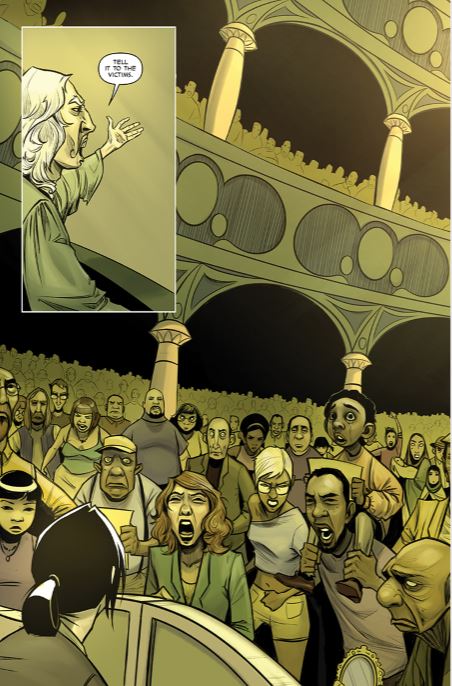
The next scene is a two-page spread that gives us a panoramic view of a courtroom that looks like it’s built inside of a cathedral. Up in the balconies and down in the pews are people crowded together, and I have to give more applause to Caitlin here. She drew every individual in this large crowd distinctively instead of making them all featureless cut-outs. There’s yet another brilliant color palette, as well. The yellow is so garish and bright that it captures the intensity of the scene. Perry is all alone, glared down by countless accusing eyes. He’s the only one arguing for his father’s life. Everyone else wants his head on a stake.
This is what I love about Caitlin Yarsky’s art. It always invokes a mood and emotional response. I think that’s largely because of her art; it’s Gothic, literally by the definition in arts and literature. You can see European Gothic in the elaborate ornamentation of architecture and intricate, sharply-shaped panel layouts. You can also see Southern Gothic in her characters. They’re drawn with a heightened plainness: bulgy eyes, disproportionate limbs, and facial expressions so over the top they cross into caricature. It reminds me a bit of Flannery O’Connor’s cartooning.
Even more impressive is that the characters aren’t ugly. These plain, lumpy people integrate with the beautiful architecture around them. Caitlin Yarsky’s art is a contradiction. That’s not a negative. Her style is such a fluid infusion of both European and Southern gothic that it creates worlds and characters that are both gorgeous and dark, enticing and foreboding. Even when she draws monsters, you can’t help but gaze in awe of them.
Each page of Bliss #1 is executed flawlessly, aesthetically intoxicating while allowing the story to flow free of choppiness. Caitlin is the foundation of this book, essential and irreplaceable. If this series doesn’t recognize her to the industry as one of the great up-and-comers, we’ll be worse off for it.
So, the art’s fantastic. Whoop Whoop! What about Sean Lewis’s writing? Well, that’s where things get uneven. As a playwright, Sean naturally uses dialogue for characterization. How characters speak to one another tells you the type of people they are, more so than exposition. A good example is Perry in the courtroom scene. He admits to being nervous, his body language only further confirming this fact. However, the love and loyalty he feels toward his father gives Perry the strength to try. That would be commendable if not for the kind of man Benton is, but we’ll get into that later.
Sean’s dialogue, unique as it is, wouldn’t work without Caitlin’s character designs. Each person she draws is distinct, both in looks and body language. The best character is the one where you can recognize by name, voice, and looks all at once. I never confused a character for another, never forgot a single face. Considering how many comics I read, that’s a feat!
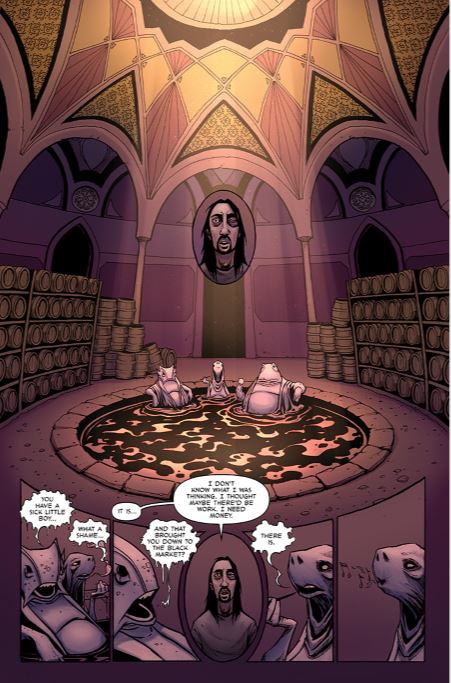
With that said, there are some characters not as well-defined. Some are intentionally so. From reading Bliss #1, all I know about the three reptilian humanoids is that they run Feral City, serve Lethe, and want Benton to take care of “problem” people. After each job, they give him Bliss to wipe away the memories. I assume so the guilt doesn’t cause Benton to resist. I don’t know how they control Feral City, why they target certain people, or exactly how Bliss conveniently only gets rid of the memories they need gone. Their ambiguity works though because it makes them scarier and powerful. It keeps the reader on their tones of just exactly what the trio is capable of. Also, it builds up anticipation for the next issues.
However, there’s also Mabel, Benton’s wife and Perry’s mother. So far, she’s just a passive character, even the beautiful dance scene between her and Benton does more to characterize him. Bliss is obviously a father-son story, but I still can’t help feeling that Mabel is underwhelming, especially after Coyotes offered a superb cast of women and girls equal to the few male characters that appeared. I still think the O’Hara family are great characters. I hope Mabel gets to develop more in later issues.
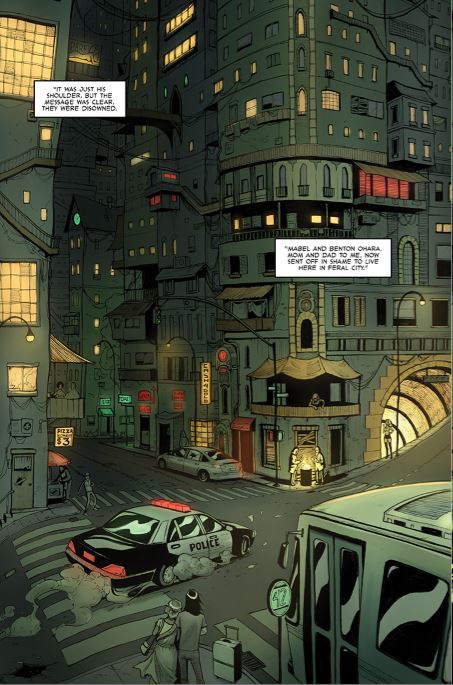
Another mixed bag is the world building. Feral City is introduced during Mabel and Benton’s backstory. We don’t see the full city, but are treated to a section of it. Both Caitlin and Sean establish the setting as a whole from this single splash page. Just look at the architecture with all its grit and decay. Combine that with the narrative caps personifying Feral City as a place that spies on you as much as the predators that live in it.
We get to further learn just how messed up this place is in the next scene. As Benton walks by hospital rooms, we see. a woman slashed by her partner for trivial reasons, a man drained of his blood on the mere assumption of a crime, and a torturer waiting for his victim to heal so he can further torture him. Jesus in a Buick! This place makes Sin City look like 100-Acre Wood!
That’s as much as we get to know about the world though. While I admire keeping the reptilian humanoids cryptic, I still feel like not enough was established about the world. I don’t even know how Lethe fits into all this. She’s not even mentioned by name. I only know she’s involved because of the solicitations. For a series compared to American Gods, I was hoping for just a little more of an established mythology. Coyotes #1 did so flawlessly, or at least from what I remember. I suppose it’s a matter of subjectivity.
Speaking of subjectivity, it’s time to get serious. The main themes of Bliss are Forgiveness and Redemption. In spite of everything his father did, Perry’s trying to convince everyone to spare him. If they don’t, Lethe will destroy Feral City, and possibly the whole world too. It’s a very interesting twist. It’s also one that’s going to divide readers.
Issue #1 focuses on Perry’s perspective, and he paints his father in a sympathetic light. He recalls memories of Benton’s love for his family, like when he fought off a mugger to bring Perry oranges while sick in the hospital. He then danced with Mabel to comfort her after getting an exorbitant medical bill. As much as I criticized this scene, I can’t deny how beautiful it is.
Bliss has also been compared to Breaking Bad, and I can definitely see similarities between both Walter White and Benton O’Hara. The thing is Walter White gets steadily less sympathetic during the show’s run. It’s hard to justify his actions when the bodies start mounting up. It stops mattering that he only wanted to provide for his family. By the end, most of everyone, including the audience, has turned on him.
We already know Benton’s crimes. His downfall has already happened. That’s driven home when we see the faces of all his victims’ loved ones. Their grief and anger is painfully clear. It can’t be blamed on brainwashing. Benton chose to be a killer. Bliss merely wiped away any guilt he might have felt, which he eventually does as evidenced by his suicide attempt.
Perry’s perspective cannot erase his father’s crimes. In fact, the focus on one side of the story makes him suspicious at best, and manipulative at worst. Perry does have a reason beyond self-interest. If Benton isn’t forgiven, Lethe is going to annihilate Feral City, probably the rest of the world included. You would think “Forgive my dad or an ancient deity will burn us all to a crisp” is a good trump card to play, but Perry doesn’t. This whole song and dance in the courtroom makes no sense.
Now, I know Sean Lewis. He’s a writer that plays the long game. All the unanswered questions are purposefully left in the air, both to build anticipation for subsequent issues and give time for readers to reflect. He’s a writer that wants to encourage critical thinking as much as entertain. That’s what I love about all his comics. I’m not one of those readers that demands to know everything right away. Hell, I despise that kind of thinking. I’m definitely thinking a lot about Bliss #1, which is why I have concerns.
Forgiveness and Redemption are clearly themes Sean is tackling here. It even came up in Coyotes, which took the latter half of the series into a wildly new direction from your typical revenge tale. Setting up these themes around a horrendous individual is a daring risk, one that could have a big payoff if done well. On the flip side, it’s potentially a disaster if the bad guy is unjustifiably let off the hook. So far, I’m not really convinced Benton deserves forgiveness because I can’t find justification yet, and I’m concerned the Lethe angle could be a manipulative plot device if nuance isn’t applied.
I think the reason I’m worried is everything happening in real life right now. If you don’t know, a number of professionals in the comics industry have been outed as sexual predators. This isn’t the first time. It’s been an ongoing problem. Some perpetrators have been reprimanded, but usually only if they become too much of a PR problem. Two camps have come out of this discourse. Those who want justice but also healing and reform, and then those that want no second chances.
I mostly agree with the former, but I can also see where the latter are coming from. Forgiveness means nothing if perpetrators don’t really change, not if all they’re given is a slap on the wrist. Hell, many times they don’t even get that. I was told once that forgiveness isn’t for the perpetrator, it’s also for the victim, a means to let go and be free of all the hurt. It’s a nice thought. Too bad that same person hurt me worse than anyone else ever has. They weaponized their own advice to get away with it. Since they show no remorse, I don’t feel compelled to forgive them.
That doesn’t mean forgiveness is impossible, nor that it can’t heal both parties. However, it is a complicated issue, there are no easy answers, and no one case is the same. Also, personally speaking, there are crimes that are just unforgivable. Some villains just deserve to burn, end of story.
With everything said, I applaud both Sean and Caitlin for tackling these themes. It frustrates me and I question its moral implications, and that’s a good thing. I’m so tired of stories that are unchallenging, that only want to assure an audience’s moral certainty. I want to fight with a story, argue with it, have it dissect me, and vice versa. For that alone, I recommend Bliss #1 on top of Caitlin’s amazing artwork. Whether or not the story succeeds depends on how it unfolds. At least for now, I’m compelled to keep reading.
Story: Sean Lewis Art: Caitlin Yarsky Story: 7.5 Art: 10 Overall: 8.5 Recommendation: Buy
Image Comics provided Graphic Policy with a FREE copy for review
Award winning playwright and bestselling comics writer Sean Lewis reteams with fan-favorite Coyotes artist Caitlin Yarsky for a dark urban fantasy maxi-series titled Bliss. It will consist of two story arcs and launch from Image Comics this June.
In this upcoming series, there’s a drug called Bliss wiping away memories in Feral City. A good-hearted young man—overwhelmed by a deathly sick child and distraught wife—makes a deal to become the personal hitman to three gods, killing those in their way and sending memories down the river of Oblivion in exchange for his family’s well-being.
Best described as Breaking Bad meets Neil Gaiman’s American Gods, Bliss is the perfect new addiction for fans of Gaiman’s Sandman and Dan Watters and Dani’s Coffin Bound.
Bliss #1 will be available at comic book shops on Wednesday, June 24.
Sean Lewis has dropped a video updating news about Coyotes and a new series.
Coyotes is at a studio, though that’s where Lewis left it. But, the bigger news is Bliss! Described as “American Gods meets Breaking Bad,” the series is with artist Caitlin Yarsky.
The first issue will be released on June 24th from Image Comics.
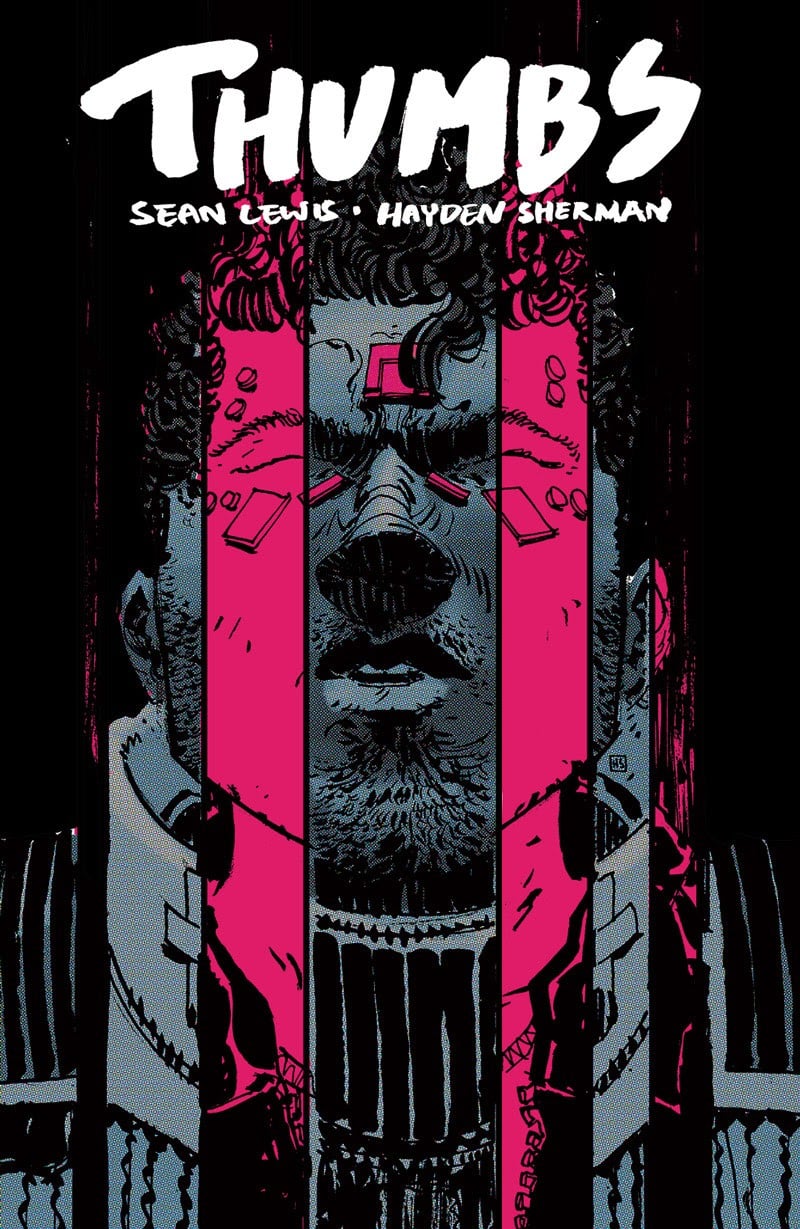
Award winning playwright and comics writer Sean Lewis re-teams with award winning artist Hayden Sherman for the pulse-pounding technology thriller, Thumbs. This trade paperback collects the complete series, issues #1-5, of the rapid-paced, science-fiction series and will be available from Image Comics in January 2020.
Adrian Camus, a rockstar tech designer, recruits children who excel at his games into his real-life war against the Power, a group of politicians and advocates aiming to take Camus’ tech away from the people. Following a life-altering injury, eponymous recruit Thumbs finds himself torn between two sides of the muddy, escalating conflict. Heartfelt, action-packed, and forward-thinking, Thumbs is a standalone story that fans of Black Mirror, Blade Runner, and Tokyo Ghost won’t want to miss.
The Thumbs trade paperback (ISBN: 978-1-5343-1359-0, Diamond Code NOV190068) will be available on Wednesday, January 29 and in bookstores on Tuesday, February 4.
The second issue of award-winning playwright and comics writer Sean Lewis and award-winning artist Hayden Sherman’s hot new technology thriller Thumbs is being fast-tracked for a second printing in order to keep up with growing customer demand.
In Thumbs #2, Charley “Thumbs” is out of his coma and back in the world. Trapped by the Power, he sees the junkies who’ve taken technology underground, the revolutionaries who deliver devices to the people, and the government that’s banned it all.
Set in a reality where a tech mogul has created his own army of tech-addicted teens and directed them to take on the government, Thumbs readers are introduced to a high-stakes story where Charley “Thumbs” Fellows is a member of just such an army. Poor and raised by the influential MOM™ app, he soon finds himself in the center of a war.
Thumbs #2, second printing (Diamond Code MAY198886) will be available on Wednesday, August 7. The final order cutoff deadline for comics retailers is Monday, July 15.