
Tag Archives: peter parker

Back to School: Ultimate Spider-Man #20-21
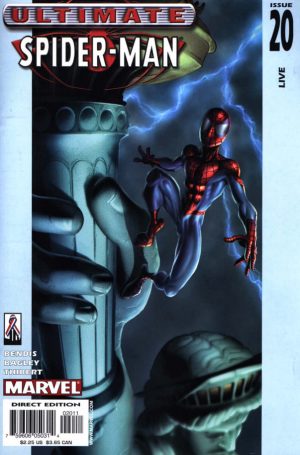
Back to School is a weekly issue by issue look at the beloved superhero teen comic Ultimate Spider-Man. In this week’s installment, I will be covering Ultimate Spider-Man #20-21 (2002) written by Brian Michael Bendis, penciled by Mark Bagley, inked by Art Thibert, and colored by Digital Transparency. 

Live from New York City is the Kraven the Hunter and Dr. Octopus show aka Ultimate Spider-Man #20! While the Kraven van is traversing the “wilds of New Jersey” to intercept Spider-Man, Dr. Octopus is trashing Justin Hammer’s limo and trying to get him to confess to his illegal genetic experiments to the reporters. This causes Spider-Man to get involved even though he’s sympathetic to the fact that Doc Ock has huge metal tentacles grafted to his body. They fight back and forth, and Dr. Octopus has some special upgrades to his arms like electric shocks and machine guns. The TV reporter on the scene starts to get Spider-Man’s story right and points out his selflessness at trying to keep the fight away from the journalists and camera people. The turning point in the battle when Spider-Man hilariously pants Doc Ock with his webbing, and this distracts the villain enough for Spidey to finally deliver a beatdown and break some of his tentacles. The TV reporter, Traci Hale, is about to get Spider-Man’s side of the story when Kraven shows up at the worst time possible.

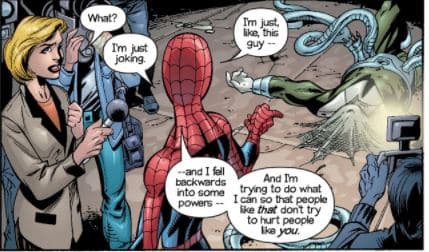
Ultimate Spider-Man #21 begins with Kraven wanting to fight Spider-Man to the death while the hero just wants to save Justin Hammer’s assistant from the wreckage of his limo and go home.  (Hammer has just passed away from a heart attack.) The fight between Spider-Man and Kraven is ridiculously one-sided, and Spidey knocks out the “showbiz phony” with one punch. Before swinging away, Spider-Man talks to Hale about why he’s a superhero and acknowledges that the mask might scare people off, but he wants to protect the people close to him from crazy supervillains and glory hounds like Kraven. Everything seems to be coming up Spider-Man when the NYPD arrests Kraven and his camera crew for their actions, and Sharon Carter and SHIELD takes Dr. Octopus into custody. However, the Parker luck strikes again when Aunt May asks about Peter’s whereabouts when he comes home at 3 AM, and he can’t lie convincingly to her. She is afraid of losing him, and this triumphant superhero is officially grounded. The comic ends with Dr. Octopus mumbling to himself in a SHIELD cell about how Peter Parker is Spider-Man. Uh oh…
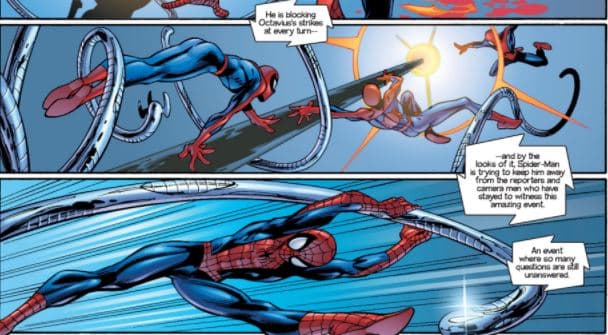
Brian Michael Bendis and Mark Bagley seriously stick the landing in the final two issues of “Double Trouble”, get what Spider-Man’s all about, and even write Aunt May like a realistic, caring parent and not a naive doormat. Ultimate Spider-Man #20 is masterfully paced with just enough Kraven and walks and chews bubblegum by featuring the final throwdown between Spider-Man and Dr. Octopus along with the shift in media perception of him. Bagley and inker Art Thibert show Spidey leap, kick, and contort while the news reporter on the scene realizes his strategy of keeping the battle away from the TV cameras and the selflessness of protecting Justin Hammer, a man who majorly trashed him in the press. Most of the issue is laid out in “widescreen” double page spreads like it’s on TV and Traci Hale’s narrative captions juxtaposed with the action shots makes it feel like we’re an audience and not in Spider-Man’s head like in previous issues.

On the surface and for the meat of the plot, “Double Trouble” is about Spider-Man struggling against and finally beating a 21st century reimagining of his classic villain, Dr. Octopus. But the real bad guy in the arc has been public perception of Spider-Man, which comes from a variety of things, including the bias of the Daily Bugle, the fact that Justin Hammer pinned nuclear sabotage on him, and the fact that he wears a mask and is shy around cameras not wielded by his alter ego, Peter Parker. That perception starts to turn around in Ultimate Spider-Man #20 and #21, and the most triumphant moment of the arc isn’t when he finally takes down Doc Ock, but when the bystanders and press on hand start cheering for him. Spider-Man has taken his share of beatings recently, and it’s nice to see him pull out a win in both his own and the public’s eye.

To take things a step further beyond Spider-Man’s in-story relation to the press, Ultimate Spider-Man #20-21 and the “Double Trouble” story as a whole are a battle between reality TV and news journalism, or news for entertainment versus news for knowledge and truth. As a former cartoonist for the Cleveland Plain Dealer, Brian Michael Bendis has made news media a recurring theme in Ultimate Spider-Man, especially through the supporting character of dogged reporter Ben Urich, who takes down the Kingpin in the comic’s second arc. Kraven’s reality TV antics and the Daily Bugle and talk shows’ negative perception are targets of Bendis’ ire throughout the arc while an actual on-camera interview with Spider-Man and a filmed news story of him gets more positive treatment. The satire is definitely painted with a broad brush, but Bendis and Bagley show that mixing news and entertainment can be deadly in the case of Justin Hammer’s death and Kraven’s action. Bendis extols the virtues of fair, transparent reporting that exposes corrupt institution, like Traci Hale’s work with Spider-Man and the real story behind the attack on Justin Hammers factory, and is a little bit hampered by the fact that he wears a mask. Also, he doesn’t play a role in the plot, but Ben Urich is the last media member to leave when SHIELD takes charge of the crime scene.

The scene where reporter Traci Hale interviews Spider-Man gets why he is such a lovable, everyman type of hero. Unlike Dr. Octopus’ almost religious utterances of grandeur, Justin Hammer trying to make a profit illegally and get away with it, and Kraven’s insensitive showboating, Spider-Man is “like this guy who [fell] backward into some powers”. Bendis’ use of “like” and his straight shooting response to the reporter, Spidey sounds like a kid, who isn’t quite ready for prime time, but has values and convictions to go with the jokes about him being the product of spiders and humans cross-breeding. I liked how Bagley cuts from the interview to Mary Jane and the Daily Bugle staff watching him on TV to show that his message are getting out there through the news media even though Peter doesn’t interact in person with MJ in these two issues.
Kraven being treated like a total and utter joke and not a “final boss” type villain in the slightest is really cathartic after all the panel time he has hogged in this storyline. He gets to be the cliffhanger of Ultimate Spider-Man #20 eliciting groans from Spider-Man, the media, and all the bystanders after Spidey has put his body and life on the line to protect them from Dr. Octopus’ rampage. Up to this point, Kraven has taken himself way too seriously with Bagley’s close-ups of his pre-hunt “meditation ritual” and his constant grandstanding about wanting to kill Spider-Man. So, it’s pretty awesome to see Spider-Man demolish him in a few pages, dodging all of his blows easily with the whoosh of Bagley and Thibert’s speed lines, and finishing him off with one punch that has him crumple woozily like a college freshman at the end of their first bender. The one punch finish is both a reminder of how “fake” reality shows are and a reminder that Spider-Man cares about more important things, like justice and his family, than ratings or demos. But why did Kraven the Hunter need so much panel time in the first place? I guess it was Bendis and Bagley trying to troll fans of “Kraven’s Last Hunt” and set him up as an actual threat hidden beneath cringeworthy reality TV tropes and then showing that he really is just a tomato can of a baddie.

Unfairly, Mark Bagley sometimes gets accused of copying and reusing panels in his artwork and collaborations with Brian Michael Bendis. Well, he definitely puts that idea to rest in the closing scene of Ultimate Spider-Man #21 where he proves he and Art Thibert can do domestic drama just as well as spreads of Spider-Man swinging, kicking, and webbing. His facial work is stellar during the extended conversation between Peter and Aunt May, but his gesture work is even better like the three panels of May putting up one finger each when she grounds Peter from the Daily Bugle, seeing Mary Jane, and makes him go straight home from school. It’s kind of funny to see a triumphant superhero get upbraided by his guardian, but Bendis and Bagley add some pathos too like when May cries in her hands after sending Peter to his room. She truly worries for her nephew, who is the only family she has left after Uncle Ben’s death.

On a realism level, Aunt May is bound to have some questions about Peter’s bruises that he gets from fighting crime and his unexplained whereabouts, especially when he goes to fight Dr. Octopus in New Jersey. Bendis doesn’t portray her as a fool when she calls all of his possible locations, including the Daily Bugle and Mary Jane’s house, and May leaves Peter enough rope to hang himself with his lies. You can see the pain and exhaustion in her face when she tells Peter that she is afraid for him and doesn’t want to lose him, like Ben. Honestly, grounding seems like a suitable punishment if someone doesn’t know about his superhero alter ego of Spider-Man, and this scene is a reminder that even though he is improving as a superhero, Spidey is just a teenager and doesn’t have full freedom just yet.

I applaud Brian Michael Bendis and Mark Bagley for deciding to end the “Double Trouble” arc of Ultimate Spider-Man on a character beat in a similar way to Ultimate Spider-Man #13. Ultimate Spider-Man #20-21 is a perfect, modern version of the “Parker luck”. Sure, Spider-Man now has a positive media reception and has defeated both Dr. Octopus and Kraven the Hunter, but he’s grounded because he came home late and lied multiple time to his aunt. This part of Spider-Man’s character is super relatable because honestly it’s hard to keep all the balls juggling in your personal, family, romantic, work, and school lives and be successful at all of them. Also, being grounded sucks and is a more realistic obstacle than Aunt May marrying Dr. Octopus or the wackier situations of Silver Age Spider-Man.

In Ultimate Spider-Man #20-21, Bendis and Bagley combine a parent’s worst fear with superhero melodrama and it’s the winning formula to finish off “Double Trouble”. Ultimate Spider-Man #20 is especially clever because readers get to see the shift in Spider-Man’s perception by the outside observers in real time because his fight against Dr. Octopus is being filmed by the evening news and other media outlets.

Back to School: Ultimate Spider-Man #18-19

USM18CoverIn issue 18, the midpoint of Ultimate Spider-Man’s third arc, Spider-Man finally gets to throw down against Dr. Octopus. He starts confidently with jokes and webbing to Ock’s tentacles, but then he is the first Spider-Man villain to break free from his web fluid and starts beating on him. Dazed and confused, Spider-Man ends up on the outside of the lab surrounded by NYPD officers, who grab him and immediately get into a verbal fight with SHIELD about who’s in charge of bringing him in. In the hubbub, Spider-Man escapes and evades some NYPD divers, who only get a big piece of his costume, and returns home where Mary Jane helps patch him up.  They watch TV, and he’s angry that Justin Hammer is using him as a scapegoat for the attack on his nuclear plant so he doesn’t have to answer questions about his relationship with Otto Octavius. Then, Mary Jane describes herself as “the Betsy Ross of superheroes”, gives Peter a good night kiss and goes home. The issue ends with Aunt May coming home a little early, and Peter is afraid she’ll discover his secret identity.

With enough ninja maneuvering and awkward one-liners about bowel movements at the beginning of Ultimate Spider-Man #19, Peter avoids spilling his secret identity to Aunt May while losing a chance at tasty chicken nuggets from KCC. (Because apparently only DC is allowed to use KFC and Colonel Sanders in their comics.) The scene shifts to school where footage of Kraven the Hunter tracking Spider-Man’s scent is being filmed. Gwen Stacy asks Peter about his bruises, but he deflects her questions while Kraven does his scratch and sniff thing. Later, Mary Jane sews Peter a new Spider-Man costume and leaves abruptly after a conversation where she thinks that he might be romantically interested in Gwen. All the while, Justin Hammer is dodging reporters, dealing with a PR nightmare, and is confronted by Spider-Man, who calls him out for making him a target of the press when Dr. Octopus is the real bad guy. Hammer offers him money to kill Octavius, but Spider-Man doesn’t take the bait and hitches a ride on top of his limo because Hammer is going to his New Jersey lab to negotiate a deal with Dr. Octopus. The issue ends with Hammer being trapped as Dr. Octopus has called a press conference to expose him while Kraven is getting to ready go to Jersey and hunt Spider-Man in the “wild”.

LamestreamMedia

The media isn’t just Peter Parker’s day job (Or after school part time job in this version of Spider-Man.) in Ultimate Spider-Man #18-19, but ends up driving how he feels and some of Brian Michael Bendis’ plot too. It’s a major stressor on him, and Mark Bagley and Art Thibert draw several scenes of  Peter muting the TV or throwing objects at it when news reporters accuse him of being a nuclear terrorist or hope that reality TV star Kraven the Hunter kills him. He’s still the shiny new thing that gets people buying newspapers and turning on their TVs and the star of the 24 hours news cycle because everyone knows bad news is more appealing and sells more paper than good news. Instead of laughing off the press coverage, Bendis has Peter react like an actual human being, who has to see negative things about themselves flashing 24/7. He does make jokes about Daredevil looking like a tool and Iron Man’s more positive media image continuing his coping mechanism of humor in scary or annoying situations with or without the mask.

On the flip side and even with metal appendages fused to his body, Dr. Octopus spins the media into almost his favor, which is kind of amazing for a murderer and domestic terrorist. It’s maddening to see Peter fight with the media like it’s a supervillain and see his antagonist win them over and expose the seriously-needs-to-hire-a-new-PR-person Justin Hammer in a single cliffhanger page. Dr. Octopus’ motivation is revenge against the man who set him up to fail as a corporate saboteur, but he wants to publicly humiliate Hammer, which is honestly more painful than an appendage to the heart.

There is more suspense and a feeling of danger in the scenes when Spider-Man is evading Dr. Octopus, the NYPD, and SHIELD agents than in the whole government conspiracy/cover-up/amnesia plot that has them chasing Spider-Man in the first place. Bendis slurs Spider-Man’s words in the caption boxes, and inker Art Thibert draws attention to the bruises that cover his body after almost being crushed to death by Dr. Octopus. After the fun opening flourishes, Doc Ock physically destroys Spider-Man, and the usually loquacious webslinger goes monosyllabic because of the pain.The combination of injuries and the emergence of heavily armed NYPD cops almost out of nowhere puts Spider-Man way on the defensive, and an arrest or unmasking seems imminent.

SpideyUnderwater

It’s to Bendis and Bagley’s credit that they lean on the internal sniping between the NYPD and SHIELD over whose “collar” Spider-Man is and use this to give Spidey a quick escape instead of him just running away on his own steam. Bagley delivers a beautiful nine panel grid with a muddy palette from coloring studio Digital Transparency showing the Herculean effort that Spider-Man makes to elude the NYPD divers. The water is no sanctuary for him, and the sequence captures the difficulty of every underwater video game level delivered in a single comic page as Spidey strains, swims, and ends up sacrificing his costume for the cause. He might be waterlogged, but Peter Parker is still a fairly clever teen and will do anything to protect his friends and family from supervillains and shady government agencies.

Speaking of friends, Mary Jane Watson gets her most extended panel time since the excellent “Confessions” standalone issue in Ultimate Spider-Man #18-19. The scenes where Mary Jane helps patch up Peter while trying to avoid adults definitely inspired some of Gwen Stacy and Peter Parker’s scenes in Amazing Spider-Man as played with excellent chemistry by Emma Stone and Andrew Garfield.  The banter between them is nice with Mary Jane suggesting a self-defense class to help him in supervillain battles and asking to wear the Spider-Man costume for their social studies superhero assignment. She very much plays a support role in this storyline taking care of Spider-Man’s bruises and costume issues even though Bendis and Bagley don’t skimp on the jokes or romance.

MJMad

Then, in Ultimate Spider-Man #19, they decide to introduce the Peter/Gwen/Mary Jane love triangle in a kind of forced, yet relatable way. At school, Gwen asks about Peter’s bruises and if they were caused by a bully, but he and Mary Jane do the whole partners-in-crime and play off his reputation as a klutz and tell her that he simply fell down the stairs. However, this little encounter kind of blows up in Peter’s face when he describes Gwen as “interesting” when Mary Jane asks if he likes her. The wording of her question betrays Mary Jane’s insecurity in their relationship and leads to her constantly saying, “No” to Peter’s questions as she leaves immediately after fixing up the costume. Bagley nails her emotional by giving her closed off body language and showing her in side profile instead of being closer to Peter. This is yet another issue he has to deal with to go with multiple supervillains, the cops, SHIELD, and the fourth estate. But I like that Bendis shows the sheer awkwardness of transitioning from friends to being in a romantic relationship and takes a more natural, slow burn approach to things.

Kraven the Hunter continues to be the odd man out in this story arc. I definitely read him, and Bendis seems to write him as a spoof of reality TV extreme outdoorsman with a deadly twist. The Ultimate Universe tried for a kind of “realism” in its takes on classic Marvel villains, but perhaps, he would have better been served as a colorful mercenary character than Bear Grylls in a loincloth. Some of the characters, like Gwen, react to him in this way and make snarky quips while he’s “stalking” his prey at Midtown High. He’s also depicted as a lady’s man and gets caught having sexy time with reporter Betty Brant in his trailer before he supposed to film. This is the one time he breaks his serene, intense hunter character. Maybe, Kraven is the Daniel Day-Lewis of reality TV stars. For now, he’s yet another obstacle in Spider-Man’s way as he scurries down the New Jersey Turnpike atop Justin Hammer’s limo for a grudge match with Dr. Octopus.

SpideyKicksAss.JPG

In Ultimate Spider-Man #18, Mark Bagley shows that he can draw the hell out of a Spider-Man fight scene using old tricks from the Silver Age, like the classic Spider-sense and targeting Dr. Octopus’ eyes, to legitimate martial arts moves like Spidey leading with a blow to the temples. Brian Michael Bendis is right beside with quips about Dr. Octopus getting his powers from a radioactive toilet snake, his bowl cut, and fashion sense. But, then the arms burst through the page and Spidey’s webbing, and it turns into a fight for survival. Ock’s arms are frightening, not silly, and Spider-Man’s narrative captions corroborate this feeling. Bagley makes them bust through the page and shows that he is totally outclassed. But, because Dr. Octopus’ attacks on Hammer’s facilities, could lead to a total nuclear meltdown, Spider-Man has the responsibility to take him out in some shape or form.

The meta-theme of Spider-Man being the optimistic, everyman hero in the face of corporate and political corruption continues in Ultimate Spider-Man #18-19. It simmers under the surface while he gets the stuffing beaten out of him by Dr. Octopus and comes to the forefront when Hammer offers him money to take out the not so good doctor. In his experience, and even extending to the Ultimates, who are on the government payroll, superhumans are freakish mercenaries. Hammer thinks Spider-Man is just the same although he is a classic, self-sacrificing hero, who protects the city and people he loves even if he ends up battered, bruised, and drawned and quartered by morning talk shows. Mark Bagley shows this visually when he flip kicks out of a scrum of arguing SHIELD and police officers. This symbolizes his idealism cutting through the bullshit of cover ups, harnessing superpowers to win the War on Terror or run a criminal empire. It also places Brian Michael Bendis and Ultimate Spider-Man in a conversation with Mark Millar’s Ultimate X-Men and Ultimates without forced crossovers and detracting from Spider-Man’s coming of age tale.

Mary Jane is relegated to a support/jealous girlfriend role and Kraven continues to be an iffy supervillain, but Brian Michael Bendis and Mark Bagley craft a suspenseful pair of issues in Ultimate Spider-Man #18-19 as Spider-Man struggles in his first matchup against Dr. Octopus and also has to deal with other things, like cops, the media, SHIELD, and keeping his secret identity. Putting Spidey through the wringer and giving him moral dilemmas usually leads to storytelling gold. These comics definitely prove this with the webslinger barely flying by the seat of his pants except when it comes to Justin Hammer, who has more money than any kind of marketable villain or business skills.

Back to School: Ultimate Spider-Man #16-17

USM17CoverBack to School is a weekly issue by issue look at the beloved superhero teen comic Ultimate Spider-Man. In this week’s installment, I will be covering Ultimate Spider-Man #16-17 (2002) written by Brian Michael Bendis, penciled by Mark Bagley, inked by Art Thibert, and colored by Digital Transparency. 

The “Double Trouble” arc continues in Ultimate Spider-Man #16, which reveals a lot more about Dr. Octopus’ motivation and current state. He was conducting industrial espionage on Norman Osborn for another corrupt, billionaire industrialist, Justin Hammer, blames him for his arms fusing to his body situation, and wrecks his mansion. The scene shifts to a TV at the Daily Bugle where Kraven the Hunter (Think a more ripped Steve Irwin) says he’s bringing his show to the United States from Australia. This is while Peter is feeling neurotic about the mysterious Dr. Octavius knowing his secret identity. At the same time, Ben Urich is trying to get info on Octavius from John Stacy and keeps getting hung up on while John scolds Gwen about her pulling a knife last issue. Peter Parker finally goes into action as Spider-Man when he overhears Robbie Robertson talking about a break-in of Hammer property and mechanical arms.

This is when SHIELD, led by Sharon Carter, gets involved in the Octavius investigation and tells Hammer the real story. He was hurt in the Oscorp labs accident, had his arms fused to his body, and is out for revenge against his real employer, Hammer. Spider-Man hears the whole thing before SHIELD starts shooting at him so he bails on his eavesdropping. The issue ends with Kraven getting off his private jet into New York and vowing that he is going to kill Spider-Man with “me bare hands”. That terrible Australian accent just cracks me up.

MeBareHands

Ultimate Spider-Man #17 begins with Aunt May and Peter watching Kraven threaten Spider-Man on a TV morning show, which Peter obviously isn’t a fan of. It cuts to Kraven chatting with his agent. The agent just wants the ratings to increase while Kraven thinks the whole thing is a publicity stunt. Then, we’re back at Midtown High where Gwen Stacy is back in school and apologizes for pulling a knife on Kong. However, she says that Kong should apologize for kicking Peter and continues to have an attitude. The school part ends with Liz Allen saying bigoted things about mutants in connection to their superhero assignment.

Then, we’re back to Justin Hammer in his limo trying to solve the Dr. Octopus situation and realizing that all his superhumans are either in jail (Electro) or still in experimental phases (Sandman). Despite the danger, Hammer unveils the Big Apple Energy Dome, a project that’s supposed to bring sustainable energy to New York. He denies that he is creating superhumans or knows Dr. Octavius. In the middle of his speech, the audience sees Dr. Octopus wrecking the dome on a screen behind him. This emergency is announced at the Midtown High assembly so Spider-Man hitches a ride on a NYPD chopper and heads to the dome. The issue concludes with Spider-Man out on his ass before Dr. Octopus, who is midway through wrecking everything.

KravenBaby

Unlike the previous two arcs of Ultimate Spider-Man, which had a laser guided focus on Norman Osborn and Kingpin as the villains, Brian Michael Bendis and Mark Bagley opt to go the multi-villain route when they introduce Justin Hammer and Kraven the Hunter to go with Dr. Octopus in Ultimate Spider-Man #16. Hammer makes sense and plays a key role in fleshing out Doc Ock’s motivation, but Kraven is a distraction at worst and an amusing riff on “extreme” reality TV at best. The scenes where he’s mugging for the camera or arguing with his agent could be better spent with Peter and his friends or advancing the Doc Ock plot line. However, there’s a hint of the Kraven that beat Spider-Man in the legendary “Kraven’s Last Hunt” storyline in a couple close-up panels of his intense eyes from Bagley when the agent mentions that Spider-Man could be Kraven’s most difficult challenge yet.

The main plot of “Double Trouble” is a tangled web of failed superhuman experiments and corrupt capitalism that a teen superhero in red and blue tights happens to be stuck in the middle of. However, Bendis doesn’t neglect the high school subplots in Ultimate Spider-Man #16-17, especially the emergence of Gwen Stacy and the “superhero” assignment for Peter’s social studies class, which uses the mutant metaphor to comment on ideas about the “appropriateness” of topics to be discussed in the classroom. Liz Allen comes across as the conservative student who wants to completely erase LGBTQ people from actual history because it’s not “age appropriate” and isn’t sympathetic in the slightest for now.

YasGwen.JPG

She doesn’t wear a costume, but Gwen is my superhero and speaks out against bullying both to her dad and her class in a genuine, non-PSA way. Sure, she definitely has what would be labeled “attitude problems” and “authority issues” in her permanent file, but Gwen has a real sense of morality and responsibility to her fellow humans. And the tears that Gwen gives her while talking to her dad show how she passionately means every word that passes through her lips.

What’s especially great about Bendis’ writing of Gwen Stacy is that she has her own storyline so far and isn’t forced into the classic love triangle with Peter and Mary Jane just yet. (I do wish Mary Jane got more panel time or spoke a single word in these two issues.) He goes into her relationship with her father John, who is having problems being the police chief and a single dad, and lectures her instead of talking about why she pulled the knife. John is playing off parental cliches instead of having a conversation with his daughter and, of course, she runs off in the chaos of the station after speaking her piece about how no one in the school was there for Peter when Kong kicked him. This thirst for justice continues when she tries to force Kong to apologize to Peter publicly as she disrupts the flow of the social studies class. Gwen wants to do what’s right even if pulling a knife in the middle of a class is a terrible idea. (She apologizes twice for that though.)

TrumpHammer

In retrospect and probably at the time too, Brian Michael Bendis sets up Justin Hammer as the Donald Trump of the Ultimate Marvel Universe, but with what seems like an over-the-top Southern accent. (It was definitely more of a joke in 2002, but is downright frightening in 2017.) There’s the obvious fact that he owns a lot of casinos in Atlantic City and has an almost reverential awe for his father from whom he got all of his money. (Justin Hammer loses his mind when Doc Ock slices up Daddy Hammer’s portrait.) Both Trump and Hammer are also obsessed with doing things “bigly”, like the former’s overly gaudy skyscraper hotels and the idea of the Mexico border wall and the latter’s energy dome.

They are also pretty incompetent at business with Hammer sinking money into a sand guy and botched attempt at industrial espionage with Octavius, and Trump’s multiple bankruptcies among other things. Finally, there is their shared hatred of the press with Hammer giving reporters a hard time at the unveiling of the Dome, and the fact that White House press conferences are now off camera and Trump’s press secretary Sean Spicer recently resigned. Ultimate Justin Trump and Donald Trump are both inept, corrupt, and hateful men who squander their great wealth and privilege and are being manipulated by forces they can’t even begin to fathom. (Dr. Octopus, Vladimir Putin) I’m not a big fan of the constant cuts from villain to villain, but the real world connection to Hammer makes his scenes more palatable.

FunnyStuff

One of the funniest (and unfortunately the saddest parts) of Ultimate Spider-Man #17 is Justin Hammer’s scientists roasting him while he’s pontificating on national TV about his splashy energy project. Seriously, what’s up with the dome, and I’m no scientist, but mixing solar, electric, and nuclear energy seems like a real bad (and combustible) idea? Bagley nails the looks of bemused boredom in their faces, and they quip about watching Oprah instead of his and just the general fact that Hammer is a total blowhard with no qualms about lying on national TV. But, of course, they’re red shirts, and the horror influence on Dr. Octopus continues with his grabbing and killing them before an audience of the rich and famous and stepping on Justin Hammer’s moment kind of like what Ivan Vanko did to him in Iron Man 2. 

As far as Mark Bagley’s pencils and Art Thibert’s inks, I love how they draw Spider-Man creep and hide while eavesdropping on Justin Hammer and the SHIELD agents. Spidey’s movements are pretty awkward at times like when he’s falling off a helicopter while trying to get to Hammer’s dome thing because he’s just a kid. He has the complete opposite of a superhero landing at the end of Ultimate Spider-Man #17 punctuated by a perfectly timed “Ow”. However, there are some hiccups in the character face department like when Bagley gives Ben Urich and John Stacy the exact same face, and it’s hard to keep track of who is talking. (Ben’s glasses come in handy in this case.) But, for every bump in the road, there’s something interesting or emotional like Dr. Octopus’ face filling the screen during Hammer’s press conference after he denies knowing him. It’s a cathartic moment for the baddie, whose occasionally justified anger has been building up throughout the arc, and really got me amped up for the upcoming fisticuffs between Doc Ock and Spider-Man.

SuperheroLanding

With the addition of Justin Hammer and especially Kraven the Hunter subplots to the main Dr. Octopus main storyline, Ultimate Spider-Man #16-#17 is “Double Trouble’s” mid-arc slump. In spending time with these characters and connecting the relatively self-contained world of Ultimate Spider-Man into the political corruption and general crappiness of the larger Ultimate universe, we lose sight of Spidey’s heroic journey. But issue 17 ends on a fantastic Spider-Man (and Dr. Octopus) moment, and Gwen Stacy continues to be a firebrand of a supporting character so it’s not a total wash.

Back to School: Ultimate Spider-Man #14-#15

USM14CoverBack to School is a weekly issue by issue look at the beloved superhero teen comic Ultimate Spider-Man. In this week’s installment, I will be covering Ultimate Spider-Man #14-15 (2001-2002) written by Brian Michael Bendis, penciled by Mark Bagley, inked by Art Thibert, and colored by Digital Transparency. 

Welcome to “Back to School”, a weekly column where I break down the fan favorite superhero series Ultimate Spider-Man by Brian Michael Bendis, Mark Bagley, and several other artists that was a huge influence on the recent, critically acclaimed Spider-Man Homecoming film. When I first read Ultimate Spider-Man in 2010, I was a high schooler and just a couple years older than Peter Parker in the comic.  Almost seven years later, I’m really excited to see what my older, if not necessarily wiser self thinks about this teen soap opera meets longform superhero epic starring Peter Parker and later Miles Morales as Spider-Man. (Also, I’m heading to graduate school in the fall so this column title is semi-autobiographical in a way.)

I tried to write about Ultimate Spider-Man in its entirety 2013 for Sequart, a publisher of excellent books and documentaries on comics creators like Grant Morrison, Warren Ellis, and Chris Claremont. Unfortunately, I only made it to issue 13, a classic story where Peter Parker reveals his secret identity to Mary Jane Watson. This is why I’m starting “Back to School” with issue 14, which kicks off the “Double Trouble” storyline, not issue 1.

And who really wants a rehash of a rehash of Spider-Man’s origin…

Ultimate Spider-Man #14 kicks off with Peter Parker’s civics (I guess) teacher giving them the on the nose assignment of delivering an oral report as either a real life superhero or one of their own creation. It cuts to Otto Octavius, who we find out is being held in a secret installment, and has eight arms of an exoskeleton he patented grafted to his body. He was injured in the Green Goblin’s attack on Oscorp several issues ago. Back at Midtown High, it’s pep rally time, and no one is invested. Instead, Peter has a discussion about superheroes with Mary Jane, Kong, Flash Thompson, and Liz Allen, who doesn’t like mutants because of something with her uncle. Then, Gwen Stacy makes her first appearance and shows them up in intensity and knowledge. In the super secret lab, Dr. Octopus realizes that the scientists who were supposedly saving his life were actually experimenting on him with his own tech, and he goes on a violent rampage. The issue closes with Kong laying on his bed and putting together the pieces that Peter Parker is Spider-Man.

SuperheroAssignment

Ultimate Spider-Man #15 begins with a rather hackneyed take on a slasher movie when Dr. Octopus kills a sweaty, blonde woman, who is living in his old apartment. Then, it’s back to school where Kong is playing Agent Scully and feeding Flash and Liz evidence that Peter Parker is Spider-Man like the fact that he was bitten by a spider, randomly became good at basketball, and beat Kong and Flash up. However, Peter’s cover remains intact when he takes a literal kick to his ass from Kong instead of dodging it with his powers. Gwen Stacy won’t stand for this and ends up threatening to stab Kong with a switchblade that falls out of her pocket. This leads to the principal calling her dad John Stacy, who is the primary detective investigating the previously mentioned blonde woman’s murder. There is also a Daily Bugle subplot where Spider-Man pretends to attack J. Jonah Jameson, and he faints. On a more serious note, Ben Urich is writing a story about the murders and thinks Dr. Octopus is a suspect because he was the previous owner of the apartment and also didn’t actually die in the attack on Oscorp. Jameson is skeptical, and the issue ends with Doc Ock ready to go on a rampage. Uh oh!

I could say this about most issues of Ultimate Spider-Man, which is a predominantly character driven book except when Bagley drew a whole issue of Spidey fighting Venom because symbiote power, but he and Bendis do a great job of making the non Mary Jane supporting cast interesting. First up is Kong, who gets to be the page end cliffhanger despite not being a nefarious supervillain.

HolocaustMetaphor

Kong is pretty clueless and insensitive towards both Peter Parker and mutants. He can’t really process their existence and thinks something should be “done” to them. Bagley shows this by giving him awkward facial expressions and gestures during the conversation about the superhero assignment unlike Peter’s determination to defend mutants and superbeings. However, like Shakespeare’s Fool, he has the wisdom and insight to see the rise of superheroes as a harbinger of the apocalypse, which ended up happening in the terrible 2009 Ultimatum storyline.

This insight extends to Kong piecing together the events of the past 14 issues and realizing that Peter Parker is Spider-Man in a great flashback sequence that looks like an old VHS tape thanks to the colorists at Transparency Digital. Memories are like a movie in my head, and Bagley and the colorist transpose this feeling to the comic. The most obvious clue is Peter Parker going from Carlton Banks to LeBron James in basketball skills as well as the broken desks and the fact that he flat out broke Flash’s hand. Even though Liz and Flash don’t believe him, kudos to the big guy for his common sense and deductive skills. And of course, he has this epiphany while a copy of Maxim magazine is lying across his chest.

GwenStacyYo

Mark Bagley gives Gwen Stacy quite the intro in Ultimate Spider-Man when she jumps into Peter and his frenemies’ discussion about superheroes and mutants with a thoughtful monologue about how they’re like the meteor, and we’re like the dinosaur. (This would later be disproven, oops.) She literally fills the page. But Gwen’s not a doomsayer and thinks that the dawn of superheroes will motivate human beings to be the best at whatever they’re good at and not be lazy bums. “Everyone has superpowers” is her thesis statement.

This well-articulated theory of superheroes sounds a lot like Grant Morrison, especially his then-contemporary work on JLA and New X-Men. The mutant as meteor metaphor seems ripped from Morrison and Frank Quitely’s “E is for Extinction” storyline of New X-Men where it’s revealed that humans are going extinct and will be replaced by homo superior aka mutants. The whole everybody having superpowers spiel reminded me of the ending of Grant Morrison’s JLA where the entire population of Earth gets special abilities to fight the villainous, Mageddon. It’s also a sentiment that wouldn’t be out of place in his Supergods aka the best self-help book ever written disguised as a memoir/history of superhero comics.

Sounding like someone who has read Grant Morrison comics instantly makes Gwen Stacy the coolest character in Peter Parker’s supporting cast. She isn’t the shy, blushing, headband wearing girl from the Stan Lee and John Romita Sr, but immediately plays an active role in the school plotlines, including standing up for Peter against bullies. Bendis and Bagley also introduce an interesting family dynamic between her and her policeman father John Stacy, who had previously appeared in the first arc of Ultimate Spider-Man. The combo of a bright, yet rebellious punk rock daughter and hard nosed single dad cop father could make an interesting comic in and of itself.

John Stacy is the connective tissue between the Dr. Octopus murders and the high school drama plots, but has quite the personality just like his daughter, Gwen. He tells off Midtown High’s principal on the phone when their tone gets “accusatory” and points out the ridiculousness of her being sent home when he’s at work and can’t discipline or talk to her. Bagley draws John as a strong jawed, go-getter homicide detective like Jimmy from The Wire, but he’s a little exasperated when he gets his case interrupted by a call from the school and the press.

JohnStacyDaddy

Yes, John Stacy and ace reporter Ben Urich, who recently wrote an article that caused the Kingpin to go into exile, face off in Ultimate Spider-Man #15, and it’s delicious. Ben is trying to do a story for the Daily Bugle on the murder, but John doesn’t serve up any quotes, only sass. He tells Ben off for the Kingpin article and said that “300 goombahs” are running loose and wreaking havoc around New York. It goes back to the old question of if organized crime is better than chaotic, disorganize crime in the scheme of things. These one-liners establish John as a hard edged, seasoned police detective who isn’t idealistic, and just does his job well. He’s the kind of guy who would call open murder cases “red balls” and easily solved ones “dunkers”. (Oops, most of my knowledge of homicide detectives comes from the works of David Simon.) The inclusion of John and Daily Bugle figures, like Ben Urich and J. Jonah Jameson in “Double Trouble”, show that Brian Michael Bendis hasn’t abandoned his roots in the crime genre even though Ultimate Spider-Man is a bright, splashy superhero comic.

OckOck

For the “origin” of Dr. Octopus, Bendis and Bagley dip into the horror genre to make him a slightly sympathetic figure.  There’s a little bit of Frankenstein’s Monster and a little bit of Cronenberg body horror when he first pops up in Ultimate Spider-Man #14. Bagley makes sure you can see some of his innards and his almost blind eyes from the optic nerve trauma he suffered in the Green Goblin’s attack. The reveal of the arms show that Octavius isn’t a patient recovering in a hospital, but an experiment to be poked, prodded, made fun of, and eventually profited on. He’s a brilliant scientist, who became a monster. And this monstrousness is being exploited for gain and not being cured or treated at all. Dr. Octopus is a killer, but his first murders are kind of justified revenge killings of people that treated him like a lab rat and not a human being beginning by calling him Dr. Octopus and not by his real name.

On the flip side, Ultimate Spider-Man #15 uses the horror genre in a pretty cheap way. There’s an opening scene where Dr. Octopus slaughters an unnamed, attractive blonde woman, who is exercising. There’s tension or fright to the scene because it’s one we’ve seen hundreds of times. Bendis and Bagley are trying to do the first ten minutes of Scream with a Spider-Man villain, but it feels more like one of those slasher flicks that is packaged onto those “10 Great Horror Movies” DVDs and sold for $5 at your local Walmart. The scene is a bad one, but it also makes Octavius less of a sympathetic villain and more of a serial killer with an octopus gimmick, which is selling him very short.

In the first couple issues of “Double Trouble”, Brian Michael Bendis exhibits some cleverness and turns a dangling plot thread and a possible plot hole into, well, a plot. Otto Octavius popped up in the first arc of Ultimate Spider-Man as one of Norman Osborn’s scientists, and he gets brought back in the nick of time as a scientist/villain, who was forcibly experimented on instead of Osborn, who took on the Oz formula (Super soldier serum) of his own free will. The U.S. government in the Ultimate Universe is pretty shady, and reporter Ben Urich knows this when he uses anonymous sources to find out that Octavius was held in a black site called (*groan*) the Octagon. These places are yet another reason why Peter Parker has only told Mary Jane about his secret identity because the government would likely run experiments on him like they did with Otto Octavius or force him to join the Ultimates and use his powers to help fight the George W. Bush era War on Terror.

The connection to Oscorp is also an organic way to create a villain instead of just having a random mad scientist with octopus arms show up. Peter and Octavius also met when Harry brought him over for a tour of Oscorp so there’s a personal dimension to be exploited when they square off later.

I already mentioned that Kong, who is the not the smartest student at Midtown High, realized that Peter Parker was Spider-Man all by himself. This is Brian Michael Bendis sort of covering his own ass because Peter Parker has done a terrible job keeping his secret identity under wraps, especially with the whole miraculously being good basketball thing. But he plugs the plot hole in one fell swoop when Peter takes a drop kick from Kong straight in his behind complete with painful facial expressions and speed lines from Mark Bagley and Art Thibert. It’s also a growing moment for him as he gets hurt for his secret identity and sets up Gwen Stacy as an anti-bullying badass. This one kick covers up a multitude of “sins” in the annoying Cinema Sins sense…

In Ultimate Spider-Man #14-15, Brian Michael Bendis and Mark Bagley draw attention to the varied supporting cast of Peter Parker and also incorporate the crime and horror genres into their teen superhero/romance saga. It’s a hell of the way to start the “Double Trouble” arc, and they make a hallway drop kick more suspenseful than a man with mechanical octopus arms wrecking a random apartment.

Mondo’s Spider-Verse Poster by DKNG is On Sale for 72 Hours

Spider-Man is one of the greats. Period. The character debuted in 1962 and is as popular now as he’s ever been – if not more. With such a storied history, Mondo has long been wanting to do a “history of” type poster for the many various Spider-people over the course of Spidey’s 55 year history.

In 2014, Marvel published an event called “Spider-Verse” that featured every Spider- character ever. In celebration, Mondo wanted to do their own take so they enlisted the magicians at DKNG to design a Spider-Verse poster that includes upwards of 70 different incarnations of the ol’ web head from alternate Peter Parker’s (and Porker’s) to other iconic characters who also donned spider powers of their own.

These posters are available right now as a 72 hour timed edition.

In addition to these posters, Mondo also has 4 new pin designs as part of their Tom Whalen Marvel pin series including Spider-Gwen, Spider-Man (Miles Morales), a “Spidey” Sense pin as well as the classic 1960s suit.

Spider-Verse by DKNG. 24″x36″ screen print. Hand numbered. Available Thursday (3/23) at 10AM CST through Sunday (3/26) at 10AM CST. Printed by D&L Screenprinting. Expected to ship in 8-10 weeks. $50

Spider-Verse (Variant) by DKNG. 24″x36″ screen print. Hand numbered. Available Thursday (3/23) at 10AM CST through Sunday (3/26) at 10AM CST. Printed by D&L Screenprinting. Expected to ship in 8-10 weeks. $50

Spider-Man (1960s) Enamel Pin. Designed by Tom Whalen and inspired by Steve Ditko’s iconic illustration of the character from his creation and throughout the 1960s. Approximately 1″ high, shiny silver nickel soft enamel pin, with a single post and butterfly clutch backing. $10

Ultimate Spider-Man (Miles Morales) Enamel Pin. Designed by Tom Whalen and inspired by Miles Morales’ Ultimate Spider-Man costume. Approximately 1″ high, shiny silver nickel soft enamel pin, with a single post and butterfly clutch backing. $10

Spider-Gwen Enamel Pin. Designed by Tom Whalen and inspired by Gwen Stacy’s appearance as Spider-Gwen in the Marvel Spider-Verse. Approximately 1″ high, shiny silver nickel soft enamel pin, with a single post and butterfly clutch backing. $10

Spidey Sense Enamel Pin. Designed by Tom Whalen and inspired by the illustration of Peter Parker’s Spidey Sense tingling in the Marvel comics. Approximately 1″ high, shiny silver nickel soft enamel pin, with a single post and butterfly clutch backing. $10

Spider-Verse 4-Pin Set. Includes Spider-Man (1960s), Ultimate Spider-Man, Spider-Gwen & Spidey Sense Enamel Pins. Designed by Tom Whalen. Approximately 1″ high, shiny silver nickel soft enamel pin, with a single post and butterfly clutch backing. $35

Investigating Alias #22-23

Alias23CoverInvestigating Alias is a weekly issue by issue look at the source material that inspired the popular and critically acclaimed Jessica Jones Netflix show.

In this installment of Investigating Alias, I will be covering Alias #22-23(2003) written by Brian Michael Bendis, drawn by Michael Gaydos, and colored by Matt Hollingsworth.

In Alias #22-23, writer Brian Michael Bendis and artist Michael Gaydos channel their inner Stan Lee and Steve Ditko and Jack Kirby respectively and give us the “Secret Origin of Jessica Jones”. Bendis’ plot manages to put Jessica Jones adjacent to many of the major events of the Silver Age Marvel Universe as she turns into Marvel’s equivalent of Forrest Gump, but she can fly and has a penchant for dropping f-bombs. However, he and Gaydos also lay the foundation for many things in her future, like her problems controlling her powers, issues with superheroes in general, and her lack of fear in publicly calling out horrible people. (It’s truly a crowning moment of awesome when she calls Flash Thompson “a fucking repressed dickhead”.) And along the way, Bendis and Gaydos don’t shy away from showing her difficult childhood with a heartbreaking scene where the head of the children’s home tells her it’s a “miracle”.

Alias #22 opens with a note that Gaydos is doing the art in the style of Steve Ditko, whose stories in Amazing Spider-Man portrayed Peter Parker as a social outcast by day and fighting animal themed villains by night before John Romita Sr turned the book into a romance comic with tights. (For the record, I enjoy both artists’ work.) Jessica Campbell (later Jones) is a student at Midtown High and is an even bigger outcast than Peter Parker, who she has a huge crush on. She finally gathers her courage to ask him out, but then he gets bit by a spider and she almost gets hit by the radioactive waste truck that gives Daredevil his powers. The scene turns to Jessica’s home life as her bratty little brother catches her masturbating to the Human Torch in his Fantastic Four comic. As her parents argue about her dad not standing up to his boss on a family road trip (He works for Tony Stark.), Jessica and her brother get into a tiff, which leads to her dad not looking at the road and crashing. Her entire family dies, and Jessica is left in a coma. In another crazy coincidence, she wakes up during Galactus’ invasion of Earth in Fantastic Four #48-50, and after a stay in a group home, gets adopted by the Jones family.

Alias #23 is all about Jessica Jones getting used to her new powers. She returns to Midtown High because her adopted family lives in Queens as well, tells off Flash Thompson, and runs away from Peter Parker, when he says that he “pities her”. This combined with the grief over the loss of her family causes her to fly for the first time and fall in the water and almost drown. Then, Thor saves her, and she thanks him by swearing and puking on his boots. She then has an insightful talk with her adopted dad about superheroes, and how that how they come across to society is why certain ones are loved and hated. Basically, the Fantastic Four are popular because they don’t wear creepy masks and are a nuclear family. The issue and short arc closes with Jessica testing her strength and flying and stopping a Z-level supervillain. It’s a traditional superhero deed done in a non-superhero way because she has no costume or codename.

JessicaJonesSuperhero

In “Secret Origin of Jessica Jones”, Brian Michael Bendis finds a happy medium between the deconstruction of superheroes in the work of Alan Moore and Frank Miller in the 1980s and the reconstruction of them in the work of Kurt Busiek and Mark Waid in the 1990s. However, Bendis is more concerned with laying the first stones of Jessica Jones’ character arc than making any sweeping statements about superhero comics as whole although he makes an excellent in-universe statement about why the Fantastic Four are beloved, and Spider-Man is feared towards the end of the story. Alias #23 ends on an up note as Jessica Jones has taken down her first supervillain with her flying, but not landing powers, but it’s no one big time just a guy, who looks the like love child of the Scorpion and one of the Serpent Squad’s groupies. It’s a glimpse of hope after the death of her family, her coma,  bullying at school, and failed attempts to fly. Bendis also finds some humor in the straight laced nature of the Silver Age by contrasting Jessica Jones’ speech pattern with Stan Lee’s dialogue, which he even takes word for word from Amazing Fantasy #15, a comic he adapted in the first arc of Ultimate Spider-Man as well as her puking all over Thor’s boots, which works really well because Gaydos draws him just like Jack Kirby’s Thor.

JessicaJonesPeterParker

In fact, the visual evolution and progression of Michael Gaydos’ art style from straight Ditko to a hybrid Kirby meets his own style towards the end of issue 22 and 23 is the most fascinating thing about his arc of Alias. Gaydos’ initial conception of Jessica Jones is Ditko meets Daniel Clowes with Jessica being lonely, alienated, and at the margins while sporting the glasses, freckles, and almost the hairstyle of Enid Coleslaw from Ghost World. Colorist Matt Hollingsworth gives the pre-coma scenes a four color feel with bright yellow buildings, blue shirts, and green grass. The reading experience is like finding a forgotten comic from the 1960s, but unlike Stan Lee, Bendis lets the art breathe without overwhelming the page with narrative captions and constant expository dialogue. A six panel grid showing Peter Parker getting in a car while Jessica silently blinks her eyes showing that she is smitten with him before tracing her hand on her diary. The scene where she masturbates to the Human Torch, and where her family dies are also silent as Gaydos’ art and Hollingsworth’s colors chronicle Jessica’s sexual awakening and the most tragic moment of her life through their art and colors. Nothing else needs to be said.

When Jessica wakes up from her coma in Alias #22, the art looks more similar to Gaydos and Hollingsworth’s usual style. The colors are muted, and Gaydos’ style is more realistic than the Ditko style cartooning of the earlier bits of the issue. However, whenever a superhero shows up, like the Silver Surfer or Thor, the designs and movementsare pure Kirby magic with the Silver Surfer soaring through the sky as Galactus blasts him with the digital equivalent of Kirby krackle. This contrasts with Jessica’s awkward moments as Gaydos cuts up the page into multiple panels to show her failed attempts at flying and flailing around in the water. She is different from the smooth moving, lantern jawed heroes of the Silver Age mainly because she’s an awkward teen. Bendis and Bagley did some similar things with Peter Parker in Ultimate Spider-Man showing him “spazzing out” and breaking desks when he nodded off in class and making him not the most competent fighter in some of the earlier arcs of the comic. Superpowers are definitely a great metaphor for growing up, and this is why teen superheroes continue to be a draw with Bendis still writing about the teen hero Miles Morales in 2016.

JessicaJonesMasturbates

The most revolutionary moment in Alias #22 and perhaps in Marvel Comics history is the teenage Jessica Jones touching herself as she looks at pictures of the Human Torch. This is probably the first time someone has been showed pleasuring themselves in a superhero comic, and Neil Gaiman wasn’t allowed to use the word “masturbate” in The Sandman because apparently no one in the DC Universe in the late 1980s masturbated. (This explains so much about Batman.) But what makes this scene so important is that Bendis and Gaydos are showing that women can be sexually attracted to superheroes (and superheroines) just like men are. Gaydos’ art evokes the female gaze as he cuts between the picture of the smiling Human Torch, and Jessica slowly putting her hand in her underwear. In that moment, he exists for her own pleasure, and Bendis doesn’t commentate on that scene showing that it is just a natural human function. Of course, her little brother bursts in, and this sets up the antagonistic relationship between them that leads to their squabble in the car and possibly the fatal crash. However, although she is a part of the fantastic Marvel Universe, Jessica Jones has perfectly normal sexual urges and can have an orgasm by herself.

Silence continues to be golden in another important sequence in Alias #23, which is when Jessica’s powers gottenJessFirstFlight through the time honored Marvel way of something nuclear, atomic, or radioactive activate. (Even the X-Men, who are born with their powers, are called the “Children of the Atom” because some of their parents, like Hank McCoy’s, worked around nuclear power plants.) Gaydos creates a concentrated emotional burst cutting between Jessica’s crying face, horrible things from her past, and shots of her shoes as she wobbles into the air. Hollingsworth overlays the past panels with yellow to differentiate between them and her current situation. Getting a pity talk from Peter Parker is the impetus for her taking flight for the first time, but it’s really more complex than that like her guilt over the car crash, Flash Thompson’s bullying, the woman at the group home say that it’s miraculous she could find foster parents for her, and her coma. Her flight gets a full page splash, but she’s no Superman and doesn’t strike an iconic pose. Her profanity as she falls into the water is how someone might actually react to having superpowers instead of finding the nearest crashing plane and catching it. (I’m really throwing shade on Supes in this paragraph.) The faux-Shakespearean English/Asgardian dialogue that Bendis writes for Thor is some of the funniest writing Bendis has ever done.

And even though she doesn’t don a costume, and her first heroic deed is saving a laundromat from being robbed, Bendis finds time to comment on the superhero genre. He does this in a conversation between Jessica and her foster dad Mr. Jones when she asks him the age-old question of why Spider-Man is hated and feared, and the Fantastic Four are beloved by the public while her future employer J. Jonah Jameson pontificates in the background. Mr. Jones nails the difference in one word, “image”. In the Marvel Universe, Spider-Man is a freaky, mysterious looking guy (Even though he has become the mascot of Marvel in real life.) while the Fantastic Four are a family sitcom with superpowers. Jessica’s dad says that he would pick a better costume and style than Spider-Man if he was a superhero and doesn’t say that he would 100% be a hero if he had special powers. This line of dialogue creates a little tension in Jessica between doing heroic things and just living a normal life and paying the bills that is explored throughout Alias from her hesitating to stop the robbery of a convenience store to trying to help Captain America keep his secret identity. She doesn’t want to be a superhero in the comic, but keeps getting caught up in that word through her cases, work as a bodyguard for Matt Murdock, and even her love interests, Scott Lang and Luke Cage.

This complicated relationship with superheroes stands in contrast with her antagonistic relationship with superheroes in the Jessica Jones TV show. Her origin in the show involves a similar non-superhero costumed wearing exploit as she stops a mugger, but then Kilgrave shows up immediately. Also, she is completely opposed to the Jewel costume that Trish Walker makes for her unlike in Alias where she wore it to fight crime for a while. The Jessica Jones TV show’s lack of connection to the Marvel Universe made it a refreshing break from the Easter Egg and teaser-laden Marvel Cinematic Universe films, but it loses a chance to explore her place in the superhero genre. But this is a smart idea because Fox owns the Fantastic Four, and most of Marvel’s big guns, like Captain America, Spider-Man, and even Carol Danvers and Scott Lang, are basically exclusive to the films.

Jessica Jones has a very Marvel and a very un-Marvel origin in Alias #22-23. Brian Michael Bendis and Michael Gaydos make her connected to major figures and events of the Marvel Universe, like going to the same school as Peter Parker and waking up from her coma the same night as the Galactus trilogy, as well as making her an orphan and getting her powers Atomic Age style. However, there is still the same emotional nuance and realism found in the previous 21 issues of Alias even though Gaydos’ art style is similar to Steve Ditko’s and Jack Kirby’s in many places as Jessica deals with her crush only talking to her because he feels bad for her, feels unwanted as one of the older kids at the group home, and takes the masturbation subtext present in Spider-Man’s powers to the bright light of day.

“The Secret Origin of Jessica Jones” is my personal favorite arc of Alias as Bendis, Gaydos, and Hollingsworth pay tribute to the Marvel Age of Comics while not being weighed down in nostalgia and use its visual styling through modern storytelling tricks like silent pages and decompression to give Jessica Jones a strong foundation as a character.

Review: Amazing Spider-Man #5

Spidey5cover-final-3c636“Written in the stars”

We are on issue 5 of this new volume, and no luster has rubbed off yet. The creative team keeps everything exciting and fresh. While Spider-Man is a character that is 50 years old, in this iteration he still feels exciting and new. Nothing old hat yet. It’s a good time to be a Spidey fan.

The issue opens with the fallout over their encounter with the newly christened “War Goblins” (which is such a freaking cool concept by the way) with Bobbie (Mockingbird) and Peter (Spider-Man) having a heated conversation over the events of last issue. While Bobbie respects what Peter did to save his Aunt May and her husband, she is an agent and the mission comes first. She voices her displeasure to his decision by giving him a right cross to the jaw. (ouch, you would think his Spider-Sense would have warned him at least there) No time to argue, Peter switches into his civvies and with a push of his chest emblem his Spider-Suit morphs into a spiffy pair of dress clothes. (a nice little nod, to his black costume symbiote days, but without the crazy killer side effects)

Peter and Bobbie jet right back to Parker Industries  (Peter’s moved on up quite a bit from being a lowly shutterbug at the Bugle to being a Tech mogul) for a quick board meeting. Basically with help from SHIELD (Strategic Homeland International Espionage.. bla bla bla, you know the name) they are tracking a criminal organization called Zodiac. (no fancy acronym there) Since they are in London, they narrow down the list of next targets and they are on their way. There is a funny little scene here with the Parker Industries staff with the helper robot offering refreshments and everyone refuses. However we learn that trapped in that humble robot shell, lies the consciousness of the evil Dr. Octopus, which will no doubt be a bother down the road. Another great scene is when they set out to fight the bad guys, Johnny (aka Human Torch) asks Peter which one of his cool new expensive toys will they be taking, and Peter says they are in a town with tall buildings so he’s going to use his webshooters and just thwip it. (This scene made me smile, good ole Spidey doing good ole Spidey things)

Of course this leads us all to the big brouhaha in the London museum, where our heroes battle it out with Zodiac forces and their mysterious leader Scorpio. Spidey and company seem to be holding their own just fine when Scorpio pulls a kamikaze trick up his sleeves forcing retreat. Fury tells Spidey that at least the mission wasn’t a total failure, but Peter can’t get behind that as the distraction allowed Scorpio to get away.

Overall: This title has just been a lot of great big fun. While The Force Awakens recaptured all the magic of the original trilogy for me, this comic is the closest I have seen a creative team come to recapturing the magic of the early days of Spider-Man by Stan Lee and Steve Ditko. Dan Slott and Giuseppe Camuncoli have done a terrific job of infusing all the elements that make Spider-Man comics great: power, responsibility, angst, guilt and humor. They have found a way to keep that classic feel while putting a nice coat of brand new over it. Sure Peter’s no longer a poor kid from Queens, but hey rich people have their problems too. (just ask Tony Stark and Donald Trump) Starting the arc with a new villain mystery is also part of great classic Spider tales. Scorpio’s identity is revealed here at the end of the issue and I couldn’t help but feel like I was reading an old Spider-Man comic from the 80’s with the Hobgoblin. Very cool stuff indeed. Good job to the creative team. For you can take the boy out of the neighborhood, but you can’t take the neighborhood out of the boy and that’s exactly what they are doing with our friendly neigh.. no, friendly WORLD Spider-Man. Epic ride so far. Catch you next month and Merry Christmas Webheads!

Story: Dan Slott and Christos Gage Art: Giuseppe Camuncoli Cover: Alex Ross
Story: 8 Art: 9 Cover: 9.5 Score: 9 Recommendation: Buy

Review: Spider-Verse #3

Spider-Verse003Of all of the big crossovers to tie into the Secret Wars event for the summer, Spider-Verse is maybe the strangest of all of them.  The theme of Secret Wars has been to resurrect the old crossovers and to put them into the Secret Wars context, but Spider-Verse was in itself a very intricate and layered crossover as well, one which employed the use of every Spider-Man that had ever been written from across the multiverse.  It gave us a new version of the old Spider-Woman and two new Spider-Womans (all of whom are absent here) but it was also sometimes confusing and overly complicated.  It is also the most recent of crossovers, so the memories of it are still pretty fresh in the collective minds of the readers, which means it has a lot to compete with.

If this series has anything going for it, it is that it at least doesn’t dwell too much on all of that, neither of the ties to Spider-Verse nor of the ties to Secret Wars.  There is still a lot of Spider-people in this book, from regular Peter Parker all the way to Spider-Ham, but the focus remains on the threat posed by the Sinister Six.  As they came up against these villains, the heroes realize that they are ill-equipped to deal with them.  Although Spider-Man has handled them alone on several occasions, this proves that less might be more, as six Spider-Mans are ineffective in taking them down, and they are subsequently brought before Norman Osborne.  This segment ties in more closely to the Secret Wars crossover, yet still leaves it at a safe distance.  Instead the issue goes back to focusing on Gwen Stacey, one of the fan favorites of the past year and one of the characters pretty much guaranteed to return to the post-Secret WArs landscape at Marvel.

Secret Wars has been really effective at times in putting together fun takes on old stories, but it has also fallen a bit flat with others.  That Spider-Verse is so fresh hinders it, but the series doesn’t really dwell on it either, instead giving us what is essentially a fairly average comic, except for a few deeper moments with Gwen.  The first half of the issue might have easily been lifted from a comic from the 1980s, and it is only with Gwen towards the end that there is any redeeming material here.  It is fun at times, and a bit of a disappointment, but it at least provides some hope for an interesting resolution with the plot development at the end.

Story:  Mike Costa Art: Andre Araujo 
Story: 6.8 Art: 6.8 Overall: 6.8 Recommendation: Pass

Diversity In Comics: We’ve Come A Long Way, But We’re Not There Yet

THOR 001_coverThe comic book industry has been making great strides when it comes to introducing more cultural, and ethnic, diversity in the last decade. Superheroes are no longer just straight white men with the odd woman around, but depending on who you talk to about diversity in comics, you could easily  be mistaken for thinking that there really isn’t any. There is diversity, but not as much as perhaps there should be.

Beginning with Luke Cage, the Black Panther, and Shang Chi in the 60’s and 70’s, Marvel Comics did begin to slowly introduce ethnically diverse characters to their roster, but in a medium traditionally dominated by straight white superheroes, diversification had been a comparatively slow process. Not because publishers were against diversifying their lines (although that may have been a part of it for some) but because the publishers wanted to make money, and because the existing popular characters they had were primarily white, and it was those that were selling the comics. In roads have been made over the years, however, with the previously mentioned characters, and also characters such as Marvel’s Northstar, who famously came out in a 1992 story, finally married his long term boyfriend a few years ago; and the hugely popular Kamala Khan, the current Ms Marvel, is a Muslim American teenager.

Stan Lee has been quoted as saying in an interview with Newsarama about the casting of a white Peter Parker as the latest on screen Spider-Man;

I just see no reason to change that which has already been established when it’s so easy to add new characters. I say create new characters the way you want to,” he also added “it has nothing to do with being anti-gay, or anti-black, or anti-Latino, or anything like that. Latino characters should stay Latino. The Black Panther should certainly not be Swiss. I just see no reason to change that which has already been established when it’s so easy to add new characters. I say create new characters the way you want to. Hell, I’ll do it myself.

While he certainly has a point, it can be difficult to launch a new superhero into the public consciousness, but by casting a person of colour into a previously white character it can be an immediate show of support.

The same is also true for replacing existing characters in story for various reasons; most recently Steve Rogers retired as Captain America and so The Falcon stepped up to the plate. Thor Odinson became unworthy of his hammer, and then gave his name (Thor) over to the woman who was worthy. Likewise for reinventing existing characters; when DC rebooted their universe with the New 52, the Green Lantern Alan Scott was a gay man.

Progress is being made, but we’re not quite there yet.

Just in the last month there have been some controversies; during a recent Batgirl story objections were raised over the portrayal of a male character impersonating the lead character (however in the collected edition, the creators revised their original script).

More recently, Image Comics has long been championing diversity and inclusion for all with many of the comics they publish. Up until, that is, Airboy #2 came out this week. Whether it was the creators’ intent to show the cultural differences between the modern day and the Golden Age (from which Airboy both literally and figuratively comes from), and how far we’ve come as a society from the 1940’s in accepting transgender individuals, (or not – I may be giving too much credit here to a misguided depiction of support for the LGBTQ community) the message that many have received loud and clear from Airboy #2 isn’t one of support and acceptance, and as such, it isn’t resonating very well – if at all.

As an industry this is obviously not the message we want to give.

Regardless of the intentions behind that scene in Airboy #2, this kind of portrayal of transgender individuals not only harms the progress the industry has made in the past, and continues to make, but it can also potentially harm real life individuals.  Admirably, the writer of the comic recognized the outcry and responded.

Comics have come a long way when it comes to inclusion and acceptance for all, but we, as an industry and as a community, still have a long we to go. We need to ensure that comics are inclusive to everybody, and when they’re not then we should follow the examples that the very comics we love have shown us so many times, and speak out in favour of those who are being treated unfairly.

It was Stan Lee who said “with great power, there must also come great responsibility,” and we’ve all got the power to speak up when we see something that isn’t right.

Also published on Ramblings Of A Comics Fan.

We Talk About Mary Jane Watson’s Dress with a Couple of Wedding Experts

dress001Marvel recently got inspired by all of the Secret Wars crossovers to release a tie-in with Spider-Man titled “Renew Your Vows” which features a poorer version of the hero as he struggles through married life as a superhero with his wife and daughter. The married life for Peter Parker has been something which has been a factor in the character’s recent history after having his first wedding special in the 1987, which set off a wave of other wedding specials in comics.

The Secret Wars series got a variant cover from J. Scott Campbell, which featured Mary Jane Watson on a presumably alternate universe wedding, in an intricate though maybe too improbable dress. We got together with Jennifer LaVie from Kiss The Bride and Fannie Vavoulis to discuss the dress and comic book weddings.
Graphic Policy: First of all, would you say yes to this dress?

Fannie Vavoulis: YES! If I had a body like that there is no question I would say YES!!

Jennifer LaVie: I’d have to say a big no to this dress.

GP: What are some things that are right about it?

JL: Well, exposed and dramatic backs are really trending and hot right now, so that is definitely something people have their eyes peeled for. The applique detail on the dress straps/sleeves is very nice and in my opinion would appeal to many people.

FV: It shapes her figure really well, very sexy yet still classic in my opinion.

dress002GP: And what did the artist get wrong?

FV: It may be a bit too revealing along the back.

JL: It’s over sexualized and would not appeal to all body types. A “normal” female probably won’t say “that could be me” but likely would be more apt to say “that could never be me”. It takes away from the fantasy when you cannot be a part of it. Plus as a female myself, I have to say it’s almost offensive.

GP: Are there any issues that you can think of that don’t make sense as far as dresses are depicted in art as opposed to the reality? In this case for instance, the dress is supposedly made with spider webs.

JL: I actually like the spider webs, to me that is something that relates to the bride and speaks to her personality, making the dress original and unique to her. The only thing I really can say is that in most cases as I mentioned above things are over sexualized and completely unrealistic to every day people, men and women. Perhaps that is the point of the art, I suppose it would depend.

FV: Well the sleeves in this dress don’t make any sense. I am not sure in reality how they are supposed to stay up around the shoulders. Also – no one could really wear this dress unless you’re Kate Upton. It is so fitting that it would show a LOT of flaws (can you say cottage cheese??) : )

GP: As a real life wedding expert, what are some things that fiction always seems to get wrong about weddings?

FV: I think the most common is the perfection of the day. Most brides will tell you that the day doesn’t always go as planned and hiccups are to be expected. But those minor details are never noticed by the guests – usually just the bride or the person planning it. A lot of things can go wrong – weather issues, time delays, vendors not arriving on time, etc. Stories and comics always depict the day as being perfect – not always the way.

dress003JL: That they are perfect. Nothing is ever perfect. Ever.

GP: It doesn’t happen very often but there are occasionally wedding specials in comics. Do these have any appeal outside of comic book fans?

JL: I think so, if you love weddings you are going to love them in all forms. Cartoons, comics, reality tv etc etc. Weddings appeal to a lot of people!

FV: Wedding specials? Meaning an entire comic book dedicated to a wedding theme?


Many thanks to our two contributors, they took time out of their busy summertime wedding planning schedules to talk with us. Also as an editorial note, it would seem that no one knows about comic book wedding specials other than comic book readers.

« Older Entries Recent Entries »