Tag Archives: jack kirby

REVIEW : DARKSEID SPECIAL #1

As mentioned in my other reviews (on several occasions, broken record that I am) of DC‘s “King 100” specials for this site, these comics have been up-and-down affairs on the whole, but I have to give credit where it’s due — between The Black Racer And Shilo Norman Special #1 and the subject under our metaphorical microscope here, Darkseid Special #1, they at least closed them out on a high note. Yes, we had to endure a couple of clunkers along the way, but these last two both give you plenty for your $4.99.

Mark Evanier was a natural choice to write at least one of these books, given his background as Jack Kirby‘s assistant and, later, biographer, and I can’t think of anybody more qualified to re-introduce the comics-reading public to the original (as opposed the bastardized, “re-imagined” version wreaking havoc in the so-called “DCU” today) version of perhaps the most powerful and iconic symbol of pure evil in the history of the medium than him.  That being said, it would be a lie to say that Darkseid himself is actually the “star” of this book that bears his name.

No, that honor would have to go to a tough-as-nails and decidedly determined young lady named Makayla who, along with a couple of fellow escapees from the orphanage/proving ground run by the dread Granny Goodness, is out to bring the lord of Apokolips down, permanently and by any means necessary. For those who find the societal and economic structure of New Genesis’ dark twin of particular interest, there are plenty of rapid-fire yet entirely effective re-introductions on offer here in addition to the aforementioned Granny : the streets (and sewers) of Armagetto, the Female Furies, Parademons, the Omega Beams, Desaad, Slaughter Mountain — they’re all present and accounted for, not to mention as compelling as ever. Makayla and her cohorts are never going to succeed in their mission, of course, but whether or not they live to fight another day is a fairly open question and offers a bit of “hey, I actually don’t know exactly what’s going to happen here” suspense/intrigue that’s largely been missing from this month’s other Kirby tribute specials. Bonus points to Evanier for titling his story “The Resistance!,” in a move that’s sure to raise the hackles of the increasingly desperate and easily-butt-hurt (talk about “snowflakes”) pro-Trump crowd.

On the artistic side of the ledger, Scott Kolins isn’t going to knock anyone’s socks off with his illustrations here, but it’s at the very least competent (if uninspired) work and the splash pages, in particular, offer a fair enough approximation of Kirby-level majesty and impact in a pinch. Dave McCaig‘s dark-ambient colors offer a nice finishing touch and on the whole these are pleasing, if far from gob-smacking, pages to look at. If you want great art, well — this ain’t it. But it’s plenty good, and sometimes (this being one of them), that’s good enough.

Considerably better, though, is the reunion of the fan-favorite team of  Phil Hester and Ande Parks in the too-damn-short OMAC back-up strip written by former DC head honcho Paul Levitz. The story’s no great shakes — OMAC finally wises up to the fact that Brother Eye is bad news and goes on the run from the Global Peace Agency — but it offers a nice little “twist” ending that old-school Kirby aficionados will appreciate, and the illustrations are straight out of the Steve Rude style school (to the extent that Rude himself is even given a hat-tip in the credits). Pitch-perfect coloring from the always-reliable Dave Stewart adds the finishing touch to this decidedly fun yarn.

As always, the back of the book is handed over to The King himself, and with another “Young Gods Of Supertown” (this one from Forever People #5) strip, and a very interesting story from Tales Of The Unexpected entitled “The All-Seeing Eye” that offers some none-too-subtle visual precursors to Brother Eye, you really can’t go wrong — so if you’re looking for a “total package,” I’m pleased to say that Darkseid Special #1 provides exactly that. Oh, and just for the record, Evanier confirms it in his backmatter essay : it’s pronounced “dark-side.”

Story : Mark Evanier and Paul Levitz  Art : Scott Kolins, Phil Hester, and Ande Parks

Story : 8  Art : 7  Overall : 7.5 Recommendation : Buy

REVIEW : THE BLACK RACER AND SHILO NORMAN SPECIAL #1

Who in their right mind wasn’t intrigued by this one when it was first announced? The Black Racer is, after all, one of the more immediately-arresting and enigmatic characters in all of Jack Kirby‘s Fourth World canon, and Shilo Norman was fondly remembered as the trusted “kid sidekick” of Mister Miracle — but given the Racer’s occupation/mission, it was pretty obvious from the outset that any story that would bring these two together would possibly, if not probably, mean that poor Shilo’s days were numbered.

And so it would seem right from the outset of Reginald Hudlin‘s script for The Black Racer And Shilo Norman Special #1, wherein Shilo, having assumed and/or inherited the Mister Miracle mantle for himself, is strapped to a missile (a hat-tip to a concept The King first utilized in Scott Free’s adventures four decades back) as part of a charity event sponsored by a casino magnate who’s an obvious stand-in for — shit, do I even need to say it? Suffice to say, we all want to see this asshole forced to fork over the cash to Shilo’s charity of choice, but the Racer appears to have other plans —

If, like me, you prefer your Kirby homages to be of the big, bold, and brash variety, then Hudlin and pencillers Denys Cowan and Ryan Benjamin, along with inkers Bill Sienkiewicz and Richard Friend, certainly deliver the goods — this is fast-paced, and decidedly high-stakes, storytelling that gives a number of terrific comics veterans who we don’t see nearly enough of anymore the chance to really flex their creative chops on some of Jack’s out-and-out coolest characters and concepts as Shilo, desperate to stay alive, finds himself not only making a quick pit stop into the world of Kamandi, but getting into an underwater tussle with none other than OMAC himself! In short, strap yourself in tight because this is one wild ride.

For all its breakneck action, though, there is also plenty of humanity at the heart of these proceedings — we get a deeper look at the Racer’s civilian alter-ego, Willie Walker, than we have at any point since his first appearance way back in New Gods #3, Shilo is both as likable and, frankly, immature (not to mention a tad bit sexist) as ever, and a genuine air of mystery and the unknown is imbued back into “The Source” in a manner that would no doubt make Kirby himself smile with appreciation. Yes, this is as much a re-hash as any and all of the other “King 100” specials, and there’s certainly nothing revolutionary about its sabotage/betrayal central plot conceit, but damn, it hits all the right notes and frankly hits them so well that I think it will have appeal to more than just the “hopeless nostalgia” crowd.

Needless to say, that’s not entirely due to the story alone although, as discussed, that’s certainly quite good — the simple fact, however, is that for a book that’s got an “art by committee” approach, this thing looks pretty damn seamless (thanks in large part to Jeromy Cox‘s vibrant and attention-grabbing colors throughout), and the Cowan/Sienkiewicz team, in particular (always a winning combination “back in the day”), appears not to have lost a step at all. This is fluid, graceful, and expressionistic stuff, rendered with obvious love for both the creations they’re playing with and, crucially, their creator. Heck, it’s borderline majestic in many instances — particular Willie Walker’s Vietnam flashbacks — and consistently dynamic and bracing from start to finish. Prepare to be thoroughly impressed indeed.

Finish it all off with three Kirby “Young Gods Of Supertown” back-up strips from New Gods #s 4, 5, and 6, respectively, and you have a comprehensively fun and entertaining spectacle with plenty of soul to both balance out and underpin all the gloriously far-out cosmic otherworldliness. I’ll be the first to admit that these DC Kirby tribute books have been a decidedly mixed bag on the whole, but The Black Racer And Shilo Norman Special #1 is definitely the best of the bunch and well worth its, fair enough, pretty steep $4.99 asking price. As The King himself used to say : “Don’t ask — just buy it!”

Story : Reginald Hudlin  Art : Denys Cowan, Ryan Benjamin, Bill Sienkiewicz, and Richard Friend

Story : 7.5  Art : 8.5  Overall : 8  Recommendation : Buy

Review: Manhunter Special #1

Of all the “King 100” specials that DC announced to celebrate Jack Kirby‘s centenary, this one probably had the biggest number of question marks swirling around it — the Paul Kirk iteration of this character is not one of the most fondly-remembered of the Golden Age, after all, and successive re-boots over the years have pretty much done away with the idea of a wealthy former big-game hunter with no super-powers to speak of putting a steel mask on his face and beating the shit out of criminals in favor of international, and now inter-galactic, “Manhunter” organizations that are increasingly further afield (conceptually and location-wise) from what Kirby and Joe Simon originally put to paper — and now that Manunter Special #1 is here, I’ve gotta say that most of those question marks remain, chief among them : why bring back this character when so many other, and frankly better, Kirby creations (one of which features in a back-up strip in this very comic) continue to gather dust?

The main story, featuring plot (to the extent one can be said to exist) and layouts by Keith Giffen, dialogue by DC “suit” Dan DiDio, and finished art by Mark Buckingham at least looks good — Buckingham’s illustrations pay homage to The King without sinking to the level of pastiche or, even worse, parody, and the fight scenes (in other words, the entire feature) are dynamic, impactful, and “pop” off the page. Unfortunately, that’s about all we can put in the “plus” ledger here.

Nearing the end of a brutal beat-down of some mid-level (at best) gangster-types operating on his Empire City turf, our “hero” is interrupted by the Golden Age version of The Sandman (in his Simon/Kirby duds — sorry, fans of the original gas-mask look) and his youthful sidekick, Sandy, who dispense a much-needed morality lecture in Manhunter’s direction while engaging in fisticuffs with him. The dialogue is flat, lifeless, and predictable in the extreme, and doesn’t seem so much intentionally reminiscent of days gone by as it does just plain bad, and the overall feeling one gets from this wholly pointless scrape is that this is a battle/debate that has happened before, will happen again, and hey, no one will ever change — and wouldn’t you know, the last page drives that exact message home, as Manhunter plunges head-first into danger one more time, aching to dish out some punishment for nothing other than the sheer and perverse thrill of it, no lessons having been learned from his more-ethical (and, who are we kidding, nicer) fellow costumed vigilantes. Good luck stifling your urge to yawn.

Slightly (I guess) more successful is the second story, featuring Etrigan, The Demon — the script by Sam Humphries is thoroughly uninspired, but it at least makes thematic sense and offers a decent representation in microcosm of what we already know about Jason Blood and his hell-spawn alter ego. Yes, it’s by-the-numbers, but at least those numbers fit together in a way that keeps you involved in the proceedings, which is more than you can say about the main feature. Best of all, though, is the gorgeous art by Steve Rude, who actually stepped in at the last minute following the departure of originally-announced artist Klaus Janson. The Dude and The King don’t have much in common stylistically, but Rude has always ha — and continues to have, as his recent issue of Kamandi Challenge demonstrates — an intuitive understanding of Kirby dynamics and pacing, and manages to successfully translate them into his own wholly unique (and always awesome) visual language. This Demon strip can’t be said to be anything more than “competent” (and only just,at that) in terms of plot and dialogue, but it looks like a million bucks — even if its brief length can’t justify the five that this comic (which I paid for out of pocket, just for the record) costs.

As has been the case with all of these specials, though, it’s the reprint material at the tail end of the book that’s the best comic-booking on offer here — a thoroughly entertaining Simon/Kirby proto-EC 1940s horror tale entitled “The Face Behind The Mask” from Tales Of The Unexpected, and two overly-optimistic (but, hey, who knew at the time?) looks at the future, “The Rocket Lanes Of Tomorrow” and “A World Of Thinking Robots,” both of which originally ran in Real Fact Comics. All this stuff in tons of fun to read, and gorgeously illustrated.

As an entire package, though, Manhunter Special #1 comes up far short of even the amorphous and unquantifiable “expectations” I had for it going in. The art ranges from “plenty good” on the low end to “stunningly brilliant” on the high end, which means this comic ranks well above the travesty that was Shane Davis‘ New Gods Special #1, but the scripting in the main story is flat-out atrocious and in the backup only passable, so this is quite easily the “second-worst” of the “King 100” books, far beneath both The Sandman Special #1 and The Newsboy Legion And The Boy Commandos Special #1 in terms of its overall quality.

Story: Keith Giffen, Dan DiDio, and Sam Humphries
Art: Keith Giffen, Mark Buckingham, and Steve Rude
Story: 3.0 Art: 9.0 Overall: 6.0 Recommendation: Pass

All Hail The King!: 100 Years Of Jack Kirby

On August 28th, 1917, in New York City’s rough-and tumble Lower East Side, the most visionary and significant artistic innovator of the 20th — and, so far, the 21st — century was born. I say that without a hint of hyperbole, exaggeration or, even more appallingly, irony, because the boy that  Rose and Benjamin Kurtzberg named Jacob (or, in their native Hebrew, Ya’akov) went on to shape modern popular culture — and, by extension, culture as a whole — more than anyone else you can name.

And speaking of names — he had many, in addition to the one written on his birth certificate. Some called him Jolly. Some called him The King Of Comics. Some shortened that to simply “King.” Early in his career he experimented with nom de plumes such as Fred Sande, Curt Davis, Jack Curtiss, and Ted Grey, among others. But the “handle” by which he is best known is the professional moniker that he stuck with, the one that would adorn all of his monumental works in the decades to come, the one that would eventually be engraved on his tombstone — Jack Kirby.

If you love it, odds are better than good Jack created it : Captain America. The Fantastic Four. The Hulk. Thor. Iron Man. Black Panther. The Avengers. The X-Men. The Silver Surfer. The Inhumans. Doctor Doom. Magneto. Nick Fury and S.H.I.E.L.D. Galactus. Darkseid and The New Gods. Kamandi. The Demon. The Newsboy Legion. The entire romance comics genre. And all this? It’s only the tip of the iceberg.

Jack Kirby created characters as effortlessly as most people concoct excuses. He was literally a non-stop idea generator. And his ideas stuck. The overwhelming majority of them have not only stood the test of time, they’ve gone on to earn billions. What is cynically called “intellectual property” these days? Most of it came from one man’s intellect.

Here’s the damndest part of all, though — he never slowed down. Never stopped. Innovation was in his blood. He may not have created the comic book. He may not have created the super-hero. But he re-created both so many times that they would be unrecognizable today, if not extinct altogether, were it not for him. And with each successive project he undertook, he went bigger. Bolder. Challenging himself to push beyond what he’d done before, and to re-shape not only his readers’ expectations, but their perceptions.

No less an authority than Grant Morrison has called Kirby “the William Blake of the 20th century.” The comparison is apt. Like Blake, Kirby seemed attuned to something beyond that he was able to translate into the immediately recognizable. He filtered complex thought-forms into visionary illustrations and stories that were both mythic in scope and human in scale. The universe of the imagination was his playground, and he not only went to worlds far beyond our own, he invented them. Time and time again.

Jack Kirby re-wrote the rules with explosive force. While his predecessors concentrated on making four-color action smooth-flowing and balletic, he set out to sock you in the jaw. While they went for something akin to formal grace and even elegance, he went for impact. Art that you’ll always remember is nice, but art that makes you remember how it feltto see it for the first time with each subsequent viewing? That’s something else altogether. That’s, as the kids say today, “next-level shit.”

Look beyond comics for a minute and consider films. Consider that Jack Kirby gave us “The Source” and Orion being Darkseid’s son before George Lucas gave us “The Force” and Luke Skywalker being the progeny of Darth Vader. Ask yourself if the concept of the “blockbuster” film as we’ve come to know it would exist if not for Kirby. The scale, the magnitude, the grandeur of the multi-million-dollar Hollywood production — Kirby did it all on the printed page first.

How about video games? Today’s “POV” and “multi-player/interactive” games all put the action right up “in your face.” Who was the first person to introduce that perspective? To put the consumer right in the middle of the action and “see” things from their vantage point before he put pencil to paper? You got it.

To drag things back to the medium that Kirby not only operated in and excelled at but flat-out owned, there are entire artistic tropes that he devised from whole-cloth and that remain entirely his as surely as the label “King Of Comics” does and always will : “Kirby Krackle.” “Kirby Tech.” “Kirby Collage.” All these are spoken of not only with awe, but with reverence. There’s nothing else like ’em. There never will be.

Let me add one more innovation to the list that The King never gets enough credit for — “Kirby Dialogue.” It was singular. It was, appropriately, mythic. It was as unconventional as his art — and every bit as effective. It contained, and communicated, entire universes of meaning. It was magnificent, in the strictest dictionary definition of that word.

What could motivate one man to do all this — to reach for the stars and bring them down to the rest of us day in, day out? How about love. Kirby was never too proud to admit that he was, at the end of the day, a worker. And he took pride in how hard he worked for the best and most noble reason of all — he was doing it to put food on the table. To provide a better future for his wife, Roz, and their four kids. Sure, he wanted to keep us glued to the page — but he did so in order to provide for them. Intentions don’t come any more pure than that.

Jack also served his country in the European Theater in WWII. Those experiences, as well as his hard-scrabble upbringing, frequently made their way on to the pages he wrote and drew, and that leads to yet another point I want to make : for much-larger-than-life modern mythology, the entire Kirby canon is, in all ways and at all times, a highly personal one. There’s more than virtuoso artistry and dynamic scripting in every Jack Kirby comic, there’s a hell of a lot of heart and soul. His work speaks to us all on a core level in a way no other comic-book creator has ever been able to duplicate — and trust me when I say, they’ve all tried.

In the coming years, we’ll be hearing more about Jack Kirby than ever. The power of his imagination, having been tapped by the Marvel/Disney bean-counters and suits for well over a decade at the box office, is about to bear lucrative financial fruit for DC/Warner, as well — Darkseid, and the rest of the Fourth World characters, are about to take center-stage in the so-called “DCEU” in a big way. Residuals, which hopefully his heirs won’t have to fight tooth-and-nail for as they spent decades doing with the so-called “House Of Ideas,” should be enough to help guarantee them all a comfortable retirement. Yup, even 23 years after his passing at the age of 76, The King is still providing for his family — and something tells me that if he’s looking down on this world, that fact makes him proudest of all.

As for everything else going on down here on the mortal plane? Kirby saw it coming. Streaming entertainment, consumerist gluttony, pointless war, clashes of ideals, global communication, even Donald effing Trump — all predicted, often with uncanny accuracy, in the pages of his books.  The King was a product of his times, without question — but he was also, and always, a few steps ahead of them. That depressingly-overused “genius” label that now gets applied to anyone who writes a half-decent novel or makes a watchable film? It’s actually too small in this instance.

And so the legacy of this great man is destined to continue on, for as long as there are ideals to aspire to and children (and grown-ups) to dream. For all the turmoil Kirby foresaw in the times ahead, his work always retained an essential and irreducible optimism — a belief that the human spirit would not only endure, but triumph. If you were to ask me to name a more aspirational, and inspirational, artist, I couldn’t do it. But Jack did a lot more than hope for the best from us — he was the best of us.

I have four heroes in this life : my mom, my dad, my wife, and Jack Kirby. The first two raised me, and continue to do so, because goddamnit, I’ll always have a lot of growing up to do. The third saved me. The fourth inspired me to dream and his work continues to keep those dreams alive. My existence wouldn’t be anywhere near as rich, as rewarding, as joyous without them. And they each, in their own way, show me the way forward every day. One could argue that I only personally know three of these remarkable, extraordinary individuals, sure —

but then I pick up any random issue of New Gods. Or Captain America. Or Kamandi. Or Machine Man. Or Black Panther. Or Silver Star. Or Challengers Of The Unknown. Or Mister Miracle. Or OMAC. Or The Sandman. Or The Forever People. Or my personal favorite, Captain Victory And The Galactic Rangers, and I realize — the fourth name on that list? I know him, too. And I know that, cliched as it may be to say, “He Will Always Be The King.”

(originally posted on Trash Film Guru)
Preview: Manhunter Special #1

Manhunter Special #1

(W) Keith Giffen, Dan DiDio, Sam Humphries, Jack Kirby (A) Mark Buckingham, Steve Rude, Jack Kirby (CA) Bruce Timm
In Shops: Aug 23, 2017
SRP: $4.99

Big-game hunter and private detective Paul Kirk has marshaled his skills to fight crime as the masked vigilante known as Manhunter. But now crime has reached epidemic proportions that may push him to the limits – and draw the attention of the Golden Age heroes Sandman and Sandy! Plus: a short story featuring Etrigan the Demon by writer Sam Humphries and artist Steve Rude.

This issue also includes the stories “The Face Behind the Mask,” from TALES OF THE UNEXPECTED #13,
“Rocket Lanes of Tomorrow,” from REAL FACT COMICS #1 and “A World of Thinking Machines,” from REAL FACT COMICS #2, all featuring art by Jack Kirby.

The Jack Kirby Museum Announces Event Schedule For “Jack Kirby: 100 Years” in New York City

Jack Kirby, the co-creator of Captain America, The Avengers, X-Men, Fantastic Four, The Incredible Hulk, and many other pop culture icons,  played an indispensable role in the emergence of comics as an art form. Kirby is to comics what Hitchcock or Spielberg are to movies, Babe Ruth is to baseball, or The Beatles are to rock n’ roll. Not only was Kirby incredibly prolific and influential, but he was an innovator whose work has come to define fantastic storytelling in comics and beyond.

To mark the 100th anniversary of Jack Kirby’s birth, the Jack Kirby Museum and Research Center will open a special, limited-engagement event, celebrating the life, legacy, and boundless creativity of the King of Comics. “Jack Kirby 100 Years” will take place at One Art Space, located at 23 Warren Street in New York City, from August 27-30.

SCHEDULE OF EVENTS

Sunday, August 27th

Opening Celebration All Day from Noon through 7pm

3pm – “Explore Kirby Original Art” with Kirby Museum President Tom Kraft

5pm – Silent Auction starts (Please note: no original art will be offered). Telephone bids MAY be available. Stay tuned.

6pm – “What is the Jack Kirby Museum?” with Tom Kraft and Founding Trustee Rand Hoppe

7pm – Silent Auction ends.

Monday, August 28th

All Day Kirby 100 Celebration from Noon through 7pm

50% of all profits will go to Kirby4Heroes campaign for The Hero Initiative

6pm – “Jack Kirby – 100 Years” talk by Rand Hoppe

Tuesday, August 29th

Open from Noon through 7pm

Event schedule pending

Wednesday, August 30th

Open from Noon through 7pm

7pm – “The Science Fiction Work of Jack Kirby” talk by writer Adam McGovern with Rand Hoppe

Jack Kirby 100 Highlights Include:

  • Oversized reproductions of some of Kirby’s most famous work.
  • Opening reception/birthday party
  • A peek into the Museum’s digital archive, allowing fans access to thousands of pages of scanned art.
  • A gift shop featuring limited edition prints of Kirby artwork, books, t-shirts, and more.
  • Watch this space for more events!

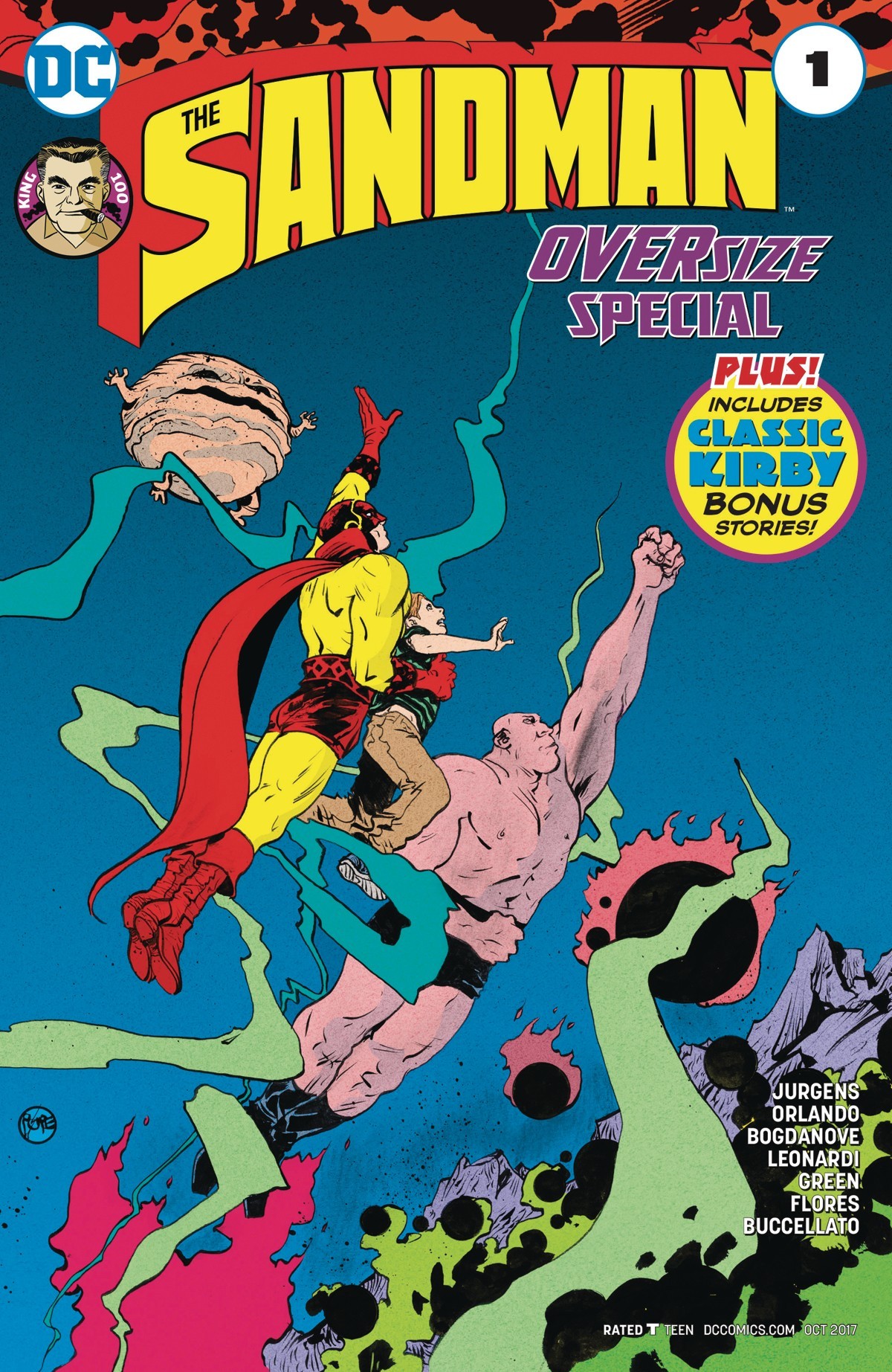
Review : The Sandman Special #1

At this point, there have been way more comic book “Sandmen” than a person can rightly count, and while the most popular remains the Neil Gaiman iteration, it owes a heavy debt — and over the course of its run makes references both tangential and concrete — to the version of the character introduced by Jack Kirby and Joe Simon in 1974. Simon and Kirby had collaborated on another “Sandman” altogether around three decades previously, but the ’70s version, while short-lived, remains beloved by fans and creators alike, and so when DC announced its series of specials in celebration of The King Of Comics’ centenary, it was certain he’d be making a return appearance — and so he has.

The Sandman Special #1 is neatly divided into three distinct sections — the first story, written by consistently-busy veteran Dan Jurgens and illustrated by nowhere-near-as-consistently-busy veteran Jon Bogdanove, sees the land of dreams’ sworn protector, along with colorful and loquacious sidekicks Brute and Glob, working overtime to try to contain the extra-powerful imaginings of a precocious little boy; the second, scripted by Steve Orlando with pencils by Rick Leonardi and inks by Dan Green, sees a now-grown version of Jed, who figured prominently in both the Simon/Kirby and Gaiman series during earlier phases of his “life,” trying to make amends with his past after the death of his grandfather; and the final third is a collection of “Strange Tales Of The D.N.A. Project” back-up strips by Kirby himself that originally ran in the pages of Superman’s Pal Jimmy Olsen. That’s the particulars out of the way, then.

You already don’t need me to tell you that the final section of this $4.99 book is the best one and worth the price of admission alone (that is if you haven’t read all these short, two-page strips already), so let’s talk about the new material : the Jurgens/Bogdanove yarn is definitely the stronger of the two, and while it’s entirely predictable, that’s also the source of its strength and charm — you know who the over-active little dreamer is from the get-go (or at least you know who you want him to be), and events play out precisely as expected. Jurgens’ script is simple and efficient, and really just gets out of the way and lets Bogdanove, who treats us to some sumptuous double-page spreads (including an amazing Kirby-esque collage) have all the fun. That’s as it should be. The art style is pure homage all the way, yet delivered in a manner free of the curse that is intentional irony, thereby allowing it all to look and feel as entirely respectful as it is. Nobody’s re-inventing the wheel here or anything, but I defy you not to have an ear-to-ear grin on your face by the time it’s all said and done.

Somewhat less successful, but still not too shabby, is the Orlando/Leonardi/Green strip — it’s great to see Jed again, don’t get me wrong, but having his grandfather be a physical doppleganger for Kirby feels like a clunkier and more forced tribute than the more seamlessly-woven one delivered just a handful of pages previously. It’s okay enough in its own right, but only that — okay. Again, the art is basically what we’ll call an extended, and entirely polite, tip of the hat to The King.

On the whole, then, I admit that I had plenty of fun reading this book, and a supremely cool cover by the great Paul Pope provides the icing on the cake for this birthday tribute celebration. I paid for this comic out of pocket and didn’t feel ripped-off in the least, and I’ll look forward to reading it again when I go through all these specials in a single sitting once they’ve all been released. Of the three that have come out so far, I’d rank this one in the middle of the pack, just a notch behind Howard Chaykin‘s The Newsboy Legion And The Boy Commandos Special, but well ahead of the dull and unimaginative travesty that was Shane Davis‘ New Gods Special.

Okay, fair enough, the greatest tribute one could pay to Jack Kirby would probably be to create new and innovative characters and concepts that actually push the medium forward, but if you’re bound and determined to play the “nostalgia card,” you could do it a whole lot worse than it’s done in these pages.

Story : Dan Jugens and Steve Orlando  Art : Jon Bogdanove, Rick Leonardi, and Dan Green

Story : 7  Art : 8  Overall : 7.5  Recommendation : Buy


Review: The Sandman Special #1

SandmanSpecialCoverBetween the Sandman with the gas mask and gun and the Gothic, critically acclaimed one, there was the red and yellow superhero suit wearing Sandman created by Joe Simon and Jack Kirby in 1974. In a pair of stories, DC Comics creators both old and new show the imaginative potential of this superhero and his unwilling, monstrous assistants Brute and Glob. First, Dan Jurgens, Jon Bogdanove, and Madpencil tell a heartwarming story with a great twist ending about a young boy whose vivid dreams of monsters and superheroes threaten to break out of the dream world and into reality. Then, there is Steve Orlando, Rick Leonardi, Dan Green, and Steve Buccelato’s slightly wilder tale of the now adult Jed Walker, a supporting character in Sandman, battling his childhood nightmares with a cameo from basically the Grim Reaper. The comic is rounded out by a collection of two page “Strange Stories of the DNA Project” from Jack Kirby’s Fourth World stories.
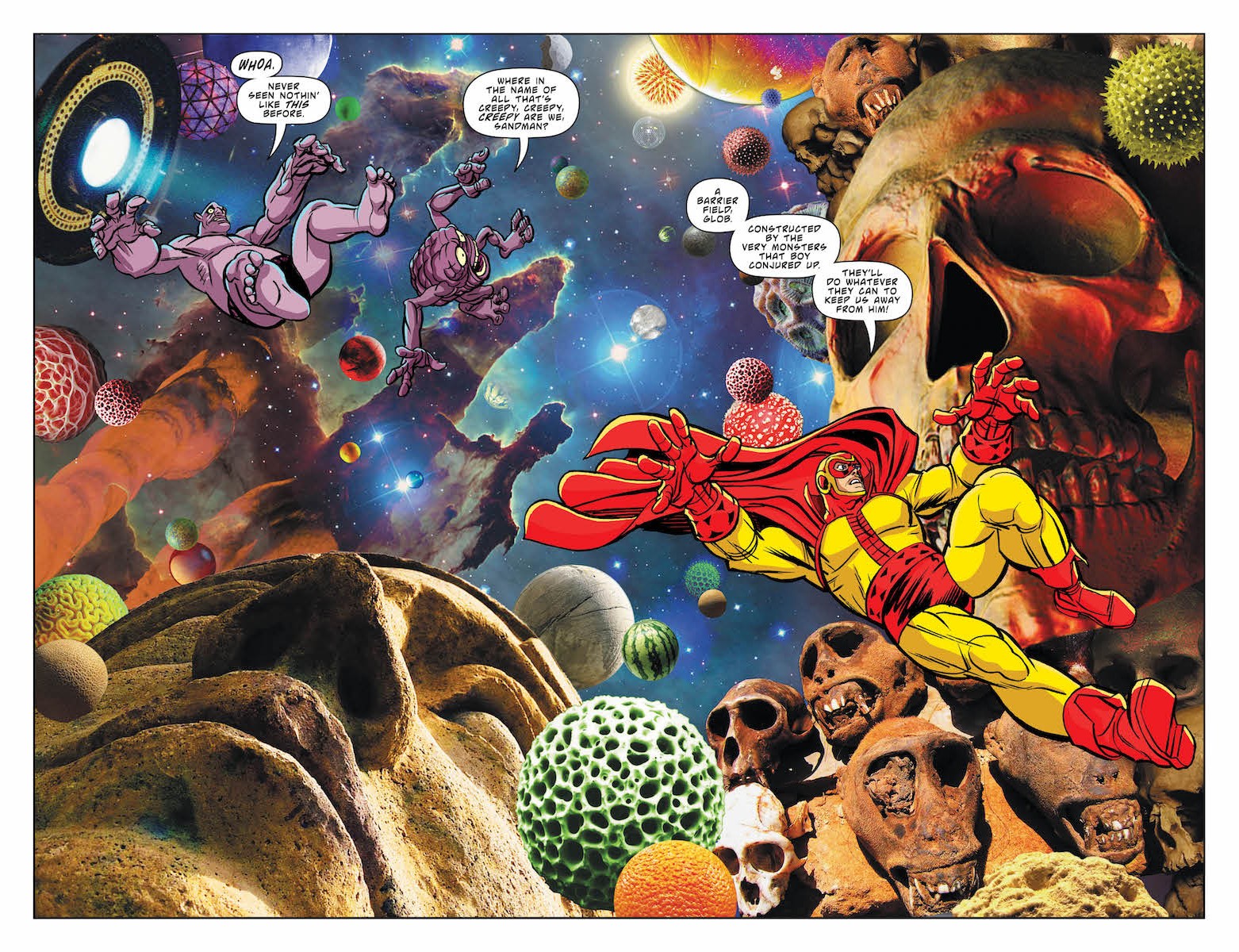
What initially drew me to The Sandman Special was Jon Bogdanove’s uncanny ability to make his art look like Jack Kirby’s while using modern techniques like photo collages to show the surrealness of the young boy’s dream world.  I wish DC Comics put him on more projects. There is weight to Sandman’s throws and punches, and Madpencil cooks up an old school color palette straight out of the 1970s, like a smooth orange take on the classic Kirby krackle. Even though it has banter, punching, a sick team-up move from Sandman and Brute, and a tentacle monster that gets handily defeated, Jurgens and Bogdanove’s story is more metafictional than a straight up superhero adventure ending in a final panel that may make you cry.

Sandmaninterior

Through action and a couple heart rending Jurgens monologues towards the end, The Sandman Special looks at the important of embracing our fears and weaknesses through the dream monsters and then facing and defeating them as symbolized by the young boy’s superhero, who is an amalgamation of Kirby’s takes on Thor, Orion, and a little bit of Captain America. The battle between Sandman and the young boy’s nightmare monsters is also a wonderful tribute to Jack Kirby’s career where he would switch from drawing superheroes to monsters and vice versa from his first work at DC and Marvel in the early 1940s to his later work in the 1970s and 1980s. And sometimes monsters could be heroes, like the ever loving blue eyed Thing, which is why it’s nice to see Bogdanove homage Fantastic Four #1 in one of his panels and have the monster that Sandman fights talk and have feelings.

Unlike the lead story, which quickly establishes Sandman’s kooky status quo with a double page spread, Orlando, Leonardi, and Green rely on previous knowledge of the character of Jed Walker and his grandfather Ezra from Kirby’s Sandman. I vaguely remember Jed from the “Game of You” arc from Neil Gaiman’s Sandman, but luckily the story kicks up a notch when Sandman, Brute, and Glob end up fighting the angel of death in cowboy form Psychopomp on train while looking for a dream about Jed’s grandfather to scare away his now adult nightmares.

Orlando doesn’t really establish Jed as a character except his constant nightmares and that he left his unwelcoming hometown and only returned for his grandfather’s funeral so the big emotional moment isn’t as powerful as it could be. But he does make a human connection to Jed’s nightmares, which are about the fact that he didn’t spend enough time with his grandfather while he was alive. On a more fun note, the banter between Sandman, Brute, and Glob keeps the story from getting too doom and gloom as they sneak and mess around with Psychopomp. Also, I liked that Dan Green used a grittier, inking style for Jed in the “real world” and his feelings of guilt and a cleaner one for Sandman and his more traditional punching and magic whistle blowing heroism. The design for Psychopomp is also a perfect bridge from Jack Kirby’s Sandman to Neil Gaiman’s.

The second story leans too much on previous reader knowledge, but Sandman Special is a fantastic tribute to the well-designed (Both Madpencil and Steve Buccelato make that red and yellow costume pop), filled to the brim with imagination Sandman of the 1970s. It also shows the literal power of dreams to craft limitless opportunities for storytelling

Story: Dan Jurgens, Steve Orlando Art: Jon Bogdanove, Rick Leonardi with Dan Green
Colors: Madpencil, Steve Buccelato

Story: 7.5 Art: 8.5 Overall: 8.0 Recommendation: Buy

DC Comics provided Graphic Policy with a FREE copy for review

Preview: Ultimates 2 #100

ULTIMATES 2 #100

AL EWING (W) • TRAVEL FOREMAN (A/C)
VARIANT COVER by MARK BAGLEY
Kirby 100th Anniversary Variant Cover by JACK KIRBY

A double-sized issue celebrating ULTIMATES #100!

  • Eternity is free – but can even he stand against the might of the First Firmament?
  • Or does the embodiment of everything need help…from Outside?
  • Featuring the Ultimates and…the Ultimates?

40 PGS./Rated T+ …$4.99

Review : The Newsboy Legion And The Boy Commandos Special #1

On paper, this sounded like an idea that was either really going to work — or miss the mark by a country mile.

Howard Chaykin‘s name has, of course, been synonymous with revamping “old-time” characters for decades now — he was the first to do it for The Shadow, and later took a crack at such venerable properties as Blackhawk, Buck Rogers, DC‘s various Silver Age sci-fi stalwarts, and many others. Doing it one more time surely shouldn’t be too much of a challenge — but this is the first time he’s taken on a Jack Kirby creation front and center, and given the relative innocence and whimsy that are the heart and soul of both The Newsboy Legion and The Boy Commandos, well — let’s just say Chaykin doesn’t seem like a “natural fit” for either. And certainly his newly-minted status as very nearly a persona non grata among many fans isn’t going to help matters much in terms of sales here, but if we leave all the controversy aside and just examine this book on its own merits, I have to say — it’s not too shabby at all.

If you’re “off Chaykin,” fair enough — but if you’re not, there’s plenty to really like in the pages of The Newsboy Legion And The Boy Commandos Special  #1 (I’m getting the full title from the copyright indicia even though both “the”s, as well as the “and,” are omitted from the cover) : Chaykin’s typically-crowded and garish visuals are nicely evocative of the worldwide air of confusion and disorientation that no doubt prevailed anywhere and everywhere during WWII; he displays an immediate and easy understanding of his large and sprawling cast and makes them all seem like fairly unique individuals; letterer/effects artist par excellence Ken Bruzenak brings his “A” game and then some; colorist Wil Quintana (who seems to have replaced Jesus Aburto as Chaykin’s hues-man of choice) adds terrific depth, nuance, and vibrancy to every panel and page; the “team-up” of these classic “kid gangs” is achieved by means both logically sound and narratively seamless; the stand-alone story cleverly telegraphs its simple-yet-effective ending early on in a manner that will bring a smile to your face when you think about it later — honestly, this all reads like a very heartfelt and respectful tribute to The King Of Comics that isn’t so much stuck in the past but informed  and inspired by it. The only thing missing that I would have liked to see? That would be The Guardian — but hey, he at least turns up in the classic Joe Simon -scripted, Kirby-drawn Golden Age Newsboy Legion reprint story that’s included as a backup feature (and is, in fairness, the highlight of the book — but how could it not be?), and that serves to round off a nicely-done package that’s $4.99 (which I paid out of pocket) well spent.

There’s a fine line between respectful homage and slavish, uninspired rehash, of course, and these “King 100” specials are sure to have plenty of both (and, indeed, already have, as Shane Davis‘ lackluster New Gods Special #1 was definitely the latter), but it’s probably not fair, given their editorial remit, to expect any of them to be especially groundbreaking or innovative. Chaykin doesn’t strive for either with this book, but he successfully operates within the parameters he’s been given to craft a perfectly enjoyable story that even manages to incorporate some genuine historical material (specifically the attempts of domestic “fifth column” Nazi sympathizers in the US to stage a coup against their own government) that adds an air of intrigue and authenticity to the proceedings that goes well above and beyond what we as readers probably have any right to realistically expect from what could reasonably be assumed, going in, to be nothing more than a simple “throwaway” yarn.

All that being said, if you weren’t a fan of Chaykin’s signature — and frankly singular — style of storytelling prior to this comic, there’s pretty much zero chance that you’ll enjoy it here, either. Things are cluttered, frenetic, deliberately “messy,” and events occur in staggering, rapid-fire succession. He’s been doing this since American Flagg!, and he’s not going to change now. You’re either on-board with “Chaykin Comics,” or you’re not. I admit that I am, but do understand why many readers aren’t, as any number of consensus “Comic Book 101” basics are either bent into unrecognizable form, or ignored altogether in Chaykin’s works. So keep that in mind before you fork over your hard-earned cash for this book.

Final verdict, then : odds are you’ll know whether or not The Newsboy Legion And The Boy Commandos Special #1 is “your kind of comic” before you even give it a glance at your LCS. If it’s not, then it won’t be. If it is, then it will be — and may even exceed your expectations.

Story : Howard Chaykin  Art : Howard Chaykin

Story : 7.5  Art : 8.5  Overall : 8  Recommendation : Buy


« Older Entries Recent Entries »