Tag Archives: demographics

Demo-Graphics Special: Superman Fandom

Demo-Graphics is back because the question still remains… who are comic fans? And we’re back with our first “special” of the year in honor of “Superman Day.”

What is Demo-Graphics?

Each month I dive into data from Facebook looking at the various demographics it can tell us about comic fans. This isn’t hard numbers, purchasers, or “Wednesday warriors,” but best used to show trends in the industry and the potential of the market out there. This has shown the shift towards women being a major force in readers and a shift to the younger demographic.

How does it work?

We use key terms, “likes”, that users have indicated and have come up with our own set to measure each month. There’s over 50 terms used (and no I won’t release them). We stick to specific terms for the industry such as “comics” and “graphic novels” and “one-shots” as well as publishers and leave out broad terms like specific characters or stories. Just because someone likes Batman doesn’t mean they like comics.

With this special Superman edition, it does use terms like the character, films, etc.

Other things to know…

This data is important in that it shows who the potential comic audience could be. These are not purchasers, these are people who have shown an affinity for comics, are potential purchasers, and those with a clear interest.

Also, with this being online/technology, due to laws and restrictions, those under the age of 13 are underrepresented.

Since the last time this feature was run, Facebook has made adjustments as to what it can report so some data is no longer available and we’ve also added in new data that hasn’t been reported before, and it now presents the data as a wide range. I’ve taken the average of the range. So, if it’s presented as somewhere between 500 and 1,000 people, the number would be 750.

So, let’s kick off this special edition!

The terms that could be used were quite limited

In years past, it was far easier to find terms for films, characters, and more, but Facebook has made adjustments that have limited the choices for this report. Still the population is well into the millions, more than enough to have some fun and take a look as to who makes up this population.

Gender

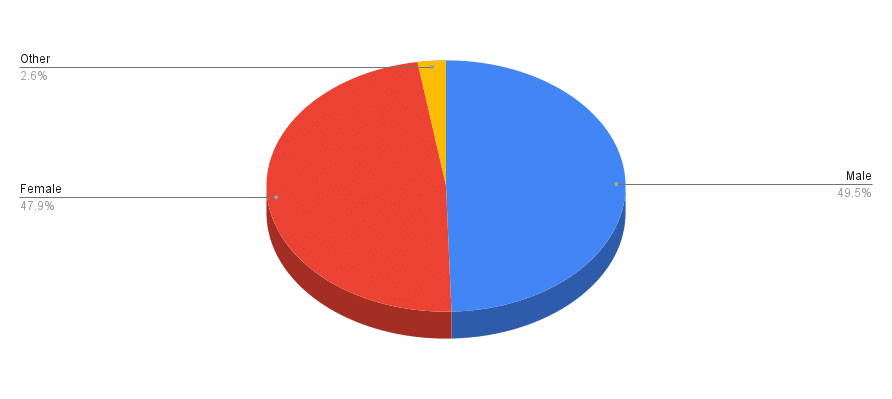
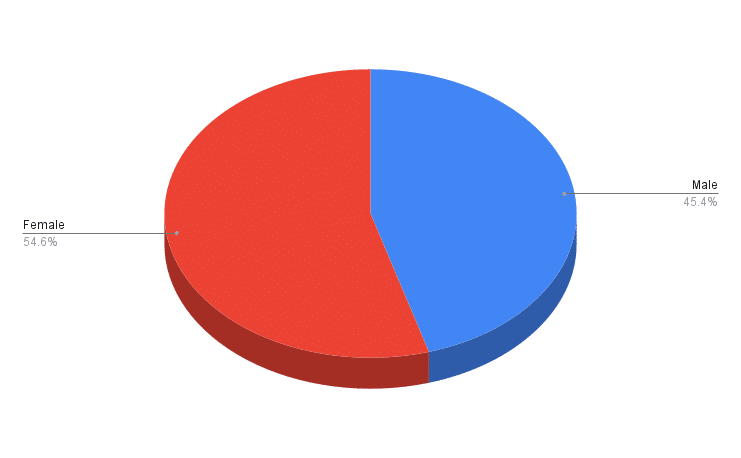
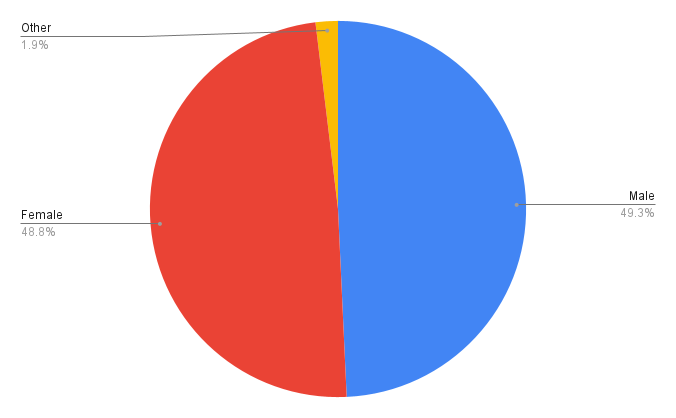
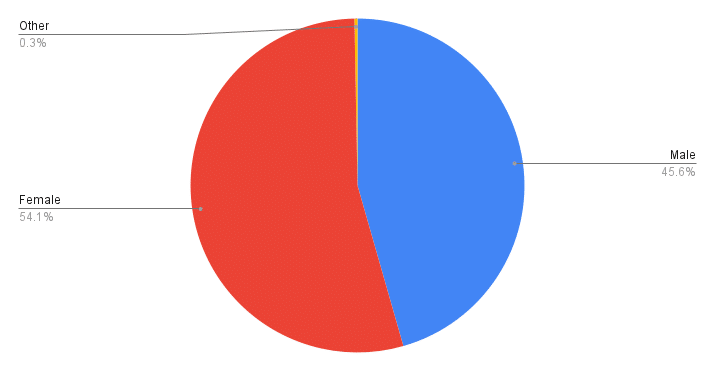
While women still make up the majority of comic fans with about 50% of the population in April, Superman fans skews more male. Men make up 54.15% of the population compared to women with 44.46%. 1.40% are unknown while that percentage is 1.19% for comic fans.

Superman likes by Gender April 2025

Age

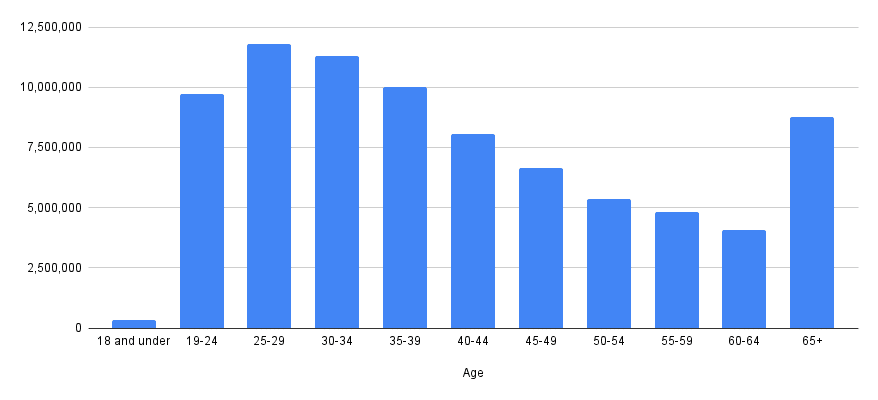
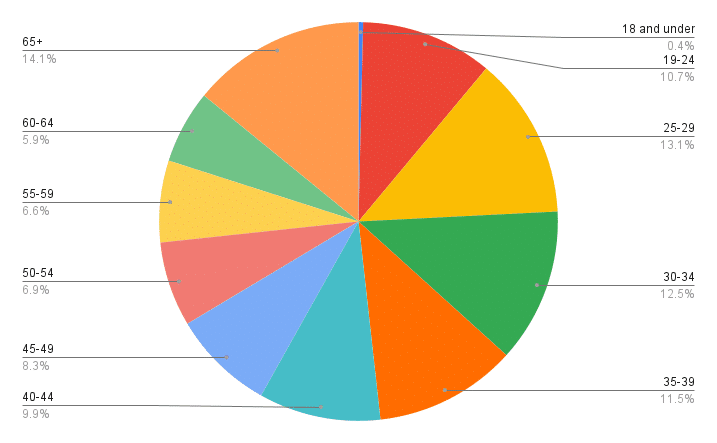
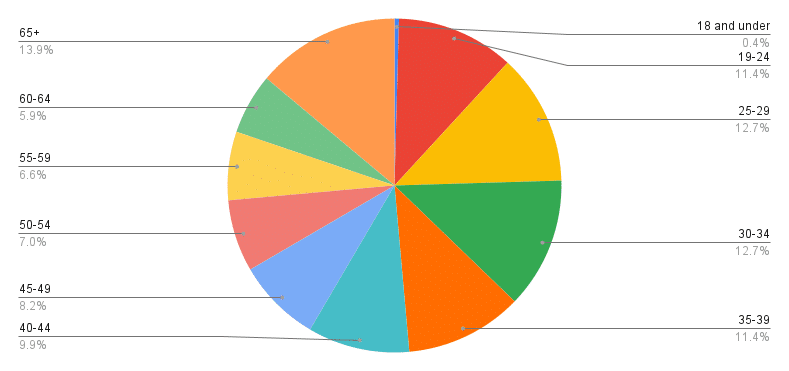
I expected fans of Superman to skew a bit older than the general comic fan population but that doesn’t seem to be the case. This population has a greater percentage in ages 19 to 34. This could be due to the popular television series on The CW that was part of this breakdown. Below is the comparison in ages for Superman likes vs. comic fan likes.

Age breakdown Superman vs. Comics

Relationship Status

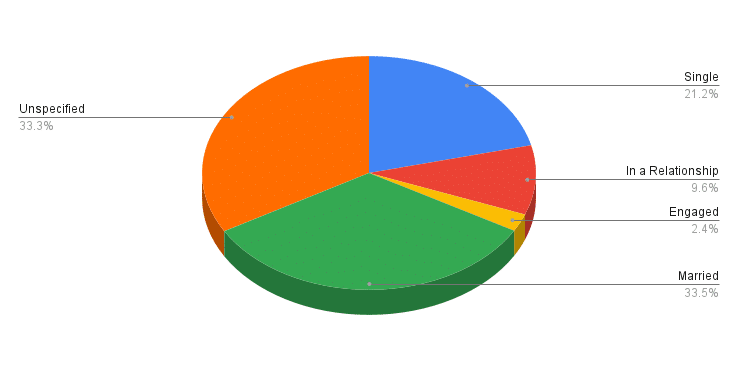
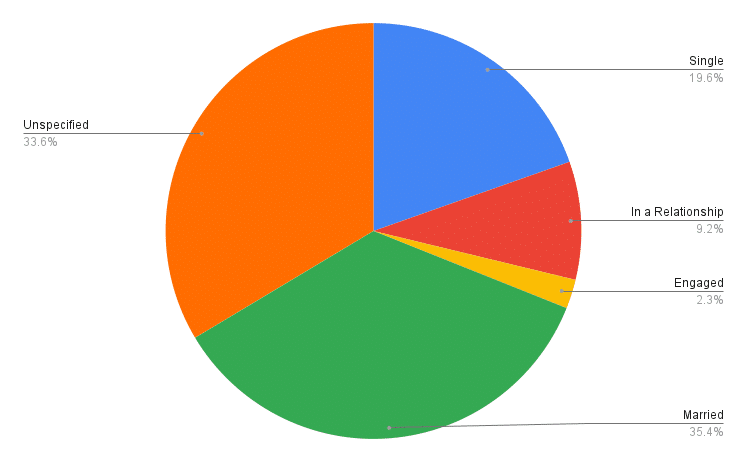
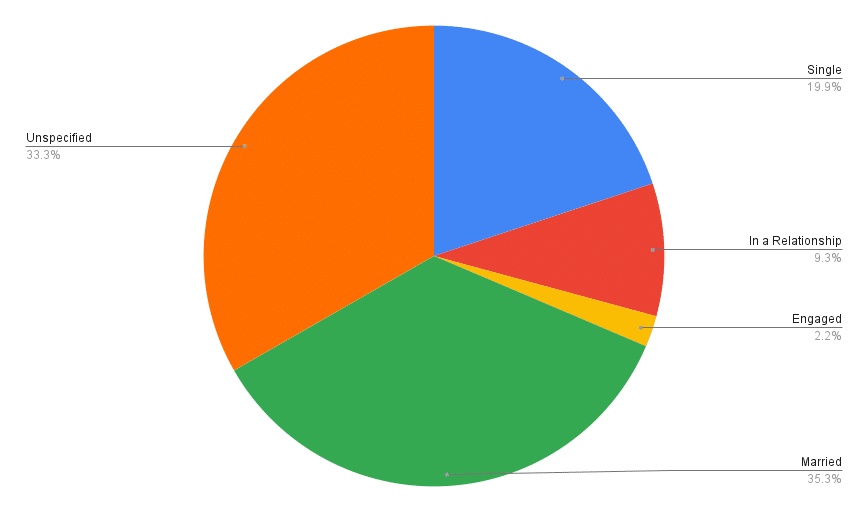
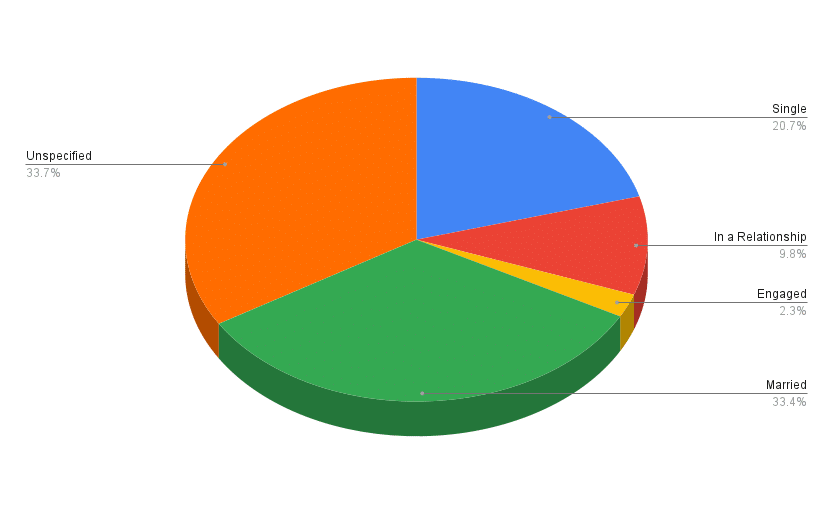
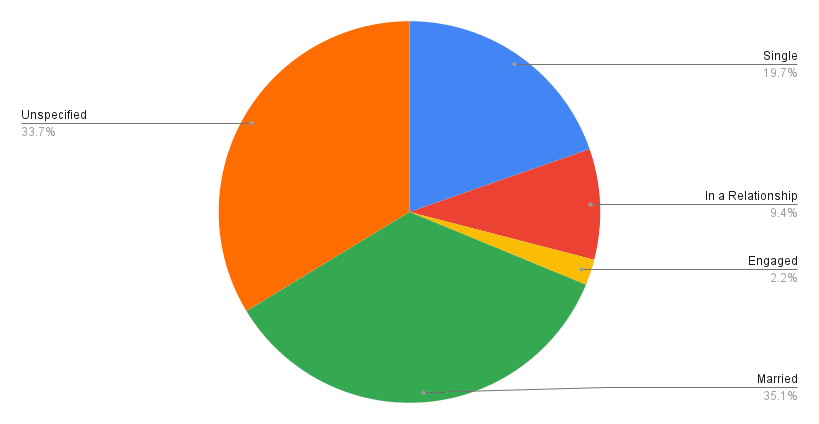
There are some differences between Superman fans and comic fans when it comes to their relationship status. Superman fans have a higher percentage across the board for almost every category.

Relationship status Superman vs. Comics

New Stats!

Parents seem to really like Superman. 30.58% of the population are parents compared to 19.72% of the comic fan population.

And Superman fans seem to be more into board games and video games. 38.80% of the population enjoy board games and 73.30% are video game fans compared to comics’ 35.70% and 58.50%. So where’s out Superman board game and video games!?

Demo-Graphics: Comic Fandom continues to slide for the year

Demo-Graphics is back with its third entry for 2025! Demo-Graphics was relaunched because the question still remains… who are comic fans?

What is Demo-Graphics?

Each month I dive into data from Facebook looking at the various demographics it can tell us about comic fans. This isn’t hard numbers, purchasers, or “Wednesday warriors,” but best used to show trends in the industry and the potential of the market out there. This has shown the shift towards women being a major force in readers and a shift to the younger demographic.

How does it work?

We use key terms, “likes”, that users have indicated and have come up with our own set to measure each month. There’s over 50 terms used (and no I won’t release them). We stick to specific terms for the industry such as “comics” and “graphic novels” and “one-shots” as well as publishers and leave out broad terms like specific characters or stories. Just because someone likes Batman doesn’t mean they like comics.

Other things to know…

This data is important in that it shows who the potential comic audience could be. These are not purchasers, these are people who have shown an affinity for comics, are potential purchasers, and those with a clear interest.

Also, with this being online/technology, due to laws and restrictions, those under the age of 13 are underrepresented.

Since the last time this feature was run, Facebook has made adjustments as to what it can report so some data is no longer available and we’ve also added in new data that hasn’t been reported before, and it now presents the data as a wide range. I’ve taken the average of the range. So, if it’s presented as somewhere between 500 and 1,000 people, the number would be 750.

So, let’s kick off the latest entry with the big question…

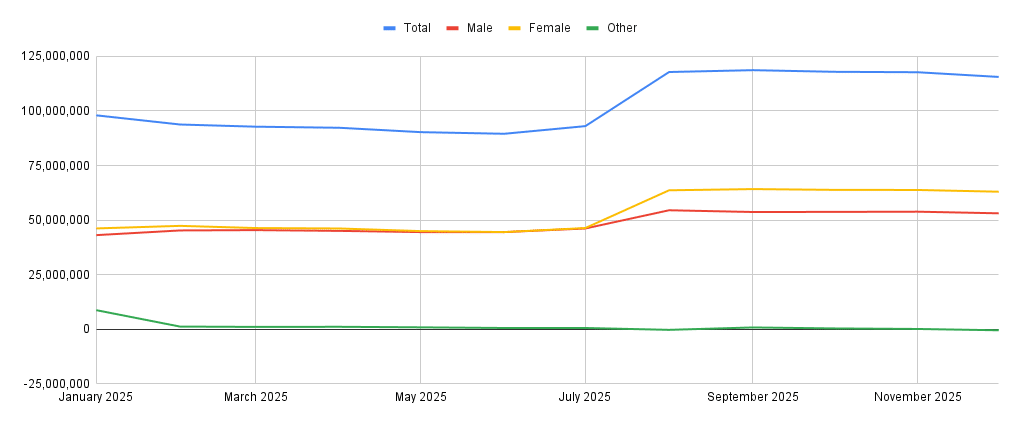
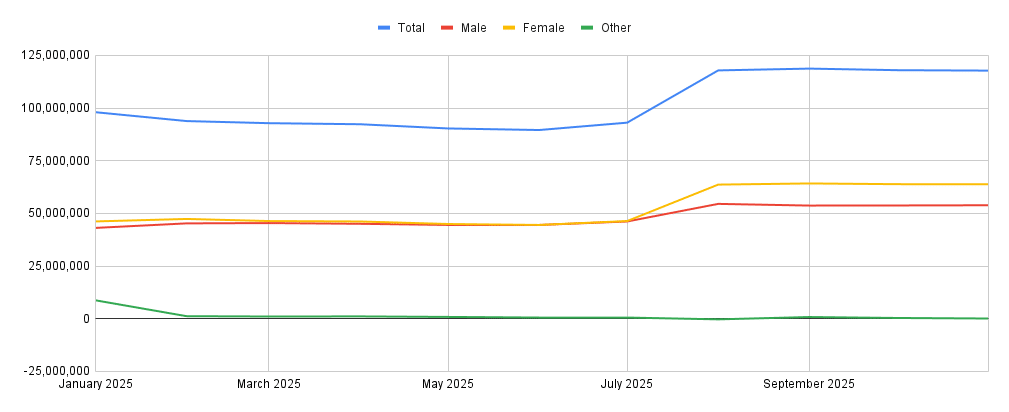
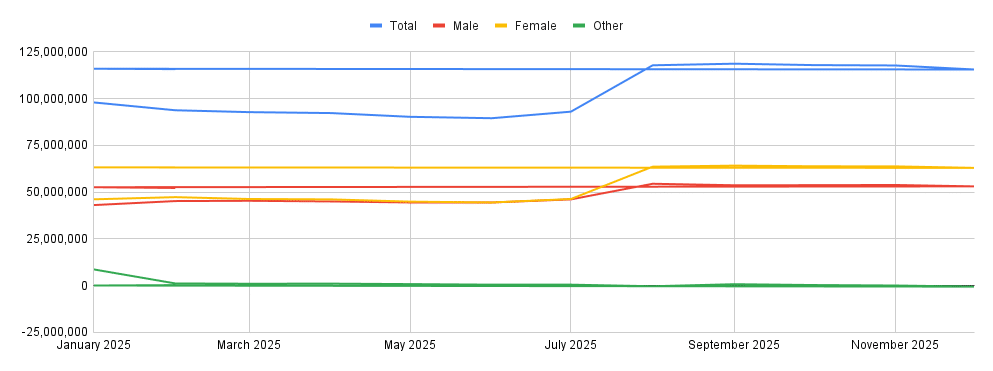
Facebook “Comic Fan” Population: Around 92.3 million in the United States

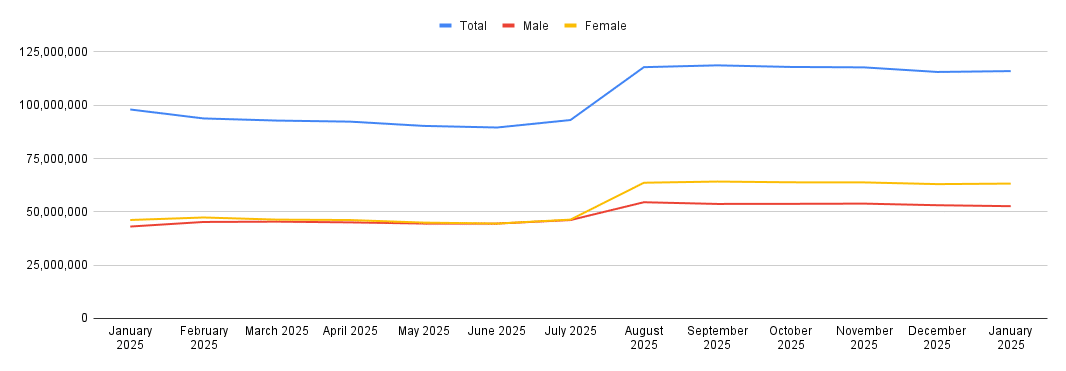
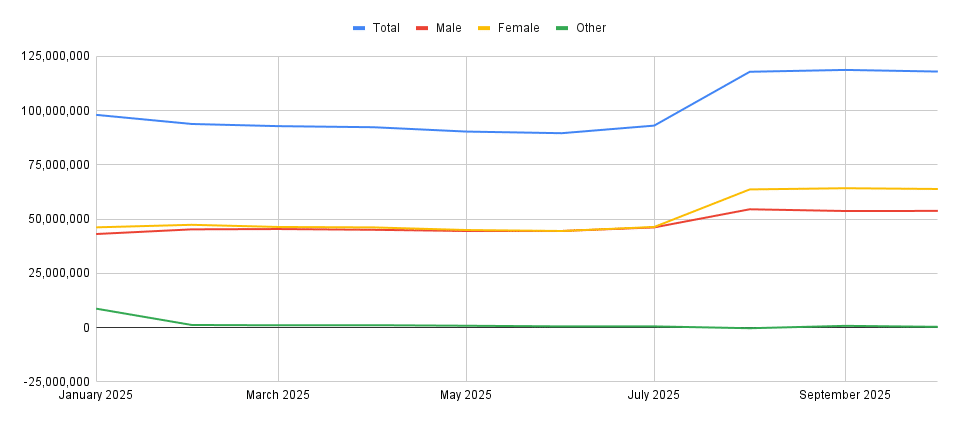
2025 is off to an interesting start as we’ve now seen three months in a row in a decrease in the overall population. That’s a 500,000 decrease from the previous month 5.7 million from the beginning of the year. and The loss is just a few of the segments while many remained the same as the previous month. These numbers often are ahead of sales trends and we might be seeing unease in the economy playing out in some way. If there’s a continue dip, we mighty see sales issues within a few months.

Facebook comic population April 2025

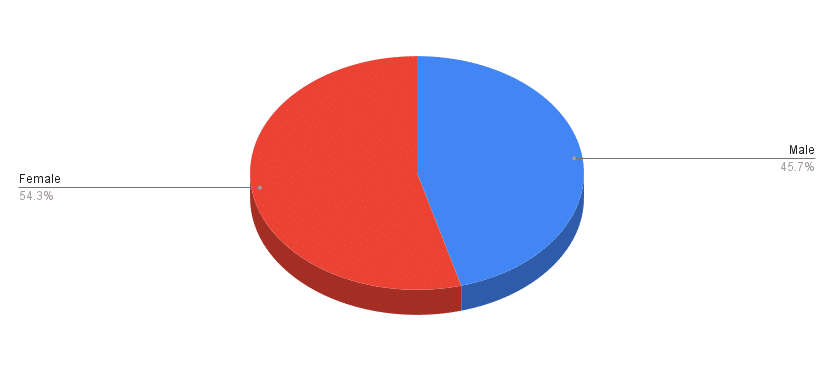
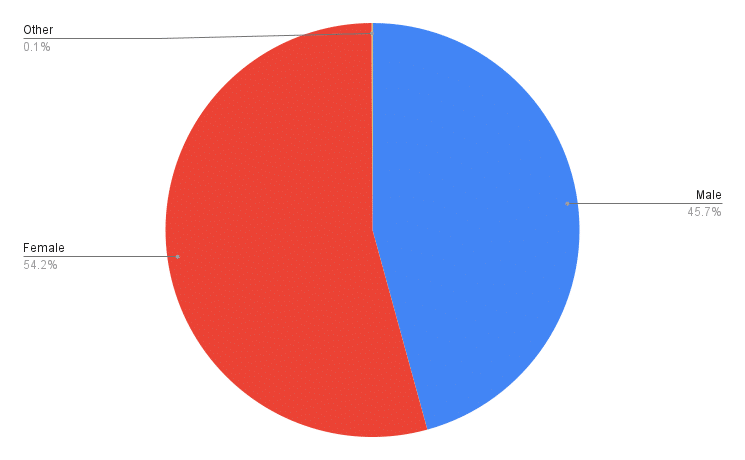
Gender

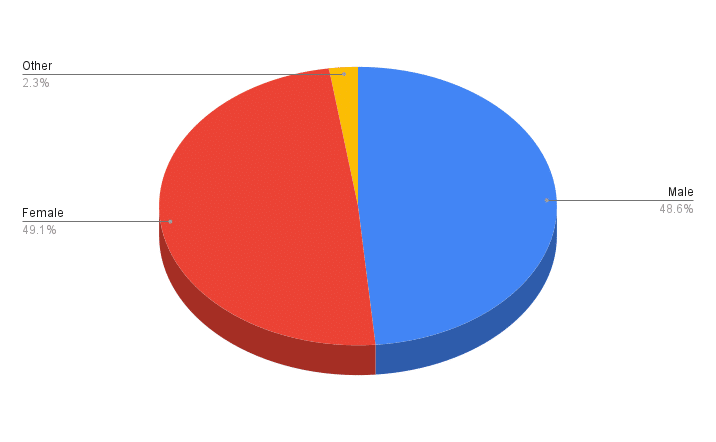
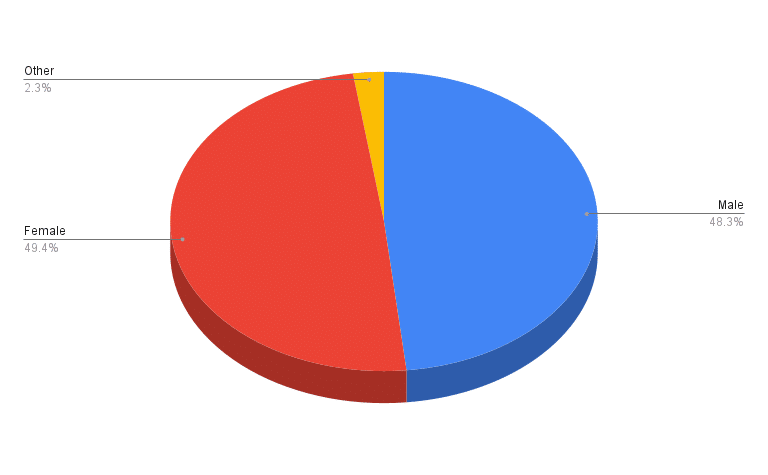
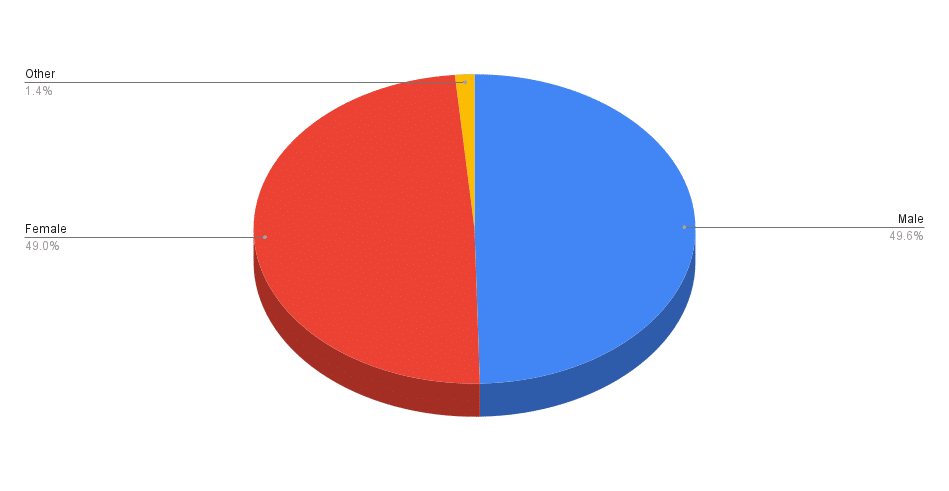
Women still make up the majority of comic fans with a slight gain over the month as far as their percent of their population. Women account for 50% of the population while men are 48.81%, and other is 1.19%.

Facebook comic fans gender April 2025

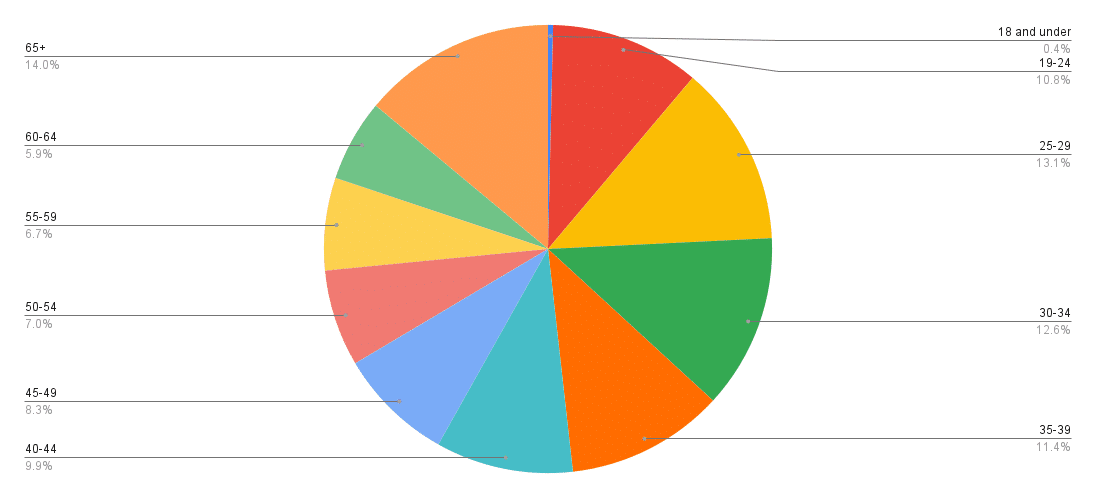
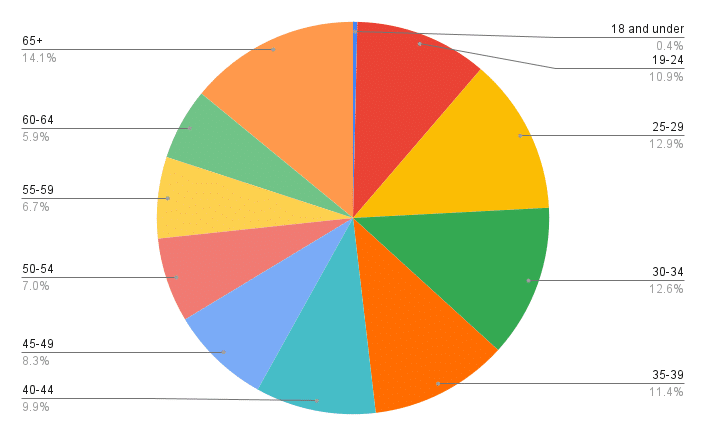
Age

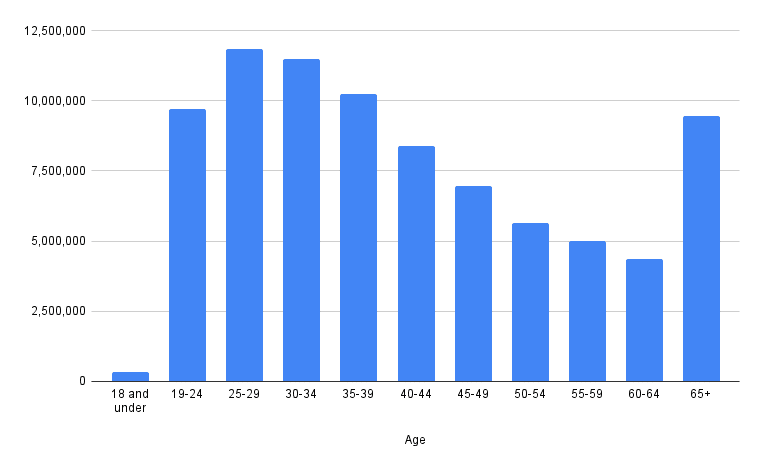
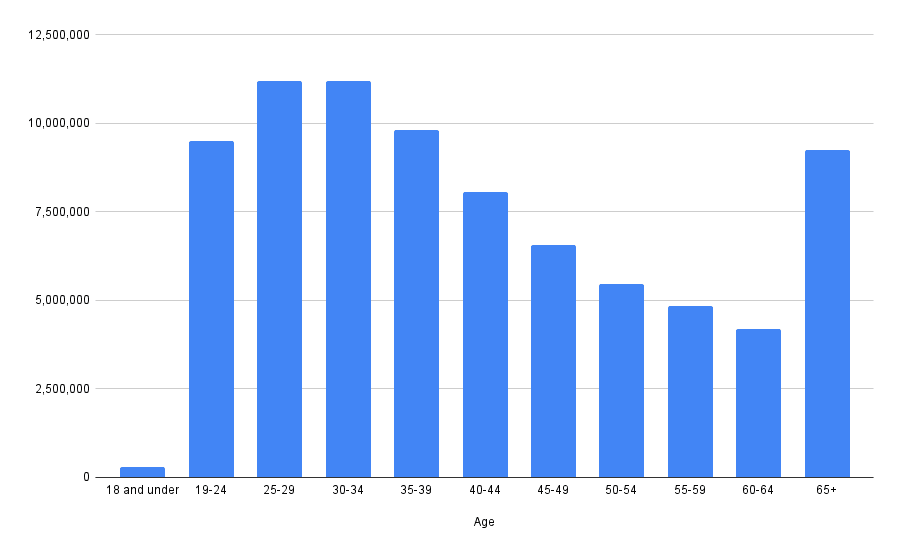
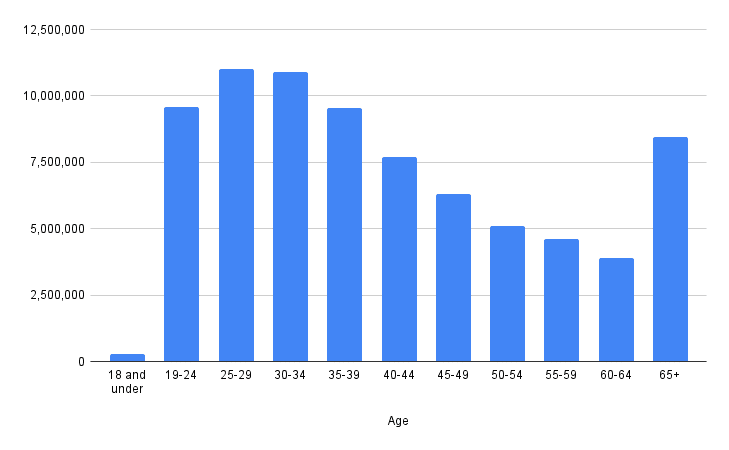
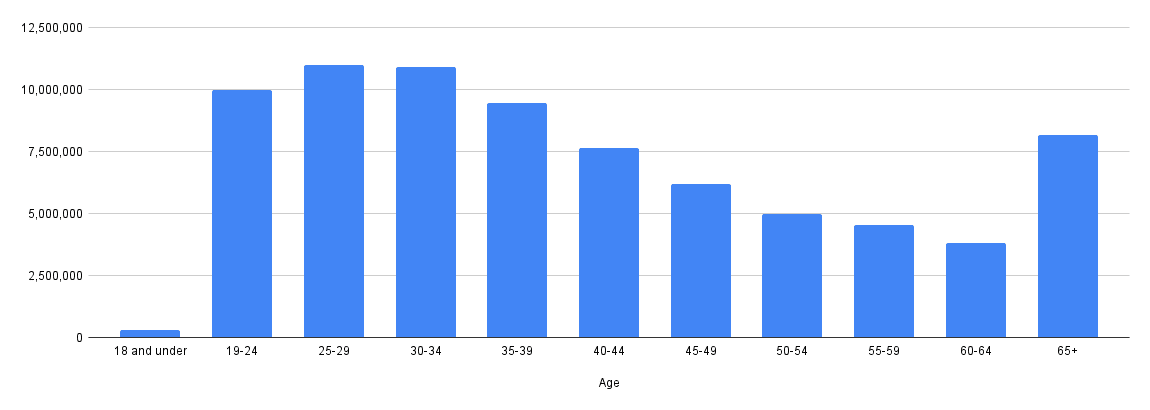
I’ve shifted how I’ve grouped ages so the data is a little different than before this year’s relaunch. While before “under 18” was one, it’s now “18 and under” with each subsequent grouping being 5 year blocks. This data is absolutely skewed as 1) It is believed younger individuals don’t use Facebook as much in the past and have migrated to other platforms; and 2) Laws restrict what can be collected based on age, ie those under the age of 13 shouldn’t even have accounts. So, younger readers are absolutely under-counted.

Age breakdown comic fans Facebook April 2025

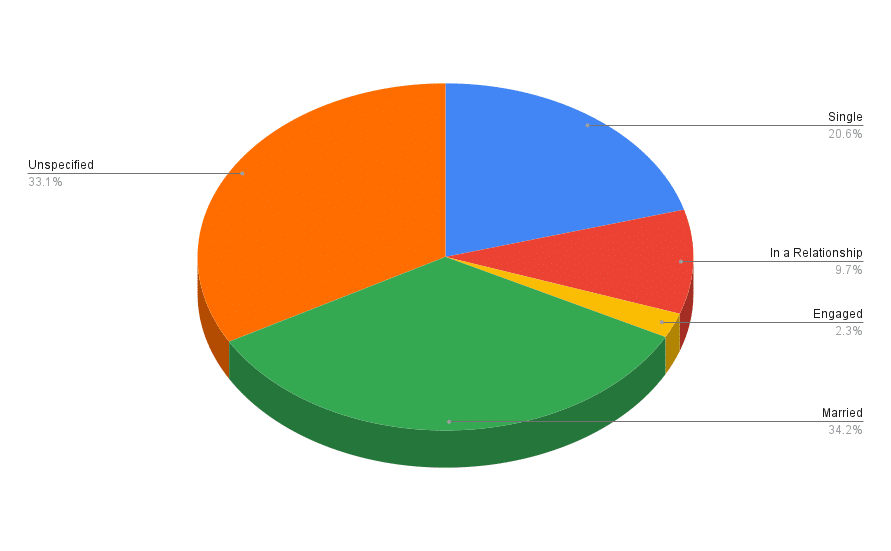
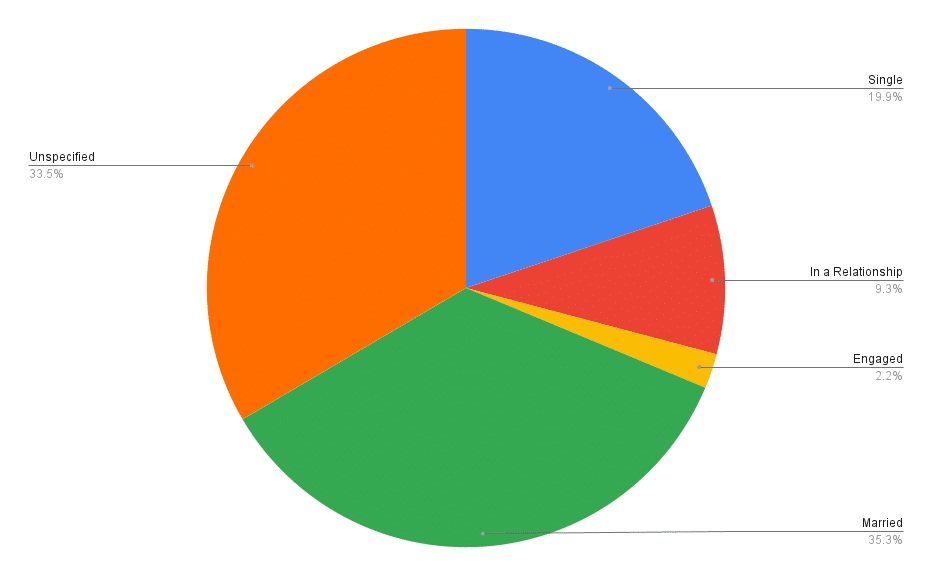
Relationship Status

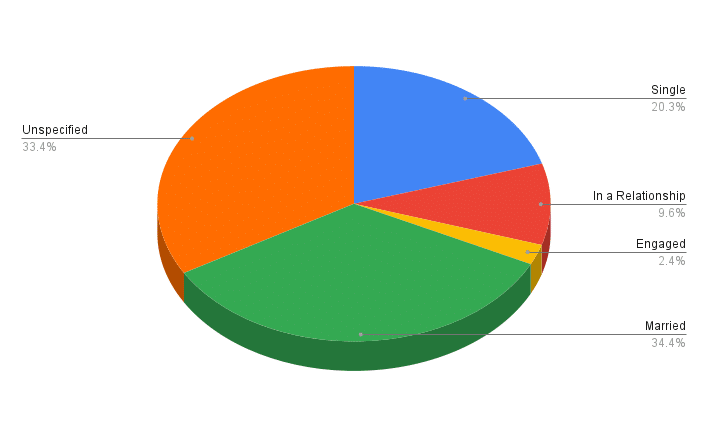
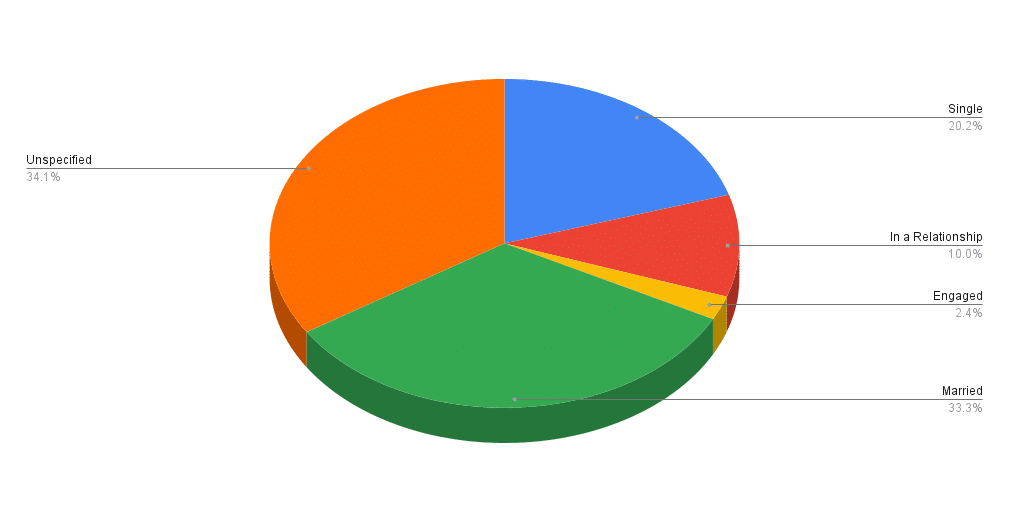
The percentages remained very similar to the previous month with little ship as to the relationship status of the universe.

Relationship status breakdown comic fans Facebook April 2025

New Stats!

Education has been combined to see how many individuals have at least a college degree. About 25.9 million fit that which means 28.06%. In 2022, 37.7% of the American population had at least a college degree.

18.2 million fans, 19.72%, are parents!

And finally, what’s the crossover with fans of board games and video games? 32.95 million, 35.70% of comic fans also enjoy board games. 54 million, 58.50% also enjoy video games. Get your licensing engines revving!
What’s Next?

All of this is a re-starting point. Things have shifted in how I’m collecting the data, like age, but it’s been quite a while since I’ve regularly done this. As we move along, we’ll continue to look at trends over time.

There’s some legacy data I’m going to try and fill in so we can get a better sense of how things have shifted over time that will hopefully be available next month. And, part of that will be me trying to find the original data files from many computers ago. Lots of work so we can all have a better sense of where things stand! Until next time… what gets measured, gets done!

Demo-Graphics: Comic Fandom continues a dip for the year

Demo-Graphics is back with its second entry for 2025! Demo-Graphics was relaunched because the question still remains… who are comic fans? While I got the information for February, I wanted to wait a month to start showing off more trends than a one month change.

What is Demo-Graphics?

Each month I dive into data from Facebook looking at the various demographics it can tell us about comic fans. This isn’t hard numbers, purchasers, or “Wednesday warriors,” but best used to show trends in the industry and the potential of the market out there. This has shown the shift towards women being a major force in readers and a shift to the younger demographic.

How does it work?

We use key terms, “likes”, that users have indicated and have come up with our own set to measure each month. There’s over 50 terms used (and no I won’t release them). We stick to specific terms for the industry such as “comics” and “graphic novels” and “one-shots” as well as publishers and leave out broad terms like specific characters or stories. Just because someone likes Batman doesn’t mean they like comics.

Other things to know…

This data is important in that it shows who the potential comic audience could be. These are not purchasers, these are people who have shown an affinity for comics, are potential purchasers, and those with a clear interest.

Also, with this being online/technology, due to laws and restrictions, those under the age of 13 are underrepresented.

Since the last time this feature was run, Facebook has made adjustments as to what it can report so some data is no longer available and we’ve also added in new data that hasn’t been reported before, and it now presents the data as a wide range. I’ve taken the average of the range. So, if it’s presented as somewhere between 500 and 1,000 people, the number would be 750.

So, let’s kick off the latest entry with the big question…

Facebook “Comic Fan” Population: Around 92.8 million in the United States

2025 is off to an interesting start as we’ve now seen two months in a row in a decrease in the overall population. The loss is nearly across the board as far as age group though 30-34 remained the same and 35-39 increased slightly. These numbers often are ahead of sales trends and we might be seeing unease in the economy playing out in some way. If there’s a continue dip, we mighty see sales issues within a few months.

Facebook comic fan population over time

Gender

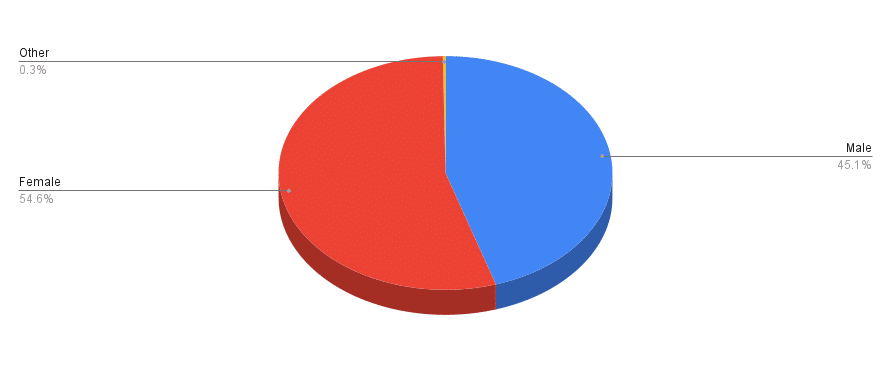
Women still make up the majority of comic fans but men have made some gains over the months. Women account for 49.95% of the population while men are 48.92%, and other is 1.13%. The gains in those reported as men as seen gains over the months as “other” has decreased. This could be more due to the current negative climate for those not conforming to a binary choice.

Gender breakdown comic fans Facebook March 2025

Age

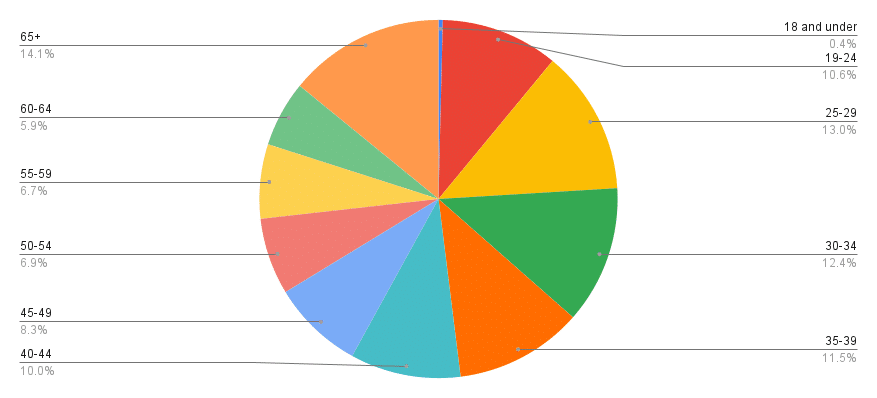
I’ve shifted how I’ve grouped ages so the data is a little different than before this year’s relaunch. While before “under 18” was one, it’s now “18 and under” with each subsequent grouping being 5 year blocks. This data is absolutely skewed as 1) It is believed younger individuals don’t use Facebook as much in the past and have migrated to other platforms; and 2) Laws restrict what can be collected based on age, ie those under the age of 13 shouldn’t even have accounts. So, younger readers are absolutely under-counted.

Age breakdown comic fans Facebook March 2025

Relationship Status

Those “married” has decrease over the past few months. It’s possible this is the population that is part of the decrease of the population.

Relationship status breakdown comic fans Facebook March 2025

New Stats!

Education has been combined to see how many individuals have at least a college degree. About 26 million fit that which means 28.02%. In 2022, 37.7% of the American population had at least a college degree.

19.15 million fans, 20.64%, are parents!

And finally, what’s the crossover with fans of board games and video games? 33.5 million, 36.10% of comic fans also enjoy board games. 54.55 million, 58.78% also enjoy video games. Get your licensing engines revving!
What’s Next?

All of this is a re-starting point. Things have shifted in how I’m collecting the data, like age, but it’s been quite a while since I’ve regularly done this. As we move along, we’ll continue to look at trends over time.

There’s some legacy data I’m going to try and fill in so we can get a better sense of how things have shifted over time that will hopefully be available next month. And, part of that will be me trying to find the original data files from many computers ago. Lots of work so we can all have a better sense of where things stand! Until next time… what gets measured, gets done!

Demo-Graphics: Comic Fandom on Facebook is Back!

Demo-Graphics is back! After an almost 4 year break since the last report, I’m relaunching Demo-Graphics because the question still remains… who are comic fans? With a new year, it felt like the right time to bring back the feature monthly and see how trends shift over time.

What is Demo-Graphics?

Each month I dive into data from Facebook looking at the various demographics it can tell us about comic fans. This isn’t hard numbers, purchasers, or “Wednesday warriors,” but best used to show trends in the industry and the potential of the market out there. This has shown the shift towards women being a major force in readers and a shift to the younger demographic.

How does it work?

We use key terms, “likes”, that users have indicated and have come up with our own set to measure each month. There’s over 50 terms used (and no I won’t release them). We stick to specific terms for the industry such as “comics” and “graphic novels” and “one-shots” as well as publishers and leave out broad terms like specific characters or stories. Just because someone likes Batman doesn’t mean they like comics.

Other things to know…

This data is important in that it shows who the potential comic audience could be. These are not purchasers, these are people who have shown an affinity for comics, are potential purchasers, and those with an interest.

Also, with this being online/technology, due to laws and restrictions, those under the age of 13 are underrepresented.

Since the last time this feature was run, Facebook has made adjustments as to what it can report so some data is no longer available and we’ve also added in new data that hasn’t been reported before, and it now presents the data as a wide range. I’ve taken the average of the range. So, if it’s presented as somewhere between 500 and 1,000 people, the number would be 750.

So, let’s kick things off with the big number…

Facebook “Comic Fan” Population: Around 98 million in the United States

I’m honestly kicking myself that I wasn’t tracking this during the pandemic. Interest in collectibles blew up during that time and it’d have been interesting to track how things have shifted. Never before revealed, in January 2023 data was pulled and it revealed a population of 118.3 million. We’ve seen a 17.16% decrease in that two year period and that could match the reported cooling in sales and/or it could also be a decrease in the overall number of individuals on Facebook which was not recorded at the time. In January 2021 the same population was 73 million and in January 2018 it was 57 million.

Gender

Women still make up the majority of comic fans but those listed as “other” (Facebook is not good on this data) has increased a lot over the years. Women account for 47.12% of the population while men are 43.98%, and other is 8.90%.

Gender breakdown of comic fans on Facebook January 2025

Age

I’ve shifted how I’ve grouped ages so the data is a little different than before. While before “under 18” was one, it’s now “18 and under” with each subsequent grouping being 5 year blocks. This data is absolutely skewed as 1) It is believed younger individuals don’t use Facebook as much in the past and have migrated to other platforms; and 2) Laws restrict what can be collected based on age, ie those under the age of 13 shouldn’t even have accounts. So, younger readers are absolutely under-counted.

Age breakdown of comic fans on Facebook January 2025

Relationship Status

It feels like more are married now with the largest segment being exactly that and the second not reporting their relationship status. It could very well be a sign of an aging population of fans.

Relationship Status breakdown of comic fans on Facebook January 2025

New Stats!

Education has been combined to see how many individuals have at least a college degree. About 28.15 million fit that which means 28.72%. In 2022, 37.7% of the American population had at least a college degree.

14.2 million fans, 14.49%, are parents!

And finally, what’s the crossover with fans of board games and video games? 33.5 million, 34.18% of comic fans also enjoy board games. 59.5 million, 60.71% also enjoy video games. Get your licensing engines revving!
What’s Next?

All of this is a re-starting point. Things have shifted in how I’m collecting the data, like age, but it’s been quite a while since I’ve regularly done this. As we move along, we’ll start to look at trends over time.

There’s some legacy data I’m going to try and fill in so we can get a better sense of how things have shifted over time that will hopefully be available next month. And, part of that will be me trying to find the original data files from many computers ago. Lots of work so we can all have a better sense of where things stand! Until next time… what gets measured, gets done!

Demo-Graphics: Comic Fandom on Facebook – US Edition

Demo-Graphics is back! We’re looking at where the “comic fans” stand when it comes to demographic details as of March 1st!

What is Demo-Graphics?

Each month I dive into data from Facebook looking at the various demographics it can tell us about comic fans. This isn’t hard numbers but best used to show trends in the industry and the potential of the market out there. This has shown the shift towards women being a major force in readers and a shift to the younger demographic.

How does it work?

We use key terms, “likes”, that users have indicated and have come up with our own set to measure each month. There’s over 50 terms used (and no I won’t release them). We stick to specific terms for the industry such as “comics” and “graphic novels” and “one-shots” as well as publishers and leave out broad terms like specific characters or stories. Just because someone likes Batman doesn’t mean they like comics.

Other things to know…

This data is important in that it shows who the potential comic audience could be. These are not purchasers, these are people who have shown an affinity for comics and are potential purchasers and those with an interest.

Also, with this being online/technology, due to laws and restrictions, those under the age of 13 are underrepresented.

Since the last time this feature was run, Facebook has made adjustments as to what it can report so some data is no longer available and we’ve also added in new data that hasn’t been reported before (but some of it has been tracked over the years).

Facebook Population: Around 60 million in the United States

Last month, we reported around 67 million. Things have dipped over the month with women making up about 31 million and men 29 million.

The Spanish-speaking population last month was 13.58%, that number has remained improved over the month to 14.00%.

NEW: Comics focused on kids has been an explosive area of growth over the years. The data tells us that 21.67% of comics fans are parents, that’s 13 million individuals! The number of parents remained the same but with a smaller population, the percentage increased.

Gender and Age

Women have been a majority for a long time in this reporting. They continue to be exactly that accounting for 51.67% of the comic fans down from last month’s 52.24%. Men accounted for 47.76% last month and now account for 48.33%. Women regularly became the majority of the fandom back in October 2017 when we first saw a 50/50 split in the demographics.

Facebook still is not good about placing gender in a binary, but it’s still a goal to better report beyond just the two regularly listed.

As we can see by the numbers below, women do slip as the majority from around age 22 to 33.

Facebook demographics gender 3.1.21
Facebook demographics gender age 3.1.21

Relationship Status

Things have remained relatively steady over the month but there has been some changes from the previous month.

How has things changed?

  • Those who have marked themselves “single” decreased about 1 million
  • Those that are “engaged” decreased by 100,000
  • Those “in a relationship” decreased 500,000
  • “Married” has decreased by 1 million
  • Other statuses shifted in numbers but their percentages remained mostly unchanged.
Facebook demographics relationship status 3.1.21

Education

Things remained steady with decreases as expected due to the smaller population. Things decreased across the board and none of it stands out.

Comic book demographics education March 1, 2021.

NEW – Political Leaning

Facebook is a data trove of political information. While I regularly tracked the information, I have never reported on the political leanings of the comic fans there. Well, here’s the third such release of the data!

Comic book demographics political leanings March 1, 2021.

But what about the gender of those comic fans?

Comic book demographics political leanings by gender March 1, 2021.

We can see, according to this data that comic fans lean more liberal. There are some interesting differences in that Conservatives are dominated by men while those Liberal and Moderate see women as a majority. Moderates especially see more women than men, even more so than liberals. We’ll see how this shifts over the months and years with the flow of American politics.


That’s it! Or, not… we’ll be back as we see the European statistics!

Demo-Graphics: Comic Fandom on Facebook – European Edition

We hinted at the return of some long-shelved regular features on the site, and the first back is Demo-Graphics! Earlier this month, we ran the statistics for comic fans within the United States and today (after a bit of a delay) we’re back with the second reporting of statistics from Europe!

What is Demo-Graphics?

Each month I dive into data from Facebook looking at the various demographics it can tell us about comic fans. This isn’t hard numbers but best used to show trends in the industry and the potential of the market out there. This has shown the shift towards women being a major force in readers and a shift to the younger demographic.

How does it work?

We use key terms, “likes”, that users have indicated and have come up with our own set to measure each month. There’s over 50 terms used (and no I won’t release them). We stick to specific terms for the industry such as “comics” and “graphic novels” and “one-shots” as well as publishers and leave out broad terms like specific characters or stories. Just because someone likes Batman doesn’t mean they like comics.

Other things to know…

This data is important in that it shows who the potential comic audience could be. These are not purchasers, these are people who have shown an affinity for comics and are potential purchasers and those with an interest.

Also, with this being online/technology, due to laws and restrictions, those under the age of 13 are underrepresented.

Since the last time this feature was run, Facebook has made adjustments as to what it can report so some data is no longer available and we’ve also added in new data that hasn’t been reported before (but some of it has been tracked over the years).

Facebook Population: Over 100,000,000 in Europe

That’s an increase of 2 million compared to the previous month. That’s 33 million more individuals compared to what I reported for the United States earlier this week.

Gender and Age

Interestingly, men account for the majority of fans. They account for 51.0% of the population compared to 50% of women. That’s a flip of the statistics in the United States where women are the majority. When looking at the data broken down by ages, women are a slight majority with about 2 million more individuals. So, it’s best to probably think of this fandom as pretty split between men and women.

There can be issues when breakdowns like this are close on Facebook as the app tends to round up and down with large numbers causing discrepancies and results greater than 50%.

Europe Facebook Gender February 2021

Similar to the previous month, things remain the same with men becoming a slim majority in the age 22-25 age group and then lose it in the 34-37 age group. It’s a similar statistic to the United States.

Europe Facebook Gender Age February 2021

Relationship Status

Compared to last month’s results things have changed slightly. While the overall population grew about 2 million, these stats increased about 1.4 million.

Highlights:

  • “In Relationship” increased by 200,000
  • “Unspecified” increased by 1 million
  • “Domestic Partnership” increased by 10,000
  • “Divorced” increased by 10,000
  • “Widowed” increased by 10,000
Facebook demographics relationship comic fans in Europe 1.1.21

Education

Things remain pretty steady when it comes to education. The percentages remain pretty much unchanged.

Facebook demographics education comic fans in Europe 2.1.21

Up next, we’ll compare the two groups of comic fans!

Demo-Graphics: Comic Fandom on Facebook – US Edition

We hinted at the return of some long-shelved regular features on the site, and the first back is Demo-Graphics!

What is Demo-Graphics?

Each month I dive into data from Facebook looking at the various demographics it can tell us about comic fans. This isn’t hard numbers but best used to show trends in the industry and the potential of the market out there. This has shown the shift towards women being a major force in readers and a shift to the younger demographic.

How does it work?

We use key terms, “likes”, that users have indicated and have come up with our own set to measure each month. There’s over 50 terms used (and no I won’t release them). We stick to specific terms for the industry such as “comics” and “graphic novels” and “one-shots” as well as publishers and leave out broad terms like specific characters or stories. Just because someone likes Batman doesn’t mean they like comics.

Other things to know…

This data is important in that it shows who the potential comic audience could be. These are not purchasers, these are people who have shown an affinity for comics and are potential purchasers and those with an interest.

Also, with this being online/technology, due to laws and restrictions, those under the age of 13 are underrepresented.

Since the last time this feature was run, Facebook has made adjustments as to what it can report so some data is no longer available and we’ve also added in new data that hasn’t been reported before (but some of it has been tracked over the years).

Facebook Population: Around 67 million in the United States

Last month, we reported around 70 million. Things have dipped over the month with women making up about 35 million and men 32 million.

The Spanish-speaking population last month was 13.29%, that number has remained improved over the month to 13.58%.

NEW: Comics focused on kids has been an explosive area of growth over the years. The data tells us that 19.4% of comics fans are parents, that’s 13 million individuals! The amount of parents remained the same but with a smaller population, the percentage increased.

Gender and Age

Women have been a majority for a long time in this reporting. They continue to be exactly that accounting for 52.24% of the comic fans down from last month’s 52.86%. Men at accounted for 47.14% last month and now account for 47.76%. Women regularly became the majority of the fandom back in October 2017 when we first saw a 50/50 split in the demographics.

Facebook still is not good about placing gender in a binary, but it’s still a goal to better report beyond just the two regularly listed.

As we can see by the numbers below, women do slip as the majority from around age 22 to 33.

Comic book demographics gender February 1, 2021.
Comic book demographics gender and age February 1, 2021.

Relationship Status

Things have remained relatively steady over the month but there has been some changes from the previous month.

How has things changed?

  • Those who have marked themselves “single” decreased about 1 million
  • Those “in a relationship” decreased 300,000
  • “Unspecified” has increased 1 million
  • Other statuses shifted in numbers but their percentages remained mostly unchanged.
Comic book demographics relationship status February 1, 2021.

Education

Things remained steady from the previous month except for one “status”. “Some Grad School” over doubled from 160,000 to 330,000 individuals.

Comic book demographics education February 1, 2021.

NEW – Political Leaning

Facebook is a data trove of political information. While I regularly tracked the information, I have never reported on the political leanings of the comic fans there. Well, here’s the second such release of the data!

Compared to last month, “Conservatives” dipped by about 200,000 individuals.

Comic book demographics political leanings February 1, 2021.

But what about the gender of those comic fans?

Comic book demographics political leanings by gender February 1, 2021.

We can see, according to this data that comic fans lean more liberal than the general Facebook population. There are some interesting differences in that Conservatives are dominated by men while those Liberal and Moderate see women as a majority. Moderates especially see more women than men, even more so than liberals. We’ll see how this shifts over the months and years with the flow of American politics.


That’s it! Or, not… we’ll be back tomorrow as we see the European statistics!

Demo-Graphics: Comic Fandom on Facebook – European Edition

We hinted at the return of some long-shelved regular features on the site, and the first back is Demo-Graphics! On Monday, we ran the statistics for comic fans within the United States and today (after a bit of a delay) we’re back with the first reporting of statistics from Europe!

What is Demo-Graphics?

Each month I dive into data from Facebook looking at the various demographics it can tell us about comic fans. This isn’t hard numbers but best used to show trends in the industry and the potential of the market out there. This has shown the shift towards women being a major force in readers and a shift to the younger demographic.

How does it work?

We use key terms, “likes”, that users have indicated and have come up with our own set to measure each month. There’s over 50 terms used (and no I won’t release them). We stick to specific terms for the industry such as “comics” and “graphic novels” and “one-shots” as well as publishers and leave out broad terms like specific characters or stories. Just because someone likes Batman doesn’t mean they like comics.

Other things to know…

This data is important in that it shows who the potential comic audience could be. These are not purchasers, these are people who have shown an affinity for comics and are potential purchasers and those with an interest.

Also, with this being online/technology, due to laws and restrictions, those under the age of 13 are underrepresented.

Since the last time this feature was run, Facebook has made adjustments as to what it can report so some data is no longer available and we’ve also added in new data that hasn’t been reported before (but some of it has been tracked over the years).

Facebook Population: Over 98,000,000 in Europe

That’s an increase of 8 million compared to the previous report that we ran in July 2018. That’s 28 million more individuals compared to what I reported for the United States earlier this week.

Gender and Age

Interestingly, men account for the majority of fans. They account for 51.02% of the population compared to 48.98% of women. That’s a flip of the statistics in the United States where women are the majority. When looking at the data broken down by ages, women are a slight majority though with 50.54%. The relationship statistics show men as the majority. We’ll have to see if this continues in the coming months and if not, figure out the disconnect between the three statistics.

Facebook demographics gender comic fans in Europe 1.1.21

Similar to the previous month, things remain the same with men becoming a slim majority in the age 22-25 age group and then lose it in the 34-37 age group. It’s a similar statistic to the United States.

Facebook demographics gender  age comic fans in Europe 1.1.21

Relationship Status

Much like with the United States. I thought it’d be interesting to see how these statistics might have shifted. The overall population actually dropped over the two years, decreasing by about 5 million, even though the overall population has increased.

Other highlights:

  • “Single” individuals decreased by about 3 million
  • “In Relationship” decreased by 1.1 million
  • “Married” increased by 3 million
  • “Unspecified” decreased by 4 million
Facebook demographics relationship comic fans in Europe 1.1.21

Education

For education, I did a look comparing some of the statistics for what I could find about Europe and it lines up pretty well. Compared to the previous reporting in 2018, the data hasn’t shifted much unlike the United States which saw a significant change.

Facebook demographics education comic fans in Europe 1.1.21

Up next, we’ll compare the two groups of comic fans!

Demo-Graphics: Comic Fandom on Facebook – US Edition

We hinted at the return of some long-shelved regular features on the site, and the first back is Demo-Graphics!

What is Demo-Graphics?

Each month I dive into data from Facebook looking at the various demographics it can tell us about comic fans. This isn’t hard numbers but best used to show trends in the industry and the potential of the market out there. This has shown the shift towards women being a major force in readers and a shift to the younger demographic.

How does it work?

We use key terms, “likes”, that users have indicated and have come up with our own set to measure each month. There’s over 50 terms used (and no I won’t release them). We stick to specific terms for the industry such as “comics” and “graphic novels” and “one-shots” as well as publishers and leave out broad terms like specific characters or stories. Just because someone likes Batman doesn’t mean they like comics.

Other things to know…

This data is important in that it shows who the potential comic audience could be. These are not purchasers, these are people who have shown an affinity for comics and are potential purchasers and those with an interest.

Also, with this being online/technology, due to laws and restrictions, those under the age of 13 are underrepresented.

Since the last time this feature was run, Facebook has made adjustments as to what it can report so some data is no longer available and we’ve also added in new data that hasn’t been reported before (but some of it has been tracked over the years).

Facebook Population: Around 70 million in the United States

We last ran this report in October 2018 which saw over 73 million individuals reported. Things have dipped over the years but the amount of individuals is still massive. Men remained steady at 33 million while women dipped to 37 million over that time frame.

The Spanish-speaking population in October 2018 was 13.7%, a little over 2 years later, that number has remained relatively the same at 13.29%.

NEW: Comics focused on kids has been an explosive area of growth over the years. The data tells us that 18.75% of comics fans are parents, that’s 13 million individuals!

Gender and Age

Women have been a majority for a long time in this reporting. They continue to be exactly that accounting for 52.86% of the comic fans compared to men at 47.14%. Women regularly became the majority of the fandom back in October 2017 when we first saw a 50/50 split in the demographics.

Facebook still is not good about placing gender in a binary, but it’s still a goal to better report beyond just the two regularly listed.

As we can see by the numbers below, women do slip as the majority from around age 22 to 33.

Comic book demographics gender January 1, 2021.
Comic book demographics gender and age January 1, 2021.

Relationship Status

The relationship status is one I’ve been intrigued to see how it’s changed over the 2 years since last reported. Would we see a major shift as people age? Would it remain steady? Well, lets find out!

There was a major drop in people reporting their relationship status as it turns out. While the population overall shrunk by about 3 million individuals there were almost 8 million fewer individuals reporting this piece of data.

How has things changed?

  • Those who have marked themselves “single” decreased about 3 million
  • Those “in a relationship” decreased 1.7 million
  • “Married” has remained the same
  • “Unspecified” has decreased 3 million
  • Other statuses shifted in numbers but their percentages remained mostly unchanged.
Comic book demographics relationship status January 1, 2021.

Education

Out of all of the statistics, this is the one I’m trying to figure out. Almost all percentages for education level listings are down. This could be due to it just not being as common a thing or there’s been a shift in the populace. The only percentage to increase are those “in high school”.

Comic book demographics education January 1, 2021.

NEW – Political Leaning

Facebook is a data trove of political information. While I regularly tracked the information, I have never reported on the political leanings of the comic fans there. Well, here’s the first such release of the data!

First up, what does this data look like for Facebook as a whole?

Facebook political leanings 1.1.21

Interestingly, Facebook leans a bit more Conservative with that population making up the largest block of users. Comic fans though are a bit different. Those identified as Liberal make up the majority

Comic book demographics political leanings January 1, 2021.

But what about the gender of those comic fans?

Comic book demographics political leanings by gender January 1, 2021.

We can see, according to this data that comic fans lean more liberal than the general Facebook population. There are some interesting differences in that Conservatives are dominated by men while those Liberal and Moderate see women as a majority. We’ll see how this shifts over the months and years with the flow of American politics.


That’s it! Or, not… we’ll be back tomorrow as we see the European statistics and then Thursday we dive in comparing the two!

Demo-Graphics: Comic Fandom on Facebook – US Edition

Each month we run demographic data of comic “fans” based on data mined from Facebook.

This data is compiled using key terms, “likes,” users have as part of their profiles. Primarily terms are focused on generic ones such as “comics” or “graphic novels” or publishers. I stay away from specific characters, creators or series because this does not indicate they are a comic book fan. Over 100 terms are used for this report.

This data is important in that it shows who the potential comic audience could be. This is not purchasers, these are people who have shown an affinity for comics and are potential purchasers and those with an interest.

Also, with this being online/technology, due to laws and restrictions, those under the age of 13 are underrepresented.

Facebook Population: Over 73,000,000 in the United States

That’s an increase of 7 million from the previous month. Men and women each increased by 3 million individuals while those whose gender is not reported came in at 1 million..

The Spanish-speaking population last month was 12.73%, and this month the population has increased to 13.70%.

Gender and Age

Last month men accounted for 45.45% and women were 54.55%. This month Women account for 53.42% and men account for 45.21%. When looking at the data for ages men account for 46.39% and women are 53.88%. When it comes to relationship status men are 46.23% and women are 54.28%.

It’s been a full year since that women became the majority of fans. Things began to change in October when the universe was split 50/50 and they have continued to change since. These numbers tend to be ahead of noticeable changes in the industry we’ve seen an increase in the overall audience and dip so expect some gains and losses over months.

This month’s distribution of gender by age is similar to the previous months.

Relationship Status

The stats have relatively remained the same from the previous month when it comes to percentages. This is despite the larger overall population.

Education

And much like the relationship status, education remains relatively the same with a few changes here and there but most can be accounted for due to the larger overall population.

Ethnicity

African Americans and Hispanics each gained about one percentage point compared to the previous month. Asian Americans also saw an increased of about a quarter of a percent.


And that wraps up this month’s data. We’ll be back on the 15th for our first look at the European data of the year!

« Older Entries Recent Entries »