Tag Archives: Sana Takeda

Preview: The Power of the Dark Crystal #5 (of 12)

The Power of the Dark Crystal #5 (of 12)

Publisher: Archaia, an imprint of BOOM! Studios
Writers: Simon Spurrier, Phillip Kennedy Johnson
Artists: Kelly & Nichole Matthews
Cover Artists:
Main Cover: Mike Huddleston
Subscription Cover: Sana Takeda
Price: $3.99

Separated from Kensho, Thurma journeys out into the wilds of Thra to find her way home, alone and unaware of the wonders that stand before her and the dangers on her trail.

Preview: The Power of the Dark Crystal #4 (of 12)

The Power of the Dark Crystal #4 (of 12)

Publisher: Archaia, an imprint of BOOM! Studios
Writer: Simon Spurrier
Artists: Kelly and Nichole Matthews
Cover Artists:
Main Cover: Kelly and Nichole Matthews
Subscription Cover: Sana Takeda
Variant Cover: Jae Lee and June Chung
Price: $3.99

While Jen and Kira deal with the chaos the Skeksis have wrought on the castle, Thurma and Kensho are out in the wilds of Thra on the run from the Crystal Guard, unaware that something far more treacherous followed their trail: the Chamberlain.

Sherlock Returns To Comics With Eisner-Nominated Sana Takeda Cover!

Titan Comics has announced the next Sherlock manga adaptation, Sherlock: The Great Game! With stunning covers from Eisner-nominated artist Sana Takeda and Piotr Kowalski, this brand-new series follows the smash-hit success of Titan Comics’ Sherlock: A Study in Pink and Sherlock: The Blind Banker!

Titan Comics’ manga comic series, illustrated by celebrated manga artist, Jay., adapts the episodes of the smash-hit Hartswood Films TV show starring Sherlock Holmes as played by Benedict Cumberbatch and Dr John Watson as played by Martin Freeman! The Sherlock TV episodes are co-created by Steven Moffat, and Mark Gatiss who wrote The Great Game episode, and are based on the original Arthur Conan Doyle stories – reimagining Sherlock Holmes and Dr. John Watson’s adventures in 21st Century London. The fourth series premiered on 1 January 2017 and the last episode, “The Final Problem” aired on 15 January 2017 to critical acclaim.

In The Great Game, someone is causing trouble for Sherlock Holmes and John Watson – and innocent victims are caught in the middle…but who is the villain and what is his link to Sherlock and John?

The Sherlock: The Great Game manga comic series will feature all new covers by a host of top comics talent including fan favourite artist Sana Takeda, alongside Simon Myers, and Verity Glass!

Sherlock The Great Game #1 hits comic stores on August 9, 2017.

Preview: Power of the Dark Crystal #2 (of 12)

Power of the Dark Crystal #2 (of 12)

Publisher: Archaia, an imprint of BOOM! Studios
Writer: Simon Spurrier
Artists: Kelly and Nichole Matthews
Cover Artists:
Main Cover: Kelly and Nichole Matthews
Subscription Cover: Sana Takeda
Price: $3.99

While Thurma’s arrival creates chaos at the Crystal Castle, Aughra tries to get a glimpse of what the future may hold for the fireling and Kensho, and discovers a familiar darkness on the horizon: Skeksis!

Preview: The Power of the Dark Crystal #1 (of 12)

The Power of the Dark Crystal #1 (of 12)

Publisher: Archaia, an imprint of BOOM! Studios
Writer: Simon Spurrier
Artists: Kelly & Nichole Matthews
Cover Artists:
Main Cover: Jae Lee and June Chung
Subscription Cover: Sana Takeda
Incentive Cover: David Petersen
Foil Incentive Cover: Jae Lee and June Chung
Price: $3.99

In celebration of the 35th anniversary of Jim Henson’s The Dark Crystal, return to the world of Thra in an official sequel to the beloved fantasy film.Discover an all-new race of creatures called Firelings that live in a realm near the planet’s core, based on official character designs by Brian Froud.

Discover an all-new race of creatures called Firelings that live in a realm near the planet’s core, based on official character designs by Brian Froud.

Years have passed since the events of the original film, and though Jen and Kira have ruled Thra as King and Queen, bringing Gelfling back to the land, they have become distracted by power and can no longer feel or see the needs of the world the way they once did.Thurma is a young

Thurma is a young Fireling tasked with stealing a shard of the Dark Crystal to restore power to her realm. Along the way she’ll befriend the young Gelfling Kensho, accidentally bring back the Skeksis and Mystics, and embark on one incredible adventure.

powerdarkcrystal_001_a_main

The Final Four Image Variants

Image Comics has revealed the final 4 of 15 tribute variants planned for February’s 25th anniversary theme month to round out the full list of “tribute covers” celebrating the legendary cover images from throughout the Image’s history.

The newly revealed tribute variants include: Sean Lewis & Hayden Sherman’s The Few #2 commemorating Jonathan Hickman & Nick Dragotta’s East of West #1Chris Dingess, Matthew Roberts, Owen Gieni’s Manifest Destiny #26 commemorating Jonathan Layman & Rob Guillory’s Chew #1, Marjorie Liu and Sana Takeda’s Monstress #10 commemorating Todd McFarlane’s Spawn #1, and Outcast by Robert Kirkman & Paul Azaceta #25 commemorating Rob Liefeld’s Brigade #1.

Each month of Image’s 25th year will announce a list of special themed anniversary variants, which will begin to hit shelves on Wednesday, February 1st—the exact date of Image Comics’ founding in 1992, and the date of this year’s “Image Comics Day.”

manifest-destiny-26 monstress-10 outcast-by-robert-kirkman-paul-azaceta-25 the-few-2

Madison’s Favorite Comics of 2016

Last year I prioritized cutting back on cape books and diversifying the publishers and stories that I read. Though many of the comics I read weren’t published in 2016 (especially ones I read during Women’s History Month) I still found it hard to narrow down the list of ongoing series I particularly loved throughout the year.

Here are ten comics I couldn’t put down in 2016:

goldie vance #1 featured

10. Goldie Vance by Hope Larson and Brittney Williams

This is a series I would have loved as a child. Goldie is the perfect mix of Nancy Drew and Eloise (of Plaza fame). Goldie Vance is great for a younger audience but doesn’t shy away from emotionally complex stories. Goldie and her friends are well-rounded characters with a wide range of interests who readers–young and not-young alike–will be able to relate to.

elasticator #1 featured

9. Elasticator by Alan C. Medina and Kevin Shah

Elasticator is the kind of smart, political superhero comic I wish was more prevalent. The writing is fresh and interesting and Shah’s art is lively and animated with great colors from Ross A. Campbell.

Snotgirl

8. Snotgirl by Bryan Lee O’Malley and Leslie Hung

Lottie Person is just about as far away from Scott Pilgrim as you could get, though they do, at times, share a similar self-absorption. Snotgirl quickly became one of my favorite series of the year, because while not many people can say they’re successful fashion bloggers, they can likely relate to Lottie’s personal problems. Leslie Hung and Mickey Quinn provide gorgeous, vibrant visuals and the best wardrobe in comics, to boot.

welcome back 1 featured

7. We(l)come Back by Christopher Sebela and Claire Roe

Reincarnation? Check. Assassins? Check. Shadowy organizations? Check. A+ fashion choices? Check. Reincarnated assassins in love running from other assassins who are trying to assassinate them? …Also check. What more can you want from a story?

shutter #18 featured

6. Shutter by Joe Keatinge and Leila del Duca

Shutter is one of Image’s most underrated titles. The story follows Kate Kristopher, the daughter of legendary explorer Chris Kristopher, and her discovery of some little-known family history. The comic is consistently interesting not only because of its plot, but because del Duca and colorist Owen Gieni are constantly experimenting with narrative structure and using different techniques to influence how the story is read.

clean room 1 featured

5. Clean Room by Gail Simone and Jon Davis-Hunt

Clean Room is a creepy psychological horror comic about journalist Chloe Pierce’s investigation of self-help master Astrid Mueller, who Pierce suspects is more cult leader than anything else. Or is she? Mueller is a fascinating character, and the unknowable question of which side she’s actually on only adds to the story’s suspense.

the-wicked-the-divine-24-featured

4. The Wicked + The Divine by Kieron Gillen and Jamie McKelvie

What if you could be a god, but you’d die within two years? Consistently equal parts entertaining and heartbreaking with consistently incredible art and color from Jamie McKelvie and Matt Wilson. You’ve probably heard of this one.

mockingbirdyas

3. Mockingbird by Chelsea Cain, Kate Niemczyk, Sean Parsons, and Ibrahim Moustafa

One of the few superhero comics I read this year, Mockingbird was one of my absolute favorites. Cain writes Bobbi Morse as confident and smart, and the result was a fun mystery thriller with gorgeous art. The series also featured some of my favorite colors and covers this year, by Rachelle Rosenberg and Joelle Jones.

By the time I write my 2017 list, I might be over Mockingbird’s cancellation.

bitch planet 2 b

2. Bitch Planet by Kelly Sue DeConnick and Val DeLandro

2016 was light on Bitch Planet–only four issues were released throughout the year–but continued to provide insightful and relevant commentary in what turned out to be a period of rapid change in the real-life political landscape.

monstress-7-featured

1. Monstress by Marjorie Liu and Sana Takeda

Monstress started strong in 2015 and only got better. The main character, Maika, is a teenage girl living with a monster inside, something she learns to live with and use to her advantage as the plot develops. Monstress is full of unrepentant female characters set in a stunningly rendered fantasy world.

The Dark Crystal Gets a Comic Book Sequel

Archaia and The Jim Henson Company have announced The Power of the Dark Crystal, a new comic book series that serves as a sequel to the beloved 1982 film, The Dark Crystal.

Based on the screenplay by David Odell, Annette Odell, and Craig Pearce that was written for a planned feature film, the 12-issue monthly limited series is adapted by Eisner Award-nominated writer Simon Spurrier and illustrated by rising artists Kelly and Nichole Matthews. The first issue of The Power of the Dark Crystal debuts on February 15, 2017.

Countless decades have passed since the events of the original film. Though Jen and Kira have ruled Thra from the Crystal Castle peacefully as King and Queen, bringing Gelfling back to the land, they have become distracted by power and can no longer feel or see the needs of the world and its people the way they once did. Enter Thurma, a young Fireling girl tasked with obtaining a shard of the Dark Crystal—by any means necessary—to restore power to her realm. This sets in motion an incredible adventure in which Thurma will attempt to steal a crystal shard, befriend the young Gelfling Kensho, and accidentally bring back the Skeksis and Mystics.

The story of The Power of the Dark Crystal is that of reconciling the inner and the outer worlds—perhaps even the unconscious and the conscious.

The main cover to issue #1 is illustrated by Eisner Award-winning artist Jae Lee and June Chung. Variant covers are illustrated by Sana Takeda and David Petersen.

the-power-of-the-dark-crystal-1-main-cover-by-jae-lee-and-june-chung

Ms. Monster

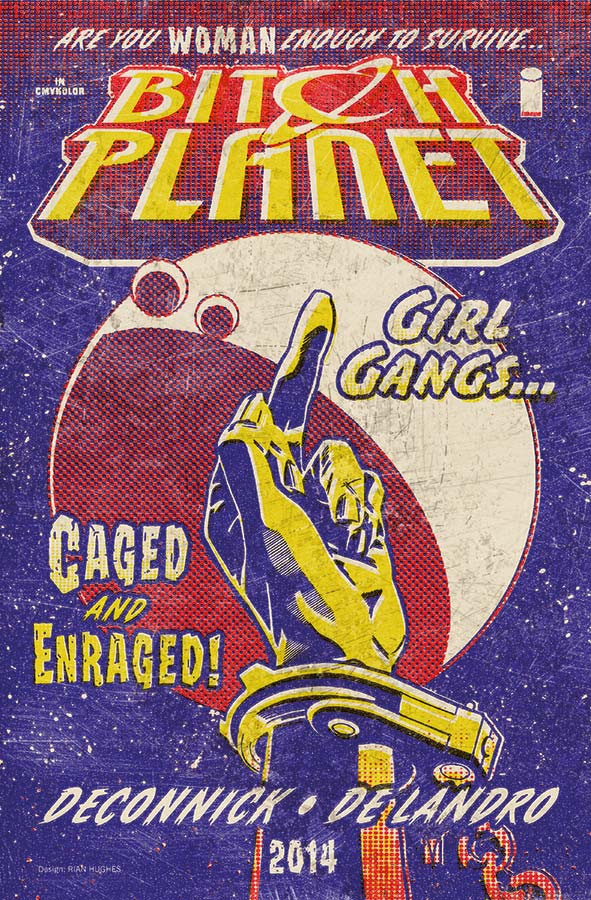
bitch planetDuring my undergraduate study, I spent an enlightening semester learning entirely about women writers and how they write women and girls. It’s something I’ve carried with me, especially in reading comics. While it is now less rare for women to occupy a central role in comics, the field is still overwhelmingly male-dominated and male character-centric. This often leaves female characters in a space that is Other, or separate from the norm.

With creator-owned comics on the rise, women are now able to carve spaces in which to tell their own stories. Two stories in particular, Kelly Sue DeConnick and Valentine DeLandro’s Bitch Planet and Marjorie Liu and Sana Takeda’s Monstress, challenge the Othering of femininity by exploiting the connection of femininity to monstrosity and allowing characters to reclaim this aspect of their identities by embracing the monstrous.

It is possible to understand this reclamation of identity by using Julia Kristeva’s theory of abjection as a lens. Kristeva is a Bulgarian-French philosopher, psychoanalyst, and feminist whose work spans multiple disciplines but is prominent in structuralism and poststructuralism.

Powers of Horror: An Essay on Abjection outlines Kristeva’s theory of abjection in a very French and somewhat complex way. The abject, by definition, is a “non-object” that lingers in a person’s psyche as a consequence of repression. The abject disturbs system, identity, and order. To abject something is to other it from the “I,” pushing it away from the self to maintain personal boundaries.

Monstress01_CoverA simple example of this sort of behavior is food loathing. This is a common behavior, especially in children, but the dissonance between something that is supposed to nourish and the unpleasant taste or nauseous feeling causes abjection. If you hated broccoli as a kid or avoid a certain food after eating something and getting sick, this is a basic form of abjection.

Abjection can also exist among people, so when discussing abjection it is important to make a distinction between subject, object, and abject. The subject is “I.” (When you, reader, speak about yourself, your thoughts, you say “I.” You’re subject.) Now table that thought for a moment. The difference between object and abject is contingent on one point. Objects hold weight and meaning. The abject is not an object because it does not hold weight. The only “object” quality the abject possesses is that it opposes the “I.”

One example Kristeva uses to distinguish each definition is that of a corpse. Kristeva says corpses are simultaneously subject, object, and abject–the body was once a person, a subject, but became object after death. Corpses are also abject because they force us to consider the uncomfortable truth of our inevitable deaths.

What both the food loathing and corpse examples have in common is the idea that they are improper or unclean. People and bodies will abject things they deem “incorrect,” but what is unclean, gross, or incorrect doesn’t directly cause abjection; they create a disruption of a person’s system, identity, and order and that causes abjection. Disruption of the boundaries demonstrates their fragility.

Abjection of people is driven by a failure of one member of a group to recognize its kin. This same lack of recognition drives fear of what has been deemed Other. A person possessing some quality that has been deemed “incorrect” on a larger social scale causes a lack of recognition, which is perpetuated on an individual level. This creates a cycle of fear and rejection by engendering disgust for the “not normal” or “not human.” Social constructs are upheld and continue to oppress the abject.

BitchPlanet02_CoverAccording to Kristeva, one natural reaction to abjection is religion, which is an attempt to create order where the abject has disturbed it. Using this reasoning, the formation of governing bodies–including the Cumaea in Monstress and the male-led government in Bitch Planetare an attempt to control the abject.

Kristeva says another natural reaction to the abject is to create art. Using comics to explore the abject allows both readers and creators to approach the subject in worlds both fictional and real. The settings of the comics discussed here (an off-world prison and an alternate version of early 20th century Asia) allow writers and artists to discuss issues present in real life. The main characters of both comics are monstrous women, all of whom are attempting to create their own space in the world. Comics give these creators a space to both examine the abject and criticize the social systems that oppress the abject in a fictional world, as well as in our real one. (Bitch Planet also accomplishes this by including essays in the backmatter of single issues.)

In Kelly Sue DeConnick and Valentine DeLandro’s Bitch Planet, women who are determined “non-compliant” are shipped to an off-world prison. Non-compliance in women is determined by any number of “crimes,” including being “aesthetically offensive,” obese, or transgender. In Bitch Planet, misogyny is taken to an extreme level. Women who fall outside of a narrow box of acceptable gender behavior and presentation and individuals who don’t conform to traditional binary standards are punished for existing. It’s a harsh critique of the standards women are held to in real life–both behaviorally and aesthetically.

Monstress, by Marjorie Liu and Sana Takeda, combines a number of fantasy elements that make up an alternate Asia, which plays home to Maika, an Arcanic teen. The Arcanics’ magic makes them highly desired by the Cumaea, a religious order that uses Arcanic Lilium to enhance the powers of its members. Arcanics are regarded as a lowly sub-human class, which allows the story to explore themes of racism and slavery. Since it is told from Maika’s perspective, much of the story also focuses on her strength (inner and outer) as she resists the oppressive force of the Cumaea.

Monstress05_CoverThough they take place in vastly different worlds, Bitch Planet and Monstress feature protagonists who have been Othered in some way. The characters readers are meant to root for and maybe even identify with are seen as non-human because they disrupt established social structures and system, identity, and order.

Inmates of the Auxiliary Compliance Outpost are abject for any number of reasons, from not being feminine enough to “driving” their husbands to infidelity. They are treated inhumanely, used only as an example for other women and bodies in sport. The women find a sense of community with each other, bound by their monstrous qualities.

Maika of Monstress is introduced as a slave, immediately establishing her as abject and Other. This is only furthered when readers learn of her powerful psychic connection to a literal monster that she refers to as her “hunger.” Maika is considered a monster even before she embraces this title.

The pathologization of women’s behavior in Bitch Planet and demonization of Arcanics mean that these characters are considered monsters regardless of whether their behavior reflects that designation. Neither comic is subtle about its connection of femininity to the monstrous, and both take care to show that women’s experiences with society intersect differently based on race and sexuality.

The metaphor of the monstrous is accessible in Bitch Planet, where the particularly relevant issue three focuses on how women are punished for attempting to conform to social standards (taking part in harmful diets and beauty rituals) and for living outside these standards (in which case they are made social outcasts). The metaphor is equally accessible in Monstress, where Maika quite literally lives with a murderous monster called Monstrum inside of her. The Monstrum, though dangerous, helps Maika to defend herself against threats and to withstand constant dehumanization.

These works are important because they bring to light issues that some readers may not experience because of their social or economic privileges. By forcing readers to interact with abject concepts, these stories also force readers to consider perspectives they otherwise wouldn’t because readers themselves wish to escape the uncomfortableness of the topic. These stories also examine institutions which have been founded on oppressive platforms whose original intent was to protect the privileged from the abject.

Despite being considered monstrous, the characters in either comic embrace this aspect of their identity. Inmates in Bitch Planet use their strengths as non-compliant women (both physical and mental) to fight for their freedom. While Maika’s goal is to find answers about her mother’s death, she also uses her monstrousness to protect other Arcanics and fight the Cumaean order. This is a way to claw back at the systems that have rejected and othered them and to reclaim their identities and their rights to live a free and happy life.

Characters pushing back against oppressive systems reflect the real-life struggle for equality between the abject and those who have abjected them. These characters want to be seen as an “object” rather than Other in the sense that this would allow them to be recognized by their peers as non-abject and human.

Though Bitch Planet and Monstress explore vastly different worlds, they both offer a unique approach to examining the abject. And as female characters fight for and claw out their own space in their worlds, their creators do the same in ours.

This paper was originally presented as part of the 2016 Comics and Popular Arts Conference in Atlanta, Georgia.

Review: Monstress #7

monstress07_coverMaika’s journey of discovery takes a somewhat darker turn in the latest installment of Marjorie Liu and Sana Takeda’s Monstress. You have been warned.

After sacrificing what remained of her left arm to defeat the Cumean Mother Superior, Maika has returned to her mother’s home with Kippa and Ren in hopes of getting answers about the mask and photograph she’s been carrying. Maika’s life before the story began has been slowly revealed in fragments, and her trip home allows for natural development of her background. Readers meet some new people from Maika’s past, each of whom are equally as interesting and surprising as every other character.

While this issue explores more of Maika’s history, it also explores the rising tension between her and Kippa. Kippa, though loyal, has grown as a character immensely since her introduction. As she grows, so does her kindness and sense of right and wrong. In the first arc of the story, Maika grew steadily more ruthless as she recognized the Monstrum’s power. Though Kippa is young and innocent, her moral code is strong and the story offers no clues as to how the growing conflict between the two will be resolved.

Monstress #7 also explores a little more background on Ren, a nekomancer. The nekomancers are, as their name implies, cat necromancers, which is not only an interesting and unique concept, but also one of the best puns in a comic possibly ever. Bringing in the different groups keeps the comic well-rounded and balanced, and introducing them little by little.

Despite the increasingly detailed and complex worldbuilding, the comic doesn’t feel inaccessible. The experience of reading Monstress is, as always, fully fleshed out with Sana Takeda’s beautiful illustration. The amount of care and attention that goes into each character’s expressions and clothing contribute just as much to the worldbuilding as the lore of the story. The inclusion of detail in everyday scenes–filigreed perfume bottles, brocaded clothing, carved stone pillars–makes a lack of detail especially noticeable. Takeda applies a lack of detail masterfully, using it to emphasize the lack of control Maika has over her hunger.

The colors emphasize the detail and set the mood. Monstress is often serious in tone and deals with dark themes, but the comic itself is rarely visually dark. Dynamic, layered colors build up and add to the magic of the series. The amount of thought put into the colors and detail make Monstress an especially gorgeous fantasy epic that will stand the test of time.

Story: Marjorie Liu Art: Sana Takeda
Story: 10.0 Art: 10.0 Overall: 10.0 Recommendation: Buy

Image Comics provided Graphic Policy with a FREE copy for review

« Older Entries Recent Entries »