Justice League: Dream Girls #4 shows both the triumphant and sad sides of queer identity
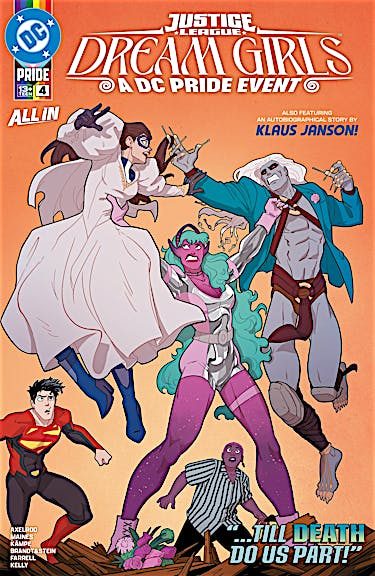
Jadzia Axelrod, Nicole Maines, Stein & Brandt, Rosi Kampe, Triona Farrell, and Dearbhla Kelly wrap up their beautiful, action-packed, and soul-searing Pride Month event in Justice League: Dream Girls #4. Most of this issue is set in the Kampe-drawn dream dimension, where Galaxy fights to save her BFF Dreamer from the clutches of the Key, who is very close to having infinite knowledge that will transform him from that one villain you vaguely remember getting knocked out by a boxing glove arrow in Grant Morrison’s JLA run to an A-list baddie. It cements the bond between Galaxy and Dreamer while setting them on two quite different, yet valid heroic paths. Axelrod and Maines give both heroines full arcs while leaving room for either them or other creators to play in the sandbox. In addition to wrapping up the weekly crossover event, JL: Dream Girls #4 features a powerful, personal black and white autobiographical comic from the legendary Klaus Janson about growing up as a gay, immigrant cartoonist in the 1960s and 1970s.
To start, it’s been such a pleasure to follow JL: Dream Girls each week and see transgender superheroes written by transgender comics creators get to be front and center in a big summer crossover with such a buffet of different art styles and a huge cast of characters, LGBTQ+ otherwise. (Batman is a trans ally, y’all!) And it wouldn’t be a summer crossover with some badass fisticuffs, and JL: Dream Girls #4 doesn’t disappoint. There’s a surreal action-horror vibe to Rosi Kampe and Kelly’s visuals, with interesting panel layouts as Galaxy flies around and tries to get Dreamer to literally wake up and not be married to the Key. For example, while Dreamer is under the Key’s thrall, the gutters are black, but when she gets her act together, they’re different colors or non-existent. Kampe’s line art and Dearbhla Kelly’s colors go from something light and almost trance-like to solid and punchy as the story progresses. As someone who has put on a variety of identities throughout the series, it’s so empowering to see Dreamer finally be herself in JL: Dream Girls #4’s climax.
After the big fight, JL: Dream Girls #4 has an extended epilogue that’s drawn by Stein & Brandt and colored by Farrell, who have done an excellent job on the Watchtower sequences throughout the series, giving this large cast of characters their own unique personalities, sometimes with a single eye movement or head tilt. (I live for Jon Kent’s eyes lighting up and wanting to play DnD even though Damian Wayne says it’s for nerds.) The use of “Bwahahaha” all but confirms, but they’re worthy successors to the superhero sitcom era of J.M. DeMatteis, Keith Giffen, and Kevin Maguire’s Justice League. The highlight of this part of the story is a conversation between Batman and Dreamer, where he tells her that if someone is uncomfortable with her being simply present in a space, that’s their problem. It brings the superhero/queerness/trans metaphor full circle and means a lot because it’s DC’s biggest seller saying those words. Jadzia Axelrod and Nicole Maines have done a wonderful job telling a story that is both a sci-fi/superhero epic with psychological dimensions that also works as a personal tale of two very different transgender women coming to terms with who they are. It was in the previous issue, but Coagula and Dreamer talking about being transgender lesbians is an all-time great moment in superhero comics. Finally, Galaxy and Dreamer are just awesome friends, and I hope they have many more adventures either as part of the Justice League or together. (DC editorial, we need a JLQ ongoing.)
After the colorful triumphs of the lead story, the black and white backup story from Janson entirely switches tone, and I appreciate the reader’s advisory between them. He gives a stark portrayal of what it was like to be a gay man in the 60s and 70s, with bullying, slurs, and not having heroes like Galaxy and Dreamer to look up to. However, young Klaus finds hope through superhero comics, which are the only part of the story done in color and give him an escape as he struggles to fit in with the oppressive society around him. Another place of escape for him is one of the first Pride parades that happened after Stonewall, and it’s cool to see the LGBTQ+ culture of the era, like when Klaus shows another young man his art portfolio after getting an early assignment at DC Comics. There’s also a shift in Klaus Janson’s art style as he grows in confidence in himself as an artist and gay man, before culminating in that iconic style that defined Batman and Daredevil for generations of heroes. And, personally, I love that a queer person like myself is partially responsible for those dark stories that were important to me growing up and still are to this day. I appreciate that Mr. Janson was able to share something so personal in such a beautiful way and that DC continues to publish autobiographical stories by LGBTQ+ creators.
Justice League: Dream Girls #4 shows both the triumphant and sad sides of queer identity through its punching and friendship-filled lead story and its sobering, yet hopeful backup story. It’s the perfect comic to read during the last week of Pride Month.
Story: Jadzia Axelrod, Nicole Maines, Klaus Janson
Art: Stein & Brandt, Rosi Kampe, Klaus Janson
Colors: Triona Farrell, Dearbhla Kelly
Letters: Jodie Troutman, Frank Cvetkovic, Lucas Gattoni
Story: 9.0 Art: 9.5 Overall: 9.3 Recommendation: Buy
DC Comics provided Graphic Policy with a FREE copy for review
Purchase: Zeus Comics – Kindle