Tag Archives: Frederico Blee

The Ultimates #10 Unveils What Happened to the Invaders
The Ultimates #10

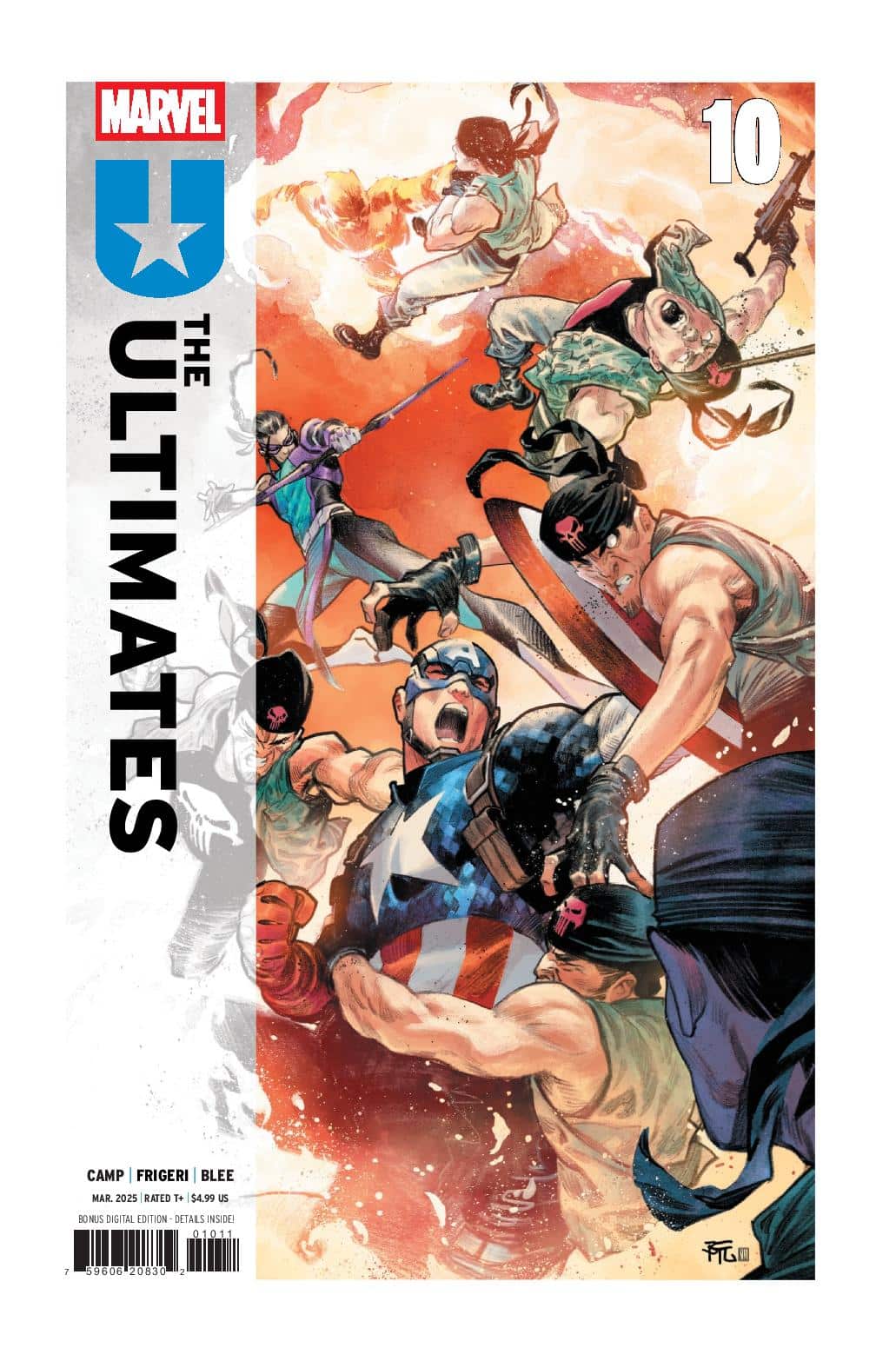
Every so often, I see a vehicle with a Punisher symbol. The white skull logo stares daggers into me whether I’m driving to work or viewing it on someone’s t-shirt or even paracord wristbands. Initially created by Gerry Conway, John Romita Sr., and Ross Andru in the 1970s as a critique of the failure of the justice system, Frank Castle and his iconography have been co-opted by the military, law enforcement, and hate groups as a positive where he is truly the only man willing to cross the line and do what it takes to get the job by whatever means necessary. The original context does not matter to them; they only care about the surface-level aesthetics and views that reinforce their messaging and beliefs. Like in the real world, Deniz Camp and Juan Frigeri examine how symbols transform and mutate in The Ultimates #10.

Previously established in issue 2, Earth 6160 Frank Castle existed in a similar capacity to the central universe as a gun-wielding vigilante evoking 1970s vigilante films like Death Wish, who committed multiple killings across NYC. Years later, after his death, the neo-nazi group called the Red Skulls would capitalize on his methods and iconography to make their movement more “marketable” to outsiders. While the Punisher may have committed mass murder, he “cleaned up the streets” and “got rid of the filth,” making him an appealing figure ripe for the taking. The Red Skulls do not care about whether or not Castle would have killed Nazis; all that matters to them as fascists are the surface-level aesthetics of his actions that they can appropriate and warp, and use to justify their behavior. Strip away the aspects that you do not agree with and craft a new symbol with the beliefs and ideology you want it to enforce. Fascism stands as an incoherent and contradictory reactionary ideology that does not care about having a true solid base below its aesthetics.

Steve Rogers and Jim Hammond, two of the original Invaders from World War II, are symbols from a previous time who wrestle with their place in the modern world. The world they once knew was stripped away and exists as only a memory they hold on to. Especially for Jim, who has to manually sort and delete his old files to record new ones. Even for an advanced machine when he was built, he still has limitations such as limited memory and needs to decide what to keep and remove—Jim’s decision of how we record the past crafts a narrative that dictates what happened. If Steve serves as the symbol of the ideals of a country long gone, then Jim acts as a living recording of a past erased. 

As for the remaining Invaders, they suffered horrific fates and fell out of history. Namor, the once majestic king of Atlantis, hangs as a dead catch of the day to the Red Skulls. Removed of his royalty and splendor, his corpse is a recruitment tool for the Red Skulls. Most shocking lies in the Bucky, who now serves as the group’s Grand Skull. We do not know what happened to him after Steve landed in the ice, let alone how he became the most recent leader of the group. One of Steve’s closest friends becoming the new symbol of the enemy he fought adds a great wrinkle to the conflict, and it will be fascinating to see how it gets resolved.

Opening on Hitler’s satisfying burning death by the Human Torch, Frigeri, colorist Federico Blee, and letterer VC’s Travis Lanham really get to showcase their artistic skills in this issue. Showcasing both blockbuster action and emotionally intimate moments, the artistic team nails the perfect visual vibes. Feeling extremely slick and modern, it has the necessary bombastic energy.

The Ultimates #10 showcases Camp and Frigeri’s talents for crafting a story that not only feels extremely relevant but is willing to dive into present topics and issues impacting our modern world, such as fascism and hate groups. As a result, it never feels dated or out of step but perfectly puts the finger on the pulse of what we are currently living through. Especially for a Big Two comic, this is highly commendable and hopefully widens the eyes of its readers to the roots of the issues surrounding us. 

Story: Deniz Camp: Art: Juan Frigeri
Color: Frederico Blee Letterer: VC’s Travis Lanham
Story: 9.5 Art: 9.5 Overall: 9.5 Recommendation: Read

Marvel provided Graphic Policy with a FREE copy for review


Purchase: Zeus ComicsKindle

The Ultimates #8 Shows You Can’t Change the Past But You Can Change the Future

“This goes on (and on)
And on (and on)
And on (and on)
And on (and on)
And on (and on)
And on (and on)
And on (and on)
And on” Nine Inch Nails- “Beside You in Time”

The Ultimates #8

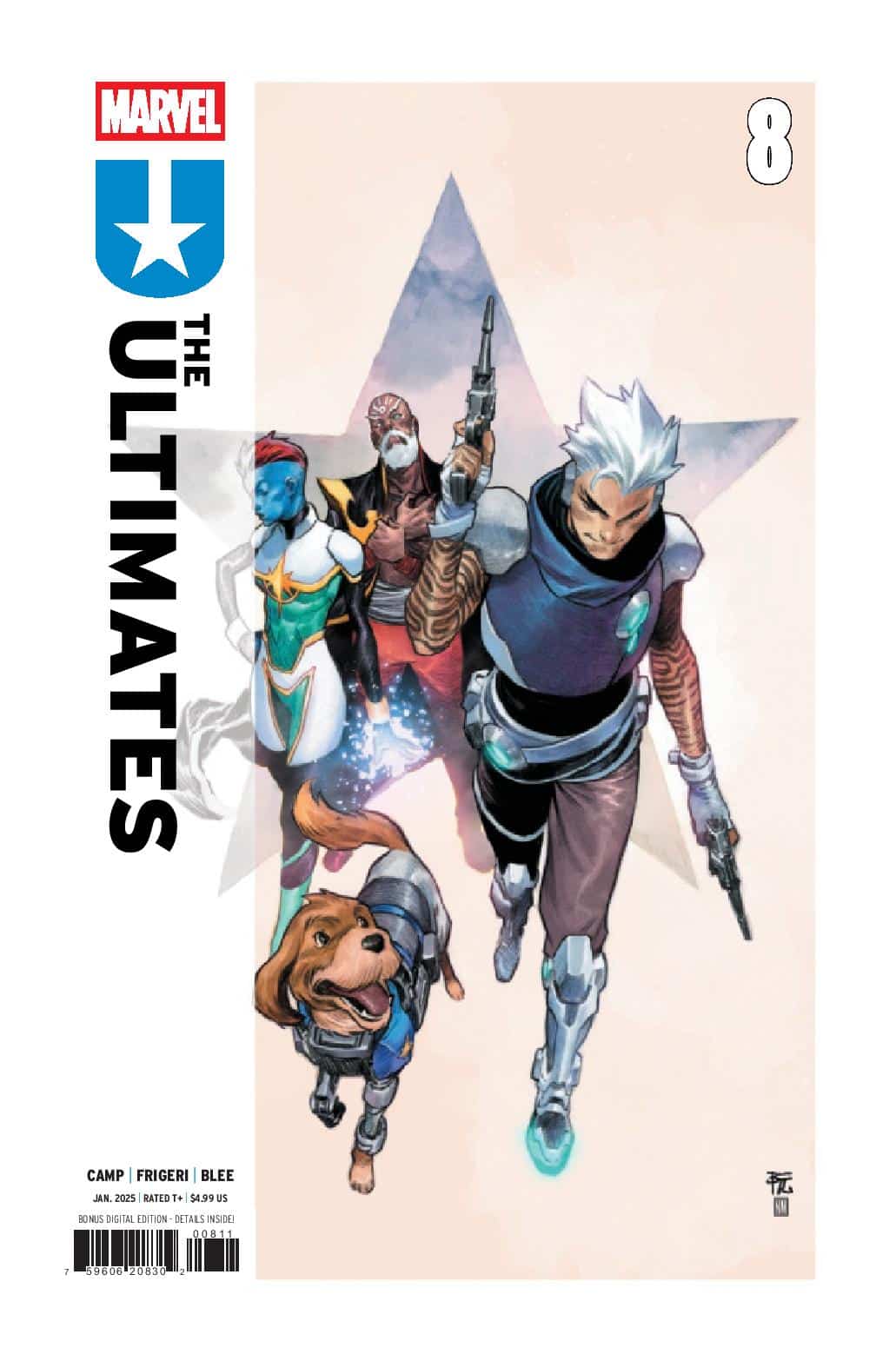
The Ultimates have been figuring out their next move after the Hulk critically injuring Iron Lad. Picking up a strange signal in time, Doom sends the team out to the middle of nowhere to see if it could be from the Council and, even worse, the Maker returning. However, the Guardians of the Galaxy, the protectors of a lost future, have traveled to the past to recruit a lost member. America Chavez, the cosmic powerhouse of the Ultimates, must make a choice that will define the present and what might come after that. Deniz Camp and Juan Frigeri reveal what happened to America Chavez and a potential future unaffected by the Maker in The Ultimates #8.

Expanding the cosmic history of Earth 6160, Camp further demonstrates the notion of a world unfairly forced to take a different path and ripped away from not only our clutches but from its descendants by introducing the Guardians of the Galaxy from the 61st century and America’s connection to them. Taking a page from the original Guardians, this team interaction presents the more significant impact of the Maker’s tinkering by having their future erased and perverted. Especially with the future achieving peace and moving to a utopia, the cruel grasp of the Maker makes this change even worse. The crisis of the Ultimate universe does not strictly bind itself to the present on Earth but beyond space and time throughout the galaxy. 

The theme of saving the future, even if it seems impossible, comes up again when it reveals how America lost her memories of her past life in the future. Stranded in the present, she chooses to stay and fight with the Ultimates since that life is no longer hers. She has found a new purpose and camaraderie with the Ultimates and aims to continue the goal of saving everything with them. Even if that was her future and her life with the Guardians of the Galaxy and Captain Marvel, she has made peace with her past and found a new purpose. The feeling that your life, especially a better one, is ripped away from you can cause many reactions, such as fear, despair, or hopelessness. Yet that emotion can be softened or more manageable when you are not alone. 

The idea of fate and destiny reappears when Star-Lord confronts Doom about how different he is from the Doom he knew. Doom constantly stands on the razor’s edge, believing he is the monster Maker created compared to who he wants to be. Are we doomed to follow the cycle that everyone expects to be in and be damned, or can we ever be free? While it would be easy for us to accept our lives and believe that we cannot do anything necessary to make a change, it would be better to take action instead of nothing. 

Frigeri’s art, paired with colorist Frederico Blee and letterer VC’s Travis Lanham, creates a visually engaging issue. I love the designs of the new Guardians of the Galaxy members and the sci-fi future we get glimpses of. They all make the world feel engaging and lived in. Also, their depiction of the future contrasts with the idealized world compared to their current timeline.

As I write this year, 2025 has arrived, and another year has passed. Often, you can feel overwhelmed by the future and how impossible it appears to change it, but once you stop fighting, that is when you lose. You cannot change the past but you can do the work to alter the future. 2024 has ended, and we have a whole new year to work towards.

Story: Deniz Camp: Art: Juan Frigeri
Color: Frederico Blee Letterer: VC’s Travis Lanham
Story: 9.8 Art: 9.8 Overall: 9.8 Recommendation: Read

Marvel provided Graphic Policy with a FREE copy for review


Purchase: Zeus ComicsKindle

The Ultimates #7 has the team reflecting on recent events and marks one year since the attack on NYC

Perfect jumping-on point for the uninitiated! The aftermath of the explosive last issue – including the loss of a major member! Join the Ultimates in their secret HQ as they regroup and launch their bold new plan to change the world!

Story: Deniz Camp
Art: Juan Frigeri
Color: Frederico Blee
Letterer: Travis Lanham

Get your copy now! To find a comic shop near you, visit http://www.comicshoplocator.com or call 1-888-comicbook or digitally and online with the links below.

Zeus Comics
Kindle


This post contains affiliate links, which means that if you click on one of the product links and make a purchase, we’ll receive a percentage of the sale. Graphic Policy does purchase items from this site. Making purchases through these links helps support the site

The Ultimates #6 is packed with action and some shocking moments

ULTIMATES ASSEMBLE TO TAKE DOWN THE HULK! The entire roster of THE ULTIMATES unites for the first time in this high octane, climactic conclusion of the first arc! Iron Lad has a plan to defeat the Hulk, the most powerful and imposing member of the Maker’s Council – but has he gotten his team in over their heads?

Story: Deniz Camp
Art: Juan Frigeri
Color: Frederico Blee
Letterer: Travis Lanham

Get your copy now! To find a comic shop near you, visit http://www.comicshoplocator.com or call 1-888-comicbook or digitally and online with the links below.

Kindle


This post contains affiliate links, which means that if you click on one of the product links and make a purchase, we’ll receive a percentage of the sale. Graphic Policy does purchase items from this site. Making purchases through these links helps support the site

The Ultimates #2 Reveals What Happened to the Former United States of America in the New Ultimate Universe

The Ultimates #2

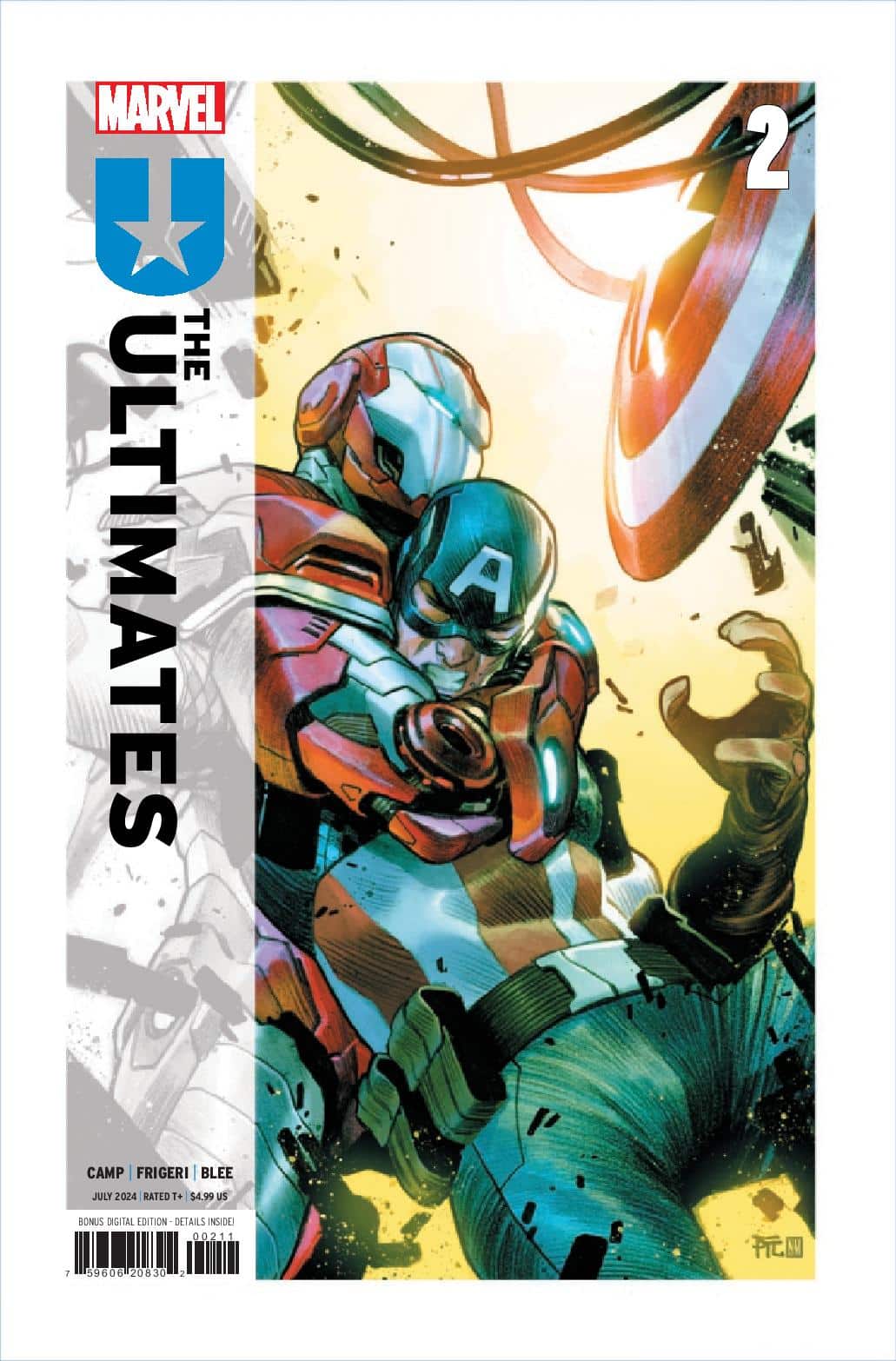
After recruiting Wasp and Ant-Man to the Ultimates, Captain America decides to travel to the White House with the team to learn more about the Maker and the history of what happened to the United States. As the dark secret truth gets revealed to him, Captain America and the Ultimates will face a different person sitting behind the desk of the Oval House. They are not solely coming to fight against the Maker’s leadership but to rescue a secret hero held hostage underground. Captain America, a man that time forgot, must reckon with the forgotten dream that the Maker erased to keep control in The Ultimates #2 by Deniz Camp and Juan Frigeri.

I applaud Camp for focusing on Steve Rogers to experience the untold history of what happened to the United States on Earth 6160 since it reflects his status as a man out of time and represents the Maker’s interference with the lost history. More important, though, lies in Camp understanding the symbolic nature of Captain America as not a mouthpiece for the government and politicians but inspiring people and fighting for justice, freedom, and the idealized American dream, which works flawlessly in him fighting with the Ultimates rebelling against the tyrannical Maker’s council. Especially with a character like Midas serving as the villain of the issue whose capitalistic greed and hunger represent some of the country’s worst qualities and history, which contrasts with what Captain America stands for. Outside of being a physical threat, he is a solid contrasting ideological foil to Steve and the ideals he fights for. 

Another significant component of The Ultimates #2 peels the curtain back of the history of what happened to the United States and how the North American Union formed. Similar to his previous works, Camp has excellent experience when it comes to crafting an alternate history and genuinely thinking about the implications and ripple effects that the Maker’s interference would have. Illustrated by the talented Frigeri, we watch in silence and horror as we experience what Steve sees and feels in the hologram program. Although it does not reveal everything, Camp and Frigeri give enough context to what has happened previously and to the present. Camp handled the intertwining real-world elements with aspects of the Marvel Universe exceptionally well and provided exciting context. Along with giving the broad strokes of what led to the dissolution of the United States, Camp does sprinkle in some hints to previously unmentioned characters and locations to provide an idea of what happened to them and their place in the universe. 

I am still in love with Frigeri’s art and how he depicts the world of Earth 6160. Everything is gorgeous and wonderful and perfectly complements Camp’s script and voice. Considering he has to craft a new universe, he makes Earth 6160 feel different than 616. With Federico Blee’s colors and VC’s Travis Lanham’s colors, all the artistic and visual elements combine exceptionally well and make another memorable issue. 

As the Ultimates gain another member for their team, the countdown for the Maker’s return creeps up. Camp and Frigeri are doing incredible work that excels beyond a flawless first issue. They prove that nothing is truly off the table in the new Ultimate Universe as they make bold choices in crafting this section of Earth 6160. The Ultimates #2 demonstrates Camp and Frigeri’s firm grasp of such beloved characters and how unafraid they are to take them in thrilling new directions while holding on to their core characteristics.

Story: Deniz Camp: Art: Juan Frigeri
Color: Frederico Blee Letterer: VC’s Travis Lanham
Story: 9.7 Art: 9.7 Overall: 9.7 Recommendation: Read

Marvel provided Graphic Policy with a FREE copy for review


Purchase: TFAWZeus ComicsKindle

The Ultimates #1 kicks off the first superhero group of the new Ultimate Universe

Kicking off a brand new team of passionate heroes willing to fight for a better and brighter future in The Ultimates #1.

Story: Deniz Camp
Art: Juan Frigeri
Color: Frederico Blee
Letterer: Travis Lanham

Get your copy now! To find a comic shop near you, visit http://www.comicshoplocator.com or call 1-888-comicbook or digitally and online with the links below.

Zeus Comics
Kindle


This post contains affiliate links, which means that if you click on one of the product links and make a purchase, we’ll receive a percentage of the sale. Graphic Policy does purchase items from this site. Making purchases through these links helps support the site

Review: Thanos Annual #1

Before he lights up the silver screen and potentially offs some superheroes in Avengers: Infinity War, Thanos gets the Tales from the Crypt treatment in Thanos Annual #1 with the Cosmic Ghost Rider playing the role of Cryptkeeper and telling the story of the Mad Titan’s most demented deeds to a surprise audience. Cosmic Ghost Rider’s pitch black, Southern fried sense of humor keeps the story chugging along through different art styles and an all-star creative team featuring Kieron Gillen‘s return to the Marvel Universe and My Little Pony writer/artist Katie Cook telling a dark of story of fratricide, mass suicide, mass graves, and candy cane impalings.

The current Thanos ongoing series’ creative team of Donny Cates, Geoff Shaw, and Antonio Fabela lead off the annual with a short, yet potent story of Thanos’ relationship with his daughter Gamora. Shaw’s art is fluid and shows why Gamora is considered to be the “Deadliest Woman in the Universe” and bursts of green blood from Fabela show that gore, death, and both physical and mental trauma are going to be a recurring motif in this comic book. Their Thanos has a malevolent evil force meets worst stage/bleacher dad ever vibe as Gamora is completely under his control to shape into something that is more of a weapon than a human being. Also, Thanos might be considered a supervillain, and Gamora is a member of the de facto superhero team, the Guardians of the Galaxy, but this story is more science fiction than superhero, especially with its twist ending that was totally once used in an episode of Rick and Morty.

Chris Hastings (Gwenpool), Flaviano (I Am Groot), and Frederico Blee (She-Hulk) go all out cringe comedy in their story which is as painful as slowly removing your fingernails and toenail, one by one. It’s about Thanos visiting a young man every year on his birthday (Except for one because there was a major Marvel Universe crossover.) and making his life utterly miserable depending on his current life situation. Basically, Thanos is evil on both a macro and micro level. He can be annoying like nuclear warfare or annoying like a hangnail. Also, the panel of Thanos texting is up there with the legendary “Thanoscopter”, and honestly, I spent most of the story wondering what evil breakup causing text he concocted. I love how Hastings, Flaviano, and Blee took a pretty standard slice of life setup and turned into torture via sequential art.

Kieron Gillen has a mini reunion with his WicDiv 455 AD collaborators Andre Araujo and Chris O’Halloran in a cosmic take on Say Anything with Thanos playing John Cusack, Lady Death as Ione Skye, and planetary explosions subbing in for a boombox. Because it’s technically about art, Gillen, Araujo, and O’Halloran’s story is metafictional with Thanos commenting that none of these stories really matter in the face of death. In a kind of Lucien’s library of unpublished books in Sandman move, Gillen also creates some of the potentially coolest planets in the Marvel Universe, including a basically Choose Your Own Adventure planet, and then literally blows it up because art can do nothing to stave off mortality. But, hey, O’Halloran colors some pretty explosions, and Araujo continues his knack for architecture in his design for Lady Death’s palace.

The next story in Thanos Annual is both funny and disturbing and sort of in the vein of Happy Tree Friends or I Hate Fairyland. In it, Katie Cook and let’s make this look as much like a cute kid’s cartoon as possible colorist Heather Breckle tell the story of Thanos visiting a planet inhabited by Adorales, who do whatever he wants. Of course, they worship him as a god and then start killing each other in twisted ways after Thanos makes a death threat towards them because they won’t stop bouncing all over him. The adorable style of Cook’s art allows her to get away with a lot more violence than the other more traditionally drawn stories in Thanos Annual and leads to some squicky moments with the Adorales’ lifeless bodies filling up the page. Luckily, Cook fills the story with some great  asides from Thanos, who was not expecting this kind of situation just as much as the readers.

In the next story, Ryan North, Will Robson, and Rachelle Rosenberg rapidly switch gears from fish out of water comedy (Thanos helping to searing existential torture and also make good use of the walking plot device that is the Infinity Gauntlet. With the exception of a colorful intro page where he and Rosenberg throw it back to the actual Infinity Gauntlet story with battles and superheroes, Robson’s art is pretty deadpan, and he nails the hilarious reactions that every day people have to Thanos helping and chatting pleasantly with an old lady. Of course, he has a supremely evil ulterior motive of stifling a brilliant mind from having an epiphany and finding a cure for all diseases and sickness. North gets to write a fantastic monologue at the end about how he doesn’t just love physical death, but the death of hope and potential. Most of us will never experience half the Earth population dying, but many people struggle with not reaching their potential so this story kind of hits hard after its absurdist beginning.

The thought provoking nature of “That Time Thanos Helped An Old Lady Cross the Street” extends to the final, full story in Thanos Annual #1 before it’s wrapped up with an ending tag featuring Cosmic Ghost Rider and a mysterious guest character. Al Ewing is one of Marvel’s most imaginative and intelligent writers, and he uses a science fiction and a gorgeously painted tale from Frazer Irving to ask an age old theological question, “Can people be moral without a higher power to look up to?” Before this question is asked by Thanos, who literally kills a god in an epic Irving splash page, Ewing and Irving create almost the perfect religion that is a hybrid of Golden Rule-driven monotheism with a side of reincarnation. However, Thanos totally upends the scientific mechanisms that kept this faith chugging along and creates one hell of an existential crisis for the Kehlrassians that bleeds into Cosmic Ghost Rider’s narration because he has been to both Heaven and Hell. It reminds readers that Thanos is both a psychological and physical threat, which is something that Ewing explored in the second half of his Ultimates run. (RIP)

Stealthily, Thanos Annual #1 is just a great collection of intelligent and darkly humorous sci-fi shorts that just happen to take place in the Marvel Universe. It features some of its most clever writers and artists that have an eye for both humor and violence on a large and small scale and makes you realize that reading stories about Thanos is like staring into the abyss or being one of those dumbasses that looked at the solar eclipse without those special glasses.

Story: Donny Cates, Chris Hastings, Kieron Gillen, Katie Cook, Ryan North, Al Ewing Art: Geoff Shaw, Flaviano, Andre Araujo, Katie Cook, Will Robson, Frazer Irving Colors: Antonio Fabela, Frederico Blee, Chris O’Halloran, Heather Breckle, Rachelle Rosenberg 
Story: 9.5 Art: 9.5 Overall: 9.5 Recommendation: Buy

Marvel Comics provided Graphic Policy with a FREE copy for review