
C2E2: Interview with Nightwing Writer Benjamin Percy

Benjamin Percy is a multitalented writer, who excels in a variety of mediums. He has written four novels, a book about creative writing called Thrill Me: Essays on Fiction, was a contributing editor for Esquire and taught at the prestigious Iowa Writer’s Workshop. Along with screenplays and short stories, Percy has written quite a few comic books since 2014, including DC Rebirth’s Green Arrow and Teen Titans. His next project is a run on Nightwing, beginning with issue 44, and I had the opportunity to chat with him about Dick Grayson’s role in the DC Universe and Bludhaven, collaborating with artist Chris Mooneyham, and of course, Dick’s most famous asset…
Graphic Policy: I first saw your name in print in a review of Michael Chabon’s Telegraph Avenue (2012) for Esquire. I was wondering how your work as a critic and arts writer influenced your work as a writer of superhero comics.
Benjamin Percy: I write novels. I write for magazines. I write comics. I write screenplays. I write essays. And let’s not forget the erotica too, which I’m celebrated for. What I love about writing in different mediums is I’m always challenging myself aesthetically. So, I’m writing comics and learning things from the medium that make me a better novelist. I’m serving as a book critic or a film critic and as a result, I’m looking more sharply at my own work and holding myself to the same standards as these artists I’m putting on the chopping block.
In every single case as I leap from genre to genre, I’m not only keeping myself excited at the keyboard because it’s always fresh. I’m also hopefully becoming a better storyteller.
GP: One thing I enjoyed about your Green Arrow run was that you returned the character to his Bronze Age roots as a “social justice warrior”. What social issues do you plan to explore in Nightwing?
BP: I was part of the Rebirth era of Green Arrow and that meant looking to his legacy and recognizing that in the O’Neil/Adams era, he was a hotheaded liberal. That’s something that had fallen away from the series. I brought that back, and I channeled the zeitgeist. I was making direct reference to the headlines on the page. There were storylines that resembled what was going on at Standing Rock and the Dakota Access Pipeline. There were stories that bore some resemblance to what was going on with Black Lives Matter.

This is Nightwing. I’m not taking the same approach. But I am thinking about what makes us anxious right now. I think that’s something that comics do very well. They channel cultural unease. They give you a cracked mirror version of reality. There’s a lot of things we should fear right now. Cybercrime is chief among them.
If you look at what’s happened with Cambridge Analytica. If you looked at what happened with the election results and the possibility of Russian meddling. If you think about how many times a day you turn your face towards a screen, maybe you think about how every time you tap a mouse or swipe your hand across a tablet or click a link that’s feeding into an algorithm that’s following you and profiling you. If you think about how every time your computer makes that carpenter ant sound, or every time your phone glitches, you’re wondering, “Has it already begun? Is a Trojan worming its way through the guts of my hard drive?”
I want to realize those fears on the page. I think it’s especially apt for Nightwing to be taking on these threats.
 GP: Why is he the perfect fit?
BP: For a few different reasons. One, I wouldn’t say that Nightwing is a Luddite, but unlike Batman and Batgirl, he doesn’t surround himself with a lot of gadgets. He’s got his batons, and he’s got his acrobatics. I love an antagonist that really challenges a hero. Nightwing is facing a villain he can’t punch.
Nightwing is also interestingly situated in this storyline because he’s incredibly vital to the whole DCU and adaptable. He knows everyone. He’s served as a follower, and he’s served as a leader. He has connections to the Teen Titans and the Titans and the Justice League and the Bat-group. If you think about vulnerable data as being one of the greatest weapons of this time, he is a vault of vulnerable data. If he’s compromised, everyone’s compromised.
So, he’s facing the the dark web, but he’s at the center of his own web, which makes him the perfect person to take on this challenge and the most worrisome person to fail.
GP: Yeah, he’s definitely the heart of the DC Universe. So, one thing I liked about Tim Seeley and Sam Humphries’ runs on Nightwing were that they brought Bludhaven back with its own personality and history. How do you plan to build off this in your own run?
BP: I want to give props to Tim and Sam who did a kick ass job. I also love what Tom [King] was doing with Spyral in his Grayson run. Right now, Bill Gates is funneling 80 million dollars into a plot of land in Arizona to create a smart city. Right now, off the shore of China, they’re building islands. They’re expanding their country and building these “smart islands”.
I’m taking this real world situation and putting it in Bludhaven, a city that has always been in need of rehab. So, a tech mogul has moved there and is trying to rehabilitate the place. Something else might be going on beneath the surface of his intentions. Not only are buildings being demolished and neighborhoods rebuilt within a 5G network, but every address in Bludhaven has a package arrive on their doorstep. Inside that package is a device known as the “Phantasm”. This Phantasm device is a VR unit that bears some resemblance to Alexa, and Alexa, as you know, is always listening.
GP: She’s so scary. I’m never getting one.
BP: I’m taking Bludhaven, and how it’s been established as a city of ruins, a city of scandal, a city that has seen better times. I’m applying to it the same sort of thing you’re seeing on the East Coast with gentrification, except this is sort of tech-laced gentrification.
GP: So, one thing I love about reading Nightwing comics is that he has this exuberant, acrobatic type of fighting style. How do you choreograph his fights differently in the scripting process versus Damian Wayne’s in Teen Titans or Oliver Queen in Green Arrow?
BP: There’s a lot less yelling since Damian isn’t involved. Far fewer insults being hurled. I’m thinking carefully about every action setpiece and trying to create staging that takes advantage of his particular skill set. If you look at the first scene in Nightwing #44, there’s a subway sequence that involves his batons and also involves, I won’t exactly say what happens yet, a kind of high wire act.
Right away, in a really dramatic fashion, I’m trying to say, “This is Nightwing” with an exclamation mark.
GP: Kind of like a Bond cold open. Speaking of James Bond, which you wrote a little bit for Dynamite, are you bringing any kind of spy elements to Nightwing?
BP: We’re starting off in Bludhaven, but the story is not staying there. Arc after arc, it’s getting bigger and bigger.

GP: That’s what I like to hear. Chris Mooneyham (Five Ghosts) is the artist on your first storyline. Why was he the perfect choice for Nightwing?
BP: He’s the second coming of David Mazzucchelli. If you look at the first few pages [of Nightwing #44], which have been released, you will see parallels in Batman Year One and Daredevil Born Again in what we’re doing. It’s shadow soaked, neo noir, intricately detailed, and he takes advantage of every centimeter of the panel. There’s a beautiful grit at work, classic staging, and a more mature sensibility.
GP: I have one last question. Dick Grayson is perceived both in the DC Universe and by fans as a sex symbol. How will you portray that in your run on Nightwing?
BP: I make a crack about it right away. On page 2, panel 6, if you look at the top right corner of the subway station, there’s some graffiti that says “Butthaven”. I’m winking right there at how Dick has been portrayed. There will be romance to come, and I’ll also say that Batgirl plays an essential role in this story. He needs someone who is tech savvy. I’ve always loved their relationship.
Nightwing #44 will be released on May 2, 2018.
Follow Benjamin Percy on Twitter.
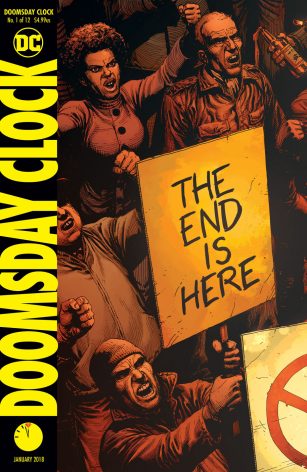 To put it bluntly, Doomsday Clock #1 is what many comic book fans (And Alan Moore wherever he is.) have feared: a direct sequel to Watchmen. The story is set in an alternate version of 1992 about five years after the events of the original series. An actor (Robert Redford) is president, the world is on the brink of nuclear war, Ozymandias is a fugitive and pariah, Dr. Manhattan is missing, Nite Owl and Silk Spectre are still happily retired and don’t appeared, and the book focuses on the new Rorschach in town. With the exception of the final scene, Doomsday Clock #1 isn’t so much a crossover, but Watchmen II. It takes its times and gives readers a flavor of Moore and Dave Gibbons’ even more dystopian universe and kicks the plot into gear in a way similar to the back half of the original series than the initial investigation into the Comedian’s death. (Edward Blake would probably appreciate the opening riot scene though.)
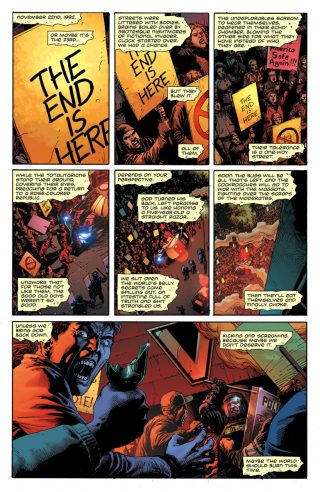 part, colorist Brad Anderson stays out of his way and lets his pencils shine. Anderson does have a couple tricks up his sleeve like color coding some panels to different characters, such as brown for Rorschach, gold for Ozymandias, and alarm red any time there’s a nuclear threat.
 Wrath Of The Eternal Warrior (Valiant) – The final issue came out in December, so technically this isn’t an ongoing anymore, and while I’ll miss the shit out of it in 2017, it sits in the top spot for 2016 (because it was an ongoing in 2016). This was THE book of the year for me without question; although the first issue felt a lot slower than I expected, this quickly morphed into the one series I couldn’t wait to read. Robert Venditti has crafted fourteen of the most exciting, and compelling, issues about Valiant‘s immortal soldier I have ever read as he finds a way to have Gilad deal with death – and failure – in a way I haven’t seen anywhere before.
 Voracious (Action Lab) I could tell you so many reasons why you should read this emotional tale about a time traveling chef who hunts dinosaurs, whether it’s Markisan Naso’s fantastic dialogue (and his recipes) or the wonderful artwork by Jason Muhr and colourist Andrei Tabacaru. I could tell you that comics like this are the reason you should pay attention to indie comics publishers, because if you don’t you’ll be missing out on some of the best stories the year. But I won’t; instead I’ll tell you tell you all the reasons why you shouldn’t read this:
 There’s no honourable mentions because there was nothing remotely close to Faith #3: (Valiant) for me this year. That’s #3 from the Hollywood And Vine miniseries, not the currently ongoing series
 Meghan Hetrick (Red Thorn, Faith)

 We’re not even a full day into 2017 and already the bullshit and clickbait is flowing on other comic sites. Numerous sites are reporting that Geoff Johns “said” he will be writing a Watchmen comic in 2017, or teased that he would. The only problem is that he did no such thing.
 This year DC Comics launched their latest initiative
  Supergirl #2 has all the ingredients of an intriguing teen superhero comic: twisted family drama, killer robots, punching, and of course, adolescent awkwardness. Writer Steve Orlando, artist Brian Ching, and colorist Michael Atiyeh give Supergirl quite the hard time as various men in her life keep telling her what’s best for her from Cyborg Superman saying that he’s her dad Zor-El to her classmate, Ben Rubel, interrupting her and getting a spot as one of Cat Grant’s Young Innovators. In light of a male presidential candidate
 Three issues in, and Orlando and Ching should be praised for not resolving the conflict between Kara being a native of Krypton and a current resident of Earth as she struggles to fit in. Ching captures her loneliness in a quiet scene where she floats above her bed while her adopted mother, Eliza Danvers, calls out to her. This moment where she finds solace in her special abilities is a perfect transition for Cyborg Superman’s “flashback attack”. Supergirl has been treated like dirt over her peers so maybe a return to Argo City would make her feel better. (If the city wasn’t populated by the main family from Tom King and Gabriel Walta’s Vision.) However, just like she defeats Cyborg Superman with the power of her fists, she uses sarcasm to keep Ben Rubel on edge saying that he only got his position at Catco because of his super interruption abilities.
 Like the Rebirth issue, Hellblazer #1 brings back memories of the title’s hey-day in the 1980s when Rick Veitch was having John Constantine act as a vessel for Swamp Thing to have sex with his girlfriend Abby Holland in Saga of the Swamp Thing, or when Jamie Delano had him running around with telepathic hippies. It’s the comic book equivalent of pulling out a battered guitar case from the attic that smells of whiskey, urine, and Silk Cuts, which are just a few of Constantine’s favorite things. But writer Simon Oliver seems to rely too much on these past stories to create new ones for John Constantine and Chas. However, his characterization is sharp as ever as Oliver writes Constantine as a manipulative bastard, who has a lot of built up guilt and regret from New York where he had a shot at settling down with the culinary skilled, family man Oliver. Add an intriguing cliffhanger that could lead to a sociopolitically interesting, slow burn story, and Hellblazer #1 ends up becoming an above average read.
 Suicide Squad #1 is really the tale of two (half) comics written by Rob Williams . The first is a highly decompressed, threadbare plotted Suicide Squad story that is basically the first few minutes of the Suicide Squad movie without the flashy music and intros. Amanda Waller assembles the team, gives them a mission to retrieve a MacGuffin, and then they get dropped out of space. And that’s the entire plot, and superstar penciler Jim Lee and inker Scott Williams are relegated to drawing Harley Quinn playing a copyright friendly version of Pokemon Go, and Killer Croc puking in his space helmet. It’s really a boring read: a gorgeous double page Lee splash of Amanda Waller’s helicopter swooping into Belle Reve notwithstanding.
 In the final chapter of this epic, is Batman truly the hero Gotham City deserves—or does it deserve better? In this ultimate showdown, where the line between allies and enemies blurs, the question will finally be answered… and the fate of Gotham will be decided.
 In Supergirl: Rebirth #1, writer Steve Orlando and artists Emanuela Lupacchino and Ray McCarthy synthesize various versions of Supergirl (Kara-Zor-El) from Pre-Crisis to her return in Superman/Batman and even the CW Supergirl TV show to create a winning combination. Orlando differentiates her from Superman by making her a recent visitor to Earth, and she picks up the civilian identity of Kara Danvers towards the end of this issue. Kara has spent almost 16 years on Krypton, and Orlando doesn’t neglect this heritage by spending some time elaborating on her father Zor-El, who in his attempt to save Argo City ended up banishing one of his own people just because he was suffering from red kryptonite poisoning. Zor-El’s actions form the basis of the conflict of this first issue.
 Danvers throws a red kryptonite grenade at Lor-On changing the panel to that color, or any time Supergirl shows up. The combination of big wide screen panels and smaller inset panels give the battle between Supergirl and Lor-On a nice rhythm as the fighting turns into talking and empathy towards the end.