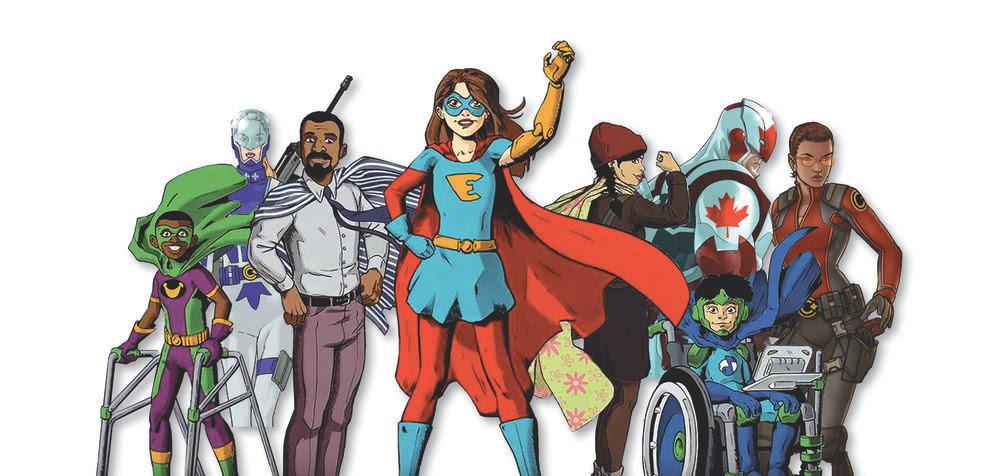
 The patriotic superhero has been a staple of comics since Simon & Kirby’s Captain America. Canada has had a few of its own, beginning with the wartime adventurer Johnny Canuck, through Captain Canuck in the 1970’s, Northguard in the 1980’s and their recent reboots from Chapterhouse Comics. But what about superheroes from Quebec?
After all, Quebec is an important part of Canada, going back as far as 1763, when France ceded New France to the British. In 1791, the original Province of Quebec was divided at the Ottawa River into Lower Canada (Quebec) and Upper Canada (Ontario). In 1841, the two were re-combined into the United Province of Canada. Finally, in 1867, Quebec became one of the founding provinces of the Dominion of Canada. In fact, the term “canadien” was originally used to mean francophones.
Knowing this, English-speaking Canadian writers generally feel it’s important to include Québécois characters in any Canadian series. But despite the best intentions of the creators, it is very difficult to write Quebec superheroes with authenticity.
First of all, there are not one, but two language barriers at work. Not only is it a challenge for English-Canadian comics writers to write French fluently, but the French that is spoken and written in Quebec is unique. Joual, as it is known, is a highly-specific dialect, like Yiddish or Creole (some go so far as to call it a language of its own). Because of its historically lower-class status, it was not taught as “correct” French; even my peers who spent years in French immersion schools never learned how people in Quebec actually speak. Writing it is something else entirely: until the Quiet Revolution of the 1960’s, and the work of writers such as Réjean Ducharme and Michel Tremblay, joual rarely, if ever, appeared in print.
Toronto writers such as Kalman Andrasofszky (Captain Canuck, Agents of P.A.C.T.) and Meaghan Carter (La Fantôme) use translators for the dialogue of their Québécois characters. But this practice has its limits: in the case of Carter, her translator and proofreader (Mederic Berton and Xaviere Daumerie) are European and use expressions that, while French, are not Québécois. (“tu nous as fichu une sacrée pagaille,” for instance.) Also, as Andrasofsky pointed out to me (which I can confirm from my own experience), no two translators ever totally agree. To write Kébec’s working-class dialogue, Andrasofsky turns to a number of francophones, including Gabriel Morrissette, co-creator (with Mark Shainblum) of Fleur de Lys. For example, one person may translate “son-of-a-bitch” to Kébec calling an enemy “un câlisse,” but another may have gone another route. In the 1980’s Northguard stories written by Shainblum and drawn by Morrissette, Morrissette provided the Québécois dialogue.
Morrissette acknowledges that American readers simply don’t understand that Quebec French is different from European French. You can see that difference in the first appearance of Northguard, when a security guard calls in for backup when the hero blows past: “J’ai un fou qui se garroche en d’dans!” the guard exclaims in perfect joual. In Northguard, he and Shainblum worked hard to give the book authenticity: “If we were going to show Montreal, we were going to show it as it really was,” he told me.
But to show something as it really is requires research. Morrissette, having grown up with European comics as well as American, was used to artists who were able to do extensive research and use accurate references. But with the tighter production deadlines of American comics, “even three days to do research was a luxury!” Mark Shainblum, in writing Northguard and Fleur de Lys, was able to draw on the fact that he had grown up and lived in Montreal: “I was immersed in all of it. I grew up during the rise of Quebec nationalism and the election of the first PQ government in 1976 [the Parti Québécois’ raison d’être is to make Quebec an independent country] and all the psychological shocks to the system that meant for Quebec, anglophone and francophone alike.”
For La Fantôme, Carter visited Montreal and its Ecomuseum and collected reference photos. But, she adds, “I’ll be perfectly honest and admit I did absolutely zero research for the character’s background!… If the story was about being a Montrealer/Quebecker… then I would have placed a lot more importance on that kind of research – or would have felt completely out of bounds writing such a thing. However, I feel that Fantome’s story is not about her background and more about investigating the Ecomuseum and being a superhero, so that’s where I focused the writing on.” Andrasofszky echoed a similar reluctance, stressing that both Fleur de Lys and Kébec are “supporting characters in other peoples’ books.” He also pointed out that, in action series, no matter how much you want to put in, “you have to cut, and cut, and cut again… It’s hard to find the time. I just want to get to the alien invasion.”
So does the fact that these are stories in the superhero genre limit the writing of these Québécois characters? “Quebec as its own unique entity has little if nothing to do with Fantome’s story,” says Carter. About Kébec, Andrasofszky says that he didn’t want her language to define her character: “I didn’t want to say, ‘Oh, she’s francophone and therefore…’ She’s a number of different things.” He tries to give an impression of their background (using language to highlight their class differences, for instance), but stresses that they are “living individuals that are more than the product of their culture.” As for Kébec and Fleur de Lys’ costumes, he was more circumspect: “It (Captain Canuck) is a book about a flag-wearing super-hero… It’s not about addressing politics… Maybe it’s a missed opportunity… I don’t know that I’m qualified to deal with that.”
I asked Shainblum if it was possible to have a flag-wearing superhero who was not political. “No,” he said. “And why would you even try? It defeats the purpose of the project… I mean, we struggled with it, Phillip Wise [Northguard] struggled with it himself.” On creating Fleur de Lys: “I wanted a Quebec-themed female character in the series, a yin to Northguard’s yang. And I wanted her to be a Quebec sovereignist to balance the maple leaf effect of Northguard, and give them a chance to actually discuss the issue and let me air some of my feelings about it.” Indeed, in New Triumph #4, Phillip and Manon discuss the Quebec independence movement in a way that’s surprisingly sympathetic, coming from an English Montrealer, and gives us insight into both characters and their motivations. Shainblum’s treatment of Manon Deschamps is by far the most authentic portrayal of a Quebec character in superhero comics, and an excellent example of the possibilities within the genre.
Quebec holds a unique place in Canada and North America. Its distinct language, culture, and history can be obstacles to creators from outside the province working fast to meet deadlines and genre conventions. But those challenges could also provide rich opportunities for those who take the time and make the effort to dig deeper below the surface of the fleur-de-lys flag.



 Toronto-based comics publisher Chapterhouse Publishing has announced a new pricing structure for its Chapterverse range of superhero titles, with every monthly comic priced at $1.99 US, and all trade paperback collections priced at $9.99 US!
 Wednesdays are new comic book day! Each week hundreds of comics are released, and that can be pretty daunting to go over and choose what to buy. That’s where we come in!


