Tag Archives: avatar press

Discovery Hashed Out in Court Cases Between Diamond and some Publishers
Diamond Comic Distributors

One of the major outstanding issues with Diamond‘s bankruptcy is the status of consignment inventory. Diamond currently has stock that was provided to it by publishers on a consignment basis. That stock is currently physically held by Sparkle Pop which purchased some of Diamond’s assets, including taking over the warehouse where these are stored, though they don’t have a right to sell it (which they did and there was drama around that). Earlier today, we reported that a group of publishers filed a motion to dismiss their cases and thus take control of their goods. But, there’s still a few more publishers that are outstanding and since that motion hasn’t been decided, things are still in motion.

Today, a report was filed concerning the cases of Goodman Games, BOOM! Entertainment, Fantagraphics, and Avatar Press, laying out the plans for “discovery.”

The various parties and Diamond met on February 26 and March 3-4 to attempt to find a resolution, the nature of the claims and defenses, to arrange disclosures, and propose a discovery plan.

Discovery is a process where documents are handed over to the lawyers for them to go through. This could be contracts, emails, text messages, and more and is a gathering of evidence to be used during the trial. It can be a costly process and involve millions of documents that need to be sorted through. With that, rules and dates are laid out for the case concerning the discover process including on the production protocol.

There are key dates now as per the initial agreement.

(a) Discovery Requests. The Parties shall serve all initial document requests, interrogatories, and requests for admissions on or before May 11, 2026.
(b) Agree on ESI Search Terms. The Parties will make reasonable efforts to agree on ESI Search Terms on or before May 25, 2026.
(c) Substantial Document Production Completion Date. The Parties expect to have document production substantially completed by July 6, 2026.
(d) Fact Discovery Cut Off. The Parties have agreed that, except for Rule 26(a)(1) disclosures, all fact discovery in this case shall be initiated so that it will be completed on or before August 31, 2026. The Parties have agreed that they may take fact depositions at any time prior to the expiration of the fact discovery deadline.
(e) Privilege Logs. Privilege logs shall be produced in accordance with the Federal Rules of Civil Procedure so as to be completed within five (5) business days of the related document production. Privileged communications occurring after April 29, 2025, need not be included on a privilege log.
(f) Expert Initial Disclosures. The identify of expert witness and subject matter of expected testimony, per Rule 26(a)(2)(A) and 26(a)(2)(C)(i), shall be disclosed on September 8, 2026. Any rebuttal experts, and subject matter of expected testimony, shall be disclosed on September 18, 2026.
(g) Expert Reports and Expert Discovery Cut Off. Expert reports and all other information required by Rule 26(a)(2)(B), along with any documents or information considered by the expert, shall be exchanged on October 8, 2026. Rebuttal expert reports and all other information required by Rule 26(a)(2)(B), along with any documents or information considered by the expert, shall be exchanged on October 29, 2026. All expert discovery shall be completed by November 20, 2026.

With that final date, that would mean the earliest a trial would happen would be late November but with Thanksgiving, early December is more likely and this agreement estimates it’d last 3 to 4 days.
Diamond Submits a Complaint Against Avatar Press increasing Complaints Against Publishers to 32

Avatar Press

There’s many issues still to be resolved when it comes to Diamond’s Chapter 11 process. One is the interest in property, aka consigned inventory, aka product publishers sent to Diamond to sell.

In September, Diamond filed 31 complaints against publishers to determine who “owns” that inventory. The publishers want it back while Diamond wants to sell the inventory to raise money to pay back loans to JPMorgan Chase Bank.

Avatar Press wasn’t part of that initial 31 but that seems to have changed with Diamond filing a complaint with the court that reads like the previous ones filed.

In their filing they ask the court to declare that Diamond:

  • it has an interest in the Defendant Supplied Consigned Inventory superior to the interest of the Defendant,
  • the Debtor’s interest in the Defendant Supplied Consigned Inventory constitute property of the Debtor’s estate within the meaning of section 541(a) of the Bankruptcy Code, and
  • the Debtors can sell or otherwise dispose of the Defendant Supplied Consigned Inventory pursuant to Bankruptcy Code section 363(b), without regard to the terms and conditions of the Agreement, free and clear of any alleged interest in the Defendant Supplied Consigned Inventory held or asserted by the Defendant pursuant to Bankruptcy Code section 363(f).

All of this was Diamond’s original argument to be able to sell the consigned goods, now they’re just making it at the publisher level instead of a blanket one for all. The questions are:

  1. Is this serious and going to play out with the upcoming hearing regarding the publishers motion over consignment goods still coming?
  2. Is this an attempt at leverage to try to get the publishers to settle and cut a deal with Diamond?

Check out the full complaint below:

The Ad Hoc Committee Drops a Motion asking Out of Diamond, Ad Populum, and Universal Distribution, Who’s Actually Selling the Consignment Merchandise?

Diamond Comic Distributors

There’s been a lot of unanswered questions when it comes to Diamond‘s chapter 11 filing and the purchase of its assets by Universal Distribution and Ad Populum/Sparkle Pop. The Ad Hoc Committee of Consignors has submitted a motion that lifts the veil a bit and gives clues as to some of those answers.

The Ad Hoc Committee of Consignors is a group of creditors, aka publishers, impacted by Diamond’s chapter 11 and also Diamond’s motion to try to sell consignment goods to help pay back its debts. The committee includes Ablaze, American Mythology, Avatar Press, Battle Quest, Drawn & Quarterly, Fantagraphics, Green Ronin, Hermes Press, Living the Line, Paizo, Udon Entertainment, and Zenescope.

At the heart of this motion is the question as to whether anyone can legally sell goods still held by Diamond and if Ad Populum or Universal Distribution properly continued any of the previous Diamond contracts.

In short, who the hell are currently selling and profiting from the comics and games being “sold by Diamond”?

Sit back, because this is a doozy of a filing and we’re going to try to break it down with bullet points for ease and the really interesting parts are in bold…

  • Diamond filed its bankruptcy on January 14, 2025 and on January 21 put in a motion to sell its assets
  • On May 1, Ad Populum/Sparkle Pop and Universal Distribution won the bidding prosses for the assets
  • On June 10, Diamond filed a notice of the sales closing with each closed in mid-May
  • Goods held on consignment by Diamond were excluded from the inventory sold to Ad Populum/Sparkle Pop and Universal Distribution
  • Spark Pop was given 20 business days after closing to decide what contracts it would continue and that includes the contracts (consignors) between Diamond and the publishers
  • Diamond nor Ad Populum/Sparkle Pop filed motions to have the “Consignors’ Contracts assumed and assigned.” This ended in early June 2025
  • Universal Distribution did include assumed contracts in its sale closing which was filed a month after closing. That included Green Ronin Publishing and a distribution agreement with Paizo. But, the purchase agreement and sale order didn’t identify any assigned contracts, so there’s some paperwork issues there.
  • On June 25, 2025, Diamond filed a motion to sell the consigned inventory it has.
  • After, there were a lot of objections to that consignment sale.
  • On April 17, Titan Publishing Group filed an emergency motion to compel Diamond to assume or reject its distribution agreement with Titan
  • On May 16, 2025, Diamond filed a motion objecting to Titan’s motion.

Got all that? In short, no one has filed the paperwork properly to assume or reject the contracts that existed between Diamond and the publishers.

There’s more interesting details…

On May 27, an email was sent to publishers stating the Ad Populum/Sparkle Pop and Universal Distribution were responsible for all sales activity after May 16 and Ad Populum/Sparkle Pop’s Diamond was a new entity. The Ad Hoc’s motion states that the email sent misled the publishers that the “Asset Sale to Sparke Pop was actually a sale of ownership, because it indicated that Diamond continued to operate under the ownership of a new buyer.”

What’s interesting is that that email says Ad Populum is responsible for new stock, but never took over any stock and that the legacy consignment stock continued to be sold… by someone.

And that’s what is at the heart of this motion, who is selling the stock that Ad Populum/Sparkle Pop and Universal didn’t purchase. Diamond isn’t providing information concerning that.

The May E-Mail confirms that the Stock continued to be sold by someone after the Sparkle Pop and/or UDL sales closed, but it is unclear who is selling the Stock. The Debtor has confirmed that it has not sold stock after May 15, 2025, but has declined to voluntarily provide any information to the Consignors as to who sold Stock after May 15, 2025, which Stock was sold, or what payments remain due and owing to the Consignors on account of
the sales. The Debtors have declined to voluntarily provide any information to the Consignors as to how any party other than the Diamond Distributor Debtor could sell Stock without a properly assumed and assigned agreement to do so.

The motion has amounts that are owned to each of the publishers. The 12 publishers are owed at least $555,971.84. But, that amount is unknown and likely higher since Diamond isn’t providing up-to-date reporting as to what’s sold or collected, so that amount may be higher.

The motion goes on further to poke holes in Diamond’s plan to sell the consignment stock and that there are outstanding obligations.

It’s asking for the status of these contracts to be determined and done so soon and the consignors what the contracts to be terminated when if Diamond rejects the contracts.

They’re also conducting discovery to find out who sold the stock after the May 15 sale to Ad Populum/Sparkle Pop.

Buckle up, this is going to get very interesting!

Read all of the filings below:

Who is the Ad Hoc Committee in the Diamond Bankruptcy Case?

Diamond Comic Distributors

During the Diamond Chapter 11 bankruptcy case, there’s been an “Ad Hoc Committee” that has represented multiple creditors impacted, the creditors being publishers and others Diamond owes money to. But, who makes up the “Ad Hoc Committee?”

Formed on or about July 11, the group is represented by YVS Law, LLC and with a new filing, we now know who is represented answering more questions as to how publishers are responding to the legal proceeding and checking off 11 more who are involved in the proceedings.

The “Ad Hoc Committee” consists of:

  • Ablaze LLC
  • American Mythology Productions, LLC
  • Avatar Press, Inc.
  • Drawn & Quarterly Books Inc.,
  • Fantagraphics Books, Inc.
  • Green Ronin Publishing LLC
  • Herman & Geer Communications, Inc. dba Hermes Press
  • Living the Line LLC
  • Paizo Inc.
  • UDON Entertainment Inc.
  • Zenescope Entertainment Inc.

Check out the filing below:

“Modded” is an Underrated Ode to the Casual Gamer

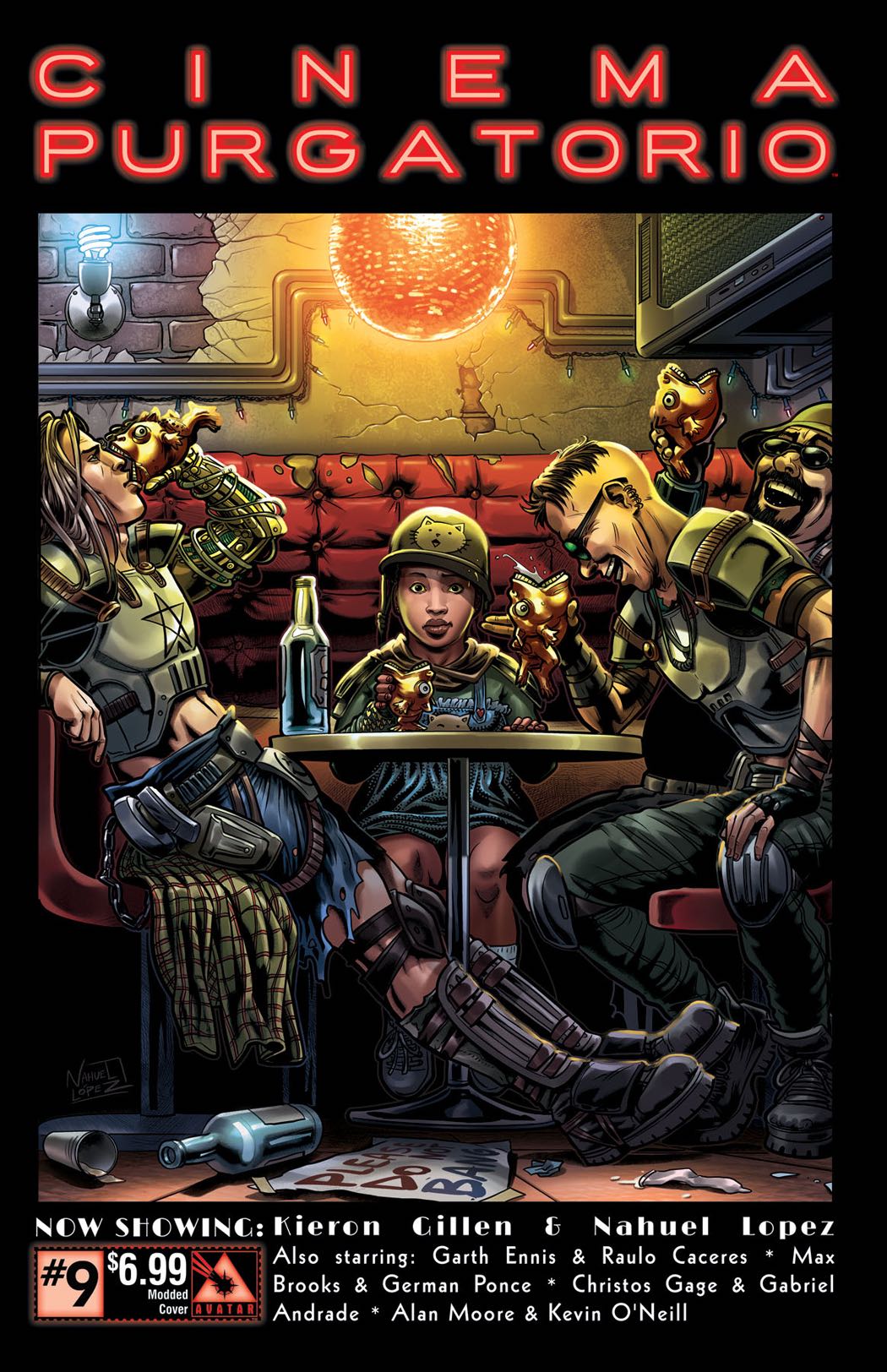
 Cinema Purgatorio #9

In advance of Kieron Gillen and Caspar Wjingaard’s upcoming comic The Power Fantasy, we’re revisiting some of Gillen’s previous creator-owned work.

Did you remember that there was a black and white anthology comic curated by Alan Moore with art from the late Kevin O’Neill that ran from 2016-2019 that had nothing to do with H.P. Lovecraft, extraordinary gentlemen, or Captain Nemo? Did you also remember that the anthology also had a Garth Ennis vampire series, a Max Brooks American Civil War-set alternate history series, and a Christos Gage kaiju series? It was called Cinema Purgatorio, and most importantly for this article, it featured a post-apocalyptic series from Kieron Gillen, Ignacio Calero, and Nahuel Lopez called “Modded” that is both a satire and love letter to video games from Donkey Kong to (maybe) Fortnite. I’m not a big gamer (Video games peaked at NBA Live 2005 and the first Lego Star Wars, but the new ones are fun too.) so I didn’t get all the references in this book.

However, I did play a few of the Civilization games and have a sister and some exes who were super into The Sims so I understand the concept of “modding”. Basically, instead of sticking with the game in the box/digital download, you add all kinds of modifications to make the game play better, which could be a map of Middle Earth to conquer or introducing full frontal nudity to The Sims and putting viruses on my laptop. Kieron Gillen, Calero, and Lopez take this classic video game concept and apply it to a Mad Max type world that initially is a dark and edgy parody of a Pokémon, but eventually takes aims at all types of games and even New Games Journalism, which was coined by Gillen back in 2004.

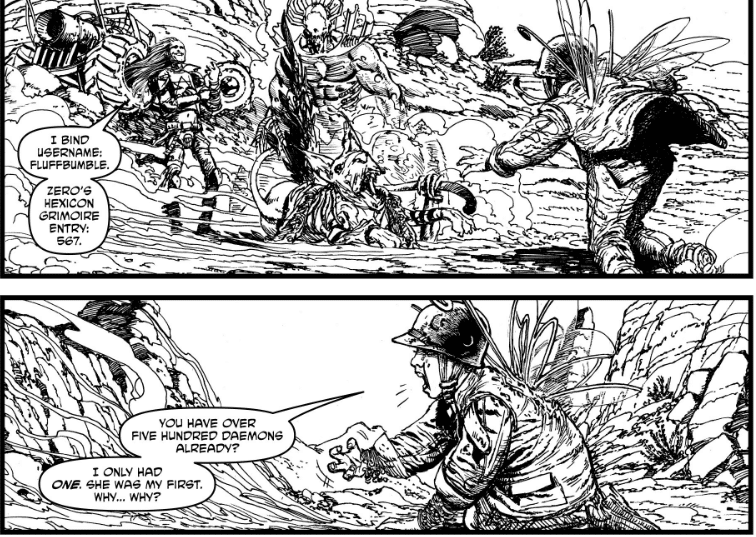
“Modded” is about a girl named Fringe from a post-apocalyptic work camp who bonds with a daemon (Basically a Pokemon) named Fluffbumble, but immediately loses the cute critter to a daemonatrix named Tommy Zero, who is just trying to round out his Hexicon. (Pokedex, but demonic.) She meets a seemingly kinder daemonatrix named Susan, who promises to help train her up and show her the ropes of this wild world so she can get Fluffbumble back and live happier ever after. However, the plotline of the series runs a lot less smooth than this with Fringe getting infected by something called Living Text, lots of hallucinogens and weirdly strong alcoholic beverages, and our protagonists actually befriending Tommy Zero for a bit. But, along the way (and Easter Eggs aside), Fringe’s character arc becomes a love letter to playing games the way you want to play.

The reason I initially connected to “Modded” was because when it came out in summer of 2016, that was also the famous “summer of Pokemon Go”. I was walking around my neighborhood in Louisville, Kentucky hatching Pokemon eggs and hanging out by the lure at the local American Legion trying to add more creatures to my Pokedex. This was the fun part of the summer, but there was also a darker side. Various landmarks were gyms where you can battle other Pokemon trainers, but the combat system wasn’t like the actual Pokemon games plus all of the Pokemon at the gyms were a much higher level than me. So, I basically was Fringe with my Fluffbumble getting humiliated by Levithane outside the local Catholic church.

Fringe actually does win some battles and competitions for better or worse throughout the run of “Modded”, but she’s mostly treated like a novelty figure, who just wants to put a pretty hat on her daemon instead of a phallic minigun or something out of Preacher. (Apparently, it’s still a must read in the post-apocalyptic world.) Even her speaking patterns are roasted by the daemonatrixes of the Abyss because she’s kind and doesn’t swear, and they drop f- or c-bombs almost every other word although there’s one hilarious scene when a member of Tommy Zero’s crew says they’re just putting on appearances. Gillen’s dialogue nails the way hardcore gamers speak with a toxic blend of jargon, profanity, misogyny, and homophobia, and this bad behavior extends to some of the daemons to with Tanky Andov reminding you that this is an Avatar book by graphically “tea-bagging” another player to Fringe’s chagrin. The middle half of “Modded” shows the addictive nature of video games, and how it’s easy to consumed with being the best/winning and let friendships and relationships fall to the wayside as Fringe and Susan drift apart.

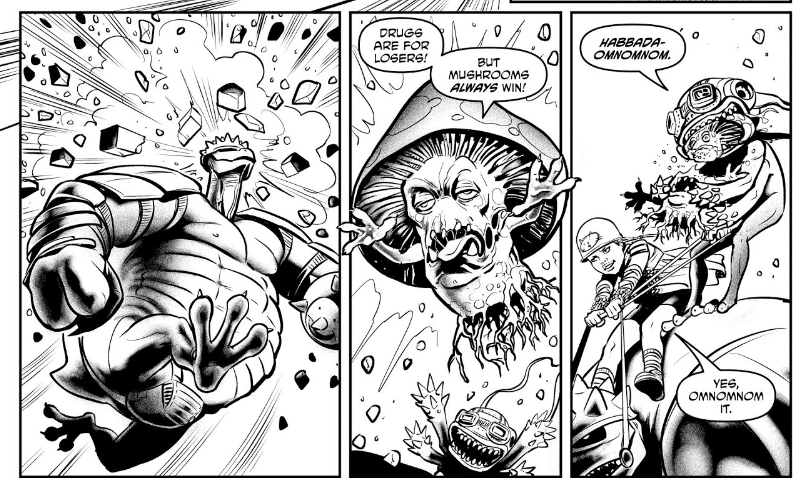
But “Modded” (and this article) isn’t some anti-video game screed, but also a love letter to how they provide freedom, escapism, and fun from a world that’s becoming similar to a post-apocalyptic one although sadly fetish wear isn’t daily wear just yet. Kieron Gillen and Nahuel Lopez explore this through the concept of “Blue sky”, which gives Lopez an opportunity to show what it’s like playing Super Monkey Ball (That’s a game I wouldn’t mind revisiting.) whilst tripping. Blue skies are also rare in the world of “Modded” because they’re like a concentrated shot of hope and optimism in a world of conflict. To take things to the real world for a second, blue sky is a reminder of a world where you didn’t have to care about bills or job performance and just thought about getting the next star in Super Mario 64 or building the ultimate University of Tennessee dynasty in NCAA Football. (Someone please get me a PS5 so I can play the new one that came out.) On the storytelling side, Gillen and Lopez free up the narrative in “Modded” Chapter 14 where Tommy Zero and Fringe race under the influence of Blue Sky. There’s speed lines galore, blocks to smash, a disturbingly realistic mushroom, and one hell of a comedown. Sadly, during this comedown, Susan steals Fluffbumble from Fringe snapping her back to reality.

“Modded” is to gaming like Phonogram is to indie music, and some of their ideas were explored in a bigger, more commercially successful way in Die (I have an essay coming out on that soon, I promise!) and The Wicked + the Divine. But “Modded” is also a hilarious series. The sequence where Fringe uses objects around her to change her name to “Glasshat Dildobeast” makes laugh out loud. But, above all else, it’s an ode to having fun with video games and your friends and not treating it like a second job. It’s hot today so I think it’s a lovely time to boot up Pokemon Snap and take cute pictures all afternoon as I live that “filthy casual” life.

Uber Volume 1 will simultaneously intrigue and horrify readers

In advance of Kieron Gillen and Caspar Wjingaard’s upcoming comic The Power Fantasy, we’re revisiting some of Gillen’s previous creator-owned work.

Uber Volume 1

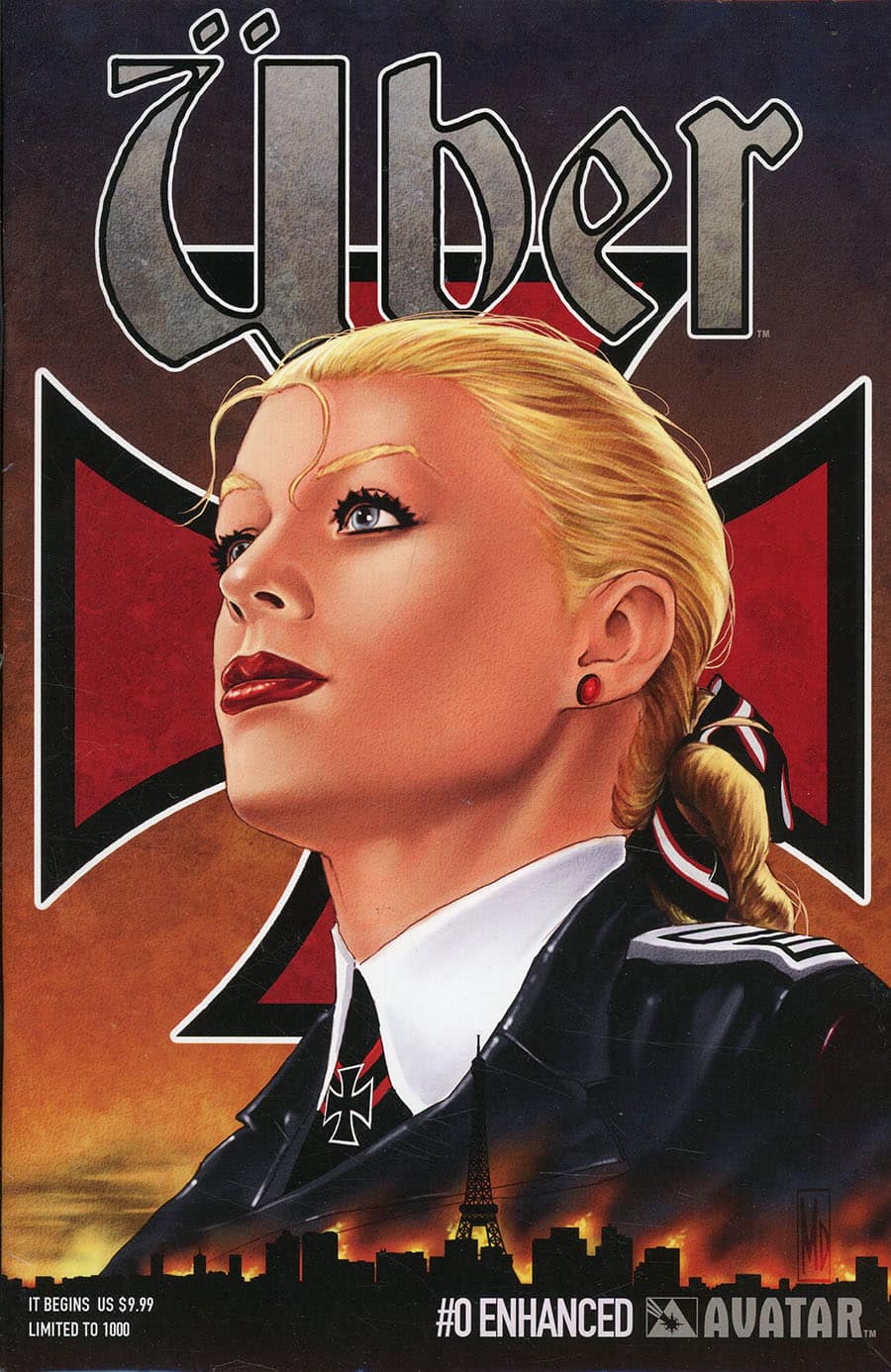
Uber has been on my “to-read” list for the better part of a decade. It’s an alternate history/superhero comic from Kieron Gillen, Canaan White, Keith Williams, and Digikore Studios set in World War II where the Germans are on the edge of surrender (Hitler literally has a gun in his mouth.), but then they have a breakthrough with superhumans, who are of course called “Ubermensch”, drive the Soviet Red Army back, and prolong the war beyond its actual historical end. The first volume introduces this brave new world with a huge ensemble cast, including actual historical figures like Winston Churchill, Heinz Guderian, and of course, Adolf Hitler, and shows the superhuman arms race between Nazi Germany and the Allies, predominantly the United Kingdom. White and Williams’ visuals marry Bryan Hitch’s widescreen visuals (Especially when the superhumans use their abilities.) with the grit, grime, and entrails of Darick Robertson’s work on The Boys. Uber reads like an intelligent, blockbuster war film or miniseries, but the ultraviolence and “equal time” given to both Nazis and Allies means that it would probably not be greenlit so it’s nice to see its creators use the creative freedom provided at a small publisher like Avatar Press to tell a story that is both well-researched (Gillen wrote a 30,000 word series bible.) and visceral.

Although English spy Stephanie is a total badass and provides the few hopeful moments of the series when she steals the Nazi formula for creating superhumans as well as copies of the books with information about enhancing humans, Uber isn’t constrained by a typical hero/villain narrative. But this action is tempered by her torturing and experimenting on participants in the German superhuman programs. Gillen and Canaan White cut between the Allies, Germans, and Soviets and almost journalistically show their motivations, strategies, and moral failings. The Nazis have the most, of course, like when Hitler overrides his generals and tells the superhumans to kill almost one million Soviet prisoners. Moments like this along with Allied characters dropping like flies throughout the volume adds a tone of menace and fear, especially in the climactic battle where the German female superhuman Klaudia aka Sieglinde eviscerates the British superhuman, the American-born O’Connor revealing that this isn’t going to be a Marvel MAX Captain America comic.

The horrific side effects around the testing and creation of superhumans whether Ubermensch or His Majesty’s Humans (HMH) are a heightened version of real life eugenics projects done during World War II and shows that everyone involved has blood on their hands except for the test subjects themselves. Uber really is more of a horror comic than a superhero one. For example, what in most superhero media would be a run-of-the-mill training montage of a superhuman lifting a car ends up having intestines flying everywhere because an HMH recruit pushed his limits a little too early. Also, the combat in Uber is more war movie and less stylized action with Kieron Gillen’s captions setting up strategies and troop deployment while White, Williams, and Digikore’s visuals show the utter destructive capability of the superhumans as well as their weaknesses. In fact, Gillen sets up a pecking order of superhumans with human tanks acting as enhanced foot soldiers while the battleship class ones like the aforementioned Klaudia are the obliterate entire armies/cities power level. This keeps the action from turning into a retread of Miracleman and leaves room for actual military tactics like any time Guderian is involved. However, for all of Heinz Guderian’s contempt for Hitler and skill at setting up tank assaults, he’s still a fascist and never pulls a Claus von Stauffenburg or even Erwin Rommel because he wants an armistice and to simply not lose the war.

Another interesting aspect of Uber Volume 1 is how Kieron Gillen pokes holes into the “great man” theory of history in his portrayal of Winston Churchill. His perspective on the beloved prime minister/imperialist stooge fits somewhere in between those two extremes as Churchill is open to new ideas like the fact that the Germans have superhumans, but also wants the Cliff’s notes of Stephanie’s intel on the Ubermensch and to immediately have her head up the British superhuman project although she’s traumatized from working deep cover with the Germans. Gillen gently roasts his obsession with the perfect turn of phrase in some of his interactions with different generals and officials while also showing his take-charge attitude that was the opposite of Neville Chamberlain’s appeasement approach to Hitler and Nazi Germany. But the most haunting scene is the final page of the comic where he opens a desk with a handgun and bullets showing that, like Hitler, he would rather die than be captured. The gun stays in the drawer showing that he still has some hope for the war although Paris lost major landmarks like the Eiffel Tower and Notre Dame cathedral in the battle at the end of the volume. It sets up a tense race between Germany and the Allies with the Nazis having the better superhumans while the United Kingdom has the chemical compound that creates them as well as skilled codebreakers like Alan Turing to figure out how to use them more effectively in battle.

Beginning with a paradigm-shifting opening issue that showcases the awe-inspiring power of the Nazi superhumans, Uber is a heightened look at the horrors of war and genetic experimentation set during the last “good war”. It’s not thrilling in a traditional sense, but Kieron Gillen, Canaan White, and company give the story solid narrative momentum, especially when the British build their own superhumans to counter the Germans. I’m simultaneously intrigued and horrified by Uber and definitely plan on seeing how it diverges from actual history, especially in the upcoming issues that look at other fronts of World War II.

Story: Kieron Gillen Pencils: Canaan White
Inks: Keith Williams Colors: Digikore Studios Letters: Kurt Hathaway
Story: 8.8 Art: 7.8 Overall: 8.3 Verdict: Buy

Review: Uber #15

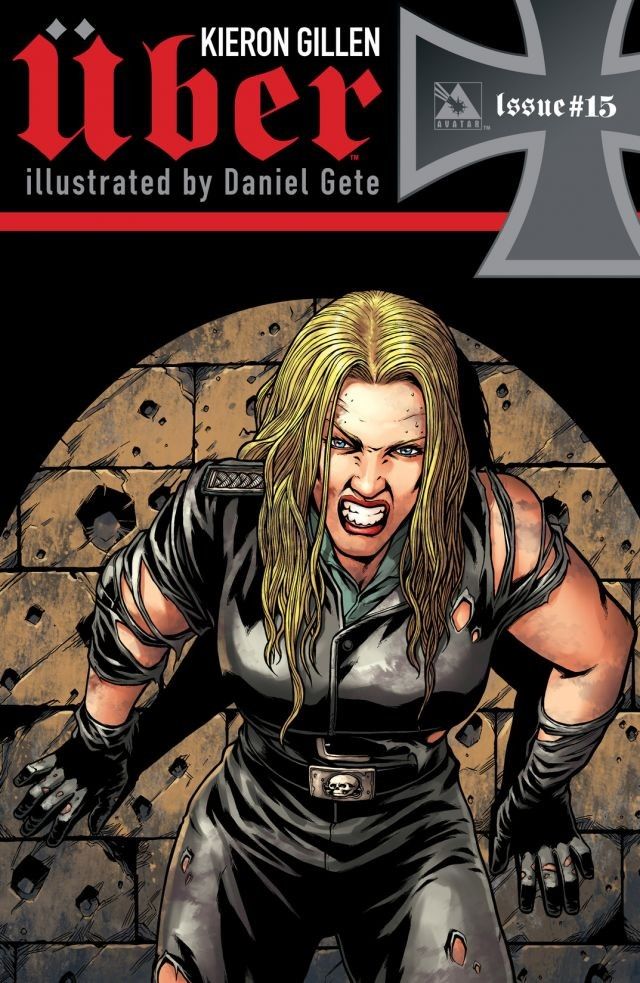
Uber #15

One of the movies that made me a cinephile is the highly underrated The Warriors. It’s one of those movies that looks like the typical B movie at first glance, that is until you get caught up in the plot. The movie begins with a gathering of all the gangs in New York for a summit lead by one of the gang leaders, Osiris. The movie moves forward with his killing and the gang, The Warriors, being blamed for his murder. They spend the rest of the movie, trying to survive every gang in New York, until daylight when they can prove their innocence.

What made that movie so good was the chase. You didn’t know if they would survive until the morning. When you have nowhere to run and everyone is out to get you, if you survive to see the other side of it, it really is a miracle. In the beginning of a new story arc, the fifteenth issue of Uber, one of the German Battleships is in Allied territory, and their capture is almost imminent.

We find Sieglinde, outgunned and behind enemy lines, as she gets attacked by the British fleet, which seems that her death was close, until one of Germany’s Elektroboats save her and destroy the three destroyers. We also catch up with Freya, as she prepares Leah for what she could mean for this extended war, as her prowess to looks to be twice what the Panzermensch has meant to Germany. As Freya, explains what her research has discovered, to the room full of men which comprise the United Kingdom’s war cabinet, as they are uneasy of following a woman’s advice. By issue’s end, Freya has come up with a plan that will turn the war to the Allies favor, and it could mean a complete sea change for all involved.

Overall, a pulse pounding issue which gives fans a glimmer of hope that the good guys have a chance to win. The story by Kieron Gillen is exciting and well developed. The art by Daniel Gete is captivating. Altogether, an excellent installment in this stellar series that captures the best of war comics and superheroes.

Story: Kieron Gillen Art: Daniel Gete
Story:9.7 Art:9.6 Overall:9.4 Recommendation: Buy

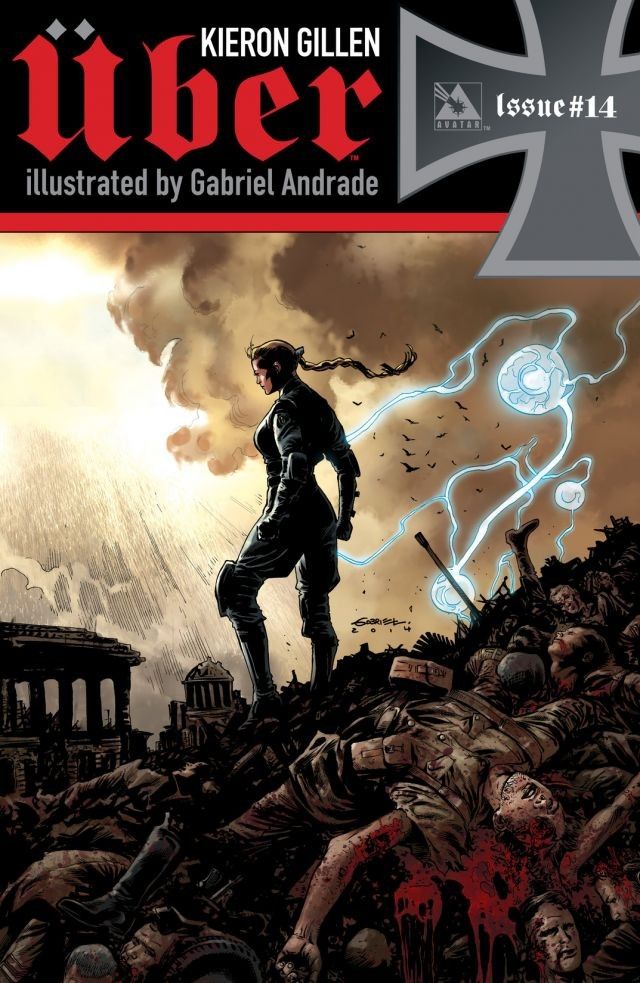
Review: Uber #14

Uber #14

For David did not ascend to heaven, and yet he said, “‘The LORD said to my LORD: “Sit at my right hand until I make your enemies a footstool for your feet.”‘- Acts 2:34-35-Bible

There’s nothing like when people underestimate you from the onset. No matter who you are most people tend to judge others from their preconceived notions. We habitually go into most situations and base them on our experiences and level of knowledge. We basically make an “educated guess” on what will happen next.  This same skill set is used to pre-judge people mostly on appearance and then possibly because they remind you of someone.

In the theater of war, military leaders cull from years of experience, data of the enemy, and military tactical history. Even with this wealth of knowledge sometimes, and actually quite often, the most prepared leaders are outmaneuvered. They cannot count on certain actors what some may call “wild cards,” as they often tip the balance of the battle and rarely is one prepared for contingencies. In the 14th installment of Uber, the Russians have unleashed their own wild card in battle of the superhumans.

We are taken to Hitler’s bunker, where his dead body is found by his personal military attaché, and with both him and Churchill dead, some new forerunners can seize power. As the reader finds out how the first airship was experimented on and eventually how they perfected the formula. We also find out how the killing of Hitler was no accident, as it had been a long gestating plan of action.

Overall, it’s a thrilling issue that gives readers another Easter egg on what is really going on that the reader won’t see otherwise. The story by Kieron Gillen is clever and enjoyable. The art by Gabriel Andrade is beautiful. Altogether, an excellent entry in this entertaining World War II series.

Story: Kieron Gillen Art: Gabriel Andrade
Story: 10 Art: 9.6 Overall: 9.4 Recommendation: Buy

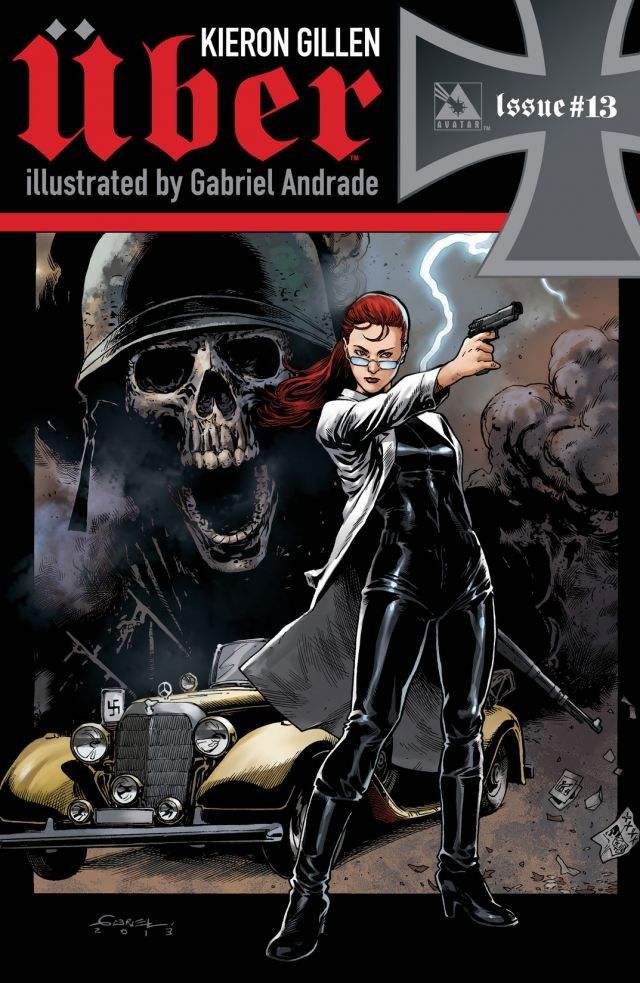
Review: Über #13

There is nothing like chase movies where the villain is in constant pursuit of the protagonist. One example has entered the zeitgeist by sparking nostalgia and pulling from the best elements of 80s movies, Stranger Things. The show made adults who grew up in the 1980s feel like the decade they grew up in was something to be proud of and be able to enjoy again. I was one of them and saw that usually most movies and tv shows made fun of the time (primarily because of horrible aesthetics).
Despite the obvious story elements, it brought back the chase story in a way that still excites and intrigues viewers and makes some of us look for the 80s movies that inspired it in the first place. In the 13th issue of Über, we find Katyusha as she faces the horrors of war in all its gory cruelty and uses that familiar element.

We find Katsuya wandering the wilderness near Ukraine, defenseless and almost out of life, as she saved by an elderly couple. As she regains her consciousness, she slowly bonds with them, eventually finding out that their sons died in this war that she had been fighting for several months. Eventually Russian soldiers come looking for her, who she destroys in minutes. By issue’s end, she destroys an army that comes for her head and eventually leaves them now knowing what happened to Chirchill.

This is one of the best issues in the series that although it feels out of sorts, gives readers a peak into Katyusha’s psyche. The story by Kieron Gillen is intense, riveting, and action packed. The art by Gabriel Andrade is world class and elegant. Overall, this issue serves as a masterclass in character exploration.

Story: Kieron Gillen Art: Gabriel Andrade
Story: 10 Art: 9.5 Overall: 9.7 Recommendation: Buy

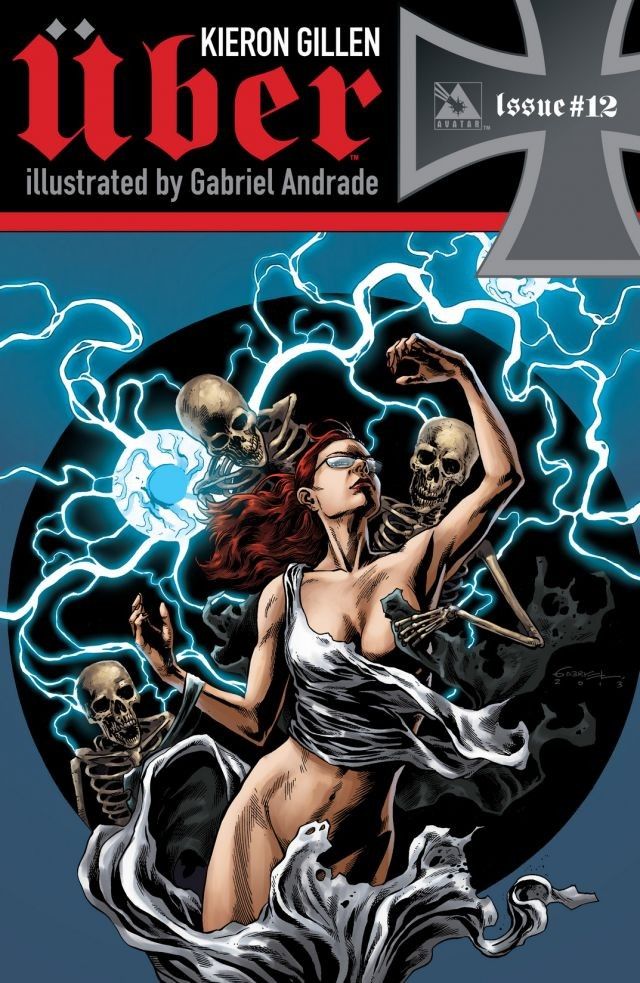
Review: Über #12

How does one carry on when change occurs beyond recognition? Some assume that our future is dictated by our past. We see all that came before and assume that we will repeat the cycle. The reality is, the cycle can be broken, as each individual can change their own destiny.

Take for instance familial skirmishes where one family has no idea why they even hate each other but just do. This all can be helped if someone from each side tried to mend things and actually have a true dialogue. These things happen when generations die off and history is lost with them.  In the 12th issue and the beginning of year 2 of Über we find all three nations rudderless without the men who lead their nations but their bloodlust even more heightened.

We catch up with Stephanie shortly after the massacre in London, as the RAF assess their casualties which includes Churchill. We soon find out that Stephanie has been using  what she learned from the Germans to create a different type of warship in Bletchley. As her ambitions become reckless, almost killing Bletchley, Alan attempts to stop her ,knowing no good can come from extreme measures. By issue’s end, some unexpected news gives Stephanie and Alan pause. Something that will change everything.

Overall, it’s quite an introspective issue that dives into the motivations of one of the main characters Stephanie. The story by Kieron Gillen is gripping and smart. The art by Gabriel Andrade is luminous and elegant. Altogether, an entertaining issue in this saga of superpowered humans in World War II.

Story: Kieron Gillen Art: Gabriel Andrade
Story: 10 Art: 9.5 Overall: 9.6 Recommendation: Buy

« Older Entries