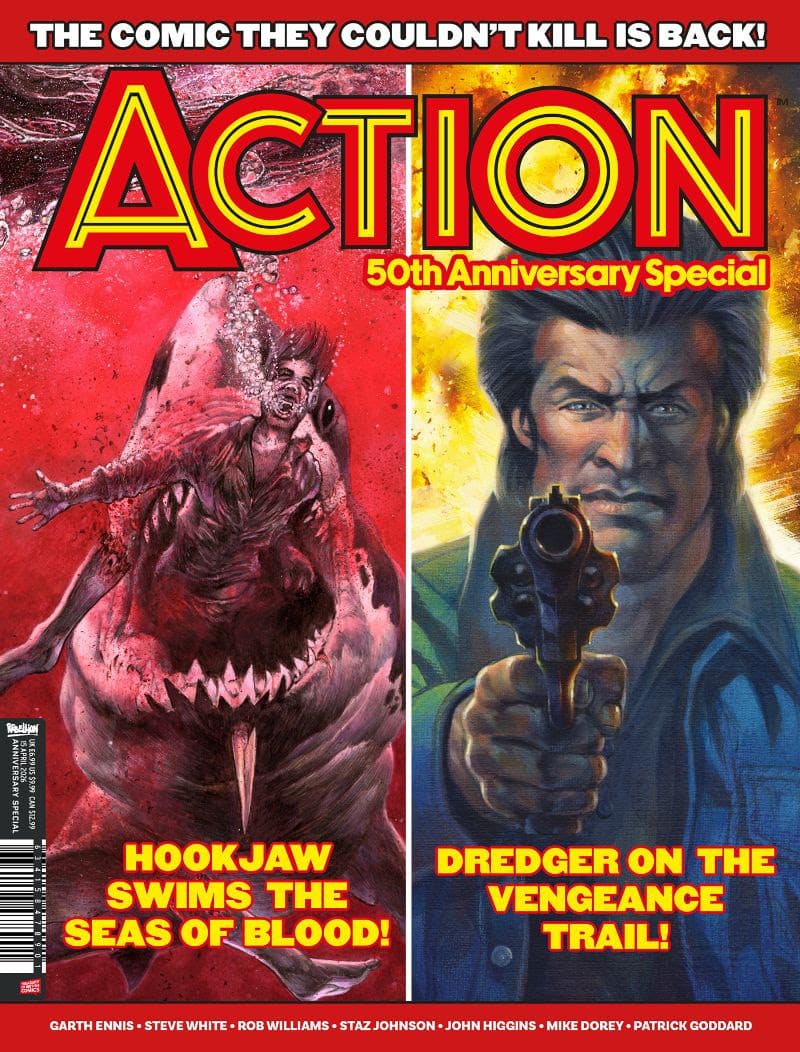
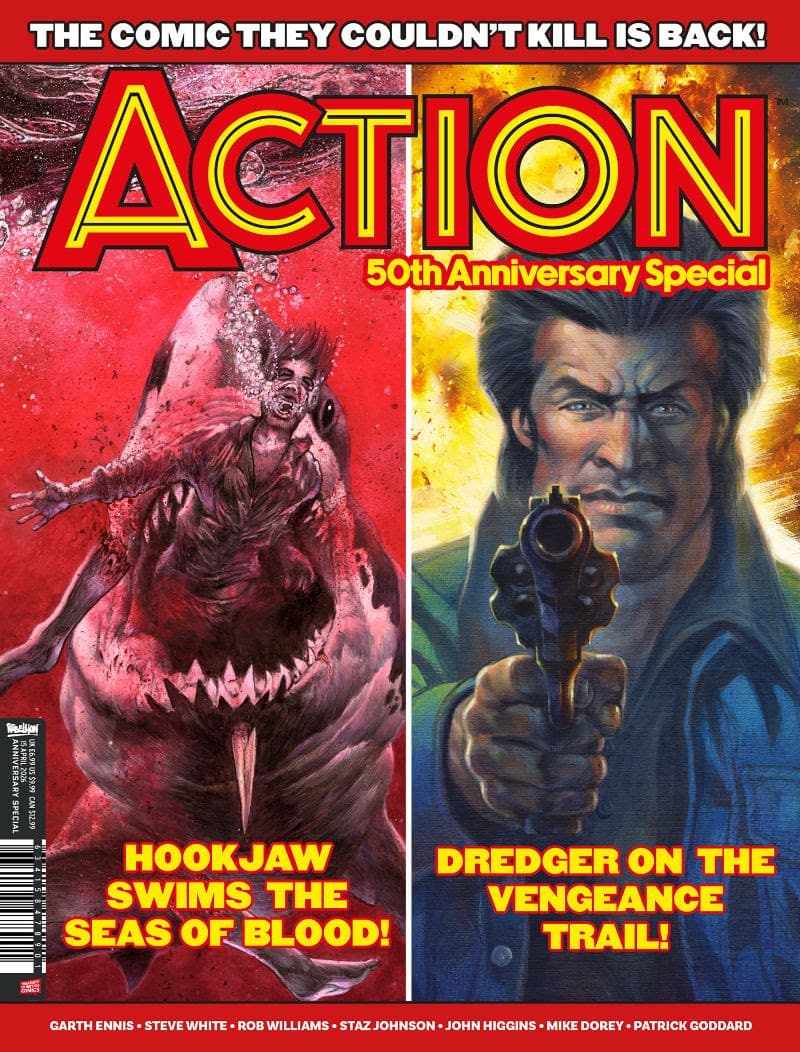
Before 2000 AD there was Action! Action was always ahead of the curve… and sometimes pushed its luck just a bit too far. Celebrating 50 years since the first issue of the original series which inspired readers across the country, Rebellion has published an all-new oversized Special which brings back all the shock and awe of the original series! Featuring a powerhouse lineup of writers and artists including Garth Ennis, Rob Williams, John Higgins, Staz Johnson and more, Action presents a brutal lineup of its heaviest hitters. Hook Jaw the killer shark takes on a gang of international drug-dealers; no-nonsense cop Dredger seeks vengeance against the men who killed his partner; and footballer Kenny “Lefty” Lampton has a memorable meeting with the King of England. Action is back, and more controversial than ever!
Story: Steve White, Garth Ennis, Rob Williams Art: Staz Johnson, Mike Dorey, Patrick Goddard, John Higgins Color: Matt Soffe, Sally Jane Hurst Letterer: Rob Steen
Get your copy now! To find a comic shop near you, visit http://www.comicshoplocator.com or call 1-888-comicbook or digitally and online with the links below.
UK and DIGITAL: 15 April £6.99 COVER: STEVE WHITE & JOHN HIGGINS
In This Issue: HOOKJAW // NECROMONE: Steve White (w) Staz Johnson (a) Matt Soffe (c) Rob Steen (l) HELLMAN // A WINTER’S TALE: Garth Ennis (w) Mike Dorey (a) Rob Steen (l) LOOK OUT FOR LEFTY // ARISE, SIR LEFTY! Rob Williams (w) Patrick Goddard (a) Rob Steen (l) DREDGER // AFTER THE ACTION: Garth Ennis (w) John Higgins (a) Rob Steen (l)
Before 2000 AD there was Action! Action was always ahead of the curve… and sometimes pushed its luck just a bit too far. Celebrating 50 years since the first issue of the original series which inspired readers across the country, The Treasury of British Comics are publishing an all-new oversized Special which brings back all the shock and awe of the original series!
First published in 1976, Action shocked the UK when it first landed on shelves, with a range of stories which not only brought hard-hitting action to the page, but offered social commentary and sharp criticism which soon caught the eye of Mary Whitehouse and her fellow censors.
After an issue which featured a controversial cover that appeared to show a teenager assaulting a police officer as part of “Kids Rule OK”, a moral panic ensued which led to the comic being withdrawn from the shelf! When it did return, readership fell at the new, “safe” version of Action which they found in their newsagent.
Although Action was eventually closed in 1977, the spirit and attitude of the comic found a new home in the form of 2000 AD, which took up the attack and has been running with it ever since. Now, fifty years later, Rebellion Publishing are reviving Action for a new Special featuring an incredible lineup of creators, and some of its most famous – and infamous characters – back on shelves and ready to inspire a whole new generation to anarchy!
The Special features:
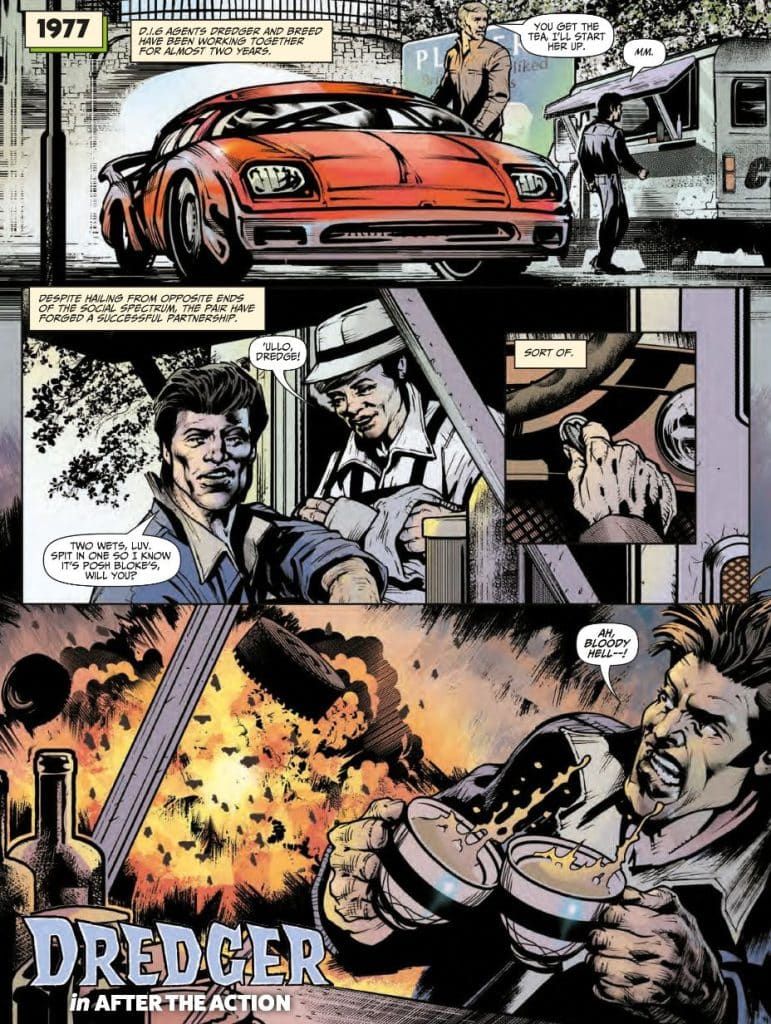
Dredger by Garth Ennis and John Higgins. Britain’s deadliest secret agent returns, hitting the vengeance trail after the death of his partner, Breed. Dredger kills and maims his way across London, intent on delivering his own brand of justice. How much of London will be left when he’s finished?
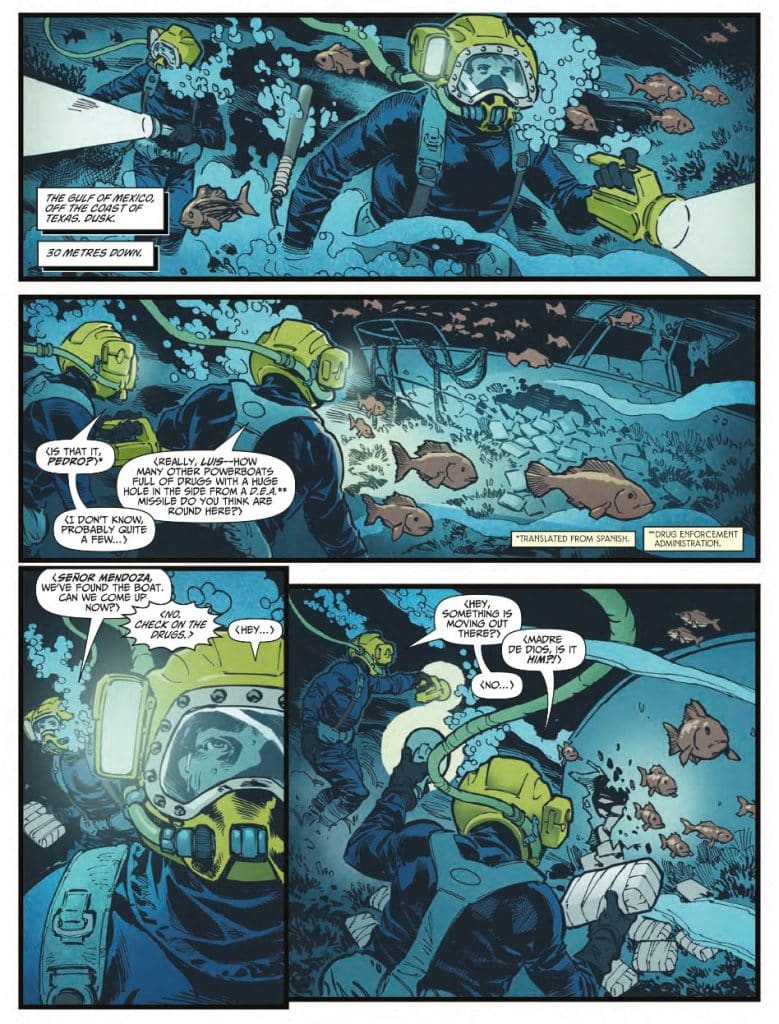
Hook Jaw by Steve White and Staz Johnson. There’s a killer out at sea! The vicious Hook Jaw has been seen in the depths of the ocean again, the killer shark with no regard for human life – and he’s heading out on the hunt! As a crew of drug dealers attempt to complete a sale in lawless international waters, they attract the attention of the legendary shark… this isn’t going to be pretty!
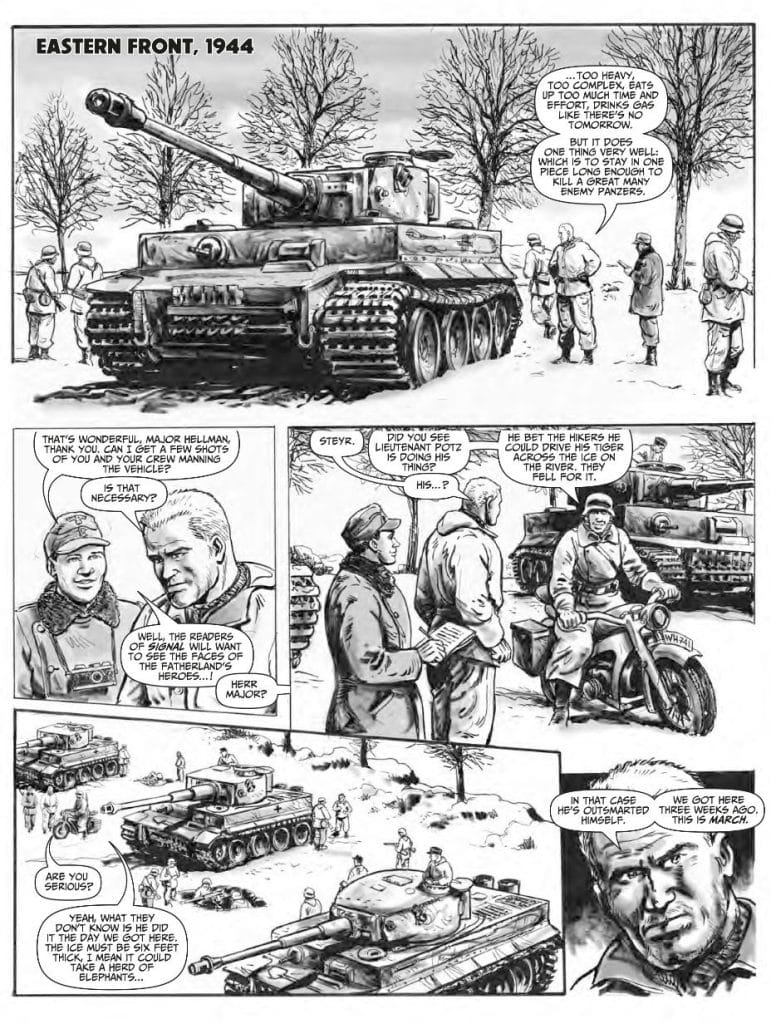
Hellman of Hammer Force by Garth Ennis and Mike Dorey. Blazing battle action on the Eastern Front in 1944, as Panzer commander Kurt Hellman leads a small German armoured unit against massed Soviet forces. As the tank men struggle to survive in this frozen hell, they face a new and terrible savagery from their vengeance-crazed Russian enemies.
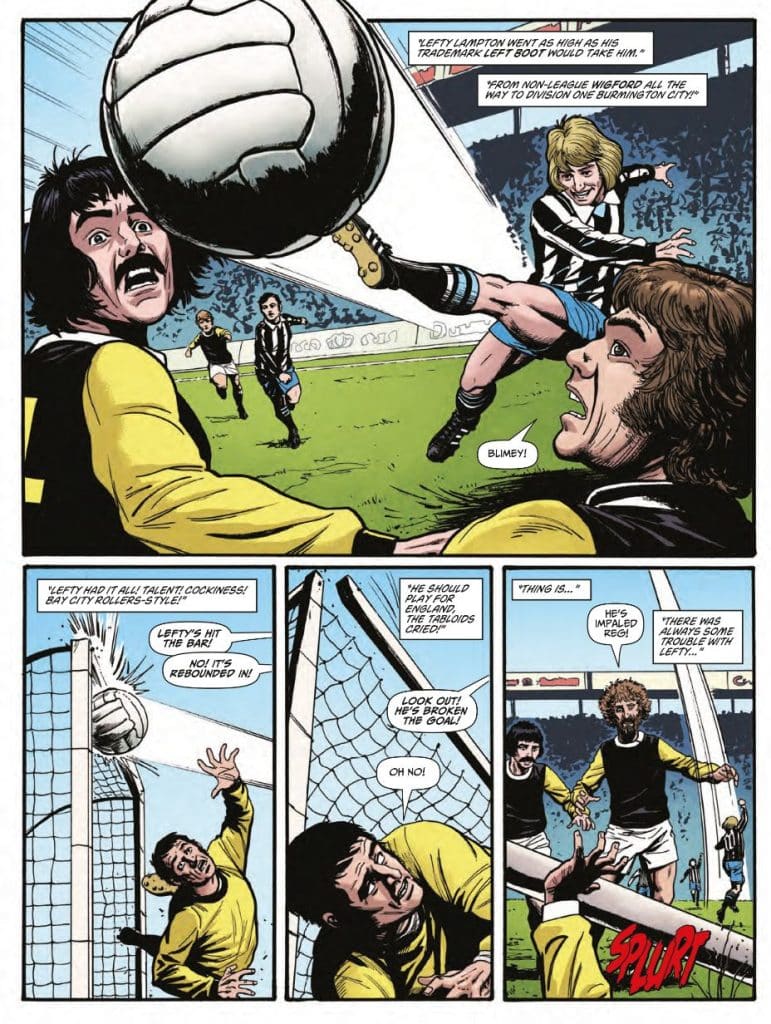
Look Out For Lefty by Rob Williams and Patrick Goddard. Footballer Kenny “Lefty” Lampton has the most dangerous left foot in the game, blazing the ball through the net. But Lefty doesn’t play fair, and his temper constantly flares up on the pitch, boiling over into fury and violence! After his anger leaves him stranded on the subs bench, he finally gets his chance – this could be his big comeback, a chance to regain his lost glory! As The Royal Family watch on from the stand, can Lefty keep it under control for ninety minutes?
Featuring a powerhouse lineup of writers and artists, Action is taking no prisoners on its return to the newspaper stand! You thought it was controversial before? You haven’t seen anything yet! Action is back, and more hard-hitting than ever!
The Action 2026 Special is coming to a newsagent or comic book shop near you on 15th April – pre-order it now!
Welcome to Ink & Imagination, brought to you by Those Two Geeks.
Britain in the 1970s was a nation in crisis; economic decline, strikes, and youth rebellion. In this turbulent era, comics reflected the clash between tradition and rebellion.
This episode explores the fading legacy of The Hotspur, one of the great boys’ papers of the mid-century, and the explosive rise, and fall, of Action, the short-lived but notorious comic dubbed “the comic the parents hate.” With its blood-soaked shark (Hook Jaw), violent street gangs (Kids Rule O.K.), and gritty working-class football strips, Action thrilled kids and horrified parents, sparking a moral panic that forced its withdrawal after just 36 issues.
But Action didn’t die in vain. Its rebellious spirit lived on in 2000 AD, paving the way for Judge Dredd, the British Invasion of comics in the 1980s, and the transformation of the medium worldwide.
From patriotic soldiers to punk-inspired antiheroes, this is the story of how British comics in the 1970s captured a society on the edge and changed comics forever.
Violent, gritty and unrelenting, Action comic was the brainchild of Pat Mills and Geoff Kemp. Tasked with creating a new anthology comic for the IPC’s boys adventure division, the pair rapidly developed a winning formula: reimagining existing story ideas from fresh perspectives and infusing them with a health dose of modern realism.
With strips such as Hookjaw, Dredger, Look Out For Lefty and Blackjack, success was instantaneous but so was the criticism. Many members of the press – including The London Evening Standard, The Sun and the Daily Mail – were quick to denounce the comic, while Mary Whitehouse and the pressure group “Delegates Opposing Violent Education” piled pressure on the IPC board to do something about it.
In less than a year, Action had been pulled from circulation, then returned months later, a sanitised, pale shadow of its former self. But the spark had already been lit. Action had made its mark and became the catalyst for the evolution of the British comics scene, paving the way for 2000 AD and the subsequent British invasion of UK talent into America.
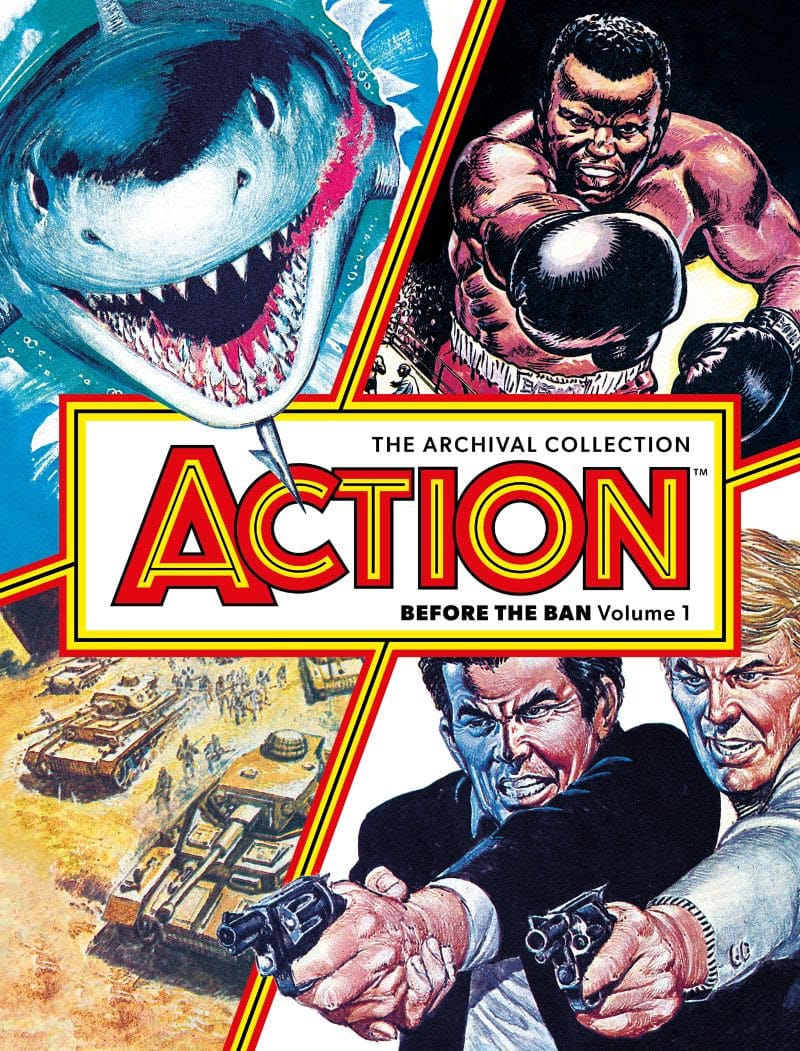
Now, for the first time in decades, Rebellion are collecting Action in a series of new archival editions, containing all of the strips and some of the editorial that created so much infamy back in the 1970s!
With brand-new introductions from Pat Mills, the legendary co-creator, editor, and writer of Action, as well as from series writer Steve MacManus, this is a sensational new release which champions firebrand comics at their most powerful and controversial.
Find out just what the shock and awe was about – featuring the original color pages as originally published, Volume 1 of Action: Before The Ban collects together the first twelve issues of Action, originally published across 1976.
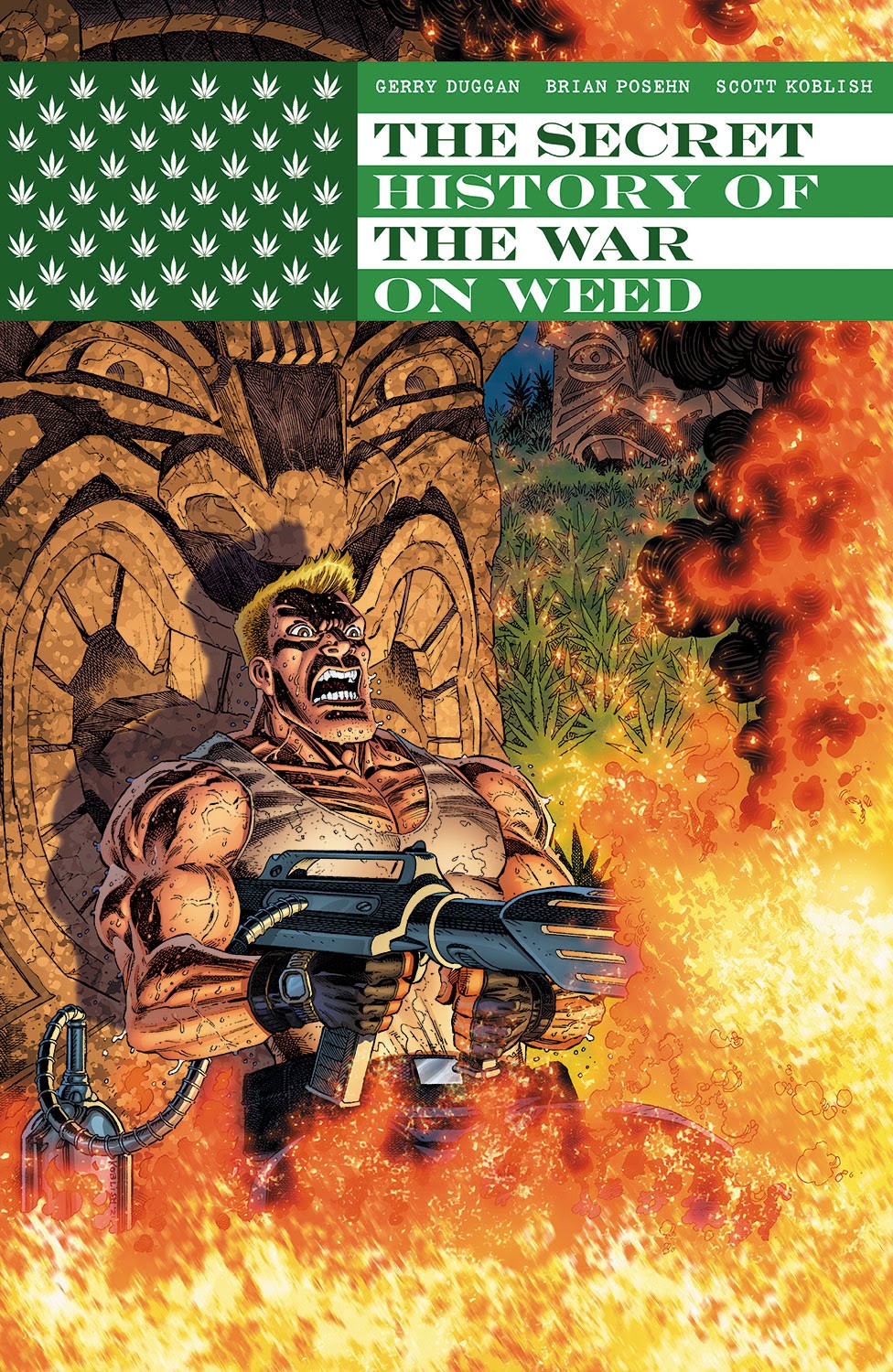
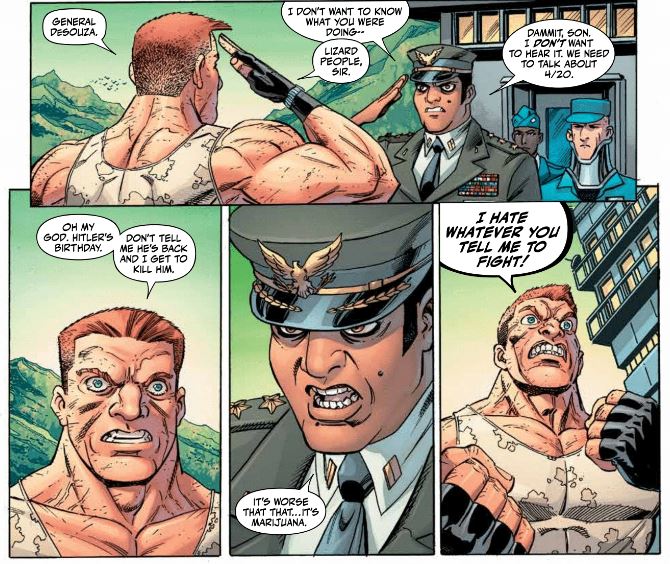
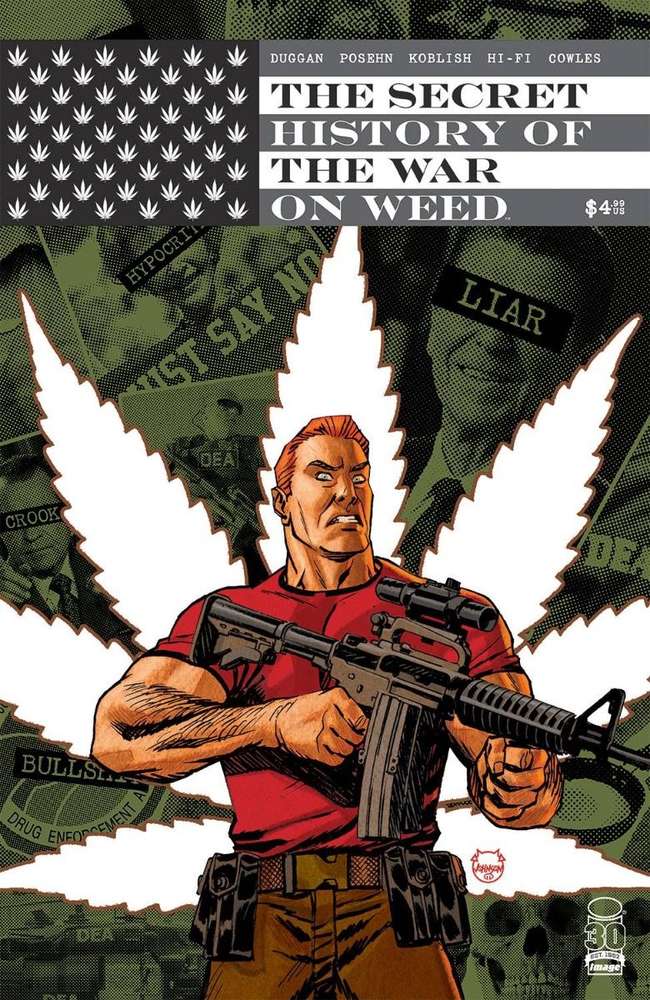
I wouldn’t be surprised if it’s an actual legal requirement to be high when writing a story about weed, be it fiction or nonfiction. The creative team behind Image Comics´The Secret History of The War on Weed seemed to be well in compliance with this when they put this comic together, and it’s all the better for it. It at least explains why lizard people and horny presidents are part of this hilarious, ridiculous, smart, and even heartfelt comic about the war on ganja and how backwards it is.
Writers Gerry Duggan and Brian Posehn along with illustrator Scott Koblish set their alternate history in 1980’s America. The President is a cross between Ronald Reagan and Margaret Thatcher that sees in marijuana a poll-raising opportunity to get the country behind her administration. To wage this war, she sends the story’s unlikely hero, Scotch McTiernan (an Arnold Schwarzenegger-type commando that’s all of the 80’s action movies rolled into one) to jumpstart the conflict.
The story takes a turn when Scotch McTiernan gets high himself and sees how unnecessary the war is and how damaging it can be to enforce the prohibition of something that has been proven not to be a major problem in its effects. In the process, Duggan, Posehn, and Koblish get the chance to comment on how America creates wars to keep the military industrial complex rolling, how misguided policies can create criminals that then have to suffer the system, and how politicians can spin narratives to create evils engineered for campaigning purposes.
There’s a lot packed into this one-shot comic, but Duggan, Posehn, and Koblish keep the action on the highest volume setting, preferring mayhem over quiet ruminations on the subject matter. It succeeds because of how sharp and funny the story is.
Dialogue is a highlight, with puns and snappy punchlines driving the messages and metaphors home through laughs. This isn’t a mere parody of the 1980’s, though. It’s a smart critique of it and the policies it enacted, especially as they pertain to our current appreciation of weed consumption.
The War on Weed takes on the culture war that was waged against marijuana in the 80’s to explain how people formulated negative ideas about it and then how those same ideas could be traced back to certain special interests that wanted to antagonize the product for reasons that didn’t have the public’s interest at heart.
Koblish’s art reinforces this argument by referencing so many pop culture elements per page, per panel even, that it becomes impossible to separate weed from the things people still look back on in a positive light. There was a lot of damage done in the 1980’s due to how irresponsible and prejudiced its war on drugs was, but it was also the decade a lot of people started smoking weed (where it grew outside the Counter-cultre/hippie identity it carried). Koblish accounts for this in different ways, being both visually indulgent and confrontational as the story develops. It’s always funny as well, so repeat readings are encouraged. This is a book you’ll want to comb through for hidden visual gags and references.
The Secret History of The War on Weed sees nothing wrong in laughing at serious things, especially if it’s in the service of getting a message across. The message here is one of fairness. By decriminalizing weed, America does better by those who could potentially go to jail for an offense that should never have been an offense in the first place. In a way, The War on Weed is a great companion book to Box Brown’s Cannabis: The Illegalization of Weed in America(2019), which also uses humor to get its point across about the problems that haunt America’s politics on weed (albeit in a more measured manner).
Duggan, Posehn, and Koblish do more than enough to keep the conversation going on what is still a hotly debated topic. They condemn bad practices while making an honest plea to eliminate a problem that has no business being considered a crime in our times. For the benefit of all, they enlist lizard people, 80’s action heroes, and a weed version of Swamp Thing to lend a hand in fighting the good fight.
Story: Gerry Duggan and Brian Posehn Art: Scott Koblish Story: 9.0 Art: 9.0 Overall: 9.0 Recommendation: Buy and read while high for added effect
Image Comics provided Graphic Policy with a FREE copy for review
I wouldn’t be surprised if it’s an actual legal requirement to be high when writing a story about weed, be it fiction or nonfiction. The creative team behind Image Comics´The Secret History of The War on Weed seemed to be well in compliance with this when they put this comic together, and it’s all the better for it. It at least explains why lizard people and horny presidents are part of this hilarious, ridiculous, smart, and even heartfelt comic about the war on ganja and how backwards it is.
Writers Gerry Duggan and Brian Posehn along with illustrator Scott Koblish set their alternate history in 1980’s America. The President is a cross between Ronald Reagan and Margaret Thatcher that sees in marijuana a poll-raising opportunity to get the country behind her administration. To wage this war, she sends the story’s unlikely hero, Scotch McTiernan (an Arnold Schwarzenegger-type commando that’s all of the 80’s action movies rolled into one) to jumpstart the conflict.
The story takes a turn when Scotch McTiernan gets high himself and sees how unnecessary the war is and how damaging it can be to enforce the prohibition of something that has been proven not to be a major problem in its effects. In the process, Duggan, Posehn, and Koblish get the chance to comment on how America creates wars to keep the military industrial complex rolling, how misguided policies can create criminals that then have to suffer the system, and how politicians can spin narratives to create evils engineered for campaigning purposes.
There’s a lot packed into this one-shot comic, but Duggan, Posehn, and Koblish keep the action on the highest volume setting, preferring mayhem over quiet ruminations on the subject matter. It succeeds because of how sharp and funny the story is.
Dialogue is a highlight, with puns and snappy punchlines driving the messages and metaphors home through laughs. This isn’t a mere parody of the 1980’s, though. It’s a smart critique of it and the policies it enacted, especially as they pertain to our current appreciation of weed consumption.
The War on Weed takes on the culture war that was waged against marijuana in the 80’s to explain how people formulated negative ideas about it and then how those same ideas could be traced back to certain special interests that wanted to antagonize the product for reasons that didn’t have the public’s interest at heart.
Koblish’s art reinforces this argument by referencing so many pop culture elements per page, per panel even, that it becomes impossible to separate weed from the things people still look back on in a positive light. There was a lot of damage done in the 1980’s due to how irresponsible and prejudiced its war on drugs was, but it was also the decade a lot of people started smoking weed (where it grew outside the Counter-cultre/hippie identity it carried). Koblish accounts for this in different ways, being both visually indulgent and confrontational as the story develops. It’s always funny as well, so repeat readings are encouraged. This is a book you’ll want to comb through for hidden visual gags and references.
The Secret History of The War on Weed sees nothing wrong in laughing at serious things, especially if it’s in the service of getting a message across. The message here is one of fairness. By decriminalizing weed, America does better by those who could potentially go to jail for an offense that should never have been an offense in the first place. In a way, The War on Weed is a great companion book to Box Brown’s Cannabis: The Illegalization of Weed in America(2019), which also uses humor to get its point across about the problems that haunt America’s politics on weed (albeit in a more measured manner).
Duggan, Posehn, and Koblish do more than enough to keep the conversation going on what is still a hotly debated topic. They condemn bad practices while making an honest plea to eliminate a problem that has no business being considered a crime in our times. For the benefit of all, they enlist lizard people, 80’s action heroes, and a weed version of Swamp Thing to lend a hand in fighting the good fight.
Story: Gerry Duggan and Brian Posehn Art: Scott Koblish Story: 9.0 Art: 9.0 Overall: 9.0 Recommendation: Buy and read while high for added effect
Image Comics provided Graphic Policy with a FREE copy for review
The FCC has announced they plan on ending Net Neutrality and that spells doom for a free and open internet. We have always supported Net Neutrality and are asking you to do so as well. A vote is set for December 14, but we have the ability to make our voices heard to Congress who might be able to prevent what will be a disaster and corporate giveaway.
There are many different definitions of what exactly Net Neutrality is, but it’s basically the ability to the go where you want and do what you want on the internet without extra charges, artificially slow accessibility or blockages.
Net Neutrality protects us the consumer as well as benefits creators. It stops internet providers from slowing down, degrading, or even blocking content or access to online content. It also prevents deals where those with deep pockets can pay to be heard over start-ups or other competitors. When over 70% of Americans have only one option for internet providers in their area, this is a big deal.
But here’s possible scenarios in a world without Net Neutrality, and outlines why this is important:
Your internet provider provides you the option to buy voice over internet from them, so they decide to degrade or block the competition, making them the only real option,
Your internet provider owns some of the content it delivers (for example Comcast and NBC) and block other services to watch the same or similar content so you have to use their video on demand service,
An exclusive deal is struck where a service, say a video game platform or digital comics platform, pay and become the only distributor or platform of that content through your internet provider,
Business pay, or people have to pay, to have their content delivered quicker, in an age where ever millisecond counts (think stock trading or online ticket buying). The haves can outpace the have-nots when it comes to online activities.
Comic creators too should care about Net Neutrality.
In today’s business world scripts and art are sent around the globe and without protection expect slower upload and download speeds and paying more to conduct business. Enjoy going back to sending files on CD or hard drive.
Your ability to chat through video such as Skype might be diminished.
And, say goodbye to digital and web comics as consumer speeds are decreased to the degree that there’s no point in attempting to download a file or wait for images to load and that’s after paying for the privilege to do so.
I can go on and on with these types of scenarios, and Comcast and Verizon have been fighting to end Net Neutrality and the internet as we know it. And with the consolidation of of internet service providers and content the scenarios become even more bleak.
The idea of Net Neutrality is to keep the internet a free and open platform for innovation and expression.
The FCC has announced they plan on ending Net Neutrality and that spells doom for a free and open internet. We have always supported Net Neutrality and are asking you to do so as well. A vote is set for December 14, but we have the ability to make our voices heard to Congress who might be able to prevent what will be a disaster and corporate giveaway.
There are many different definitions of what exactly Net Neutrality is, but it’s basically the ability to the go where you want and do what you want on the internet without extra charges, artificially slow accessibility or blockages.
Net Neutrality protects us the consumer as well as benefits creators. It stops internet providers from slowing down, degrading, or even blocking content or access to online content. It also prevents deals where those with deep pockets can pay to be heard over start-ups or other competitors. When over 70% of Americans have only one option for internet providers in their area, this is a big deal.
But here’s possible scenarios in a world without Net Neutrality, and outlines why this is important:
Your internet provider provides you the option to buy voice over internet from them, so they decide to degrade or block the competition, making them the only real option,
Your internet provider owns some of the content it delivers (for example Comcast and NBC) and block other services to watch the same or similar content so you have to use their video on demand service,
An exclusive deal is struck where a service, say a video game platform or digital comics platform, pay and become the only distributor or platform of that content through your internet provider,
Business pay, or people have to pay, to have their content delivered quicker, in an age where ever millisecond counts (think stock trading or online ticket buying). The haves can outpace the have-nots when it comes to online activities.
Comic creators too should care about Net Neutrality.
In today’s business world scripts and art are sent around the globe and without protection expect slower upload and download speeds and paying more to conduct business. Enjoy going back to sending files on CD or hard drive.
Your ability to chat through video such as Skype might be diminished.
And, say goodbye to digital and web comics as consumer speeds are decreased to the degree that there’s no point in attempting to download a file or wait for images to load and that’s after paying for the privilege to do so.
I can go on and on with these types of scenarios, and Comcast and Verizon have been fighting to end Net Neutrality and the internet as we know it. And with the consolidation of of internet service providers and content the scenarios become even more bleak.
The idea of Net Neutrality is to keep the internet a free and open platform for innovation and expression.
The FCC has announced they plan on ending Net Neutrality and that spells doom for a free and open internet. We have always supported Net Neutrality and are asking you to do so as well. A vote is set for December 14, but we have the ability to make our voices heard to Congress who might be able to prevent what will be a disaster and corporate giveaway.
There are many different definitions of what exactly Net Neutrality is, but it’s basically the ability to the go where you want and do what you want on the internet without extra charges, artificially slow accessibility or blockages.
Net Neutrality protects us the consumer as well as benefits creators. It stops internet providers from slowing down, degrading, or even blocking content or access to online content. It also prevents deals where those with deep pockets can pay to be heard over start-ups or other competitors. When over 70% of Americans have only one option for internet providers in their area, this is a big deal.
But here’s possible scenarios in a world without Net Neutrality, and outlines why this is important:
Your internet provider provides you the option to buy voice over internet from them, so they decide to degrade or block the competition, making them the only real option,
Your internet provider owns some of the content it delivers (for example Comcast and NBC) and block other services to watch the same or similar content so you have to use their video on demand service,
An exclusive deal is struck where a service, say a video game platform or digital comics platform, pay and become the only distributor or platform of that content through your internet provider,
Business pay, or people have to pay, to have their content delivered quicker, in an age where ever millisecond counts (think stock trading or online ticket buying). The haves can outpace the have-nots when it comes to online activities.
Comic creators too should care about Net Neutrality.
In today’s business world scripts and art are sent around the globe and without protection expect slower upload and download speeds and paying more to conduct business. Enjoy going back to sending files on CD or hard drive.
Your ability to chat through video such as Skype might be diminished.
And, say goodbye to digital and web comics as consumer speeds are decreased to the degree that there’s no point in attempting to download a file or wait for images to load and that’s after paying for the privilege to do so.
I can go on and on with these types of scenarios, and Comcast and Verizon have been fighting to end Net Neutrality and the internet as we know it. And with the consolidation of of internet service providers and content the scenarios become even more bleak.
The idea of Net Neutrality is to keep the internet a free and open platform for innovation and expression.