Tag Archives: sean lewis

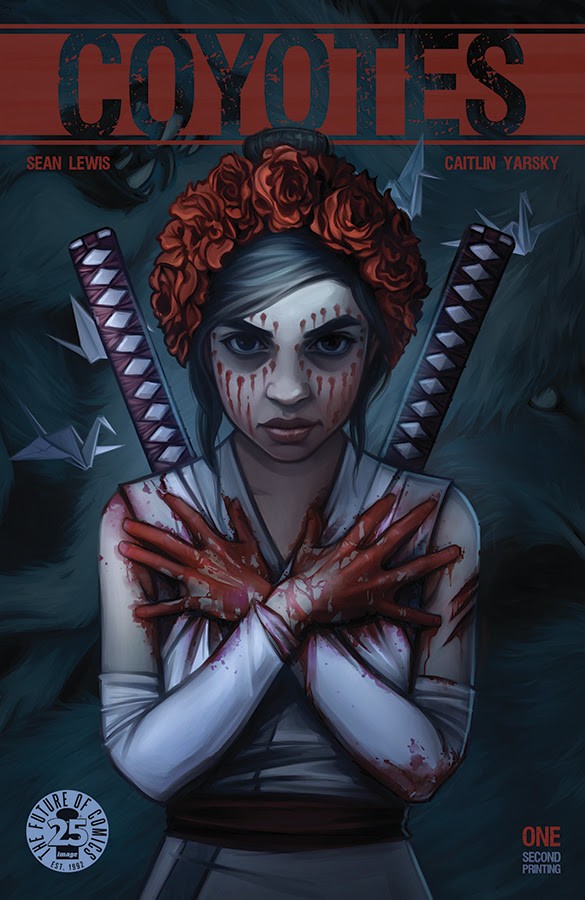
Coyotes #1 Heads to a Second Printing

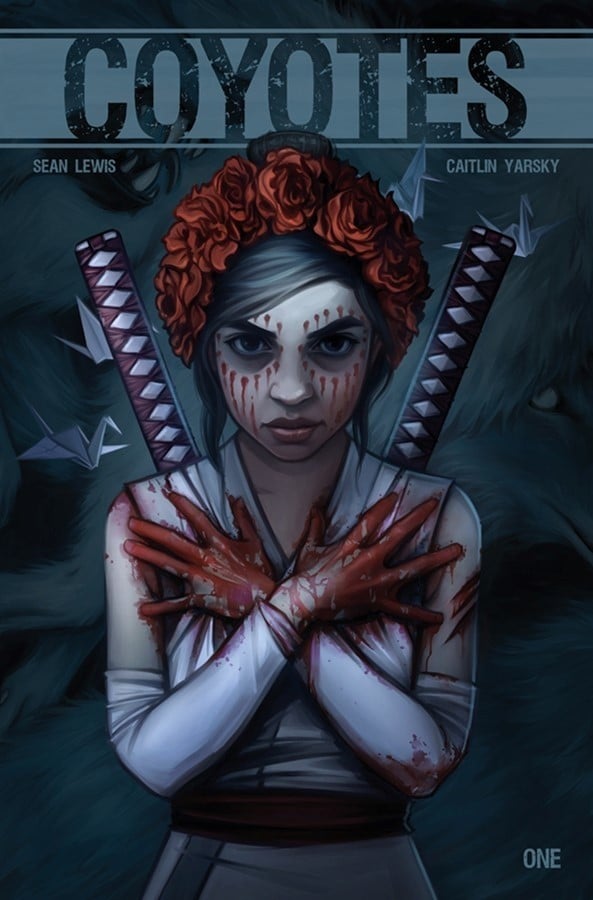
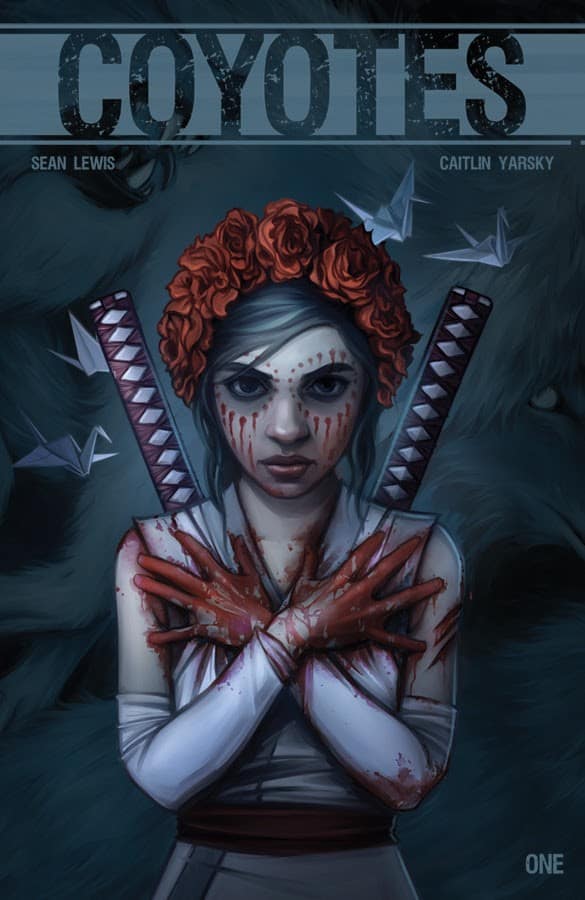
Image Comics has announced that the first issue of Coyotes, the new dark fantasy series from Sean Lewis and Caitlin Yarsky, is being rushed back to print to keep up with customer demand.

Underworld meets Sicario in Coyotes, a mythological thriller that offers up a tale of disappearances, secrets, and bloodbaths. Women are going missing, and war is brewing in retaliation. Detective Frank Coffey arrives to try and make sense of the carnage—but what he finds is a little girl with a secret and a sword.

Coyotes#1, 2nd printing (Diamond code: OCT178072) and Coyotes #2 (Diamond code: OCT170665) will be available on Wednesday, December 13th. The final order cutoff deadline for comics retailers is Monday, November 20th.

Review: Coyotes #1

I’ve been following Sean Lewis’ work since his debut at Image with Saints, co-created by the exceptional artist Benjamin Mackey. I also recently reviewed every single issue of The Few Lewis co-created with Hayden Sherman. I love Lewis’s knack for choosing the perfect artist to fit the content of the story and writing so viscerally as to challenge the reader to make sense of it. Caitlin Yarsky I’ve only recently learned of but already love her art given its gothic nouveau style: loose, picturesque and curved lines with a dark color palette.

In summary, Coyotes is the story of a girl named Analisa. She lost her family to a roaming group of coyotes that target mostly women and girls. She and her friend Valeria a.k.a Eyepatch, are taken in by Duchess and the Victorians, a powerful group of women. They run the City of Lost Girls, a sanctuary for women lost, abused, forgotten, and cast aside by the world. Analisa has vowed revenge upon the coyotes, and so Duchess trains her to become the assassin Red.

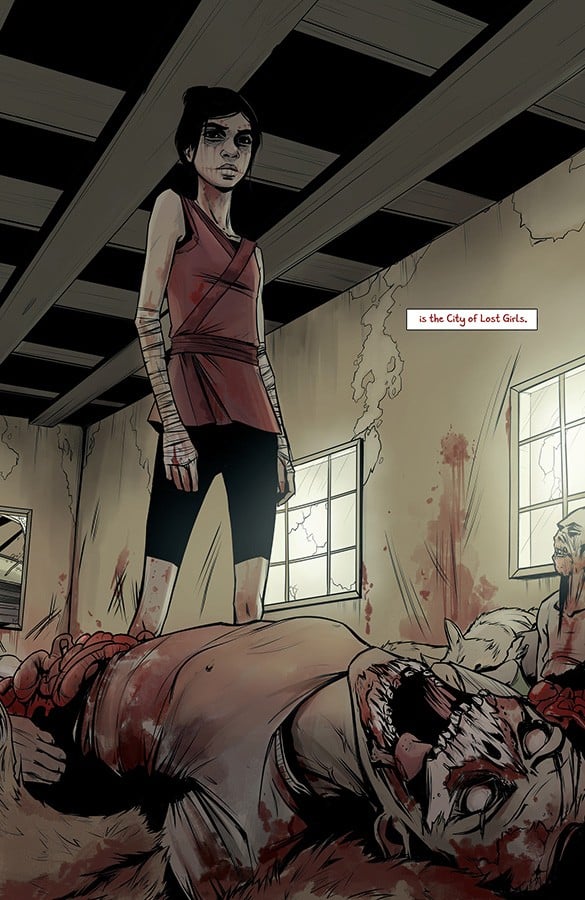
Coyotes starts off with a straightforward opening. A police officer, Detective Frank Coffey, enters a crime scene, a cabin out in the middle of a desert. It’s full of corpses, mostly women and children, but also a few coyotes. Analisa is the lone survivor, standing in the middle of the carnage covered in blood. This opening, and the entirety of the comic, is masterfully executed. Yarsky’s loose shapes move from one panel to the next so effortlessly it feels like an animated sequence. Most of the panel layouts are boxed, rarely breaking into paneless collages except a few times. However, each page always visually strikes you and stays in your mind even if you can’t recall parts of the story. It’s the type of visceral reaction that happens so rarely in comics, but when it does you just know the feeling, like for a moment you were absorbed into the pages and felt inside the world instead of looking at a mere sequence of static images.

Coyotes01-03

Before this, Detective Coffey drives by a field fenced by towering red crosses. Red is a reoccurring color in this series, from the blood to the red lettering that appears (infrequently) in Analisa’s dialogue. Like most of the story, it’s not yet clear what the significance of the color red is–aside from being Analisa’s codename–but will probably play a larger thematic element later in the series.

After the introduction, the next page opens to a flashback. These sequences are where the story starts to get tricky. Right after the first flashback of Analisa with Duchess, explaining to her the need to forget the past or be killed by it, another flashback opens with Analisa with her mother and older sister Maria. Double flashbacks are tricky to pull off. They can cause confusion with the chronological order of events, making it frustrating for the reader to progress. Fortunately, a second read clarifies things and the reader gets, if not a whole, in general how Analisa went from a poor small town girl to an assassin for a hidden city. It’s not like you’ll need to go back multiple times armed with an encyclopedia of subliminal messages.

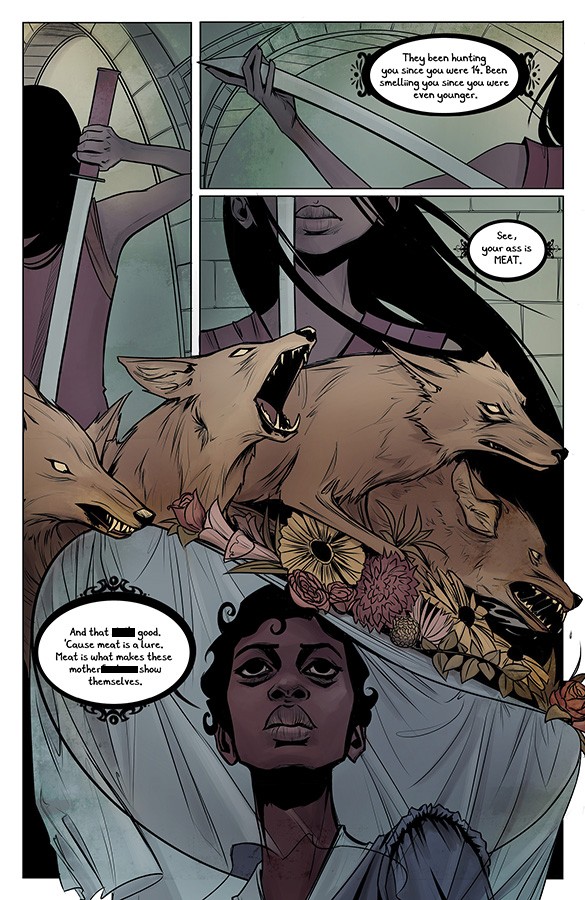
When the story does start coming together, it’s quickly evident Coyotes is a feminist tale. Much more than just ravenous animals, the coyotes are metaphorical representations of patriarchal violence. The women they target most often are free-spirited and non-conformist. The women prefer going out at night to work or have fun rather than staying at home as domestic servants. It’s only hinted at, but the coyotes’ nightly attacks are so frequent, they’ve become urban legends, scaring women into staying home. It’s this reason the City of Lost Girls is at war with the coyotes. It’s a war over women’s autonomy which they’ll fight to the death to preserve.

Much of how the story is written resembles a fairy tale. Analisa is a young, naive girl facing off against beastly antagonists that have gain urban legend statues in regular society. Duchess and the Victorians are like Analisa’s fairy godmothers, wiser, older women that instruct her on how to defeat the coyotes. Caitlin Yarsky aesthetically adds to this fairy tale structure with fitting visuals, particularly how her dark color palette creates a gothic undertone to the picturesque magical realism and invokes a sense of danger underneath.

The edgier, more violent tone adds an action element to the story, a somewhat grindhouse feel with buckets of blood and swearing. It’s a fusion that at times can seem contrarian, especially when Duchess and the Victorians, women that dress properly and convey a sense of hierarchy, curse like sailors and host parties involving lots of drinking and dancing nude. At first, I found it confusing but the harder I thought about it, the more it made sense with the idea of these women being complex people.

Autonomy for the Victorians is not just being able to go out at night. It’s about being your own person, to not fit neatly into one type of woman but a multitude that cannot be pin downed. In other stories, having beautiful or finely dressed characters spit out curse words would seem like pointless shock humor, but here it actually drives home the point that women should be allowed to act like actual human beings, which often involves behavior that is contrarian, inconsistent, and most of all difficult to understand. It’s not an element in fiction appreciated because readers tend to want more consistency in order to have a structure that leads to a satisfying conclusion, but it is something that can add an element of relatability and authenticity to characters that would otherwise be genre tropes.

This complexity isn’t always a positive though. There are hints in the comic, culminating in a splash page more frightening than even the coyotes, alerting the reader that the Victorians’ plan for Analisa isn’t for her benefit. All the empowerment she’s receiving might be just to shape her into a better pawn. This seems to undercut the feminist narrative, but I had to defend it on several counts. One is that being complex people, the Victorians are as capable of evil as they are good. They are united in a fight to end patriarchal violence but willing to manipulate someone to do it. It’s unclear if that decision is based on true malice, blind desperation, or whatever. Perhaps it’ll be explained in subsequent issues.

Coyotes01-06

Another reason I have to defend it is how much it adds to Analisa’s character. There isn’t much yet to her aside from being a traumatized victim turned into an almost robotic killing machine. She currently acts according to what older people tell her. It’s an uneven power relationship, and I have to again give Yarsky credit to how she visually represents this. Duchess dressing fanciful while Analisa dresses either plainly or in her uniform hits at, in the worst sense, a master/servant dynamic. This is also true of how Duchess always seems to be towering over and talking down to Analisa. However, Analisa isn’t that naive. She is started to get a sense of not being in complete control over her destiny. Analisa wants to be more, for herself and her good friend Eyepatch (Eyepatch has yet to grow as a character too).

I think Analisa struggling to grow as a character and currently a blank slate for others to filter their agenda through is another underappreciated element in fiction. It’s something that far too many children go through because they’re condescended to by adults. They’re feelings and opinions are not taken seriously. This can even happen in circles that are meant to empower the marginalized. It doesn’t have to be a cynical situation though. Kids are much smarter than given credit, and it’s satisfying story arc for a child to evolve as their own person even without adult support or approval. I can seen Analisa growing as a person in the future. Her relationships, complicated or positive, are going to fully form how she turns out in the end.

As much praise for all the story elements I’ve given to Coyotes, it’s not without reservations. The biggest one is how too vague and esoteric the writing can often be. I expected this much from a story written by Sean Lewis. Like I said earlier, he writes in a visceral way that forces the reader to critically think about the story presented to them. Unfortunately, Coyotes seems to go by too quickly. After reading the first time, I felt dazed and confused. This was very different from reading The Few in which I had an easier time processing the first read through. In that series defense, each issue was double-sized, beyond the typical 20-24 page count. At some point, telling a story on a visceral level can too far, and the cerebral part in which a reader processes the meaning can be muddled. I understand there are works of art where this work, but maybe not so much for a monthly comic series.

Finally, I have to nitpick the setting. Unlike Saints and The Few where Sean Lewis made environments just as much a standout personality as characters, the setting of Coyotes has one as much as a postcard. I feel like a lack of familiarity with it might explain why. Perhaps Lewis and Yarsky have taken trips and been to Mexican or South American locales, but they seem to go more with generic cultural signifiers. It could also be a lack of interesting design. I remember how Yarsky draws characters more than settings save for two.

With all that said, the emotional core of Coyotes remains intake. I highly recommend the book based on the visceral impact the story has. It’s not just the terrifying sequences of the coyotes’ rampages, or the bloody fights between them and Analisa. It’s the anger, not a pitiful anger, but an anger that clearly wants justice and revenge for the wrongs committed against women. It’s not anger all the time, there’s also hope and joy. Particularly two scenes of women celebrating, one in the diner where Analisa’s sister works, the other one of the Victorians’ aforementioned parties. While the story might be lacking at times, the emotions it wants you to feel will stick.

I highly recommend Coyotes. It’s story is a little too vague at times, but has strong visuals, interesting themes, and an emotional impact that will stick. If nothing else, it’s got a little girl killing monsters which never gets old.

Story: Sean Lewis Art: Caitlin Yarsky
Story: 8.5 Art: 9.5 Overall: 9.0 Recommendation: Buy

Image Comics provided Graphic Policy with a FREE copy for review

Myths Become Rallying Cries in Coyotes from Sean Lewis and Cailtin Yarsky

Writer Sean Lewis and rising-star artist Caitlin Yarsky will launch their new series Coyotes this November from Image Comics.

Women are disappearing. A legion of wolves roam the border, hunting them down, and a band of survivors have come together, ready to wage war.

Detective Frank Coffey is struggling to wrap his head around this mythic-level bloodbath when he meets Red, a little girl with a secret—and a sword.

Coyotes #1 (Diamond code: SEP170611) arrives in comic shops Wednesday, November 8th. The final order cutoff deadline for comics retailers is Monday, October 16th.

Cult Hit The Few Collected in Paperback this August

Critically acclaimed writer/playwright Sean Lewis and rising-star artist Hayden Sherman will release a trade paperback collection of their dystopic series The Few this august from Image Comics.

In an America divided between the haves and the have-nots, Edan Hale is a soldier on the run. Saddled with a gas-mask-wearing infant and aided by the very terrorists she was once sworn to hunt, Edan has become a woman without a country in a place where survival is only possible if you have allies.

The Few (Diamond code: JUN170653, ISBN: 978-1-5343-0235-8) hits comic book stores Wednesday, August 23rd and bookstores Tuesday, August 29th. The final order cutoff deadline for comics retailers is Monday, July 10th.

Review: The Few #6

TheFew-06_cvr.jpgAfter her long journey of self-discovery, after they’ve taken everything from her, Edan Hale has turned on the Palace and infiltrates its city to strike a devastating blow, but Captain Jariks is waiting for her. As for Peter and Davey, they have learned the truth of Edan’s past and her tie to their younger sister. They must decide if she is still worth befriending or too far down the path of destruction. It’s a bloody, epic conclusion to one of the best series of 2017.

Before I go into the review, I want to say how much fun it has been reading and reviewing this series. Out of all the books currently in the direct market, The Few exemplifies the most of what comics as a medium can be, visually outstanding, narratively gripping, and sharply political. I plan on rereading this series again and again. If I ever do a list of Top Comics of 2017, this will be going somewhere up in the top 5. I thank Sean Lewis, Hayden Sherman, and Image Comics for having the smarts to create and publish this powerful dystopian scifi.

The fun begins with the cover, Edan striking a badass pose as she faces the Palace with a gun in hand. It also works thematically as a representation of Edan going turncoat, abandoning the home and values she once upheld with brutal force. She now plans on tearing it all down. Even more significant are the sentences on the back cover:

“A Hero To One.

“A Terrorist To Another.

“A Necessity To Herself.”

There is that word again, “necessity.” Throughout the series, it has been a dangerous concept justifying horrific actions. However, what this back cover suggests is that it can be more complex than that. It depends on the viewpoint of the judge. Actions can be justified, unjustified, or even both. This happens to be the thematic climax of Edan’s character arc.

As always with each chapter, there is a quote by a famous author/figure in history:

“As you get older it’s harder to have heroes. It’s almost more necessary.”

TheFew06-03

Ernest Hemingway said that, and I think he means that people develop higher standards for who they consider a hero. They’re needed for better results. Now, does that mean Edan reaches the standard? Probably depends on your own. Personally, I think she becomes both.

The book opens to a two page spread of The Palace at night. It’s a sprawling black and white metropolis with a gray aerial tone. This is an interesting visualization given that Sherman colored the Palace mostly red in the previous issue. I think this change in color has meaning in perspective. From the previous issue, the perspective was that of Captain Jariks, a person who despite knowing her country’s flaws still regards it highly. In this issue, the perspective is that of Edan as indicated by the narrative captions. As someone that has turned against the Palace, the black and white coloring mirrors her cold disdain for it.

This opening spread is but one of the many examples of how much an art beast Hayden Sherman is. His style reminiscent of Frank Miller and punkzines that at first looks simplistic but becomes more complex and detailed the closer you look. The coloring plays a big factor here. Sherman is not representing reality but presenting ideas, adding a striking layer to visually represent the themes of the story. Also, they just look cool, especially during fight scenes. There’s a scene where red moves around with the combatants like an amoeba. In another fight, a 14-panel grid(!!!) switches back and forth between red/black and light/dark gray. Never in a moment does the art look dull in this book.

Going back to the opening spread, the true beauty of Sherman’s art is how it heightens Sean Lewis’ story, particularly dialogue and narration:

“My dear Palace. Bustling streets. Tall buildings. Home. We’ve been doing this dance for a while, friend. And tonight it ends.”

I hate the “We’ve been doing this dance” part of the paragraph. It’s a cliche done too many times in action stories and smudges the graveness of Edan’s statement. She is reminiscing about the Palace yes, but in a way to indicate she no longer sees it as her home. Combined with Sherman’s  dark art, it’s apparent Edan has nothing but cold disdain for the Palace. She is determined to do something to it for revenge. This can be interpreted without seeing Edan’s face. Never before have I seen a collaborative work where the writer and artist takes full of advantage of comics ability to combine text and image for deeper thematic meaning.

On one hand, this vendetta is justifiable given previous events. The reader feels for Edan and is cheering her on. I certainly was ready to watch her kick the Palace’s ass. Then I flipped to the next page and those feelings got complex.

The scene transitions to the Few’s campsite. Edan has made a dirty bomb, which shocked me as an American because of how strongly associated that weapon is with terrorism. Edan narrates that she has plans to cause massive damage on the Palace with it. She does not specify who the targets are. In fact, she does not seem to care about differentiating between military, government, or civilians. Edan’s revelation that the Palace are bad, while an important part of her development, has a dark consequence to it. Edan hasn’t become more empathetic. She simply has changed the target of her brutality. This is not portrayed as a good thing. The Few see that Edan is more violent than ever and keep their distance. She realizes this and decides to go alone. Her isolation represented by a blizzard as she disappears into.

TheFew06-08

What’s amazing about this turn is that I still feel Edan’s justified. After all, the Palace have to be stopped. At the same time though I feel wary how hate has consumed her. It doesn’t get much better as Edan infiltrates the Palace during a festival and plots her attack with the specific goal of hurting them in a way that makes a statement. Just like the dirty bomb, I can’t help but associate this line of thinking with terrorism. It’s a mode of thinking that doesn’t take into consideration civilian harm. What happens if a person whose only sin is just happening to be born in the Palace gets stuck in the crossfire? The comic has no qualms siding with those that fight for their survival against oppressive regimes, but it becomes murky when attacks have no motivation except hate.

There is a happy ending (well, happy enough), but the comic never lets go of complexity. Even more challenging is the idea that complexity is a necessary part of freedom fighting. Edan does her best to make her target but the destruction she causes could lead to civilian casualties. Minimal perhaps, but still possible.

Bringing up history, I don’t think there is a single armed rebellion where there weren’t innocent casualties. The American Revolution, the Soviet Revolution, etc. In many cases, these revolutions would be overshadowed by later atrocities committed by the new regime. Even in peaceful revolutions, innocents are killed. I think the ending of The Few is a way of forcing the reader to face this issue. Edan has become a freedom fighter instead of an oppressor, she is fighting the good fight with the right people, but has to live with collateral damage. Like the back cover of the issue says, hero to one, terrorist to another. In the end, a necessity to herself and the world because who else is going to stand up to the Palace?

One of the flaws to this otherwise outstanding character arc is how it takes development away from other characters. Peter, Davey, and Captain Jariks are full of potential, but rarely fleshed out. The most disappointing is Captain Jariks, who earlier in the series got upset learning how the Palace had a hand in creating Herrod, a blood-thirsty militia leader. In #6, her complexity disappears and she reverts to being an unquestioning loyalist. Peter and Davey at least get a little more growth when having to make a decision regarding Edan. The dialogue exchanged between them is an intense emotional journey. The Few manages to have strong drama along with its striking visuals.

What stands out to me most about the series is its political relevancy. We have a comic about an oppressive, ultranationalist regime that views a group of outsiders as immoral leeches that only want to destroy them and take their belongings, a wall built to keep non-natives out, brutal police that don’t mind gunning down even children if they profile them as a threat, a roaming gang of sociopathic men that find pleasure in the pain and misery they cause others, a small group of diverse rebels fighting desperately for survival while finding it hard to trust each other and worried that they could become the thing they oppose. This is Trump’s America as it is now, albeit an extreme fictional version. I don’t know if it was Sean Lewis’ intent or not, but there is no way of avoiding the similarities. I see this series in two ways: At it’s best, it is a cautionary tale of what will happen to America if we do not unite and work out our issues. At it’s most frightening, it is a prediction of what is going to happen years from now, and those on the left or at least against ultranationalist, xenophobic regimes will need to be ready for the inevitable war. I think many of us can agree we hope the former happens. But more and more each day, envisioning the latter as becoming a necessity.

Visually, narratively, and politically charged, The Few #6 is a satisfying conclusion. There are some turns that seem too convenient or easily achieved, but it does not dampen the raw, visceral reading experience. It is a series that I can say for certain goes beyond entertainment and enters the realm of true literature. I recommend this to anyone that is yearning for relevant scifi comics or relevant scifi in general.

Story: Sean Lewis Art: Hayden Sherman
Story: 9.5 Art: 10 Overall: 10 Recommendation: Buy

Image Comics provided Graphic Policy with a FREE copy for review

Review: The Few #5

TheFew_05-1

WARNING: MINOR SPOILERS AHEAD

Last time, Edan, Pete, Davey, and the remnants of the Few squared off with Herrod and the Ragers. Herrod was defeated, but the Few took heavy losses, and Davey’s life is now hanging by a thread. Worse, Edan’s secret has come out, and Pete must decide what to do with her. Meanwhile in the Palace, decorated soldier Colonel Aliss Hale has learned of his daughter’s treason, sending him into a deep depression. Will his love for Edan trump his loyalty to the Palace? As the end approaches, pre-existing tensions will reach a boiling point in this issue, and after the events that transpire, there will be no turning back.

I’ve reviewed this series since issue #1, and I must say that no other issue has awed me with its visually beauty while simultaneously experiencing emotions of despair, joy, and anticipation quite like it. This for me is the best of the series and here is why.

As always with my reviews, it starts with the cover. The photograph is of Tracee, the young sister of Pete and Davey. I won’t reveal why, but she ties Edan’s dark past to her current predicament, the first connection with the Few that now weighs heavy on her conscious. Sherman’s color choices have always been fascinating, but I find symbolic relevance here. Tracee is ethnically black yet colored white. I’m guessing a mark of innocence. The background of her photograph is orange, intensely so. There’s something beautiful about this choice, capturing the energy of a happy disposition.

The gray hand holding Tracee’s photograph is ominous, a deathly gray contrasting the lively orange. Did something bad happen to Tracee? Is looking at the photograph filling the person with a dark feeling? Mind you, I read this comic and know what happens, so maybe I’m making up crap in order to give this cover more meaning than it has. I’ll let you decide on that.

I’ve repeated ad nauseum about Hayden Sherman’s amazing art, his mastery of panel layout, experimental coloring, and moody atmosphere. Issue #3 and #4 were more action-packed, allowing him to draw brutal destruction that would give Mad Max a run for its money. Issue #5 has Sherman return to atmosphere but just so happens to be his best work because of how it illustrates the raw emotion and thematic significance of Sean Lewis’ script.

TheFew05-01

It starts with the opening pages of the Few entering a small town via RVs. It is surprisingly pristine, appearing to be closed down due to weather and not abandoned. Edan reminisces how even her father respected the Few for keeping their old homes intake, as though it’s there way of saying “We’re here too.” This scene is thematically part of Edan’s arc as she comes to recognize the humanity of the Few instead of little more than faceless terrorists. Lewis wrote this arc in a beautiful, heartfelt way and it has come to its peak. Unfortunately, that doesn’t mean Edan’s saved.

The next scene is an intense interrogation as she confesses to Pete. Sherman decompresses it with close ups as the two exchange dialogue back and forth, tension boiling naturally. Edan’s arc might have come to a significant turn, but so has Pete. He now realizes his duty as the leader of the Few, to protect them from all potential threats including Edan. It is an intense and excruciating scene, especially with the photograph of Tracee present. It is an object that reminds Edan of her sullied past, how deep she truly hurt Pete. Death and melancholy are present in the dull, grayish color choices, a palette that has been omnipresent in the series to symbolize the desperation of the world, now more so given the scene’s emotional significance.

The story cuts to a new scene in the Palace. Captain Irks, who has been pursuing Edan, goes to a skyscraper for a meeting with Colonel Aliss Hale. Red is a prominent color in this scene, and something about its particular hue feels domineering. It seems purposeful, a symbolic representation of the authoritarianism and chauvinism running deep in the city’s culture. Colonel Hale is drunkenly sobbing, broken that Edan would betray the Palace. With the red around him and his figure cast mostly in shadow, one gets the notion he is completely brainwashed and willing to do anything for his country. A common theme in the series is the danger of necessity, the willingness to do even the most heinous acts if you feel the conditions are justified. This scene adds a scarier layer, one that shows a person can justify their actions when completely enamored with the party they serve. I think of all the MAGAs and Pepe memes online, how they staunchly defend far right wing politics to the point of psychotic behavior like harassment. Perhaps even more insidiously subtle are people that persist in showcasing their patriotism with an overabundance of American flags, bald eagles, and other paraphenalia. We can say it’s just extravagance, but what if they’re so enamored with the U.S., they’re neurotically driven to overcompensate, and any flaw in that vision causes a massive meltdown?

The next to final scene is a damning, yet brilliantly illustrated point to this rabid jingoism. It involves a swarm of drones using holographic screens to project a speech on-screen. The catalyst of the scene leads to a series of four two-page spreads, one of the panels containing this simple but devastating lettering:

The emotional context this spread has to the unfolding events is devastating. The Palace is not only detrimental to the Few but its citizens as well. They get to live a comfortable life but in exchange for their sanity and value of life. Pete discovers a similar problem in the Few, wondering if the two sides will ever stop killing each other. He knows that an attack is still needed or else the Few will be wiped out. The truly dark power of Necessity is that it ties people to take actions that repeat an endless cycle of violence because the only other option is roll over and die.

I’m probably making The Few seem like a pessimistic series. To a certain extent, it is. All dystopias are like that. You need a pretty dark outlook on the state of the world to envision nightmarish futures. However, there’s always a kernel of hope. It happens earlier in a scene with Edan having a moment with the baby she’s been caring for since issue #1. The baby has called her mama. The area they’re in is claustrophobic and gray, yet feels calming, a moment of peace. Outside her window, the ghost of Ephram appears and tells her “Now you can fight for what you really believe” before disappearing. This scene is one of forgiveness and growth. Edan realizes she believes in the shared humanity of the people she once feared and will protect them with her life. It is a beautiful scene, a glimmer of hope that gives Edan a reason to fight on. Even after the devastating scene of the drones, she takes her anguish and uses it to fuel for her cause.

It has been a long while since a comic, a single issue no less, has been able to make me go through a whirlwind of emotions like this, experiencing both the lowest of despair and the highest of joy. It’s beautifully rendered in word and visual by the amazing creative team. The one flaw to an otherwise fantastic issue is that I think the Few forgive Edan too easily for her crimes. Maybe save that after a major conflict in the final issue. It continues to bug me, but then I think of everything else the issue has achieved and learn to deal with it.

The Few #5 is the most visually stunning, emotional issue of this amazing, relevant scifi series. Both Sean Lewis and Hayden Sherman bring their A-games with the kind of passion all comics should have. This is Eisner-worthy material, and I’ll be rooting for the comic when the time comes.

Story: Sean Lewis Art: Hayden Sherman
Story: 9.5 Art: 10 Overall: 10 Recommendation: Buy

Review: The Few #4

After the attack on the Few’s headquarters by Herrod, Edan Hale escapes into the woods along with the remaining guerillas, including Peter, Davey, and their father, leader of the Few. They’re not just licking their wounds though. The Few have a plan for revenge on Herrod. But there will be consequences, and Captain Jariks is right behind with the Palace forces. They now know of Edan’s desertion and plan on taking her in dead or alive. Will Edan finally see the error of her ways and change sides? More importantly, is it too late to atone for her sins?

The cover for The Few #4 might be the best in the series. Herrod and his Ragers are in full gear, posed intimidatingly, and colored in red which looks like they swam through a river of blood. The emotion one feels is fear, which is exactly the response these guys want while in their presence. I found this to be the most visceral response I’ve had to The Few’s cover so far, and also visually represent the focus of this issue, Herrod and his indulgent violence.

The opening quote comes courtesy of Nicollo Machiavelli:

Men ought to be indulged or utterly destroyed.

I do not know what line this comes from (probably Machiavelli’s classic book The Prince) or the original context in which it is written, but here it implies to Herrod and the Ragers, men who indulge in violence.

Throughout the series, Herrod and the Ragers appearance in a scene almost always ended in grandiose acts of violence. They kill in high numbers and in the bloodiest of fashions, leaving behind a grotesque crime scene. But why do they act this way? It was revealed in a previous issue that Herrod had been driven insane by hunger and a lack of oxygen due to the Palace’s theft of resources. One could assume Herrod’s extremism is revenge and, possibly, justified. However, that doesn’t take in account the sadistic glee he and his men demonstrate. Their introduction in issue #1 used a man’s failure to retrieve promised information as an excuse to slaughter an entire community, the back of issue #3 contains a Herrod newsletter (wait, what?) advertising the opportunity to rape women for new members, and this issue contains a scene of Davey confronted by Ragers as they talk to him with uncomfortably sexual and cannibal-toned dialogue.

For Herrod and the Ragers, the Machiavelli quote can be seen as nothing but negative. Indulgence in this series is bloodshed and cruelty. However, given Machiavelli’s questionable views (many say he taught despotism), Herrod is simply doing what is normal in a world where it’s survive or die. I have mentioned this in my previous reviews, how in a world without order and balance, morality becomes relative. So, in a twisted sense, Herrod’s actions, his indulgence, makes perfect sense. Same goes for the Palace. They indulge in resources stolen from outside states, but it’s fine because the world requires cruelty in order to survive. However, it is hard to argue this point when the demonstrations of cruelty or so brutal.

I believe, as characters, Herrod and the Ragers succeed as a cautionary tale of the survive or die philosophy. At what point does making traditionally immoral choices reverse back to just being that? When do you stop being a survivor and become a monster?

This question becomes the dramatic high point for Edan Hale. After three issues of struggling with her conditioning in the Palace to see the Few as nothing but the enemy, her ongoing struggle with reconciling the anti-Few sediment, one that allowed Edan to commit despicable acts for “the greater good”, comes to a dramatic climax, literally causing her to break down crying at one point. It is a satisfying, poignant moment topped by only the subsequent moment where Edan’s past catches up to her, hinting at an even greater conflict in the next issue.

For me, these dramatic character developments are the strongest points of this issue. So much build up from the past three issues has coalesced and cascaded into a great climax. It helps that Hayden Sherman continues to bring his A-game in art, this time with some of the most explosive, stylized action scenes so far in this series. He accomplishes this with very little, using a series of white lines for gunfire and explosion clouds surrounded by dark or medium colors to emphasize their intensity. My favorite piece of action was a splash page of a single man being gun downed. He is placed in the bottom center of a white page, orange gunfire events surrounding him in a downward direction accompanied by a barrage of bullets. It’s both a beautiful and emotionally devastating piece of art.

The color of blood changes in one scene from the experimental pastel red to a more typical darker shade. I believe this was made to emphasize the amount of dead bodies in the scene. It’s impressive, but also slightly annoyed by the sudden change to standard blood color that doesn’t go along with the rest of the unique pastel color scheme of the series. Finally, before the major showdown between Herrod and the Few, there are two pages utilizing the 9-panel grid for a scene of stealth. It is expertly used, slowly building up the tension before unleashing hell.

As for how this issue plays into the bigger themes of the series, I already mentioned how it further examines the danger of committing horrible acts out of necessity, namely that it is dangerous when rationalizing horrible acts on another side through dehumanization. This becomes harder when one spends time with the other side, seeing their humanity and realizing they are just like you trying to survive in a world that has gone insane. On the other hand, this issue justifies dehumanization, namely when a side proves to be truly awful. Herrod and the Ragers are so cruel and monstrous, no amount of understanding where they’re coming from can excuse or promote kindness toward them. I find this relevant to modern America where arguments are made to show the new crop of Neo-Nazis and fascists coming out of the woodwork under feeling empowered by Trump compassion. But how can that argument be made when their intentions are solely to cause harm to the marginalized? Turn the other cheek, and you quickly run out of cheeks. Sometimes there is no other option than to fight back.

There is no ideal, straight cut way of resolving conflict in The Few. Like Hayden Sherman with his art, Sean Lewis shades the moral landscape with an overwhelming gray tone. It often feels like there are no answers or at least none that will always be the right one. The story is deeply complex, always challenging, and I wouldn’t want it any other way.

Story: Sean Lewis Art: Hayden Sherman
Story: 10 Art: 10 Overall: 10 Recommendation: Buy

Image Comics provided Graphic Policy with a FREE copy for review

Review: The Few #3

TheFew_03-1-1

WARNING: POSSIBLE SPOILERS

With the help of Peter and Davey, Edan Hale has infiltrated the headquarters of the Few, enemies to her home, the Palace. Edan now must make a decision between completing her mission or starting a new live with her new friends and the baby she saved. Unfortunately, Herrod and his Ragers are not far behind but hot on the trail. Captain Jariks and her special Palace forces are also on the trail. Will Edan survive? Will she finally choose a side to fight for?

Violence is a cycle neverending. It inspires conflict, motivates conflict, and ends in conflict. It seems that the only solution to it is non-violence, right? If an eye for an eye makes the whole world blind, then why not turn the other cheek?

Well, then you run out of cheeks.

How is nonviolence morally superior when, say, you find yourself in a situation where you choose to stand by and let something horrible happen, like the murder of innocent people? Nonviolence becomes selfish and immoral. After all, that won’t really stop the violence but cause more of it to happen.

Violence is complex. The pro-violence or anti-violence routes are never clear cut. Even motivations are questionable. Were you justified in your actions or did you just make the worst decision ever? Are you ready to face the consequences?

How do you know what is the right decision when there could be so many reasons it’s wrong?

The cycle of violence is the central theme of The Few as conflict revs up to a dramatic midpoint and more of Edan Hale’s dark past is revealed.

As always, Hayden Sherman is on point with his covers, designing simple yet striking covers that are but a small taste of his great talents with minimalist colors and composition. Also, #3’s cover has interesting symbolic meaning. The protagonist Edan Hale is in a framed photograph but there is a crack in the glass and spots that look like blood. This symbolizes that Edan’s pass is a troubled one marked by violence. It’s a simple design, but one that speaks a lot to the story contents. When attempting to convey symbolic meaning on a cover, it does not have to be complex. It just needs to hint at the story contents in anyway effective way.

It probably doesn’t need to be stated a third time, but Hayden Sherman continues to be outstanding at interiors. He creates a unique world thick with an atmosphere of death and uncertainty, huge white negative spaces dominating the page. The world feels empty of hope, life, and soul, yet there is a strange, sad beauty to it all. The dominance of white negative space does not mean the art lacks details. Characters have unconventional body shapes. Their clothes are drab military and winter wear, but match the dreary atmosphere.

A flaw I did not realize until now was that characters don’t demonstrate organic changes in emotions, sometimes very little emotion at all. However, when Sherman conveys an emotion on a character’s face, it hits home. Most striking is a splash page of Ephram Charr, Edan’s trainer. It’s a close up of his face. I felt my heart actually sink, sad for this man and his disappointment.

Splash pages and two-page spreads are prevalent in this issue, and they serve to display extraordinarily detailed scenes. Understand, when I refer to Sherman’s art as minimalist, I don’t mean a lack of details. It’s obvious by looking at the panels that he has plenty. I call it minimalist because it’s not hyper realistic. Sherman chooses to craft his world with an expressionistic style. It’s what gives the world a unique vision along with the limited color choices responsible for the moody atmosphere.

preview-the-few-3-by-lewis-sherman-image-L-6sRBh9

The most impressive use of large page displays is a chaotic, brutal battle scene between the three factions of the series. I was reminded of one time in elementary school when I sketched the octopus fight scene from 20,000 Leagues Under The Sea. As an eight-year-old, I had no sense of proportion or scale. Heck, it wasn’t even accurate to what happened during the scene. I just kept drawing what I thought looked cool until I got bored. I did, in my opinion, come up with a rocking portrait of weapons, dead bodies, blood, and limbs flying around. This is the type of scene Sherman captures, and unlike little me, he has way better art.

The enormity of the scene does not detract the seriousness of the violence. This is not a glorious blockbuster fight out of the Avengers smacking down faceless goons but flesh and blood people fighting to the death for what they believe is a better future. In this context, it’s a grim, depressing battle that robs the reader of enjoyment. Conflict does not lead to riveting adventure but bloody mayhem.

Sean Lewis continues to delve deep into the backstory of Edan Hale, from her childhood home to her becoming a Palace soldier. Edan had a happy life with a stable home, a family that loved her, and plenty of resources. She is told that the Few are evil people that want to take away all of it, even though the Palace technically stole those resources from them. As I discussed in my review of the second issue, Edan doesn’t see this as a moral failing because she is lead to believe it’s necessary given the current state of the world. Since the only members of the Few that Edan encountered were saboteurs, it was easy for her to kill them without question. Her privileged life and lack of exposure to the outside world lead to dehumanizing anyone that opposed the Palace.

TheFew03_03

A counterbalance to Edan’s brutal “us or them” philosophy was her ex-commanding officer Ephram Charr. Despite looking like Solid Snake, Ephram operated on the basis on empathy. According to information provided by Edan’s narration, Ephram spent time outside of the Palace. This implies that he lived among the Few and other survivors. Not only that, but he seemed to develop an understanding of them. Ephram would fight to defend the Palace like any other good soldier, but refused cross a line he deemed inhumane.

Ephram and Edan butted heads despite their mentor/student relationship. Edan constantly referred to him as “Ephram the Beloved”, so much so this implies she highly revered the man. However, Edan could not learn empathy. Her deep indoctrination into anti-Few sentiment made Ephram’s lessons seem illogical. Her focus first and foremost was eliminating all threats. This headstrong mentality led to Edan committing a despicable act, and the beloved Ephram became her enemy, and it ended in betrayal. This is why his ghost now haunts her.

This is the most poignant moment in Edan’s character development. Even now as she infiltrates the Few, memories of her past come back, bringing guilt and regret with them. It could be these are slowly changing Edan. After all, betraying Herrod and the Ragers to save a random baby does not sound like something the old Edan would do, not if it compromises her mission. Perhaps she is trying to make amends for her actions, but is it enough for things she has done?

This much emphasis on Edan’s character shows a glaring flaw in The Few. While Lewis is doing a fine job of developing her as a complex character, everyone else is less developed. Peter, Davey, and other players are given moral complexities (Peter in particular for this issue as he makes a serious threat to Edan), but they are not nearly as deep as Edan. She is the narrator of the comic. Everything the reader learns about the world comes from her. As such, Edan’s encounters with other characters gives the reader only small doses of information about them. She can read into them, speculate what they’re thinking, but she will never truly understand what’s going on in their heads, and neither will the reader. There are scenes showing some characters to develop freely without the limited scope of Edan’s perception, but not nearly enough.

Also, Edan’s develop is formulaic. Three issues in, and there is a common narrative pattern. The comic usually starts with either a flashback or at least a scene that quickly leads up to a flashback. These flashbacks center solely on Edan, and they all seem to involve a chase scene. These chase scenes are action-packed ways to develop her character, and they work in that regard. However, they take up huge chunks of the comic, impressive given these issues range anywhere between 40-60 pages! While I do enjoy them, I think they take away space that could’ve been used to show Edan spending more time with her companions, talking to them and getting to know about them. The issue of Edan’s limited perception would still be an issue, but at least there would have been an opportunity to develop other characters. Now, I understand that despite its strong socio-political themes, The Few at its heart is an action sci-fi comic. It still has to entertain, it can’t be all talk. I think the series would have benefited from being a longer project, perhaps even an ongoing instead of a limited. This might come off as demanding more than is possible, but in a story with three major warring factors, I like to know what is going through the head of everyone involved, to understand why they’re doing what they do and their justifications.

Speaking of justifications, the justification of violence is the central theme of this issue. The Few has the most justification for using violence. They are outsiders, deemed “undesirable” by the Palace and left to survive in a land with next to nothing. However, it is shown that the Few aren’t above putting the lives of civilians in danger. These civilians are citizens of the Palace, so probably just as guilty in the Few’s opinion, but still. It’s hard to get people on your side with collateral damage. In a strange way, it could be said the Palace is also justified, or at least their actions have logic. The United States fell apart, making resources scarce, so of course they would use their power to hoard what they could get. The only side that is irredeemable are Herrod and the Ragers, who are just bloodthirsty murderers out for revenge and sadistic pleasure.

Justified or not, the violence all leads to more violence. No matter how many times either side beats the other down, they come back for more and nothing is accomplished accept new graves. The major battle scene in this issue is a testament to this point, a culmination of the tension between warring parties, but there are no winners, no end. More violence is bound to happen. It’s a cycle. The Palace steals from the Few, the Few attack; the Few attack, the Palace strikes back. Violence repeats itself.

However, this doesn’t mean the message of The Few is non-violence. In fact, it’s a much more cynical message. Like the past two issues, the story starts off with a quote, this time by the Greek tragedian Aeschylus:

“This is the law of the land: blood spilt upon the ground cries out for more.”

The message here is not that violence is right or wrong, but necessary. it’s not like non-violence could work in this scenario. Is either side supposed to roll over and let themselves be gutted while their enemy reaps the rewards? Non-violent protest can only work in a stable environment where peaceful resolution is possible. That’s not possible in an unstable world where at any moment, you can die of anything. “It’s necessary” might be a dangerous term used to justify horrible things, but perhaps traditional ideas of good and evil no longer apply. It boils back down to survive or die.

This makes The Few #3 sound like a pessimistic issue. It is, and there’s only three issues left, so who knows how this mess can work out for a happy ending? I have to stand by the pessimism though because I feel more and more that this series is a warning to America: If we do not find solutions to our current political climate, ones that can either put a stop to or decrease the tensions between race, class, gender, etc., it will end in a massive conflict, maybe even a second civil war. It’s a lot more complicated than that, and, again, that doesn’t mean marginalized groups should roll over while dudes like Trump use “legal” means to harm them, and then Internet fascist like Richard Spencer fuel the flames of white nationalism. Stay angry and fight back. Just be careful and consider the impact your actions will have in the future.

The Few #3 is another riveting entry in the series with yet more great art and deep, meaningful story involving the growth of Edan Hale’s character and exploring relative topics. It does suffer a little from formulaic story beats and not giving characters equal development, but the emotional impact should keep readers engrossed.

                                                                Story: Sean Lewis Art: Hayden Sherman
Story: 9 Art: 10 Overall: 9.5 Recommendation: Buy

Image Comics provided Graphic Policy with a FREE copy for review

Review: The Few #2

WARNING: SOME SPOILERS

The Few is a six-issue miniseries about a dystopian future where what was known as the United States has mostly disappeared, the majority of the country under control of a megastate called the Palace. Those that have not fallen underneath Palace control are called the Few. Civil conflict has broken out between the two factions, and loyal Palace soldier Edan Hale has been assigned the task of infiltrating the Few’s headquarters. Along the way, she unexpectedly saves a child and befriends brothers Peter and Davey, two members of the Few. They’re on their way to the headquarters, unknown to them that she is a spy. It’s not going all good for Edan. She is haunted by the ghost of her commanding officer, Ephram Charr. To make matters worse, the merciless militant Herrod and his army of Ragers are right behind them along with a squad of Palace soldiers. If the three factions intercept, there’s no telling what carnage will unfold.

In my review of the first issue, I criticized The Few for lacking story content. I now consider this unfair. The first cover showed protagonist Edan Hale running with a bundle on her shoulders. And what do you know? In the first major scene, she’s being chased. So, story content is shown, just not a whole lot. It’s probably better this way because showing too much content can give away the story entirely.

No, the ideal cover or poster is a clue to what happens in the story. #1’s cover did this superbly, and issue #2 continues this trend. Davey and the baby are shown with a bloodied figure behind them that looks like Solid Snake after a bad day. Turns out, he is a figure from Edan’s past, but more on that later.

The composition of the cover is exceptional, and the minimalist coloring sets the dystopian tone of the series. This issue has a variant cover as part of Image’s 25th anniversary, some of these covers being recreations of older ones. Recall that in my previous review, I said that The Few looked similar to another dystopian American sci-fi…

I KNEW IT! I @#%!ING KNEW IT!

…Anyway.

Hayden Sherman continues to prove he is a master of negative space to create a bleak, death-like atmosphere, arguably even more so as some scenes of snow are blinding in their whiteness. Character designs still have legs that appear longer than upper bodies that have a squarish outline. These designs are not bothersome, in fact there is something rather odd and unique about them. The choices of clothing, a series of jackets and boots and military gear, fits the winter climate. There is a surprising amount of detail put into these and character faces which are highly expressive. However, the sketchiness of the inking can cloud the reader’s vision. It works for vehicles and buildings, and arguably gives character’s a gruffer look, but it can be a bit much.

TheFew02_07

It’s interesting that even though I call Sherman’s art minimalist, he has so much detail in certain areas. In fact, detail is the artistic highlight of this issue. Two locations are revealed: The Palace and the Few’s hidden headquarters. Both are introduced in two-page spreads and are breathtaking.

Only one section of the Palace is shown, a shopping center, but Sherman crams a maximal amount of detail. Streets are littered with pedestrians, each designed uniquely; walkways and skyscrapers have bolts and screws, metal supports and cracks, trash and stains speck here and there on concrete surfaces. Neon lights dimly glow, steam from manholes perspiring against their bulbs. The Palace in its gritty metropolitan splendor is brought to life. Sherman sticks to a minimalist color palette of brown, green, white, and black, yet somehow makes all the detail more intense.

The Few’s headquarters is equally detailed but with a different aesthetic. It looks more like an underwater city, shadowed metal structures only visible by the intense yellow glow of lights. It’s an eerie appearance, one that hints at conspiracy and danger.

If minimalism brings out the best in Sherman’s natural settings, then maximalism does just as much for the urban.

For issue #2, Sean Lewis expands the mythology of The Few, particularly the three main factions: The Palace, The Few, and Herrod and his Ragers.* Each faction is complex. All are guilty of deplorable actions and fostering a climate that makes these actions permissible.

Edan monologues explaining the backstory of how the Palace came to be. It suggests there was a second civil war over resources, and the Palace managed to take control by obtaining the majority. These actions caused massive suffering, but as Edan’s father told her, “it was necessary.”

TheFew02_03

This word, “necessary”, is particularly unnerving. The Few is socially relevant given that many of its themes on civil conflict touch upon modern America. “Necessary” is another layer to this social commentary. In just three months, President Trump and his cabinet have passed borderline if not full-on fascist immigration policies, attacked and banned media outlets, and are in the process of butchering the Affordable Care Act, not to mention unraveling protections for transgender school students and other minorities. It is all deemed necessary to make America great again, and stubborn loyalists tell dissenters to obey (a massive hypocrisy given they did everything in their power to attempt at crippling Obama).

“Necessary” is a dangerous word. It gives an excuse for actions, no matter how horrible, even if they have devastating consequences. The Palace’s necessary actions created The Few and Herrod. Both parties actions against the Palace appears justified, but are just as brutal. The Few are so paranoid, they will even search and imprison their own for interrogation; they might even employ terrorist tactics. Herrod is a butcher, killing anyone, even women and children, he deems deserving. He will do anything for revenge on the Palace. Human lives do not matter to him.

It is hard to tell which side is worse, or even who the reader should be cheering for. The danger of necessity and conflict’s moral complexity are deeply explored and interwoven, allowing Sean Lewis to develop them naturally.

These two themes become parts to another essential theme in issue #2: the past coming back to haunt the present. Ephram Charr, Edan’s commanding officer, appears to her several times, even though he is not really there. Is he a ghost? A manifestation of guilt? Whatever the case, Charr drops hints that Edan is also willing to do whatever is necessary no matter what.

This is not the only scene where Edan’s moral is highly questionable. In a flashback, she is chasing down a teenage terrorist spray painting targets for smart bombs. The art for this scene is fantastic, Hayden Sherman using thick lines and frantic color splatter to capture the speed and intensity of the chase. Particularly interesting is the coloring of the terrorist as pastel red. It’s a unique choice for blood and scenes of violence over the traditional dark red, one that fits the art style perfectly. By the end of the chase, Edan makes a decision that while justified is still questionable given the perpetrator’s age.

There is no clear cut good and evil in The Few. Everyone has justification for their actions while still being deplorable most of the time. There are characters that even recognize the complexity of the conflict, such as newly introduced Captain Jariks. She is a loyal soldier of the Palace, but when she learns of Herrod’s origins, why he hates them so much, she can’t help but understand him and feel frustrated her side created the monster in the first place.

While I stated earlier that necessity is a dangerous excuse for heinous actions, what if the world gets to the point where all sides of a conflict are forced to and even justified as such? In a bleak world of survive or die, with no chance of reverting the mistakes of the past, maybe heartlessness is the new normal.

The Few #2 is an excellent follow-up to the series’ promising start. It expands on characters, world-building, and themes while delivering even more top notch art. There is no telling what will happen in the next issue, but it’s no doubt going to be epic. Go out and get this book now.

*I wrote in my first review that the Ragers were fighting for a mysterious man named Herrod. I was completely wrong. The crazy old guy leading them is Herrod. My bad.

Story: Sean Lewis Art: Hayden Sherman
Story: 10 Art: 10 Overall: 10 Recommendation: Buy

Image Comics provided Graphic Policy with a FREE copy for review
The Few Rushed Back to Print Again

Image Comics has announced that the first and second issues of the dystopian hit series The Few, written by Sean Lewis and drawn by Hayden Sherman, are being rushed back to print in order to keep up with customer demand.

Nothing is as it seems in this dystopian future, and everything is at risk. Two survivalist brothers, caught up in the fight for what’s left of America, stumble upon an injured woman in the woods, holding nothing but a gun and a baby wearing a gas mask. As their pasts—and their secrets—begin to come to light, it’s clear that their futures are muddier than ever.

The Few #1, 3rd printing (Diamond code: JAN178372), The Few #2, 2nd printing (Diamond code: JAN178373), and The Few #3 (Diamond code: JAN170730) will be available on Wednesday, March 22nd. The final order cutoff deadline for comics retailers is Monday, February 27th.

the-few-1-third-printing the-few-2-second-printing

« Older Entries Recent Entries »