Tag Archives: comic journalism

Around the Tubes


Bookmark and Share

It’s been a pretty quiet weekend so far, but while you were out enjoying it, here’s the news you might have missed.

Around the Blogs:

Archcomix – Audio from the Joe Sacco Comics Journalism Panel @Stanford, 6/5/11I don’t always agree with what he has to say, but the man is a pioneer in comics journalism.

Bleeding Cool – Thor Press Kit Causes Terrorist AlertA lot less causes terror alerts here in DC.

Color Lines – Where is Our Culture’s Racial Subconscious? In Comic BooksAn interesting article on race and comic books.

Bleeding Cool – With Only 407 of 6000 Comics Sold So Far, Gary Dahlberg’s Collection Tops $1.38 MillionPretty sure my collection would bring in about $1.38.

Around the Tubes Reviews:

Fangoria – Hellraiser Masterpieces Vol. 1

Inside Pulse – Wolves

Martin’s View – Comic Books of the Week (5/11/11) part 3

Graphic Journos Launches


Bookmark and Share

Journalists using graphic story telling is nothing new (think political cartoons), but it does seem like it’s becoming a hotter way of doing it.  With that being said Graphic Journos has launched bringing together a site to showcase some of the hottest journalists doing this sort of story telling.  According to Dan Archer (one of those involved) the site is a:

…a showcase/forum/sounding board for drawn journalistic pieces featuring a handful of up and coming journalists…

From the about on the website

We believe that this type of storytelling is an incredibly powerful and woefully untapped kind of communication worthy of broader recognition. As journalism struggles to find its way with new technology and economic constraints, we are adamant that things don’t need to be as they always have been. If there were ever a time for new narrative forms, now is it.

Readers are bombarded with more information than ever before, but art has a unique power to make those readers stop instead of flipping the page or clicking away. This kind of work is consistently popular, and yet it is all too rare. In the transition from print to the web, original art has been all but lost.

So, listen: that “Joe Sacco thing” isn’t a novel gimmick. Graphic reportage is a fast-growing medium that is being drawn to its full potential by an expanding range of talents with unique approaches and skill sets. We are just some of them.

We plan to use this space to promote not only our own work but also that of other talented visual communicators, as well as spread the good word of fact-based graphic narrative and help interested editors and creative directors to do this stuff right (and often!).

Taking part in the website are:

Dan Archer. Knight Fellow 2010-2011 at Stanford University. Published at Alternet, the Huffington Post and others.

Susie Cagle. Columbia Journalism School graduate and former words-only reporter. Published at the Awl, Campus Progress, the Rumpus, the Bay Citizen and others.

Sarah Glidden. Recently published the travelogue How to Understand Israel in 60 Days or Less, Vertigo. Published at Cartoon Movement.

Wendy MacNaughton. Recent winner of an Awesome Grant! (Yes, that’s really the name.) Published at Pop-Up Magazine, GOOD, The Rumpus, Longshot Magazine and others.

Jen Sorensen. Cartoonist of the beloved, long-running editorial strip Slowpoke. Published at the Oregonian, Bitch and others.

Congrats and I can’t wait to see what’s in store!

graphic journos

Around the Tubes


Bookmark and Share

It’s the latter part of the week and anticipation is building to see what Wondercon has as far as news.  I’ll be at synDCon instead checking out what a Washington, DC game convention is like.  We, of course will have coverage.

Around the Blogs:

The Back Room – Indy Comic Book Fail Lesson 46:The Crushing Defeat Of Moderate Success – How’d I miss this great series of articles about indy comics?  I  have a lot of reading to do to catch up I guess.

Evil Twin Comics – Talking to Comics “Pirates” – Writer Fred Van Lente wants to hear why you pirate comics.

The Beat – Comics retailers talk about business in 2011 – Unlike what Rebecca Black thinks, it’s not all “Fun, fun, fun, fun.”  The Beat has the view of the comic book industry from various retailers at the front lines.

The Economist – In graphic detail – More and more journalists are turning to cartooning to report the news and The Economist covers this new trend.

The Sydney Morning Herald – Here’s hoping for a superhero every girl can aspire to – It’s not just a costume that Adrianne Palicki will be stepping into, it’s also a hell of a role model.

Bleeding Cool – Kyle Chandler Sought For Starring Role In Powers – I’m a huge fan of Friday Night Lights, so I’m first on board to say hells yes.

Around the Tubes Reviews:

Bleeding Cool – Action Comics #899

Multiversity Comics – Chew #18

Cosmic Book News – Cyclops #1

Bleeding Cool – Cyclops #1 and Wolverine #7

Comicvine – Savage Dragon #170

Complex – The Best Comic Books This Week: Captain America, Batman, Lex Luthor and More!

Kotaku – Week in Comics

Around the Tweets:

AIPAC and the Israel Lobby: A Graphic Retrospective


Bookmark and Share

We came across this post from Religion DispatchesAIPAC and the Israel Lobby: A Graphic Retrospective is the latest journalistic entry from Dan Archer who tells his stories through comics.

Archer also co-teaches a graphic novel course at Stanford University and was recently named a Knight Fellow in Journalism. You can check out more of his work at Archcomix.com.

Click here to read AIPAC and the Israel Lobby: A Graphic Retrospective.

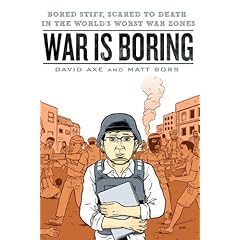
Graphic Novel Preview – War is Boring


Bookmark and Share

Journalism story telling through graphic novels is increasingly being popular and covering everything from War is Boringwars, to major events like the past Presidential election.  A citizen journalist entry into the medium comes this August in the form of War is Boring.  Published by New American Library, written by David Axe and illustrations provided by Matt Bors, Axe describes it as a “graphic memoir” chronicling his travels to war zones across the globe.

Their mission and team:

We are citizen journalists with a deep interest in world and national security. We are opposed to violence but recognize the necessity and utility of war. We advocate diplomacy and compromise over force as a solution to conflict.

We are wary of partisan politics, skeptical of the military-industrial-media complex, calm in the face of extremists’ rhetoric and adamant that open debate almost always trumps secrecy.

We lament the passing of old media but embrace the emergence of New Media. As journalists, we abide by three simple rules:

* Be accurate
* Be honest
* As often as possible, observe first-hand

We are expeditionary, investing our own resources and those donated to us, in order to travel to current and emerging conflict zones.

We emphasize the developing world over the developed, counter-insurgency over Cold-War posturing, peacekeeping over war-making, and persistent land- and sea-power over air bombardment.

We read Tom Ricks and Tom Barnett and listen closely to General David Petraeus, General James Mattis and Admiral James Stavridis.

We try to avoid terms like “war-fighter,” “effects,” “Islamo-fascist” and “GWOT.”

Their website, http://www.warisboring.com/, has been providing examples of what we can expect with very interesting observations on some of the absurdity that goes on behind the veil of war.

You can find examples of what to expect here, here, here, here and here.  The graphic novel is available for pre-order at Amazon.com.  David Axe has previously published the graphic novel War Fix which covered his interest in covering war, and Army 101: Inside ROTC in the Time of War.

Controversy Over Footnotes in Gaza

We figured that Joe Sacco’s latest graphic noverl Footnotes in Gaza would have it’s detractors.  But the Committee for Accuracy in Middle East Reporting in America (CAMERA) has issue has issues not only with Sacco’s work but also the New York Times review of the graphic novel.

CAMERA accuses both Sacco and reviewer Patrick Cockburn of anti-Israel bias and “antagonism towards Israel.”  They go on to question the Times’s stance since it both ok’ed the review and Cockburn’s writing of it.

Sacco has admitted his sympathy for Palestinians and his attempt to show their side of the issue.  CAMERA doesn’t quite make the case of Cockburns’ bias (only poor writing).  CAMERA then goes onto praising the Wall Street Journal’s review as more balanced.

From their website CAMERA is described as:

Founded in 1982, the Committee for Accuracy in Middle East Reporting in America is a media-monitoring, research and membership organization devoted to promoting accurate and balanced coverage of Israel and the Middle East. CAMERA fosters rigorous reporting, while educating news consumers about Middle East issues and the role of the media. Because public opinion ultimately shapes public policy, distorted news coverage that misleads the public can be detrimental to sound policymaking. A non-partisan organization, CAMERA takes no position with regard to American or Israeli political issues or with regard to ultimate solutions to the Arab-Israeli conflict.

As we’re fairly new to Sacco’s work we have all of his graphic novels on order or in our hands to read and will be providing our review of both his work on issues in the Middle East as well as his coverage of the Bosnian war.

Footnotes in Gaza

Maltese-born US journalist Joe Sacco is a graphic novelist we’ve covered in the past.  He covers real world issues in graphic novel form, a new form of gonzo-journalism.

Sacco depicted his travels and encounters with Palestinians and several Israelis in Gaza and the West Bank during the mid-1990s in his appropriately named PalestineFootnotes from GazaThe graphic novel won numerous awards.  Sacco has also won international critical acclaim with his Safe Area Goražde, a similarly pictorial account his experiences in the troubled Balkans during the Bosnian conflict.  That also won awards.

The artist’s latest book, Footnotes in Gaza, chronicles two episodes in 1956 in which a U.N. report filed Dec. 15, 1956 says a total of 386 civilians were shot dead by Israeli soldiers.  Sacco said the events have been “virtually airbrushed from history because they have been ignored by the mainstream media.”

Israeli historians dispute the events claiming the totals are exaggerations.  Meir Pail, a leading Israeli military historian and leftist politician has said:

It’s a big exaggeration.  There was never a killing of such a degree. Nobody was murdered. I was there. I don’t know of any massacre.

Sacco’s has been accused of a bias for the Palestinian cause.  Jose Alaniz, from the University of Washington’s Department of Comparative Literature says Sacco uses techniques to manipulate the readers such as angling Israeli soldiers in certain ways in the artwork.

Sacco at least admits he takes sides:

I don’t believe in objectivity as it’s practiced in American journalism. I’m not anti-Israeli … It’s just I very much believe in getting across the Palestinian point of view.

Sacco has his admirers too.  Israeli filmmaker Ari Folman, who directed the 2008 Golden Globe winning cartoon ocumentary Waltz for Bashir.

Whenever I’m asked about animation that influences me, I would say it’s more graphic novels. A tremendous influence on me has been Sacco’s ‘Palestine,’ his work on Bosnia and then Art peigelman’s ‘Maus,'” he said in a telephone interview.

His work quite simply reflects reality.

We’ll have a review of numerous works by Sacco in the upcoming weeks.

Journalist to Take on Immigration Through Comics

Malta Today has an article about Maltese-born US journalist Joe Sacco.  Sacco is best known for his take on such issues and the Middle East Peace Process and the Bosnian war using the comic book format.  He has turned his attention towards immigration as the topic for an upcoming publication.

In an interview with The Observer (UK), Sacco revealed that he is currently working on “a 48-page comic for the Virginia Quarterly Review about African migrants who attempt to get into Europe via Malta.”

Sacco was born in Hal Kirkop in 1960, but emigrated to Australia as a child and later to the United States.  He is the author of a number of critically acclaimed political comic-books.

Palestine, which was published in 1996, is arguably the most successful of his career. It has been described by leading orientalist Edward Said as:

A political and aesthetic work of extraordinary originality.

Sacco depicted his travels and encounters with Palestinians and several Israelis in Gaza and the West Bank during the mid-1990s.  These interactions make up the strips that is Palestine.  The publication won an American Book Award in 1996 and was serialised as a comic book from 1993 to 2001 and then published in several collections.

Sacco has also won international critical acclaim with his Safe Area Goražde, a similarly pictorial account his experiences in the troubled Balkans during the Bosnian conflict. Safe Area Goražde won the Eisner Award for Best Original Graphic Novel in 2001.

Joe Sacco earned a Guggenheim fellowship for his work, which has helped him finance future projects – including his ongoing work on immigration through Malta, as well as a simultaneous project depicting life in Camden, New Jersey – America’s poorest town.

Comic Journalism has become an increasingly popular form of story telling spanning such topics as travels of the authors, personal biographies and recent events such as the 2008 Presidential election.

Recent Entries »