Tag Archives: western

The Enfield Gang Massacre #1 promises a whole new chapter in the world of Ambrose County

The Enfield Gang Massacre #1

Westerns are bursting at the seams with infamous towns and counties whose histories are written in blood. The city of Tombstone in Arizona, the town of Deadwood in South Dakota, these are places that birthed stories and legends about how wild the West really was, and how violent the men in them were. Chris Condon and Jacob Phillips already had their very own dark Western town in their Neo-Western comic That Texas Blood, a place called Ambrose County. Now, fans of Texas Blood get a kind of origin story for it in a new spin-off series called The Enfield Gang Massacre, a story that goes back to the time of cowboys to unearth the violent happenings that gave birth to the land future criminals will take up residence in.

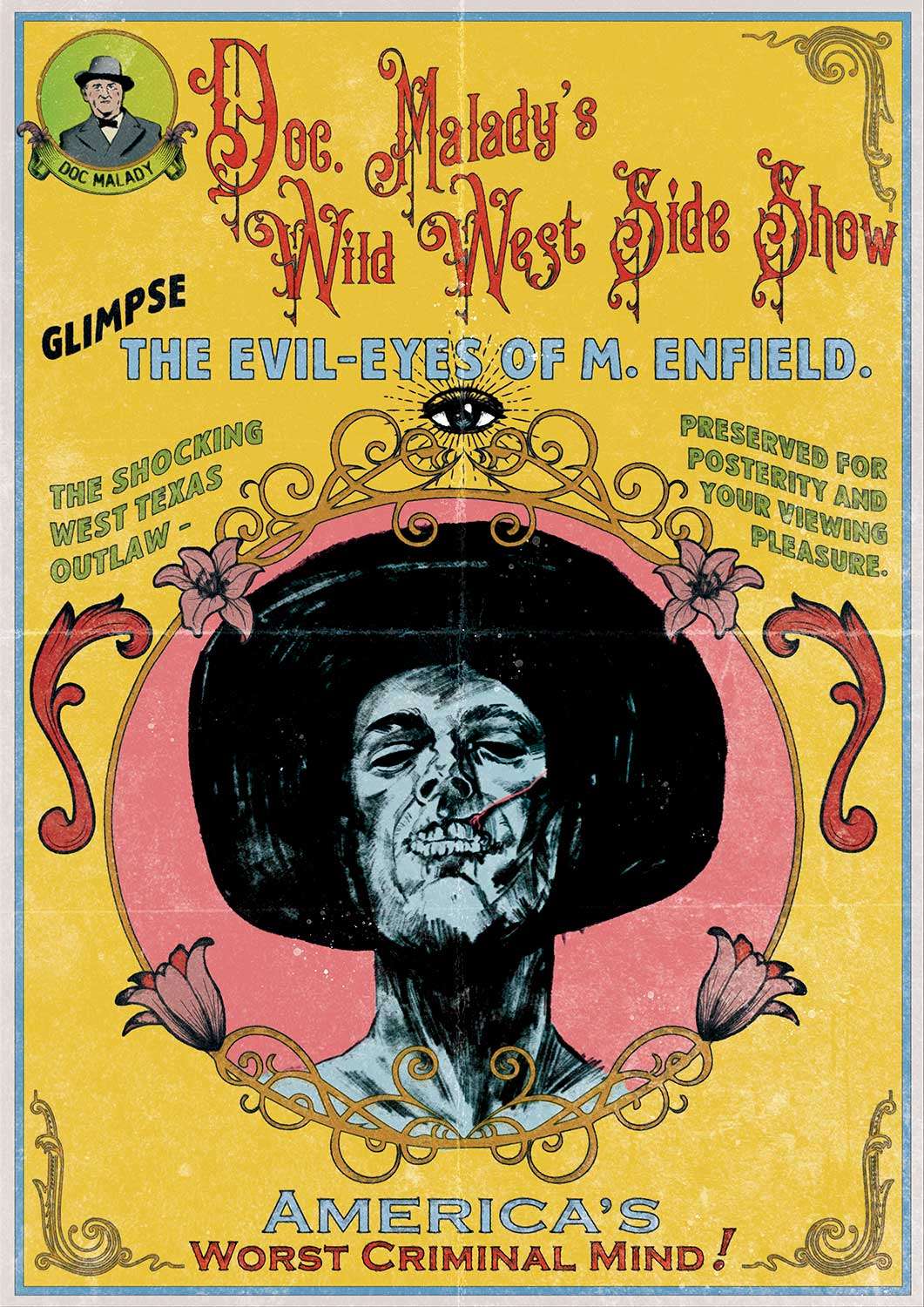
The story centers on the pursuit of Montgomery Enfield, an outlaw with a gang of his own, that’s believed to have authored the grisly murder of a bank worker back in 1875. The people of Ambrose County, a small Texas town at this point in time, demand justice at any cost. A mob of angry people have decided this man’s particular killing demands justice be repaid in kind, a comment on how thin the lines is between legal consequences and revenge. Just how fair the whole ordeal will turn out to be remains to be seen, but things are pointing to a very messy end, something that’s given credence by the comic’s title itself.
The Enfield Gang Massacre #1

Condon brings the same attention to detail to character development and world building that’s present in That Texas Blood. Both the people of Ambrose and the members of the Enfield Gang feel storied, complete with their own stubborn prejudices and ideals. It’d be easy to equate the world and character work done here with that seen in the crime films of the Coen Brothers, and while there’s certainly some of it here, Condon’s approach is specific enough to warrant its own space in the genre.

The same carries over to Phillips’s art, another showcase of nuanced character design and geographic cohesiveness. Phillips’s attention to character is as focused as that afforded to Ambrose County. Personalities and attitudes jump out of every person displayed on a panel, while the location’s essence is felt throughout. Phillips harnesses the violence Condon extracts from his dialogues and makes sure everything follows suit.
The Enfield Gang Massacre #1

The coloring, done by Phillips along with Pip Martin on assists, makes sure there’s an aesthetic link to Texas Blood. There’s an interest in capturing an overarching feel to the story that places Enfield Gang in the continuum of Texas Blood‘s history. Every single element is tuned to that particular frequency, and it allows for a personal type of worldbuilding that favors the minutia of shared experiences rather than large scale events to hold everything together.

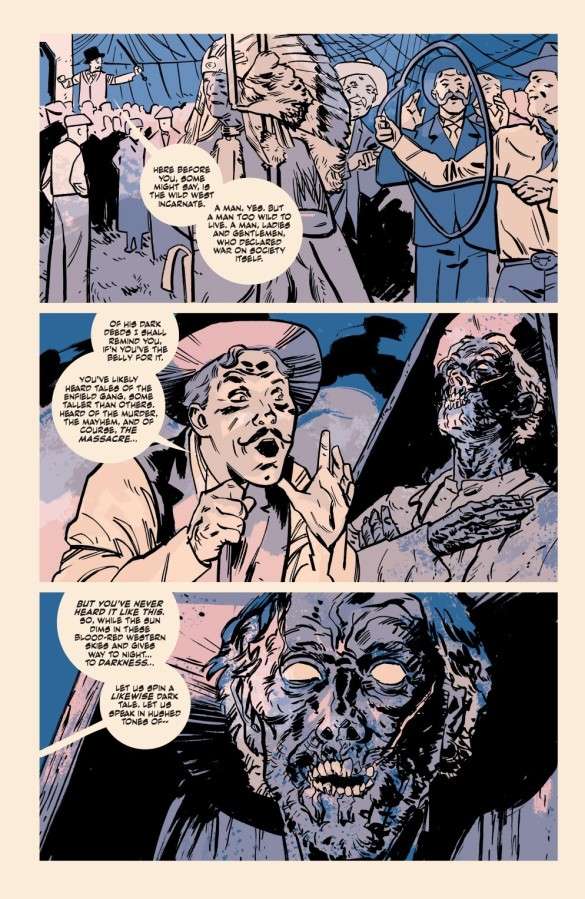
Special mention has to be given to the faux newspaper article exploring the titular massacre found in the last pages of the book. It takes the form of a special investigative report on the myths behind the massacre and how important it is to remember that facts are always pulling in one direction while local legends push with equal strength in the other. It puts the story’s essence on a slab for readers to dissect, inviting discussions on the nature of verifiable truth vs. agreed upon truths. I look forward to more of them.

The Enfield Massacre #1 promises a whole new chapter in the world of Ambrose County, giving it a longer narrative reach while opening numerous doors for more stories spread throughout the location’s history. Condon and Phillips are producing career-defining work here, and we’re lucky to be witnessing it one comic at a time.


Story: Chris Condon, Art: Jacob Phillips Color Assists: Pip Martin
Art: 10 Story: 10 Overall: 10 Recommendation: Read and make sure you’re also following That Texas Blood.

Image Comics provided Graphic Policy with a FREE copy for review


Purchase: Zeus ComicsKindle

Underrated: The Man With No Name: Sinners and Saints

This is a column that focuses on something or some things from the comic book sphere of influence that may not get the credit and recognition it deserves. Whether that’s a list of comic book movies, ongoing comics, or a set of stories featuring a certain character. The columns may take the form of a bullet pointed list, or a slightly longer thinkpiece – there’s really no formula for this other than whether the things being covered are Underrated in some way. This week: The Man With No Name: Sinners and Saints.


I’ve not read a lot of books published by Dynamite over the last few years, partly due to their flirtations with that group of specific comic fans, and partly because there was nothing that really grabbed my interest from the publisher. I’ve long been a fan of their take on the pulp heroes (the Black Bat, the Spider and the Phantom to name a few), and so when a used copy of The Man With No Name: Saints and Sinners came into my LCS I figured I’d give it a go.

Written by Christos Gage, with art by Wellington Dias and letters by Simon Bowland, the book was initially published in single issue format as issues 1-6 of The Man With No Name around 2009 or so (at least according to the copyright info in the front of the book and not a google search). The book serves as a sequel to The Good, The Bad and The Ugly, though you don’t necessarily need to have seen that film to enjoy this – albeit I say that as someone who might have watched the movie twenty years ago and doesn’t remember a lot of it (I never made it to the third of Sergio Leone’s trilogy during my Western kick two years ago after I finished playing Red Dead Redemption 2.

All you really need to know about that trilogy you can puzzle out during this story; whether The Man With No Name’s actions and reasons for said actions make sense is up to you to decide; having no seen the movies in a long time I don’t really have anything to say on that one way or another, is the truth; it feels a touch off, but that could very well be my memory confusing the Man With No Name with another Western antihero Clint Eastwood played at some point in the past. It ultimately isn’t a deal breaker for the comic itself.

The story in the book is fairly straight forward; the nameless outlaw finds himself defending the defenceless as a repayment of a debt, and the audience gets to see some pretty fantastic gunfights in the desert. By audience I mean readers. Explaining too much more of the plot would ultimately be me padding this column out for the sake of word count, which I won’t do. Suffice to say that this really feels like a snapshot in the eponymous antihero’s life and (probably) flows well as a sequel the the trilogy.

The book was a nice diversion on a rainy Saturday morning, and as far as my limited experience with Western comics goes, far from the worst one I’ve read (take that more as a statement on how few I’ve read that have made an impact either positively or negatively). Not a bad book at all, and definitely an underrated one when it comes to how often you see it talked about. Are there better comics out there? Absolutely; but I enjoyed my time with The Man With No Name: Saints and Sinner, and at the end of the day that’s what matters.


There we have it. Are there other comic book related stuff out there that is, for whatever reason, underrated and under-appreciated?

Absolutely.

Because of that, Underrated will return to highlight more comic book related stuff  that either gets ignored despite it’s high quality, or maybe isn’t quite as bad as we tend to think it is. In the meantime, though, if you do get a chance check out the characters in thisUnderrated, then you may need to hunt through the back issue bins for some, but others do have some stories collected in trades.

Until next time!

Ed Brubaker and Sean Phillips’ Pulp is the anti-Fascist Western We Need Right Now

“Shoot to win can feel so bittersweet. But you can take what you can get ’cause there ain’t no glory in the west.”

-from “No Glory in the West” by Orville Peck
PULP is the next OGN from Ed Brubaker, Sean Phillips - The Beat

Thanks to their work on titles like Criminal, The Fade Out, Kill or Be Killed, and many others, writer Ed Brubaker and artist Sean Philips’ collaborations have been some of my favorite comics to seek out on the stands. And their new Image Comics graphic novella, Pulp, is no exception. Set in New York in 1939 with occasional flashbacks to the turn of the 20th century, Pulp chronicles the last days of Max Winters, an Old West gun fighter and outlaw turned writer of pulp Westerns for the fictional magazine Six Gun Western. Brubaker and Phillips with amazing spot reds from colorist Jacob Phillips blur fact and fiction and show and steadily build up that Winters’ character, the Red River Kid, is a barely fictionalized version of his younger self.

While Ed Brubaker and Sean Phillips riff on crime fiction tropes in their usual manner and add a dollop of the “one last job” story, I would consider Pulp to be a straight Western even though it’s predominantly set in New York. This mostly comes from the way Max behaves, especially in crime settings. (Car chases are definitely more stressful than horse ones.) However, Brubaker and Phillips aren’t merely content to do their take on this classic American staple of the Western, but instead recontextualize the genre to be about resistance against those who would exploit others (Basically, class warfare.), especially Nazis and fascists.

Image from Pulp

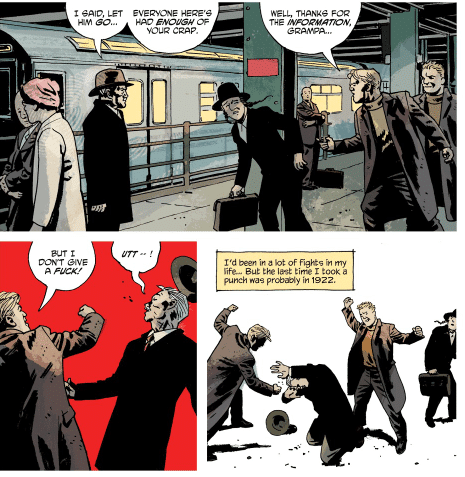
They lay the breadcrumbs for this early on as Max stands up for a young Jewish man at the subway station even though it leads to him getting his ass kicked, having a heart attack, and being robbed of his entire freelance paycheck that he was squirreling away to buy a house in Queens for him and his partner, Rosa. This scene sets up Max as a champion of the marginalized as Phillips and Phillips’ visuals convey the righteous fury in his soul as he stands up for what’s right even if no one helps him out when he takes a beating. The fury extends to the salty frankness of his dialogue as he tells the young anti-Semite, stating “Everyone here’s had enough of your crap”. Max is like if Clint Eastwood in Unforgiven had a social conscience, and this informs all of his actions in the narrative, especially in the second half of the book when he decides to fall in with an old foe. And not just any old enemy: a Pinkerton.

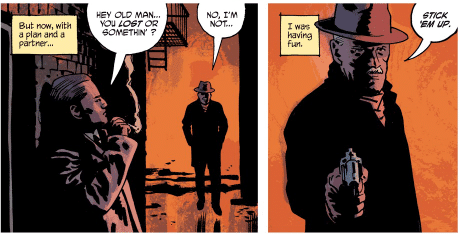
Even though they had semi-heroic beginnings as bodyguards for President Abraham Lincoln during the American Civil War, Pinkertons become synonymous with strike-breaking and cloak and dagger operations to uphold the status quo. Historically, they tracked down the Jesse James Gang and Butch Cassidy and the Sundance Kid so they’re a good fit for baddies in a Western and are still doing private security to this day as part of the firm, Securitas AB. So, basically, Brubaker and Phillips set up the former Pinkerton, Goldman, who catches Max trying to do a robbery in broad daylight as an untrustworthy fellow with a bit of a bitter edge. Sean Phillips never draws Max and Goldman as buddy buddy arranging them in opposition to each other with Goldman as a savvy operator and Max as a cowboy stuck in city alleys instead of the open plains of Wyoming or another Western state.

This visual depiction extends to Ed Brubaker’s plot as what Max thinks is just good old-fashioned stage coach robbery (But with Nazis instead of cattle barons.) turns into something a little more complex as Goldman wants to hit at the names and accounts of Nazis, not just their cash. Of course, Max thinks this is all nonsense, and his captions the 1939 Old West gun fighter version of ACAB. (“Why would I trust a Pinkerton?”) However, Brubaker and Phillips drop in Goldman’s backstory that he had a good job doing accounting work for Henry and was laid off because he was Jewish, which makes him more of a sympathetic figure, and also sets up Max’s final showdown where he takes guns a-blazing vengeance against the fascists and on behalf of his Jewish partner, who was wrongfully murdered, even though he (and we) know that this will end in his demise. But he has that house in Queens for Rosa so he has nothing left to lose.

Image from Pulp

For better or worse, Max’s actions in both the Western past and New York present of Pulp are consistent. He always fights on behalf of folks that are exploited by those who have the power in society whether that’s settlers and robber barons or Jewish people and Nazis. He even advocates for ownership of his character Red River Kid (Pretty much self-ownership.) and going in a new creative direction with the character instead of retreading the same plots, but as anyone who has read about the history of comics that’s a futile battle. There’s a real Martin Goodman/Stan Lee vibe from Max’s editor Mort and his nephew Sidney, who’s a fan of Max’s Westerns and will do his job for a much cheaper rate. These scenes and Max’s sense of justice lead to more anger and chest pains and is what leads to him to picking up gun again and becoming an outlaw.

Image from Pulp

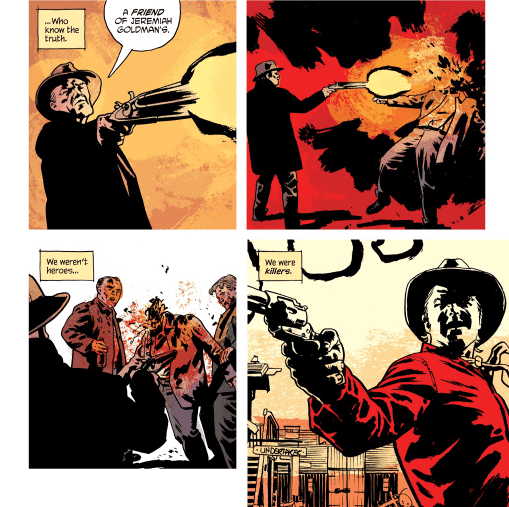
In Pulp, Brubaker and Phillips create a strong through-line between the exploitation of capitalists and fascists whose actions are insulated by people “just following orders”. Max is very aware of the banality of evil, and that’s why his final showdown is at German Bund beer hall and not against a veiled stand-in for Adolf Hitler atop a zeppelin. He has put his affairs in order, has set up his partner Rosa for life, just wants to avenge the death of his unlikely friend, Goldman, and put some goddamn Nazis six feet under. Sean Phillips and Jacob Phillips up the intensity of the visuals in these final pages with plenty of guns, red, and abstraction while Ed Brubaker’s narration sums up what Max thinks of himself before his death, namely, “We weren’t heroes. We were killers.” Even though Max has good values, it was his quick trigger finger that kept him alive in the Old West, and it’s deteriorating heart that gets him in the end in a bar in New York surrounded by swastikas. But, at least, he went down shooting.

Pulp is a fantastic transposition of the Western to the big, modern city as Ed Brubaker and Sean Phillips apply outlaw-turned-pulp-writer code of fighting for the downtrodden to championing Jewish people against fascism even before the United States declared war on Nazi Germany. Max’s actions and ideals strike a chord in 2020 where the President of the United States himself called Nazis and white supremacists “very fine people”, and they run rampant both in the street and online. With his vulnerability, tenacity, soft spot for Rosa, and heart for justice, Max Winters is definitely the character find of 2020, and Ed Brubaker, Sean Phillips, and Jacob Phillips do a wonderful job making a Western story both exciting and socially relevant.