Tag Archives: south korea

Review: Banned Book Club
Banned Book Club

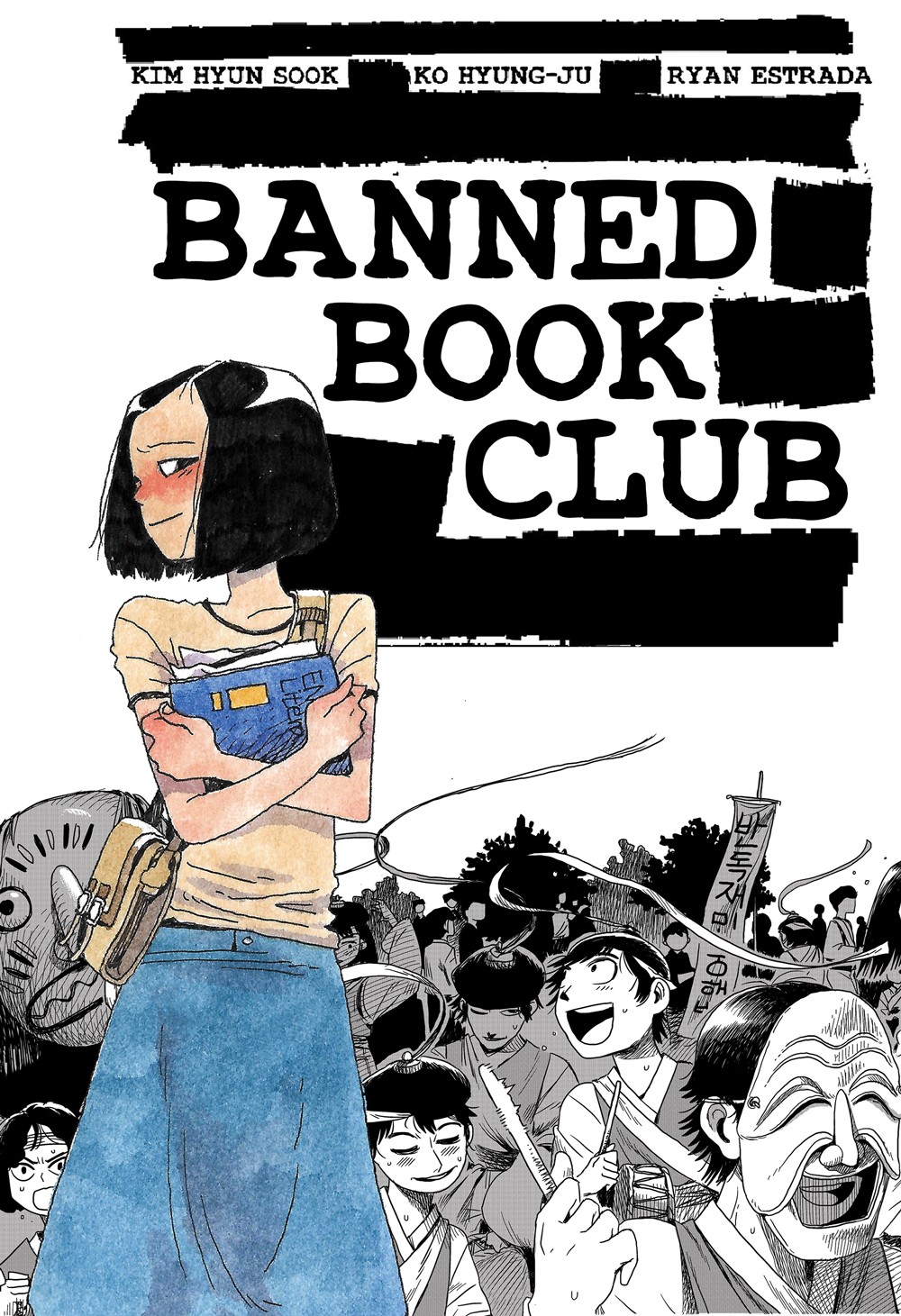
Banned Book Club is an inspiring and educational piece of graphic non-fiction from writers Kim Hyun Sook and Ryan Estrada with manhwa-influenced visuals from artists Ko Hyung-Ju. It tells the story of the 1983 student protests about South Korea’s authoritarian Fifth Republic from the perspective of Hyun Sook herself, who begins as a young, timid girl that just wants to study English literature, and ends up joining the revolution via extracurricular activities. (I will be using Kim Hyun Sook for the character and Hyun Sook for the creator.)

However, between dodging cops, dealing with her friends being arrested, and sexual harassment from her once respected literature professor, Kim Hyun Sook finds self-actualization and also learns a little bit how the world works. I mean why would a regime ban books with fascist enemies if deep down, they didn’t see a little of themselves in these books. Banned Book Club is also a strong narrative argument for the power of literature, including fiction and nonfiction, to effect change and use things like imagery and metaphor to expose the truth about the world. In that case, maybe this comic is just a tiny bit metafictional.

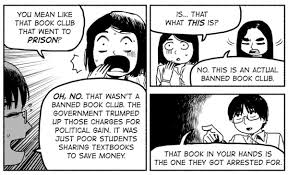
Hyun Sook, Estrada, and Ko Hyung-Ju do an excellent job harmonizing the words and visuals in Banned Book Club to create a certain feel on different pages or get a point across. For example, there’s a flurry of word balloons when the members of the book club get in an argument when one of their members are jailed. On the other hand, they drop out the dialogue for more tense, action-driven scenes like when Hyun Sook takes multiple buses to deliver a package from the club to one at another university as part of her “public relations” duties.
Panel Mania: Banned Book Club by Kim Hyun Sook, Ko Hyung-Ju, and ...

This variety in storytelling keeps Banned Book Club interesting, and I love how Hyung-Ju’s characters wear their emotions on their sleeves. He also uses shadow and differences in line thickness to show when they’re afraid, embarrassed, or more relaxed. The relaxed emotion doesn’t pop up that much in the story, but it’s on full display during the club’s 2016 class reunion when they band together to protest another authoritarian South Korean president. This epilogue adds perspective to the events of the previous chapter and also is just a damn good testimonial to the power of protest. I mean, imagine if Americans went out and protested Trump every weekend of his impeachment hearings…

Hyun Sook, Estrada, and Hyung-Ju aren’t afraid to whip up a little controversy in Banned Book Club with the club member Jihoo reading the writings of North Korea’s authoritarian dictator Kim Il-Sung under the guise of a book of love poems. (Of course, he’s the one club member who actually gets arrested.) Jihoo gets some gentle ribbing from his friends for reading “government propaganda”, but it’s a testimonial to their dedication to freedom of speech and the press that he doesn’t get censured.

The pages where he reads Kim Il-Sung’s overwrought, loaded writing shows that the freedom to read extends to books that one doesn’t agree with. But it’s also connected to the freedom to critique books. I have to give kudos to Hyun Sook, Estrada, and Hyung-Ju for using this consequence-infused scene to add ambiguity to the club’s activities. They weren’t just reading Karl Marx, Jean-Paul Sartre, and Noam Chomsky and trying to save South Korea; they were also reading North Korean propaganda to compare it to the techniques their government were using. It’s an example of the book club just wanting to have freedom of inquiry at university instead of being stuck reading, thinking, and publishing (In the case of the school newspaper.) what the government approves.

Banned Book Club has its fair share of dark and tragic material like any time a member of the club is hauled in for questioning by the government. Hyung-Ju use thick cross hatching to show the pain and stress the club members are under, which is contrasted with Hyun Sook and Estrada’s dialogue for the guard, who talks about catching “bad guys” to his son on the phone. It’s the banality of evil in action showing that authoritarianism is propagated by its yes people.

Kim Hyun Sook, Ryan Estrada, and Ko Hyung-Ju turn in the next great historical non-fiction comic in Banned Book Club as they portray a pivotal time in South Korean history from a ground-level point of view. They also explore the relationship between politics and art through three-dimensional characters with even Hyun Sook’s father getting a spotlight when he tells the backstory of why he decided to start a steak restaurant and letting his daughter know that it’s okay to have dreams that aren’t in line with societal norms. Finally, Banned Book Club is a wonderful showcase for the connection between the visual and verbal, which is what the comics medium does best.

Story: Kim Hyun Sook, Ryan Estrada Art: Ko Hyung-Ju
Story: 9.0 Art: 9.2 Overall: 9.1 Recommendation: Buy

Iron Circus Comics provided Graphic Policy with a FREE copy for review


Purchase: AmazonBookshopTFAW

Advance Review: Banned Book Club

Banned Book Club

Banned Book Club is an inspiring and educational piece of graphic non-fiction from writers Kim Hyun Sook and Ryan Estrada with manhwa-influenced visuals from artists Ko Hyung-Ju. It tells the story of the 1983 student protests about South Korea’s authoritarian Fifth Republic from the perspective of Hyun Sook herself, who begins as a young, timid girl that just wants to study English literature, and ends up joining the revolution via extracurricular activities. (I will be using Kim Hyun Sook for the character and Hyun Sook for the creator.)

However, between dodging cops, dealing with her friends being arrested, and sexual harassment from her once respected literature professor, Kim Hyun Sook finds self-actualization and also learns a little bit how the world works. I mean why would a regime ban books with fascist enemies if deep down, they didn’t see a little of themselves in these books. Banned Book Club is also a strong narrative argument for the power of literature, including fiction and nonfiction, to effect change and use things like imagery and metaphor to expose the truth about the world. In that case, maybe this comic is just a tiny bit metafictional.

Hyun Sook, Estrada, and Ko Hyung-Ju do an excellent job harmonizing the words and visuals in Banned Book Club to create a certain feel on different pages or get a point across. For example, there’s a flurry of word balloons when the members of the book club get in an argument when one of their members are jailed. On the other hand, they drop out the dialogue for more tense, action-driven scenes like when Hyun Sook takes multiple buses to deliver a package from the club to one at another university as part of her “public relations” duties.

Panel Mania: Banned Book Club by Kim Hyun Sook, Ko Hyung-Ju, and ...

This variety in storytelling keeps Banned Book Club interesting, and I love how Hyung-Ju’s characters wear their emotions on their sleeves. He also uses shadow and differences in line thickness to show when they’re afraid, embarrassed, or more relaxed. The relaxed emotion doesn’t pop up that much in the story, but it’s on full display during the club’s 2016 class reunion when they band together to protest another authoritarian South Korean president. This epilogue adds perspective to the events of the previous chapter and also is just a damn good testimonial to the power of protest. I mean, imagine if Americans went out and protested Trump every weekend of his impeachment hearings…

Hyun Sook, Estrada, and Hyung-Ju aren’t afraid to whip up a little controversy in Banned Book Club with the club member Jihoo reading the writings of North Korea’s authoritarian dictator Kim Il-Sung under the guise of a book of love poems. (Of course, he’s the one club member who actually gets arrested.) Jihoo gets some gentle ribbing from his friends for reading “government propaganda”, but it’s a testimonial to their dedication to freedom of speech and the press that he doesn’t get censured.

The pages where he reads Kim Il-Sung’s overwrought, loaded writing shows that the freedom to read extends to books that one doesn’t agree with. But it’s also connected to the freedom to critique books. I have to give kudos to Hyun Sook, Estrada, and Hyung-Ju for using this consequence-infused scene to add ambiguity to the club’s activities. They weren’t just reading Karl Marx, Jean-Paul Sartre, and Noam Chomsky and trying to save South Korea; they were also reading North Korean propaganda to compare it to the techniques their government were using. It’s an example of the book club just wanting to have freedom of inquiry at university instead of being stuck reading, thinking, and publishing (In the case of the school newspaper.) what the government approves.

Banned Book Club has its fair share of dark and tragic material like any time a member of the club is hauled in for questioning by the government. Hyung-Ju use thick cross hatching to show the pain and stress the club members are under, which is contrasted with Hyun Sook and Estrada’s dialogue for the guard, who talks about catching “bad guys” to his son on the phone. It’s the banality of evil in action showing that authoritarianism is propagated by its yes people.

Kim Hyun Sook, Ryan Estrada, and Ko Hyung-Ju turn in the next great historical non-fiction comic in Banned Book Club as they portray a pivotal time in South Korean history from a ground-level point of view. They also explore the relationship between politics and art through three-dimensional characters with even Hyun Sook’s father getting a spotlight when he tells the backstory of why he decided to start a steak restaurant and letting his daughter know that it’s okay to have dreams that aren’t in line with societal norms. Finally, Banned Book Club is a wonderful showcase for the connection between the visual and verbal, which is what the comics medium does best.

Story: Kim Hyun Sook, Ryan Estrada Art: Ko Hyung-Ju
Story: 9.0 Art: 9.2 Overall: 9.1 Recommendation: Buy

Banned Book Club is out May 19, 2020, Preorder: AmazonBookshop
Iron Circus Comics provided Graphic Policy with a FREE copy for review


This post contains affiliate links, which means that if you click on one of the product links and make a purchase, we’ll receive a percentage of the sale. Graphic Policy does purchase items from this site. Making purchases through these links helps support the site.

Around the Tubes

So, it was new comic day yesterday. What did everyone pick up?

Around the Tubes

CBLDF – South Korean Child Pornography Law Targets Drawings, Animation – Intention good, execution bad.

The Mary Sue – Chinese Military Slams Pacific Rim For Being “American Propaganda” – Ok then.


Around the Tubes Reviews

Comic Vine – All-Star Western #23

Comic Vine – Aquaman #23

Comic Vine – Avengers Arena #14

Bleeding Cool – Batman/Superman #3

Comic Vine – Journey into Mystery #655

Comic Vine – Justice League #23

Comic Vine – Larfleeze #3

Comic Vine – New Avengers #9

Comic Vine – Red Lanterns #23

Comic Vine – Secret Avengers #8

Comic Vine – Thor: God of Thunder #12

Comic Vine – Uncanny Avengers #11

CBR – X-Men: Battle of the Atom #1

Korea’s Educational Comics


Bookmark and Share

The Obama StoryThe Korean Times is reporting that educational comic books are flourishing in Korea as a new way to grab the attention of children and engage teachers and adults.  That wave of educational comics is making it’s way across the seas to here in the United States.

A comic bio series in English published by Dasan Books has been adopted as supplementary textbooks at a U.S. elementary school in New Jersey.

The New Jersey Fort Lee Elementary School announced it will use “The Obama Story,” “The Bill Gates Story” and “The Charles Darwin Story” for history, social studies and bilingual education classes for the second half of this year. The three books are part of the comic biography series aimed at third to sixth graders.

In February 2009 Dasan Books even opened up a branch in Englewood Cliffs, New Jersey to enter the U.S. market. Six biography comics have so far been produced, including ones about Martin Luther King, Jr., Abraham Lincoln and Hillary Clinton. By August, volumes on Oprah Winfrey, Steven Spielberg and Stephen Hawking will be released.  Their plan is to release 50 bio comics over the next 18 months.

The Obama Story clocks in at 200 pages and targets children ages 8 to 12.  It focuses on his life from his early child hood up to his recent election as President.

The comic biography series is available in some nations in North America and Asia via online bookstores.

Anti-North Korea Comic Books Distributed – Update

Yesterday we brought you the news about the National Police Agency having published a comic book critical of the North Korea regime and it’s nuclear program.  The Financial Times picks up the story and expands upon the story a bit.

The comic is called Ji-yong goes time travelling to school children between the ages of 10 to 15. The plot focuses on a young boy who rides through time with his grandfather’s ghost on a giant, red dragon.  He witnesses the North Korean invasion of the South in 1950 and the Stalinist dictatorship built by Kim Il-sung as well as present-day labour camps, starvation, nuclear weapons and cyber attacks.

The goal of the comic is to provide security education to elementary and middle school students. The creators cite a survey showing that 57 per cent of schoolchildren were “not aware” of the Korean war and 60 per cent of people in their 20s could not say when the war started.

“In the past, national security education was conducted forcefully and stirred up hostility,” the police said. Children’s cartoons would depict North Korean soldiers as wolves and Kim Il-sung as a pig. “These new comic books are based on facts to help children form a fair appraisal.”

The agency invested 90 million Won which is about $77,000 in American dollars.  They produced 150,000 copies and distributed them to schools and police stations.

The comic books follows a “spot the spy” computer game that South Korea’s intelligence agency put online during the summer.

The two nations went to war in June of 1950 and paused confrontation in July 1953.  There has never been an official treaty ending the war (it’s technically still going on for this reason) and occasional flair ups and skirmishes have occurred.  North and South Korea are divided by a demilitarized zone (DMZ) at the 38th parallel.

Anti-North Korea Comic Books Distributed

News comes from the Korean Times that the National Police Agency has published comic books critical of the North Korea regime and it’s nuclear program.  The goal is to provide security education to elementary and middle school students.

The agency invested 90 million Won which is about $77,000 in American dollars.  They produced 150,000 copies and distributed them to schools and police stations.

This is all a part of an effort to strengthen education about security.  The two nations went to war in June of 1950 and paused confrontation in July 1953.  There has never been an official treaty ending the war (it’s technically still going on for this reason) and occasional flair ups and skirmishes have occurred.  North and South Korea are divided by a demilitarized zone (DMZ) at the 38th parallel.
