Tag Archives: robots

Review: Not All Robots #1
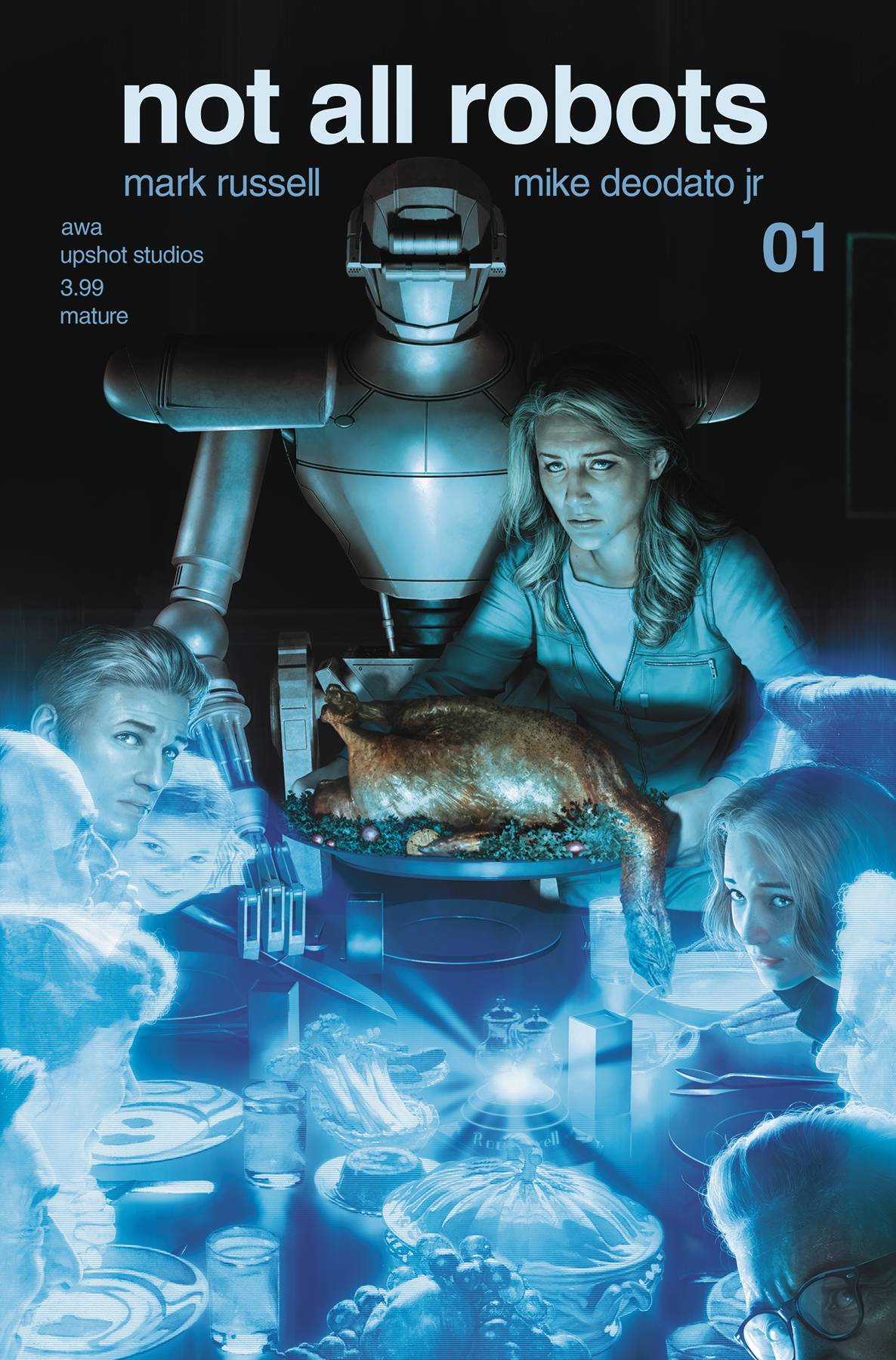
Not All Robots #1

The robot takeover doomsday scenario, where humanity gets replaced by the machines they created, has been the basis for many a sci-fi story, but the aftermath is rarely given time to shine. Just what is life under robotic law and what does the new day-to-day look like after humanity’s gone extinct? Say Ultron finally gets one over the Avengers, what’s next? Aren’t robots near-perfect beings with infinite knowledge? Museums and libraries would become obsolete as robots store everything in their memory and can access it at a moment’s notice, not to mention grocery stores and bars. Well, maybe not bars.

Mark Russell (Prez, Billionaire Island) and Mike Deodato’s new AWA Studios comic, Not All Robots, offers readers an answer: the robots will eventually become more like us. Once you get to the top of the food chain, it’s possible that the only way forward is to downgrade. That is, unless they’re content with being static automatons surfing their own databases without a need to move around or physically engage with anyone.

Not All Robots is another great Mark Russell satire on the ridiculousness of existence and the things we do with our existential dilemmas. Humanity, what’s left of it, is very quickly becoming obsolete as worker robots have become the sole providers of living families by completely taking over the workforce. Humans are quite simply redundant at this point and robots are catching on to the fact of how superfluous they’ve become. There’s even a talk show within the story called Talkin’ Bot that puts everything into perspective and I am one-hundred percent certain this show will actually exist a few years from now.

The comic centers on a house bot called Razorball. He’s the main provider for the Walters, the family that owns him. Razorball has become a disenchanted worker, cynical at every turn. He complains about life, the monotony of it, and his disdain for all the unnecessary things he has to do at work.

Deodato (Marvel’s Original Sin, The Resistance) illustrates Razorball as a somewhat outdated and clunky machine, in need of an update or to be updated by a newer model. That’s where the Mandroids come in, robots that can easily be confused with humans given the quality of their build. In other words, the future.

Not All Robots #1
Not All Robots #1

It’s hard not to confuse Razorball with the average Joe, an unhappy guy that hates his life and his job and feels unappreciated by society. Russell’s genius, though, comes in how he takes that archetype and injects classic Asimov-like science fiction ideas into the story to not let the metaphor consume the narrative entirely. The associations are easy to make between Razorball and his human counterparts, but there’s a real sci-fi heart beating at the center of it.

Deodato crafts a universe’s worth of worldbuilding into the story with futuristic vistas and designs that firmly place the story within the realm of plausibility. It keeps the characters grounded and the story human. Deodato’s panel layouts and overall page structure—which has evolved throughout his career and stands as one of his signature skills as an artist—keeps things busy too, as if the new standard of life is governed by on-going activity carried by the never-ending stamina of a well-oiled machine.

Russell, on the other hand, isn’t just content with making fun of humans through worker robots. The idea that machines have forced people into a sedentary lifestyle echoes current debates on how technology is eliminating jobs people used to do by hand and got paid for. The robots act as living cautionary glimpses into what our reality could turn into if progress is allowed to continue pushing forward unfettered. Also how disenchanted robots will get once they realize how mundane human existence actually was.

Not All Robots is a funny, scary, and plausible take on humanity’s self-authored descent into obsolescence. Readers will laugh hard the entire way through, but they’ll also have no choice but to think about the consequences of our exponential growth into a machine-dominated world. The kicker, though, is that regardless of how advanced these robots turn out to be, they might not have a choice but to become a bit human to find some meaning in the new status quo.

Story: Mark Russell, Art: Mike Deodato
Story: 9.0 Art: 9.0 Overall: 9.0 Recommendation: Buy and maybe consider throwing your iPhone into the ocean

AWA Studios provided Graphic Policy with a FREE copy for review


Purchase: comiXologyKindleZeus ComicsTFAW

Advance Review: Not All Robots #1

Not All Robots #1

The robot takeover doomsday scenario, where humanity gets replaced by the machines they created, has been the basis for many a sci-fi story, but the aftermath is rarely given time to shine. Just what is life under robotic law and what does the new day-to-day look like after humanity’s gone extinct? Say Ultron finally gets one over the Avengers, what’s next? Aren’t robots near-perfect beings with infinite knowledge? Museums and libraries would become obsolete as robots store everything in their memory and can access it at a moment’s notice, not to mention grocery stores and bars. Well, maybe not bars.

Mark Russell (Prez, Billionaire Island) and Mike Deodato’s new AWA Studios comic, Not All Robots, offers readers an answer: the robots will eventually become more like us. Once you get to the top of the food chain, it’s possible that the only way forward is to downgrade. That is, unless they’re content with being static automatons surfing their own databases without a need to move around or physically engage with anyone.

Not All Robots is another great Mark Russell satire on the ridiculousness of existence and the things we do with our existential dilemmas. Humanity, what’s left of it, is very quickly becoming obsolete as worker robots have become the sole providers of living families by completely taking over the workforce. Humans are quite simply redundant at this point and robots are catching on to the fact of how superfluous they’ve become. There’s even a talk show within the story called Talkin’ Bot that puts everything into perspective and I am one-hundred percent certain this show will actually exist a few years from now.

The comic centers on a house bot called Razorball. He’s the main provider for the Walters, the family that owns him. Razorball has become a disenchanted worker, cynical at every turn. He complains about life, the monotony of it, and his disdain for all the unnecessary things he has to do at work.

Deodato (Marvel’s Original Sin, The Resistance) illustrates Razorball as a somewhat outdated and clunky machine, in need of an update or to be updated by a newer model. That’s where the Mandroids come in, robots that can easily be confused with humans given the quality of their build. In other words, the future.

Not All Robots #1
Not All Robots #1

It’s hard not to confuse Razorball with the average Joe, an unhappy guy that hates his life and his job and feels unappreciated by society. Russell’s genius, though, comes in how he takes that archetype and injects classic Asimov-like science fiction ideas into the story to not let the metaphor consume the narrative entirely. The associations are easy to make between Razorball and his human counterparts, but there’s a real sci-fi heart beating at the center of it.

Deodato crafts a universe’s worth of worldbuilding into the story with futuristic vistas and designs that firmly place the story within the realm of plausibility. It keeps the characters grounded and the story human. Deodato’s panel layouts and overall page structure—which has evolved throughout his career and stands as one of his signature skills as an artist—keeps things busy too, as if the new standard of life is governed by on-going activity carried by the never-ending stamina of a well-oiled machine.

Russell, on the other hand, isn’t just content with making fun of humans through worker robots. The idea that machines have forced people into a sedentary lifestyle echoes current debates on how technology is eliminating jobs people used to do by hand and got paid for. The robots act as living cautionary glimpses into what our reality could turn into if progress is allowed to continue pushing forward unfettered. Also how disenchanted robots will get once they realize how mundane human existence actually was.

Not All Robots is a funny, scary, and plausible take on humanity’s self-authored descent into obsolescence. Readers will laugh hard the entire way through, but they’ll also have no choice but to think about the consequences of our exponential growth into a machine-dominated world. The kicker, though, is that regardless of how advanced these robots turn out to be, they might not have a choice but to become a bit human to find some meaning in the new status quo.

Story: Mark Russell, Art: Mike Deodato
Publisher: AWA Studios

Story: 9.0 Art: 9.0 Overall: 9.0 Recommendation: Buy and maybe consider throwing your iPhone into the ocean

AWA Studios provided Graphic Policy with a FREE copy for review


Pre-Order: TFAW

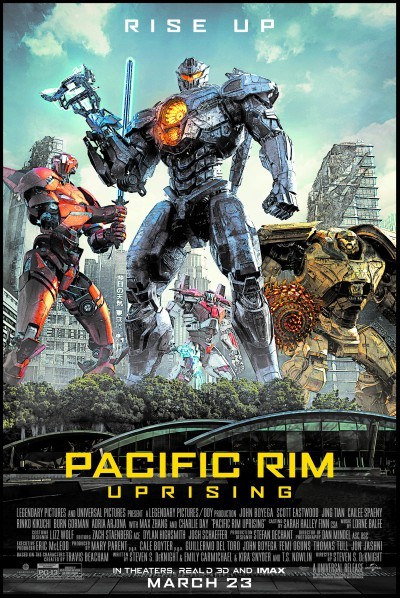
Movie Review: Pacific Rim: Uprising

Pacific-Rim-Uprising-posterThe original Pacific Rim felt so much like lightning in a bottle, and its lackluster sequel does nothing to dissuade us of that notion.

On one hand, how hard could it be to deliver on a simple winning formula? Giant robots fighting monsters? And while Pacific Rim: Uprising has plenty of that (and it is, at times, spectacular) it is weighed down by all of its exposition and human characters and some especially clunky performances.

In this sequel, John Boyega stars as Stacker Pentecost’s son Jake. Set ten years after the last film, and with no sign of kaiju invasion in a decade, Jake is far removed from the Jaeger program but is reluctantly recruited back in to help train a new team of pilots. However, they’re on the verge of being replaced by a new generation of remotely piloted Jaeger drones which don’t require drift-compatible two person pilot teams. What could go wrong with semi-autonomous giant robot drones in every major city? And this, of course, ends in the return of the kaiju and an apocalyptic showdown in Tokyo.

The original worked largely because screenwriter Travis Beacham and director Guillermo Del Toro were so in sync creatively. Despite the film being somewhat formulaic, it delivered a fun, exciting take on “robots fighting monsters” by having interesting human characters. For Uprising, writer and director Steven DeKnight, a veteran of Netflix’s Daredevil, the CW’s Smallville, and numerous Joss Whedon Buffyverse projects, just doesn’t seem to quite mesh with the material.

The script, while serviceable, telegraphs its giant robot punches miles away. If you had stopped the film after ten minutes and asked, “How is this going to end?” it’s easy to predict… and so then the film plays out in a paint-by-numbers fashion. And while the original gives us some great scenes outside the jaegers, including one of my favorite fight scenes of the movie (right), Uprising is a snoozefest when it isn’t being cringeworthily bad.

Chief culprit here is Charlie Day, who provided a lot of comic relief and exposition in the original (especially in his Odd Couple science buddy pairing with Burn Gorman) but who is just the absolute worst in this film. It doesn’t help that Scott Eastwood could be replaced by a cord of firewood and would be more interesting to watch. Also gone is any real character building for the supporting cast, who mostly end up unmemorable. Boyega is the only real standout star, but as much as he tries to carry this movie by himself, it’s just not possible, especially when he is saddled with this sometimes inexplicably bad script.

But the fight scenes? Those are pretty fun. Again, it doesn’t have anywhere near the charm and innovative feel of the first one. But, we were never really expecting it would, right? And when it sets us up for the inevitable sequel, we can only hope that someone is willing to lure Del Toro and Beacham back to work their magic.

If you’re a devoted fan of robots and kaiju, they already have your money. You bought your tickets ages ago and no mediocre review is going to keep you from seeing this. But for general audiences? Save your money for Ready Player One, or go see Black Panther again.

2 out of 5 stars

There Are No Strings on Me

no strings 02Somewhat unexpectedly yesterday, Marvel Studios released earlier-than-expected the first live action trailer for what might be the most anticipated comic movie in history – Avengers: The Age of Ultron.  Not to be listed as being light on action, the trailer relied heavily on the battle between Tony Stark in Hulkbuster armour against the Hulk.  Perhaps more interestingly though is that the trailer introduced three new characters, new Avengers Scarlet Witch and Quicksilver, as well as the movie’s antagonist Ultron.  While there is bound to be analysis and over-analysis of the trailer by those that can’t wait until next May, there is very little in terms of plot which can be discerned from the trailer.  It would seem as though after the teaser scene at the end of Captain America: The Winter Soldier, that it is Ultron that rescues the Scarlet Witch and Quicksilver, and the battle between the Hulk and Iron Man which might set up the rumored next Hulk film focused on World War Hulk are both present, but no plot is there, and anything else beyond some speculation would only border on gossip.  What is interesting though is the theme of the trailer, and whether that will be an underlying theme of the movie.

Ultron and the twins

Ultron and the twins

Even dedicated fans of Disney would have been unlikely to recognize the melancholic version of “There Are No Strings on Me” playing in the background of the trailer, and if not for the final words of the villain at the end of the trailer, might have even gone unnoticed.   Robots searching for their humanity is one of the most common themes in regards to stories involving the artificial beings, and forms the basis for many of the most famous characters and stories in science fiction, whether it be Data in Star Trek or the replicants in Blade Runner.  Often times, and especially with well-established characters, there are references made to the artificial men of literature.  For instance, in one episode of Star Trek TNG, Data is compared to the Tin Man, who himself sought his own heart.

In a bit of a twist, Ultron though he is a robot with artificial intelligence has never been very concerned with his humanity, declaring his own sentience to supersede that of humans, despite having been patterned on the  persona of Hank Pym, though presumably someone else in this movie seeing as Pym has not yet shown up in the Marvel Cinematic Universe.   The artificial man in reference in the trailer is Pinocchio, who as far as artificial men go is in a category of his own.  As the story goes, the wooden boy was first sculpted from a piece of magical talking wood, and strove for true humanity, but with a background based on magic, the impulse is still the same, to be truly human or as the song says “there are no strings on me”.  As a choice for the underlying music of the trailer it is therefore a little bit confusing.  Ultron is not the best example of a robot trying to understand humanity, and it is even seen as one of his fatal flaws, as the hero The Vision was able to overcome Ultron in an early appearance because The Vision had a conscience whereas Ultron did not.  Perhaps then, another reading of the music is necessary, not holding true to the story or the genre at all, but rather taken at face value.  Ultron and machines will not be ruled by man and this is all the setup that the new Avengers movie needs.

More than meets the 3rd party eye!

Fans-Toys-Transformer-Soar-Not-Swoop-8Fans-Toys-Transformer-Soar-Not-Swoop-4


Fanstoys, a  Japanese 3rd party toy manufacture, has showed off their latest “Iron Dibots“figure. This one’s official name is Soar, but we all know it’s Swoop. For OBVIOUS legal reasons they can’t call it Swoop, mention Dinobots, Transformers, or anything else that would bring a truck load of lawyers down upon them but the figure kinda speaks for itself. With a great design in both robot and dino-mode, this figure would fit really well in any Masterpiece collection. Swoo….I mean Soar is available in both red and blue paint decos for those who prefer the original toy or the show colour scheme.

Fans-Toys-Transformer-Soar-Not-Swoop-5

This is the 2nd Dinosaur themed transforming robot from Fanstoys. The first being Scoria, or “not Slag”. With this image released, it looks like Fanstoys does plan to make the entire classic line-up in their Iron Dibots series. Which means we’ll see a “King” T-Rex eventually. I have the Masterpiece Grimlock (Hasbro release) and I love that figure, the only problem is the size. Grimlock is a little too small in my opinion and the Fanstoys versions look to be a little beefier in size, so hopefully their T-Rex will follow suit.

If you’re interested in adding either Soar or Scoria to your collection, hop on over to your favoutire online toy retailer and lock in a pre-order. These beauties are selling for around $200 but that will only go up on the secondary market. I’ve never taken the the plunge into 3rd party figures before but these may be a great place to start.