
Godzilla’s Monsterpiece Theatre Presents: Romeo & Juliet and Godzilla #1 deepens the tragedy of the love story while also throwing in slapstick humor on a colossal scale
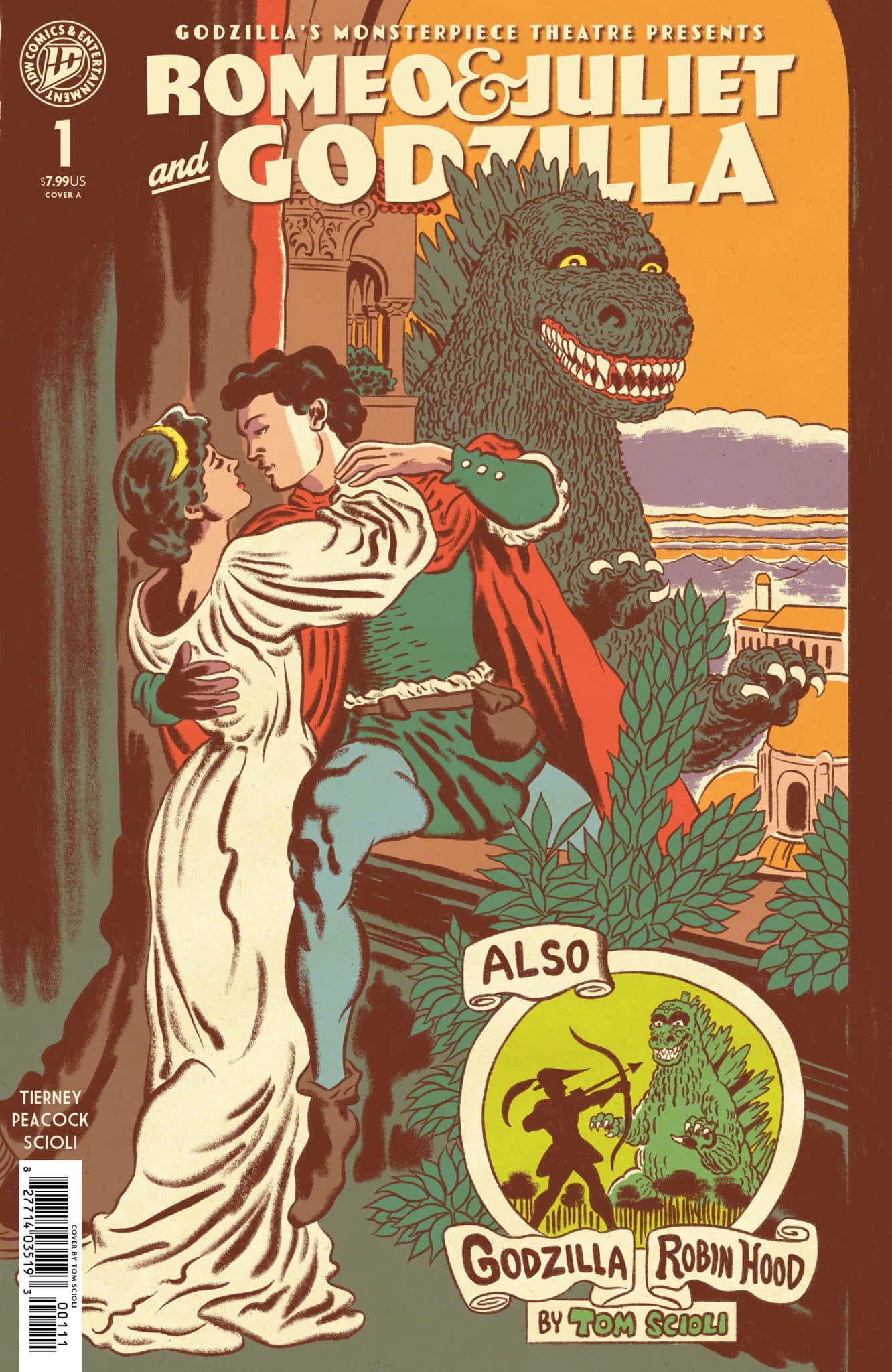
In Godzilla’s Monsterpiece Theatre Presents: Romeo & Juliet and Godzilla #1, Adam Tierney and Sean Peacock intensify the classic tragic melodrama of William Shakespeare’s doomed lovers with an old-fashioned kaiju attack on Renaissance Verona. With the exception of a gorgeous fantasy sequence and some fun genre riffs, Tierney’s plot (and language) doesn’t stray from the classic story. However, Godzilla stomping, Mothra flying, and Capulet’s medieval take on Mechagodzilla add an extra level of mayhem and dark, slapstick humor.
Adding Godzilla to the mix really shows how self-absorbed and infatuated Romeo and Juliet were with each other. While the monster destroys their town killing family and friends, they only have eyes for each other. (And by extension, so do Godzilla and Mothra.) Shakespeare’s beautiful speeches and soliloquies take the foreground while carnage reigns in the background. I cackled when Godzilla took out Juliet’s famous balcony with a blast of nuclear breath, even though it sets up Romeo as the romantic hero sweeping her up in his arms before their kiss. Also, the Capulet/Montague feud doesn’t go away while the town is being attacked, but it only gets (literally) hotter. Tybalt and Mercutio (Especially Harold Perrineau’s performance as him in Romeo + Juliet) are two of the best characters in the play, and Adam Tierney and Peacock give them time to be witty and combative. However, their deaths result from being caught in the crossfire between Mechagodzilla and Godzilla. The combination of Gothic visuals from Sean Peacock and ominous lettering from Brian Kolek, with the classic line “A plague on both your houses,” captures the comic’s overall tone very well: highbrow, yet not afraid to laugh at itself.
Yes, the themes of the irrationality of love and family feuds shine true in Romeo & Juliet and Godzilla. There’s even a gorgeously colored dream sequence where Romeo and Juliet find a happy ending under a stained glass window of Toho monsters that illustrates that this isn’t Verona’s first Kaiju rodeo, as well as the cyclical nature of war and conflict. It’s just also a plain cool piece of art from Peacock, and he adds depth and humor to Tierney and Shakespeare’s text. He has a Tom Scioli meets Classics Illustrated style that works for the tone of the book, even if some of the panel transitions can be muddled and confusing, like when Juliet takes this story’s take on the “poison”. But, overall, Sean Peacock brings a dynamic approach to layouts that draws parallels between Romeo/Juliet and Godzilla/Mothra. The way the action is staged feels like a stage play, too.
Even better than the lead story is the first chapter of Tom Scioli’s Robin Hood and Godzilla serial that will run as backups in all of the Godzilla’s Monsterpiece Theatre Presents titles. The King of Monsters plays a background role in this story, with Scioli gleefully throwing himself into an all-swashbuckling, all-the-time adventure yarn with violence and hijinks that would make Errol Flynn smile. He uses page layouts to spring the trap that Robin Hood pulls off on the Sheriff of Nottingham and his goons, and honestly, this comic works out as a straight-up Robin Hood comic without the Godzilla bit. However, with his face poking out of the water, Godzilla represents menace and the escalation of stakes to come. Tom Scioli uses Godzilla’s presence in the book to put Robin Hood in the tradition of the chivalric romances because this hero finally has a kind of dragon to slay.
If you enjoyed Godzilla’s Monsterpiece Theatre, Romeo and Juliet & Godzilla is much in the same vein, adapting the key moments and themes from the William Shakespeare play while adding some explosive giant monster action. Tierney and Peacock use the presence of Godzilla, Mothra, and Medieval Mechagodzilla to deepen the tragedy of the love story while also throwing in slapstick humor on a colossal scale and showing how self-involved Romeo and Juliet were, as well as the futility of their families’ feud.
Story: Adam Tierney, Tom Scioli
Art: Sean Peacock, Tom Scioli Letters: Brian Kolek
Story: 8.8 Art: 8.6 Overall: 8.7 Recommendation: Buy
IDW provided Graphic Policy with a FREE copy for review
Purchase: Zeus Comics – Kindle
 Merry Men #2 is mostly focused on the backstory of Robin Hood, his relationship with King Richard Lionheart, and why the queer Merry Men got thrown out. This is a comic dealing with important and relevant issues like homophobia and Islamophobia under the guise of an alternate history of medieval England. There is a scene where Prince John and his evil ally, the Bishop of Hereford, look at the Bible and use one vote in Leviticus to ruin Richard’s supporters, who are gay and bisexual men, that reminded me a lot of contemporary Republican politicians who take the Bible out of context to justify their hateful legislature.
 As a young lad, I really enjoyed reading the Roger Lancelyn Green Robin Hood stories, and their tales of rebellious derring-do as Robin Hood and his colorful band of warriors protected the disenfranchised of England from the evil Prince John while King Richard the Lionhearted was off on the Crusades. Merry Men #1, a new comic from Oni Press, is true to the Green stories as well as the various legends and ballads they were based on, but with an excellent twist: all of Robin Hood and his followers fall somewhere on the LGBT spectrum. Robin Hood and Little John are a power gay couple, the flirtatious bard Alan a Dale is bisexual, and Scarlet is a trans woman. There is even a Middle Eastern character named Sabib al Hasan, who is skilled with the scimitar. Writer Robert Rodi, artist Jackie Lewis, and colorist Marissa Louise transport readers into an alternate version of 12th century England where Robin Hood is exiled not for some political reason or hunting the king’s red deer, but because of the man he loves. Rodi and Lewis do ensure that the conflict between the Anglo-Saxon and Norman inhabitants of England is a factor, like in Sir Walter Scott’s Ivanhoe, but it mostly takes a backseat to the Sheriff of Nottingham’s oppressive homophobia.
 of Elton where his friend and Scarlet’s lover, Daniel of Doncaster is being held captive as he stealthily and brutally takes out the main guards. She works well with Rodi’s writing in a later scene that captures the heady blend of tender love and violence in Merry Men as Alan tells Scarlet that the Merry Men believe in equality for everyone, but protect it in a way that can be bloody. These high ideals are juxtaposed with a montage of hacking and slashing from Robin Hood and the Merry Men as they take out Prince John’s men in Elton. Marissa Louise also uses more jarring colors like blacks and dark pinks whenever there is fighting in contrast with the warm verdant palette used for Sherwood Forest.