Review: Superman and the Authority #4
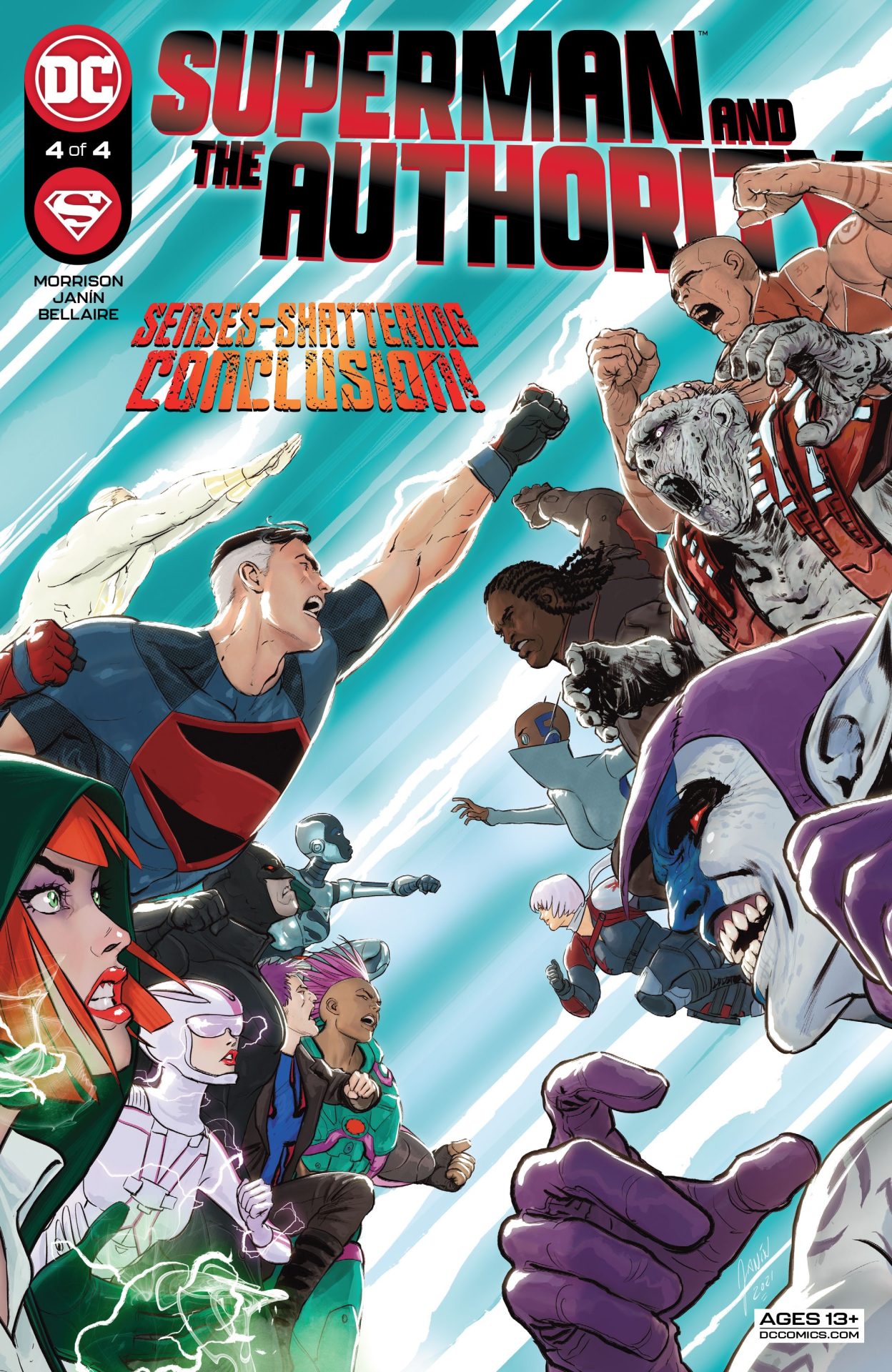
After an all-too brief four issues, Superman and the Authority #4 ends before the titular team can even blast off on their first mission together. However, that kind of seems to be the point as Grant Morrison, Mikel Janin, and Jordie Bellaire drive home that this is a team that has much bigger fish to fry than Ultrahumanite, Brainiac (I eye-rolled when he was revealed as the “Big Bad”. Of course, he was.), and rejects from the original run of The Authority. Also, in a more metafictional way, Morrison is showing that they’re beyond such petty things as superhero fisticuffs and are giving the DC Universe one last gift of a kick-ass superhero team plus one final, beautiful Superman moment and a couple “stingers” that could fuel a whole damn event comic or two.
Superman and the Authority #4 continues the divide and conquer structure of the previous three issues with Grant Morrison and Janin showing Superman fighting the Ultrahumanite by his lonesome, then the Authority doing their Wildstorm political satire with a heavy dose of punching, and finally, a primal, elemental battle between light and dark aka Apollo and Eclipso for the soul of Lightray. Lightray is more potential than a character at this point, but she does bring in a nonbinary, queer OMAC fittingly named Mac into the story that almost steals the whole comic at the end and might even have Manchester Black and Midnighter beat in the snappy one-liner department.
Each portion of the story plays with tropes from different comics eras or eras of Morrison’s career. For example, the opening fight between Superman and the Ultrahumanite mentions the gangsters he fought in the Golden Age and the different kinds of kryptonite from the Silver Age while Morrison’s whip-smart characterization of Lois Lane is straight from All-Star Superman. And after these small stories come to a close, Superman and the Authority #4 wraps up in a clever way that rejects the final slugfest that most “event” type books turn into and instead act as a road map for future characters, and in universe, heroes.
But, just because Superman and the Authority #4 doesn’t conclude with an apocalyptic punch-up, doesn’t mean it doesn’t have plenty of action. Mikel Janin turns in layouts and choreography that updates early aughts widescreen superhero books for the era of TikTok and NFTs. He takes glee in showing Midnighter kick the shit out of a white supremacist baddie named Iron Cross, who is probably pissed that Donald Trump doesn’t have a Twitter account any more, in swooping panels.
On the other hand, Janin uses tighter grids in conjunction with Bellaire’s intense flat colors to show any time Authority members are stressed out or in real danger like when Natasha Irons has to switch armor while fighting alien refugee Siv, who is not so bad in the end. There’s real power behind the punches and kicks with Mikel Janin adding speed lines and energy bursts to his clean figure work. Kirby Krackle meets ligne claire and all is right with the world as he, Morrison, and Jordie Bellaire embrace the fun, bombastic side of superhero comics while also shifting the paradigm just a little bit.
The Authority’s “new way” of doing things that Superman alluded to in previous issues comes to play in the battle between Natasha Irons and Siv. After making the Authority’s first opponent a totally irredeemable Nazi, Grant Morrison shakes things up and makes Siv, an alien who fights to raise awareness for her species that is hated and feared after accidentally crash landing in California. By beating up some superheroes, she can help her people get resources and recognition. Natasha Irons is aware of this fact, but still ends up shorting Siv out in the heat of battle as she switches armor in mid-air.
Janin’s frenetic paneling and MTV style “edits” helps build suspense as he cuts from Irons free-falling to Manchester Black tussling with one of his old Elite buddies Coldcast, a Black superhero that is trying to repair his reputation … by teaming up with a white supremacist aka respectability politics with metahuman powers. However, after all the hullabaloo, there’s one great panel of Irons apologizing to Siv and doing everything in her power to help Siv’s people while Siv contemplates pacifism. This little mini arc shows that like a great rock song, Grant Morrison and Mikel Janin can nail the quiet moments as well as the loud ones like Midnighter aggressively fighting and flirting with a French queer badass named Fleur de Lis, who I hope makes an appearance elsewhere.
Superman and the Authority #4 features the memorable action and one-liners of its predecessors while having a true heart thanks to the sequences with Superman deciding to move on to deal with other threats and letting his amazing, bisexual son Jon Kent defend Earth as Superman in his stead. There’s a real Shakespeare/Prospero in The Tempest relationship between Morrison and Superman as they, Janin, and Bellaire put on one last spectacle, remark on how the old days weren’t so great (I love Black’s dialogue about JFK), and set up some threads for the next generation of DC Comics writers to play with. I personally think this won’t be Grant Morrison’s last DC story, but if it was, Superman and the Authority #4 is suitably entertaining and thought provoking and looks towards the future instead of being blinded by nostalgia, namely, bring on nb OMAC!
Story: Grant Morrison Art: Mikel Janin
Colors: Jordie Bellaire Letters: Tom Napolitano
Story: 9.0 Art: 8.8 Overall: 8.9 Recommendation: Buy
DC Comics provided Graphic Policy with a FREE copy for review
Purchase: comiXology – Kindle – Zeus Comics – TFAW


 5. OMAC (8 issues, last in April 2012): OMAC wasn’t brilliant and it was, of course, little more than a tribute to Jack Kirby that hadn’t really been developed into anything of its own yet, but it had a lot of potential. Keith Giffen gave us art that was as true to Kirby as if Jack had done it himself. Dan DiDio was starting to establish an original character in Kevin Kho (the only Cambodian-American character in comics I know of) and there were a lot of Brother Eye stories to be told. Many crappier titles survived into the Second Wave of the New 52, hopefully we’ll see more from Kho, OMAC and Brother Eye again soon.
 4. Heroes for Hire (12 issues, last in November 2011): Dan Abnett and Andy Lanning showed us with this series that there are no small characters, just small stories and small writers. Misty Knight and Paladin were turned into compelling and entertaining characters in a way they rarely have been in the past. The first issue of this series, with its shout-out to The Warriors, remains one of the best first issues of any series I’ve ever read. Luckily we got to see the story continued in Spider Island and Villains for Hire, but with the team having no current home, I worry that we won’t be seeing them as much.
 3. 28 Days Later (24 issues, last in June 2011): In the days when zombie comics are rightfully dominated by The Walking Dead and wrongfully imitated by dozens of inferior titles, 28 Days Later was one of the few non-Robert Kirkman series that actually added something to the genre. Every issue started with a brilliant cover (most of the recent ones by Sean Phillips), continued with solid interior art by Alejandro Aragon and top-notch storytelling by Michael Alan Nelson. Following in the footsteps of the first movie, the series was always compelling and gave us a look at the aftermath of the British zombie outbreak that broke new ground in a well-worn genre. The comic did the same.
 2. SWORD (5 issues, last in March 2010): SWORD is exactly what I’m looking for when I pick up comics. It was one of the smartest comics on the shelf, fast-paced, funny, filled with references and jokes that you don’t need to know, but if you do they add layers to the story, action-packed, and consistently awesome. It featured a strong female lead who could’ve developed into one of Marvel’s better characters and introduced us to one of the more intriguing characters to come along in years in the Unit. Luckily, we’re still seeing flashes of these characters and SWORD in X-Men comics, but it’s sad, that from what I understand, the comic was never really given a chance. Keiron Gillen gets most of the credit for how great this comic was.
 1. Secret Warriors (28 issues, last in September 2011): Secret Warriors beats out SWORD, to me, because, while SWORD is exactly what I come to comics to find, Secret Warriors consistently surprised me. It was way better than I expected and it brought to my attention things I wouldn’t have otherwise read or thought about. It also had better art than SWORD. Another series with consistently brilliant covers and superior art by the likes of Allesandro Viti and Stefano Caselli (among others), the comic clearly had its own visual style and it was better than most of what was on the market. On top of that, the writing was even better. Originally a Brian Michael Bendis project and later taken over by Jonathan Hickman, the comic delved into the espionage side of the Marvel Universe, particularly the ongoing tale of Nick Fury, better than it has been done in decades. I’m not even that big a fan of Fury and the espionage stuff. Well, I wasn’t until this series. The only thing that still touches on this stuff in a good way are the ongoing Captain America and Secret Avengers titles, but neither of them is as consistently good (and shocking) as Secret Warriors was.
