
Tag Archives: mr. fantastic

Fantastic Flops: Fantastic Four (1994) Season 1 is an Exercise in 90s Cheesiness

In a continuation of the “Fantastic Flops” series, I’m going back and re-evaluating the 1994 and 2006 Fantastic Four cartoon as well as the 1998 Silver Surfer seriesand various crossovers and seeing if they’re a “Flop”, “Bop”, or “In-Between”.

The 1990s are seen as somewhat of a golden age for superhero cartoons with such classics as Batman: The Animated Series and X-Men: The Animated Series as well as Superman: The Animated Series and Spider-Man: The Animated Series. One show that doesn’t seem to get as much love of these is the 1994 syndicated Fantastic Four cartoon that aired with episodes of Iron Man as part of The Marvel Action Hour. In fact, contemporary Fantastic Four comic book writer Tom DeFalco made fun of it in Fantastic Four #396 where replacement team member Scott Lang roasts the show while ribbing The Thing.

Fantastic Four‘s animation is nothing to write home about with the exception of some cool monster designs for Namor and Mole Man’s denizens as well as a very Jack Kirby-accurate Blastaar. Mr. Fantastic’s powers definitely will always look better in this medium. On the writing and story side, showrunner Ron Friedman and his cohorts Elwin Ransom (So cool that they have the same name as the protagonist of C.S. Lewis’ Space Trilogy) and Don Segall’s scripts fluctuate from poignant adaptations of the source material to chaotically humorous (See “The Mole Man”, especially Johnny Storm’s rap because voice actor Brian Austin Green wanted to have a hip hop career.) or intelligence insulting (Both Skrulls episode.) This is a show that jokes about Prince Charles dating Roseanne Barr and features guest spots from Dick Clark and Gary Owens in the two part pilot, but also the solution to defeating various villains comes up in unrelated conversations between Mr. Fantastic and other members of the team. It also loves a running gag and catch phrase, which makes sense for the team that brought you “Flame on” and “It’s clobberin’ time”, but I swear if I have to hear the Thing say “One for the money, two for the show”, I might cancel my Disney Plus subscription. (I do enjoy the Thing’s obsession with Wayne Newton, and how he fights with Johnny Storm when he tries to burn them up.)

The mediocre “Mask of Doom” three-parter is the Fantastic Four show in a nutshell. It begins with the Thing poorly following a TV yoga workout and follows with 2 episodes of he, Mr. Fantastic, and the Human Torch dodging various Dr. Doom death traps while he mansplains his origin story to the Invisible Woman. The third part is an anachronism-filled time travel caper set in 4th century BCE Greece that has big Bill and Ted energy, especially when the Human Torch romances a Greek oracle. The extended theme song, credits, and “previously on” recaps really eat into the runtime of the episode, and important plot points like Victor Von Doom’s relationship with Reed Richards as a college student is quickly glossed over so the team can run around in creepy passageways. Dr. Doom’s origin story should have been the A-plot, and the action hijinks should have been the B-plot, but Friedman and Ransom flip that dynamic. One thing I will say about the Fantastic Four cartoon is that your never more than a few minutes away from the Thing punching something and generally crashing out.
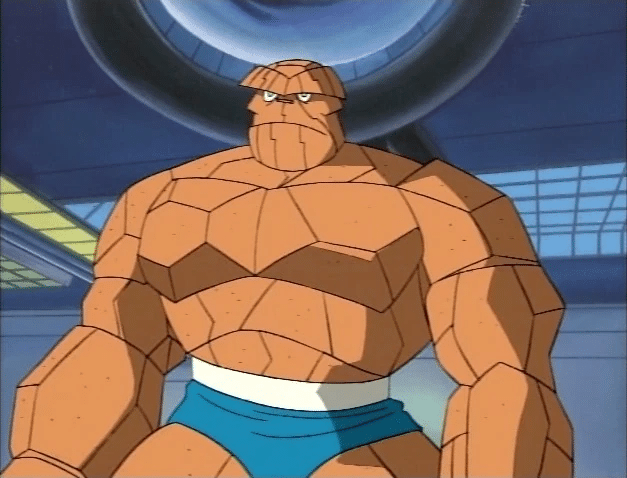
I briefly mentioned the two Skrulls episodes as being the low points of Fantastic Four, and they are along with “Behold the Negative Zone”, which shows that Annihilus and Blastaar are more interesting in their own world than on Earth. Despite having a vast invasion fleet and a warrior with all the powers of the Fantastic Four plus hypnosis, the Skrull never come across as a threat. Friedman, Ransom, and Segall would rather do a cheap imitation of basically Mars Attacks (Which hadn’t come out at the time of the cartoon.) than dig into Marvel’s rich cosmic tapestry. The most memorable moments from this episode are finding out that the Thing didn’t vote for Bill Clinton in the 1992 presidential election, and that he has bars. Seriously, he spends the entire “Super Skrull” episode trying to film a rap rock video for MTV, one of his many attempts throughout the season to capitalize on his fame as a member of the Fantastic Four to make money.

The high point of Fantastic Four other than the utter silliness of “Mole Man”, which also features Reed Richards and Human Torch/his spoiled girlfriend Melinda and Sue Storm and the Thing working as pairs, is the “The Silver Surfer and Coming of Galactus” two-parter. The scene where Alicia Master senses the Surfer’s humanity and kindness and compares it to Ben Grimms is played beautifully by Pauline Lomas and Robin Sachs. Also, Alan Oppenheimer and Shakespearean actor Tony Jay bring a real direness and grandeur to the episode as Uatu the Watcher and the Devourer himself with the Fantastic Four facing their greatest threat yet. And while this is going on, they’re facing eviction from their landlady Ms. Forbes in a take-it-or-leave-it performance from Joan Lee, who did a much better job as Madame Web in Spider-Man: The Animated Series. Dealing with every day struggles while facing the end of existence and finding the good in antagonists is Marvel at its finest, and these plus the YouTube clip of Johnny Storm rapping are the episodes of this series you should watch.

The framing narrative of the two-part pilot of Fantastic Four set at a Dick Clark telethon reminded me a lot of how Fantastic Four: First Steps told the team’s origin. Even though the film was set in the 1960s and the show was set in the 1990s, it hops right to the adventures with the Fantastic Four being a known entity with recurring foes, a relationship with the US government (And a nagging landlady), and as public figures. The 2025 film handles these elements in a much more interesting way, but it’s also a PG-13 blockbuster film and not hamstrung by the need to sell toys to cereal eating children and maybe a stoner or two. I really wanted to give a “Mid” score to Fantastic Four Season One, but am choosing to get a “Flop” instead because there is definitely potential for improvement as evidenced by a season finale that balances pathos (Silver Surfer must doing something heroic without his abilities.) and humor (A few meta jabs at their Action Hour compatriot Iron Man). If anything, the theme song is an ear worm!

Overall Verdict: Flop
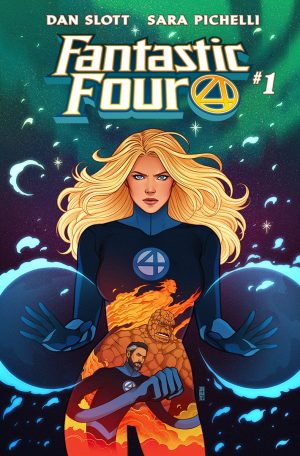
Review: Fantastic Four #1

After a three year absence, the book that kicked off the Marvel Universe is back sort of in Fantastic Four #1. Dan Slott, Sara Pichelli, Elisabetta D’Amico, and Marte Gracia’s first issue doesn’t have Marvel’s First Family fighting Mole Man or the Trapster just yet and creates a slow build to the reunion. However, there is plenty of sweetness, comedy, and a little of bit of familial strife along the way as Slott and Pichelli play in-universe with reader expectations about the team reuniting and the oil and water dynamic of the Human Torch and the ever loving blue eyed Thing. They do have a quite funny flashback to a “forgotten” adventure of the Fantastic Four that asks as a proof of concept that shows that Slott call pull off all the voices of the bickering, yet loving sitcom family with superpowers. In addition to this, Slott, Simone Bianchi, and Marco Russo craft a Dr. Doom backup story that is a little more traditionalist than his recent appearances in Invincible Iron Man and Marvel Two-in-One,  and there’s also a super fun and quite metafictional one page backup drawn by Skottie Young and colored by Jeremy Treece.
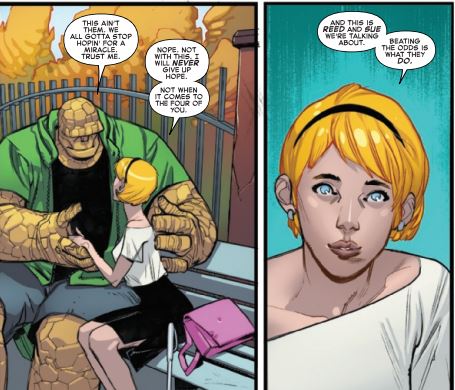
For her work on Fantastic Four #1, Sara Pichelli brings a looser, almost more playful art style that still shows emotions and body language in a fluid way with the help of inker Elisabetta D’Amico and colorist Marte Gracia. Even though he’s made of rocks, Pichelli’s take on The Thing is lively and utterly human. Beneath his ungainly movements, he’s a loving man, and the scene where he proposes to his long time girlfriend Alicia Masters is sentimental without being sappy. Dan Slott writes The Thing as maybe giving up on seeing Reed, Sue, Valeria, and Franklin ever again, but he still has a family in Alicia and Johnny. However, The Thing and the Human Torch aren’t always loving BFFs, and Gracia shows the subtle difference in the Torch’s flame when he’s going off in action and when he flies off the handle after Ben asks him to be his best man. This scene shows that there’s still tension in Ben and Johnny’s relationship in an organic, not drama for the sake of drama way and even builds off the way that Chip Zdarsky has written them in Marvel Two-in-One where Ben knows that Sue and Reed are lost forever while giving Johnny a false sense of hope that they’re somewhere in the multiverse.

Johnny still believes the Fantastic Four will reunite and immediately flames on to where their sign shoots off in the sky with a flare gun like in the original Fantastic Four #1. Of course, it’s just a prank, but it’s foreshadowing to a grander, earned moment all overlaid in a beautiful blue by Marte Gracia like hope in the midst of despair. And hope and family are major themes throughout Dan Slott and Sara Pichelli’s story in Fantastic Four #1. Even if Ben and Johnny don’t interact with Ben and Sue, they share plenty of moments with the “extended” Fantastic Four family, including Wyatt Wingfoot, Jennifer Walters, and the aforementioned Alicia Masters. Johnny and Wyatt take in a Mets game, and Slott engages in what is either queer subtext or queer baiting using the stadium kiss cam while Jen pops up later to flirt with Wyatt and also legally represent the Yancy Street kids who set off the false Fantastic Four flare. Slott modernizes the relationship between the Thing and what was formerly known as the Yancy Street gang making him kind of a community leader instead of the participant in an endless Itchy and Scratchy situation.

Other than the poetic ending, the best moment of Fantastic Four #1 is the flashback sequence where the Fantastic Four and supporting cast find their way back to New York City through the power of Johnny singing the Wayne Newton standard, “Danke Schoen”. It’s funny, cheesy, heartwarming, and adventurous all at once like the best Fantastic Four stories. This is thanks to some little details emphasized by Pichelli like the way Reed cranes his neck when explain the quantum science or whatever of this karaoke journey home situation and then immediately retracts when he doesn’t want to out and out say that Sue isn’t the greatest singer. There’s also time for some transcendent beauty in the midst of screwball comedy: a Marte Gracia colored cosmic flame in the deep blue night sky that even Alicia, who is blind, can see. This little adventure shows the Fantastic Four are about science as well as deep human wonder through the vessel of a family ensemble.

Slott, Simone Bianchi, and Marco Russo’s Dr. Doom backup story creates a different kind of wonder, and the baroque severeness of Bianchi’s art easily contrasts with the cosmic smoothness, yet expressive cartooning of Sara Pichelli and Elisabetta D’Amico. It’s a back to basics Doom story as one of his former subjects pays a visit to the half-abandoned Doomstadt (There’s lots of Doombots per usual.) and asks him to liberate Latveria from one of the many stop gap authoritarian regimes that have been in place since he left them to play hero/Iron Man. And the way Slott writes Doom and Bianchi draws him is the complete opposite of the “Infamous Iron Man” as his face is no longer pretty, and he’s ready to rule with an iron grip and an iron mask. Like the main story of Fantastic Four #1, the Doom backup is about hope and symbols, but it’s a dark and twisted mirror to Marvel’s First Family.

Fantastic Four #1 is nothing short of a triumphant return for Marvel’s first superhero team. Dan Slott hits a nice balance between tearing heart strings, broad humor, and the wonders of the universe in his script while also crafting an aura of mystery and terror in the Dr. Doom backup story with Simone Bianchi and Marco Russo. In the visual department, Sara Pichelli shows why she is one of Marvel’s best and versatile artists hitting all the smaller, yet very important character beats as well as the big spreads and “Flame on!” moments.

Whether you’ve been reading the title since 1961 or this is your first FF adventure, Fantastic Four #1 is definitely worth your $5.99.

Story: Dan Slott Pencils: Sara Pichelli Inks: Sara Pichelli with Elisabetta D’Amico
Colors: Marte Gracia Backup Art: Simone Bianchi, Skottie Young
Backup Colors: Simone Bianchi and Marco Russo, Jeremy Treece Letters: Joe Caramagna
Story: 9.0 Art: 9.5 Overall: 9.3 Recommendation: Buy

Marvel Comics provided Graphic Policy with a FREE copy for review

Push Comics Forward – The Female Super-Scientist

j4p4n_Scientist_Woman_(comic_book_style)Recently the head honchos at BOOM! Studios put out the idea that comics needs to change and to not be stagnant as a medium.  Long since dominated by superhero stories, the medium has indeed made a number of changed in the past couple of decades and the change is noticeable in some regards.  Equally though, comics are somewhat of a niche when it comes to their perception in popular culture.  Although there is an increasing amount of female readers, the medium is slower to make the changes to draw in fans of all backgrounds, and especially at the big two publishers instead still focuses on mostly a collection of characters who are both white and male.  While the interest in push comics forward doesn’t necessarily lie solely with the big two publishers, change has to happen there as elsewhere in order for the medium to evolve.

Science in comics was a bit of an x-factor until the onset of the silver age.  Until that point, science was usually grossly misapplied in order to move along a plot.  Gross inaccuracies were made and aspects of scientific knowledge would be presented, leaving what was actually used of the science to be misappropriated and simplistic.  As the silver age started, the focus on science is what rescued comics from being a medium for children, and instead allowed the medium to mature.  The changes first came at DC, though with the generally more god-like powers of the characters, the science was not as pertinent.  Hawkman and Green Lantern became intergalactic police, the Atom used White Dwarf matter to give himself powers, and the Flash became a scientist that gained powers by a scientific accident.  While the science was there, it was not until Marvel arrived that it redefined science in comics.  Although still unreal, the science was still presented in a way that it could be real, at least in our imagination.  Instead of characters that were either given or born with their powers, the new wave of heroes earned it the hard way, by building it themselves.  Not every Marvel hero was a scientist, but there were a few – Peter Parker, Bruce Banner, Tony Stark, Hank Pym, and Reed Richards.  While this did push the envelope forward for comics as a medium, what was left behind were the women.  The female leads to these heroes were still sometimes heroes, but they fell back into the template of having powers given to them.  Sue Storm was a college dropout, and Janet van Dyne was just an girlfriend.  They even did better than Betty Ross, Pepper Potts and Mary Jane Watson, who were often relegated to secondary status as damsels in distress (though Sue Storm also performed this role despite being a power superhero.)

lego women scientistsWhile there are perhaps more men than women in science still as a profession, there is no real clear reason why.  Women at younger ages are as adept as their male counterparts, and the interest for science is equally there.  Some consider it to be a genderized problem, that the “old boys club” of science discourages women from entering its field in some cases, and that women are taught gender roles by society to be less focused on science as opposed to other ventures.  While there is debate on these assertions, it is true that women have no more or less natural inclination to science than men do.  So why can’t there be a female version of a super scientist?  There are of course some very intelligent women in comics.  The female version of the Hulk is an accomplished lawyer, and others have shown an ability to pursue more academic fields than what is traditionally typified by their genders, but there is still a gap in terms of the heroes, and who can do what.  Female characters can still be powerful, but it is unlikely that their minds are capable of giving them those powers.  In fact a large portion of female characters derive their powers from either magic or the supernatural.

What has been an interesting and worthwhile development in the cinematic versions of comics, is that the women characters are presented in a way which is a lot more progressive.  Jane Foster is an astrophysicist and in the previous round of Fantastic Four movies, Sue Storm was shown to a be a scientific genius in her own right.  This is because as the characters move to a more popular medium, they are forced into a more acceptable presentation of the role that women play, more so than just damsels in distress, but also as able thinkers on their own.  So why is there no female superscientific genius yet in comics?  This comes back to the inherent idea behind #pushcomicsforward, that there can and should be such female characters, because the medium simply has not caught up yet to the reality of the world.  There is even maybe not a need for as many as Marvel has, but a character that is at least adept at science, and who knows the periodic table from the kitchen table.  There is no reason not to, as such a character wouldn’t even have to carry a series, but they could still be there, guiding the scientific discussion to a place that is more realistic.

The Best Just Got Better! Best of Marvel Minimates Series 2 Coming Soon!

Collecting Marvel Minimates can be daunting — after all, they’re celebrating their tenth year in 2013, and releasing their 50th consecutive series of mini-figures. So where does a new collector start? Which are the “best” Marvel Minimates? Diamond Select Toys answered that last year with the first Best of Marvel Minimates assortment, which featured the best-ever versions of some of Marvel’s top heroes and villains. Now DST is bringing you more of the Best in Series 2!

This time, eight more of Marvel’s most famous heroes and villains get the ultimate Minimate treatment: Mr. Fantastic and Doctor Doom, Daredevil and Venom, the Punisher and Deadpool, and the Hulk and Loki! They’re the best versions of Marvel’s best characters, and each 2-inch mini-figure comes with additional parts and accessories — the Hulk can actually transform into Bruce Banner! This series will only be available at comic shops and specialty stores starting in Spring 2013, but Series 1 is available now, with Wolverine and Sabretooth, Captain America and Thor, Iron Man and the Thing, and Spider-Man and the Green Goblin.

Pick up Series 1 today, and pre-order Series 2 though your local comic shop or favorite online retailer!

BestOf2 BestOf_DareDevilVenom BestOf_HulkLoki BestOf_MrFantasticDrDoom BestOf_PunisherDeadPool BestOfPkgBack