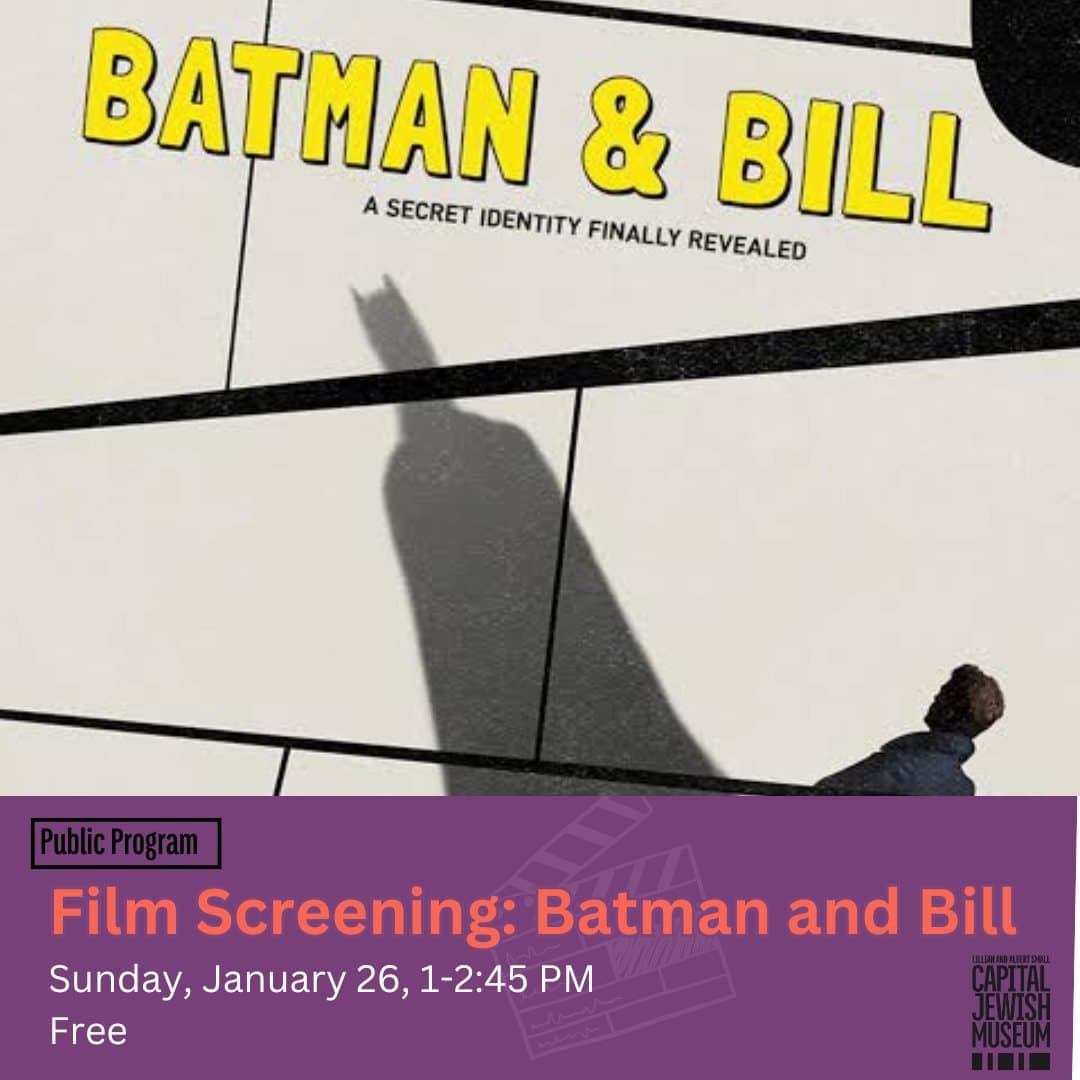
 Last year, DC finally acknowledged Bill Finger as the co-creator of Batman. If you’ve paid attention to any comics featuring the Dark Knight lately, you’ll have noticed a slight change in the byline. Instead of just one name, it now reads “Batman created by Bob Kane with Bill Finger.” A driving force behind Finger finally being officially acknowledged after so many years was Marc Tyler Nobleman, who wrote Bill The Boy Wonder: The Secret Co-Creator Of Batman, and in the process of researching that book he also uncovered some previously unknown pictures, and descendants, of Bill Finger (and you can read more about that here).
Marc‘s book, and school tours, have introduced an entirely new generation of people to the name of Batman‘s co-creator, and his work is essential reading for those looking to find out more about Milton “Bill” Finger.
I was fortunate enough to be able to talk with Marc Tyler Nobleman about his book, his work to get Bill Finger the official credit he has deserved for more than 75 years.
Graphic Policy: Firstly, I want to say what an honour this is for me, personally. Your efforts to bring Bill Finger the justifiable credit for co-creating Batman have been both fantastic and inspiring. Did you ever think that you would get to see that credit printed in a Batman comic, or on the silver screen?
Marc Tyler Nobleman: Thank you for your kind words, Alex. I campaigned so hard for so long to get Bill’s name on Batman stories because I believe Back to the Future: if you put your mind to it, you can accomplish anything. I default to optimist. However, I’m also a realist so I prepared myself for the possibility that it might not happen. That said, I devoted most of my thought energy to the positive.
GP: During your quest (can I call it a quest?) to have Bill officially recognised you unearthed some previously unknown photographs of Bill. Did you ever expect to find anything like that?
MTN: I did feel confident I could find at least one or two photos, but I don’t think I stopped to consider that I might find as many as I did (at least 13). Early on I realized that the only way I’d have a chance of succeeding is by locating people who were close to Bill but who did not work in comics. If they were in the industry, their photos would most likely already be public.
GP: In your book, Bill The Boy Wonder: The Secret Co-Creator Of Batman you imply that some of the responsibility for Bill’s lack of credit at his own feet. Do you think that if he’d stood up for himself earlier than he did he may have been credited before now?
MTN: I’m not programmed for hypotheticals.
GP: Do you feel that you’ve achieved what you set out to achieve for Bill with the “Batman created by Bob Kane with Bill Finger” credit, or is there still more to do?
MTN: Yes and yes: obtaining official credit was the driving force for me but the cultural obligation to tell Bill’s story is a lifelong job. Also, the man needs a permanent memorial, all the more so because he has no gravestone, and I’ve been working on that since before the book came out. It’s not familiar territory for me but I’m finding my way. Stay tuned!
GP: You visit a lot of schools giving talks about the research involved in two of your books; the already mentioned Bill The Boy Wonder: The Secret Co-Creator Of Batman as well as your biography on Joe Shuster and Jerry Siegel, Boys of Steel: The Creators of Superman. How receptive are the kids to the history of the creators?
MTN: Profoundly so, I’m happy to report. I’ve been to schools where kids have made a board game about Siegel and Shuster and where kids have written letters to Bob Kane as Bill’s son Fred. Hearing Bill’s story, kids reveal the best of humankind—their desire to go out and do good in the world becomes palpable (and hugely inspiring). Kids have asked me questions that have almost brought me to tears.
GP: I think one of the strongest aspects of Bill The Boy Wonder… is its accessibility. I’m guessing that was done to increase awareness of Bill Finger with a younger audience?
MTN: Thank you. Yes, I wrote the book for all ages but with special emphasis on a younger audience. Unlike me, they can learn the truth about this icon before they grow up. We should always pay attention to whoever has created something we love. It’s hard to direct thanks into an abyss.
GP: Any plans to release an updated version of Bill The Boy Wonder now that his name is included in the byline?
MTN: The final words of my book: “Will his name ever be added to every Batman story? Batmanians are keeping their Fingers crossed.” Part of me wants to leave the book that way—it’s an instant time capsule. And it will encourage some readers to do further reading. Another part of me, of course, wants to revise it. Too soon to say which part of me will get his way.
GP: Brett (Graphic Policy’s blogger-in-chief) wanted me to ask: I’ve always wondered if folks knew what they were a part of when they were creating all of these characters and if there was some idea they’d last so long and be so loved?
MTN: I found no documentation of what the Bill and Bob of 1939 (the year of Batman’s debut) thought about posterity, but I think it’s safe to assume neither could have foreseen this character being around in a decade, let alone seven. Comic books were barely considered an art form then.
GP: I think it’s important to recognize the contributions that the early creators had to the comic book and pop culture landscape. How important do you think it is for publishers to acknowledge the men who built their characters? Do you think that we, the fans, have just as much responsibility in asking for that recognition – whether it be in bylines, or an official recognition?
MTN: I think it’s obvious that I feel it is vitally important to credit anyone for anything s/he contributes to society! And yes, now more than ever, fans have the power to share their opinion easily and on the world stage. Take it from me: stating your case sensibly and steadily can make a difference.
GP: After reading through your extensive research notes on your blog, do you have any plans to release another book detailing either the search for Bill, or all of the information you were able t unearth, or will that stay largely on your blog?
MTN: Given how many people have asked if I will write a longer book on Bill, I should…but too early to say. For now, the material on my blog isn’t going anywhere.
GP: And finally, pirates, ninjas, cowboys or ninjas, and why?
MTN: Of pirates, ninjas, or cowboys, I chose knights, of course. In particular Dark ones.

 Welcome to Gotham Weekly’s first unscheduled recording!
 Until recently, that is, with last years reveal that the byline would finally change. More on that later, though.


 Bill The Boy Wonder: The Secret Co-Creator of Batman was released on July 1st, 2012. It was sometime between then and the middle of 2013 that I learned about the book after I read about it in a comics magazine that I initially thought to be the British Comic Heroes, but after searching through the issues I have, I was unable to locate the article. So regardless of when and where I first became aware of the book, once it was on my radar, I quickly tracked it down on Amazon.
 A few weeks ago I attended a slideshow tour of New York City’s Superhero Sites with
