Tag Archives: justin aclin

10 Questions With Justin Aclin, Writer of S.H.O.O.T. First

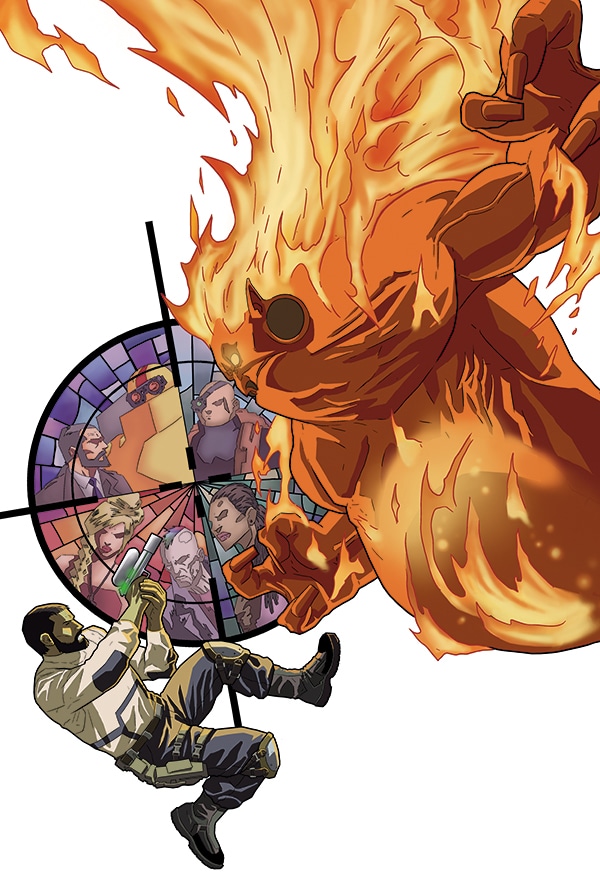
shoot first 2 coverS.H.O.O.T First is the story of a task force that battles myths and monsters with the power of atheism. Yes, you read that right, it’s an interesting twist on the crack team of individuals taking on religious beings and monsters. Instead of a religious team we have a bunch of atheists, writer Justin Aclin gives us a different take on a story we’ve seen before. And with that, a world with its own set of rules and a set of characters that are proud of their lack of faith.

We got an opportunity to ask Aclin about this new series and a bit about this new take on religion in comics. The comic has “Secular Humanist” on the cover! Justin Aclin is up next for our “10 Questions.”

Graphic Policy: How did you get involved in the comic book industry?

Justin Aclin: I started out as an editor for ToyFare Magazine, Wizard’s toy-focused sister publication. Over many years there I worked my way up to be lead editor and lead writer of Twisted ToyFare Theatre, the satirical comic strip whose creators would later go on to launch Robot Chicken. Around the same time I started writing an original superhero graphic novel called Hero House, about a college fraternity for superheroes. That was illustrated by the incredibly talented Mike Dimayuga, who just passed away a couple of months ago, far too soon. Hero House was published by Arcana Comics in 2009, and I continued writing Twisted ToyFare until the magazine ceased publication in early 2011. Every opportunity I’ve had in comics since, from writing Star Wars graphic novellas to the adaptation of the Spicy Horse game Akaneiro, has come about because I’ve been working on getting S.H.O.O.T. First up and running with Dark Horse.

GP: Where did the idea of S.H.O.O.T. First come from?

JA: Basically, I was looking for an idea I could pitch to Dark Horse for the anthology they had at the time, called MySpace Dark Horse Presents. My favorite genre that Dark Horse did was the “team of heroes battling the supernatural” genre, which obviously included titles like B.P.R.D., but also titles that put more of a twist on it, like Beasts of Burden. So in trying to figure out what kind of twist I could put on the genre, I came up with a team that didn’t believe in the creatures that they were fighting, and therefore refused to fight the creatures on their own terms. The example I always give is if you see a team go after a vampire, they always bring crosses and holy water – you never see a team that says “This is all baloney” and goes after the vampire with their own, science-based weaponry. And then that idea happened to dovetail with something that I was going through at that time, which was beginning to question my own religious faith in a more extreme way than I’d done before. So going through that, I think, helped me craft an idea which was more personally meaningful than I’d set out to write – and writing the comic helped me work through those issues at the same time. So the prototype short story appeared in MySpace Dark Horse Presents in 2010, and I’ve basically been working with Dark Horse and my co-creator Nicolas Daniel Selma on turning it into a mini-series ever since.

GP: How did the series come to Dark Horse?

JA: Dark Horse was the only place I wanted to take S.H.O.O.T. First, because it was written for Dark Horse!

GP: The series takes on religion from a very different angle, the non-believers Why’d you go that route as opposed to the typical religious warriors?

JA: Partially, as I mentioned above, it was to express something that I was dealing with. And partially because, as you said, religious warriors is the more typical route. There are a handful of avowed atheists in action/adventure comics, but it’s far more common to see characters entering Hell or battling demons, and nobody bats an eyelash. People always cite Michael Holt, Mr. Terrific, as an atheist superhero, but he’s part of a universe where an angel was on the Justice League and the Phantom Stranger is, at least in the current incarnation, Judas Iscariot. There’s not a lot of room for skepticism there. S.H.O.O.T. First is the first action/adventure comic to my knowledge where not only are all of the main characters atheist, but the actual backstory of the world says, firmly, “religion is incorrect.” And I can understand why that’s not a position the big superhero universes would take, of course. But if a world where superheroes get their powers directly from Judeo-Christian God is the norm, I think there’s room for a universe like this one, that hopefully atheists can relate to more than those.

GP: You’ve also included the character Infidel, a Muslim struggling with his belief. Inclusion of that religion or characters that practice that religion is often touchy with a visceral, negative reaction from a vocal minority. Did you have second thoughts about that at all?

JA: I can honestly say that I didn’t give a crap what the anti-Muslim voices would think about it. I was more concerned with offending actual Muslims. Ultimately, I’m hoping the portrayal of Infidel won’t offend anyone because he’s not an in-universe stand-in for all of Islam. He is, just like all of the characters, someone who’s having their own personal struggled with faith. He doesn’t even self-identify as a Muslim anymore, even though obviously that’s his background. When I first started outlining the characters, Infidel’s “new guy” role was filled by an American Priest who’d been a chaplain in the military and lost his faith as a result of that, but that’s a story we’ve seen a lot more often. I thought it would be more interesting to include a Muslim who had lost his faith, because that’s not a story I’ve seen told as much. I think when you spend time on the Internet, there’s a tendency to think of “atheist” as synonymous with “white dude on Reddit,” and I think that the range of atheist experience is much wider than that. So it was important for me to make the cast diverse.

And I do think it’s important, by the way, to have those heroic depictions of religious Muslims in comics. If your worldview is challenged by a fictional character being depicted as heroic, then your worldview sucks. Fiction can and should depict a wide range of experiences.

GP: Have you heard from religious or even non-religious individuals about the series? What’s been their reaction?

JA: I’ve read a couple of reviews from religious people who couldn’t get past the fact that religion is depicted as incorrect in the story, and I can certainly understand that. I do think that there’s something in the story for everyone no matter what you believe, but I can understand having that reaction. From non-religious people, I’ve seen a lot of excitement about a comic that’s not only about atheists and has an atheist viewpoint, but has the words “Secular Humanist” on the cover. I’ve also seen a lot of skepticism. When people first hear the premise, a lot of atheists say, “Well, how can they not believe in a creature if it’s staring them in the face? That’s not being skeptical, that’s being stupid.” But I hope that if people check out the story, they’ll understand where we’re coming from.

GP: What type of research did you put in when it came to religion?

JA: I had to research religions that weren’t my own, of course. Kenshin, who’s one of the team members, practices Shinto, and in looking into that I learned about Kami, which is a blanket term for spirits and supernatural beings in Shinto. And the way that Kami are described, and the fact that for Shinto practitioners things like angels and cryptids would be considered Kami, is very similar to how Outside Actors work in S.H.O.O.T. First. Although of course Outside Actors aren’t spirits – they’re scientifically explicable. I’ve done a lot of interesting research into different supernatural creatures from different religions, and different end-times prohpecies. You won’t see all of that depicted in the mini-series, but it all helped me find the story.

GP: There are obviously rules with how the weapons work and the beings of this world. How worked out is all of those rules?

JA: The answer is “very.” I had to make sure I understood how everything worked, because even if not every single rule is laid out in the mini-series, I had to make sure that everything is consistent and makes sense. Luckily, when you’re creating a world you’ve got a bit more leeway into making the rules work for you than when you’re working in an established universe. For instance, I need the guns that S.H.O.O.T. uses against Outside Actors to be effective, but not too effective, otherwise the battles will be very short and uninteresting. But if you’ve got a question about how the weaponry works or how the Outside Actors function, chances are I’ve thought about it and have an answer for you.

GP: What types of hurdles have you met creating comics, and any lessons learned you can share? What advice do you have for someone breaking into the entertainment industry?

JA: I think the most important piece of advice I can give, other than “sit down and write something,” is to understand that you’re not going to hit it out of the park your first time at bat. It’s extremely important to find people you trust, have them look at your work, and be open to their feedback. Your first draft is not a sacred document that must be protected against interlopers. Productive feedback is more valuable than gold, because your goal should always be to make your work as good as it can possibly be. I believed in the story of S.H.O.O.T. First, so if someone told me that the concept sucked, I wouldn’t have taken that advice. But my first draft sucked, and I was willing to see that even though I’d thought it was pretty good when I turned it in. And I was fortunate enough to be working with an editor who could help me see some of the major problems and then let me fix them. So if you want to get into entertainment, you have to work at it, and you have to accept that what you do is probably going to suck at first, and you have to be committed to listening to how and why it sucks and to fixing it.

GP: What can we expect from you next?

JA: We’ve got two more issues of S.H.O.O.T. First to go, and stuff gets really, really crazy in those two issues. After that, I’ve got another project for Dark Horse that isn’t quite ready to be announced yet. Stay tuned!
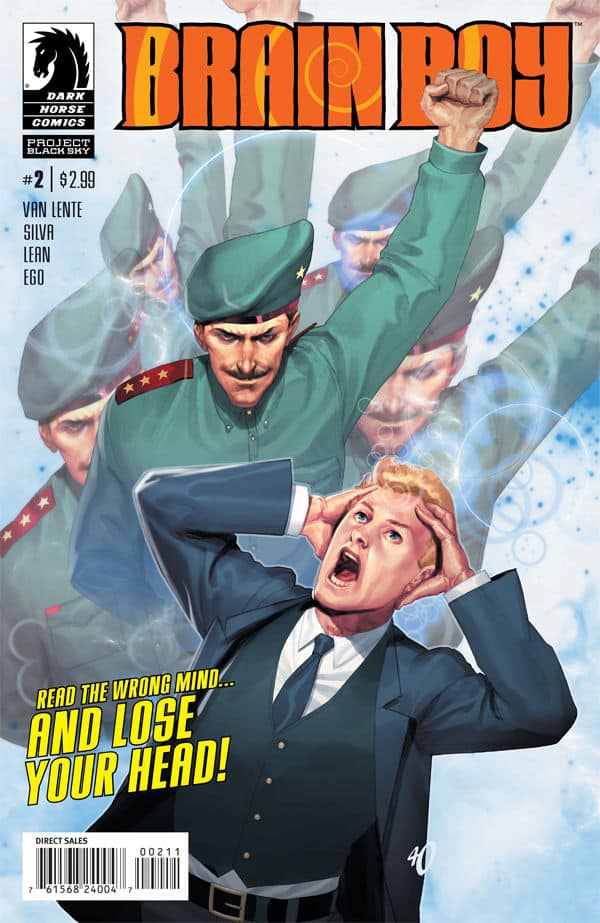
Review: Brain Boy #2, Buzzkill #2, S.H.O.O.T. First #1

Brain Boy #2

brain boy 2Ambushed while protecting an important foreign dignitary, Matt Price, a.k.a. Brain Boy, finds himself wrapped up in political intrigue when an assassination plot that could derail a key United Nations conference sets Brain Boy on a collision course with a man whose mental powers rival his own! Get ready for a psychic smackdown over the streets of New York City!

There’s something that’s a hell of a lot of fun about this series which mixes super powers with a bit of espionage. The world that writer Fred Van Lente has set up is ripe for expansion and growth and hopefully we’re just getting the beginnings of it all.

Overall, there’s a super hero James Bond feel to the first two issues, one that could be even more fun as the series progresses. We still don’t know the full extent of Brain Boy’s abilities, which is some times a positive, and some times a negative, but overall, the twists and turns with that have been entertaining.

The art by R. B. Silva is impressive capturing the excitement of the series. His use of panels is cool often breaking them for action packed pages. He seems to capture the vibe of the series quite well.

Overall, the series hasn’t blown me away, but it is quite fun and entertaining, worth checking out as an alternative to the rest of the capes and tights.

Story: Fred Van Lente Art: R. B. Silva
Story: 7.5 Art: 8 Overall: 7.75 Recommendation: Buy

Buzzkill #2

buzzkill 2Ruben’s attempt at a twelve-step recovery stalls before it begins, as an army of supervillains, led by his old nemesis Brutal Juice, assembles against him. But the alcohol-fueled superhero won’t give up yet . . . and before this blood-soaked issue is through, one of them will recognize a HIGHER POWER.

We’ve seen flawed super heroes before, but one whose powers directly comes from those flaws is an interesting twist and nice spin to the over used character type. Buzzkill is about addiction, but more than just addiction to substances, it’s also an addiction to power.

The series written by Donny Cates and Mark Reznicek feels like a fresh take after two issues. The fact that Ruben’s powers change depending on the drug taken, and the detail as to what counts as drugs, shows the series and rules within, have been thought out pretty well. It’s a small detail that’s appreciated.

Also, two issues in and we have a hell of a lot of action mixed with some solid back story. We see the things that lead up to Ruben wanting to clean up his act, something that adds a lot to the character and our perception of him and his decision. While many series would dedicate entire issues to that, this is done in flashbacks that are mixed in with the brutal action in the present.

That brutal action is perfectly put on page by Geoff Shaw who fits the series quite well. He’s got an awesome style for the series, both calm and action scenes.

Overall, Buzzkill to me came out of nowhere. I didn’t know what to expect going into the series and have come out of it loving both issues so far.

Story: Donny Cates, Mark Reznicek Art: Geoff Shaw
Story: 8.5 Art: 8.5 Overall: 8.5 Recommendation: Buy

S.H.O.O.T. First #1

shoot first 1The Secular Humanist Occult Obliteration Taskforce—defending humanity from angels, demons, and a bunch of other crap S.H.O.O.T. doesn’t believe in.

Justin Aclin as writer and Nicolás Daniel Selma on art take aim at the supernatural in an all-new big-action, big-ideas sci-fi adventure!

And those big-ideas I like a lot. Usually when you have a series of humans taking on some supernatural beings, it involves the Church or some secret sect. To do that same story with secular humanists is a nice twist. And working that into how their weapons work is even better. But, concept isn’t execution.

The first issue, is just ok overall. There’s some things I liked, and a lot I didn’t. The issue starts off with action and not much explanation which causes later scenes to involve lots of explanation that felt like it was there just for the reader’s benefits. I would have much preferred a story where I as the reader learn at a slower pace and items are doled out over time and through action instead of folks standing around talking.

The characters are just interesting each fitting an archetype that’s a bit predictable and none of it is new so far.

Overall, the first issue has some interesting promise, and maybe it’ll improve as the series progresses, but so far this one is much better in concept than execution.

Storyr: Justin Aclin Art: Nicolas Daniel Selma
Story: 6.5 Art: 7 Overall: 6.5 Recommendation: Pass

Dark Horse provided Graphic Policy with FREE copies for review

Review: Akaneiro #3, Amala’s Blade #4

If you’re a Dark Horse fan, it’s a pretty sad week, witnessing the end of three incredible mini-series that are testament to a great publisher supporting some of the best comics art in the business. Throw some Eisners and Harveys at these creative teams!

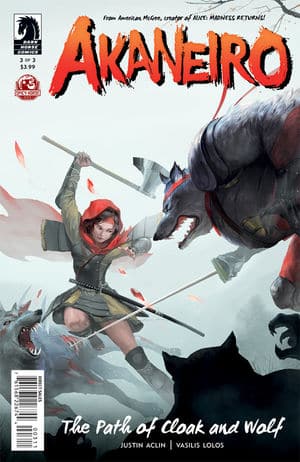
 Akaneiro #3

22676Justin Aclin’s American McGee video game adaptation finds its awesome end this week with Akaneiro #3. After journeying to a Yokai (demon) infested village, protagonist Kani takes to her own and becomes a red hunter—clearly a special ‘chosen’ one, since she uses the powers without training. This final issue includes a dramatic end, with battle after battle, and the ultimate resolution of Kani and her many personal identities.

Aclin, as I’ve noted before, is rather new to comics, having mostly written Star Wars comics, but he has yet to disappoint (with the exception of the rather novice line used on the last page: “And suddenly it’s months later, and my destiny has been fulfilled.” This line, however, speaks to the quickness with which the series presents itself and ends—abruptly. Not many writers could adapt such a complex world to just three issues, but Aclin has succeeded; it’s the narrative itself, with its complexity, that yearns for at least one more issue (an intermediate one, really). But I’m entirely satisfied with the little bit we got.

Lolos and Atiyeh make one of the best artistic teams I’ve seen all year. Lolos’ art is so unique as to be hardly comparable to other artists with books by major companies, and Atiyeh’s talented coloring puts life in his art, mastering the vibrant end of the color spectrum. Lolos has strayed away from sexualizing what, in the comics industry, would be a perfect target: a young, sword-fighting Japanese girl, with the exception of the third panel on the third page, which is your typical knock-the-character-down-and-show-her-butt shot. Aside from this, Lolos’ work begs no complaints.

In summary: Dear Dark Horse, please make more Akaneiro, and congratulate Aclin, Lolos, and Atiyeh on an incredible series.

Story: Justin Aclin  Art: Vasilis Lolos, Michael Atiyeh
Story: 8  Art: 9  Overall: 8  Recommendation: Buy

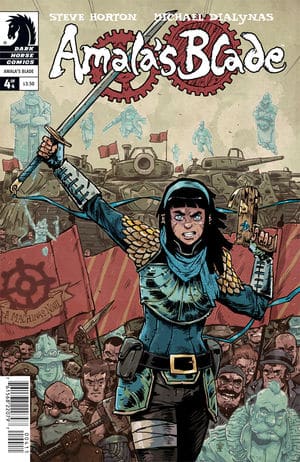
Amala’s Blade #4

22082If there could be a better mini-series than Akaneiro, it would have to be Amala’s Blade, a gritty, steampunk, sci-fi, fantasy, swashbuckling, haunted assassin’s story that makes a hero out of the most powerful and least sexualized WoC to grace mainstream comics in a long time (sure, a number of powerful WoC, but how many have been without sexualization?). This small story, four issues total, packs a mega-sized punch, and has blown me away both narratively and artistically.

As with Akaneiro #3, it appears that Amala’s Blade #4 is suffering from too-short-a-series syndrome. Steve Horton has managed in the previous three issues (and zero-issue) to pack quite a punch with each one, telling a succinct story that introduces all of the characters and ideas and builds a fascinating world. But this final issue wavers on the edge of the plotting quality of previous issues, with somewhat awkward turns of events in the space of a page, which create the false illusion that Horton is not a skilled writer. Amala starts a war, just as quickly ends it, wants to kill her mother, just as quickly doesn’t, then ghosts force her to do so, and then she banishes the ghosts. All of this narrative splendor is packed into the second half of the comic—that’s a bit much for some twelve pages.

Yet while Amala’s Blade #4 was a departure from the near-perfect narrative development of previous issues, Michael Dialynas’s pages are bursting with art that demands to be made into a paragon of fantasy/sci-fi comics art. I haven’t seen anything else by Dialynas, but I imagine it’s all of the same caliber, and I wouldn’t mind seeing his work on some of the more ‘mainstream’ books in order to give the general comic-reading public an idea of how diverse their books can become.

Amala’s Blade #4, like Akaneiro #3, suffers slightly from crunched plotting. But does that means it’s bad? Hell no! Go buy a copy for yourself, open in up, and be blown away by the best mini-series I’ve read this year! I’ve gotta get my hands on this TPB!

Story: Steve Horton  Art: Michael Dialynas
Story: 7  Art: 9  Overall: 8.5  Recommendation: Buy

Dark Horse provided Graphic Policy with FREE copies for review

Aclin & Selma Deliver Atheists and Action in S.H.O.O.T. First!

Justin Aclin and Nicolas Daniel Selma take aim at the supernatural in S.H.O.O.T. First, an all-new big-action, big-ideas creator-owned mini-series from Dark Horse Comics!

The Secular Humanist Occult Obliteration Taskforce uses the power of their own disbelief (as filtered through sci-fi weaponry) to protect humanity from supernatural creatures that seek to do us harm…but for S.H.O.O.T., that means demons, angels and everything in between. Original, irreverent and sure-to-be controversial – S.H.O.O.T. First promises sci-fi action in the Dark Horse tradition, with a bold new twist!

S.H.O.O.T. First #1 (of 4) is in comic shops everywhere October 16th!

SHOOT #1 FC FNL

Review: Akaneiro #2

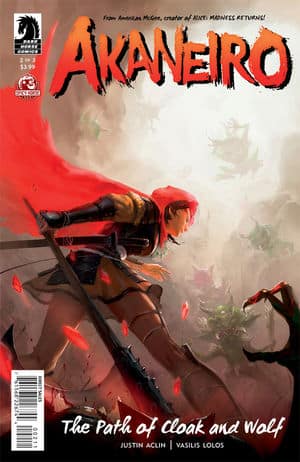
Akaneiro 2Akaneiro #2 does more than live up to the official Dark Horse descriptor “brilliant,” placing the Japonic demon-hunting game world of American McGee into the young-to-comics hands of Justin Aclin, with art by Vasilis Lolos and colors by my personal favorite, Michael Atiyeh.

The story is that of a young Ainu-Japanese girl in ‘feudal’ Japan, whose destiny it seems is to become a demon hunter. This book has been described as, and was pre-marketed as, a Japanese version of the classic Little Red Riding Hood story. This becomes even more evident in Akaneiro #2, which follows Kani into a den of werewolves, tricked into going there by a fox demon, who told her it was the village where she would learn to become a Red Hunter (yokai, or demon fighter) of the Order of Akane.

The plot hangs on the premise that the natural/supernatural, human/non-human, and good/bad must be placed in balance, and that it is the role of the Red Hunters to achieve this. The concept is not unprecedented, and is in fact age-old, something witnessed in almost every reconceptualizing of traditional Japanese culture for American audiences—every animal is a god, and demons aren’t necessarily bad. As Kani goes through her unforeseen trials among the werewolves, she starts to discover this for herself; surely the mark of a chosen one who will bring balance to the For-, I mean, nature.

Justin Aclin may be a comics newbie, but it’s obvious he’s talented, having adeptly adapted American McGee’s video game to the comics medium. However, the turning of dead demon blood into ‘karma’ which the Red Hunters consume is a bit clunky, since in the game it serves as a means to gain power and level up, but is obviously an awkward holdover from the game medium.

Every page of this issue is a piece of art, thanks to Vasilis Lolos, who’s worked on a lot of other Dark Horse books, and whose style is reminiscent of Mignola (especially his uncanny and creepy portrayal of demons!). With the aid of colorist Atiyeh, the story has the lighthearted seriousness of a Miyazaki film, colors dancing across the wonderful art like a Japanese watercolor print.

Akaneiro is of the caliber of incredible storytelling that continues to make Dark Horse one of the best, most artistic publishers in the business, and the second issue is a must-have. The Miyazaki-meets-Hellboy patois is endearing, its protagonist a stolid outcropping in raging rapids, desperate to keep her moral code and values in the face of overwhelming odds. Kani is a modern hero in an ancient time lost in a tale of identity challenged and retained. We all have something to learn from this book, and I think we all know a few Yokai playing at being human…

Story: Justin Aclin  Art: Vasilis Lolos and Michael Atiyeh
Story: 9  Art: 9  Overall: 9  Recommendation: Buy

Dark Horse provided Graphic Policy with a FREE copy for review