Tag Archives: censorship

Kickstarter Attacks Adult Comics While Updating its Rules

Kickstarter

There’s been an attack on art in recent years by rightwing puritan reactionaries who won’t stop until everything is hetero, white, Christian, and bland. That has been in the form of book bans as well as attacks on credit card companies and payment processors.

In 2025, an “anti-porn lobby” got payment processors to censor thousands of video games and digital platforms Steam and Itch to remove video games from their stores. In their reporting on the topic, CBC has the payment processor Stripe stating:

We do not support adult content.

While PayPal stated they take action on anything “that violates the law, our policies, or the policies of our partner banks and card networks.”

Which brings us to Kickstarter, the popular crowdfunding platform/storefront which has updated its “rules” and in doing so, banned Adult Content. It is believed to be due to Kickstarter using Stripe as its payment processor as the reason for the change.

According to artist and writer Mike Wolfer, Kickstarter began emailing creators in March 2026 to inform them that “Stripe will conduct its own review” of any projects featuring “adult/NSFW content.” It could then choose to shut down any projects while they’re “live, or even after” they’ve been successfully funded. 

What Changed?

On May 9, Kickstarter’s “rules” read as follows:

We welcome and support projects from a variety of categories: Art, Comics, Crafts, Dance, Design, Fashion, Film & Video, Food, Games, Journalism, Music, Photography, Publishing, Technology, and Theater. Here are five rules every Kickstarter project must follow.

Projects must create something to share with others.Kickstarter can be used to create all sorts of things: art and gadgets, events and spaces, ideas and experiences. But every project needs a plan for creating something and sharing it with the world. At some point, the creator should be able to say: “It’s finished. Here’s what we created. Enjoy!”

Projects and backer statistics must be honest and clearly presented.Our community is built on trust and communication. Projects can’t mislead people or misrepresent facts. Creators should be candid about what they plan to accomplish and how they plan to do it. When a project involves manufacturing and distributing something complex, like a gadget, we require projects to show backers a prototype of what they’re making, and we prohibit the use of misleading imagery. Creators should not misrepresent or artificially inflate the number of backers or amounts pledged to their projects.

  • Prototype demonstration should reflect a product’s current state and should not include any CGI or special effects to demonstrate functionality that does not yet exist. If a project requires software and hardware integration, creators are required to show that functionality and any dependency clearly, or disclose that it has not yet been developed.

  • Misleading imagery includes photorealistic renderings and heavily edited or manipulated images or videos that could give backers a false impression of a product’s current stage of development.

  • Projects developing artificial intelligence (AI) technology or including AI-generated content are allowed in some situations, so long as the creator is transparent about how it will be used and they are contributing creativity to the project. Additional context on our rules about the use and development of AI can be found on our Creator Questions page.

  • Updates should be communicated to backers at regular intervals to honestly communicate the progress of the work.
Additional context on our rules requiring prototypes and prohibiting misleading imagery can be found here. Further guidance on crafting an honest and clearly presented project can be found here. Additional context on presenting facts about backers can be found here.

Projects can’t fundraise for charity.

While nonprofits are welcome to launch projects on Kickstarter, projects can’t promise to raise funds to donate to a charity or cause. Funds raised on Kickstarter must go towards facilitating the project outlined by the creator on the project page.

Projects can’t offer equity.

Investment is not permitted on Kickstarter. Projects can’t offer incentives like equity, revenue sharing, or investment opportunities.

Projects can’t involve prohibited items.

We do not allow any of these things.

These rules don’t cover every possible use of Kickstarter, but they explain our purpose and perspective. Final decisions regarding which projects are appropriate for Kickstarter are based on these rules and made at our discretion.

But, on May 12, those rules were updated to include AI, Charity, Mature Content, and Hate and Violence.

We welcome and support projects from a variety of categories: Art, Comics, Crafts, Dance, Design, Fashion, Film & Video, Food, Games, Journalism, Music, Photography, Publishing, Technology, and Theater. Here are some requirements that every Kickstarter project must follow.

Projects must create something new to share with others.

Kickstarter can be used to create all sorts of things, but every project needs a plan for creating something and sharing it with the world.

  • All rewards must be new and unique.
  • All rewards must have been produced or designed by the project or one of its collaborators.
  • As long as there is human creativity and human involvement, the use of AI is permitted.

Information must be honest and clearly presented.

Our community is built on trust and communication. Projects can’t mislead people or misrepresent facts.

  • Projects should be clearly and fully presented at the time of submission. Making substantial edits or additions that change the core of a project after submission may result in the project being canceled.

  • Projects must solely contain materials that the creator has rights to using. Stealing content or using it without permission is illegal and may lead to intellectual property disputes.
D&T Projects
  • Prototype demonstration should reflect a product’s current state and should not include any CGI or special effects to demonstrate functionality that does not yet exist. If a project requires software and hardware integration, creators are required to show that functionality and any dependency clearly, or disclose that it has not yet been developed.
App Projects

  • Projects developing apps or software must fit into an existing category and must be based on original, creative thinking. Like Design and Technology projects, a prototype must be demonstrated.

Creators and Collaborators

By using Kickstarter, you agree to, in addition to our Terms of Use and our Privacy Policy:

Be honest and transparent. Creators should be candid about what they plan to accomplish and how they plan to do it.

  • Creators and their Collaborators should not misrepresent or artificially inflate the number of backers or amounts pledged to their projects.
  • Creators and their Collaborators must add personal information that accurately reflects their own identity and, when applicable, accurate information for their business.
  • Where a project is being launched on behalf of a business or other legal entity, entity information must be disclosed and presented clearly to users.
  • Creators and their Collaborators must not use Kickstarter as a method to funnel engagement to external websites or platforms.

Be engaged and committed.

  • Creators and their Collaborators are expected to regularly update their projects and respond to messages in a timely manner.
  • Creators and their Collaborators are expected to put a genuine effort into fully completing their projects. If failure occurs, creators should be proactive about communicating this to backers.
  • Creators and their Collaborators should try to resolve issues directly with the backers. Kickstarter may be able to assist in certain situations however we are generally unable to mediate disagreements
  • Creators and their Collaborators are asked to engage with any and all outreach from Kickstarter teams.

Be respectful.

  • Creators and their Collaborators, along with all our users, are asked to treat others with respect and kindness, even when disagreements arise.
  • Creators and their Collaborators should not spam or distribute any unsolicited communications.
  • Creators and their Collaborators should protect backer information.

Rules

These Rules cover content that has limitations or content that is prohibited on our site. These Rules reflect our values and seek to protect the safety and well-being of our community.

Projects are also subject to our partner’s Rules and Restrictions.

AI Use

Creators must be transparent about how AI is used.

Excessive AI use in projects, occurring when projects have little to no human thought or human involvement in the creation and/or execution of the goal, is prohibited. Creators should clearly explain how AI is being used in the project and should refer to Kickstarter’s Support pages on AI guidance for additional information.

Charity

A portion, up to 10%, of campaign funds may be donated to charity provided this is disclosed at the time of submission. Creators may also donate Reward items.

Mature Content

Kickstarter is committed to providing a space for creative expression, while also ensuring that content is appropriate for a diverse audience. Kickstarter is not a venue for adult-only or sexually explicit content and such content is prohibited.

We do not allow:

  • Any project specifically stating it or the rewards being offered are being created for sexual pleasure.
  • Any project that distributes or enables distribution of pornographic content.
  • Any project that seeks funding for receiving or providing sexual services or spaces that offer sexual services.
  • Any project that promotes, glorifies, or praises sexual or abusive content or language that is coercive, degrading, humiliating, or otherwise sexually exploitative or abusive. For example: derogatory terminology (“slut”, “whore”, “MILF/DILF”, etc.) and explicitly violent (rape fantasy, etc.)
  • Illegal content (bestiality, incest, etc.)
  • Child Sexual Exploitation and Abuse Material. Kickstarter takes the protection of children and vulnerable populations very seriously. We prohibit any and all sexual content and nudity of actual, or inferred, minors and vulnerable persons. If we detect or are alerted to sexually explicit content involving underage persons, we will report it to the National Center for Missing & Exploited Children (NCMEC or other equivalent law enforcement or designated reporting body, as required by applicable law).
  • Photographs, photo-realistic depictions, printed models, sculpture, and illustrations of:
    • Sex acts or implied sex acts, inclusive of masturbation.
    • Nudity inclusive of female nipples/areolas, genitalia, anuses, gluteal cleft (buttocks).
    • Implied nudity where the subject is wearing lingerie, fetish wear, or clothing that is see-through or very tight and shows human genitalia, the anus, or the nipple/areola of female breasts.
  • Sexual wellness products that:
    • Are explicitly designed for sexual stimulation through insertion or penetration, or are intended to have body parts inserted into them.
    • Are marketed or presented primarily for sexual gratification in a manner that creates heightened safety or moderation concerns.
  • Dating or meet up type websites, applications and other software.

We do allow:

  • Romance/”spicy” literature, including comic books
  • Sexual wellness products that are not designed for insertion or penetration and are not marketed primarily for sexual gratification. Examples may include lubricants, nipple jewelry, and other intimate items such as bras and underwear.
  • Any photographs or illustrations containing:
    • Revealing photographs in a non-sexual setting. Examples of this are: a model in swimwear or an actor in their boxers getting ready for work.
    • Intimate acts that are not explicitly sex acts. Examples of this are: two people kissing, two people cuddling, etc.
    • Nudity (breasts, genitalia, anuses, gluteal cleft/buttocks) found in projects that are portrayed in a non-sexualized, scientific, educational, or documentary style where the focus is not on genitalia or reproductive organs.

Kickstarter may still restrict content that is presented in a sexualized, exploitative, or otherwise harmful manner, even if it falls within an otherwise permitted category.

Anti-evasion / anti-circumvention

Creators may not evade any of these rules through cropped, blurred, obscured, misleadingly labeled, or otherwise disguised content.

Hate and Violence

Kickstarter does not tolerate discrimination, bigotry, intimidation, exploitation, or intolerance towards marginalized groups. We do not support projects that promote, glorify, incite, or threaten violence or other illegal acts.This includes hateful content, incitement, violent threats, glorification of violence, extremist content, and symbols, slogans, or terms that are associated with hateful rhetoric or violent ideologies.Kickstarter may evaluate context on a case-by-case basis where such content appears in documentary, educational, historical, journalistic, or anti-hate uses.

Reporting

Users and rights holders may report violations of these Rules through Kickstarter reporting channels which can be found here.

Enforcement

Kickstarter may reject, remove, hide, cancel, suspend, or otherwise restrict projects and/or accounts that violate this policy, and may take additional action where required by law or where necessary to protect users.

Prohibited Items/Applications

  • Cryptocurrencies and NFTs
  • Service Providers: Projects cannot be centered around establishing and providing services (travel agent services, life coaching, food delivery, etc.)
  • Marketplaces: Physical or virtual spaces where the primary purpose is to sell or re-sell items.
  • AI companions (with and without a physical component, such as a robot) that:
    • Offer romantic or sexual companionship
    • Primarily advertise to children or parents/guardians of children
  • Items claiming to diagnose, cure, treat, or prevent a serious illness or condition, inclusive of sexual dysfunction.
  • Items claiming to prevent a serious injury or death.
  • Contests, raffles, or gambling games.
  • Energy food and drinks, not inclusive of products where the primary ingredient is coffee beans or herbal tea.
  • Alcohol
  • Equity
  • Live animals, fish, or birds.
  • Human or animal body parts or fluids.
  • Spaces for human or animal fighting or gambling.
  • Drugs and related paraphernalia. This is inclusive of nicotine, tobacco, kava, psychedelics, and cannabis.
  • Weapons and replicas of weapons designed or presented in such a manner that implies the ability to harm a person or an animal. This is also inclusive of weapon accessories.
    • Knives without a clearly defined, non-violent purpose. This is inclusive of all knives that have automatic (switchblade), gravity, and ballistic components and knives that are disguised.

That’s a massive update that makes some things clearer and outright changes some policies. This 180 is being seen by many within the comic industry as a broadside against adult comics and possibly LGBT comics which had made themselves a popular category on the crowdfunding site. What’s listed under “Mature Content” is rather vague overall and up for interpretation that may not be consistent and likely will discriminate.

In 2015, the platform reincorporated as a “Benefit Corporation,” a for-profit entity that is “obligated to consider the impact of their decisions on society, not only shareholders. Radically, positive impact on society becomes part of a Benefit Corporation’s legally defined goals.” It’s hard to not see this change as a direct attack on its Benefit Corporation status and the company’s stated goals.

Kickstarter killed its stats page some time in January 2026, but the most recent archive in January 21, 2026 of them had these stats:

  • Launched Projects: 33,730
  • Total Dollars: $332,720,000
  • Successful Dollars: $320,550,000
  • Unsuccessful Dollars: $11,040,000
  • Live Dollars: $1,130,000
  • Live Projects: 184
  • Success Rate: 68.85%
  • Successfully Funded Projects: 23,097
  • Less than $1,000 Raised: 2,562
  • $1000 to $9,999 Raised: 14,430
  • $10,000 to $19,999 Raised: 2,978
  • $20,000 to $99,999 Raised: 2,701
  • $100,000 to $999,999 Raised: 416
  • $1,000,000 Raised: 10

As you can see, that’s not a small number and there’s over 23,000 projects that might have never come to fruition without Kickstarter.

There’s currently 260 projects that are live on the platform and 35,143 in the comic category currently, an increase of about 1,400 projects since January, over 300 new projects a month.

So, What Can the Comic Industry Do?

The comic industry as a whole is rife with saying one thing and doing absolutely nothing to actually back up their beliefs. But, it, the creators, publishers, and fans, do have power to either help change Kickstarter’s policies, force Kickstarter to find a new payment processing partner, or add in new steps to allow “adult content” on the site.

  1. Contact Kickstarter showing your anger at the change by sending them a message on social media or through their support.
  2. Creators need to stop using Kickstarter to fund their projects even if they’re not adult in a sign of solidarity.
  3. Publishers need to stop using Kickstarter to fund their projects even if they’re not adult in a sign of solidarity.
  4. Consumers need to stop supporting projects on Kickstarter and pressure creators and publishers to use alternative platforms.

Kickstarter will change its policies if its revenue is impacted and it’s clear this is the reason. Comics is often cited as one of the most successful categories on the platform and they will notice if activity vastly drops.

There are other platforms, other options, for crowdfunding beyond Kickstarter. All of them have their own good and bad aspects, none are perfect. But, to keep supporting and giving money to a platform that is squarely at odds with the industry is full of folly.

Kickstarter’s policy change has shown again that technology and the profit driven corporations behind them are not friends of creators or consumers. This should be yet another wake up call to build independence and self-reliance so creators and publishers can walk away and still succeed. It’s our jobs as fans and consumers to help them do exactly that without the need to support our adversaries.

FCC Commissioner Anna M. Gomez sides with Disney in its Battle with the FCC Over Censorship

In late April, the FCC again went on the offensive against Disney and ABC over comments made by Jimmy Kimmel on his late night show. The FCC has ordered its eight owned-and-operated stations to renew their broadcast licenses ahead of schedule. That’s not currently due to at least 2028. It’s another attack by this current administration against free speech and an attempt to further mold the media to be friendly to not just President Trump and his administration but to Republicans and the right as a whole (as if they could be any more).

While there has been some support, a big one has come from FCC Commissioner Anna Gomez, the panel’s lone Democrat. Gomez believes the goal of the FCC under Chairman Brendan Carr is to pressure networks into self-censorship. Disney already has settled with Donald Trump, paying $15 million in a defamation lawsuit that was launched in 2024.

What Disney and ABC are facing is not a series of coincidental regulatory actions but a sustained, coordinated campaign of censorship and control, carried out through the weaponization of the FCC’s authority as a federal regulator and aimed at pressuring a free and independent press and all media into submission,” Commissioner Gomez wrote.

Gomez sent a letter, which you can read below, to Disney Chief Executive Officer Josh D’Amaro on Monday describing her opinion of what’s going on and the pressure campaign against Disney and others.

The letter traces the censorship campaign from its origins in the settlement of a baseless defamation lawsuit brought against ABC, through a series of investigations into ABC’s debate moderation, diversity programs, and The View, and culminating in an unprecedented early license renewal order against all eight ABC-owned stations, which Commissioner Gomez has called the most egregious First Amendment assault this FCC has taken to date. Gomez is calling on Disney to fight the attempted censorship by the FCC.

Gomez goes further calling out a “stark double standard” at the heart of the FCC’s enforcement posture as well as raising serious questions about the FCC’s conduct in other investigations.

Gomez also has concerns over the FCC’s investigation into Disney’s diversity, equity, and inclusion programs, noting that the agency’s own rules on this topic are limited to recruitment outreach and say nothing about internal corporate policies.

Federal Communications Commission
Washington, DC 20554

OFFICE OF
COMMISSIONER GOMEZ

May 11, 2026
Mr. Josh D’Amaro
Chief Executive Officer
The Walt Disney Company
RE: This Administration’s Campaign of Censorship and Control Against Disney and ABC

Dear Mr. D’Amaro,

I am writing because The Walt Disney Company has once again been made a target by this FCC, and the record of its actions against your company demands a clear accounting.

What Disney and ABC are facing is not a series of coincidental regulatory actions but a sustained, coordinated campaign of censorship and control, carried out through the weaponization of the FCC’s authority as a federal regulator and aimed at pressuring a free and independent press and all media into submission.

You are not the first target of this campaign, and you will not be the last. But Disney’s experience is, by now, the most documented, and it is worth laying it out plainly.

This Administration’s campaign against Disney and ABC began in earnest when ABC agreed to pay $15 million to settle a baseless defamation lawsuit brought by the incoming President of the United States. Whatever the legal calculations behind that decision, its effect was immediate and unmistakable. It told this Administration that pressure works. It told every other company watching that capitulation was an option. And it opened the door to every action that has followed.

That settlement did not buy you peace. It only bought you time. Disney’s experience since then has made one thing undeniable for any company facing the same pressure. You cannot buy this Administration’s favor. For the right price, you can only borrow it. And the price always goes up.

Since that settlement, the FCC has pursued your company on multiple fronts, none of which reflect legitimate regulatory enforcement.

In late 2024, a politically motivated outside organization filed a complaint with the FCC alleging that ABC violated the FCC’s news distortion policy in its coverage of the presidential campaign, specifically the presidential debate ABC journalists moderated. Agency staff reviewed that complaint and dismissed it in January 2025, finding it contrary to the First Amendment and that it failed to even assert a set of facts that, if true, would violate FCC rules. See, Preserving the First Amendment, GN Docket No. 25-11, released January 16, 2025.
(https://docs.fcc.gov/public/attachments/DOC-408880A1.pdf)

This FCC revived it anyway, for reasons that have nothing to do with the merits and everything to do with politics. It is unclear to what degree this FCC has even seriously pursued that complaint, and I suspect there will be no end in sight for that investigation because the process is the punishment and keeping it open serves that goal.

Then, in March 2025, the FCC opened an investigation into Disney and ABC’s diversity, equity, and inclusion programs, directing the Enforcement Bureau to demand a full accounting of your company’s diversity policies and practices. The FCC’s broadcaster equal employment opportunity (EEO) rule is limited to requiring broadcasters to conduct broad, inclusive recruitment outreach. 47 C.F.R. § 73.2080.

This narrowly tailored rule resulted from significant and hard fought litigation over years that addressed both the scope of the Commission’s authority and the substantial intrinsic dangers that arise from the Commission using its licensing authority to enforce its views of the “correct” racial or gender balance in employment practices, dangers this FCC’s current course of action exemplifies precisely. As the D.C. Circuit stated when vacating the FCC’s prior EEO rule as unconstitutional, “the FCC is not the Equal Employment Opportunity Commission . . . and a license renewal proceeding is not a Title VII suit” because the agency’s authority is limited by its statutory remit. Lutheran Church-Missouri Synod v. FCC, 141 F.3d, 344, 354 (D.C. Cir. 1998) (citing Bilingual Bicultural Coalition on Mass Media, Inc. v. FCC, 595 F.2d 621, 628 (D.C. Cir. 1978)) (“The only possible statutory justification for the Commission to regulate workplace discrimination would be its obligation to safeguard ‘the public interest,’ and the Supreme Court has held that an agency may pass antidiscrimination measures under its public interest authority only insofar as discrimination relates to the agency’s specific statutory charge.”). See also, Title VII of the Civil Rights Act of 1964, 42 U.S.C. §§ 2000e–2000e1.
And in its subsequent decision vacating the Commission’s revision of its EEO rule, the court went further and described the inherent coercive danger of investigations on alleged discrimination by licensing agencies such as the FCC. MD/DC/DE Broadcasters Ass’n v. FCC, 236 F.3d 13, 19 (D.C. Cir. 2001) (Investigation by the licensing authority is a powerful threat, almost guaranteed to induce the desired conduct. [See Chamber of Commerce v. Department of Labor, 174 F.3d 206, 210 (D.C. Cir. 1999)] (noting that agency “is intentionally using the leverage it has by virtue solely of its power to inspect. The Directive is therefore the practical equivalent of a rule that obliges an employer to comply or suffer the consequences; the voluntary form of the rule is but a veil for the threat it obscures”)).

The FCC’s attempt to usurp control over internal corporate decision-making through its limited authority requires reaching for legal power that the statute, agency rules, and the applicable case law simply do not provide. Courts have repeatedly and decisively determined that actions such as the FCC’s current investigation are unconstitutional. Despite the extraordinary overreach this investigation represents, it is my understanding that Disney has engaged with the agency in good faith and timely responded to the Commission’s Letter of Inquiry and Supplemental Letter of Inquiry by producing over 11,000 pages of responsive documents to date. See, KTRK Television, Inc. and American Broadcasting Companies, Inc, Petition for Declaratory Ruling Under Section 315(a) of the Communications Act of 1934, as Amended, at page 4, fn. 17, filed May 7, 2026 (KTRK Petition). (https://www.fcc.gov/ecfs/document/10507899614175/1)

Last year, this Administration tasked the FCC to escalate its campaign against ABC by targeting Jimmy Kimmel. The goal was clear: use regulatory pressure to force his removal from the air and send a message to every other broadcaster about the cost of critical coverage. Under that pressure, Disney pulled Kimmel off the air. But the public outcry from local communities across the country and democracy watchers around the world was immediate, broad, and impossible to ignore. Viewers and community voices from across the political spectrum and every corner of our great nation, including small towns, large cities and everything in between, made themselves heard, and that pressure forced Disney’s hand to have Kimmel reinstated.

What that moment revealed is something with which this Administration has never fully reckoned. When the government tries to dictate what people can watch and who is allowed to speak, the American public will fiercely defend their First Amendment rights, the most fundamental freedom we have in this country.

Earlier this year, the FCC opened yet another investigation into ABC, this time targeting The View over an alleged equal opportunities violation stemming from an appearance by a political candidate. To facilitate these investigations, this FCC’s Media Bureau issued new interpretive guidance on the equal opportunities rule that upended decades of settled agency precedent, rewriting the rules of the road specifically to create new exposure for broadcasters it wanted to target. See, FCC’s Media Bureau Provides Guidance on Political Equal Opportunities Requirement for Broadcast Television Stations, DA 26-68 (January 16, 2026) (Media Bureau PN).

The pattern by now is familiar: a complaint is filed, an investigation is opened with maximum visibility, and the process itself becomes the pressure.

This Commission has repeated that same pattern across multiple companies it regulates. These investigations are often announced with much fanfare, pursued selectively against perceived critics of this Administration, and most are destined never to be brought to any enforcement conclusion that could face judicial review. That is because the threat is the point. As sitting Supreme Court Justice Neil Gorsuch recently reminded us by invoking Justice Thurgood Marshall: “The value of a sword of Damocles is that it hangs, not that it drops.” First Choice Women’s Res. Ctrs., Inc. v. Davenport, 598 U.S. _ (April 26, 2026), No. 24-781.

And the double standard could not be more glaring. This FCC has trained its enforcement apparatus on ABC while staying conspicuously silent about other broadcasters operating under the exact same rules, in the same markets, that aired interviews with political candidates without filing notices and received no inquiry, no letter, and no investigation whatsoever. See, KTRK Petition at pp. 37-38.

Meanwhile, in what appears to be a form of entrapment, the Commission selectively pressured ABC affiliates in Texas to file late equal opportunities notices while offering them amnesty for doing so, then used the resulting inconsistency that the Commission helped create as evidence against your station, which received no such offer. The facts as described by Disney, if true, are disturbing. In 2002 the FCC’s Media Bureau issued a declaratory ruling that The View is a bona fide news interview program exempt from the equal opportunities provision. See, KTRK Petition at pp. 27-28. This January the FCC’s Media Bureau issued a Public Notice creating confusion over longstanding guidance on how the bona fide news exemption from the Commission’s equal opportunities rule should be applied and included an invitation for shows to file petitions to obtain clarity. See Media Bureau PN at p 4. The Commission appears to have followed this up with actions that helped create the facts on which it relied as a basis for its investigation of KTRK Television (KTRK), the Disney owned and operated ABC broadcast station in Houston Texas. Specifically, it is alleged that on February 11, 2026, following James Talerico’s February 2, 2026, appearance on The View, the FCC sent a Letter of Inquiry to KTRK asking whether it took the position that The View qualified as a bona fide news interview program and had placed a record of James Talerico’s appearance in its political file. See, KTRK Petition at pp. 2-4. KTRK timely responded that The View qualifies as a bona fide news interview program and it had not placed such a record in its political file. Id. The Commission then issued a Supplemental Letter of Inquiry (SLOI) on March 26, 2026, based, at least in part, on the assertion that KTRK’s position was contradicted by the positions taken by 19 of ABC’s affiliated stations in Texas, as they all had placed such records in their political files. Id. The SLOI allegedly failed to note, however, that those filings were made more than two weeks after the appearance at issue and in response to the FCC’s direction that making such filings would protect them from an enforcement action. Id. See also, FCC public inspection files (https://publicfiles.fcc.gov/ ) to view publicly filed records of James Talerico’s February 2, 2026 appearance on The View by ABC Texas affiliates (e.g., WFAA (Dallas–Fort Worth) filed 2/20/2026; KTXS-TV (Abilene/Sweetwater) filed 2/20/2026 and KVII-TV (Amarillo) filed 2/20/2026).

If true, that is a government agency abusing its authority to punish speech it dislikes while protecting speech it favors.

In what is now the most egregious assault on the First Amendment this FCC has taken to date, the agency has directed Disney’s eight ABC-owned local television stations to file for early license renewal, a mechanism that has not been invoked in more than half a century. Some of these licenses were not set to come up for renewal for nearly five years. Using the licenses of individual local stations as leverage against a parent company is an extraordinary and dangerous misapplication of this agency’s authority. The FCC licenses local broadcast stations, not national networks, and every action taken against these stations is, in truth, an action taken against local communities and against press freedom.

Ultimately, this effort to punish and intimidate your company will not succeed. The FCC’s internal process will be lengthy, and should it produce an outcome unfavorable to your stations, Disney will have every right to challenge that outcome in federal court, a process that could take years. Throughout all of it, Disney’s stations keep their licenses.

Disney has been here before. When the state of Florida came after the company with the full weight of its government, Disney fought back and won. The same resolve that carried that fight can carry you in this one. The First Amendment does not belong to this Administration to grant or withhold. It belongs to the public, to the press, and to every broadcaster willing to defend it.

Your stations serve real communities, and the audiences who depend on ABC extend far beyond those eight licenses. Your journalists do work that matters to millions of Americans across the country, and the viewers who rose up to defend Jimmy Kimmel are the same viewers who will stand up again if this FCC follows through with its threat. I am encouraged to see that Disney is choosing courage over capitulation. The fight ahead may not be easy, but the law, the facts, and the public are on your side. This is a fight worth having, and one that I am confident you will win.

I am committed to using every tool available to me as a Commissioner to shine a light on what this FCC is doing to curtail press freedom and to hold this process to account at every step.

Sincerely,

Anna M. Gomez
Commissioner
Federal Communications Commission

The FCC Again Threatens to Censor Disney and ABC over Kimmel while Paramount Retaliates over a Stand Against the Acquisition of Warner Bros. Discovery

Mickey censored

When it comes to journalism, it’s been ominous for a while. Venture capital and private investment has gutted news services, newspapers have shut down and folded, and there’s been attacks coming from all sides in an attempt to censor and reign in their right and duty to report the news freely.

Once again, the FCC and its chair Brendan Carr are attacking Disney and ABC over comments Jimmy Kimmel made on his late night show. It involves a review of Disney’s broadcast licenses, ordering its eight owned-and-operated stations to renew their broadcast licenses ahead of schedule. That’s not currently due to at least 2028. Via Business Insider:

ABC was directed by the FCC to file early renewals for its licensed TV stations by May 28, or within 30 days. This order applies to the eight affiliate stations owned by ABC, including those in New York, Los Angeles, and Chicago.

Disney has confirmed that the company had received the FCC’s order about the accelerated license review.

Kimmel made a joke on his show saying First Lady Melania Trump had the “glow of an expectant widow,” explained as a reference to the age difference between her and her much older husband, President Trump. The comment was made before Saturday’s reported attempted attack during the White House Correspondents Dinner. That failed attack has been used by the right to attack the left claiming their rhetoric incites violence. First Lady Melania Trump took to social media demanding ABC fire Kimmel over the joke that they’re branding a threat and calling it hateful rhetoric. Kimmel defended the joke on Monday’s episode. He stated:

It was a very light roast joke about the fact that he’s almost 80 and she’s younger than I am. It was not by any stretch of the definition a call to assassination.

Business Insider reports that the FCC under Carr is investigating Disney for its DEI practices. From a filing:

The FCC has been investigating Disney’s ABC stations for possible violations of the Communications Act of 1934 and the FCC’s rules, including the agency’s prohibition on unlawful discrimination

The right has made it a mission to further mold the media to fit their worldview. After its purchase by Paramount, CBS News has been scrutinized for its editorial shift right. The current attempt by Paramount to purchase Warner Bros. Discovery would also give it control of CNN, another popular destination for news. Paramount’s David Ellison’s father also has a part of TikTok, a major news source for younger generations.

But beyond what its done to CBS, Paramount has shown its teeth towards individuals willing to scrutinize and speak against its purchase of WBD, teasing a possible era of blacklists and retribution if it succeeds.

The AV Club has a report that a columnist at The Ankler who has spoken out against the acquisition was blacklisted by Paramount. We too have been vocal against the media consolidation, so if there is a blacklist, please add us.

Richard Rushfield recently attended CinemaCon and was handing out swag, a pin that read “Block the Merger.” Paramount didn’t appreciate that and pulled its advertising from The Ankler and talent was instructed to not speak to its reporters. It’s absolutely a canary in the coal mine, and another example of why this merger should not go through.

Is this a future we can expect for sites like ours? We have been vocal against the megamerger but also have written some not flattering news concerning DC Comics which would be owned by Paramount under this deal. Will we see retaliation if another scandal were to hit the publisher and we covered it?

It’s not hard to see all of this as a pattern, and an ominous one for independent journalism, even journalism that focuses on entertainment.

Newsarama has recently seen its final staffer exit, sunsetting what was a major entertainment news site, officially killed off by its parent company Future PLC after initially being folded into GamesRadar.

It’s all reasons for the comic, television, video game, tabletop game, toy, movie industries, and more to support independent journalism that’s not at the mercy of large corporations looking to profit and maximize clicks and views or the mercy of VCs looking to suck money from their investment like the capitalist vampires that they are.

There’s a war being waged against the fourth estate and it’s not just a moment calling for solidarity but a moment to lift up the voices who are free to challenge, criticize, and report, exactly what journalism should be doing.

Alberta looks to Censor Books Looking to “Find the Line” for “Age-Appropriateness”

Looks like the US is exporting something after all to Canada, book bans! Calgary‘s Education Minister Demetrios Nicolaides made a surprise announcement for plans to “find the line” for age-appropriate books for schools. The announcement was a surprise to both the Calgary Board of Education (CBE) and Edmonton Public School Board (EPSB) who are left scrambling after the decision. The books have been pulled from libraries in response to “review their content.”

Four graphic novels were referenced during the announcement. Nicolaides claims they contain mature contant such as depictions of sexual activity and nudity. The four graphic novels are Gender Queer, by Maia Kobabe; Fun Home, by Alison Bechdel; Blankets, by Craig Thompson; and Flamer, by Mike Curato. All of the graphic novels are regularly on “banned” lists in the United States.

On Amazon, Gender Queer is listed as 18 years and up on its “reading age” listing, Fun Home is 15 years and up, Blankets doesn’t have an age range listed, and Flamer is listed for ages 14 to 18 years old. Books are often listed with age ranges they’re meant for, this isn’t a new phenomenon.

Calgary is “consulting with parents” to create standards for what is and what isn’t appropriate for school libraries. So, make your voice heard to prevent the slippery slope these witch hunts turn in to.

While Nicolaides said:

I want to be clear right from the onset, this is not a question of banning specific books or specific titles, but rather, establishing clear policies and guidelines for all school divisions to follow.

We know that’s never the case and when given an inch, these sort of “think about the children” movements quickly slide into book bannings with fascist overtones.

Alberta doesn’t have a single provincewide standard to guide school boards leading to different approaches in what is chosen for school libraries.

Nicolaides’ press secretary said the books were found in 57 public schools across Calgary and Edmonton but didn’t disclose which ones with Nicolaides himself stating that ” many of these books exist in elementary schools.” As noted above, none of the books are listed as age appropriate for elementary schools.

The school boards, libraries, and Teacher’s Association said they were blindsided by the announcement and undermines the partnership they expect.

Feedback is being gathered through an online survey until June 6 and Albertans can provide input about what they believe is acceptable for school library collections. Really, the survey is open, so anyone can provide input… hint, hint.

The province doesn’t have the authority to “ban” books from school libraries and hopes to have new policies in effect by this September in time for the 2025-26 school year.

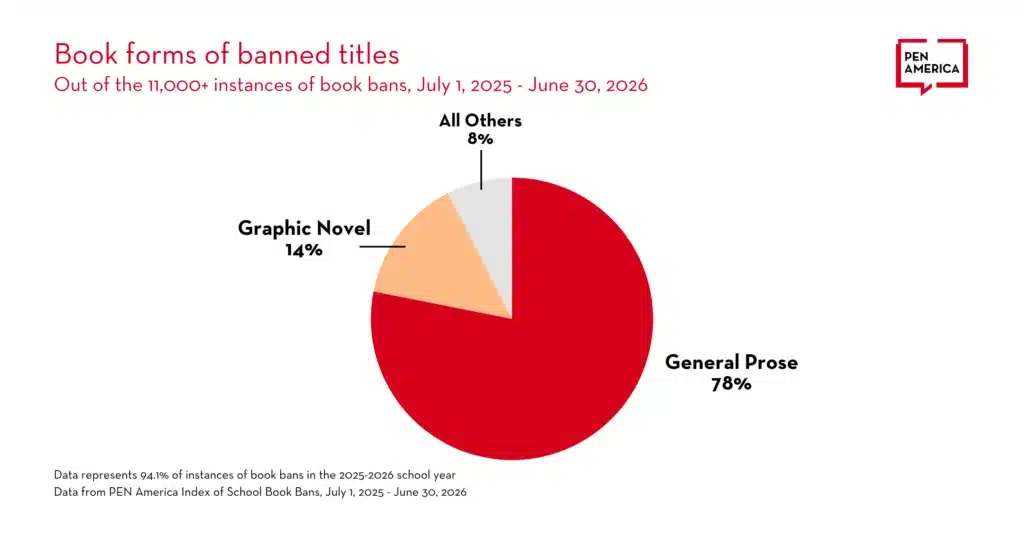
In the United States during 2023 and 2024, more than 10,000 book bans affecting more than 4,000 titles were put in place in the United States according to PEN America. In 2024, Canada saw 97 books challenged.

PBS Censors Art Spiegelman: Disaster Is My Muse

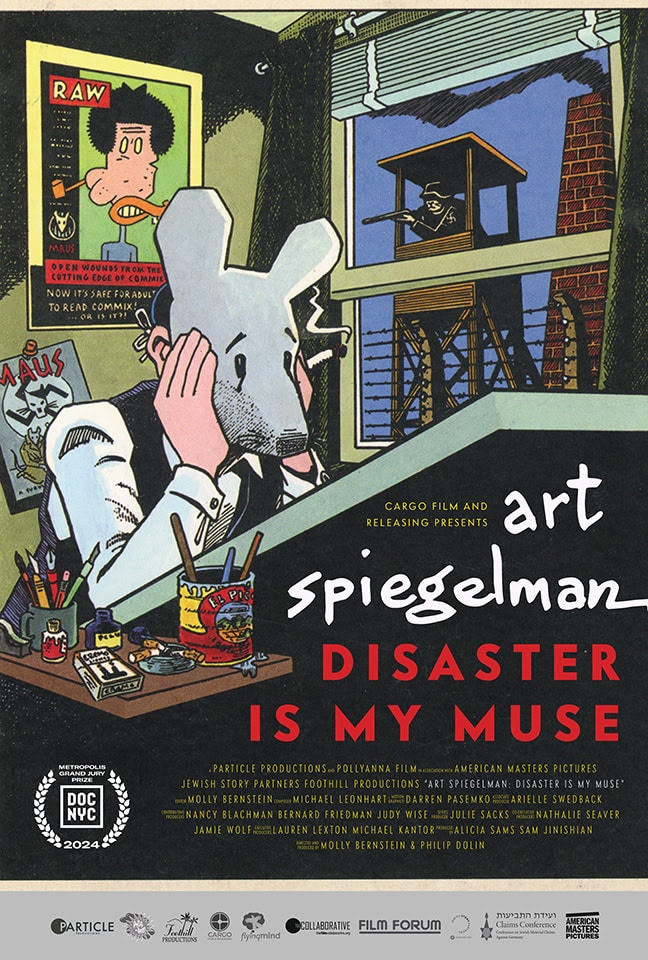
Art Spiegelman: Disaster Is My Muse

I’ll admit I haven’t had a chance to watch Art Spiegelman: Disaster Is My Muse which is airing on PBS as part of the 39th season of the award-winning documentary series American Masters. After this latest revelation, I’m not sure I want to. Originally reported by Anthony Kaufman for Documentary, PBS cut out a 90-second segment of the film where Spiegelman referred to President Trump’s “smug and ugly mug.” PBS has been embattled with the President and Republican part who have been trying to cut funding for the broadcast channel.

In May, the President signed an executive order directing federal funding cuts to PBS and NPR as well as root out other indirect sources of public financing for the two. Trump and Republicans claim the outlets “receive millions from taxpayers to spread radical, woke propaganda disguised as ‘news.’” It’s not hard to connect the dots that this is the reason for the editing demands.

According to the Documentary article, the filmmakers of the documentary were told to cut a 90 second sequence twelve days before it was broadcast on April 2017. The segment is from 2017 and Spiegelman discusses an anti-Trump cartoon he created for the 2017 Women’s March newspaper.

The filmmakers, directors Molly Bernstein and Philip Dolin, who produced the film alongside Sam Jinishian and Alicia Sams had to choose to either back their licensing deal or agree to PBS’ decision and let it be broadcast with the edit.

You can see some of the deleted scene in this Instagram post:

In the scene, Spiegelman scholar Hillary Chute says:

“In this Trump and post-Trump moment, [Spiegelman] recognized how useful Maus was as a text for people explicitly reacting to and fighting fascism.”

PBS also removed Chute’s words “in this Trump and post-Trump moment,” which alters the meaning of her comments and the original context.

The decision to censor the film was made by the programming executives at PBS National and agreed to by the leadership of WNET which is one of the largest PBS networks and makes up 350 member stations and produces American Masters.

A WNET spokesperson said in response to the edits:

“as it was no longer in context today. The change was made to maintain the integrity and appropriateness of the content for broadcast at this time.”

While that might be the official statement of WNET and PBS, it’s hard not to think the real reason is that Executive Order and Trump’s focus on defunding PBS and NPR.

It also follows a pattern of media bending over backwards to not anger Trump and Republicans. Trump has threatened and launched investigations as well as filed lawsuits in a revenge tour and media has generally caved to the mad tyrant. In December, ABC News settled a defamation lawsuit brought by Trump, agreeing to offer a written apology and make a $15 million “charitable contribution” to Trump’s future presidential foundation and museum. Trump has also filed a $10 billion lawsuit against CBS claiming they edited a 60 Minutes interview with Kamala Harris. He also sued The Des Moines Register, its parent company Gannett, and pollster Ann Selzer for publishing a poll suggesting Trump would lose Iowa. There’s an attack on free speech by the administration and instead of fighting against it, fights the media would likely win, they’re giving in, a step towards total fascist control. In PBS’ case they’re worried about funding, as if this editing would change that. In others, it’s Trump’s power over broadcast licenses and parent corporations. Jeff Bezos, whose companies true value is in their government contracts, censored The Washington Post‘s opinion section to be less critical of Trump resulting in contributors and editors to leave. Democracy didn’t die in the dark, it died when the broligarchs took over the media and news.

There’s irony in capitulating to a Fascist by censoring a documentary that is anti-fascist. Remember this when PBS says it fights for free speech during its next pledge drive.

U.S. Department of Education’s Office of Civil Rights ends its Book Ban investigations

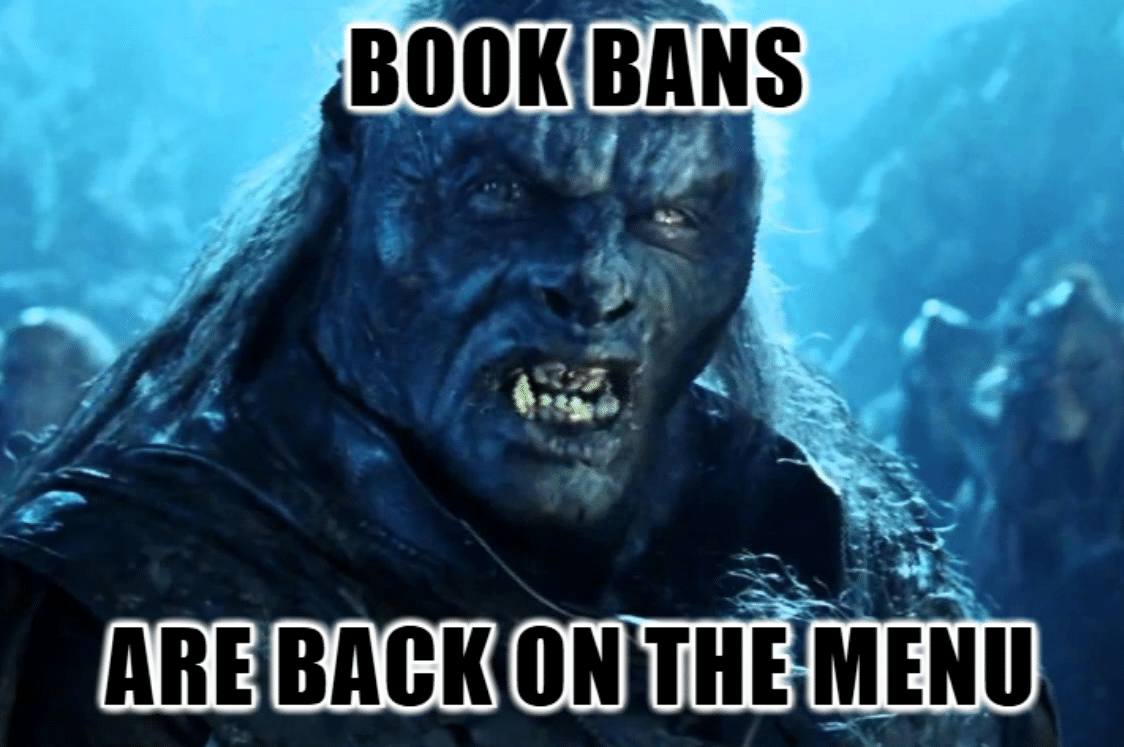
Book bans are back on the menu

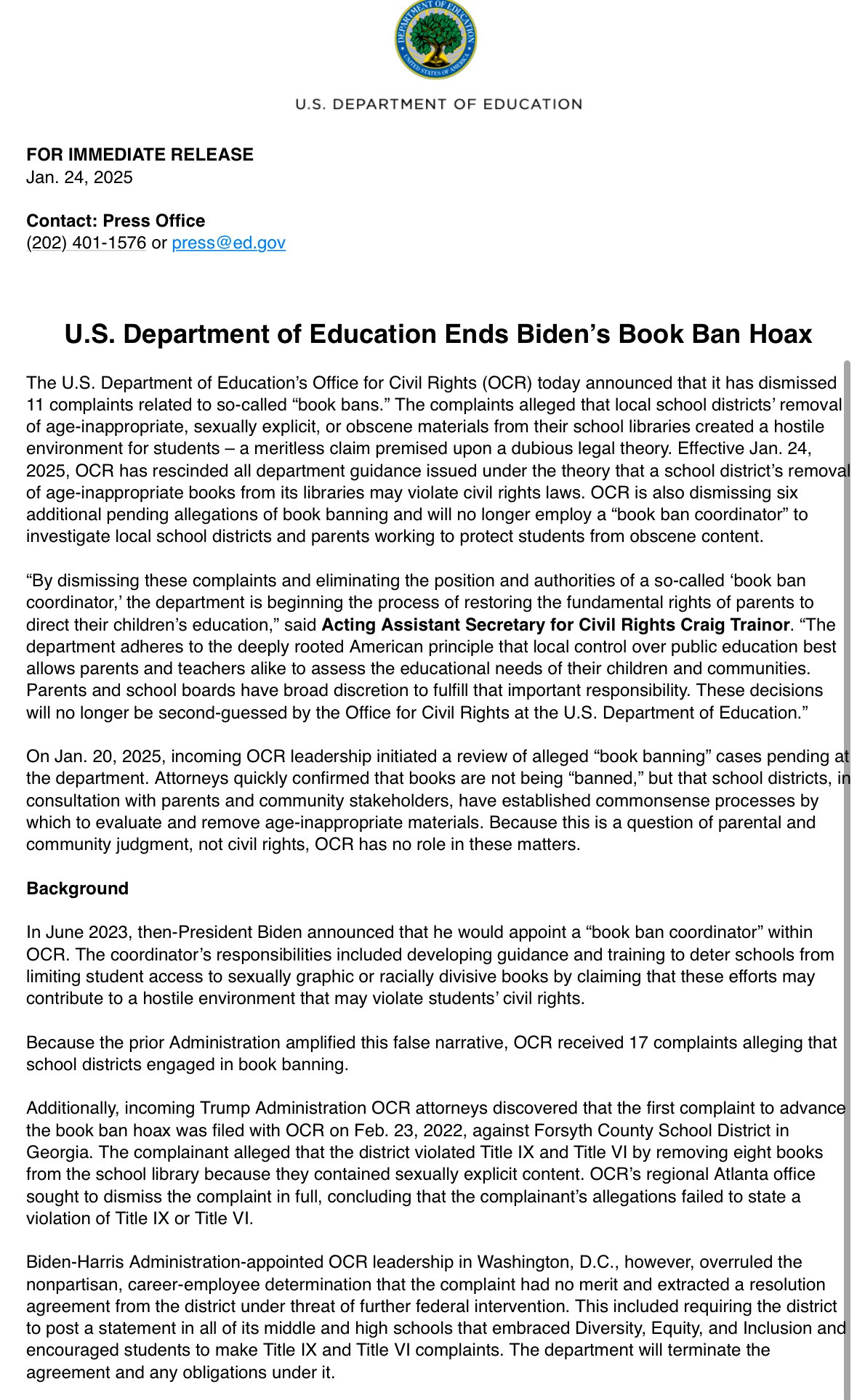
Book bans are back on the menu! In a press release, the U.S. Department of Education announced that it has dismissed 11 complaints related to book bans and 6 pending allegations. The complaints were related to school districts removing books often written by women, minorities, LGBT individuals.

The coordinator of the anti-book ban initiative has had the position eliminated and lawsuits have been dismissed.

In the release, the misinformed called the book bans a “hoax” as if they haven’t been happening.

The U.S. Department of Education, which President Trump has said he might eliminate, has “rescinded all department guidance issued.”

The move has been promoted under the rightwing dog-whistle of “parental rights.”

For those who want to fight against such bans, we encourage you to get involved at the local level attending school board hearings and becoming a part of your PTA. There’s also organizations like Authors Against Book Bans.

You can read the full gaslighting below.

New Jersey’s Governor signs the Freedom to Read Act

Book bans have been back for some years. It’s a popular attack and culture war tactic for the right and usually targets books about and by minorities. Some states are pushing back and New Jersey joins Illinois and Minnesota in signing laws that prohibit the banning of books at public schools and libraries.

New Jersey Governor Phil Murphy signed into law Monday the Freedom to Read Act which not just prohibits bans but also protects librarians who obey state law.

12.9.24 PDM Stands up for books-20

This year has seen 13 states introduce legislation to disrupt library services and limit the material provided. Over 10,000 books were removed in 2023-24 according to PEN America. 8,000 were pulled in Florida and Iowa alone where laws to restrict books were passed.

The New Jersey law takes effect in a year from the governor’s signing but librarians and state education commissioner are allowed to begin implementing it immediately.

First they came for libraries, next they’re coming for your Little Free Library

FIGHT CENSORSHIP, READ COMICS! Button Set Logo Design by Tom Muller Free for the First 200 Attendees!

Book bannings are popular again with regressive bigots, puritanical nutjobs, and those who offer nothing but culture wars, attacking libraries across the country. Some are seeing success not just with local school boards but also entire states.

Utah passed a law that banned 13 books that took effect on July 1, 2024. Now, individuals in that same state are beginning to target Little Free Libraries. Little Free Libraries are small, book shelves where individuals can drop off and pick up used books. Often, they are on private property like people’s lawns.

Utah Parents United, a driver behind the Utah bans, are now arguing owners of Little Free Libraries should face prosecution if they make “obscene” material available. The Utah law is vague and just mentions the distribution or “offers to distribute” any pornographic material to others can run afoul of the law. Often, those who have Little Free Libraries are unaware of what is available in the box as strangers can add and take books from it at any time of the day.

We at GP have had a Little Free Library running for over a year, often making sure to put in banned graphic novels. It’s also stuffed with books from the neighborhood, most have not been added by us. Utah State Rep. Sahara Hayes announced she was celebrating Banned Books Week by placing titles that are banned in Utah inside Little Free Libraries which of course led to an uproar from the pearl clutchers.

So far, Salt Lake City police have said they haven’t received complaints of Hayes’ book-sharing. While you of course need to follow the law, even on private property, this shows that it was never about libraries, it’s about thought control for everyone.

It looks like the modern day book burning is expanding and the modern day brown shirts are coming for the books you share on your private property. Give them an inch they’ll take a mile.

School Board Debates Bans Manga, Not Understanding it’s Read Right to Left

The discussion and vote is about the 47 minute mark

Book bannings are popular today with regressive entities who use culture wars to be elected and expand their control. Usually, those doing the banning just wear their bigotry on their sleeve, but the chair of the Brevard County, Florida school board went with proudly displaying her ignorance of other cultures too.

In a discussion about banning manga, the chair couldn’t understand why it was read right to left. Saying the book is read “backwards,” and partially due to that, it shouldn’t be provided to children as it might confuse them. Yes, this is the level of intelligence that is making vital decisions regarding children.

You start the book, you read it backwards. I mean, when you start reading a book, which we’ve been teaching our kids from day one, you start at the beginning and you read from left to right, bottom to top, not that book you don’t.

The second individual at least spoke up stating it was Japanese and stuck to the law, saying the manga didn’t violate Florida’s statute.

Being discussed was Sasaki and Miyano Vol. 1 by Shou Harusono and published by Yen Press. The manga is part of the “boys’ love” genre. Also debated were People Kill People, which addresses gun violence and white supremacy and Damsel.

Sasaki and Miyano Vol. 1 was initially recommended in being removed due to the same-sex relationship. An alternative suggested? Chainsaw Man! No, we’re not joking.

Florida House Bill 1069, gives school boards the authority to determine the age-appropriateness of library content, and has led to the removal of dozens of books in Brevard since its passing.

Around the Tubes

It’s one of two new comic book days! What are you all getting? Sound off in the comments below. While you think about that, here’s some comic news and a review from around the web.

The Beat – A Year of Free Comics: Don’t read MANNY before bedtime – Free comics!

The Mary Sue – Book Banners Reach New Low, Censoring Girl Scout Project That Fought Censorship – Sigh. Fuck these assholes.

Review

The Beat – The Harrowing

The Harrowing
« Older Entries