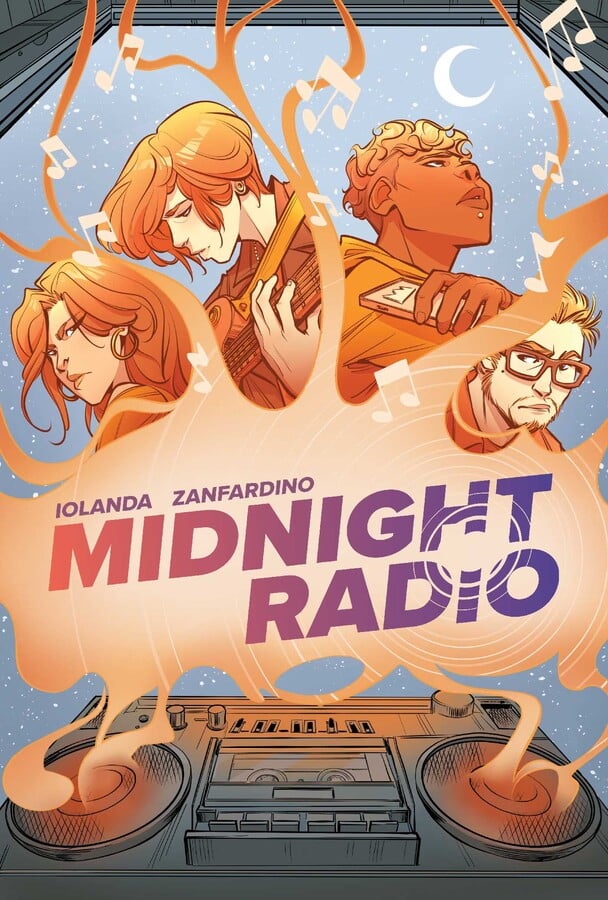
Originally published in 2019, Midnight Radio was Italian cartoonist Iolanda Zanfardino’s debut solo graphic novel, and it’s getting a nice re-release from Oni Press just in time for the holiday season. The comic follows four characters (Mike, Jo, Seika, Steph) of different ages, races, gender identities, and sexual orientation who are brought together by a mysterious radio broadcast telling them to basically live life to the fullest. The defining characteristic of Midnight Radio is that each character gets a different color palette that connects to their arc and personality in a gorgeous marriage of form and content. Zanfardino also interweaves commentary on racism, homophobia, social media addiction, and the exploitative nature of corporations into each character’s deeply personal journey.
The first character that we bump into in Midnight Radio is Mike, who gets a green palette not unlike the glow illuminating the scenes in The Matrix in The Matrix film series. This is fitting because Mike is a punk/indie game developer turned IT worker for an evil healthcare company, who wrestles with his conscience. Zanfardino shows his frustration through acts of violence as he wrecks the trappings of his old life (Battle vest, computer, demo of the game he and his friends worked on.), and as he succumbs to workaholism while dealing with a pesky hacker called Woodpecker throughout the story. Mike’s arc is a modern update of the concept of “selling out” because he wants to be creative and anti-authoritarian with his friends, but wants to pay the bills and get the respect of his parents. As someone who has worked both corporate and more creative, life affirming jobs, his storyline was highly relatable to him.
Bursting forth with a shock of red, Iolanda Zanfardino mines the queer experience and spaces, grief, and depression in Joanne’s story arc. Fitting for the color palette, there’s lots of rage in this portion of Midnight Radio as she deals with the aftermath of a shooting at a queer bar in San Francisco (One of the most haunting panels of the book features the bullet holes from it.) as well as romantic relationships, the drive to be creative, and conservative family members. There’s a viscerality to the way Zanfardino writes Joanne’s dialogue and captions only mellowing out when she vibes out and plays a long with some Guns ‘N’ Roses songs. Just like Mike’s story, Jo feels like her authentic self when she’s playing music and working at the queer bar. There’s powerful energy and even a bit of sensuality in her story arc.
The most, let’s say, melodramatic story arc of Midnight Radio features Seika, a Japanese-American woman, who gets in trouble and is forced by some corrupt cops (Of course, the color palette for this plotline is blue.) to become an informer on a Mexican-American forgery ring. It’s a crime/romance sandwiched between the more slice of life stylings of the other plotlines. (Bits of Mike’s arc have a techno-thriller influence though.) However, between the getaways, the wire wearing, and gunplay, Iolanda Zanfardino tells a story about racism, imperialism, and the immigrant experience as Seika falls for the the leader of the forgery ring, Francisco. However, she also continues the through-line of finding an authentic existence through creating art as Francisco and his friends playfully splash paint in the back of their van.
The final plotline is the yellow-tinged saga of Steph, a non-verbal social media influencer. Zanfardino uses captions and detailed facial expressions and gestures to tell probably the most emotionally resonant bit of Midnight Radio and play with the reader’s perception. Initially, Steph comes off as arrogant and above-it-all: a Baby Boomer’s conception of what Gen Z folks are like. However, as you learn more about his relationship with his parents, sister Pearl, and best friend Ruth, he becomes a more sympathetic figure and the beating heart and literal voice of Midnight Radio. As someone who has used social media as a stim and/or security blanket, I personally connected to this story, and Iolanda Zanfardino handles Steph’s non-verbality in a sensitive way without holding him up as some kind of saint.
Through its distinct, yet interconnected narrative, Midnight Radio is a comic that capture both the uniqueness and universality of the human experience. Zanfardino uses color innovatively to establish each character’s arc while connecting them through little chance meetings and the shared theme of finding their own authentic selves through relationships and creativity. Midnight Radio is a life-affirming comic full of feeling and worth a read during the dark days of winter.
Story/Art/Letters: Iolanda Zanfardino
Story: 8.8 Art: 9.2 Overall: 9.0 Recommendation: Buy
Oni Press provided Graphic Policy with a FREE copy for review
Purchase: Amazon – Bookshop