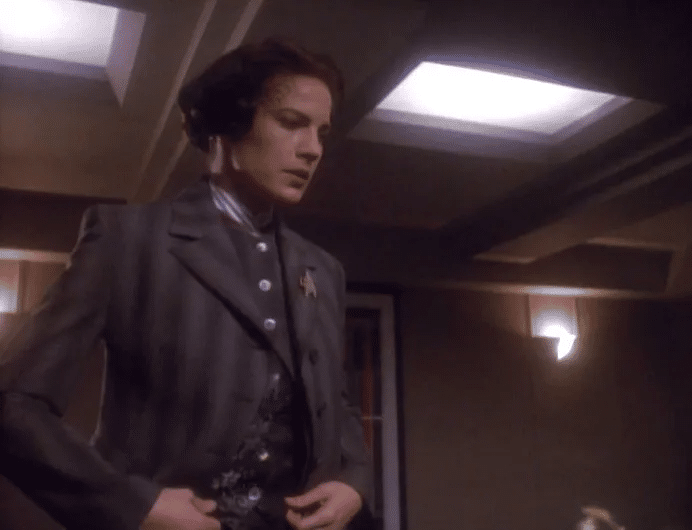
Category Archives: Deep Space Dive

Deep Space Dive, a Star Trek DS9 Podcast: Necessary Evil

Film Noir has been a cultural touchstone for nearly a century, and Deep Space Nine revels in it in season 2 episode 8. In “Necessary Evil” we flashback to Odo and Kira’s very uncute meet-cute during the Occupation. Join us as we discuss Sarah Daniel Rasher’s favourite DS9 episode, unpacking all of its references and allusions while tackling some of its hard hitting substance.

From Ferengi Casablanca and the mystery of Kira’s ponytail to Odo’s multitudes and the difference between a murder and a “casualty”, this episode demands a rewatch whether you’re new to noir or a buff like Sarah and I. Because after all: it’s the stuff that podcasts are made of…. 


DSD “Necessary Evil” Transcript

Elana: Deep Space Nine is the Star Trek with the greatest focus on political concepts like colonialism, feminism, queerness, and post scarcity economics. Join hosts and guests who aren’t just Trekkies, but activists, academics, artists, therapists, and more as we take a deep dive into the text and subtext where few Star Trek podcasts have gone before.

Sarah: Welcome to Deep Space Dive. We’ll be discussing Deep Space Nine’s themes and characters, not doing recaps. There are many fine recap podcasts out there. Instead, we look at the show as a whole, and this episode, like all of our episodes, is probably full of spoilers.

Elana: Mm hmm.

Sarah: If you’re watching the show for the first time, we recommend finishing your watch through before starting to listen to our podcast. All of the old episodes will be waiting for you when you’re ready. I’m Sarah Daniel Rasher. When I’m not getting paid to use math to save the world, I write about film and figure skating. I was the founding captain of my high school Star Trek club and I once got Nicole de Boer to kiss me at a convention.

Elana: I’m Elana Levin, also the host of Graphic Policy Radio. I’ve worked at the intersection of comics, nerd culture, and social change for a really long time. And my biggest cred was giving a speech on fan activism at a rally organized by Leta, a.k.a. Chase Masterson.

Sarah: So this episode is a little different than the ones we’ve done before. Elana and I were talking about what our favorite episodes of Deep Space Nine are, especially the ones that we haven’t been able to go into depth about on the podcast yet. We want to talk about them not as a recap, but how they fit into the rest of the series and why they represent the best of Deep Space Nine. In this episode of Deep Space Dive, we’re looking at my favorite, “Necessary Evil”. The one where a new discovery about an Occupation era murder makes Odo reflect back on that time in his life and his relationship with Major Kira.

Elana: What’s my favorite episode? You’ll find out next time.

Sarah: People seem surprised when I say this is my favorite. They’ll say, ‘Oh yeah, that is a good one’, but it’s not the first thing that comes to mind or apparently what they associate with me. Um, but for me, it represents a lot of firsts for the series and sets up so much of what happens later in terms of character development and world building. It’s also just a really well made episode. It’s well directed, the performances are really strong, it– part of that is because it relies on some of the better actors on the show. Um, also my general taste, like beyond Star Trek, runs to quieter and more interior drama. So, I like that this episode has kind of a quiet intensity to it, that there’s no space battles, it’s a lot of talk. And the other thing about it is just like, it was kind of the right episode at the right time. It first aired right around when I started watching Deep Space Nine, and it was the first one I watched that– my reaction was ‘this is what this show is trying to accomplish that sets it apart from other Star Trek’ and I’m like 15 years old and just at the age where you’re starting to have thoughts like that. So, um, it’s an episode that means a lot to me, and we’ll get into some of the more specific reasons for that. But “Necessary Evil” is my favorite episode of Deep Space Nine. So, one of the things that I think people think about first related to it, and I know Elana, you had a lot of thoughts about this, so I kind of want to start here, is that it’s kind of the film noir episode.

Elana: Oh yeah. No, I mean, going back to when you and I were first talking about our plans for the podcast, one of the themes we had was like, ‘oh, we should do an episode about all the film noir references in the series’, but this is just a really great way to kind of talk about one of the most condensed places where it does show up. Uh, you know, the, the, even the lighting is more dramatic than usual, like more high key lighting than we normally have on the series. And it’s such a wonderful cold open on the femme fatale, just straight out of a movie from the forties, I’m just like ‘nailed it’.

Sarah: She’s in like this silk nightgown standing by a window on a rainy night, but at the same time like, she’s alien looking like she’s Bajoran, she’s got the earrings, she’s got the nose, her hairstyle is not 30s, so it’s like it’s making sure that we’re clear, ‘okay, this is an alien, we’re doing sci fi, but we’re still gonna really aggressively quote–

Elana: Mm hmm.

Sarah: this sort of pop culture touchstone.’

Elana: And she definitely wears a fascinator later– or two, a fascinator or two in the series that are very much period. So like, they have little– oh my god, but her pantsuit that she wears when you first see her. Even that being, right? Deep Space Nine, like a lot of Star Treks, that– often doesn’t have the costume budget that I wish it would, but they really, they really used it well in this episode for that. 

Sarah: Yeah, it was a lot of really simple costuming that was just– it’s, I think of like, when it shifts to your first view of Odo in the earlier time frame and he’s in this kind of like turtleneck and jacket and that also looks sort of 30s and 40s in the same way, but at the same time it still looks very Odo.

Elana: Mm hmm. Yeah.

Sarah: Then it’s almost like you wonder if some of this stuff was just off the rack or off the standard sort of like costume closet stuff that they just picked very simple things because they’re not trying to make it look as sci-fi as they often do, but at the same time it ends up looking very sci-fi because the lighting is different, there’s– one of the things that I want to get into is there’s barely humans in this episode.

Elana: Mm hmm. But I would just say that her, the pantsuit, the white jumpsuit outfit that she was wearing when we first see her, if that is off the rack, like, I want to know what rack that is from because it was a bold statement outfit and I’m very happy for her.

Sarah: Yeah, it’s um, and I think that when we’re talking about like this is an especially well made episode, I think that’s what we’re talking about too. It’s not just the act-acting and the direction, but there’s a lot of costume, and hair, and makeup, and set design, and props management that’s just really smart.

Elana: Yeah, totally. One of the things that we both had in our notes when we prepared was like… I think my note was literally like ‘Quark giving his best Humphrey Bogart’ and you brought up like ‘Quark as– literally as Rick from Casablanca’ we–

Sarah: Yeah, and that’s a thread kind of. Like I feel like there’s a number of episodes where he’s– either in the way he’s being shot or like literally in the story, he’s got the one with the old Cardassian ex-lover that’s literally just Casablanca, um, but that that sort equivalence comes up a lot in the show, and it’s one of the things that I think helps humanize the character, so to speak, or make the character not a villain but a sort of relatable and morally complex individual, is like ‘let us remind you that if he didn’t have the rubber helmet on, like we definitely have human equivalents to this kind of person.’

Elana: And also just like he really has this whole thing where he tries to pretend he’s completely amoral, that’s part of how he performs Ferengi-ness, but he actually does have this moral code. I mean, it’s like so fucking Rick from Casablanca. It’s just interesting also because in that opening exchange between him and the femme fatale, I mean– and that, their dialogue lines are just so fucking good. Um, he’s, he is playing the Peter Lorre role in Casa– like that kind of like role in that moment. Like he’s, his acting performance is very much physically evoking Humphrey Bogart, but like, he is being the Peter Lorre in that scene. Um, I’m also just obsessed with her saying, ‘at least the Cardassians kept the power on’. It reminded me so much of the cuckoo clock speech from The Third Man.

Sarah: Oh wow, yeah, you’re right. And then as you’re, and then as things unfold, you see that the Bajorans are keeping the power on just fine…

Elana: Mm hmm.

Sarah: …it’s her change in circumstances.

Elana: I, uh, the quickest attempt to explain the cuckoo clock speech, if you look up The Third Man, the Carol Reed film noir, starring Orson Wells and Joseph Cotten, there’s an exchange– well, one, go watch the fucking movie. I– I love that movie so much. But there’s an exchange where, basically one of the, one– a major character sort of explains why a little fascism is okay sometimes. He’s also the villain, so remember that. Anyway, but yeah, I– the way she puts that, you know, and it’s definitely a direct reference to like, ‘well, the Nazis kept the trains running on time’, and as much as we like, ‘yeah, like, okay, they’re not the space Nazis’, but that is what is being evoked in her bellyaching around that. And you’re right, like it’s important that the episode actually shows the way in which she’s just griping and it’s not actually, it’s not actually what’s going on.

Sarah: What she’s really griping about is that she can’t pay people off anymore to– or, you know, use other resources or her connections or whatever to live a certain lifestyle because the people who are now in power just see her as the lowest of the low.

Elana: For a reason.

Sarah: Oh, yeah. And for more reasons than it initially seems. Like it’s not just that she’s a collaborator, she’s just like a pile of awful. And I think it’s really important in Deep Space Nine, that for every alien species or most of the alien species we see, we see examples of really, of good people and people who are trying to be better, and we also just see that like, the Bajorans are notionally the good guys, but we get Kai Winn, and we get her. Like, there’s definitely some real awful Bajorans out there.

Elana: One last really big film noir thing that this episode calls to mind for me is it points out the way in which the whole captain’s log and, I don’t know what Odo calls his log, but the Odo’s log, the constable’s log, is itself a film noir device because it gives you the excuse for the first person narrator to be like, ‘so I was walking into her office that– you know, she, there she was walking through the door. I knew she would be trouble’. Like that whole like monologue that we associate with the film noir genre, like, the captain’s log is our sci-fi version of that, those logs, and I don’t think it was till I was watching this episode with that in mind that I was like, ‘well no wonder this is such a perfect tone setting because every episode, more or less every episode of Star Trek has somebody film noiring it out in their monologue to themselves in their little diary in the beginning.’

Sarah: Right. And just, I mean, it benefits, especially from René Auberjonois’ uniquely gravelly voice, just really lends itself to that film noir voiceover and also a way of sort of linking it to characterization is just later finding out that Odo is a really avid reader of trashy novels.

Elana: Yeah!

Sarah: That like when he’s creating, when he’s, you know, he’s speaking, but he’s effectively writing. Like, his go to is like, his voice is from a detective novel because he reads them.

Elana: Yeah.

Sarah: And at the same time, a lot of those voiceovers have a certain sort of like, wisdom and longing to them that’s really that kind of escapes those bounds. And it isn’t just a bunch of film noir cliches either.

Elana: Yeah. Yeah. He’s so much fun in this. Like what a great opportunity for him to have here and yeah. And Quark is just acting the fuck out of that scene with femme fatale. It would have been the fact that we like, believe him and her in that moment and that he can actually kind of come off as a little bit, like, less weaselly and more debonair in that fucking insane contraption covering so much of his head and face is really remarkable. And I don’t know that we see Quark effectively in that mode that much in this show, and we haven’t with him as Pel, I guess, right?

Sarah: Yeah,

Elana: Check out our last episode. But, yeah, it’s like a nice moment where he gets to really do that.

Sarah: I think we get it more than we realize that because Armin Shimerman is so good and really embraced the physicality of this part. Like– it’s one of those things where it’s like, we forget about– I always bring up “Little Green Men” when people start complaining about Ferengi episodes. I’m like, that’s such a hugely good episode, and that’s one where there’s a lot of emotional range. Um, but I do think that he, and I want to get into Rom because this is, this episode is a breakout moment for, for Rom and for Max Grodénchik, but, uh, both of them really take this opportunity to figure out how the physicality of the, of wearing those appliances affect how their emotions are coming off and really uses them and works with them rather than against them.

Elana: Yeah, let’s talk about Rom.

Sarah: Because this is the first episode where the show really figures out who Rom is. Like, in the first season when he shows up, he’s kind of like a mean idiot.

Elana: Mm hmm.

Sarah: To the point where like, there’s a suspicion that he has some kind of intellectual disability.

Elana: Yeah.

Sarah: And then this episode turns around and shows that he, it’s not like an intellectual inadequacy. It’s a combination of like, neurosis and not being intelligent in a way that’s valued by his culture.

Elana: Yeah. And just being bullied. I mean, he’s just–

Sarah: Yeah.

Elana: –he’s just been bullied his entire life.

Sarah: He’s smart and devious, but he’s awkward with no self confidence. So like, he doesn’t believe he’s smart because nobody in his entire life has ever told him he’s smart, but we as outsiders are seeing what’s going on. And it’s one of those things where the show gives enough information to contest what you’re being told about a character in a way that allows it to, without feeling like a massive retcon, just say like, ‘okay, here’s where we’re going with this from here on out’ and he validates that later when Odo is interrogating him and Odo is sort of making jokes about his intelligence, but then you’re sitting there going, okay, he saw this list for like 30 seconds, and it’s written in what is probably his third language, 

Elana: Yeah.

Sarah: and he managed to read a name and remember it with enough fidelity that he’s able to give Odo something to go on. And that does seem to change how Odo treats him later when Odo is giving him updates on Quark’s condition and Odo is taking him more seriously as like, ‘don’t you dare kill him just to get the bar because like, now I realize you’re capable of it.’

Elana: Do you think Odo suspects him at one point? Or is he just being like that?

Sarah: Oh yeah! Well, it’s, I mean, Odo suspects everybody who has a reason to harm somebody.

Elana: Which is pretty much everybody.

Sarah: Right. Like, it’s Odo’s nature.

Elana: There’s such good dialogue that just feels very noir throughout the whole episode. Like the whole, um, ‘she knew you couldn’t resist opening’. ‘I’m sorry’, ‘me too’, and then shoot– I mean, like, they’re going straight for the genre reference points in this. Like, they know their shit, and it works so well. I-I’m curious how that reads to people who aren’t as familiar, I guess. But…

Sarah: Yeah, I wonder if that is one of the reasons why it’s not considered, like, an all-timer is that it relies on a certain amount of viewer knowledge to come off as, not just a pretty good episode, but one that’s really doing something very creative.

Elana: That makes sense. And it’s one thing for a science fiction show to do something that’s pulling from a science fiction agecent genre, but there can be less, necessarily, of an assumption amongst the film noir nerds and stuff like that. 

Sarah: And I think as this episode becomes older, all of the things it’s referencing that are already 40 or 50 years old when this episode happens, are now even another generation older and are coming up on a century old now in some cases.

Elana: Yeah. It’s insane to think about.

Sarah: So the expectation that like a teenager who finds this streaming and watches it for the first time is going to pick up on the references that to them are so old–

Elana: Mm hmm.

Sarah: Like they were already old to us. There were already lots of people our age watching it when it aired who would not have gotten these and we only got them because we were giant nerds–

Elana: A particular kind of nerd.

Sarah: of a way specific kind.

Elana: You know what you’re making me think, I, we should at the end of the episode give people some film noir suggestions for viewing for folks who, this might, who might not have been aware of. Who, you know, might be looking for a place to go if they’re into this sort of thing.

Sarah: Yeah. Um, yeah, I did not do my homework on that one, so it’s probably gonna have to be you, but go for it.

Elana: No problem.

Sarah: Yeah. And at the same time, and this sort of brings me to the next point on my list, is while it’s incredibly grounded in sort of 20th century Western pop culture, it’s also incredibly alien. Um, O’Brien doesn’t appear. Dax, who is an alien but is sort of human allied, especially in a situation like this, does not appear. Bashir has like two lines. Sisko pops in and out, but doesn’t have a whole lot to do. They’re never in any way the point of view character, it’s really these groups of aliens who are shown as, you know, relatable, but still very alien. And it’s sort of aliens acting out this very familiar thing in a certain way.

Elana: Yeah. I just– it’s such a cool thing that they have built out different other species’ cultures and histories and the complexities of their interactions with each other so much at this point in the series that they don’t need any humans.

Sarah: And this is, you know, to be clear, this is a season and a half into this show.

Elana: Yeah, exactly. Season two. 

Sarah: It’s season two, and while we’ve seen all of these aliens before, except for changelings, there was not a lot of depth put into like, Bajoran culture or Ferengi culture as cultures before Deep Space Nine. So the fact that we have enough reference to see the underlying cultural norms that would produce both a Kira Nerys and um, Mrs. Vaatrick, and we can say like ‘those people are both acting like Bajorans.’

Elana: Mm hmm.

Sarah: Um, it’s really remarkable and I mean, part of it is that back then you got, you know, a billion episodes per season, but back then things were also very episodic and reset and didn’t focus on creating that kind of lore and world building. So it’s, that’s what’s, that’s really very remarkable. It’s also one of the other firsts. Um, the Occupation has been frequently referenced to this point, but this is the first time we get a flashback and see what Deep Space Nine looked like when it was Terok Nor, and it seems very long ago and far away. And then late in the episode, Odo reminds us this was five years ago. This was like, not that long ago.

Elana: There’s a moment where, like, when later in the end of the episode, when, Odo is like, ‘you know, you’ve known me for, we’ve been free for a year, and you haven’t’, and I was just like, ‘Odo, that is no time at all! No time at all!’

Sarah: Yeah, it feels very– there’s this sense of like things being both very recent and very long ago and far away that I think as like our current, you know, political situation in a lot of ways has that feeling to it, like, I think that that stands out more now than it might have in the 90s, or is at least more relatable to us as, as Americans living in a very different time than we were then.

Elana: Yeah.

Sarah: That like, how much and how little changes in a five year period.

Elana: It’s just so funny to hear them not quite own it in the way that it feels like, really clear to me, you know?

Sarah: I think, and this is something that has been brought up in a very different context at other times in this podcast. Odo is very young, so there’s also– he might be young enough that like a year or five years does really feel like a long time as a percentage of his life.

Elana: How, how long would this have been for him?

Sarah: It’s not clear. I think that this is one of those things that people have tried to map out, but he’s like, he’s probably developmentally a teenager in the flashbacks. Like he’s young, young.

Elana: It’s, I mean, René Auberjonois just acts the fuck through that ridiculous mask, and there’s just these moments where you see his eyes change or soften– like, the look on his face when, um, I believe I put it as, ‘Odo was acting the fuck out of that mask when Kira looks like she’s about to cry in his office’. Like, I mean, it just, his whole, his eyes just completely soften. It is, it is a different thing.

Sarah: Yeah. And it’s really remarkable that an actor of his age is able to convincingly play a character who is so much younger. And I think because of the age difference between the actor and the character you can sometimes forget that. But I think that this is an episode that draws attention to the fact that Odo is very young and he’s naive, even in the present at this point in the show.

Elana: Hmm. Do you think Kira is bad at lying, like he says she is?

Sarah: Hmm. I feel like it’s, you know what? I think she is, but not always in the way that the show intends.I think there are times when the script tells us that her lies are, um, you know, passing the deception role, but though– either intentionally or unintentionally, and I tend to give Deep Space Nine actors the benefit of the doubt, that, um, that Nana Visitor plays scenes where Kira is lying or especially when she’s hiding her past, um, that she often plays it so that Kira has a lot of tells. 

Elana: That’s cool. Yeah,

Sarah: But it’s realistic to say that, like, just meeting her, Odo wouldn’t necessarily recognize those tells yet, 

Elana: Right.

Sarah: but by, by the show’s present, he would recognize those tells.

Elana: It’s just interesting because he says that to her so early on that she’s not a good liar, and it made me really wonder, like– it feels like he’s doing a noir act to her, and sometimes, like, when he tries to pull a, ‘what’s a young lady like you doing in a place like this?’ And she’s like, ‘don’t fucking talk to me. I will knife you’. It was like, wonderful, her calling him on his, like, posture. But I kind of viewed that almost as one of his other moments where he’s trying to do an act of how he feels like he’s supposed to be in this situation.

Sarah: Yeah. And not knowing and being, again, young, and also not having probably a lot of good models for how people talk to Bajoran women, especially.

Elana: Yes.

Sarah: Like, he’s probably never met anybody who didn’t objectify Bajoran women.

Elana: Yeah. I don’t think it occurred to him that it wasn’t going to go well, like, at all. At all. And she just sort of blew his mind. It’s almost like, ‘did you know that we are also people? My god’. And I liked how he absorbed her perspective of what was so fucked up about it. So then when like Quark tries to lie about her, even though she wants Quark to lie about her, he takes offense at her behalf in a way that he wouldn’t have before that conversation perhaps.

Sarah: Yeah, and I think something that’s very consistent about Odo is that, in a way that facilitates being a creature that can change his shape, he adapts very readily to his own observations, unless he’s got an emotional reason to not want to take it in. So he adapts to what he’s observing about Kira, which is she is a person with motivations, and reflects that back. He adapts to seeing that Rom is in fact a competent individual and changes the way he interacts with Rom. And to me one of the challenges of watching Odo do anything is that he is definitely the police state, and he very much has a policing and carceral mentality that is much harder to cheer for in 2024 than it was in the 90s. But at the same time, his ability to respond adaptively and to not presume ill will when he can see something else going on with somebody is a rejection of one of the things that we really object to about policing.

Elana: Yeah. Like he’s sort of the idealized, ‘well if they were like this, it wouldn’t be a fucking, you know, nightmare game.’

Sarah: And there are times when he isn’t that flexible and it’s really frustrating because like you want him to show that potential and that goodness that makes it okay to see him as your heroic even if you’ve got big problems with his desire to just like throw everybody in jail. ‘Cause he really does still want to throw everybody in jail, and you could kind of laugh at it most of the time.

Elana: And do you feel like it’s because he wants to create order? Like is that, or like what, is that what he wants to throw everybody in jail?

Sarah: Yeah, he, it’s– and one of the things that I noted is that, at first your instinct is to say, well, ‘during the occupation, this was like, you know the Wild West, and then the Federation showed up and the place is still ungovernable. It’s unpoliceable’. So I think it’s coming more out of exasperation than anything else. Um, and how frequently someone like Sisko will look at Odo and be like, ‘you cannot just put him in jail’. That like, it’s a perspective that is sympathized with, but not permitted free reign.

Elana: Yeah. Yeah. Speaking of Rom from before, uh, and aliens, I do believe this is the episode that first establishes that Ferengi shriek at an incredibly high, loud decibel system as part of the early Ferengi warning system.

Sarah: Yes. And Max Grodénchik’s unaugmented no like sound effect, like they just had him go in and shriek.

Elana: It was amazing.

Sarah: Like, I think some of it was, I think some of it was looped. But it was definitely him, yeah.

Elana: It’s him. And like, I just love this idea of this being like an evolutionary development. The Ferengi were like, ‘what sound can we produce that’s so obnoxious that others will stay away? I know! Or immediately come running to aid us? I know!’ Oh god.

Sarah: And yeah, I think what you’re pointing out is that despite being a pretty heavy episode in a lot of ways, there are moments that are just goofy. And it lets them be that sort of like dark laughter. And that’s the big one, where Rom is just shrieking.

Elana: It’s the recent changes, but the shriek lives on.

Sarah: Yes. So we’ve talked about the big reference here, which is to film noir and film noir adjacent cinema from like the 1930s to the early 1950s. But I pulled out a bunch of other points of reference that I think are throughout the series, like film noir, but also really concentrated here, and that they’re more in reference to Odo specifically. And I want to go over the quicker one first and the one that you’re gonna have to like, rein me in a little bit next. Um, so, there’s a lot of Sherlock Holmes moments for Odo.

Elana: Yeah.

Sarah: And Star Trek loves it some Sherlock Holmes. It was a huge thing, obviously, throughout Next Generation, like, there’s literally a holodeck version of Moriarty that gains sentience. It’s a, you know, it’s a big through line in the Next Generation. It doesn’t really carry through to Deep Space Nine in the same way, but there’s all these little moments where Odo is noticing little things that are outside of typical perception. And sometimes he’s showing off a little, and sometimes it’s very matter of fact that he doesn’t realize that it’s not something that everybody would know. And when he’s trying to get Rom to recall, he’s using this sort of like–

Elana: Memory castle.

Sarah: Yeah, the memory castle visualization techniques. And one of the things that came to mind for me, and especially in both of my like backward references are going to have a forward reference because I have been consuming some pop culture this week that I’ve really liked, was thinking forward to, um, the premiere of the TV show Elsbeth on CBS, which is the first network show in quite a while that I have given a shit about. And that’s about a detective character that is very intentionally positioned as neurodivergent. And the question is, and this is an open question for me, because Odo is definitely not neurodivergent like I am, and he’s not frequently read by like neurodivergent fans of the show as being their sort of like neurodiversity touchstone.

But what do you think of Odo’s portrayal as neurodivergent in this episode and sort of more broadly?

Elana: I’m surprised that more people don’t identify that as him. And I have to wonder if it’s because they don’t identify with him and therefore that’s not something that they want to see, because I think it’s very clear.

Sarah: Yeah, because he’s really set up as the sort of like Spock/Data lineage character where he’s the outsider, and while there’s definitely a lot of fondness for Odo and people really latch on to him for other reasons, the one that I see autistic people in particular getting stuck on is Bashir, and the one that I see people with non-autistic ADHD getting stuck on is Dax. 

Elana: Yeah.

Sarah: That like Odo seems to, to be neurologically atypical in a way that seems very alien.

Elana: I also just think he’s, it might be, if we’re looking and thinking about conversations that are happening now versus before, because remember listeners, I was not part of active Star Trek fandom back in the day. If we’re looking at conversations that are happening now, I think he’s just too cop-coded for people. They are choosing not to see it.

Sarah: Yeah, that makes sense that he’s too cop-coded. And I think like beyond that, a lot of the, a lot of his behavior, some of it stemming from being cop-coded and some of it just you know, stemming from other things is, traits and behaviors that we don’t want to identify in ourselves, that we kind of want to reject in ourselves. And I think that was true at the time as well, that Odo is a really difficult character.

Elana: Sure. Yeah. I mean, I definitely think, you know, when you were telling me how much you had related to him early on, I was also like, ‘what?’, because I didn’t want to see that either. You know what I mean?

Sarah: Yeah. So my other, and again, we’re, I’m going to be looking back in order to look forward and to connect some things that like make sense only in my head. Um, hopefully not–

Elana: I don’t think only in your head.

Sarah: Yeah, I think that like at least the looking backward part where the– so I see Odo figured clearly here and even more clearly and other things later on as a Frankenstein’s monster figure. Like he was literally raised by, I hesitate to say mad scientist, but definitely like an outsider scientist, um, who is an odd and quirky individual, and that one of the wonderful things about Odo’s relationship with Dr. Mora is that they do find a way to have a parent child bond and to find a kind of love for each other and a way to forgive each other. That’s really one of the, one of the things I love most about Odo’s character is that he’s depicted as moving toward forgiveness in that relationship and really wanting to have a parent, but at the same time he’s literally raised in a lab and he’s brought out as a specimen that does tricks, and one of the things that doesn’t really happen in Shelley and kind of happens in some later adaptations, but really explicitly– there is a great speech in the movie Poor Things, which I literally saw yesterday and which I went with a friend and we looked at each other at the end of this very long, very intense movie and we just looked at each other and we’re like, ‘well, that was great, let’s go get a drink’. And we sat for an hour talking about this movie, and this is one where it takes the psychology of being Frankenstein’s monster to an extent that I think Deep Space Nine also in some of its better moments with Odo also ends up doing. And one of the things that resonated with me was Odo talking about how he went to Terok Nor because he realized he was at a point where he was always going to be a specimen and not a person if he stayed with Dr. Mora. And so he left and went somewhere where nobody knew him. And there’s a very similar moment in Poor Things, where the main character is also literally a lab experiment, and that is the only thing I can say without uh….

Elana: Sure sure, and I– I’ve heard people- I’ve heard critics draw that comparison. I haven’t seen the movie yet, I’m very much looking forward to it–

Sarah: It’s intentional, it’s not just critics. Um, like the director has drawn the comparison, like it’s intentional and it’s systematic. But I think it’s something that, um, the Deep Space Nine writing and production team were aware of enough to continually quote it for Odo. And what’s fascinating to me is that it doesn’t get quoted nearly as much for Data or for, um, the Doctor on Voyager as it does for Odo.

Elana: Why do you think that is? Did the others simply forget or?

Sarah: I think it’s that– it might be that Odo is more monstrous.

Elana: Yeah.

Sarah: That both because of his association later on with the Founders and just because, like, Data is very whimsical. The Doctor is crusty, but in a way that’s not threatening. There’s some real menace to Odo. Like, there’s a real sense that Odo is a person who could snap. And it’s not just a malfunction like it would be with Data or the Doctor.

Elana: And also Odo is even more of a person than Data or the Doctor, right? Like, Odo is organic.

Sarah: Yeah, um.

Elana: I wonder if that lends itself partially to the metaphor, because Frankenstein is ‘made out of people! Ah, ooh, people’. Sorry, I had to bring in a different, unrelated science fiction movie to it, but…

Sarah: And just to fully belabor something that I do go back to with Odo a lot because it’s so important, is that in a way, being, um, sort of delivered into the political circumstances that his discovery brought him to, he is this like sort of cultural hybrid of Bajorans, and Cardassians, and later Federation culture, and then we get the moment where he literally merges with a trill and, that there is– that he is this sort of amalgam of different cultural and psychological elements that he builds himself out of because he’s not, he isn’t like anybody else. And something I’m actually thinking of is when he meets Worf and Worf– like he’s met Klingons before, but Worf is the first Klingon he’s really had, like, an emotional connection to or emotional relationship with, and seeing some Klingon things in himself that he’s never really seen from any of the other cultures he’s interacted with. And finding some satisfaction in that. 

Elana: Yeah, totally. I want to talk about the neck trick. I love how horrified the series is consistently about it and how much they just really need us to know how unacceptable and dehumanizing it is that this was something he was forced to do to as a freak basically, for the Cardassians. And that we never see it. Chef’s kiss, excellent.

Sarah: And it’s, and there’s callbacks to it throughout the series. And we never see it because he never has to do it again, because he’s been liberated from it.

Elana: And like so many shows would have felt the need to explain it or show it as a flashback  or– because they would they would believe that their viewers needed to witness it. And in fact, I would even think that perhaps under modern fan culture you would see fans explain what it would be and theorize and there’d be videos and this and that, but no then they’re like no, it’s not appropriate, that’s why it doesn’t happen.

Sarah: Right. And one of the brilliant things that the script does is it contrasts that Cardassian neck trick with ‘nobody had to teach me the justice’ trick. That like that’s something that he sees as innate about himself, and there’s this tragedy of him saying, maybe the rest of my kind are like that, and then you meet them and you’re like, ‘fuck, no, that’s an Odo trait, not a species trait’.

Elana: Which I think says something even better about him, although I also think in a meta way it shows that these, they hadn’t figured out what his people were gonna be at that point. But um, I do think it’s better that it’s just him and not… I don’t like the thought of inborn racial traits. But people think that way about themselves. They absolutely do. So it’s not unreasonable or unusual that he might wonder or think about this, especially in lieu of having any other information. I’m not saying Odo’s bad for wondering this or thinking this, I just don’t like when stories validate it.

Sarah: Right. And, you know, when we’re saying, ‘why is he the kind of person who wants to throw everybody in jail?’, that does seem to have some kind of like instinctual species component where in the same way Ferengi have envolved– have evolved shrieking, that the, that changelings have evolved like that’s a response to threat like…

Elana: Yeah, their threat response. They say that. What’s her name says that, right? It’s like, ‘well, we do this because you guys all tried to like eat us or whatever’.

Sarah: Yeah, um, so maybe it is worthwhile to say that a lot of the things that we really are frustrated with about Odo are sort of, on some level species-based threat responses and that in his better moments, he overcomes the threat response and becomes somebody who’s driven by a much higher sense of justice. And recognizing that sometimes justice means letting the guilty go free, which is the moral of the story here.

Elana: The punchline here for sure. Who do you think, or what do you think, Odo told Gul Dukat at the end of the day?

Sarah: Yeah, because that’s never answered. We know from other depictions of the Cardassian justice system that Odo saying, ‘I don’t know, I couldn’t figure it out’, is not acceptable. And I’ve never had a satisfying answer to that, I don’t think the episode tells us.

Elana: It’s really hard to think about.

Sarah: Yeah.

Elana: Kira shows so much trust in him, in her being like, straight up, I will tell you that I am a terrorist so that you don’t think I’m a murderer. Like, what an insane gambit, right?

Sarah: Yeah.

Elana: She’s right. It paid off because her instinct, her, not her instinct, but her, her educated guess that this was a person who would see the bigger picture or could see the bigger picture, you know, paid off.

Sarah: And that sort of amplifies the idea that part of Odo’s sense of justice is that the Bajoran resistance is morally right to the point where he’s never gonna implicate the resistance because it would not be just to punish them any more than they’re already being punished.

Elana: Yeah. Which is interesting, right? Because somebody could like be against the occupation and still say like, ‘but I don’t think it’s okay for you guys to, you know, be murdering traitors’. Like, that’s an opinion that I think a lot of people would certainly have. And so it’s extra brave that she doesn’t think he’d even hold that, you know? What do you think about the scene where they’re seen in the office at the end?

Sarah: I think it’s an incredi–, like, I think the ambiguity of the scene is really beautiful. That like, there’s no emotional ambiguity, but there’s narrative ambiguity and I think that’s really hard to pull off. And I think that is fully the actors. Um, and I think there is a reason why that scene is generally perceived as the beginning of the Odo and Kira romance.

Elana: Yeah, for sure.

Sarah: Because whether you’re perceiving that as romantic love or as something else, there’s no way to come out of that scene without believing that he feels a type of love for her.

Elana: Yeah. I mean, he could see through even her bad wig.

Sarah: Oh my god, that, that bad, bad hair extension with the ponytail, oh my god.

Elana: Well, it’s funny because like it made sense for the show to give her very different looking hair for a flashback.

Sarah: And also something that they could clip to the back of her head in 10 minutes because…

Elana: Yeah, exactly. You know, so it’s like, yeah, that’s why it looks like that. But it is so funny, it’s like, ‘yeah, it’s not your look, it’s not your look’.

Sarah: Yeah, I feel like, um, there was a whole lot of ‘not your look’ for poor Kira Nerys throughout the show.

Elana: I know. It’s so crazy. They’re like, ‘okay, we’re gonna cast this really gorgeous woman and then just do really weird things with her hair and makeup for years on end.’

Sarah: Yeah, like definitely–

Elana: What a strange choice!

Sarah: Like definitely the pixie cut was the was the look hair wise, but they paired that with blush decisions that even by a 90s standard it was like come on.

Elana: What in the name. It’s so funny because like they okay they have like Terry Farrell and they’re like ‘okay this really gorgeous actress, and we’ve decided that the right way to handle this is to not do weird shit to her because her character isn’t that kind of woman and you don’t need to paint shit on her to look great. Great. We’re done. Okay. Now we have this other really gorgeous actress. We have decided to keep doing really weird things to her hair and makeup’. I don’t know why. I mean, part of it is like, they can’t decide how butch they’re going to let Kira be at any given point in time. And so all of the weird decisions that they make about styling her is all a negotiation with how butch to femme, they are going to allow this character to appear on screen. That’s my theory.

Sarah: Yeah, I mean, yours is the plausible and it is backed up by, like, subsequent, discussion of the show that, yeah, like, they had to put her in corsets, which were miserable, and they had, they could not make her, they could not make her look more like an action hero than a certain point, and there were certain members of the production staff who, enforced that rigorously.

I like my like no prize internal story of she’s like all of our Holocaust survivor grandmas who like never went out without a full face of makeup and went to the hair salon twice a week and did not leave the house without wearing heels because they understood the emotional value of being high femme at all times.

Elana: Yeah, no, yeah, I mean, literally my grandma, like literally my grandma. Exactly. Multiple times. Save her life during the Holocaust, including in Auschwitz, by performing femininity and like the most insane extreme circumstances. You know, uh, becoming the most obsessive cleaner person, for example. It’s just what prevented her from getting murdered. It’s it’s very, very real. So it’s real, real trauma survivor woman. Shit.  Um, so I really do think you’ve got some great, no prize analysis there.  And it also explains why she doesn’t really know what exactly looks good on her. 

Sarah: Yes. Um, and I think that, and I, because we do keep going back to, um, Holocaust references here in a way that we usually tell our guests not to, I think it’s both because when it’s just the two of us we feel like we’re not going to step on each other’s toes that way, but also because I feel like this is one of the few episodes of any Star Trek that approaches that question in a way that’s not incredibly frustrating for me.

Elana: Yeah. This episode does so many hard things well.

Sarah: Yeah, and I think that’s why I like it is because I’ve, I am as sort of a viewer of media always like the level of difficulty person. And like, one of the reasons I love this is, it goes back to that sort of like quiet intensity, like it’s, it’s easy to screw up and go overboard with a big drama episode, but it’s also easy to be impressive with those kinds of moves, and it’s much harder to be impressive in an episode that has very few big dramatic moments and is mostly, um, it’s almost like sustaining tension rather than building it.

Elana: Hmm.

Sarah: And I think that that’s something that’s respected in, like, prestige films and not just literary novels, but also a lot of genre fiction that like, we respect that in other contexts, but it’s less likely to get acknowledgement as strength when we’re watching TV.

Elana: Hear hear. 

Sarah: One of the, and there are like, there are lines in this episode. This is an episode that is scripted very well, but the line that kept returning to me as I was watching this time for the billionth time that I’ve seen this episode was, Dukat asks Odo if he’s ever seen a dead person before, and Odo says, ‘yes, in the mines’ and

Dukat–

Elana: Your mines, in your mines, so good.

Sarah: In your mines, you’re right, you mines. And Dukat says, ‘those are casualties, this is murder’. And he says it very matter of factly.

Elana: Yeah, which is the only Dukat way. Dukat has never said anything that wasn’t like, ‘I am telling you exactly how it is’, despite the fact that he is definitely not the best determiner of anything.

Sarah: Yeah.

Elana: His full confidence in his rightness is…

Sarah: He also has a Worf level of believing very strongly that his pronouncements are reflective of Cardassian culture as a whole, and them not being at all. And then, you know, you’ll see random Cardassian number eight going in and saying, ‘oh, by the way, he’s full of shit’. Um, yeah, and like so many completely unreliable Dukat lines, it has an incredibly resonant truth to it. Because every physical or emotional injury that you see throughout the rest of the episode leaves you wondering, like, ‘was that a casualty or was that a murder?’

Elana: Yeah. I also think there’s something about like, Dukat, trying to swagger about like, ‘look at this tough guy situation I’m bringing you into’. With being like, this is the reality that your people have created for everyone else around you, actually.

Sarah: Yeah. And also, just the irony of Dukat dismissing all of those other Bajoran lives and then taking such an interest in this Bajoran life.

Elana: And of course we get such a good explanation why. I mean, that’s one of the things which I think really, that’s one of the central things, I think, to how Odo solves this case. Is him understanding what would it make, ‘why would Dukat want me to be the guy who figures it out instead?’

Sarah: And one of the other things that the show, that this episode suggests, is– it centers around a chemist’s shop and Odo’s saying, ‘I don’t use chemicals’. And that line makes you wonder what else is going in and out of that chemist’s shop other than ginger tea, but the episode doesn’t focus on it, it just lets you know that maybe something’s happening. And I think it does that in a lot of ways that it’s like, ‘we’re just gonna throw that out there and we’re not going to tell you what’s happening.’

Elana: Right. No that’s very smart. There’s another moment I’m a little obsessed with when, um, one of the few Sisko moments in the show, where Sisko says to Odo, ‘you look like you lost your best friend’. And it’s really like Odo thinking about Quark, who he certainly doesn’t consider his best friend, except like, there really is that friendship underneath it all. And it’s funny because it’s also like, I guess Sisko’s the one, first person to call it.

Sarah: Yeah.

Elana: You didn’t know, but…

Sarah: Except that maybe he did. Like, Sisko’s pretty on the ball with that stuff.

Elana: I guess, but I guess I just mean that I don’t know that Sisko had a sense of what Odo was thinking about in that moment. 

Sarah: You’re right, you’re right. Um, but yeah, you know, talk about, setting things up that are going to be major emotional arcs of the whole show.

Elana: Mm hmm.

Sarah: Yeah, so basically we’ve kind of looped back to where we began, which is one of the great things about this episode. And one of the reasons why, if somebody listening to this has not revisited this episode in a while, should go back to it is how much of the rest of the series is built in this one episode. How much of…

Elana: Mm hmm.

Sarah: And how much in retrospect, an episode that as you noted with things like ‘they didn’t know who the founders were yet when they wrote this one’, how much retrospectively still works, and how delicate the rest of the show has to be built to take this fairly standalone second, season episode and make it so that it seems like it’s predicting the entire rest of the show.

Elana: Right on. And with that, I think we have our episode!

Sarah: I think we do.

Elana: Well, I do want to give the kids the world’s least inspired, most literal, but also, fairly indisputable quick hit list of some film noir movies to check out if you are curious in the genre. I think if anybody is interested in mysteries, women who are mad, bad, and dangerous to know, really good art direction, lighting, styling, dramatic costumes, people who aren’t generically good looking but are interestingly good looking, powerful, interesting voices, and movies that are not designed to make you cry messy and ugly all over the place. I don’t do sad very well. I love film noir, it is my comfort genre, as it were. And if you’re looking for a few movies to start with, I am actually not pointing you at any neo-noirs at all. These are all OG flavor with suggesting A Touch of Evil, Double Indemnity, Big Heat, The Maltese Falcon, and Laura. Again, the least surprising, least, uh… there are no edgy, surprising, or unique picks, but I give this to you because it is a great starting point for movies that I am sure you will enjoy. And, incidentally, many of them are very short. You can fit them into your lives very nicely.

Sarah: Absolutely! It’s an unimpeachable list. Like, every single one of those is a classic and a movie that you can pick up now and, time has not dulled them a bit.

Elana: Mm hmm, hear, hear. It’s not, I’m not telling you to eat your broccoli. This is 100 percent fun times. Uh, and as for me, when you’re interested in good opinions about things, you can find me hanging out on Bluesky, where my handle is @levin, that’s my last name, at Levin, and of course I’m always hosting Graphic Policy Radio. And I am still on the other evil site, predominantly for work reasons, but that handle is @Elana_Brooklyn. And where can they find you, Sarah?

Sarah: I have completely ditched and disavowed that other site. Um, the one that used to have a bird on it. But I am on Bluesky. And because I copy my awesome friends, my Bluesky handle is Rasher, @rasher.bsky.social. And I also have– especially because we were talking a lot about film in this episode– my letterboxd where I review everything I watch in a sentence or two, is pas_dechat. I have a newsletter that is currently on hiatus but might not be for long. I will start publicizing that when that starts existing. But yeah, that’s sort of where we are.

Elana: Excellent. Does Odo have any final thoughts for us this episode?

Sarah: I think Odo’s given us nothing but thoughts for an hour and Odo says he’s just going back to, back to his bucket for a while because wow, that was a lot of attention.Elana: Oh my god, you know our cat Axel Rose literally loves to hang out in the bucket I use for hand washables, and so Frank has started to refer to that as Axel’s bucket. He’s like ‘Axel, are you in your bucket like Odo?’ He is in his bucket like Odo. And with that, have a great night. If you like the show, start it, review it, and share it, and we’ll be back with you soon!


Episode Guide

1. Season 2, Episode 8
2. Casablanca 
3. The Third Man
4. Pel Episode
5. Season 4, Episode 7
6. Moriarty appears in:
TNG Season 2 Episode 3, “Elementary, Dear Data” 
TNG Season 6 Episode 12, “Ship in a Bottle”
7. Elsbeth
8. Poor Things
9. A Touch of Evil 
10. Double Indemnity
11. The Big Heat
12. The Maltese Falcon
13. Laura
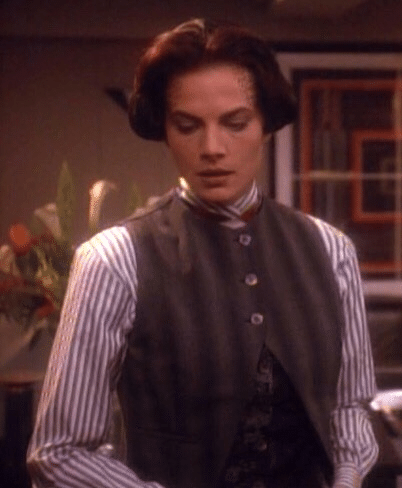
Deep Space Dive: A Star Trek Deep Space Nine pod: Jadzia Axelrod on Jadzia Dax

Jadzia Dax is a woman in science, a member of a structurally gender fluid species, and a batleth swinging badass. She has one of the best coming out as trans scenes. She’s lived many lives and she’s the emotional glue that holds the crew together. Dax is a beloved Star Trek Deep Space Nine character and she shares a name (and more) with a fantastic writer who joins as our guest:

Jadzia Axelrod is the GLAAD award nominated comics writer of Galaxy: The Prettiest Star and Hawkgirl for DC Comics. She’s the writer of The DC Book of Pride for DK, as well as The Battle of Blood and Ink for Tor. Obviously we needed to have Jadzia on to talk about Jadzia.

You can listen to Jadzia talk about Galaxy and Hawkgirl on Graphic Policy Radio here.

Follow Jadzia here https://www.jaredaxelrod.com/ and as PlanetX on the socials https://twitter.com/planetx 


Transcript

Jadzia Axelrod on Jadzia Dax

Graphic Policy Radio’s Deep Space Dive is hosted by Elana Levin and Sarah Daniel Rasher. 

Music: David Raphael Levin
Editor: John Arminio
Transcript and listener guide: Sophia Longmuir 

Sarah: Deep Space Nine is the Star Trek with the greatest focus on political concepts like colonialism, feminism, queerness, and post-scarcity economics. Join hosts and guests who aren’t just Trekkies, but activists, academics, artists, therapists, and more as we do a deep dive into the text and subtext where few Star Trek podcasts have gone before. We’ll be discussing Deep Space Nine‘s themes and characters, not doing recaps. As a result, this show is full of spoilers. If you haven’t seen the entire series and want to, we suggest finishing your watch and then coming back to the archives, where all of the episodes will be waiting for you. 

Elana: Welcome to Deep Space Dive, a Deep Space Nine podcast from Graphic Policy Radio. We are your hosts. I’m Elana Levin, also the host of Graphic Policy Radio, and I’ve worked at the intersection of comics, nerd culture, and social change for over a decade. My biggest Trek cred is that I gave a speech on fan activism at a rally organized by Leta, AKA Chase Masterson.

Sarah: And I’m Sarah Daniel Rasher. When I’m not getting paid to use math to save the world, I write about film and figure skating. I was the founding captain of my high school Star Trek club, and I once got Nicole de Boer to kiss me at a convention. 

Elana: Hmm. Jadzia Dax represents a lot of things to a lot of people. She’s a woman of science, she’s a member of a structurally gender fluid species (the Trill), she’s a bat’leth, swinging badass, she has one of the best coming out as trans scenes in a show, and she’s often the emotional glue that holds the crew together. And her spots canonically go all the way down.

Sarah: To talk about her, joining us today is a writer who lives up to her name, Jadzia Axelrod. 

Jadzia Axelrod: Hello! It’s so nice to be here.

Elana: Yay. Welcome back.

Jadzia Axelrod: I don’t know if I have any Star Trek cred. Uh, I was a contributor to the DSZine comic anthology, that was a lot of fun, in which I did do– I wrote and drew a Jadzia Dax story, where she has a heart to heart with my second favorite character in DS9, the Klingon chef. 

Elana: Oh, yay!

Jadzia Axelrod: –best as it goes.

Elana: Oh my God, I love it. 

Sarah: Another character who deserves his own episode of this podcast. 

Jadzia Axelrod: Oh my gosh, please bring me back for that if you do.

Sarah: Jadzia Axelrod does have cred in many areas. She is the author of Galaxy: the Prettiest Star, and Hawkgirl for DC Comics, the DC Book of Pride for DK, as well as The Battle of Blood and Ink for Tor, Frankenstein’s Support Group for Misunderstood Monsters for Quirk Books, and the odd issue of Cat Ninja for Epic Originals. She lives in Philadelphia, where she cooks needlessly elaborate meals for her wonderful wife and delightful child. 

Elana: Jadzia has been on my comics podcast, Graphic Policy Radio, to talk about Galaxy, the Prettiest Star, which is a must for all queer comics fans, and those who love them. Uh, and also for Bowie fans, obviously, and we also get a bit of a taste for her Hawkgirl series, which is out now at DC Comics.

Jadzia Axelrod: Oh that was the wild thing. It’s like you brought up Hawkgirl and you didn’t even know it was coming.

Elana: I sensed it though from our conversation. I was like, we’re going to hear a Hawkgirl announcement any minute, but I’m respectful and I did not try to scoop anybody–

Jadzia Axelrod: –can keep no secrets, that’s the thing. 

Elana: I could, I’m like, she’s working on a Hawkgirl book, and now it exists. It is a really fun Kate book, even if you have no idea who Hawkgirl is. She is the one with the mace and wings and some Philly Eagles merch. So she’s, she’s that Hawkgirl. But, um, but I’m so– we knew we’d have to have you on to talk about your namesake. I mean, obviously, obviously.

Jadzia Axelrod: Um, yeah! I, I, I do have, uh, the same sounding name as Jadzia Dax. It is a human name, though, I do want to make that clear. Like, it is, it is from Eastern Europe, but it’s pronounced Yadya, not Jadzia. I like the Star Trek pronunciation, so I do go by Jadzia, but it’s not 100 percent just taking the name from Star Trek. It is a, a name from, uh, my heritage.

Elana: Oh, cool. Well, wouldn’t you believe my first question was I wanted to get your thoughts about the name Jadzia.

Jadzia Axelrod: Wow, we are so in sync.

Elana: And its significance for you, I know.

Jadzia Axelrod: It’s really great to be on this show, can I say, because I used to be on podca–podcasts to talk about nerd stuff all the time, and now the only time I’m on podcasts to talk about nerd stuff is my own nerd stuff, which is different than talking about someone else’s nerd stuff. So I’m very excited.

Elana: Oh, hooray. No, I’m really glad we got to make this happen. I would love to hear more about–about your name. 

Jadzia Axelrod: Well it means– the translations, uh, typically means “warrior woman” or, this is my favorite, “she who wants to fight”, which is a different thing than a warrior and I like that a lot. Uh, so it’s very fitting that Jadzia Dax, who is a woman who is frequently put in a masculine role over the series, has that name. Uh, and makes, makes a lot of sense. And it made a lot of sense for me when I was choosing a new name.

Elana: I love it. It’s like, it’s so interesting that this is like a, you know, a different pronunciation of a, of a, a name from another language that actually also makes sense with the character. Like I just, it didn’t even occur to me to think about that question.

Jadzia Axelrod: Yeah, it’s uh, it’s wild. It’s absolutely wild. Um, when I first considered it as a name, I um, made a joke. And, ‘cause I wanted to keep my original initial. Which was J, and none of the J names that I came across really lit my fire, and I was like, Ugh, I’m not really a Julie, that’s not me. And I made a joke that was like, maybe I’ll just do Jadzia, and when I did that, like, my heart started beating faster. And then, when I was like, well maybe, maybe I could be Jadzia, and then I started doing research on the name and found that originally came from where my father’s side of the family came from, and I was like, well, alright. This is probably meant to be. And then, as I was testing it out, my daughter said it for the first time, uh, and she said, JADZIIIAAA! In this tiny little baby voice, and I was like, nope, nope, we’re done! The search is over! I can’t change it now, that was too good.

Elana: Aw that’s so sweet, that’s so sweet. I love that. That is so beautiful. I, I like I– your– people’s names should make their heart be faster. That should be true for anyone regardless of what phase in life you are, I think.

Sarah: Yeah. 

Jadzia Axelrod: Agreed.

Elana: So tell us, what is your history with Deep Space Nine as a TV show?

Jadzia Axelrod: Um, well, it’s my favorite Trek, number one. Like bar none. Um, like, I love Lower Decks now, but Lower Decks is still second place.

Sarah: Yeah. 

Jadzia Axelrod: And also, lo– Um, Deep Space Nine walked so that Lower Decks can run, like it, it, it– clearly the DNA of one is in the show of the other, like that’s obvious. But it’s all– it’s been my favorite Trek. I couldn’t watch it when it was originally on, because we couldn’t, didn’t have the television channel that it was on, so all my friends in middle school were watching it and excited about it, and I was like, I don’t know what you’re talking about, but it sounds fun. I could watch Next Generation, because it was on a completely another channel. Um, but I couldn’t watch Deep Space Nine. So it wasn’t until, um, all my friends had moved on, that I had discovered Deep Space Nine for myself, and just fell in love, and still continue to this day. I– rewatching episodes for this podcast, like, I hadn’t rewatched them in a while, and then, the moment I hit play and there was Quark’s weird little face on the screen, and I was like, aw, yeah, this is great. So it’s like my comfort show now, which is weird because it’s not a comforting show. It’s about very difficult questions that don’t have answers, that’s its whole thing. But it is comforting to see those characters grapple with those situations.

Sarah: Mmhm, I think, yeah, it’s become a comfort show, I think for a lot of people, and I think that the pandemic kind of accelerated that?

Jadzia Axelrod: Oh, it was so relatable during the pandemic, because we did start rewatching it during the pandemic, and there would just be scenes where, uh, Sisko is just so exhausted to have to get onto another Zoom call. And it’s like, no, I get, I get this. I feel it. 

Elana: Well, no, I’m, yeah– I’m, I think our, our postulate, we began the podcast during the ongoing pandemic and it was partially like, we realized how good it felt to watch people with power dealing with hard problems who, even if they couldn’t solve things were at least really trying hard and were serious about their work and making the best decisions they could, uh, it was like, look–

Jadzia Axelrod: Despite like us falling apart.

Elana: Yeah, yeah. It’s like, it’s like these people are taking their job seriously. Unlike the people in charge right now, and that feels nice. So, um, I’m not surprised… That–that–that’s sort of the official show I think working theory on why it speaks to folks right now so much. But um, but yeah, it, it is, it is funny ’cause a lot of what people think of in terms of comfort viewing is a lot more cuddly than this.

Jadzia Axelrod: Yeah, it’s one of the least cuddly Trek shows and I think that’s part of the charm? Um, because they’re not a family, right? Like, the whole thing is they are a workplace. And like, half of them don’t like the other. Like, no one likes Quark, but they also couldn’t imagine not having Quark there. And it’s, it doesn’t feel the same way other Trek shows feel because they’re not traveling anywhere, they’re not a tight knit unit so much as they are a collective of people with mostly similar goals, and, um, I just love it. I just love it because it allows for that sort of complexity of narrative because they’re there’s not um, a planet of the week, because there’s not an overarching mission of discovery and exploration, because they are stuck there and they have to deal with consequences, especially in the latter seasons when they were allowed to kind of have a proto-Battlestar Galactica feeling to them. Like, you can really see how Battlestar Galactica was like, ‘this is the story I wanted to tell’ from Ronald D. Moore. ‘They wouldn’t let me at Deep Space Nine’. Um, but that idea of, like, after the Enterprise leaves the planet, ‘what happens then?’, is kind of Deep Space Nine‘s whole ethos, and that is fascinating to me just in general, but especially as a writer, to be like, ‘yeah, what does happen after the Enterprise leaves?’, and like, the revolution has been successfully happened, but like, what happens to the revolutionaries, once that goes on, and those questions, um, are always going to be interesting.

Sarah: Yeah, and also that idea of, like, what happens to the parts of the Star Trek universe where humans aren’t the default and aren’t the center of the narrative. 

Jadzia Axelrod: Yes! Yes! As someone who loves aliens and also, um, makeup appliances. Two different ideas that nonetheless go hand in hand in television. Uh, Deep Space Nine is a, uh, goldmine for that.

Sarah: Yeah, so one of the other things that I’ve seen in my sort of very specific circles of the internet that I think probably intersect with yours is that more and more, um, Jadzia Dax has been embraced as an icon for trans fans and is unusual in that, um, she is embraced by, um, trans fans regardless of their sort of gender identity and gender journey. So transmasculine, transfeminine, nonbinary, agender, you sort of hear from across that spectrum getting very excited about Jadzia as somebody who represents their experience. And why do you think that she has that appeal for such a wide range of trans fans? 

Jadzia Axelrod: Uh, I think it’s twofold. One is that with the multiple lives behind her that are both male and female, that idea, um, even though she’s female bodied during the show, um, she can still embody a sort of transmasculine idea, because she brings forth the, the male persona. You can really see this in, uh, “Rejoined”, where Terry Farrell kind of slides back and forth between masculine and feminine body language, as, depending on the scene and how it goes, which is fascinating. But like, she can embody those previous hosts in a masculine way, uh, but also, she is a woman now, and that is something that’s a part of her and something she enjoys and doesn’t try to hide or diminish. And so that’s something that trans feminine people can do. Uh, the other way I think this works is something I found with Galaxy: the Prettiest Star. Um, that character Galaxy, uh, Taylor Barzelay, she has also been embraced by people who are transmasc or non-binary. And I think part of that is that sci-fi element where you don’t have to get bogged down in the transition itself, so it’s not about the hormones you take, and the way your body changes, so much as there was a change. And that change is what people identify with more than the specifics. Which was the goal, so I’m glad that worked. But I think that’s something that also fits with Jadzia, in that she has a pa– she has past lives. They are different than who she is now. Um, there’s one of my favorite lines. In, um, “Trials and Tribble-ations”, where she wants to go and meet, Koloth, right? A Klingon friend of Curzon’s. And she says, ‘it’s not like he’ll recognize me, so it’s okay to do this time travel, mess with the past thing, because he won’t recognize me, I look different.’ Um, which is such a trans thing to say. And, like, that’s, appealing, even no matter what your body looks like, I feel

Elana: I mean, for me, it’s so funny because you’ll totally see people tie themselves into knots about like, oh, are they misgendering? Is Sisko misgendering Dax by calling her ‘old man’? And I’m like, it feels really validating to me that someone can look at someone who most people would assume was a young woman and also acknowledge this other aspect of her actually.

Jadzia Axelrod: Right! Yeah, the old man–

Elana: Old Man-ness. 

Jadzia Axelrod: The ‘old man’ thing is weird, right? And like, we can, I don’t know if this– Yeah, we’ll go ahead and get into this. Because Trill society, as presented in Star Trek, makes no sense and is easily contradictory, ‘cause the whole point of it is you’re supposed to– If you’re a Joined Trill, right, you have the Symbiont inside you, you are supposed to seek out new lives. You are not supposed to associate with people in your own life, you are to find new experiences. Which is refuted by the entire show, where Jadzia is hanging out with an old student of hers, but that’s fine. It’s other times where she meets old members of her past that it’s not okay. But it’s just, that doesn’t make any, even make any sense, because you’re going to find the same people over and over again, because you’re going to be drawn to the same people over and over again. 

Sarah: Yeah, I think that Trill society is one of the least explored alien societies within the Star Trek universe, especially for–

Jadzia Axelrod: It is barely explored!

Sarah: Yeah, for a species where there have been multiple mai– you know, like main cast characters, but you’re right. I think one of the main reasons is that if they actually tried to explore it as a society, it would be like, none of this makes any sense, none of this is sustainable as an actual culture. 

Jadzia Axelrod: Yeah, it’s, it’s, it works as a metaphor, and it works as, like, one person. But the moment you put in a whole society, it’s like, wait a second. Um, but one thing I do like is that what little Trill we’ve seen around is not like Jadzia at all. Like, they are not like her. They are more like the prescribed notion of like, you are a new life, you move on, and you don’t allow what happened previous to affect who you are. Whereas Jadzia all the time is evoking her previous lives and enjoying that and relishing that. And so I feel like Jadzia is an atypical Trill in a lot of ways. And that’s certainly borne out in the way other Trill treat her. You can either look at it as the entire Trill culture are jerks, or they just look down on Jadzia because she’s not like the others. Um, or they, those are not mutually exclusive ideas, I guess. They could both be jerks and not like the way that she kind of slides so easily between the, um, previous lives and also the Dax essence itself.

Elana: They are jealous. 

Sarah: Yeah. And, um, it’s part of a pattern, I think, in Deep Space Nine of a lot of the, um, alien characters who are the only one or one of only a few on Deep Space Nine that like Quark is in a lot of ways a very atypical Ferengi. Garak is in a lot of ways a very atypical Cardassian. Like we see that Worf is a very atypical Klingon. We see that as sort of a through line among a lot of the alien characters. And so she fits in in that, in the group in that way. But yeah, she–

Jadzia Axelrod: She’s also in the ascent of space, right? Like, this is the other thing. Like, nobody on Deep Space Nine, uh, can be anywhere else because if they could, they would be.

Elana: Hmm.

Jadzia Axelrod: I mean, that’s certainly how this show starts, like, about halfway through, like, Worf is there. And Worf can be anywhere, he’s a decorated Starfleet officer. But, like, that opening is, you know, we’re in the Wild West, and the people are here because they have nowhere else to go, and we have to make do with it. And one of that– and Jadzia stands out, because, like, why is she here? She does not seem to fit with everybody else. She seems like a bright young woman with a future ahead of her and an extensive past. But to kind of position her as like an atypical Trill who maybe doesn’t feel at home in Trill society, um, and that could be something about Dax because the previous lives were travelers and roamers and people who interacted without the Trill society, for the most part, like, Curzon was a big diplomat, I know the gymnast, whose name I’m forgetting, was frequently involved in Starfleet stuff despite not being a Starfleet person.

Elana: Really?

Jadzia Axelrod: Yeah, um, just by happenstance, it was one of those things. Spent a lot of time on Earth, apparently. And so, like, there’s this element of Dax, in general, just not being someone who likes the Trills.

Elana: Good..

Jadzia Axelrod: And then that’s, I think, compounded with Jadzia, who, again, is embracing of all her past lives and at the same time, wants to do entirely new things than they did– but yet surround herself with her past.

Elana: I was really struck during this rewatch at how much of a character note it is that Jadzia does not want to go to Trill and feels really anxious and like traumatized by what she went through on the home world, both as an initiate and just in general. And like, I kind of love that like, you know, that as a, as a beat for her, if you want to. Yeah.

Jadzia Axelrod: Yeah. It’s, and it’s really interesting too, because like. When Curzon rejects her initially, he says it’s because she would get too lost in the previous lives. Like, there’s not enough of herself to handle a Trill Symbiont. Like, she needs to have more of an identity beyond being just someone who has a Trill inside of her. And so when we see her now, as someone who is bonded with the Dax Symbiont, she still gets overwhelmed by those previous lives and finds herself caught up in the emotions and feelings of the people who came before her, um, in a way we don’t see other Trill doing. Um, so while that’s presented as, like, a bit of a trumped up reason because also Curzon was in love with her or something, I don’t know– that, that episode is weird, but if we take that at face value, it does seem to be something that’s borne out in who she is and how she lives, which is someone who surfs the reality of all these previous memories.

Sarah: Yeah. Something that you’re sort of moving toward that actually like we were just talking about right before we started the podcast, which, which is the, um, if you go through all of the main characters on Deep Space Nine Jadzia is the only one who we never see any of her family on screen, or at most mentioned in passing, or there’s like one or two jokes about them. Like almost everybody else, you see at least one parent. O’Brien, you don’t, but you hear a lot about his family and his past. Like, how does Jadzia’s lack of connection to her family feed into all this?

Jadzia Axelrod: Yeah, that’s a good question that I’m not even sure how to answer. Because we don’t really see who Jadzia, surname never revealed, exists. We see Jadzia Dax. But we don’t really see pre-Jadzia. In the same way that we see Odo before Deep Space Nine. We see Sisko before Deep Space Nine. We see Kira before Deep Space Nine. We meet uh, Julian’s family, even if we don’t see him before that. And so there is a delving into who these characters are before episode one starts. And while Jadzia talks about her past lives, she does not talk about her past life before she was a Joined Trill. And that’s I, I feel like that’s unexplored territory, and that will never be explored now. 

Sarah: Yeah, you get some flashes when, um, there’s discussion of her training and her sort of apprenticeship to Curzon, um, and it’s all sort of like, well, you were shy, you were sort of–

Jadzia Axelrod: Yeah, you do get a feeling that she doesn’t like who she was before joining.

Elana: Yeah.

Jadzia Axelrod: And that, whether that’s something that comes from being Joined with Dax, or it’s something that’s like, yeah, I was a try hard kid who was shy and never really knew what to do with myself. We’ve all been there. Who hasn’t looked at their school age time and been like, ‘oof boy, uh, you need to chill out’. So there’s something there, right? Like, looking at your younger self. But also, there does seem to be a very conscious effort to separate herself from everything that was Jadzia, uh, surname, surname never specified, with the exception of her love of science. Which is a new thing that the other lives didn’t have.

Sarah: There’s a sense that, like, her decision to become Joined had a lot to do with her desire to escape her past and to escape the person she used to be that she didn’t want to continue being.

Jadzia Axelrod: Yeah, that’s it. It’s annoying that that’s implied and never outright stated.

Sarah: Right. 

Jadzia Axelrod: You know, like that could have been a really cool monologue to give Terry and they never did.

Elana: Yeah. It also just feels very much like that is like a place where she, where she has test trauma. Um, like from, and that’s something that I think a lot of folks our age and younger relate to, um, is having been through an insane quantity of testing that, like, is just so intrusive and invasive. And it’s, it’s interesting because it works both on the, like, person who is either gifted or learning disabled, or perhaps learning disabled and gifted and been through the school system and has had to take a lot of tests in order to get their IEP, their individualized education plan approved so that they can have the accommodations they need or the classes they’d like to access, but also feels very much like trying to get hormones from your doctors. It kind of is like on multiple levels of like these gatekeepers who have to insist on asking her questions and keeping things from her.

Sarah: She also in, um, and I’d forgotten about this, but we, uh, did we all rewatch “Equilibrium”? But, um, that actually expresses some medical trauma there too, that like, she doesn’t want to go to the doctor, she doesn’t want to be medically evaluated, that she seems to have some association with negative experiences in the past there too. Um, and Julian very, very sweetly talks her down from that. Um, but, um, I think that that’s something that a lot, that a lot of, um, trans folks have in common with her too

Jadzia Axelrod: Oh 100 percent, yeah.

Elana: I, it was really powerful, um, watching Sisko in that episode stand up to the doctors demanding they give Dax the right to self determination on how she should be treated. Um, I mean, it just really seemed like a parallel to me for letting trans people make their own medical decisions. Because this doctor was totally just making the doctor on– for folks who haven’t recently we watched the episode when, when Dax goes back to the Trill homeworld because like equilibrium her, whatever her levels are messed up and it’s all tied into that secret life that was hidden from her. You know, backstory, the, um, the– one of the Trill doctors is basically saying like, ‘well, if we let her know, you know, it could be dangerous to her, she might not recover’. And Sisko is just like, ‘you don’t get to fucking decide for her. She deserves– why don’t you bring her out of coma and ask her what she wants’. And like this Trill doctor who cannot even occur to them to like respect her autonomy or ask her for what she wants, feels to me very typical of what Trill society must have been like.

Jadzia Axelrod: Yeah, yeah, it seems a very regulated society right, like it seemed– especially if you are involved with the symbionts and want to be a Joined person, like it’s a very, almost fascist-esque society where it’s like ‘you have to follow these rules in order to do it’. Um, and it’s, I think it’s an “Equilibrium”, I’ve watched so many episodes, they’re blending together now. But I think it’s in “Equilibrium” where it’s revealed that like a lot more people can be bonded to a Trill than they’ve let on.

Elana: Hmm.

Jadzia Axelrod: Right, so it’s like not only is this thing regulated and in, and very difficult, but it’s like needlessly so.

Elana: I, I’m just so struck at how apt it seems.

Sarah: Talk about this is that it also ties into, um, both the pattern throughout the show of people, um, having sort of mental health crisis moments and then finding ways to recover from them, some of them organic and some of them like coming and going as the plot requires, (O’Brien), but, um, but that, um, We tend not, we tend to talk about, you know, Garak’s trauma and claustrophobia and panic attacks, and then O’Brien’s recovery from the imprisonment trauma and Nog recovering from the sort of– his sort of combat trauma and the trauma of losing his leg, and I feel like Dax’s mental health journey with the uncovering of Duran and the incorporation of Duran, where during “Equilibrium” she is basically having dissociative episodes. 

Jadzia Axelrod: Yeah. 

Sarah: Like it really fits into this pattern of like so many people on Deep Space Nine are dealing with serious mental health trauma.

Jadzia Axelrod: Yeah, well, you don’t go to Deep Space Nine if you’re mentally healthy. Like, a mentally healthy person does not look at a Bajoran outpost on a broken Cardassian space station and is like, That’s where I need to go. 

Sarah: Yeah, so when we were asking like, ‘well, what is this bright young woman with this great future doing there?’ It’s like, well, she’s a mess is the, it might be the answer. Like, she’s somebody who needs…

Jadzia Axelrod: She’s competent enough to be a lieutenant in Starfleet. That’s, and that’s not easy. But at the same time is like actively separating herself from any sort of personal bonds. Like, it’s funny that the friends that she has are Curzons, right? Like, that’s her friends. We don’t see friends from Jadzia’s past. We see Sisko, we see Martok and Korath and Kang and all those guys who are Curzon’s friends. We don’t see Jadzia’s friends.

Sarah: Yeah. She is, she, she cut off whatever social world she had before joining. She cut that off hard.

Jadzia Axelrod: Which also feels very trans, right? It’s like these are the friends I made before I transitioned. They’re still my friends, I haven’t been this person long enough to make friends who just know me as me yet, and I can see how that’s very appealing.

Sarah: But also saying like, this group of friends. I can make the transition with. 

Jadzia Axelrod: Mm hmm!

Sarah: And then this group of friends and family, like, the only way to transition is to remove them from my life

Jadzia Axelrod: Right. Yeah, it’s like you guys are cool, my family, however, will get a letter sometimes.

Elana: Why don’t we talk about that scene with her and her Klingon Blood Oath brothers, um, which is so powerful that it’s become a meme really at this point. “Blood Oath” is, “Blood Oath” is that good, everyone. “Blood Oath” is–

Jadzia Axelrod: I was surprised! I was surprised because I watched it going in with like, even like high expectations because I’d watched “Rejoined” right before it, which is great, um, and, and an atypical Star Trek episode in a lot of ways. And then watching, um, “Blood Oath”, and it’s like, this is also great! And it’s, and it shouldn’t be, honestly. I mean, the, the the conceit is so hoary. It’s like, ‘let’s get the gang back together for one last ride, right?’ And it’s like bringing back these original series actors to play their characters again, but they’re now a hundred years older. It’s so silly, and yet, because all of these guys are these incredibly talented workhorse character actors, like it’s so grounded and you feel all the emotions, and I love Klingons in general because everything is operatic, right? It’s never just, ‘oh, it’s a nice day today’. It’s always like, ‘the day has grown upon us and should we be damned or should we be blessed? We shall move forward.’ Like it’s all, everything is too huge with Klingons and I love that. Um, yeah, and so like it really it feels– it elevates the scenario which could just as easily be any other television show in any medium or format. But because it is Star Trek, we get this idea of how much do you owe your past self, in a very visceral way. If Curzon made this blood oath, is Jadzia responsible? And everyone says no, and Jadzia says ‘yes, actually, I am responsible’. Um, which again, goes back to that whole previous life bleed that Jadzia is such a part of her and is so comfortable with in a way that we don’t see other Trill being.

Elana: So why do you think she feels that obligation?

Jadzia Axelrod: Because it’s hard for her to separate herself from her past lives. Like, she talks about not Curzon’s godson, but her godson.

Elana: Yeah. 

Jadzia Axelrod: In the same way that she talks about Lenara in “Rejoined” as her wife. Like, these, this is– the past lives are visceral to Jadzia, in a way they aren’t even to Ezri who has trouble, like, separating them, but they’re not, uh, visceral to her. Like, it’s not a Dax thing to have this sort of wandering bleed of past lives, that’s a Jadzia thing that she embraces and enjoys. And I think that’s fascinating, that like, she feels more comfortable with that, with the people of a past life, with the setting of a past life than she does in her own. Life which we, again, never see.

Sarah: And even as she’s establishing herself as, you know, this, really this war hero, and as this person who really does have a unique legacy and unique relationships that are all her own, that, yeah, that part, I think that almost part of her construction of her personality as a Joined person is like not prioritizing her current self as separate from her prior selves, but just as, this is who I am now, but all of these other people are also who I am. 

Jadzia Axelrod: She is truly a gestalt entity in a way that the other Trills, even her past life and then future life with Ezri, are not. She has to explain Trill identity to people who knew Curzon. So clearly, Curzon is not someone who talked about past lives frequently to these men whom are– he is so close that one of them is, made him the godfather of his child, right? These are tight emotional bonds that he had with these men, and he clearly never talked about a past life that he had. Because when Jadzia says hi, I’m Curzon, they do not believe her. Like, this seems like the most ridiculous thing. And part of that is because every episode is someone’s first, right? So you have to explain Jadzia’s deal in the course of the story, so people understand. But, the consequence of that is very interesting and it means that Curzon did not talk about his past lives to these men, whom he shared everything with.

Sarah: I’m not sure Blood Oath was the first episode of Deep Space Nine I ever saw, but it was like, no more than the second or third one I ever, like, it might be the first episode of Deep Space Nine I ever saw. 

Elana: That’s a good way to get started. But I have a theory for why in canon this is true though, with why Curzon would not have talked about this with the Klingons is– I think because, because Trill society has historically been sexist, his assumption about the functioning of Klingon society would be such that the Klingons would not take him seriously as a man if they knew he had not always been a man. And then Dax is the person who actually understanding the Klingon culture fully, but also through the lens of having like being, you know, present as a woman in this moment is like, I think they can handle this actually. Like, I think we should give them a chance to understand the thing actually.

Jadzia Axelrod: I mean, I think that tracks, but also there’s been male um, previous lives to Curzon, right? One of which was a shuttle pilot. And so like they’re in space, that must’ve come up, right? It was like, yeah, I know how to fly this shuttle because my previous life was a, was a shuttle pilot who was a dude. We’re all dudes here. Just guying around, dude style. Um, so I think, I think that certainly works, but also, um, you know, it’s just weird– the only way that makes sense that he never spoke about it at all is because that’s just not what Trills do. And like, again, Jadzia is an atypical Trill, in that she flaunts her past lives. She luxuriates in them. She makes sure you know them and you know them by name, because they are important to her and in a way it almost feels like overcompensating, right? Like she’s like I am more than me. I am also these other six people. You don’t have to, like, judge me on face value, because I am also six people you can’t see. Trust me.

Elana: I love that for her. 

Sarah: It’s one of the, something that has come up and I, I apologize to whoever I was discussing this with in case they’re listening because I, because I’m pretty sure it wasn’t my wife, but it was like somebody else, but I can’t remember who, um, is that we tend to presuppose because Klingon culture is intermittently very sexist and has a sense of like overall old-fashionedness to it, we tend to presuppose that it’s also a homophobic and transphobic culture and the sort of like, well, what if it’s not? Like, what if it’s, that’s not been one of their problems for centuries? Like, what if they worked that out and they think, you know, you know, your child says he’s a boy and has been a boy all along, you just give him the hormones and let him pick his new name and things just motor right along and that that’s just something that’s part of Klingon culture that’s just sort of accepted. Um…

Jadzia Axelrod: My wife, and I have a headcanon that, um, Klingons are very– because they’re so personally– It’s all about the personal journey, right? Your progress, your journey forward, what you’re supposed to be going toward, that they are very trans positive, and that it is no big deal. And it’s like, I don’t know, Dad, I just feel more like throwing furniture than reading poetry. And it’s like, ‘well, then you’re my daughter and I love you. Here is a chair, throw it at whoever you love.’ And like, that sort of thing would be, like if you can prove yourself as a man or a woman, then that’s all that matters. It doesn’t really matter your origins, right? Like there’s not a caste system in Klingon, I mean, there is, but you know what I mean.

Elana: Yeah. Yeah.

Jadzia Axelrod: That it’s like this, it’s very much like the personal journey, and like, if you can rise above, if you can kill your commander and take his place, if you can do that, then you deserve it! Like, you’ve earned that by your own personal determination, so yeah, I 100 percent believe that not only do Klingons accept trans people, but they also accept queer people and there are scenarios where two men just read poetry to each other and two women throw furniture. I mean, both of those sound hot, honestly.

Sarah: And that sort of tracks with her romance with Worf, which, um, generally the consensus is that Jadzia and Worf are one of the few canon couples that are actually hot and make sense. Um, that like, Worf has all kinds of anxieties about being with Jadzia and he, you know, his jealousy and his biphobia come into play. But like–

Jadzia Axelrod: That’s the Jewish side of him and, you know, he’s working on it. 

Sarah: He’s working on it. Yeah. But one of the things that never seems to faze him is the fact that she used to be a man. 

Jadzia Axelrod: Yeah, no problem with that.

Sarah: No problem.

Elana: Do we have any other things we want to point to from the blood oath, from blood oath episode, or?

Jadzia Axelrod: It’s just so great to see a show with older actors. Like, people who really have studied their craft, and like, then they come on the show and they just make Shakespeare out of the silliest of billies. I love that.

Elana: So good.

Jadzia Axelrod: I love that. It’s, it’s something that Deep Space Nine does a lot. They’re frequently pulling from the well of these stage actors who are so talented. And they have them come on for uh, in the case of Martok, several episodes, but for the most part like one or two episodes, and they just really ground some of the most ridiculous ideas, and it’s just a delight. And you don’t see that as much, especially in the recent Trek stuff, which I think is really a shame.

Elana: Agreed. I also think one of the reasons why the gif of…

Jadzia Axelrod: Kor.

Elana: Kor, sorry, of Kor saying, ‘ah, Jadzia, my old friend’, is so beloved by people is that there’s something powerful about being this obviously craggly old man being the person who can just throw up his arms and embrace his friend and say, ‘okay, these are your pronouns, that’s your name, and I’m taking you at your word’. And that’s that.

Jadzia Axelrod: Yeah and it, again, speaks to an element of trans culture within the Klingon universe that he doesn’t miss a beat and is like, ‘Oh, you’re Jadzia now. Yeah, you’re my– still my old friend’.

Elana: I love them.

Sarah: I think it is actually sort of an, an, like, like the experience, the negative experiences that people have with like older relatives or older co-workers. Like they, the majority of them are negative to neutral, so that tends to be like the assumption, but the number of trans people who, if asked, can talk about that one person who’s much older than them, who had a really wonderful reaction and never got their pronouns wrong again. Like, a lot of us could come up with that one person and can use it really as a way to say ‘hey, um, it’s not that like age makes it impossible for you to embrace change in others. It’s just all of us have been burned so badly that we like, erase the positive examples and the people who have been really great advocates.’ I’m even, um, I’m thinking about my parents, have some friends that I didn’t really get to know until after our wedding and they came to our wedding and like, they’d never known me or Amy as anybody else except like how we look and how we present ourselves after transition. And they just like, know us and these are people in like their 60s and 70s and pretty much never mess it up and pretty much are just like excited to know us and learn about us as we are, and like I feel like so many of those older people are out there and don’t get the acknowledgement that would I think help other people of their generation be more understanding and be more embracing of change and difference. 

Jadzia Axelrod: Yeah, I think it’s a, it’s a, it’s a false reason, right? Like it’s what people cling to, because they don’t want to take the responsibility for their own actions. And it’s just like, ‘oh, that’s just how I was raised, that’s just the time’, when it’s clearly not true, because there are people of older age who have no problems with that? Um, and it’s, it’s definitely a personal difficulty that they like to make a generational one, and it’s so great to have this very clearly an older man roll with the punches here and be like, ‘yeah, okay. I got it, moving on.’

Elana: Do we want to talk about her relationship with Worf some? Um, because yeah, we definitely had, you know, like, I definitely agree that like Worf and Jadzia make sense as a couple and they actually have chemistry and they actually seem hot. Um, what– a listener. This is also true. Listener, uh, comic book writer themself, uh, B Khan asked, “How many seconds did it take Dax to realize she was extremely into Worf?” And it’s interesting, because I watched an early interaction with them and I’m not sure I know the answer to that. What do you think, Dax? Dax, wow. What do you think, Jadzia? I’m sorry.

Jadzia Axelrod: No no, I love that that happened, I just wanted to let it sit there for a moment. Um I think, I don’t think she, I don’t think she was attracted to him until he let some of his walls down. I think he had a lot of walls up and that made him like a great target for ridicule from her. Like there’s a lot of teasing that goes on early on and I don’t think that teasing has a flirtatious aspect until he starts to loosen up a bit, which is a nice little character move. That he has to like open up before she’s attracted to him. And and I like that. And that’s, that’s my, my theory on it. And I don’t know when exactly the moment is that things start to change, um, I want to say it’s the second episode of his first appearance because it’s a two parter and it’s near the end that he starts to loosen up a bit, and then their relationship starts to change from then on. I think, I haven’t watched that episode in a long time. It is strange then that they have the Risa episode and like, they’re clearly in a relation– in flirtation mode, and then he regresses, and then she gets mad at him. Um, but, I think that, they, they’re, she is someone who’s very open, which is very cool, and I like that about her, and that, about what she’s thinking and what she’s feeling, and that’s never something that’s being hidden, with the exception of her life as Jadzia surname never specified.

Elana: Mm.

Jadzia Axelrod: But like, and so then, her job then is to open up Worf, who is, by nature and incredibly understandably given his history, he is very closed off, like he has had to be for his entire life in order to kind of just get through childhood. And then Starfleet, like he’s had to be a very collected and calm and guarded person. And then, what’s weird, it’s weird watching these episodes again and you see people be casually racist to Worf, and it’s like, how is this allowed? In the 21st century, no one’s calling this out? Why is it okay to be racist to Klingons? I don’t understand. Um, not the 20, the 24th century. If you, if you look at that as text, right, and it’s like, oh, Worf has probably had a lot of, uh, microaggressions thrown his way his entire life, being a Klingon in human society. And their pairing also is very similar in the same way that, Jadzia can go back to Trill, but she knows she’s not welcome there. Um, Worf can go back to the Klingon homeworld, or go back to the Rozhenkos. Did we ever, was it ever established where the Rozhenkos live? They feel very Jersey. But I don’t think that’s true. Um…

Elana: I don’t know. I don’t know if we talked, you know, we had the one, that, that, that very robust Worf episode with fellow Jew of color Raf Shimunov, and I don’t know if we talked about where the Rozhenkos live, but I could see…

Jadzia Axelrod: I don’t think it’s, is it established? 

Sarah: This is me trying to like, pull up Next Generation lore, which is much rustier than Deep Space Nine lore. Um, it’s they, he was raised on a colony…

Jadzia Axelrod: Okay. That’s right. That’s right.

Sarah: But they now live on Earth, and it’s somewhere in Eastern Europe, it is not really well pinned down. 

Jadzia Axelrod: Of course.

Sarah: Because of their surname, I just assume that it’s Ukraine, but like it could be anywhere in that part of the world.

Jadzia Axelrod: Right, just him having to be closed off and how he, he can go back to his, where his parents live, he can go back to the Klingon home world, but he’s not going to fit in there. Um, and either way, uh, he spent too much time not around Klingons, so he can’t really exist in either world. I can see them bonding over that, even if they don’t explicitly say it. There’s something about, um, these two who are, are not necessarily outcasts, but definitely outsiders in their own cultures.

Elana: What’s interesting is, you know, once you see them as a couple, it’s like, well, of course, Dax wants to be with a Klingon. Dax loves Klingons. Like, how could anything else be true? You know, like, what, what I, I, I, I couldn’t imagine Dax being with a non Klingon in a way, because that’s a culture that she has such a passion towards. 

Sarah: Um, and it’s also something, and I know that we don’t want to get too deep into the whole, one sided. obsessions that both Julian and Quark have for her. Like, those are such a problem and often the result of bad writing that, like, I don’t think we want to get too deeply into those, but I think that the way we can look at it is–

Jadzia Axelrod: Julian’s repressed homosexuality, of course.

Sarah: I mean, I’d go more for, first of all, bi, and second of all, with the amount of fun he’s having with certain Cardassians, it’s not real repressed. Um, but, uh…

Jadzia Axelrod: Right, but in the beginning, it’s very much repressed.

Sarah: Oh, yeah, I mean, but, you know, Garak jumps in there pretty fast.

Jadzia Axelrod: Sure. Like, Garak solves all his problems. I think we can agree on that.

Sarah: But I was going to say that like there that I’m sure that looking the way Jadzia looks and presumably has looked for a long time, and this does seem to be something that Terry Farrell taps into in her portrayal of the character and in the way she responds to these two men very aggressively declaring their interest in her, is that like when you– when you have an entire lifetime of mostly men approaching you that way, that like having somebody who clearly has interest in you and who clearly you connect with and, um, feel interest in, who you can tell is absolutely never going to behave that way and is absolutely never going to act like he’s entitled to your attention because he’s interested in you? I can see that being a big part of Worf’s appeal for her. That like, she knows he’s feeling it, they get along, she can see a future there, the attraction is there, but she knows he’s not going to make a big first move. He’s not going to push it past where she’s comfortable, he’s always going to acknowledge her agency in the relationship. And other things that are never stated but are very firm in my own headcanon are, he learned all this from dating Deanna Troi, like, you know, you date a therapist.

Elana: Hmm.

Sarah: Yeah, 

Jadzia Axelrod: I mean, he’s also a little older than– Quark is, who knows how old he is, but he is not a mature person. Right? And Julian is, you know, an adorable twink. So, like, he has a maturity that they don’t have, and that has to be very attractive to someone like Dax, who carries around a maturity that belies her appearance.

Elana: You know, I, I think this might be a good entry point to talking about Terry Ferrell’s performance as an actor in the series. Um, this was her first real, you know, acting– significant acting role in that way. Although actually, wait, when did the, um, horror movie come out? When did the Hellraiser come out?

Sarah: I don’t know, I’d have to look it up.

Jadzia Axelrod: I don’t know anything about the Hellraisers, but I do know she played Cat in the American pilot of Red Dwarf that was apparently awful. 

Sarah: Yeah. she had some roles before this, but I think that she talks about it as like her first sort of big starring role.

Jadzia Axelrod: Yeah. 

Elana: Which is just funny to me. So yeah, Hellraiser 3 was one year before, because to me, Hellraiser 3 is still like a pretty big deal, but that’s because I’m a Hellraiser fan. Needless to say, this was, this was a big career, you know, step for her. I think you really see her grow as a performer insanely quickly through the series when, when I was watching– and she’s someone who has to embody, yeah, like a whole different range of gender and ages and bearings and presentations throughout the whole series. And I was, I was rewatching the very end of “Rejoined”. There’s the moment where she sees her ex get on the shuttle transport, you can see that she is about to absolutely fall into tears, and then she realizes that that will not help her and she’s going to put the mask back on and like try to brush it off, and she communicates all of this with a single hardly audible sigh and movement of her neck, and it’s just astonishing. 

Jadzia Axelrod: Well, I think a lot of that comes from the fact that her main scene partner for Deep Space Nine is Avery Brooks, who is a master class in acting in general, and also directed her in “Rejoined”, which is why the performances are so good in that show. And like, how can you not like learn from watching that man do his thing? There’s a great, he’s, he’s got one scene in “Blood Oath”. So we are going to talk about “Blood Oath” once again.

Sarah: Hehe.

Jadzia Axelrod: You asked and now I’m coming back. Where he run– he comes into Jadzia’s room to tell her that she can’t have leave to go on this wild goose chase, and he comes in and he’s out of breath. The implication being that he ran all the way from Ops down to Jadzia’s quarters to tell her not to go. And like, to have that sort of being in the moment, that present of mind of not just where I am when the scene starts, but where I am before the scene has begun is so great. So like, he is there, and to be a young actor and to see him work, you had to pick up all the stuff that he is putting down, right? Like there’s no way. And so like, and clearly a quick study, because she’s amazing. Again, to go back to “Rejoined”, an amazing performance there. Like I love the way that she shifts between masculine and feminine body language throughout that episode depending on what the scene requires of her character. Um, and it’s something that she does all through the show, right? But it’s very evident in “Rejoined” in a really nice way.

Sarah: Yeah. It’s, I think it’s notable in terms of her acting that she began as a model and a lot of models cannot make a successful transition to acting, but the ones who do, one of the things they seem to draw on very well is, using your physicality to tell a story because so much of modeling, you don’t have lines at your disposal. Everything that you’re doing is with your body. So I think, yeah, all of these examples that you’re mentioning really feed into that idea that as she was learning to think of herself as an actress rather than as a model, that you see her drawing on the idea of ‘how much can I convey with my body? What am I using my body to say here on top of how am I delivering the lines?’ And you’re right, there’s so many examples of her, giving a lot physically and often filling in between what’s on the page for her. Another kind of contrasting example I’m thinking of is in “Trials and Tribble-ations”, just like how giddy she is the entire episode, and to convey in a way that doesn’t make her seem foolish, just makes her seem excited and happy and to maintain that register, um, throughout and to put levels into–

Jadzia Axelrod: She swings her hips more–

Sarah: Yeah. 

Jadzia Axelrod: –in that old uniform. Like when she walks, she does an exaggerated hip sway, which she does not do in the DS9 jumpsuit.

Elana: No…

Jadzia Axelrod: Um, so that’s very fun.

Elana: That, that actually brings me to a question I, I wasn’t sure if I was gonna do, but I’m like, no, we actually have to talk about this. So when you’re looking for gifs of Dax in the internets, the, the GIF keyboard will immediately first pull her stuff from, um, “Trouble with Tribbles”, and then after that, it’ll all then be stuff from her in the holodeck. Like people are pulling images of her where she is not– in anything but her Star Trek uniform and it’s–

Jadzia Axelrod: Which is weird because she looks great in that uniform.

Elana: Well, I think that there’s a subset of the, I mean, like, look, I think she’s hot, but I think that there’s a subset of fans who, because they’re pea-brained, can– they only want to see her sexualized in a very traditional way and they jump at any opportunity to try to view her in a way they’re, like, those are all costumes for Dax. That’s Dax doing a play. That’s not Dax being Dax. 

Jadzia Axelrod: And it’s weird too, because that– her normal DS9 jumpsuit is tailored within an inch of her life. Like especially in the later seasons with the gray shoulders, like that thing, she could not take a breath like a deep breath and not have a seam split. So it is weird to me that like a character who is always presented as beautiful and sexy and, visually pleasing, like that’s part of who she is. Um, to the obnoxious amount of characters commenting on it. That’s text. But it’s like there, and so to– it is weird to me that like, yeah, I love the, um, original series miniskirt as much as anybody. But like, she looks great no matter what she’s wearing.

Elana: Mm hmm.

Jadzia Axelrod: And in part because that was a conscious effort on the costumers to make her look great.

Elana: She also has really good outfits in the, um, the bell riots episode.

Jadzia Axelrod: Yes!

Sarah: Oh my god–

Elana: Whatever she’s wearing right now is really good.

Jadzia Axelrod: She’s got that, like, that suit with, like, the black tights and, like, the feathers. It’s, like, uh, amazing. I love her Risa swimsuit, too. The Risa–

Sarah: Oh, I was going to bring up the Risa swimsuit too. I was also going to say that the number of people who are actively mad that we are like a year away from the bell riots and none of us are dressing like that. 

Jadzia Axelrod: Agreed. Agreed. Also, the wrist computers look way cooler in the bell riots than we have them now. So I expect everyone working at Apple watch to step it up um…

Elana: Speaking of, um, Risa and such, uh, Sarah, do you want to ask that question that I thought was really good?

Sarah: Yeah. So, one of the things that I find really interesting that I hope judging– you can expand on is the idea of Dax is very consistently the voice of like sex positivity and seeing beauty and attractiveness in all different kinds of body types and all different kinds of appearances. And often to the point of like, Kira will say something about somebody’s appearance and Dax will be like, ‘do you hear yourself right now?’ But like what does it mean and how does it fit into her character that she is this very consistent voice of sex positivity? 

Jadzia Axelrod: Well, I think that’s definitely true, but I would expand them on that and that she is the voice of all positivity. Like that’s her role in this series is to… not necessarily look on the bright side because she’s not a pollyanna, but to take things as they are, right? And like, when someone is presented as weird or unusual, or a, a, a culture ele– cultural element is presented as weird and unusual, she is the one who’s like, ‘okay, but let’s look at it. Let’s examine the beauty here, the reasoning behind it.’ And I think that’s something that she does repeatedly. I think it’s most clear when someone is like, ‘I don’t know about that.’ And she’s like, ‘Oh, I do. Absolutely.’ Um, and that’s the beauty, uh, of the pansexual Trill culture that we’re deciding is– exists. Or maybe it’s that’s just the Jadzia element because we’ve also established that they’re tight ass fascists. So, um, Trills make no sense. I think we already said that and I’m going to say it again. She is always that person who’s like, ‘let’s look at this from another point of view.’ Um, and that I, from a storytelling point, that makes sense because she has so many points of view, right? It makes her a very interesting character in that here is someone who is literally a statuesque model, right? That’s, that’s, who the actress portraying her is, and yet she’s the one who’s like I am not as concerned about traditional standards of beauty as you are. And I do find that interesting.

Elana: I love that with them. Well, let’s talk about her friendship with Kira! Um, they, I just love watching them interact together. Sarah and I were talking before you came on about like the nature of the KiraDax ship. 

Jadzia Axelrod: Mm hmm.

Elana: So, you know, a fair amount of folks in the queer community ship them, but, Sarah and I have thoughts, but no, I want to hear your thoughts before we pressure this. What are your thoughts about the Dax and Kira friendship? And as well as the ship potential with them?

Jadzia Axelrod: I think they have a friendship that really works because Kira has had much more life experience than her years would suggest. Right? And Dax, similarly, looks like a young woman, but has a lot of life experience that people don’t assume. And so, the fact that they would be friends, beyond just being the only two women in Ops, makes a lot of sense, right? Like, these are women who’ve been through a lot, and a lot of people don’t expect that because they are relatively young. Um, extremely young, I think in Dax’s case, she was in her 20s when the show started. I don’t remember how old Nana Visitor is, but she’s always looked kind of ageless, so who knows.

Elana: This is true.

Jadzia Axelrod: So I can see them like bonding in that way, right? And like having a similar perspective, even though they were not friendly in the beginning, because no one was friendly in the beginning. As far as the relationship, I, I get it. It’s not something I see because it feels like Kira never really owns up to her own desires. Um, whether she is– I, I feel like Kira reads extremely queer, right? Like, we can agree on that. Um, but it’s also like a very closeted queerness, right? And so I see Jadzia as like the bisexual friend who’s like, ‘come on. Come on. Let it out. I know you’re gonna come out eventually, but I can’t force you. I can’t say that you’re queer, because that would be, um, violating your own journey, and you need to come to it on your own, but I’m here for you, and I’m going to keep nudging you in the right direction.’ And Kira clearly is attracted to Dax, because again, who wouldn’t be? And then– but is not acknowledging it, and it’s like, ‘yeah, uh, Dax is just my big friend, Dax. Like, we’re really good friends, and I just love being around her and looking at her. That’s not weird.’

Sarah: Yeah, it’s what the thing that we were sort of talking about is that like because people do sort of, um, see the queer potential in that friendship, and it’s one of those, it’s like, for me, it’s like, I see the potential, I, I totally buy it, but it’s not something that I’m particularly focused on, and the difference that I always want to make clear is that like, when we’re talking about Garak and Bashir, we’re talking about a relationship that like, the actors involved like, built it into their conceptions of those characters, some of the writers were in on the gag. Like, that’s, like, it’s not–

Jadzia Axelrod: Yeah–

Sarah: not stated, but it’s, a, yeah.

Jadzia Axelrod: You can see Andrew Robinson undressing, um, Alexander Siddig with his eyes. Like, that’s, that’s there, right? And it’s not, it’s not there with Kira and Dax.

Sarah: Right. That is fans building in something from what is given to them and doing wonderful transformative work with it. And we are a pro transformative work podcast. So, like, that is a positive to me, but at the same time, it’s saying, like, yeah, that potential is there, but I’m kind of where you are, Jadzia, where I see them as, like– what’s cool about them is, like, they are the only two women in the room a lot of the time and the fact that they’re, that they create that bond that kind of starts there and then just becomes a friendship on the basis of really liking each other and having things in common that are linked to their gender but aren’t about their gender, like that they get to be friends because they’re people who would like each other, um, is just really cool. And that is written into the, into the show very strongly. So like, I do enjoy them on that basis. 

Elana: Yeah. I wanna call on your DC comics awareness and world for a moment here, um, I remember one of the–

Jadzia Axelrod: Which is extensive, yes. 

Elana: Indeed, you’ve written an encyclopedia in fact, uh. I remember one of my first things I noticed when I began watching DS9 was, wow, that woman looks like Linda Carter. Um, I mean, good God. And it’s interesting because my understanding from interviews with Terry is, and my recollection of season one, is the whole like, um, Jadzia as like, she, well, Terry jokingly calls her Action Barbie, but like Jadzia as a, you know, a, a woman who does combat sports really well and is hand to hand combat was something that came early in the show, but was not something that was written into the character from day one. And so I think it’s interesting that they cast someone who looks like Linda Carter to like, And it wasn’t necessarily to have her, like, be beautiful and kick people in the head. Um, is she Star Trek‘s Wonder Woman, or is it just a physical resemblance? 

Jadzia Axelrod: I think there’s a lot of similarities now that we bring that up. Like, that’s not something I considered because like Wonder Woman, Jadzia is, purposefully exiled herself from her home. Like, she, she’s not on Paradise Island. She is in our world in order to do the most justice. And so, like, that certainly tracks, right? And the fact that she is a tall, beautiful woman, comfortable with violence in a way that we don’t often see portrayed is certainly there. I wonder how much also an influence Xena had because that was about the same time, right? So like there’s this sort of mid 90s one– off brand Wonder Woman revival that was going on, uh, with Jadzia and Xena. So there’s something could be said there. And I do wonder if, like, the nature of the character might have changed if they had cast another actress who did not resemble Linda Carter quite so much. That’s a good question. Probably something to do with the fact that Terry is a very physical actor, like we said, and throws herself into the performance in a physical way. So giving her action sequences and fight scenes and a batleth to hold, um, while often replacing her with a stunt double that’s six inches shorter than she is still, makes sense, right? It’s like ‘you, you have an awareness of your movement, here, hold this weapon. Oh, you’re holding it really well. You can take this sort of direction and go with it.’ But I did, but it is a, there’s a lot of going on with Dax, being someone who is centuries old and a similarity having Wonder Woman, who’s also depending on your depiction, either from a culture that is centuries old or is centuries old herself. Yeah, I really like that, that, that connection. I had never considered that before, but I’m really enjoying it.

Elana: So, we should have had Dax for the whole series and it is truly the result of an abusive employer situation that her character was killed off. Uh, and in a just world, we would have been able to see Dax all the way through the final season, well Jadzia Dax, all the way through the final season. And Ezri could have just been there as a non Dax, but needless to say. In a world in which we had Terry Farrell playing her character in the final season, what would you like to see her do? What would you, what would you want from a final Dax season?

Jadzia Axelrod: I mean, number one is to get some of the Ezri beats, because I want Jadzia to go back to her family. I want Jadzia to be part of the baseball game. I want Jadzia to be in on the, uh, holodeck heist, right? Like, I want her to be, have those stories. Um, so number one would be that. But also, it would be really interesting to explore in that final season who Jadzia is apart from Dax. And not necessarily like literally removing the Dax Symbiont, because they did that like three times. But like exploring the life that she’s left behind and why she left it behind. And now that she’s setting up a new life with Worf, it would be really interesting to kind of like, close the book on the old life. In a– in a nice way, rather than like a, ‘and, see you later, losers! I’m outta here!’ kind of way that it’s the vibe that she just, like, left and never wanted to go back. And it would’ve been nice to have some closure. on who she was, maybe even learn her pre-transition surname? Like, it seems like so much of Dax’s character is unfinished, and clearly was never intended to be finished, and it would have been nice to have seen that. Given her the fully rounding that Julian got, that O’Brien got, that Sisko got, that Kira got. And to like, really have her be like, ‘these are my origins. This is who I am now. I am a different person than that. But that does not make me lesser and in fact, that makes me stronger.’ All of the characters had that story, had at least one episode where that main conflict happened, and she never did. I would have liked to have seen that.

Sarah: Um, yeah, I love all of those ideas. I love the idea of using that time to build facets of her character that we never saw. The other thing that comes to mind for me is something that is just noted in those last couple episodes of season six, which is that she and Worf want to have children and that Julian is working on the exact types of gene therapy that would be necessary to do. I never want anybody on a TV show to get pregnant or have children like, that’s like my least favorite storyline, but for her and for them, and with the like interspecies implications and the queer implications, like that would have been really–

Jadzia Axelrod: And what if Worf carried the baby? 

Sarah: Yeah. Um, 

Jadzia Axelrod: It’s a sci-fi show, anything’s possible. 

Sarah: And also just knowing that so much of season seven is a war arc to find out what her role would be during those periods of time when the crew is split into those various responsibilities surrounding the war and see what kind of heroism is– what, what position of heroism she’s placed in is just fascinating to me. So it’s like, I wanna see that sort of like domestic side of her and I also just want to see the most badass possible side of her. 

Jadzia Axelrod: It would also be really interesting along those lines to have them keep trying to have a child and failing. Like that’s something a lot of people who have difficulties in conceiving and need medical assistance, like Julian’s gene therapy, wrestle with and to see that in a sci-fi context where it’s like ‘we have all this magical science at our disposal and we still can’t make this happen’ would have been a really interesting storyline. 

Sarah: Yeah. Yeah. I think there’s a lot there. I think that, I mean, my thing is always too, that like, if there had been hindsight, it would have been great to have Ezri on the show as a recurring character from the start as well, and to be able to move some of that stuff earlier so that they could both develop, that it’s not like I would have wanted Jadzia instead of Ezri, I would have wanted Ezri from season one. 

Jadzia Axelrod: It would have been interesting–

Elana: ‘Cause that crew needed a therapist. 

Jadzia Axelrod: Yeah, definitely needed a therapist. I am pro-counselor on every Star Trek season. Every cast needs a counselor and it’s obnoxious when they’re not there because it’s such a good idea and they go through so much drama on a regular basis, like there should be a counselor on every show.

Elana: Mm hmm.

Jadzia Axelrod: And beyond that it would be really interesting to have a bonded Trill and a non-bonded Trill and to show the, um, ways that the culture is different from their separate perspectives, and like how Ezri treats Jadzia and how Jadzia treats Ezri and have them both there and to have different ideas about who the other person is just because they’re bonded or not would be really fascinating. 

Sarah: Especially because one of the things we learned from that, um, Ezri family episode, which I apparently am one of the five people who likes that episode, but that one of the things we learned is that there’s a sort of class divide between the kind of people who become Joined and the kind of people who don’t, and that like Ezri is kind of a class traitor, and that it would be your for that reason to that idea of like, ‘well, we’re both the same species, but she’s not like me.’

Jadzia Axelrod: Right, and especially with that, artificial scarcity built into the society, right? Of course a certain class of people are the ones who are willing to put their children through this sort of thing. Um, as opposed to like having blue collar jobs or whatever. So that dynamic could be really fascinating to pull back and forth over several episodes. So having Ezri as part of the cast earlier would have been really cool. 

Sarah: You’ve got me thinking about things like Trill joining Trill symbiosis commission affirmative action and like diversity joinings and like all the like politics of this, for all our saying that like Trill society doesn’t work that contradiction of a society that does on the one hand seem to be very Federation and very at least surface progressive, but at the same time, like their internal cultural stuff is completely like hierarchical and rule bound and nobody changes anything. Yeah. That like, I can definitely think of Earth parallels to that sort of contradiction of like, there are definitely many countries I can think of that have a healthy democracy and universal health care, but if you get into their cultural stuff, it’s like, wow. 

Jadzia Axelrod: Also, while we’re imagining future Dax episodes, how crazy is it that, um, Curzon has not shown up on Brave [Strange] New Worlds? Like, come on, it’s right there.

Sarah: Well, I actually looked this up and there is a reason for that, and that is because Audrid would have been the host at that time. Curzon would not have been Joined yet. 

Jadzia Axelrod: Well why hasn’t Audrid showed up?

Sarah: Well, that’s my thing, is we know very little about Audrid except that she was the head of the Symbiosis Commission. 

Jadzia Axelrod: Right? So perfect! Oh my gosh! 

Sarah: She’s the one that Quark plays with the hair brushing in “Facets”. 

Jadzia Axelrod: Right. See? See, that would have been great. ‘Cause then we would finally get a nice intro into Trill society, but, I guess, since I’m the only one interested in that, it’s not going to happen. 

Sarah: No, that’s no, but you’re not because that was actually a listener question was, was, um, from Reese Indigo, whose podcast Alana has appeared on, and whose podcast I love, um, asked, “Would you like to see a new slash old Dax or Ezri Dax show up in any of the new Trek properties?” And our question is, yes. yes, on Strange New Worlds right away. 

Jadzia Axelrod: Also, on this– I guess Discovery is over, but like, if we had seen a Dax in the future there, it would have been great. 

Sarah: Future Dax, oh wow, yeah. 

Elana: It’s true.

Sarah: I also just want Ezri to show up for compulsory therapy on Lower Decks.

Jadzia Axelrod: Considering their DS9 love on that show, it’s surprising that she hasn’t.

Elana: I think there’s time. And, I do hope we, we should keep putting the idea out into the world.

Jadzia Axelrod: Yeah. She needs to be the mentor to uh, Paul F. Tompkins bird character, whose name I’ve forgotten.

Elana: Ah yeah, totally, the asshole bird…

Jadzia Axelrod: Yeah, like, like he has to go back to her for advice, that’d be so good. 

Elana: But yes, listeners check out Reese Indigo’s podcast Is it Camp, obviously the podcast where they determine if something is or is not camp.

Jadzia Axelrod: Oh, Reece! Get me on that show, Reece! Come on!

Elana: Yeah, I’ll, I’ll, I’ll, connect you guys. I-I’m sure they’d be psyched. Absolutely. Um, obviously I talked about David Lee Roth. I mean, there’s obviously so many good topics. Um, oh, uh, yeah, so I think Lower Decks could happen, potentially. It’s interesting though, like Terry actually seems like she was in two like, attempts at, at spinoffs that didn’t come together? I–I just, like, literally learned about these on IMDB like from 2015. There was some, like, some, some series starring Chekhov that had, like, two episodes that she might have been in. With so much more Trek media right now, I think those would be some fun places. Jesse Meyerson asked us a couple of questions, hi Jesse. But one of them was really the question of like, so Curzon dropped her because he couldn’t keep it in his pants, and then she successfully reapplied. Like, what, what do we think and make of that? Like, I’m a Curzon fan, but that just broke me. I was like, fuck you, Curzon.

Jadzia Axelrod: I like to pretend it didn’t happen.

Elana: That’s what I was wondering. Like, so that’s for you a pretend it doesn’t happen. It’s not like a, um, like this is actually a part of this character that’s fucked up.

Jadzia Axelrod: Yeah, like that’s something I just pretend doesn’t happen because it doesn’t make sense, and it doesn’t make sense that she wouldn’t know that after having been bonded, it’s something that I just let slide. It makes far more sense that he would reject her because she, he’s worried that she will get overwhelmed by the previous lives because we see her do that, so like, that tracks with me and that feels honest and real, and him actually just being hot for a teenage girl seems wrong. 

Sarah: I, you know, as a recovering academic, um, who has– I was never I had different kinds of incredibly dysfunctional, um, mentor and mentee relationships, but I’ve seen these kinds where, like, things get screwed up because there’s sexual or romantic… often one sided in either direction in those very intense mentoring relationships, and to me, it’s like, I kind of, I can see it as like a consistent flaw in Curzon’s character that he could not often separate his professional self from his personal self in a way that would have been healthier. 

And that that’s something that Jadzia seems to sometimes have challenges in negotiating as well that she seems to have inherited a bit. Um, to me it’s like– also it’s like, can I still love all of the things about Curzon that I think are awesome, whilst acknowledging that he was also probably kind of a creep? And like, how does that translate to all of the situations where we encounter that in the real world? Like, to me, it actually is a meaningful thing to accept, and especially this, like, how does she accept into herself that one of the people who is part of her is somebody who is so admirable in so many ways, but was also a problem guy, like, how do you incorporate the parts of your prior lives that you are– that are traumatizing to you? And like, I think that that’s, there’s a sci-fi metaphor in that too, for those of us who, for whom the idea of like the living many lives part of being a Trill really resonates. Like there are definitely parts of my past selves that like, I have to reconcile with the person who I was then. Um–

Jadzia Axelrod: I agree with you on the face of it, and I think if there had been an episode or part of an episode where that sort of scene of reconciling that had taken place it would make a lot more sense, but because the reveal happens near the end of an episode, and then we move on to another episode with little to no acknowledgement of what happened previous episode, because of the nature of the television, it feels… it feels weird. Like I think that there’s grounds for drama that you’re talking about that is real and true and accurate. And absolutely the kind of person that Curzon is is someone who would totally creep on a teenager. Not gonna argue that one. 

Elana: Yeah.Yeah. 

Jadzia Axelrod: But it’s something that, like, should be more important to Jadzia in general, and the fact that it’s dropped out at the end of an episode, and never addressed again, and her feelings about it are never truly explored, and the reason why she never knew, even though she is clearly in Curzon’s head a lot, or Curzon is in her head, is weird and never explained, and that’s my problem with it. Um, but I do agree with you that it is a ground for, a very fertile ground for a story that they never told.

Sarah: Yeah, that makes sense to me. It’s like, yeah, you’re right. That like, the problem is that they dropped the ball with it, or perhaps were not permitted to go forward with it in a way that somebody might have liked to. 

Jadzia Axelrod: Or just not interested in it. And it’s like, I don’t, ‘I’m not interested in how a woman might feel about, uh, her mentor creeping on her like that, because I’m a dude writer.’ I don’t know who wrote that episode. It could have been a woman. The frustration with a lot of the Jadzia Dax episodes is her perspective is not something that the writers are interested in a lot. And it’s something that bothers me when I watch them and rewatch them. And it’s just something that comes from uh, being a female character in mid 90s media.

Sarah: Speaking of episodes that feature Jadzia– Jadzia Dax without really considering her actual perspective as an individual. 

Jadzia Axelrod: Oh, what a nice segue! 

Sarah: Yeah, I, you know, I try. Um, uh, Jesse Meyerson’s other question was basically like, ‘what’s up with that guy that she randomly falls in love with in “Meridian”? And, um, you know, is willing to, like, leave Starfleet and run away with to go live on Brigadoon?’ And I, I have a clear sense of how I would answer that, but Jadzia, do you have any insight? 

Jadzia Axelrod: Uh, it’s, it’s twofold. Number one, it’s, you know, it’s an early episode, it’s, they only have so many minutes, they can’t do a lot of character development because there’s a lot of plot they have to get through. So it feels rushed because it is rushed. The other one is if we’re going to be charitable, let’s be charitable. Um, Jadzia does a lot of running away. Like she runs away from Trill. She runs away from the Federation to join Deep Space Nine, the ass end of the Federation, right? Like she’s– wanting to like leave everything behind is something that she does frequently. So it’s not entirely out of character that’s when in a Brigadoon situation, she’s like, ‘Well, maybe I’ll leave everything behind again. It’s worked for me so far.’ Uh, so I don’t think that was the intent. I think the intent was like legitimately, this is a romantic relationship, and they just didn’t have enough time. And it’s not the bestly constructed episode that Deep Space Nine has ever made , but you can, if you squint, see it as an element of her character.

Sarah: I, I like that interpretation more than anything I would have come up with, um. 

Elana: Mmhmm.

Sarah: Star Trek does have a tendency to like try to prove a character’s love for another character in a one off romance episode by having them like be ready to pick up and leave Starfleet for the other person and then having that not happen because, you know, they–they screw their heads back on. Um, especially female characters, but not only female characters. So yeah, so it’s part of a pattern of like a certain kind of mid-tier to let’s pretend that never happened level Trek episode. And as people, as regular listeners to this podcast have probably noticed, um, we do tend to skip over certain episodes because we’re like, ‘there’s not really anything to interpret there.’

Elana: Yeah. Yeah. And another question we got was from Ben Wheeler. ‘Why did Jadzia feel like the right life move would be to bond with an elderly Symbiont?’

Jadzia Axelrod: This is interesting because, like, are there young Symbionts that she could have bonded with? Um, I don’t think you get a choice, right? If you want to be bonded with a Trill like, they assign you one.

Sarah: Yeah. 

Jadzia Axelrod: So it’s not like there is a bunch of Trill out there. But I guess the larger question is, why did Jadzia want to be bonded so bad? And I think, like we’ve talked about that a little bit, there’s an implication that who she was pre-bonding, I know a couple of times I’ve said pre-transition meaning pre-bonding, but, um, but there is a transition in the bonding, and it is a giant trans metaphor, so of course. I feel like this is a person aside, but I feel like at this day and age, if they have more Trill episodes, all the Trill bonded or not should be played by trans people and just as a thing and like have trans people there with the spots on that. I feel like that’s important and I, I’m not explain, going to explain why. I think it’s either obvious or not, but that’s not for me to say. 

Anyway, moving back to the actual question. Yeah, we don’t get to know anything about Jadzia’s past and who she was beyond like the barest of implications. So it’s hard to say why she wanted to be Joined so bad. The implication being, I think that her life was not something that she enjoyed, at the very least, like, either from her home life or her situation and like, she needed to have a larger connection to something else, and being bonded was something that could give her that. And I think it I don’t know if she joined Starfleet after being bonded or before, but it was definitely before being bonded is where her love of science started, and that is what allowed her to be bonded the second time, is because she had a life path that was hers, as opposed to just someone who didn’t have anything going for them and wanted to be bonded. It could be that like, Jadzia as a person, whether that’s Jadzia Dax or Jadzia surname-not-specified, has a desire to be a part of something bigger, and that’s why she’s part of Starfleet, that’s why she got bonded, like she needs to be part of a… a larger group. And we see that as her being Jadzia Dax and always wanting to be a very pro-social person. And, which I don’t think is a bad thing. So that’s my theory, I guess. Because we don’t have any hard facts.

Sarah: I think sort of looking at the timeline of the, of Deep Space Nine, it is implied that she at the very least was at the Academy before she was Joined.

Jadzia Axelrod: That tracks.

Sarah: Just considering the timeline of Deep Space Nine, that she would have had to at least have started the Academy and especially since her initiate process was interrupted and was restarted, that it’s likely that at the very least by the time she was Joined, she was toward the end of her Academy experience or was already a Starfleet officer. 

Elana: Or was already a Starfleet officer. Okay. 

Jadzia Axelrod: I do like that. I like that she’s, was already a member of Starfleet, and an officer at that. Um, and then, And that is something that like pushed her application over the edge. And been like, ‘yeah, she’s ready for a Symbiont. Uh, look at her. She’s got a promising career started in Starfleet. How many Trills do we have in Starfleet? None. Let’s give that symbiotic experience of being an officer in Starfleet.’ Or are there a lot of Trill in Starfleet? 

Sarah: It does seem like there are some. 

Jadzia Axelrod: You know, there’s a lot of ships. Like, just because the ones that we’ve seen haven’t had Trill on them doesn’t mean there aren’t other ships that have a bunch.

Elana: And we see them on Lower Decks, but I, I, and I think one of them is, I think that one is Joined maybe even. Um, so they’re around.

Sarah: And it’s sort of established, setting aside the Next Generation episode that introduces the species that is totally inconsistent with all subsequent Trill lore. 

Jadzia Axelrod: Yes. 

Sarah: That–

Jadzia Axelrod: A mark of all Trill lore is the inconsistency. 

Sarah: Yeah, but like, that one’s extra inconsistent. So we’re, so like, it’s not that we’re pretending that it didn’t happen, but we’re pretending a lot of Next Generation didn’t happen on this podcast. But that, um, it does seem from like new Trek from Discovery in particular, which gives us the most additional Trill information, that like the Trill have been part of the Federation for quite a while, that okay, it’s probably, like there’s probably not like tons and tons of Trill in Starfleet, but Jadzia Dax is presumably not the only one. And of course, Ezri’s in Starfleet when that happens, so like, yeah, it looks like there’s a few of them rolling around. 

Jadzia Axelrod: It’s weird that they’re not in the background more since as a makeup job, you would just have to airbrush some spots on. 

Elana: Right. Exactly. Easier than making a Bolian.

Jadzia Axelrod: Right! 

Elana: So, those are the listener questions that we brought in. I actually have one last thing I would like to hit if we can, but it, it, it’s okay if folks don’t want to– I just, I’m really struck by the statement that we keep hearing from the Trill’s leadership, which is that like nothing is more important than to protect the life of the Symbiont. And it feels like, I mean, that gets played as a way to, um, downplay the importance of Jadzia as an individual a lot of the times. But I also wonder if there’s ways I could see that mimicking the way certain cultures, you know, prioritize what does the community want over the self, uh. 

Jadzia Axelrod: Well, also in that certain cultures are more highly valued than others, right? And certain, certain people of certain racial backgrounds are valued more highly than others by society. And so to have that then be, ‘these are the most important members of our society. These slugs.’ kind of puts a fine point on the ridiculousness of that, in a nice little sci-fi way.

Sarah: So yeah, somebody who has more time than me needs to write the like, um, A Stitch in Time of pre-Joining Jadzia that reconciles Trill culture and makes it in some way coherent, because clearly we need all of those things. 

Jadzia Axelrod: It’s funny that you have Star Trek cultures like the Klingons which is also contradictory but feels whole, and then you have the Trill which is contradictory and never quite gels, and I wonder why that is beyond like the strong visual and maybe that’s all it takes is there’s not a strong visual for Trill in the same way that there is for Klingons or Vulcans or Cardassians.

Sarah: I think it’s also, um, like Klingons, we see a lot, a lot of Klingons come in and out of the show. We see a lot of Ferengi come in and out of the show. We see a lot of Cardassians. a lot of Bajorans. With Trill although we do briefly. meet other Trill, there’s nobody else who really gets fleshed out as like a plausible human being except maybe for Lenara Khan. Like, you get a lot of like Trill with two or three scenes, but you don’t get a lot of Trill who seem like full-fledged people other than Jadzia, and it’s really hard to worldbuild when you’ve only got one character. 

Jadzia Axelrod: Right. But, you know, they did a great job with Quark. 

Sarah: But there’s other Ferengi, there’s a ton of Ferengi.

Jadzia Axelrod: That’s true. I mean, you can’t have Quark without Rom, and like, the push and pull between those two characters alone says a lot about Ferengi society.

Sarah: Plus you have Nog, and the Nagus, and Brunt, and Ishka, and like there’s tons of them.

Jadzia Axelrod: There’s tons of them. It’s true. It’s true. Yeah, I do wish there was more Trill, just in general. I feel like it’s a very interesting, um, concept, right? And it would be really interesting to see, see more actors take on the idea of having these past lives in a different way than what, uh, Terry Farrell has done. Because I do believe that Jadzia is an atypical Trill in that way, and so it’d be nice to see some typical Trills. 

Sarah: The other thing that we pointed toward is, so it is established in “Equilibrium” that the Symbiont– the Symbionts breed, and they like have to like be un– they have to be Unjoined at the time, and like they have to be in these like very carefully chemically controlled pools to do so, but if they’re breeding, there must be new Symbionts, and I’m curious, what is it like to be in your first joining as a Symbiont?

Jadzia Axelrod: That is interesting. Is it just… yeah, because it’s definitely there’s an element of gestalt no matter what, right? Because who you are, then turns into who you are, plus this other person. And but if that other person is a slug, who hasn’t really experienced anything beyond the nutrient pool, how does that change how you perceive the world then? How much of Dax, the Symbiont, is the first host? That’s a really interesting, that’s a really interesting thing. I hadn’t even considered that.

Sarah: And the first host is one of the ones that we know the least about. 

Jadzia Axelrod: Mm hmm.

Elana: Well Jadzia, I want to thank you for coming on the show. Is there anything you want us to make sure we talk about before we wrap or…

Jadzia Axelrod: Yeah, well, Hawkgirl 1 through 6 finished, um, not too long ago, so you, if you can find issues 1 and 2, which I’m told are very hard to find right now, you can pick up the whole story, or you can wait until June of 2024 which is when the Collected Trade Edition comes out.

Elana: Yes you were mentioning that all of your comics are coming out in book form in June because you’re queer. That’s just what they do.

Jadzia Axelrod: Uh, they either come out in June or late May. That seems to be what happens now. Um, and despite Hawkgirl having a straight lead, the queer supporting cast and my general queerness is enough to overwhelm that and make it a June book. Uh, which is amusing to me.

Elana: I think Kendra Saunders would be very happy to know she’s been made honorarily queer by the publication industry.

Jadzia Axelrod: I think she’d be very confused by that. I think that’s ‘what does that say about me then if I’m honorarily queer by the publication industry? Do I need to re-examine some stuff about myself?’ I think she would see too much into it. And if you liked what I did with Kendra Saunders and wanted to see more, buying the Trade is the best way to support that.

Elana: Bring more Hawkgirl into the world.

Jadzia Axelrod: Yes. Hawkgirl also has Galaxy from Galaxy: the Prettiest Star as a supporting cast member. It was a lot of fun to write her again, so if you enjoyed Galaxy: the Prettiest Star you will probably enjoy Hawkgirl.

Elana: I just love that there is a trans woman superhero, trans lesbian woman superhero who is just in the DC universe, you know, as like a supporting character and has had her own book and like, that’s wonderful.

Jadzia Axelrod: Yeah, she’s great, right? Um–

Elana: We’re fans here. We’re fans.

Jadzia Axelrod: I, I do love that the first trans character from either Marvel or DC to have her name in the title of a book and not be just an ensemble person is is a bonafide queer person. Like, I love that. Um, not that there’s anything against, um, my, my straight doll friends. Cause like, you have your own path to walk and that’s cool. Um, but it’s nice to, to have that on or be on a queer. trans woman and I love that I get to showcase her queerness and I don’t have to like nudge, uh, wink, nudge, nudge, wink, wink, or hide behind an inference and like we can be open about her girlfriend and her, attraction to women and her trans history, and I, I think that’s great, and, uh, I love that I’ve been allowed to do that, and I love the way that the artists I’ve worked with have illustrated that and shown it, and it’s, uh, made me very happy in that, which is an unusual feeling in corporate owned comics to be like, ‘I really like how this was handled. I feel like this was handled the way I wanted it to be.’ And that’s nice. And I’ve heard so many horror stories of people who try to do similar things and it didn’t quite come out. So it’s really nice to be able to look at these panels and be like, ‘yes, that’s what I, I wanted to see.’

Elana: Well, it’s such a good, ‘you’ve come a long way baby’ moment from where we’re talking about with Dax and the, uh, in the show.

Jadzia Axelrod: Who could only do it through metaphor, but like, also still get a gay makeout. 

Elana: Mm hmm. Mm hmm. 

Jadzia Axelrod: Um, that that episode handles it is so much better than any other homosexual metaphor episode that Star Trek has done, and they’ve done a high [unintelligible], and I think it’s entirely because we get to see two people of the same gender have passion for each other. And normally those homosexual metaphor episodes are so bloodless and so sterile, and that we get to see two queer women kiss and have consequences to that kiss because of the society they live in gives it a power and a– a lasting power, and that other episodes which have aged like milk don’t have. 

Elana: It is a passionate kiss that we did, we did not get cheated.

Jadzia Axelrod: They are intense! They are intense in that, like, it feels like everyone involved knew that this wouldn’t work unless they sold it, right? Like, everything has to be genuine in order for the the episode which again is the silliest of billies like it’s not like concept-wise it’s not one of their better ideas, but it it works because everyone is so real and so intense with their emotions from, from Dax and Khan themselves to even the supporting cast members, like Lenara’s brother, like everybody feels real and lived in in their emotions. And that shows, um, the screen. 

Elana: That Avery Brooks directed. 

Jadzia Axelrod: Yeah, like, of course, of course all the acting’s gonna be good on an Avery Brooks episode. 

Sarah: I think that one of the hallmarks of good Trek is that so many of the best episodes have, on paper, the absolute most ridiculous premises. And you have to just sit there with somebody who’s never seen it and say, no, no, but wait, trust me, it’s good anyway. 

Jadzia Axelrod: Yes.

Sarah: No, no, they all play baseball. No, really, it’s a good one. 

Elana: So tell our listeners where they can follow you online.

Jadzia Axelrod: I mean, don’t.

Elana: Fair enough.

Jadzia Axelrod: No, no, it’s fine. Um, I just feel really weird about social media right now. So like when people say, what’s your social media? I’m like, I don’t know if I want to tell you. Um, but I’m on Instagram @planetx. I’m on Twitter @planetx. Um, if you search, uh, Blue Sky, Blue Ski, Blue Ski, whatever that, however you pronounce that in real life, um, for Jadzia Axelrod. Uh, I’ll be there, and it’s like @planetx.bsky.social

Elana: Love it.

Jadzia Axelrod: Um, yeah, so if you look for a Planet X handle on most social medias, you will find me. You can find me at jadziaaxelrod.com. Um, and I have a newsletter there that I haven’t really updated this year, because I’ve been busy writing comic books.

Elana: Good for you.

Jadzia Axelrod: Thank you! Um, yeah, I’ve been busy writing Hawkgirl, and then, I, I, as of yet, unannounced book, that I’m very excited about that you will probably see in like two years because that’s how long these things take.

Elana: Yeah.

Jadzia Axelrod: But I’ve been busy so I haven’t been doing the newsletter. But on the off chance that I do finally do a newsletter, please subscribe! Um, and then you’ll know about things that are happening, theoretically. Uh, but yeah, I’m pretty easy to find, so. Find me there.

Elana: As for me, I am on Blue Sky @levin, and I am still on the other terrible sad place but trying to be there less, @Elana_Brooklyn.

Sarah: And I am also on, I call it BlueSki, uh, @rasher.bsky.social. I have left the bad place, my account is still there, I don’t use it. Um, and like Jadzia, I have a newsletter that I swear I’m resuscitating any day now. I will announce that if it comes back to life. And I think it will, because I’ve got something going on. Um…

Jadzia Axelrod: I always do a New Year’s post, so like, you’re guaranteed at least one is gonna happen soon. 

Sarah: Um, so, so Jadzia, let us both resolve in the new year. Those newsletters are coming back. 

Jadzia Axelrod: Yes. Absolutely. That’s, yes. Yes! People have asked me my New Year’s resolutions and I haven’t known, but now, now I know. The newsletter is coming back.

Elana: And with that, uh, does Odo have any parting remarks for us, Sarah? 

Sarah: As Odo says, sometimes it was just a bad episode and it never happened. 

Elana: See you next time everyone, please spread the word about the podcast!

Episode Guide!

1. Link to the Deep Space Zine Anthology

2. Season 4 Episode 5, “Rejoined”

3. Season 5 Episode 6, “Trials and Tribble-ations”

4. Season 3 Episode 4, “Equilibrium”

5. Season 2 Episode 19 “Blood Oath”

6. Terry Farrell played Joanne ‘Joey’ Summerskill in Hellraiser III: “Hell on Earth” (1992)

7. That same year she was in the second American pilot of Red Dwarf, a British sitcom from 1988. The spin-off didn’t get picked up, leaving Terry free to join DS9 the following year. 

8. Season 3 Episodes 11 and 12, “Past Tense” (Parts 1 and 2)

9. Risa swimsuit

10. Season 7 Episode 11, “Prodigal Daughter”

11. The Lower Decks character’s name is Dr. Migleemo

12. Star Trek: Renegades

13. Season 3 Episode 8, “Meridian”

Deep Space Dive: Trekking While Nonbinary. (A Star Trek Deep Space Nine Podcast)

Deep Space Nine inspired us as nonbinary people. On this episode the hosts (we’re both nonbinary) delve into DS9 characters read through a nonbinary lens, especially Ezri Dax, Jadzia Dax, Odo and Pel, the Ferengi.

Find out:

  • Is it nonbinary to be a Bajoran hawk? 
  • Odo’s “I can’t get the ears right” is extremely trans.
  • If you’re a shapeshifter why not make yourself a cooler shirt? 
  • The limits of language and when making things awkward is the point.
  • What we saw in this show as teens figuring out our identities Vs. what we see in it now as adults reflecting back.

Catch all our past episodes of Deep Space Dive podcast.

Deep Space Dive: A Deep Space 9 pod w/ NY State Senator Gustavo Rivera

From Bajor to the Bronx we’re joined by State Senator Gustavo Rivera, a tried and true Trekkie. Serving in the New York Senate since 2010, Gustavo has beaten the odds, facing down real world Kai Winns, negotiating soil reclamator disputes and championing New York’s Medicare for All bill.

We talk about communities, real and fictional alike, pulling through the wreckage of colonialism. Especially Puerto Rico and Bajor.

Follow him on Twitter at https://twitter.com/Rivera4TheBronx and https://twitter.com/NYSenatorRivera

Donations still needed for the Puerto Rican-lead Hurricaine Fiona Community Response Fund https://secure.actblue.com/donate/fionaresponse

Elana takes full responsibility for the really sloppy photoshop images. 

Deep Space Dive: A Star Trek Deep Space 9 podcast: Mirror University

DS9’s Mirror Universe episodes: simultaneously campy and tragic, we love these episodes’ windows into other possible Star Trek worlds. Join us as we recalibrate the transporter polarity for a journey through the looking glass.

Deep Space Dive is a Star Trek Deep Space Nine podcast where we examine the series’ social and artistic themes and characters– particularly with a queer lens. We don’t do recaps, we do do spoilers. DS9 came out in the 90s, so watch then listen. 

Catch up on our podcast within a podcast with this playlist of Deep Space Dive episodes https://graphicpolicy.com/deep-space-dive/. This is episode 9. 

Got a question? Tweet at Elana – https://twitter.com/Elana_Brooklyn or email: deep space dive podcast gmail.com (no spaces).

Deep Space Dive: A Star Trek Deep Space 9 podcast: Is the Space Pope Catholic?

Deep Space Nine‘s handling of religion is unique in Star Trek. While other Trek treats faith with skepticism and suspicion, DS9 depicts a variety of religious characters who explore faith in their own ways. 

Our guest: Anthony Oliveira is a National Magazine award and GLAAD award-winning author (his comics “My Drag Brunch with Loki” and “X:Men Early Thaw” are queer Marvels). His graphic novel, Apocrypha, about queer teens versus the Christian apocalypse, has been acquired by HarperTeen. His first novel, Dayspring, is forthcoming from Strange Light Press in 2023.

He’s online @meakoopa, where he tweets about the arts, politics, and LGBT culture, or on his podcast, The Devil’s Party, as he reads through the classics of Christian literature (including Milton’s poetry and the Gospels) through a queer scholarly lens. https://anthonyoliveira.com

Deep Space Dive: a Star Trek Deep Space 9 Podcast: Gul Dukat

Attention Bajoran Workers: This is Now a Gul Dukat Podcast.

Gul Dukat is more than a scenery-chewing space lizard war criminal who looks like Mitt Romney – he’s Star Trek’s most complex villian. Talking about Dukat means talking about colonialism, fragile masculinity, and the interplay between mental health and morality.

And Deep Space Dive is a Star Trek Deep Space Nine podcast all about topics like those. So join Sarah Daniel Rasher and Elana Levin for a deep dive into the text and subtext where few Star Trek podcasts have gone before.

Catch up on past episodes here – https://soundcloud.com/graphicpolicy/sets/deep-space-dive

Distrubingly accurate Real Gul Dukat twitter account https://twitter.com/realGulDukat 

The tumblr post we reference — https://roadhouseendgame.tumblr.com/post/664651419419394048/i-was-talking-to-my-mom-about-cardassians-and-said 

Deep Space Dive, a DS9 pod. Worf: Star Trek’s 1st Jew of Color

“We’re ALL ambassadors.” –  Rafael Shimunov.

Artist and organizer Rafael Shimunov’s family of Bukharian Jewish refugees from Uzbekistan learned English by watching Star Trek. Raf’s read on Worf as a fellow Jew of color is eye opening. We talk all things Worf, but especially about his depiction as a Jewish person of color, directly within Star Trek’s coding of his background and metaphorically as an individual who finds meaning in his multiple identities. 

We answer listener questions on everything from Worf and Orthodox religious identity to his success with the ladies and his post Deep Space Nine future. And how Klingon has more in common with Jewish languages than you might think. 

Follow Raf’s twitter: https://twitter.com/rafaelshimunov

And for more Jewish Leftism check out the organization Elana and Raf are on the steering committee of, https://www.jfrej.org/

Deep Space Dive: a Star Trek DS9 pod Sends Miles & Keiko To Couples Counseling

We love Keiko and Miles so much that we’re sending them to fictional couples counseling. 

Joining us is Scott Thorough, a lifelong Trekkie with a Masters in Social Work.  Scott did his internships for social work school with narrative focus. He’s the perfect guest to join us to determine if the O’Briens’ marriage can or should be saved.

Scott is also the co-host of the excellent Zebras in America Podcast https://twitter.com/ZebrasPod

Keep up with Scott’s podcast and music here https://twitter.com/Scott_Thorough 

Catch up on past episodes of Deep Space Dive with this playlist – https://bit.ly/playDeepSpace

« Older Entries