
Author Archives: Andy Wilson

Movie Review: Pacific Rim: Uprising
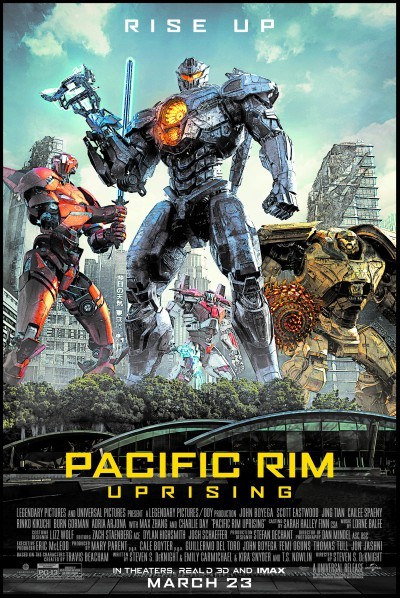
Pacific-Rim-Uprising-posterThe original Pacific Rim felt so much like lightning in a bottle, and its lackluster sequel does nothing to dissuade us of that notion.

On one hand, how hard could it be to deliver on a simple winning formula? Giant robots fighting monsters? And while Pacific Rim: Uprising has plenty of that (and it is, at times, spectacular) it is weighed down by all of its exposition and human characters and some especially clunky performances.

In this sequel, John Boyega stars as Stacker Pentecost’s son Jake. Set ten years after the last film, and with no sign of kaiju invasion in a decade, Jake is far removed from the Jaeger program but is reluctantly recruited back in to help train a new team of pilots. However, they’re on the verge of being replaced by a new generation of remotely piloted Jaeger drones which don’t require drift-compatible two person pilot teams. What could go wrong with semi-autonomous giant robot drones in every major city? And this, of course, ends in the return of the kaiju and an apocalyptic showdown in Tokyo.

The original worked largely because screenwriter Travis Beacham and director Guillermo Del Toro were so in sync creatively. Despite the film being somewhat formulaic, it delivered a fun, exciting take on “robots fighting monsters” by having interesting human characters. For Uprising, writer and director Steven DeKnight, a veteran of Netflix’s Daredevil, the CW’s Smallville, and numerous Joss Whedon Buffyverse projects, just doesn’t seem to quite mesh with the material.

The script, while serviceable, telegraphs its giant robot punches miles away. If you had stopped the film after ten minutes and asked, “How is this going to end?” it’s easy to predict… and so then the film plays out in a paint-by-numbers fashion. And while the original gives us some great scenes outside the jaegers, including one of my favorite fight scenes of the movie (right), Uprising is a snoozefest when it isn’t being cringeworthily bad.

Chief culprit here is Charlie Day, who provided a lot of comic relief and exposition in the original (especially in his Odd Couple science buddy pairing with Burn Gorman) but who is just the absolute worst in this film. It doesn’t help that Scott Eastwood could be replaced by a cord of firewood and would be more interesting to watch. Also gone is any real character building for the supporting cast, who mostly end up unmemorable. Boyega is the only real standout star, but as much as he tries to carry this movie by himself, it’s just not possible, especially when he is saddled with this sometimes inexplicably bad script.

But the fight scenes? Those are pretty fun. Again, it doesn’t have anywhere near the charm and innovative feel of the first one. But, we were never really expecting it would, right? And when it sets us up for the inevitable sequel, we can only hope that someone is willing to lure Del Toro and Beacham back to work their magic.

If you’re a devoted fan of robots and kaiju, they already have your money. You bought your tickets ages ago and no mediocre review is going to keep you from seeing this. But for general audiences? Save your money for Ready Player One, or go see Black Panther again.

2 out of 5 stars
Movie Review: The Death of Stalin

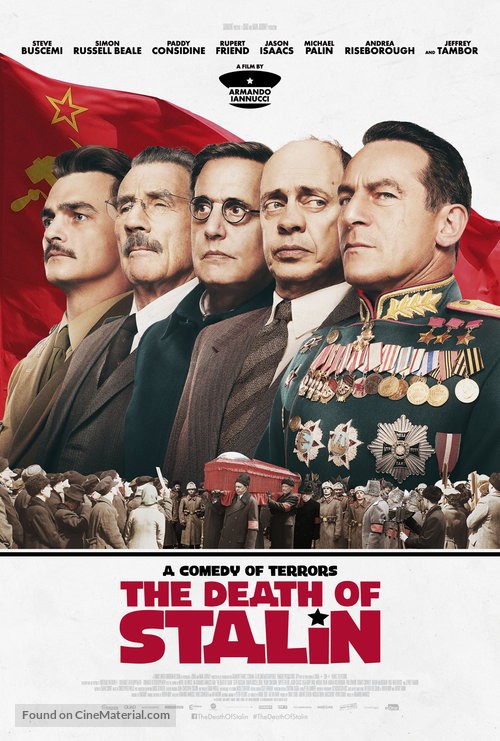
the-death-of-stalin-posterThis is a film the Russian government doesn’t want you to see. Literally.
Banned by Putin’s government and labelled as “extremist” and “propaganda,” really this is little more than a continuation of director Armando Iannucci‘s continued skewering of government apparatchiks set against the backdrop of Soviet Russia. If you loved his previous work (In the Loop, The Thick of It, and Veep), this is more of that same brand of humor– all it’s missing is Peter Capaldi swearing very loudly.

Instead, you have an all-star cast that includes Steve Buscemi as Nikita Krushchev, Jeffrey Tambor as Georgi Malenkov, and Michael Palin as Vyacheslav Molotov. Simon Russell Beale also plays the head of the NKVD (Stalin’s secret police) and Jason Isaacs tries to steal the movie when he shows up halfway through as Zhukov, head of the Red Army. And if you know those names and institutions and who they are, you will probably also love this movie. (Yes! That Russian Studies degree finally pays off!)

Based on a comic book of the same name (which we reviewed here), it’s the same sort of bureaucratic pissing contest between insecure men which Iannucci has made a career out of skewering. The basic tension is over succession following Stalin’s (spoiler alert!) eponymous passing. At the height of Stalin’s terror and paranoia, the various apparatchiks go about plotting against one another. . .  and wackiness ensues.

A darkly hilarious early scene involves an ailing Stalin unconscious on the floor, and he has soiled himself. The Soviet leadership gathers in the room and must decide by committee vote what to do. All of the good doctors have been sent to the gulags. So do we call a bad doctor? What if Stalin recovers and blames us for calling a bad doctor? And when they finally go to pick him up to take him to a bed, no one wants to kneel in the spot where Stalin peed. That’s basically the movie– and also lots of people being shot in the head for treason.

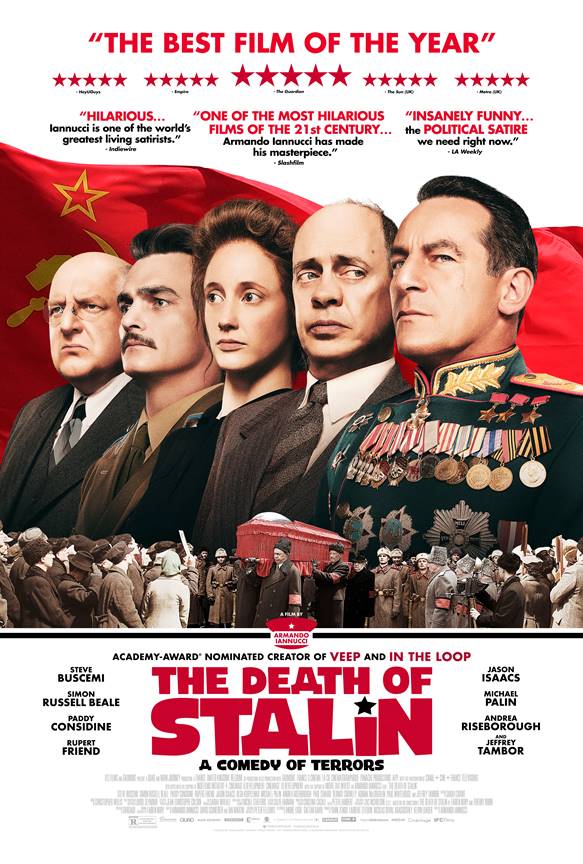
Death of Stalin US posterThe biggest problem in the film is its failure in its lack of representation. Two women have very minor roles in this, and it in no way approaches passing Bechdel or any other test. This seems to be something people noticed about the film, as the US poster released features Andrea Riseborough as Svetlana, Stalin’s daughter. But she is barely in the film. It is also as white as a Leningrad blizzard.
If I’m going to call out films like Dunkirk and Darkest Hour for choosing to tell stories only about and involving white men, I feel the need for consistency to do so here as well. Yes, yes, yes, historical accuracy and all that, but any time you choose to tell a story only involving white men — even if it viciously satirizes them as this film does — you have to ask why we chose to make this movie and not something else.

Despite that problem, it’s still a really funny movie and something that is incredibly enjoyable– and disturbing. If any of this sounds interesting to you, you’re going to love this film and its dark humor. If not, well, there’s always Tomb Raider, A Wrinkle in Time, and Black Panther out there if you want to see an adaptation that’s a little lighter. The Death of Stalin opens in limited release March 16, expanding March 23.

3.5 out of 5 stars

Movie Review: Tomb Raider

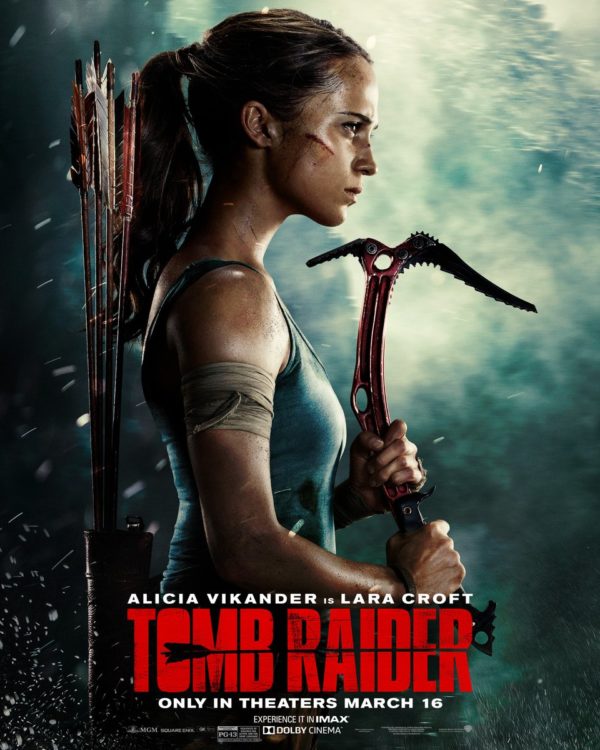
Tomb-Raider-posterIt’s a good video game movie! Will wonders never cease?!?

Don’t set your expectations too high, but Alicia Vikander fully brings to life the character of Lara Croft. Taking its cues from the recent successful game of Rise of the Tomb Raider, it suffers from some of the tropes inherent in any hero origin story and from the source games themselves. But mostly it plays out like an updated Indiana Jones with the trappings of Tomb Raider added in, which is both a good and a bad thing.

Our story follows a young Croft, orphaned when her father disappeared on a hunt for an ancient tomb of the “Death Queen” Himiko. When Lara inherits puzzles that her father left behind, she finds his research and takes up the search for herself, convinced that her father may still be alive.

It’s this grounding in humanity, grief and sorrow Lara feels that makes this so relatable to us as an audience, even if the plot is somewhat predictable.

Vikander is also joined by Walton Goggins as the story’s antagonist. Goggins always brings a gleeful sociopathic vibe to whenever he inhabits a villain, and he does this incredibly well here as well. There’s also a brief cameo from Nick Frost, who gives the film one of its funnier moments– even in a movie with lots of humor used to cut the tension.

On top of all of that, the film is action-packed. We barely go ten minutes ever without something happening. Even more impressive is Vikander’s commitment to the role and doing her own stunts, which director Roar Uthaug uses to give us crystal clear close ups of her face during some of the film’s most harrowing moments.

So, yes, it does feel like it treads a lot of the same ground as the Indiana Jones movies. But coming from a video game franchise that has been doing that for decades, that’s not entirely unpredictable — or even a bad thing. It’s sort of like complaining a band ripped off The Beatles. Yeah, so does everybody. It still sounds good.

In a genre which includes Assassin’s Creed, Super Mario Brothers, Street Fighter, Double Dragon, Mortal Kombat, Resident Evil, Hitman, Warcraft, and the other two Tomb Raider movies starring Angelina Jolie, the question you always ask yourself is “Would I have rather spent those two hours playing the video game?” In literally every other video game movie, the answer is a profound yes, making them failures as films. This film made me want to go play Rise of the Tomb Raider. Congrats to everyone involved.

3.5 out of 5 stars

SXSW Movie Review: Alt-Right: Age of Rage

This is the scariest movie playing at the SXSW film festival, because it’s all 100% real.

The film opens and closes with the “Unite the Right” rally in Charlottesville in August 2017 and shows key background on how we got there and its aftermath. The documentary focuses on two key figures on both sides. The first is Richard Spencer, popularizer of the term “alt-right” and recipient of everyone’s favorite Inauguration punch.

The second is Daryle Lamont Jenkins, an Antifa activist whose work over the past several years has been exposing white supremacists and organizing counter protests.

Their styles and substance could not be more different. Spencer is the more polished, smug, and comfortable in the limelight he has courted. He also immediately goes for the throat, and attacks Daryle on his looks rather than his substance. (You know, for someone who claims he is of a superior race and academic style, he sure immediately goes for the ad hominem. Just sayin.) Jenkins talks about Spencer as a symptom of a larger problem, and even tells Spencer to his face that if all he has left to say is fat jokes, then he has already won. And the coup de grace comes in the final moments of the film, as each of them is asked how divided we are as a country and what is to be done about that. No spoilers, but their answers tell you everything you need to know about each of them and their agendas.

The documentarians here have done an amazing job. It feels like they just happened to be at the right place at the right time — including on the street in Charlottesville where a right wing terrorist plowed over peaceful protesters in his car, killing one. It’s unsettling and traumatic to watch. And it should be. But this is where we are as a nation.

And when the tiki torch brigade surround protesters, starting fights with them, shooting their guns at protesters, and the police stand by and do nothing, you can see exactly what is so wrong with the system. Indeed, you see the Antifa protesters getting tear gassed and maced, including Jenkins himself, but they remain undeterred.

Meanwhile, Spencer and his team of personal security plan for how to get in and out of a black SUV motorcade as though they expect the hippies to come after them with AR-15s. It’s comical, except that it’s so sad. Spencer and his fragile white male contingent really do feel that somehow they are threatened. They feel like their right to free speech is under attack, when nothing is further from the truth.

Free speech means the government can’t shut you down or arrest you for saying something. It doesn’t mean people have to put up with your bullshit, which is exactly what the Antifa contingent repeats during the film.

And when you have a president — THEIR president — who is actively attacking the 1st Amendment by trying to prevent stories about him from being broadcast on 60 MinutesI just can’t feel sorry for Richard Spencer because he doesn’t feel welcomed on the campus of UC Berkeley.

If there’s a fault in the film, it’s that even though trying to achieve balance by presenting Spencer and his ilk in their own words and going behind the scenes of their movement, the film feels heavily slanted against white nationalists. But, is that really a vice? I mean, did you want a documentary that was sort of milquetoast on Nazis?

It’s unsettling and sticks with you. And, unfortunately, doesn’t really leave with any sort of resolution, except, perhaps for the hope that Jenkins leaves us at the end.

3.5 out of 5 stars

Alt-Right: Age of Rage premiered at SXSW on March 9. It has a final screening March 13, 8:30 pm at the Alamo Ritz, but you can check its official page for more “buzz” screenings.

SXSW Movie Review: ¡Las Sandinistas!

Get ready to cheer for badass feminist socialist revolutionaries. ¡Las Sandinistas! tells the story of the women involved in the Nicaraguan revolution and government. They were key to their success; but their work, sacrifice, and goals have largely been erased.

This celebrates them and will make you root for them.

But, Sandinistas, you say? Weren’t they. . . c-c-c-communists? Yes and no. Watch for yourself before pre-judging anything, as the women of the movement saw themselves fighting for something wholly different than what we normally think of as “communism,” even in the vein of Cuba or Venezuela. However, the film does gloss over any real critique of the regime — except for the one brought by the women themselves, who claim they had to fight “a revolution within the revolution” for equality and against the raging machismo of so many of their compatriots.

Las Sandinistas! Still 3 Dora Maria

The film is told through a series of interviews with five women, Dora Maria Téllez (pictured at right), Claudia Alonso, Sofia Montenegro, Gioconda Belli, and Daisy Zamora, and intercut with archival film, newscasts, and photos. Dora Maria becomes a sort of breakout star among them, especially given her pivotal role in the assault on the National Palace, seen as a turning point in the overthrow of the Somoza dictatorship. She then became the first Minister of Health, leading to the eradication of polio and massive reductions in malaria and other illnesses as health care was provided to the masses.

Prepare to come out of this film with a giant social justice crush on Dora Maria, whom one of her fellow interviewees referred to as “the smartest woman in the hemisphere.” She may be right.

But all of these women are remarkable, and today continue their fight. Despite the Sandinista government re-taking power in 2006, they now face many of the same repressive barriers they had torn down previously, including a nationwide abortion ban. They also find their contributions to the revolution and as early government leaders suppressed and forgotten, literally removed from historical records and monuments that instead celebrate current president Daniel Ortega.

While the film is a little bit long, it is simply because there is so much story here to tell. They win the revolution at around an hour in and you think, “Ok, we’re done here, right?” Instead, the second hour takes you everywhere you had no idea it would, up to and including the present where they continue to fight in the political sphere.

This is one of the best documentaries in a while, and is hopefully seen widely enough to make it into contention for next year’s Academy Awards. It’s certainly Oscar-worthy.

4.5 out of 5 stars

¡Las Sandinistas! premiered earlier today at SXSW and has two additional screenings later this week that you should not miss!

Tuesday, March 13, 4:15pm, Alamo Lamar A
Thursday, March 15, 2:45pm, Alamo Lamar A

Its official schedule is here where you can see any additional “buzz” screenings added later in the week.

SXSW Movie Review: They Live Here, Now

Jason Outenreath Still2 Photo by Martin do Nascimento

One of the best things about the SXSW film festival is how personal so many of the films shown are. They Live Here, Now is a documentary about Casa Marianella, a unique shelter for immigrants and refugees on Austin’s East Side is intimate, unique and powerful with a message that couldn’t be more timely.

Writer/Director Jason Outenreath (left), a former Peace Corps volunteer who got his film degree at the University of Texas at Austin, hopes the film spurs “people to be galvanized to action. I want people to be moved by the stories of the immigrants in the film, and to have a stake in what happens next in this narrative.” To achieve this, he uses a cinema verite style of just setting up the camera and letting people tell their stories.

This produces sometimes comic results, as people are interrupted, or other residents notice the cameras running and quickly move out of frame. But what it mostly produces is an experience that is incredibly personal and feels very much free of artifice. It never feels heavy-handed or like it’s pushing an agenda

THEY LIVE HERE NOW Still 10

Some of the residents wished to remain anonymous, and their stories are among the most powerful. An anonymous woman, whom we only see from the chest down, from Cameroon tells her story of violence both in her home and along the path to America, including being kidnapped and tortured in Mexico.

Indeed, stories of gang violence, war, and struggles of crossing the border are among the most common elements of their stories. What they don’t comment on are the politics of the situation. Indeed, a refugee from Iraq goes so far as to say he doesn’t want to talk about the politics or get into a discussion of how the US destabilized his home– he instead speaks of the kindness of everyone he’s met and how grateful he is to be here.

While I mentioned how the film is free of artifice, that isn’t exactly true. Outenreath instead employs a single actor to bring to life a fictionalized story of Nayelli, a sixteen year old Mexican girl who lost her mother on the way to the US and is searching for her father. You might feel outraged or manipulated except that her story is by no means the most fantastical and is inspired by true stories of other immigrants.

THEY LIVE HERE NOW Still 2

Because Nayeli’s story is the only one we keep coming back to in the film, it provides a thematic through-line weaving what otherwise would just be a dozen disconnected stories together, so I will forgive Outenreath his artistic license here.

What we end up with is a beautifully empathetic story that hopefully will spur people to action on the issue of immigration. Even if at the very least you can come away with a greater sense of empathy for immigrants and refugees, this film will have hit its mark.

3 out of 5 stars

They Live Here, Now had its world premiere earlier today, Sunday, March 11, at 4:30pm at the Alamo Drafthouse South Lamar. You can catch two more screenings later this week at:

Monday, March 12, 5:45pm, Austin Film Society Cinema at the Marchesa
Wednesday, March 14, 1:30pm, Rollins Theatre at the Long Center

See its official schedule at sxsw.com for any additional “buzz” screenings added later in the week.

SXSW Movie Review: Number 37

NUMBER 37 PosterA low-level criminal, Randall (Irshaad Ally), owes money to a loan shark. His legs broken and with a ticking clock to pay back his debt, his only connection to the outside world is his window facing out over his slum neighborhood of Cape Flats, South Africa and a pair of binoculars that let him see too much of what is going on.

A series of desperate and poor decisions suck in his girlfriend Pam (Monique Rockman), his friend Warren (Ephraim Gordon), the local pastor, and the police as director and writer Nosipho Dumisa rachets up the tension. “Number 37 might look like a gritty, South African street gangster movie, but it’s a lot more than that… It’s about everything that could go wrong for a couple when ambition, curiosity, greed, fear and horrific bad decision-making collide,” said Dumisa.

The very obvious immediate comparison is to Hitchcock’s Rear Window, but that almost does this film a disservice. Dumisa revealed that this was her sort-of love letter to Rear Window, which is one of her favorite films, but also her influences for the film were as based on David Fincher’s Se7en, as well as the more recent Green Room and Don’t Breathe– and that really feels more like the pedigree of the film despite the obvious homage to Rear Window. Hitchcock relied on a sense of voyeurism and mystery, but Number 37 straight up shows us the domestic abuse, threats, people being killed, and so on. We never wonder about the mystery, because there is none. What it does by showing us the action through Randall’s binoculars is contribute to the tension by making us feel as helpless as he does as events unfold.

Number 37 Film Still 2

The acting here is nuanced and powerful. Randall has to remain stoic despite his world collapsing around him. Meanwhile Pam is a voice of reason who is too often ignored, and they both face the consequences of their failures. She has to do so much more of the outward emoting, while Randall tries to fold everything together.

The filmmaking behind this is also spectacular, with excellent camerawork helping us feel the small, confined spaces the film takes place in. It has such a perfect sense of place by taking us into these slums, which become a metaphor for the tension of the film and feeling “trapped.” According to Dumisa, “These areas were constructed in the times of apartheid and people of different racial groups were forcibly removed from their homes to these areas, with the idea that the people in there would not be allowed to leave without permission. This was legal back then but over two decades after apartheid, these areas still exist, although nobody is “forced” to live there anymore…legally. Economically and psychologically these suburbs can often feel like a prison even now. Once you’re inside, it’s difficult to imagine the beautiful tourist Cape Town could exist.”

Dumisa also revealed she wrote the film originally in English, then working with her actors– most of whom were locals — and some translators, they translated the film into an Afrikaans dialect that is specific to the Cape Flats area she was trying to emulate.

This is a great film, especially for a first feature from a young 29-year old director. If Marvel is looking for someone to take the helm of a Shuri-centric spinoff of Black Panther, they should check out Number 37.

4 out of 5 stars

Number 37 had its premiere at SXSW March 10, 2018, and will have two additional showings:

Monday, March 12, 2:30pm, Alamo Lamar C
Wednesday, March 14, 7:30pm, Alamo Lamar C

For more information and for additional “buzz” screenings, check out their official schedule at SXSW here.

Movie Review: A Fantastic Woman

a_fantastic_woman posterIt’s easy to see why A Fantastic Woman, a Chilean drama, is nominated for “Best Foreign Language Film” in this year’s Oscars. It’s a beautiful, empathetic depiction of a trans woman and all of the obstacles she faces.

Marina (Daniela Vega) is a talented singer whom we first meet performing in a nightclub singing a song about how “your love is like yesterday’s newspaper.” She has just moved in with an older man, Orlando (Francisco Reyes), when he falls ill and dies. Dealing with the grief of the loss of her love is compounded when she faces aggressions both micro and macro from Orlando’s family, the police, and society at large because of her status as a trans woman.

Her performance is heartbreaking and layered as we see her deal with her grief while also fending off so much else. It’s hard to watch at times because director Sebastián Lelio puts us through the same emotional journey. But it’s beautiful and complex in ways most films about dealing with loss and grief aim for, but never quite reach.

We are also taken on a journey, falling in love with her and seeing why Orlando fell for her too, as we see just what an amazing, talented, thoughtful, emotional person she is.

And this is going to sound strange, but this is also one of those films where you should also put the politics of it aside for a moment and just enjoy it for how beautiful a film this is. The film’s use of various kinds of light is fun and gorgeous. They also use reflective surfaces and mirrors throughout the film to great effect, although it at times gets a little bit too on the nose. We also get a gorgeous sense of place and a love of the city of Santiago, from its hills to its city streets to its nightclubs, Chinese restaurants, and opera houses. This could have been any city we are more familiar with — Los Angeles, Vancouver, New York, Miami — but it uses its place so beautifully to make us feel at home. Putting the politics back in to this for just one moment, you can plainly see that Santiago is no “s#!thole.”

Now with the politics back, you can’t understand this film as anything but a broadside against those who would deny trans people equal treatment in our society. Can you watch how Marina is treated through the film by Orlando’s family, the police who suspect her of somehow being involved with his death, and society in general and really think this is right?

It should also bring to mind the fact that trans women are far more likely to be victims of violence than almost any other segment of society. The humiliation Marina endures is almost comical in how juvenile it is — if it wasn’t so hate-filled and traumatic. Again, this goes to director Lelio’s touch here. It’s never so overwhelming that we have to look away, but it’s still emotionally resonant and we feel the greatest empathy for Marina. For example (minor spoiler– skip to end of paragraph if you don’t want to know) at one point, Marina is forcibly taken into a car by one of Orlando’s sons and his friends, called “faggot” repeatedly, and then has her face disfigured by being wrapped up in an entire roll of scotch tape. In a lesser director’s hands, this could have gone two ways– either overly comical and not serious enough, echoing the classic scene where Pee Wee Herman plays with tape on his face in Pee Wee’s Big Adventure, or being overly traumatic and hard to watch as sort of post modern tarring and feathering. The fact that it threads the needle so well is a testament to this director and the actors knowing exactly what they’re doing.

Una mujer fantastica hits theaters in limited release this weekend, just in time for us to see Daniela Vega present at this weekend’s Academy Awards, and to see whether this wins Best Foreign Language Film. It’s certainly worthy of the nomination.

4 out of 5 stars

Movie Review: Red Sparrow

RedSparrowIf you’re looking for a good spy thriller, search literally anywhere else than here.
From the open to close of Red SparrowJennifer Lawrence‘s character Dominika Egorova is brutalized in every way possible. Her leg is viciously broken, robbing her of her life’s work of being a prima ballerina at the Bolshoi in Moscow. She is raped, beaten, groped, tortured, another attempted rape, beaten some more, stabbed — all in the service of the state’s “Sparrow” program, which teaches agents to use their sexuality to engage in spycraft.

Really? It’s more of a pretense for patriarchy — state sanctioned sex slavery where the price of not complying is a bullet in your head — and the film plays out more like a snuff film than a spy thriller.

No. Just no. This is the opposite of smart. This movie does nothing that is not telegraphed a mile away.

And it’s just tiring to see a movie literally based around the single conceit of a woman robbed of any agency or efficacy. I can see why acolytes of our sexual-assaulter-in-chief or alpha male Vladimir Putin would enjoy it.

In case it isn’t clear, this movie will be incredibly triggering for rape survivors. Beyond that, it’s just gross. Anyone who enjoys watching this is highly suspect.

This movie is rated R for “strong violence, torture, sexual content, language and some graphic nudity.” Once again, the MPAA completely fails and exposes itself as a tool of a cishet normative patriarchy. This time, its shortcoming is not in unnecessarily censoring things, but in not warning audiences exactly how disturbing this film is. An R rating simply isn’t sufficient, nor is a dreaded NC-17, which I’m sure this film was never actually in danger of getting.

Let’s break this down: “some graphic nudity” means a short shot that includes a wide angle on a naked man showing his penis. That’s what’s “graphic” according to the MPAA — dong. If that had been omitted, it’s unclear what the MPAA would have said about the female nudity in the film, which is always always always coupled with violence. The MPAA simply has no problem with the sex and violence of this movie, as it’s all heterosexual and it’s all womens’ bodies. It’s R. And it’s the same R as, say, Atomic Blonde, or Lady Bird. And that is absolutely ridiculous, especially in a world where Call Me By Your Name has to be careful not to get an NC-17 rating because it involves homosexuality.

It shouldn’t be surprising, since the MPAA is upholding the same traditional power structures that underpin so much of what is wrong in America today. And anyone who doesn’t see what’s wrong with the film and why it might be offensive is, frankly, part of the problem.

The job of a film critic is often to sit through garbage so you, the audience, doesn’t have to. This is garbage.

And it didn’t have to be! Jennifer Lawrence is amazing, and here’s she’s reunited with the same director from the last three Hunger Games movies. A sexy spy thriller? Yes please! Set in the geopolitik of American-Russian relations? How timely!

What’s not timely? How tonedeaf this film is in its graphic depictions of rape and violence towards women during the #MeToo moment.

Someone who has no idea what the words “consent” or “agency” mean might see nothing wrong with this film. But at no point does our main character have any control over her own destiny. Even at the (spoiler alert? IDGAF) relatively triumphant ending — yay! our heroine is victorious! — all she really has done is climbed the ladder in a violent, patriarchal state. She didn’t break the system, she merely played it to get what she needed. She’s Cersei Lannister, not Daenerys Targaryen.

This film was at one time talked about as though it was a sort of Black Widow movie that wasn’t really a Black Widow movie. It’s not. A Black Widow movie would be great– a kickass spy thriller with a smart woman manipulating everyone around her set in the Marvel Cinematic Universe. But Red Sparrow is a blueprint for exactly what not to do.

Natasha Romanoff is always in control. Even if she’s following orders, she’ll go rogue when it meets her personal moral compass. Even if she’s tied to a chair and getting punched by a Russian in the opening of The Avengers, she’s in control, and she’s the one actually doing the interrogation. She subverts perceptions of power to use it. And so everything that Black Widow is, Red Sparrow is not.

It’s also incredibly long. It feels every second of its 2 hour 20 minute runtime. And so much of it was completely unnecessary. It’s like a horrible meal in an awful restaurant, and the servings are ginormous.

If you thought the year couldn’t sink any lower than Fifty Shades Freed. you were wrong. As misogynistic and rapey as that is, this takes it to a completely different level.

0 stars

If you’d like to hear me swear loudly in Russian about how much I hated this movie, check out this week’s episode of the Bored as Hell podcast, where we also talk about Game Night, Annihilation, and make our Oscar picks.

Movie Review: Game Night

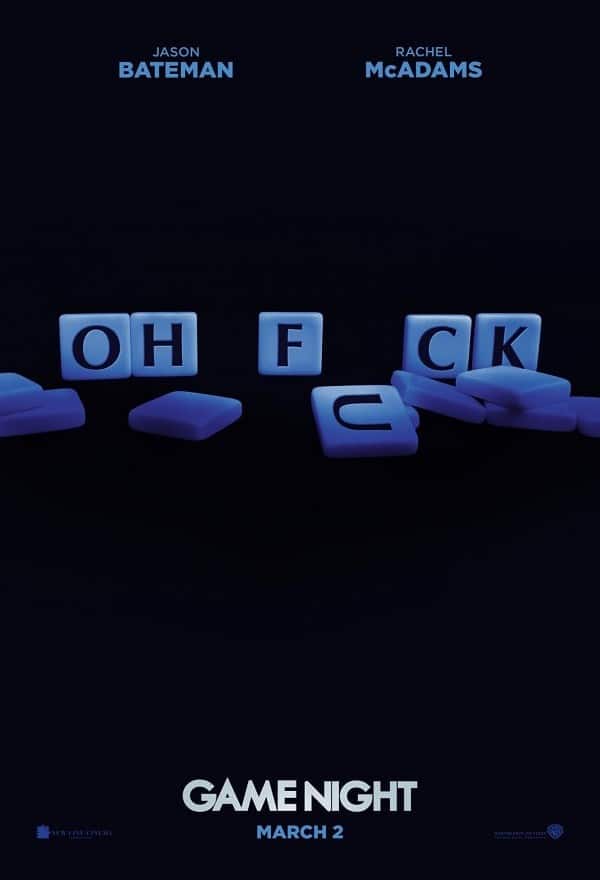
game-might-movie-2018-posterIt’s Horrible Bosses meets David Fincher’s The Game.

Max (Jason Bateman) and Annie (Rachel McAdams) are a mostly happy married couple living in the suburbs whose highlight of their week is a game night with their friends. But when Max’s much more successful and wealthy brother Brooks (Kyle Chandler) comes to visit, awakening Max’s sibling rivalry and competitive streak to the next level, Brooks decides to take over their game night by replacing it with a kidnapping / murder mystery. The twist? Brooks is actually kidnapped, and our group thinks it’s just a game. And. . . hijinks ensue.

What could’ve been another mundane comedy actually has some good laughs, including when it’s using its R-rating to the fullest extent it can. But more than that, it relies on building its characters and a great supporting cast to keep it interesting. Normally this premise might have worn itself thin, but there are a couple of twists and turns that keep it enjoyable. However, it’s never too much and the script never takes itself too seriously or thinks it’s smarter than it is. Overall, it’s what we expect from the people who made Horrible Bosses. 

The real gem of the movie, though, is Jesse Plemons, who plays a creepy cop neighbor who really wants to get invited back to their game night. Plemons is one of the best actors working today, and he is perfect, even if a little over the top at times.

But his performance, like so many elements, actually make sense as things wrap up and you see the entire film for its totality. For instance? There are all these shots of various neighborhoods from above that somehow look like tiny scale models rather than real life. . . is it all part of a (gasp!) game? Make sure you stay through the first part of the credits for some specific payoff.

The other enjoyable part of this film is just how well it’s put together. An earlier comparison to Fincher is not just hyperbole– there is some artistry in the cinematography and directing here. For instance, a scene three-fourths of the way through the film during which a Fabrege egg (really it’s just a mcguffin– go with it) is used in a game of keep away in a gorgeous mansion as baddies chase our protagonists around– up and down staircases, in and out of rooms, swooping up and down giant open rooms with balconies above — all done to look like a single take.

It’s almost as much fun to watch as Plemons enjoy the heck out his character.

The biggest weakness of this film is it happens to be released amongst other films that will overshadow it at the box office. Can I recommend Game Night? Yes. Can I recommend you go see it instead of Black Panther or Annihilation? Well. . .

But if you are like our protagonists and are seeking some fun time with adult friends — and especially if you can go to a theater that will sell you adult beverages to go with it — and you just want to laugh and have a good time without thinking too much? This will scratch that particular itch. Otherwise, this is a definite recommend for watching at home with friends, with adult beverages, and perhaps with board games, especially if the game includes betrayal and murder. I highly recommend pairing this with a good game of Betrayal at House on the Hill or Werewolf.

(Rolls a d6 to determine overall score)
(Adds +2 Jesse Plemons)

3 out of 5 stars

« Older Entries Recent Entries »