Author Archives: cjstandal

The Forbidden Chamber: An Interview with Sarah Searle About Gothic Tales of Haunted Love

Cover with Editors_rgb

cover art by Leslie Doyle, logo by Dylan Todd

Sarah Searle brings a new twist to the gothic genre and an old tale in her story for Bedside Press’ anthology Gothic Tales of Haunted Love. A fundraising campaign is currently running on Kickstarter and you can read more about it in this previous article.

Searle’s story, “Ladies of the Lake”, is Searle’s “spin on the classic Bluebeard tale, incorporating some Arthurian themes over a setting of spooky 1920s Wales.”

The new themes and setting is one twist Searle gives this source material, but this story is even a slight departure for Searle herself. “I’ve done a good amount of historical fiction at this point, but I’m allowing myself to stylize it and go a bit darker this time, which sets it apart from my past works that focus more on research.”

Although Searle hasn’t “read anything from that time period [the 1970s gothic romance comics that inspired this anthology]”, she is “a great lover of gothic literature and romance comics, so it was a natural fit!”

It was such a good fit, in fact, that she “had this story already written, just waiting for the perfect home. ‘Ladies of the Lake’ references some of [her] favorite books, including Northanger Abbey, so [she pays] homage to [her] own inspirations as well.”

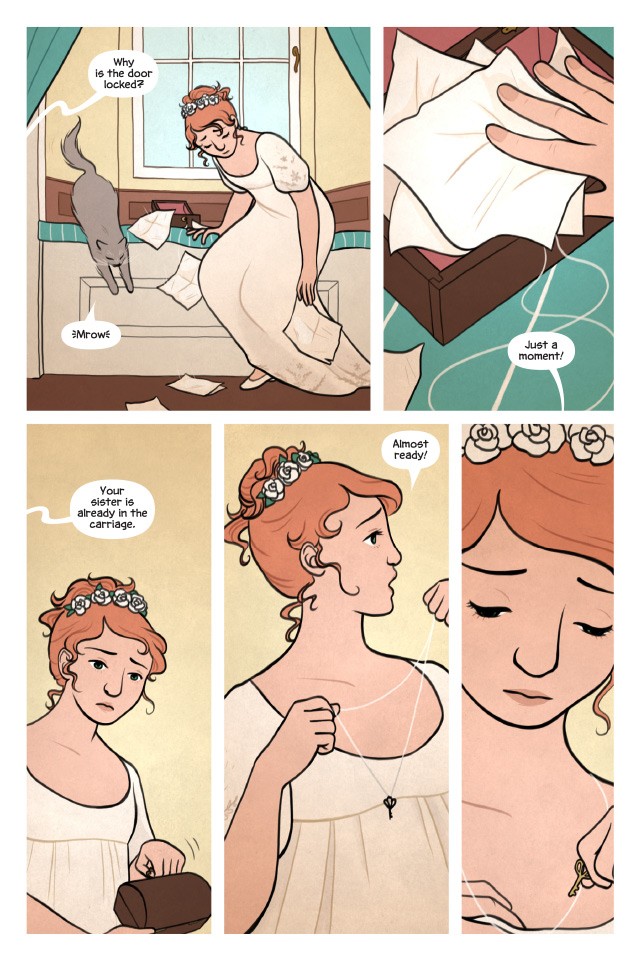
ladies of the lake searle gothic tales anthology

“Ladies of the Lake” by Searle

Searle elaborates on her love of Northanger Abbey: “Jane Austen’s Northanger Abbey is a delightful play on the gothic romance genre back when it was much fresher, which is an enjoyable read.”

But Northanger Abbey isn’t her only gothic inspiration, as Searle explains: “I also love Terry Pratchett’s Carpe Jugulum for a healthy dose of vampire romance. I suppose I’m drawn more toward humorous, satirical approaches these days, but I can’t help but love taking it seriously sometimes, too.”

And Searle doesn’t just create and read gothic stories–she plays them too, as she explains: “My D&D group recently finished the Curse of Strahd campaign and I really enjoyed seeing the romance and drama unfold amongst the NPCs.”  

When discussing Hope Nicholson and Sam Beiko, the two editors in charge of the anthology, Searle had nothing but good things to say: “I haven’t worked directly with Sam before but she’s had great feedback for my script, and Hope is always super on top of the business side.”

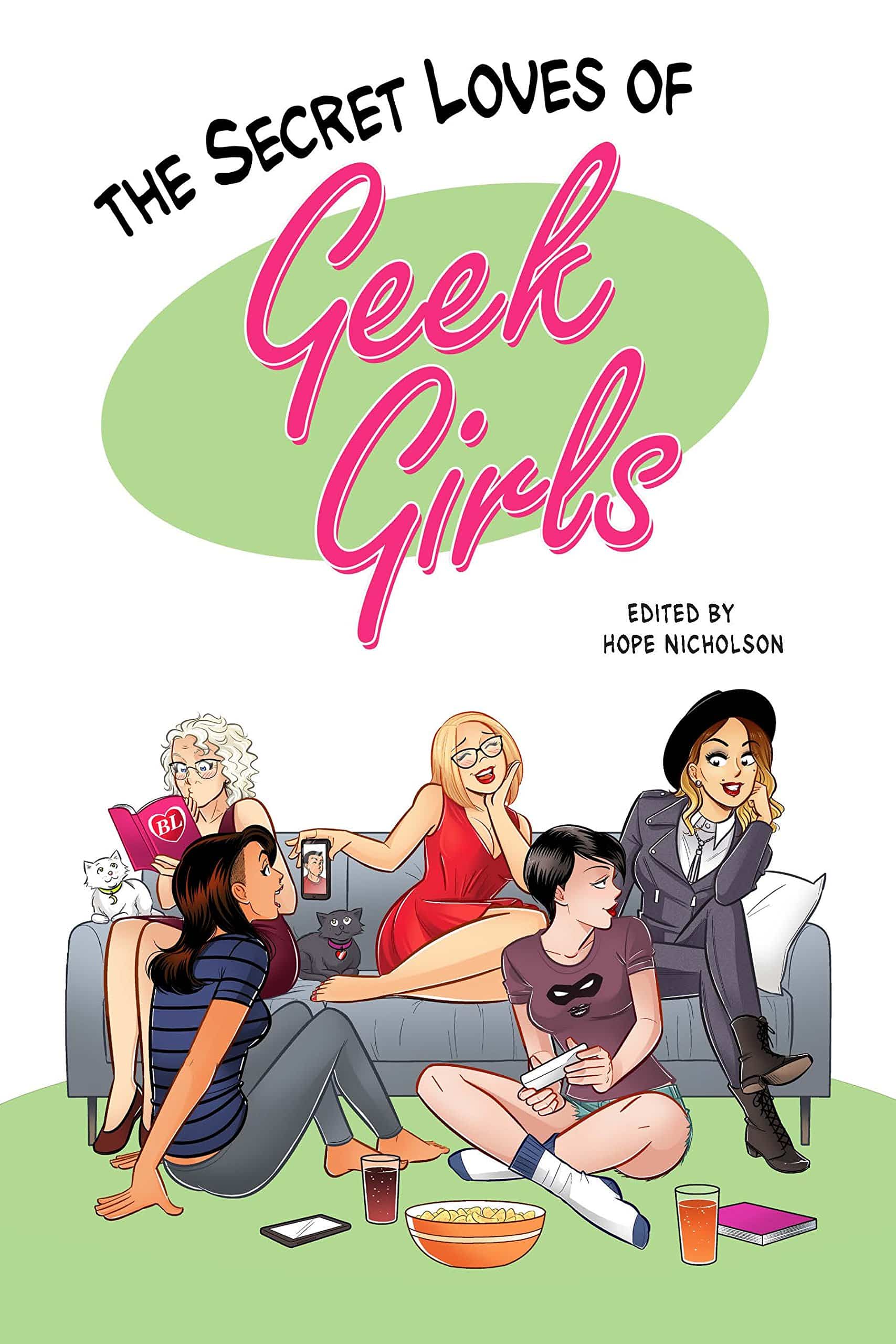
Having worked with NIcholson on The Secret Loves of Geek Girls, Searle had already experienced Nicholson’s business acumen.  In particular, she commented on how “everyone in publishing is so busy all the time, which often means (understandably) long waits on emails, so [she] extra appreciate[s] how quick they’ve been with communication.”

secret loves of geek girls kickstarter edition

The Secret Loves of Geek Girls Kickstarter Edition Art by Gisele Lagace and Shouri

Searle offers one last word on the Gothic Tales anthology itself: “I’m especially excited for the comic my friend Hien Pham is working on, about a man who gets help from a friendly ghost during the Vietnam War”, a comic covered in this interview with Pham.

But this anthology isn’t the only place to see Searle’s work.  Much of her work can be seen on her website, www.swinsea.com.  Searle is passionate about her site, putting in the same effort in designing it as she would her comics, saying, “I started it back when I was a new media major learning coding and web design, and I don’t know if I could ever leave it behind. It’s like I’ve built this time capsule that tracks my whole career.”

She continues to express her passion for her site: “I keep it mostly for myself, but I do see that it gets regular traffic, and I like knowing people can get a taste of my work even while I’m toiling away on books that won’t see the light of day for years to come. Plus the accessibility of webcomics has been so important to me, I try to put as much out there as possible.“

As seen in the images above, both the anthology piece and the pieces posted on her website, Searle avoids extensive cross hatching and weighing her work down with unnecessary details.  

searle FreshRomance1PDF-18

Searle’s “Ruined” from Oni Press/Rosy Press’s Fresh Romance

Part of this comes from her many inspirations.  While “it changes all the time,” Searle lately has “been studying the works of Hayao Miyazaki and Jillian Tamaki in particular”, artists known for conveying much emotion and story in few lines.

As Searle herself says, “’I’m very story-focused so my art ends up on the minimalist side, and I want to learn from artists like [Miyazaki and Tamaki] who seem to really understand just how much detail is needed in a character design or environment to convey meaningful nuance.”

Reflecting on “Ladies of Lake” and her other work Searle concludes, “I’m proud of all the comics I’ve made for various reasons, but I’m also generally pretty happy to leave them in the past. I learn so much from every project I do, even the small ones. Even if I don’t feel confident about the quality of story or art anymore, I’m proud of myself from making them so I could grow into the better storyteller that I am today –– and still growing, I hope!”

Anyone interested in more of Searle’s work can follow her on Twitter and study her online portfolio while waiting for Gothic Tales to release!


CJ Standal is no stranger to Kickstarter, having run a successful Kickstarter for his comic Rebirth of the Gangster, for sale as a print copy or an ebook now!  Find out more about him at cjstandalproductions.com.

A Ghost of a Chance: An Interview with Hien Pham About Gothic Tales of Haunted Love

Cover with Editors_rgb

Hien Pham brings a new twist to an old genre in his story for Bedside Press’ anthology Gothic Tales of Haunted Love — an anthology and Kickstarter that you can find more information on in this previous article.

Pham’s story, “Minefield”, concerns “a young ghost in love with a young farmer whose home is under attack by a foreign troop during the later stages of the Vietnam war.”

Part of what makes this story unique, however, is that it draws on stories Pham’s parents–who grew up in Vietnam–would tell him. According to Pham, “This is the first time I have directly tapped into my parents’ war stories I grew up on. There has always been some sort of war-like, bigger forces and conflicts in my stories, but I haven’t done anything so close to the source material.“

Pham elaborates on this inspiration for “Minefield”:

“The story that inspired Minefield was actually a precautionary myth of sorts: back then, if you weren’t conscripted into the American army in the day, and you weren’t conscripted into the Vietnamese army in the night, the next morning you’ll find your head on a spike. ‘Minefield’ originally was written to directly reference this ‘rock and a hard place’ position Vietnamese folks had to live through. After rewrites, the comic has lost some of this resemblance, but hopefully it’s still a good gothic romance nonetheless!”

Gothic Tales of Haunted Love draws inspiration from 1970s gothic romance comics, but Pham “wasn’t too familiar with the genre until [he] did [his] research to write [his] anthology submission!”

But perhaps this lack of familiarity is what led Pham to take such a personal and unique approach with his story:

“The stories from that era that I’m used to are simply horror stories from my parents who lived through the war. These stories are always human stories, myths, rumours, and precautions that were either passed down to my parents or actual life experiences they have lived through. Growing up in the Vietnamese culture has made me entirely too aware of the pain and horror their generation suffered. I wanted to take this chance to put a sweeter slightly-less-bitter spin to that.”

sample5_hienpham

Image Credit: from “Minefield” by Hien Pham (told entirely in Vietnamese)

In creating this story and trying to make it as authentic as possible, Pham decided to use Vietnamese instead of English (as seen in the above image).  

To explain this choice–telling a story in a different language than the one the target audience speaks and reads–Pham said,

“This is a Vietnamese story. These are Vietnamese characters and for them to speak Vietnamese just rings true to me. In the process of writing the story. I made two different scripts: one with the dialogues in Vietnamese and one in English. There are tiny subtleties and nuances in the way they speak that scream Southern Vietnamese that are lost in translation. Some parts of the story change ever so slightly and feel less interesting when I have them speak English. To me, there’s just something that’s slightly more genuine and authentic when I let them speak Vietnamese.”

Pham adds in his trademark self-deprecating way, however, that he has “no idea if it works better or worse on the comic page, ahaha! That’s my challenge to solve!”

Hien_Pham_Large profile pic

Image Credit: Hien Pham’s“The Young Giant” promo picture on Supanova Comic Con page

He elaborates on these concerns–and the second guessing almost any artist experiences in creating something new and personal:

“I am downright terrified, ahaha! I’m quite afraid of the fact that the readers can’t understand what the characters are saying which might put them off finishing the story altogether. I’m afraid that they can’t connect to the characters and find the story boorish and boring. I’m afraid that Vietnamese readers might read it and say I didn’t do it justice and they would rather read it in English anyway! I’m quite the paranoid person so I have millions and millions of worries in my head.”

Despite all these worries, though, Pham insists he is making the right choice:

“What makes it worth it is that it might just work as I intend it to. The language barrier emphasizes that this is specifically a Vietnamese story, not a romanticized vision told by anyone who hasn’t been on excursions to actual prisons where people were tortured and murdered since first grade. I wanted these Vietnamese characters to speak Vietnamese as a way to reclaim a tiny bit of my culture from everything that’s used it as exotic backdrop or tragedy porn. I’m hoping the the audience would be firmly aware of the cultural differences, yet still be able to emotionally invest in these characters, and find love, lost, hope, and dreams within them.”

Another benefit, he adds, is that creating the story this way presents a unique artistic challenge: “the classic ‘show don’t tell’. The story is practically wordless, so I will need to flex my storytelling muscles to get the emotive language across. I’m very excited to give it a good shot!”

Pham expressed his working relationship with Hope Nicholson and Sam Beiko the editors of the Gothic Tales anthology as very rewarding:


“I am a new face to the comic-making community in general and haven’t had much experience working with editors. They were very open to my ideas and gave me great advice and direction to go with the story. I wholly appreciate their trust in letting me do a foreign-language story and believing that I’ll have the skill to deliver it.”

hien-pham-float-w00-p01

Image Credit: from Hien Pham’s “Float”

Nicholson is also well known for working with diverse creators on diverse stories, and there is one more part of Pham’s “Minefield” that aligns with this diversity: “Minefield” is also a love story between two men, something not frequently seen in mainstream comics.

And this focus on homosexuality is something Pham is looking to explore more of with Pham’s future work, It Will Be Hard, which has no release date yet–Pham says it will be coming out soon though.  Pham describes it is as a “lite choose-your-own gentle smut adventure about two men’s relationships with their bodies and with each other.”

He adds that he’s “still got a long way to go with [his] drawing skills and drawing this comics has been practically doing anatomy aerobatics!”

Other than improving his anatomy skills, Pham has found that working on It Will Be Hard has carried other benefits: “Making this comic has also made me look more into my own sexuality and the different ways I feel about my body and myself. It’s given me a lot to think about and a lot still to process but I can feel myself being more confident in my own skin the more I work on the comic.”

Anyone interested in Pham’s work can follow him on Twitter and his online portfolio!


CJ Standal is no stranger to Kickstarter, having run a successful Kickstarter for his comic Rebirth of the Gangster, for sale as a print copy or an ebook now!  Find out more about him at cjstandalproductions.com.

Creators Corner: Exercises in Cartooning: Week 3

brunetti cartooning cover

I’m a writer, not an artist. But for the next 8 weeks, I’m going to be a cartoonist.

And you can join me on this journey–not only by seeing what I do, but by completing the exercises I do along with me.

*Note* To see Week 1’s adventures, click here, and to see Week 2’s adventures, click here.

The great cartoonist Ivan Brunetti, also a teacher of comics/cartooning, has a book that publishes his course; it is a 10 week “class” that has a few exercises for each week, some of which I might even use in my own graphic novel class.

I thought it’d be fun–especially since I’m a writer and need to challenge my skills as an artist–to run myself through his course and post each of my exercise on here.  So without further ado…

Exercise 3.1 (there’s only one exercise this week, but Brunetti still labeled it this way for some reason)

Part 1:

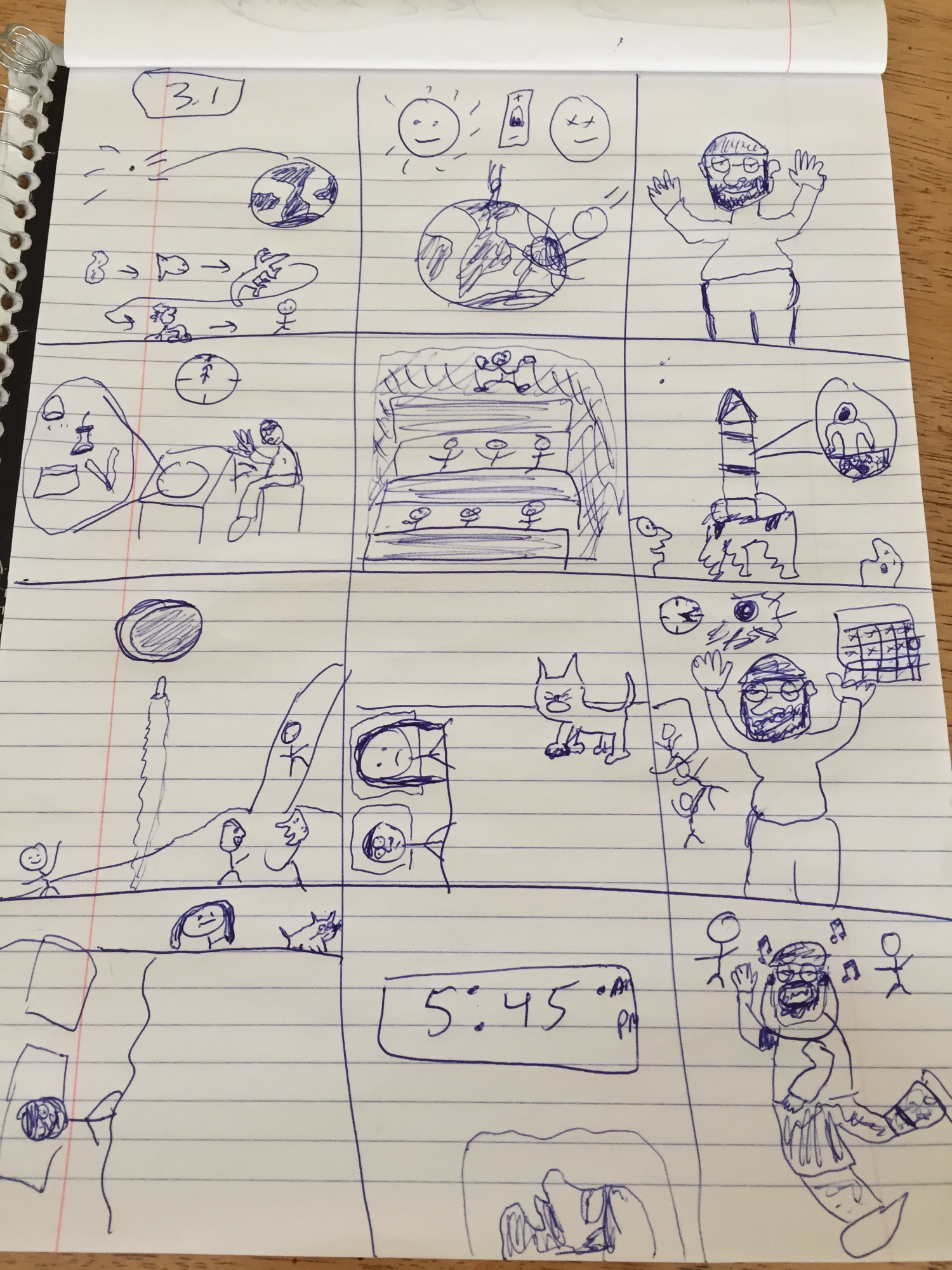
Draw a one panel cartoon for each of the below scenarios; spend 3-4 minutes on each cartoon (so you don’t overthink and add too many details): you can’t use any words (so you focus on visual storytelling and showing instead of telling) and you can only use black and white (so you don’t rely on color to separate items that look too similar; only using black and white makes you create distinct items and characters, as my artist Juan Romera does so well on Rebirth of the Gangster, (trade paperback on sale later this week, but a digital copy available now).

Brunetti specifically says to use a notecard for each of them, but I just split a page into 12 squares, since I didn’t have notecards on hand.

The scenarios:

A) the beginning of the world

B) the end of the world

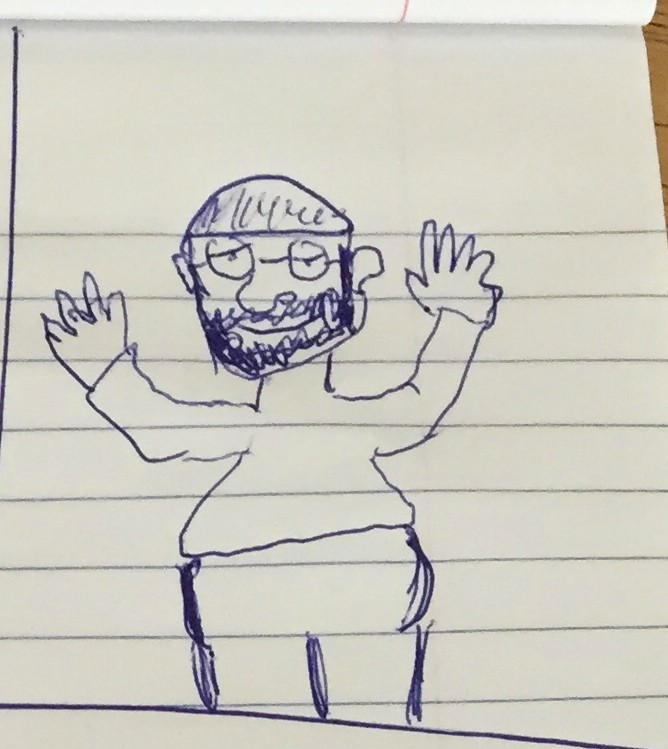
C) a self-portrait, including your entire body

D) something that happened at lunchtime (or breakfast, if it’s still morning)

E) an image from a dream you had recently

F) something that happened in the middle of the world’s existence (something in between cartoon A and cartoon B)

G) What happened right after cartoon F?

H) something that happened early this morning

I) something that has yet to happen

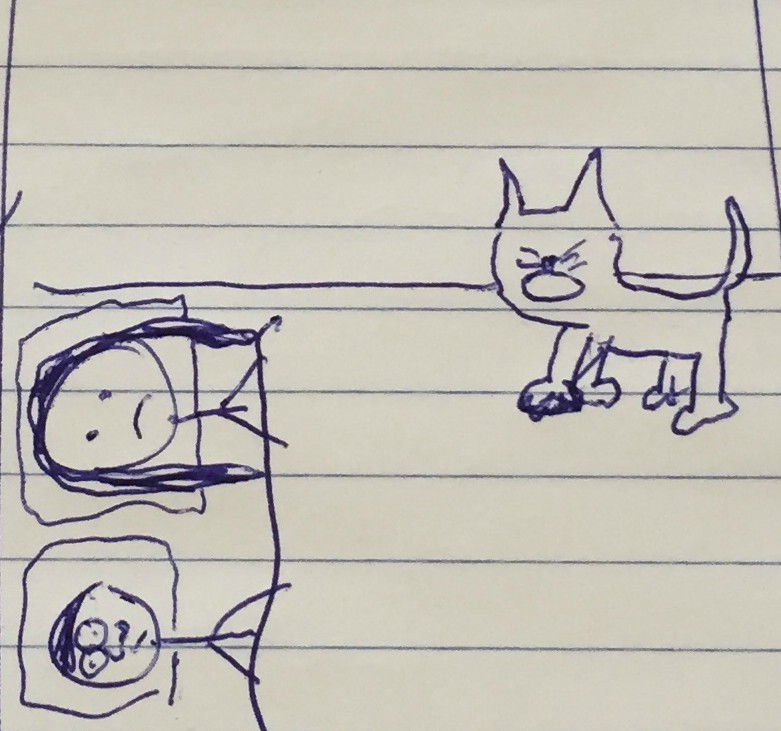
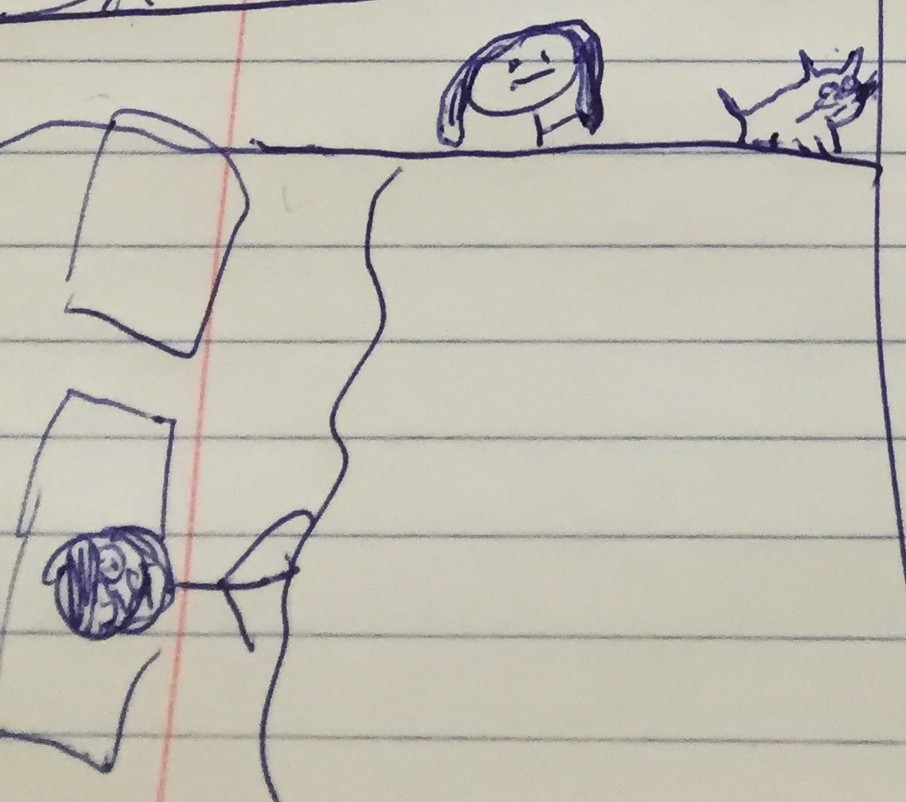
J) pick any of the above panels and draw something that happened immediately afterward (I chose right after cartoon H, which is about my girlfriend and I’s cat waking us up)

K) draw a “riff” on panel J; it could be a different perspective, a different character’s viewpoint, something happening off-panel, or a close-up of a detail on the panel

L) draw something that has nothing to do with any of the panels you’ve drawn so far

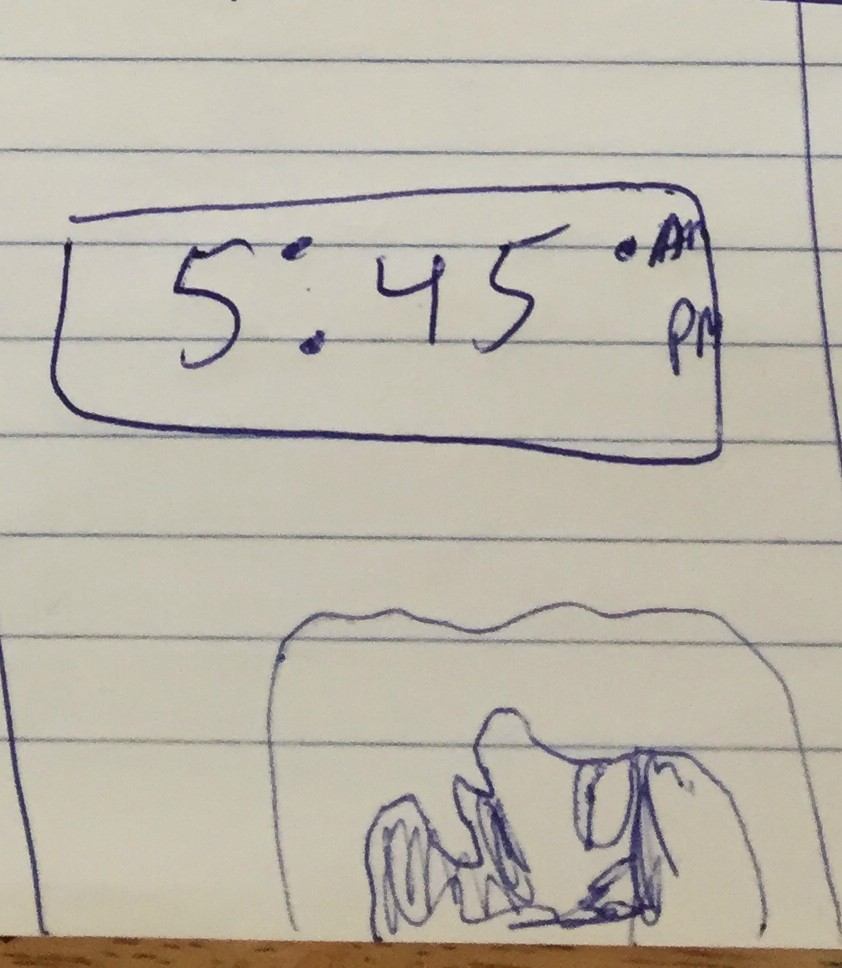
Here are my cartoons (row 1: A-C; row 2: D-F; row 3: G-I; row 4: J-L)

Part 2:

Take 4 of the panels and arrange them so they tell a story.  Study if any beat is missing. Rearrange the order and see what has changed–is it still readable or has it now lost its narrative?  Finally, decide on the best order that tells the most concise and engaging story.  Without knowing it, you just brainstormed your way into creating a four-panel comic.  The next exercises in weeks to come will refine this ability.

I decided to organize my panels this way: H, J, K and C.  Essentially the first three were all the exercises asking me to draw parts of what happened this morning (the cat walking me and my girlfriend up) and the last one is a rough looking self-portrait, which is sometimes how I feel when I’ve woken up early to a cat’s hungry meows.

This was a helpful way to ease into creating a four-panel comic; there was some guidance in the prompt about what to draw, but being able to choose which panels to use gave me some flexibility.  I almost always find that working within rules and guidelines like this is, perhaps counter-intuitively, more freeing and creative than having no structure.

That’s it for Week 3 folks!  Tune in next week for Week 4, but you can check out my updates until then on my blog at cjstandalproductions.com.

Hope Nicholson and Bedside Press: A Dream Realized

Bedside Beginnings

Last Saturday, July 15, marked the beginning of another Hope Nicholson Kickstarter, Gothic Tales of Haunted Love–a Kickstarter discussed more throughly here— Nicholson has been publishing comics under the Bedside Press imprint and running successful Kickstarter campaigns for years.   
bedside press logo

At first, Nicholson didn’t expect Bedside Press to become as big of a part of her life as it is now.  

In fact, when she started the imprint in 2014, she “just wanted to do this one reprint book because [she] didn’t see it in the market! But what [she] learned about the process is not only did [she] really, really enjoy it but [she] had the seeds to be good at it too. Ever since Nelvana of the Northern Lights [she has] been trying to nurture these seeds and grow as a publisher.”

nelvana of northern lights

Her “first project was a reprint, but after [she] caught the publishing bug from Nelvana [she] knew that [she] wanted to do new content too. Getting the pinups for Nelvana and Brok was [her] first experience with working with artists and it was a rush.”

Working on Brok didn’t only just become a fun experience because of working with the artists. In fact, “Brok Windsor is [her] pride and joy”, the comic she’s proudest of so far.

Nicholson holds this comic in a special place in her heart, because it’s “a beautiful comic, so iconic of Canadian history, and of [her] own city Winnipeg in particular, and completely forgotten.”

brok windsor

As mentioned before, “that project really was [her[ first solo outing, and it was a joy to be able to reach out and see what [she] was capable of in all avenues. Discovering the real Brok Windsor, finding ALL of these lost 1940s comics to reprint, hiring a new artist to reinvision a comic only available as a text script and reaching out to over 30 artists to draw pinups of Brok made [her] really proud of my abilities.”

And it seems like she was onto something–since starting Bedside Press, Nicholson has published 11 books, sometimes graphic novels and sometimes a mix of traditional text and comics. As the Kickstarter shows too, she’s only getting started.

Refreshingly, Nicholson seems to enjoy “the feeling of satisfaction in producing books and working with really talented creators”, and focus on that feeling more than trying to be a publisher only focused on the bottom line.

“Plus,” Nicholson adds “all the readers seem really happy!”

A Diverse Touch

Maybe the reason the readers seem happy stems from that personal touch and from a focus on producing a wide range of texts from a wide range of creators.

Early on, she knew “that [she] wanted to focus on diverse content” although that focus is still on hiring “people who tell good stories”.

However, Nicholson noted that when a publisher focuses on good stories, they’ll find that “people who tell good stories come from everywhere. It’s important to tell their stories”.

And one of those stories is making it’s way into Gothic Tales of Haunted Love:

“One [story] really caught [her] eye, so much so that [she] had to hire a restorationist so [she] could reprint it in this collection…[that story] was Sanho Kim’s ‘The Promise’. It’s an exceptional gothic romance, set in Korea, created by a Korean artist, and lettered in both Korean and English. It’s proof that there are always resistance and exceptions to dominant genres and [she’s] really excited to showcase it.”

sanho kims the promise

This is just one of many diverse stories, however, both in Gothic Tales of Haunted Love and in the rest of Bedside’s publishing catalog.

Nicholson attributes her success at attracting diverse voices to a few things:

“At first when [she] did open calls, [she] didn’t have as far of a reach, so a lot of creators outside of [her] immediate circle never even heard of [her] projects, let alone could apply for them. But over the years [she has] had more and more standing in the industry and since [she] promote[s] a lot of different creators…people who aren’t white, who aren’t straight, who aren’t binary gender.. [diverse creators] are now within [her] social sphere.”

secret love of geek girls

But she knew she had to do more than just rely on her social sphere:

“[She had] to put the work into research and asking for specific recommendations in order to compensate for [a social sphere’s] limitation. For example when [she] did The Secret Loves of Geeks, it was a bit of an attempt to fix an issue that feminism has with binary gender. [She] didn’t want just stories from men, just stories from women–[she] wanted stories from people where the gender binary just wasn’t accurate for them. So [she] asked specifically for stories from nonbinary creators, and received several!”


Bedside Bumps


Although Nicholson has been successful in her publishing experience so far, she does admit that there have been a few bumps in the road, mainly stemming from her steadfast commitment to publish stories she loves instead of only pursuing commercially successful stories.

Distribution and finances are the biggest bumps she’s experienced so far:

“In Canada because of our sparse population base most publishers exist on grants, and grant eligibility is restricted to very strict criteria. [Because of this limited funding, she] fund[s] most of [her] projects through Kickstarters, but this only reaches an audience of usually 400-3,000 funders, and is usually only done two-three times a year.“

She adds that “distributors don’t want niche projects for the most part, so it limits [her] reach to what [she] can hand-sell. That’s tough”.

It’s so tough that Nicholson has had to adjust her life a little. “Because [she uses] almost all of [her] freelance income to put into new projects, it also means [she has] had to cut personal costs as much as [she] can” so she lives with her parents.
spectacular sisterhood of superwomen

On the bright side, though, she’s “had better luck licensing the projects to publishers later (like with The Secret Loves of Geek Girls through Dark Horse), and using all [her] freelance payments from other projects (like writing The Spectacular Sisterhood of Superwomen for Quirk Books) to fund additional books.”

For example, “The Spectacular Sisterhood paid for all the production and printing fees for Love Beyond Body, Space, and Time!”
lovebeyond

Kickstarter Boost

Part of her success as a publisher comes from running successful Kickstarters; Nicholson has run six successful Kickstarter campaigns and is looking to add a seventh.  In fact, she’s been so successful in this area that Kickstarter has made her one of their Thought Leaders, an honor only bestowed on seven creators so far.

kickstarter thought leaders hope nicholson

When describing this experience and honor, Nicholson says that “ it’s been nice!”

But she adds that, “not too much has changed for [her], since unofficially [she] was already giving a lot of advice and panels and seminars on how to use Kickstarter and tips on how to succeed. It’s basically just given [her] a degree of legitimacy when [she says she’s] an expert!”

Nicholson was more than happy to share some of those Kickstarter tips in this interview.

One of her biggest pieces of advice is to “keep a lot of spreadsheets of lists! It’s tough to re-do all your research from scratch for each campaign.”

While Nicholson has raised enough funds with all of her Kickstarters, she does offer some light for those who don’t have her track record.  She reminds them that “failure is OK.”

Not only is it OK, it’s so much a part of life that she prepares “as much for the failure of a campaign as [she does] for its success.”

woody allen failure quote

Sometimes this means asking the right questions, such as “at what point would [she] be comfortable making a personal investment in the project if funding doesn’t push [her] over the edge”?

Does she think that she would “try the project again at a later date or through a different method”?

“Would [she] approach a publisher with the project instead, or would [she] let the project die and encourage the creators to apply with their story for other projects?”

Even though she prepares for failure, she hasn’t had to answer those questions outside of the abstract yet.

And she attributes that success to many things:

“[A big part of success is] putting the work in. And that goes from every aspect. It includes having and maintaining a newsletter, having an active social media life (yes, life not just promotion! People want to know who you are before they feel connected), chatting to press and journalists like they are human beings (so many creators treat press like a necessary evil which is ridiculous. We’re all in this equally together!), identifying your weak spots ([hers] is design) and hiring appropriately (S.M. Beiko did all the amazing design for the kickstarter!)”

Despite this success, she made a point to say that she is ”always learning, and anything outside of comics kickstart-ing is still a bit foreign to” her”.

*Note* All quoted material is from Hope Nicholson.


Hope Nicholson Talks Gothic Tales of Haunted Love

The summer might be almost half over, but Hope Nicholson and her imprint Bedside Press are just getting started on a Kickstarter for their new anthology Gothic Tales of Haunted Love, stories that will chill the blood even on the warmest night.  

Image Credits: “Gothic Tales of Haunted Love”

cover art by Leslie Doyle, logo by Dylan Todd

(click on link to see anthology credits and details)

Or in Nicholson’s words herself:  “If you like horror, you’ll like this book. If you like suspense you’ll like this book. But if you need happy endings, well….you might NOT like this book!”

Blog544_Dark+Mansion+Forbidden+Love+Cover_1 1970s gothic romance

Image: Cover of a 1970s gothic romance comic; typical of the comics that inspired the anthology (not part of Gothic Tales of Haunted Love anthology)

The campaign itself started July 15 and ends on September 15.  After that point, the creators involved in the anthology have two months to finalize their stories before the anthology goes to print with January 2018 as the targeted delivery date.

Gothic Tales of Haunted Love, like Nicholson herself, has many inspirations.  It all started when she “was doing research for The Spectacular Sisterhood of Superwomen [published by Quirk Books].”  She discovered the 1970s comic genre of gothic romance, and had one reaction: “They were thrilling! After spending days reading romance comics, which were entertaining but usually pretty formulaic, it was so great to read stories just as emotional but with a lot more unpredictability.”

Hope elaborates on her love for the genre, saying it’s “interesting because though it still had many stories of pale beauties on the moors and dastardly lords, it was also very campy and supernatural. Lots of demons, witchery and ghosts!”

Despite her interest in this genre, though, she did admit that it had one drawback: “[These stories] were still mostly focused on North American creators, white girls, and straight romances.”

For anyone familiar with Bedside Press and Hope Nicholson, it’s no surprise that this lack of diversity troubled her–in her own words, that lack of diversity is “boring for an anthology”–and it’s something she’s looking to fix with Gothic Tales of Haunted Love.

sample5_hienpham

Image Credits: from “Minefield” by Hien Pham (told entirely in Vietnamese)

Specifically, to create an anthology that reflects true diversity and brings this genre into the 21st Century, they “did a half-curated, half-open call for new content and the stories…in this project have a focus on global gothic romance.”

And this is reflected in the stories themselves; one story has “two young men falling in love in Vietnam”, another has “pain and loss in Jamaica,” a third has “fashion intrigue in Taiwan, and [overall there are] lots of beautiful ghosts of all genders falling in love with mortals.”

The anthology itself is the reward Nicholson hopes most people enjoy.  

However, there are some other killer rewards: “Something really fun [Bedside Press] did was reach out to the estates of classic 1970s gothic romance cover artists and license artwork for special print reprints. So while [there is] a lot of new content, [Bedside Press] still [offers a] nod to the aesthetics of the old.”  Finally, as part of the rewards they “also have brand new prints from our creators as well!”

Next week, we’ll continue Nicholson’s interview, focusing on her journey as a self-publisher and Kickstarter Thought Leader.  But until then, make sure you check out the Kickstarter for Gothic Tales of Love!


*Note* All quoted language in this article was from Hope Nicholson.

sample1_janet

Image Credits: from “Crush” by Janet Hetherington, Ronn Sutton, Becka Kinzie, and Zakk Saam


sample_7

Image Credits: from “Fazenda do Sangue Azul” by Dante L. & H. Pueyo

Creators Corner: Adventures in Cartooning, Week 2

I’m a writer, not an artist. But for the next 9 weeks, I’m going to be a cartoonist.

And you can join me on this journey–not only by seeing what I do, but by completing the exercises I do along with me.

*Note* To see Week 1’s adventures, click here.

The great cartoonist Ivan Brunetti, also a teacher of comics/cartooning, has a book that publishes his course; it is a 10 week “class” that has a few exercises for each week, some of which I might even use in my own graphic novel class.

brunetti cartooning cover

I thought it’d be fun–especially since I’m a writer and need to challenge my skills as an artist–to run myself through his course and post each of my exercise on here. So without further ado, let’s take the next step in our journey…

Exercise 2.1

Get handful of index cards and write phrases/sentences that you’ve heard recently (from eavesdropping, conversations you’re actually a part of, something you saw on TV, etc… Brunetti didn’t specify a certain number, so I just went with 5 index cards; you should use 7 or more, since the next exercise involves drawing 7 single-panel images and then pairing them with these phrases.

Exercise 2.2

Using some new index cards draw a single-panel cartoon (no words allowed) of these things; then pair them with the index cards from 2.1, mixing and matching until you find the best caption.

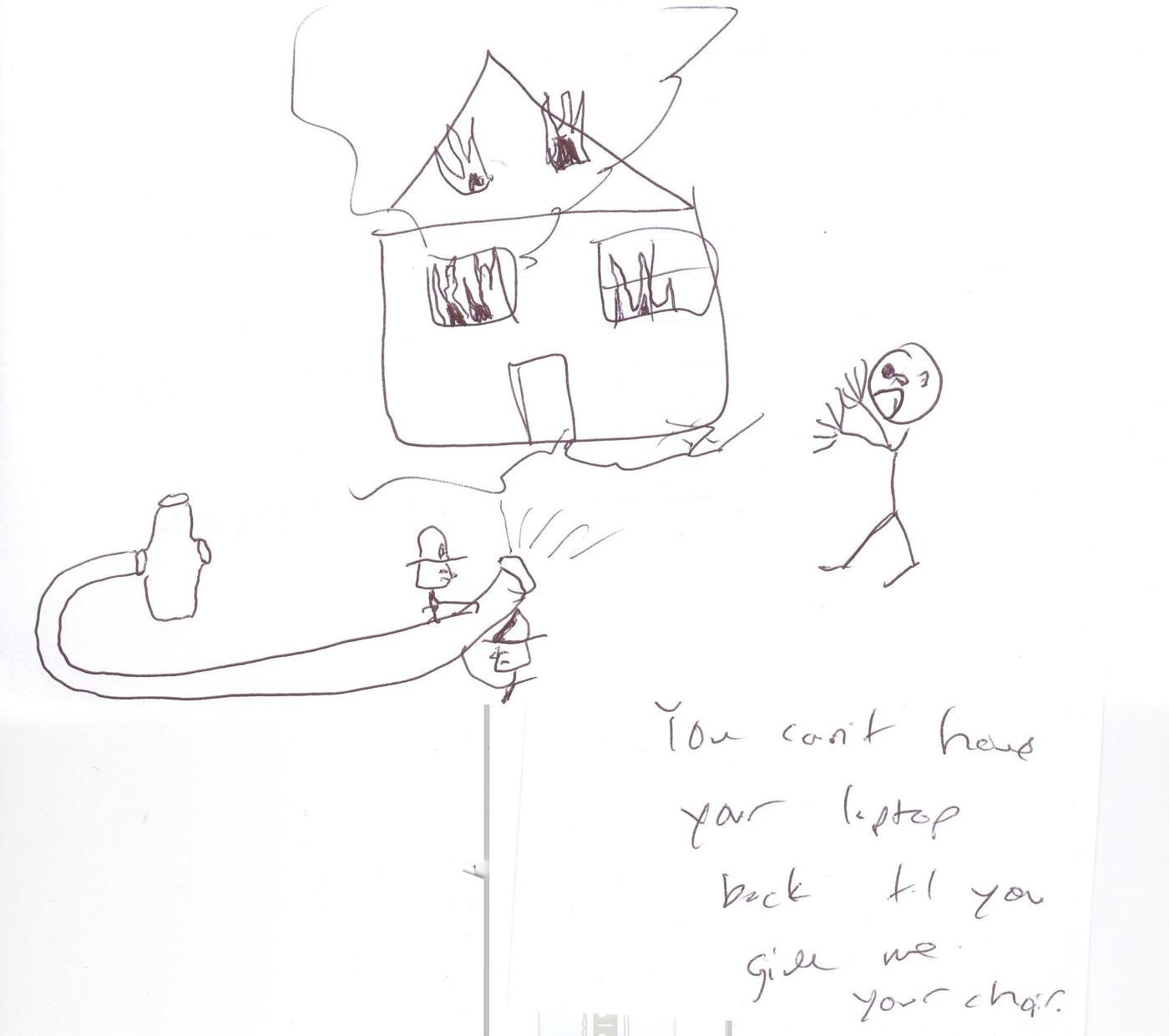
The intent behind this is to show that sometimes the funniest or just best comics happen when juxtaposing things that don’t seem to go together.  (Case in point: my carton that shows firefighters helping put out a housefire, which was combined with a caption featuring someone trying to bargain/extort the other; that’s not really how firefighters work, but that reversal of expectations builds the humor).

It also shows that we should pay attention to the world around us, because it might offer the best way to complete an idea (more of this tip in Exercise 2.3).

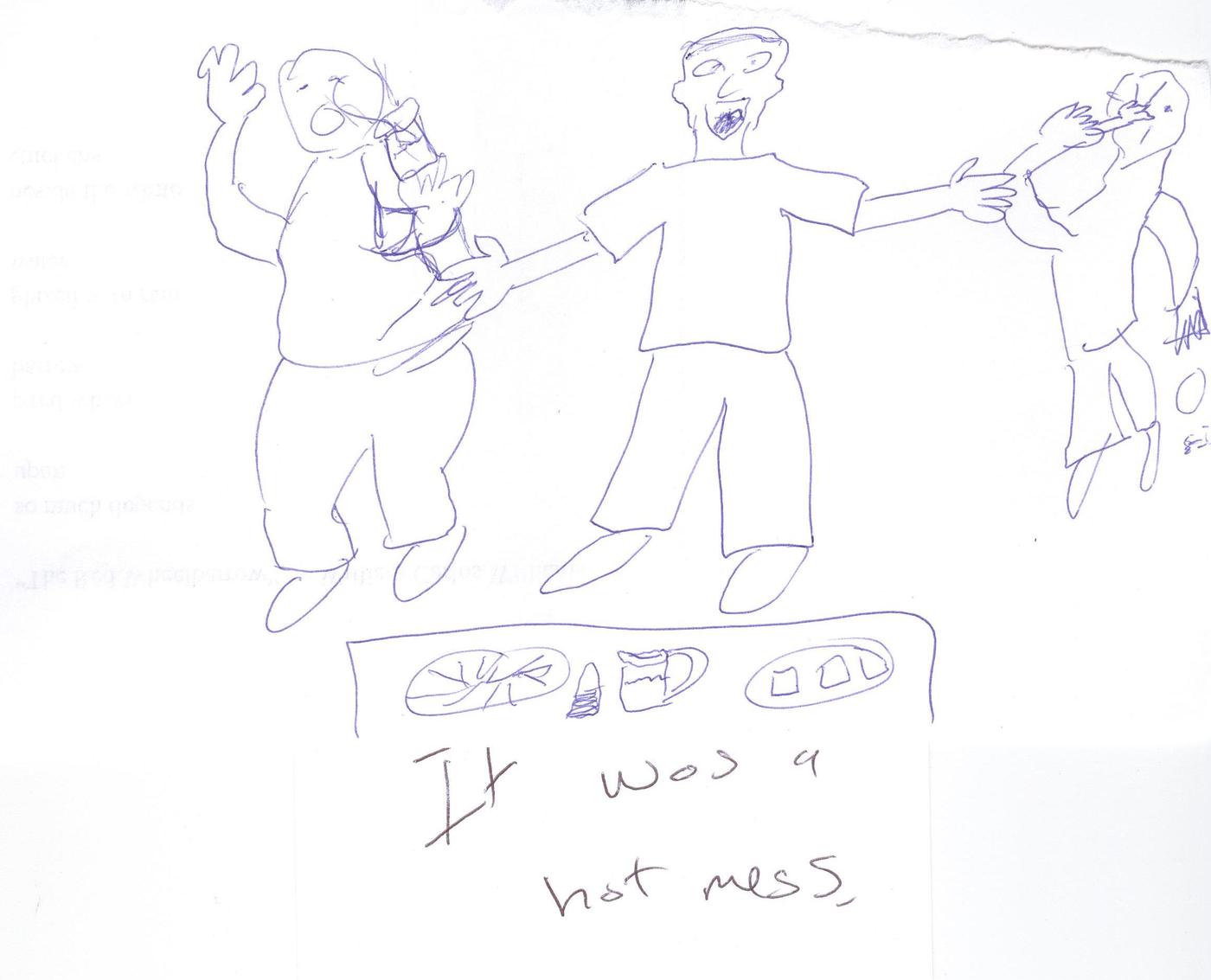
Check out my work!  I’ve both typed the captions and scanned them, because my handwriting is so awful someone might not be able to read the scanned caption.

1) the funniest thing you can think of (someone entering a party so enthusiastically they slap food and drinks in others faces)

IT WAS A HOT MESS.

2) something sexy (I didn’t do this, sorry)

3) something scary (my house–and all my books and comics–burning)

YOU CAN’T HAVE YOUR LAPTOP BACK TIL YOU GIVE ME YOUR CHAIR.

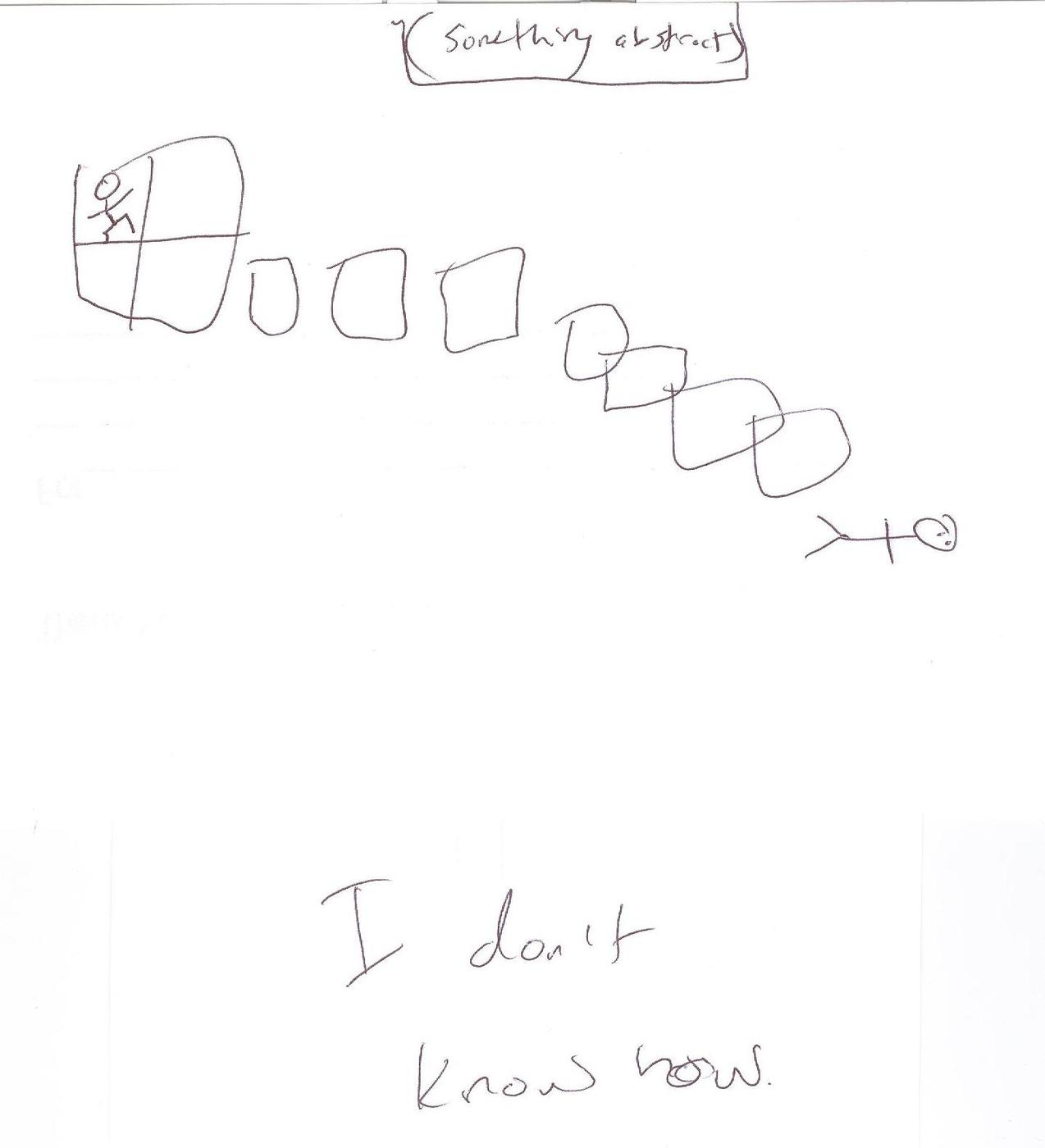
4) something abstract (looks like panels of a comic, but maybe not?)

I DON’T KNOW HOW.

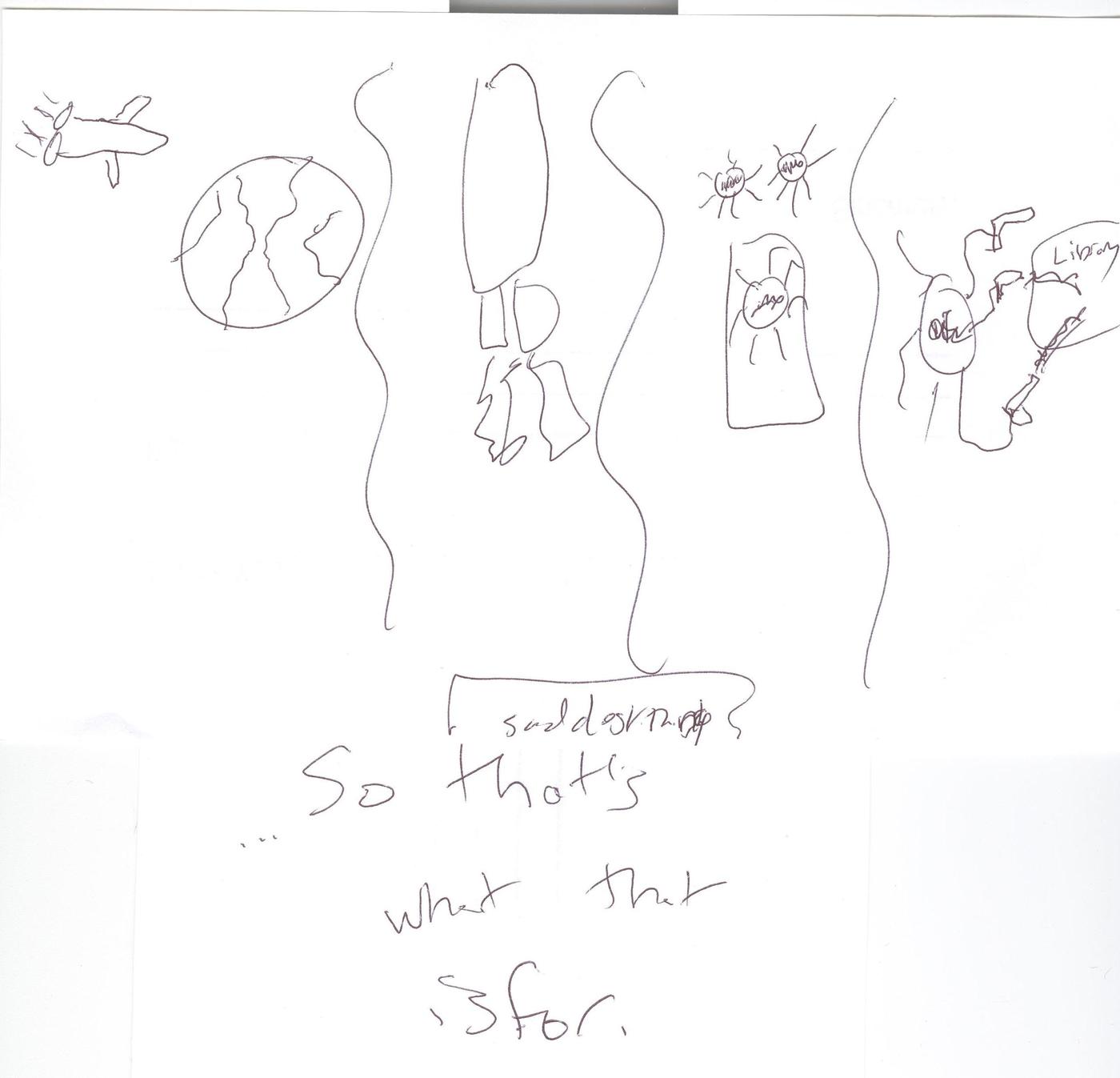
5) the saddest thing you can think of (an alien landing on Earth and, first thing, shooting a library with a space ray gun). This is one of my favorites–either my favorite or second favorite–because of the unexpected caption, but I did cheat and make it a few panels, all wordless.

…SO THAT’S WHAT THAT’S FOR.

6) something you saw in a dream lately (I didn’t do this one, sorry)

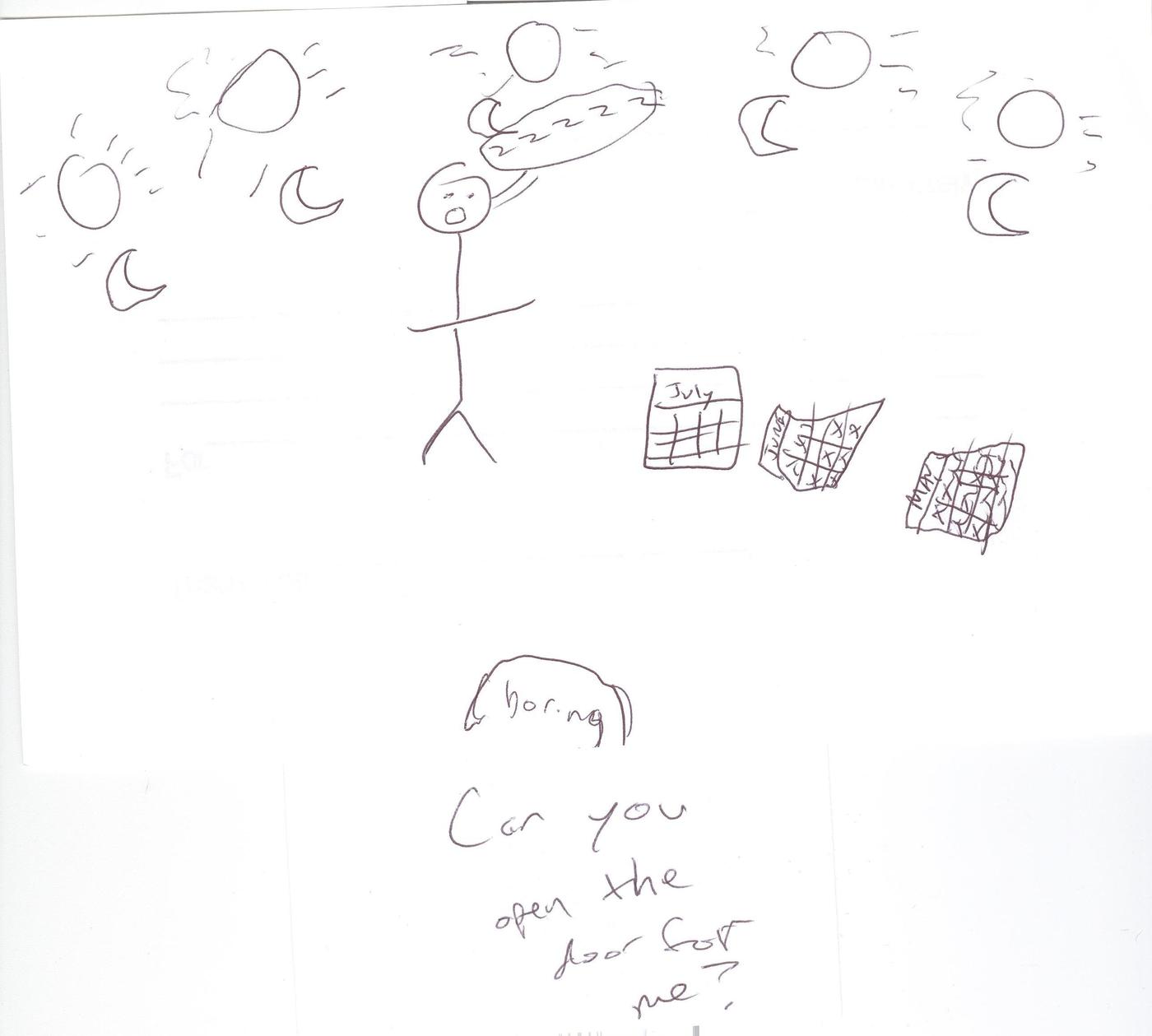
7) something boring or mundane (sleeping the months away and doing nothing). This is one of my favorites–either my favorite or second favorite–because the caption both fit and didn’t fit (he’s cooped up inside so needing a door open kind of makes sense, but a closed door shouldn’t make someone sleep a couple months away). I also did a small cheat and used the ZZZs to indicate sleeping, but they don’t count as words–they’re accepted symbols for sleeping–so I think it’s fine.

CAN YOU OPEN THE DOOR FOR ME?

Exercise 2.3

Over the course of the week, take note of 12 small objects and write them down.  Then, brainstorm commonalities for all 12.  After that, eliminate 2 objects, because they’re most dissimilar to the rest of the objects.  The purpose of this is to create more and more connections between things–which is what art does after all–but to see what can be jettisoned to be more streamlined–which is what great art does after all.

My list:

watch, lunchbag, strainer, phone, book, cleats, notepad, picture frame, lighter, nametag, cat toy and waterbottle.

Commonalities:

things found in a house, things to make memories with

What I got rid of and why:

cleats and waterbottle; being associated with sports, exercise and outdoor activity it didn’t fit as much with these things found and mainly used in a  house.

While I like how this exercise tries to show that we can find more commonalities between things than we normally feel–although we shouldn’t force these commonalities too much–I wasn’t the biggest fan of this exercise.

I think my brain already does that (hence the reason that my comic, Rebirth of the Gangster, is influenced by my experiences with the students I teach and the coworkers I instruct with, Breaking Bad, issues with immigration, The Wire, hip-hop,  The Godfather, the opiod epidemic and even more recent political/social issues; I’m even throwing a little Shakespeare in the mix with a taste of Macbeth and Othello.

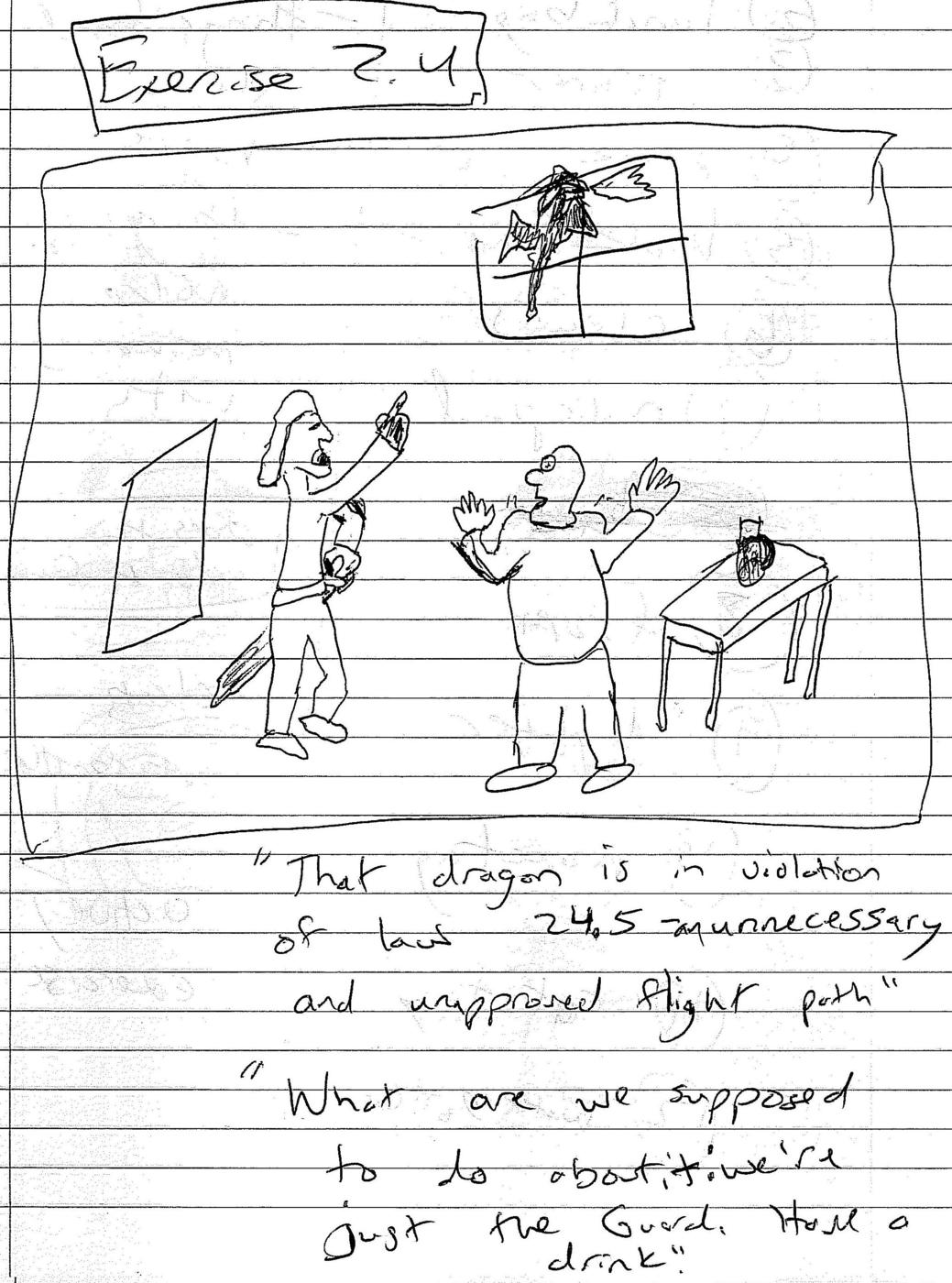
Exercise 2.4

Create a one-panel cartoon adaptation of a famous literary work.  Brunetti gives an example of how he would adapt The Catcher in the Rye, a piece he recommends because there aren’t already film adaptions or comic adaptions of this piece, so the visuals are more original.  To see that, though, check out the book, because it’s insightful, but too in-depth for me to go into without risking copyright infringement.

I chose Guards, Guards by Terry Pratchett, which focuses on a Night Watch group (although this group has seen better days, with only 4 members, 3 of whom don’t enforce the laws and just get drunk instead–the only one who does is a new country boy who enforces dated laws from an old book he had read).  And in the midst of this lack of law, a dragon starts terrorizing the countryside.

Here’s my cartoon, and this was probably the most fun I’ve had in the first two weeks (I’ll type the caption beneath it too, since my handwriting is awful):

“That dragon is in violation of law 24.5–an unnecessary and unapproved flight path.” “What are we supposed to do about it: we’re just the Guard. Have a drink.”


That’s it for Week 2!  Come back in about a week to see how Week 3 turns out.

And if you can’t wait that long, check out until then on my blog at cjstandalproductions.com where I post each exercise individually.

I try to post daily but as a teacher (and since I’m working on the print edition of the first story arc in Rebirth of the Gangster, cover below and digital copy available now), it’s an ideal goal that hasn’t become a reality yet.

cover-GN1

Thanks and see you next time!

CJ

Creators Corner: Adventures in Cartooning, Week 1

brunetti cartooning cover

I’m a writer, not an artist. But for the next 10 weeks, I’m going to be a cartoonist.

And you can join me on this journey–not only by seeing what I do, but by completing the exercises I do along with me.

The great cartoonist Ivan Brunetti, also a teacher of comics/cartooning, has a book that publishes his course; it is a 10 week “class” that has a few exercises for each week, some of which I might even use in my own graphic novel class.

I thought it’d be fun–especially since I’m a writer and need to challenge my skills as an artist–to run myself through his course and post each of my exercise on here. So without further ado, let’s take the first step in our journey…

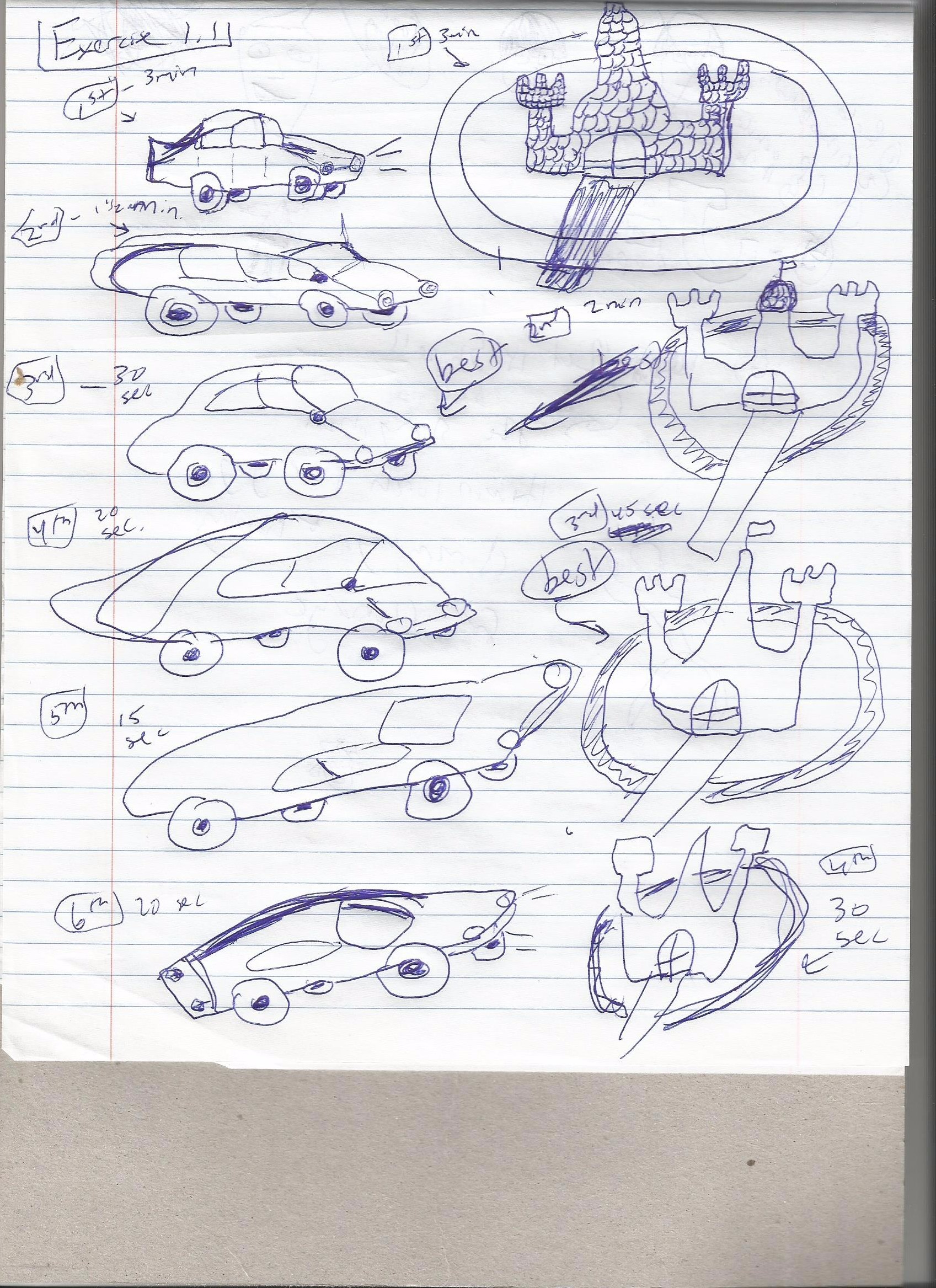
Exercise 1.1

This exercise follows these guidelines:

1) Draw a car in 3 minutes.

2) Beneath that, draw a car in 1 1/2 minutes.

3) Beneath that, draw a car for 1 min.

4) And so on, using more intervals like 45 sec, 30 sec, and 10 sec.

5) Repeat with other objects like a castle, cat, and more.

The intent behind this exercise is to streamline your drawing until you have the most iconic and universal representation of that image, while still being detailed and polished enough to ground it in some reality.

This is what I did for the car and castle versions; I think my best in each was my third try, which was always around 45 sec-1 minute.  With less time, my drawings got even worse than my natural skills already are, and with more time, my drawings got too messy but in a different way: too messy with details.

Often, we love looking at the art with the most detail, like Bryan Hitch’s cinematic scope, but this exercise shows that creating too much detail can slow storytelling; we end up focusing more on the beauty of the image than the story itself.  While I’m not looking down on detailed, beautiful artwork, it is helpful to keep this idea in mind and focus on storytelling more than pure aesthetics, adding a gorgeous, detailed page every now and then.

The compromise I’ve seen many artists also take–and the balanced approach I gravitate towards–to find this balance between storytelling and detail, especially manga artists, is to add detail in setting but streamline characters and main objects to their bare essentials. This was a fun, low-pressure first exercise with some good learning opportunities.


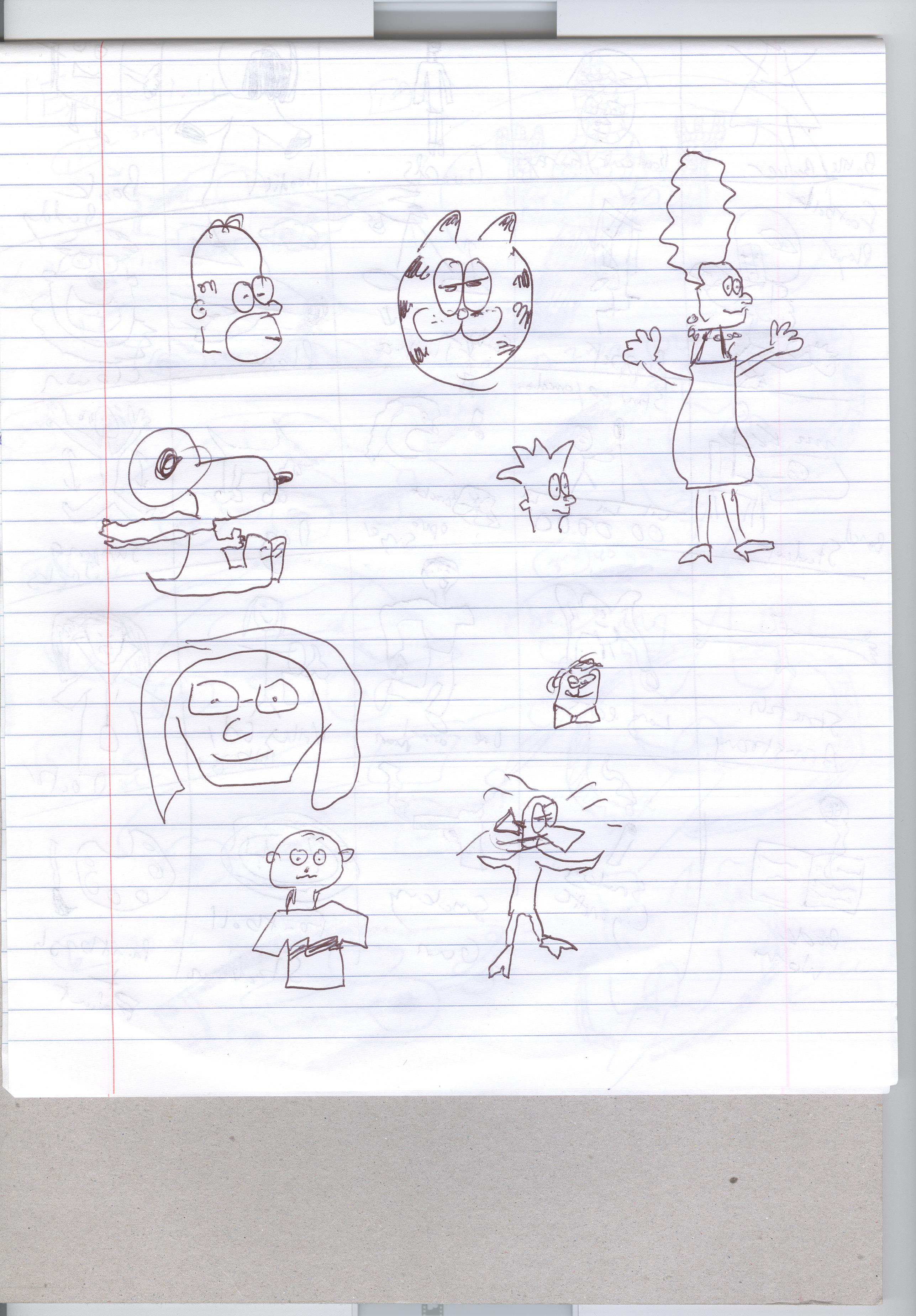
Exercise 1.2

This exercise follows these guidelines: From memory, draw quick doodles (spending about 10 seconds or so on each) of about 25 famous cartoon/comic characters.

The intent behind this exercise is twofold:

1) It shows that the most recognizable characters are often still recognizable in the rushed pen of a layman or laywoman; this is generally because those recognizable characters have been streamlined, so we remember and recognize them from less detail than we would think.  This goes hand-in-hand with the streamlining focus of exercise 1.1.

2) It also shows that to draw these characters perfectly, most people would need a model to look at, which also raises the issue of consistency: if we want to cartoon ourselves, we have to create a character than can be duplicated relatively quickly with a constant consistency, and we should have models (showing the same image from different angles) to help accomplish this.

These are some of my doodles; I think the comic characters and Homer Simpson looks good, but some of the others aren’t very recognizable.


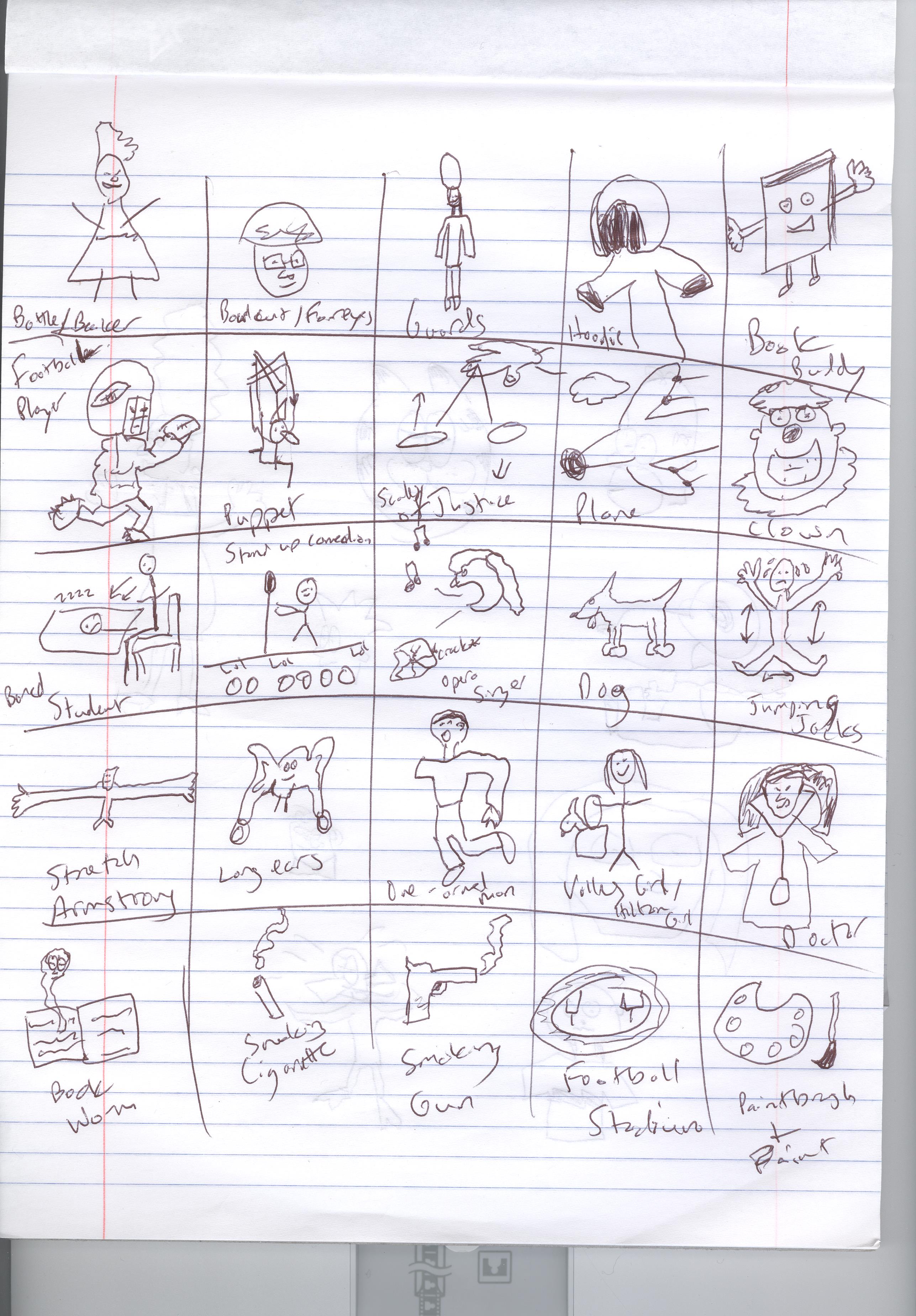
Exercise 1.3

This exercise follows these guidelines: Create a grid (like a big 10×10 tic-tac-toe board); spending no more than 5 seconds per drawing, draw whatever word comes to mind (people, objects, places, jobs, feelings, etc…)

The intent behind this exercise is twofold:

1) It shows that when a cartoonist simplifies and boils drawings down to their most basic components, the image is still recognizable and universal, which can actually make a simpler drawing better than a detailed one.

This simplification process is something Brunetti has really hammered in this week, and like any good rule, it’s a great guideline but can always benefit from exceptions when breaking that guideline for a purpose.  And for those familiar  with Brunetti’s work, it’s probably no surprise that he stresses simplicity and clarity above all else.

2) It also shows that obsessing over a drawing for hours isn’t the best approach, because we often add unnecessarily details that distract from the needed, fewer, universal details.

This is what I did, and I think it’s better than the previous exercise, partly because I was free to draw what I wanted (instead of other people’s creations) and because a simpler cartooning style suits my, shall we say, less-than-refined drawing abilities.

That’s it for this week!  It’s been a fun, and educational, experience so far, and I look forward to continuing this for the next 9 weeks.  Check my next post on week two of this journey next week for Graphic Policy.

However, if you want to follow me along for each exercise (not just the week recap), I post each exercise on my blog and at my site, cjstandalproductions.com.

Creators Corner: Creating Rebirth of the Gangster, Part 3 – Outline, Synopsis, & Chapter Breakdown

Rog outline with TK comment

*Note: This is the third part of my series about creating Rebirth of the Gangster. The first part focused on brainstorming the big idea and plot, and the second part focused on brainstorming all the details and outlining them into a coherent whole. This one will focus on transforming the brainstorming and outline into a series synopsis and chapter/issue breakdown.

Now that I’d brainstormed possible story beats, I was ready to write the synopsis [I’ll also place peer feedback in brackets like this–I got the peer feedback after I wrote the synopsis and outline]]:


Synopsis for Rebirth of the Gangster (Of course spoiler alert, although things will change as I write the piece and already have changed in the five issues I’ve written so far.):

Rebirth of the Gangster

Two sons–one rich and one poor, one black and one white, one with both parents living and one with a dead father and a dying mother–get sucked into a world of crime as they are haunted by their families’ secrets and a murder as old as the sons themselves.


Rebirth of the Gangster is

  • a long form narrative like 100 Bullets, also echoing its playful dialogue, ensemble cast, and shadowy visuals
  • with seasons that explore many facets of society like The Wire
  • and dripping in the noir-grounded reality of Criminal and Damages that marches characters towards an almost certain doom

(potentially released as a series of limited series that intertwine like Criminal does, if that’s a better commercial approach)

Marcus Thompson is a young African American man, a prosecutor for the state. His mom, a Hmong woman named Andrea, is a successful stockbroker and his dad, Curtis, owns a large, national business. When Marcus was born, his grandfather was killed. But that’s not the only murder that’s part of his family’s past, even if Marcus doesn’t know it: his dad used to be a criminal, before using his proceeds to fund his legal business ventures. And he was involved in a murder that’s going to haunt his whole family.Hunter Anderson is a young white man who works in a warehouse and struggles with anxiety and depression. His mom, Linda, is an administrative assistant; his dad, John, was killed by Curtis. Now, though, she’s trying to live a normal life: she’s remarried to a construction worker, a man who doesn’t treat her with as much respect as Hunter would like. Recently, she’s been diagnosed with cancer, and they’re struggling to afford her treatment. Hunter’s friends know this and convince Hunter to join them in a life of crime.

To open the story, Curtis receives an award for his work with his charity. Marcus walks home from the event with a co-worker, Alex. Alex gets in a fight with a homeless black man. Marcus stops the fight, always trying to play the peacemaker, but the homeless man accuses Marcus of betraying his race and history. The next day, these comments under his skin, he puts a young man (Devonte) in jail for drugs. Devonte says he’s innocent–the drugs were planted.

Although Marcus wins the case, he feels some guilt, as he flashes back to when he was a kid, giving into peer pressure to cheat for drugs: other black kids also played the race traitor card. They were all busted by the cops, but Curtis pulls some strings and Marcus has no consequences–the arrest is even erased from his criminal record. Because of events like this, he’s lately been feeling disillusioned with his role in prosecuting non-violent drug crimes. His coworker and friend, Kaitlyn–a black woman–tries to cheer him up, unsuccessfully.

Later, Marcus and his coworker, Alex, are at a gas station. A few men come in and rob the gas station. Marcus remains silent, hoping it will blow over, but Alex talks back. When one of the robbers (Hunter) comes over, Alex points out who Marcus is and warns Hunter. Hunter sees Marcus and Curtis’s pictures on the TV, and then cracks the gun on Marcus’s head. [Peer 2 Feedback: Love the premise so far. Hey, how does Hunter know that Curtis killed his dad, and why hasn’t he taken revenge yet? No opportunity?–My response–This made me have Hunter’s mom tell him the whole truth after this robbery; I also adjusted the plot, so that Randy’s dad was blamed for John’s death. That also gave Hunter greater reason to keep Randy around, even though Randy is a jerk: he’s trying to atone for the family legacy of a framed crime]

After the robbery, Hunter flashes back to what got him here (his mom’s depression and anger, his struggles in school, his dead end life, his mom’s sickness). At the same time as these flashbacks, he’s talking to his partners in crime, hiding the truth about why he hit Marcus. Angry at his emotional actions, they decide to stop working with him. He leaves and talks to his mom in the hospital, finding out the truth about his dad’s death: before, he thought the dad of a neighbor, Randy, killed John and that Curtis was only responsible for sucking John into the life of crime. He comes up with a plan and gets one of the robbers to do this as a last favor.

This plan, it turns out, involves the robber staging a fake mugging of Marcus where Hunter “saves” Marcus. Grateful, Marcus takes him out for a drink and the two start becoming friends. Marcus and Hunter start hanging out regularly. He even starts partying with Hunter and his friends, slipping back into his past drug use, even buying. While they’re hanging out one day, a Hispanic cop stops by to ask Hunter some questions about his recent robberies.

This cop, Lorena, grew up with Hunter and almost fell into a life of crime herself because of her struggles with a fractured family and faith, partly because she’s gay. She found her faith, closure with her family, and decided to become a cop to help others like her. Although her beat isn’t in Hunter’s neighborhood, she’s a workaholic who keeps in touch with her old life. She gets nowhere in the questioning, but vows to find out what he’s up to & why Marcus is there.Andrea & Curtis end up meeting Marcus with some of Hunter’s friends, but not Hunter. Although they run this charity, they still feel uncomfortable with these guys. Echoing what he said when Marcus was caught with drugs, Curtis worries that this might affect their image.

Andrea, however, isn’t as afraid of their past life. In fact, she’s been getting bored lately, and longs for more of the old life–her killer instinct is reawakened when someone attacks her while going home one night and she fights him off. There will be a few instances where women in this series are in danger. Like Andrea, they’ll be more than capable of fighting their way out.

This killer instinct isn’t new: in flashbacks it’s revealed that she has a wild streak, including helping Curtis kill Marcus’s grandfather, because he found out the truth of their activities and was going to turn them in. Andrea–in Lady Macbeth fashion–convinced Curtis to kill him. Similar to Curtis, Linda is trying to put her past anger behind her. She had always tried to get John to leave that life. After he died, she turned to drugs and petty crime to deal with her

depression and anger. Now, though, she starts seeing how Hunter is falling into the same trap,

and she’s going to do everything she can to help him avoid her mistakes before cancer kills her.

Two more characters close the beginning third of our series: Dennis, a friend of Hunter who was just released from prison, and Lizzeth, a Hispanic teacher who’s friends with Marcus.

Dennis is quickly pulled into Hunter’s plans, although Dennis isn’t certain he wants to re-enlist in a life of crime. Prison haunts him, including his time in solitary confinement, and he’ll do anything to avoid going back. Lizzeth meets Dennis through Marcus. There’s clear attraction between her and Dennis, but she doesn’t want to get involved with him because of his past.

As Marcus and Hunter continue to party more, Hunter asks Dennis to document (tape, photograph, etc…) Marcus’s illegal activities, eventually planning to blackmail Marcus. At first, Dennis doesn’t want to do this, but he’s eventually convinced and starts slipping back into the life that sentenced him to prison. While this is going on, Lorena busts one of their parties but gives them a pass, partly because she’s not interested in something that small, and partly because she knows Hunter is up to something and thinks he might crack if she’s playing the good cop. She starts to obsess over this, leading to another fight with a girlfriend.

Marcus starts to slip up at work because of the fast life; Kaitlyn tries to help him out. He at first wants to listen to her, but eventually gets too caught up in his partying and Hunter’s schemes. As Marcus continues his fall, Andrea does so too. She starts taking risks, like shoplifting and picking arguments with random people that almost lead to fights. Curtis notices this behavior, and at first tries to find out what’s going on. When Andrea says nothing, they start fighting and a distance grows between them that will last. Linda tries to talk to Marcus and warn him about Hunter’s intentions, but she backs out at the last minute, afraid of betraying her son. [Peer 2 Feedback: Getting a real Iago-Othello vibe here–minus Desdemona–and it’s pretty fascinating. Is there anything redeeming about Hunter, though? Iago’s always a character who’s absolutely evil–I mean, you like him because he’s so damn clever, but otherwise, he’s awful. How do we feel sympathy for Hunter beyond him losing his dad and, potentially, his mom? I mean, Marcus didn’t actually kill his dad–so why does he deserve to have his life ruined? Just throwing thoughts out there. I’m intrigued!–My response–I’ll add some sympathetic character traits as I write individual issues, but this was a good reminder.]

Eventually, Hunter reveals his evidence to Marcus and blackmails him for a plea bargain–he’ll rat on a gang leader, even though that leader had nothing to do with the crime. And even though it’s against his code, Marcus, afraid of tarnishing his image, agrees to go along with it. Unknown to Marcus, Dennis is videotaping this interaction too.Marcus goes to work the next day and starts the plea bargaining process immediately. Kaitlyn starts getting suspicious and starts double checking the plea bargain documents and rifling through Marcus’s desk, while Marcus goes to visit Randy. At the prison, Marcus is confronted by Devonte, the prisoner he put away at the beginning of this story–the prisoner has heard from other inmates about what Marcus is doing (and why he’s doing it) and threatens to go to the warden. Flustered, Marcus calls Hunter and warns him about what’s going on; Hunter agrees to take care of it, and later that night, Devonte is found stabbed, close to death. Lorena comes to Hunter’s place shortly after this, partly to check up on Randy and partly to ask questions about this prison violence; they’ve been able to pin it down to Derek, one of Hunter’s friends that is in prison; he hasn’t talked, but she wants to pressure Hunter and see if he cracks.

Marcus gets back from visiting the prison, and is faced with a bunch of questions from Kaitlyn. Clearly rattled from confronting Devonte, he acts shady and makes Kaitlyn even more suspicious despite revealing nothing. She’s met Curtis & so she calls him with her worries, which leads to Marcus confronting Curtis again about professional behavior & the family image.

The next day Marcus finds out about Devonte. He goes to Hunter and gets into an argument with him, threatening to go to the authorities. Hunter brings up the phone call Marcus made from the prison and tells him that they’re both going down if Hunter goes to the

authorities. Shortly after this, Lorena confronts Marcus and he comes close to telling the truth. At the last second, though, he lies. After this he goes to talk to Hunter, who pushes him even more off balance: Hunter wants Marcus to help him rob Curtis, but he doesn’t reveal why yet.

While all this is going on, Dennis and Lizzeth have started a romantic relationship. Lizzeth is still uncertain about Dennis and Dennis is hiding how he works for Hunter. Eventually, LIzzeth finds out because Lorena tells her in hopes of getting an informant, and so LIzzeth tells him to make a choice; even though Dennis really likes LIzzeth, he walks out on her.

Linda is so worried about Hunter’s actions and possible plans with Marcus’s family that she does the unthinkable: she goes to see Andrea and warn her about Hunter and Marcus’s friendship. They fight about how important it is, but when Linda leaves, Andrea talks to Curtis about it, clearly worried. It’s also revealed in this fight that Andrea was the one who killed Marcus’s grandfather. Curtis is so worried that he forbids Marcus from hanging out with Hunter, but he won’t tell Marcus why. Although Marcus knows how dangerous Hunter is, he still gets in an argument with Curtis about not wanting his life dictated to him. Still, Marcus is unsure what to do: he’s dug himself a hole, but he’s not sure how to get out of it.

He goes to confront Hunter, trying to find a way to avoid both blackmail and the robbery: he’ll do another plea bargain, he’ll owe him, etc… An argument follows, and Hunter reveals part of John and Curtis’s past. He tells him about their dad’s being partners in crime but not about Curtis murdering John. However, he does reveal something shocking: while they were still partners, Curtis and John were going to be turned in by Curtis’s dad; Curtis came up with a plan and killed his own dad. Horrified, Marcus leaves without committing to anything.

After this conversation, Linda steps out of the shadows and confronts Hunter about his actions. She knows the hurt he’s going through, but she also knows that anger and revenge isn’t the way out. They get in a fight and Hunter storms out, still too focused on revenge. As he walks away, though, we can see that he’s lost in thought, second-guessing his own actions.

Meanwhile, Marcus confronts Curtis about his grandpa’s murder. At first Curtis looks like he’s going to tell Marcus the truth about Andrea, but he ends up saying that it was him that killed his own father, arguing that it was for the good of the family. Marcus and Curtis get in a fight and Marcus storms out, lost in thought. He eventually calls Hunter & tells them that he’s ready to help. Marcus, Hunter, Randy, and Dennis start planning the robbery. Marcus and Randy clearly have some tension, but are able to pretend to put it aside. Things are looking good, until Dennis backs out at the last minute. Dennis has been going through a personal struggle with falling back into his old life, but losing Lizzeth pushed him in the right direction. Hunter tries to talk him out of leaving, but Dennis is finally helping himself out and thinking long-term.

Desperate, Lorena has been doing some investigation into Marcus’s life, looking into the murder of Marcus’s grandfather. She stumbles on photos that show John and Curtis together. At the same time, Kaitlyn finds some questionable financial reports from when Curtis started his business,brings it to the police, and partners up with Lorena on the case.

Reeling from the loss of Dennis, Marcus and Hunter try to find a replacement. Marcus has an idea: he’ll offer a plea bargain to Devonte (further implicating the rival gang member that

Randy ratted on) in exchange for his help. When he goes to the prison to offer this plea bargain,

though, Marcus makes it clear that Devonte is only going to answer to him and that they’re going to sabotage the plan–keeping the money for themselves and killing Hunter and Randy.

The night of the robbery, Lorena and Kaitlyn have managed to secure a warrant to search Hunter, Marcus, Linda and Curtis’s houses. They start at Marcus’s house and find nothing; they go to Linda’s house, where they find her collapsed on the floor and rush her to the hospital; at Hunter’s place they find some of the plans for the robbery and rush to Curtis’s house.

The night of the robbery–everybody in masks, wearing gloves–Randy goes to secure Curtis and bring him to the room with Curtis’s safe; Devonte does the same for Andrea. Hunter and Marcus are waiting, safe open and valuables packed away. At the same time, Lorena pulls up to Curtis’s house. When she gets no answer, she enters, radioing for back-up.

Hunter removes his mask and explains why he’s there. He’s hesitant to kill Curtis, though, his mom’s words are ringing in his head. Before he can make a choice either way, Lorena barges in, warning them that more police are on their way. Lorena and Hunter talk, Lorena reminding him of the times he helped her when they grew up, appealing to his good nature. It’s working. [Peer 2 Feedback: This is what I hope to see flashes of throughout–it’ll make Hunter ripe to be talked out of this…maybe!]

Randy’s been watching this with growing unease: he shoots Lorena in the side (which we’ll later see wasn’t a mortal wound). Hunter breaks down and kills Randy, then rushes to Lorena’s side. Sensing an opportunity, Curtis grabs Randy’s gun and shoots Devonte, killing him. He turns to Marcus, about to fire, but before he can, Marcus pulls off his mask.

Now, it’s time for Marcus to launches into a tirade against Curtis. Curtis tries to placate him. Andrea joins in, but keeps her distance. Sirens start to wail as tension mounts and Lorena’s back-up finally arrives. With the sirens echoing in his head, blood tainting his vision, and memories assaulting him, Marcus shoots his dad, killing him. He points the gun at his mom but can’t pull the trigger. Aware of the sirens again, he places the gun in Randy’s hands and brings his mom into a corner, huddling together as if they’re both victims.

The cops break in, see Hunter with a gun in his hand crouching over Lorena and open fire. Hunter dies quickly, but takes one last look at Marcus, tears staining both their faces. The cops rush to Marcus and Andrea’s side, shepherding them out of the room.

The next few weeks pass by, and we next see Marcus visiting Linda in the hospital. He tells her that Hunter changed his mind at the last minute, and then leaves her, clearly haunted by this whole experience. Lorena is in the next room over, her girlfriend visiting her and forgiving her. Lorena resolves to retire to a desk job and give up her investigation of Marcus; we learn some of this from Kaitlyn’s visit to Lorena. Marcus holds a press conference announcing his promotion to CEO and his renewed dedication to Curtis’s charity from the beginning of the book. Dennis and Lizzeth happily cook dinner as they both talk about their day, Dennis raving about his new job. The story ends with Marcus talking to Andrea, trying to figure out how she coped with her past. She gives him advice, but he’s clearly haunted by it, and the series closes on him reflecting, unsure if he’ll ever be redeemed.

[Peer 2 Feedback: Based only on the synopsis, this reward doesn’t seem just, but that’s only because Marcus doesn’t seem likable yet. He’s so conflicted all the time and seems easily manipulated–but I expect he’ll be a lot more complex than that once he gets some dialogue time. Wild ending, man–I’m impressed! The characters all come together in a final clash I can see being really epic in graphic form. Looking forward to seeing it all come together!–My response–I agree that the reward isn’t just, but part of the thematic point of this comic is that we live in an unjust world, where some suffer more for past sins than others because of the status they have.]

INLINE_DRAWING: InlineDrawing

Chapter/Issue Outlines (spoiler alert again!):


Outline of Chapter/Issue Order, Rebirth of the Gangster, CJ Standal

(Of course I’m flexible, given market conditions and demands of the story as it’s created)


Meet the Family (all 24 issues/chapters are going to be around 22 pages)

1–Marcus: In which we meet Marcus at a gala honoring his dad, followed by a close encounter with a homeless man that unearths old memories and new doubts at work until we finally witness his assault from a masked Hunter.

2–Hunter: In which we meet Hunter after his assault of Marcus, clearly shaken, haunted by his mom’s battle with cancer and his own fall into crime, and then end with a resolution from Hunter and a call to arms.

3–Lorena: In which we meet Lorena in her element–chasing criminals–see her flashback to relationship ending fights with her girlfriend about her obsession with her job–partly due to her harsh childhood–and close on her trailing Hunter on one of his clandestine meetings.

4–Marcus and Hunter: In which we find the fruits of Hunter’s scheming and the unexpected wrench in his plans, Marcus’s ability to fight back hints at his dark nature and violence, and the first “friendly” meeting between Marcus and Hunter.

5–Andrea: In which we see Andrea’s growing concerns over Marcus’s friendship with Hunter, a flashback to a youth spent learning how to curb her anger and put on a pretty face, and a robbery that reawakens her second face: one of violence, lies, and greed.

6–Lorena, Marcus, & Hunter: In which we see Marcus and Hunter partying at breakneck speeds, [Peer 1 Feedback: NICE! – this is the best example how you told me a situation without flat out saying it. Go through and make more sound like this] witness Lorena launching an investigation against Hunter–and shortly, Marcus–watch cracks appearing in Marcus’s professionalism as his coworker Kaitliyn tries to help , and learn that Hunter has been compiling evidence to blackmail Marcus.

After this story arc, it might be a good time to have a Rebirth of the Gangster Month, almost like Vertigo’s Sandman month, which drove up sales and recruited new readers. It could include:

  1. A release of “Meet the Family” as a trade paperback, if we’re releasing RofG in individual issues beforehand
  2. A release of “The Birth of the Comic: A guide to how the RotG was created and how you can create a comic too”–this hopefully would start with a short comic book narrating the story of how we created the comic, but then it would break down into traditional textbook format, with sections featuring our advice and models on writing and script, pencilling, inking, coloring, lettering, and proposing/promoting the comic.
  3. A prequel graphic novel on how Marcus and Hunter’s parents met and started committing crimes. It would show the tension between John and Curtis, Curtis’s dad finding out about their criminal behavior, Andrea’s manipulation of Curtis into the plan to kill Curtis’s dad, John and Linda’s attempt to double-cross Curtis, and Curtis beating them to the punch: killing John.
  4. The release of the first issue in “What’s Old Is New Again” storyline.

What’s Old Is New Again

7–Linda: In which we are reintroduced to Linda as she starts to challenge Hunter’s new decisions, reflecting on her past experiences abusing drugs after John’s death, and see her try to warn Marcus away.

8–Dennis and Lizzeth: In which we join Dennis on his first day home from prison, watch him face the fork in the road that divides the old and the new life; in which we join Lizzeth as she offers Marcus a helping hand and recoils away from Dennis’s advances.

9–Marcus and Hunter: In which Curtis and Andrea meet Hunter’s friends and express disapproval, and Hunter blackmails Marcus, leaving Marcus unsure what to do.

10–Andrea and Linda: In which Andrea continues to feed her wild side and Linda attempts to curb Hunter’s.

11: Lorena and Kaitlyn: In which Lorena busts a party that Hunter is holding, but doesn’t press charges in the hopes of finding out more information on the bigger score, and Kaitlyn starts digging into Marcus’s professional and personal life.

12: Marcus, Hunter, and Lorena: In which Marcus gives in and creates the plea bargain leading to a discussion with Devonte, Hunter puts a hit on Devonte, Marcus and Hunter fight, while Lorena waits in the wings for them to slip up.

A Family Affair (first idea for the story arc title was Turnabout is Fair Play)

13: Lorena and Kaitlyn: In which Kaitlyn finds something shady in the plea bargain Marcus just did, starts investigating Marcus and her family, and Lorena investigates the prison hit against Devonte while also telling Lizzeth the truth about Dennis.

14: Hunter and Marcus: In which Marcus finds out about the hit on Devonte, argues with Hunter, makes Kaitlyn suspicious, and Hunter tries to get Marcus to join him in robbing Curtis.

15. Randy, Dennis and Lizzeth: In which Randy joins Hunter’s crew again, clashes with Dennis over his recent doubts, and Dennis visits Lizzeth for a second chance, both with her and with reformed life.

16: Hunter and Marcus: In which Hunter tells Marcus some of the truth about Curtis, Marcus confronts Curtis about his grandfather’s death, and Marcus reluctantly agrees to side with Hunter.

17: Andrea and Linda: In which Linda tries to get Andrea’s help after Hunter refuses to change his ways, and Andrea confers with Curtis about this new wrinkle in Marcus’s life.

18: Hunter, Marcus, Lorena, Kaitlyn, and Devonte: In which Marcus enlists Devonte’s help in the robbery because of Dennis’s second thoughts, Hunter plots with Randy, and Kaitlyn finds out about Curtis and John’s connections, causing her to go to Lorena for help.


A Little More Than Kin and Less Than Kind


19. Marcus, Hunter, Devonte, and Randy: In which Marcus, Hunter, Devonte, and Randy all plan the robbery, pretending to be working together when there are actually plots within plots, betrayals abounding.

20. Lorena and Kaitlyn: In which Lorena and Kaitlyn continue to unearth clues, finding enough to get a warrant to Hunter, Marcus, Linda and Curtis’s houses.

21. Andrea and Linda: In which Andrea tries to get Marcus to change his ways, and when that doesn’t work, she redirects his anger towards Curtis, and Linda’s failing health place her in a hospital bed.

22: Beginning of Robbery (Everybody other than Dennis and Lizzeth): In which Hunter, Marcus, and more start their robbery, and Hunter unmasks himself to confront Curtis, while Lorena and Kaitlyn find clues but no crime in Hunter, Linda, and Marcus’s house, finally rushing to Curtis’s house.

23: End of Robbery (Everybody other than Dennis and Lizzeth): In which motivations are laid bare, and the intrusion of Lorena and second doubts causes the plan to go off the rails, leading to more violence and death.

24: Falling Action (Marcus, Andrea, Lorena, Kaitlyn, Linda, Dennis and Lizzeth): In which we see, Lorena and Kaitlyn trying to return to their life with a new work-life balance, and Marcus visiting Linda, Dennis and Lizzeth adjusting to their new life together, and Marcus and Andrea trying to cope with the events of the robbery and the new mantles of business leadership.

FIN


[Peer 1 Feedback: Overall, fucking awesome, really want to read where it’s headed. I have some overall notes below.


Be less on the nose, give me 9/10 of the pie, let me wonder about the 10th – for example, don’t tell me outright who he is blackmailing – a good reference point for these intros is reading one of Tarantino’s screenplays. His character descriptions are great because:

1. The writing is tight and punchy. Short sentences. Every line better than the last.

2. He focuses on the character’s attitude, drilling into their core, and less so on the events of their life.

Right now I’d say you’re about 70% background events – 30% emotional characteristics

I would bump up the emotional side to 50/50, if not higher.

My response: Yeah, I will show and hint more in the actual comic. This is more of an outline for what I want to happen/be hinted at in each chapter.]


That’s it for part three folks! Stay tuned for the part four, in which I’ll discuss writing my first script; like part three, I’ll show you the product, along with some peer comments and my own reflection.


*Note* To see more behind the scenes, check out “First Shot: The Making of Rebirth of the Gangster“ for sale on Amazon!

 

Creators Corner: Running a Successful Kickstarter Part 4: Promoting Your Campaign

Now that you’ve done your research,  brainstormed rewards, and created the campaign page (video and all), you’re ready to start doing the most fun part of the Kickstarter: begging people for money. That’s right, I’m talking about promoting your campaign to anyone willing to support you, which is always barrels of fun. It’s not quite the hoot that soliciting for reviews is, but it’s pretty close.

FanbasePressReviewPicsforKickstarterPart4Promotions-page-001

In all seriousness, though, most creators view this as the worst part about running a Kickstarter, and I can’t really blame them: it’s practically impossible to stand out in the midst of so many other campaigns being advertised online. And if you’re even able to stand out, you have to make the pitch and possible rewards memorable enough for people to click on that link to your Kickstarter page. And even if all this aligns perfectly, you’ll probably still feel a little shady to be hitting up friends, family and strangers for money. But, despite the drawbacks to this stage, you can still have fun with it and–most importantly–use it to to reach that end goal: campaign completion.

Victoryannouncement--kickstartercampaign-page-001


Building that Base

The first step of promoting a campaign starts before you’ve even created it. Essentially, you need to build a base for you and your work first, and you also need to preview the Kickstarter for at least the month leading up to the actual campaign. Building a base–and connections–helps make it more likely that others will promote your campaign; after all, if they already like what you’ve been doing, chances are they’re going to want to help you even more. I did this in many ways: writing guest posts on others’ sites, getting reviewed, giving the first issue away for free, getting on podcasts (shout-out to This Freakin’ Show, my first and most faithful podcast so far!), and more.

thisfreakinshowpic2PicsforKickstarterPart4Promotions-page-002thisfreakinshowpic2PicsforKickstarterPart4Promotions-page-001

indieshadeqanda--kickstartercampaign-page-001indieshadetweetofsupport4hourstogo--kickstartercampaign-page-001

And as far as previewing the Kickstarter before it even launches, it helps to give people a heads up to plan for a possible budget item. You don’t want to have a friend who would’ve donated a few hundred dollars donate five bucks simply because they didn’t have enough notice to make that cash available. Even better, announcing the Kickstarter in advance and giving away a free excerpt/issue is one way to make sure that possible backers have the needed knowledge and excitement to support you when the Kickstarter launches.

Freeissue1offerPicsforKickstarterPart4Promotions-page-001


Should I Pay (for tweet splashes/PR from an agency) or No?

The next step on this seemingly endless journey is to decide if you want to shell out money to an agency for their expertise and PR machine. Before I dove in, I dipped my toe in the water and just ordered a 24-hour tweet splash to coincide with the first week of launching the campaign for Rebirth of the Gangster. I got some retweets, but to be quite honest, it was a waste of my money. That doesn’t mean a big agency would be a waste of money, but it does heavily suggest that tweet splashes are a waste of money. Yeah, they might have more followers than you, but (being a follower of those accounts myself), those followers won’t actually pay close attention to their tweets.  So the question remains: should you enlist the aid of an expert agency in the hopes of either completing your goal or even exceeding it?

PRCrowdfundingpic-page-001

Initially I decided not to, but a few things happened that made me start to reconsider that position. First, after a week of the campaign being live, I wasn’t receiving the level of response I’d hoped for (or in other words, I wasn’t getting enough of that cash money!). Secondly, I started to get a lot of emails from agencies like the one above, telling me that my Kickstarter had strong appeal and only needed the boost of an agency to propel it in the atmosphere.

funding progress and pledge sources Kickstarterpic

I was really close to giving in and signing with one of these agencies about halfway through the campaign when the miraculous happened: I started getting more and more donations, and it looked pretty feasible that I was going to reach my goal. Seeing that, I started re-evaluating how much I was leaning towards these companies.  

Given that I didn’t have a big goal ($1000, which isn’t that high of a goal compared to other Kickstarter campaigns), I didn’t think that paying hundreds of dollars to maybe hit that goal and maybe exceed it was worth it.  If I had a bigger goal (like the $3000+ I was thinking of to print the graphic novel of the first story arc), it would make sense to me to enlist their help, but with such a small goal, it didn’t seem worth it to me. And to make that decision even easier, I saw that a lot of my friends and family were donating and donating big (I’m lucky in that I have friends and family who are pretty affluent), so it didn’t seem like I needed even more support. There is no right answer, just a careful consideration of all these variables and costs. And besides, I found another, cheaper way to garner support from others versed in Kickstarter: other campaign creators like myself.


Kickstarter Creator Solidarity

Once I launched my Kickstarter campaign, my inbox started piling up with messages from other Kickstarter creators, asking if I was interested in backing their project in return for them backing mine. Now, we’re only talking about a $1-$5 pledge, so it’s not that much money for either of us, which might make it seem like it wouldn’t be worth it.  

metweetingbackingofotherkickstarter--kickstartercampaign-page-001

However, Kickstarter–like so much of the internet and life in general–favors the popular, which in the Kickstarter world means that projects with more money donated will appear higher on searches and be more likely to get pledges (it’s kind of like that old cliche when applying for a job: “You don’t have enough experience” to get the job so those who already have the experience will be more likely to be hired instead). So, that’s one benefit of donating to other campaigns and getting others to donate to you, all for the temporary cost of a few bucks that will be “rebated” to you when they donate to your pledge too. Even better, those creators I backed were more likely to publicize my Kickstarter on Twitter, Facebook, etc…!  

otherstweetingbackingofmykickstarter--kickstartercampaign-page-001

So, after being contacted myself, I started contacting others for this support: after all indie authors love sticking together. And even though, I only had about 5% of creators I contacted agree to this support, that’s still better than nothing and still free publicity.

rtotherkickstarterannouncement--kickstartercampaign-page-001

(above, a pic shared with me by someone I backed)

Stretch Goals

Even with all of these supports and keys to success, you might see your Kickstarter lagging after a few weeks, and that’s when you need to think of greater incentives to meet the goal and keep your campaign in the public eye (after all, according to recent studies, humans now have an attention span of 8 seconds, shorter than a goldfish’s). Some of these stretch goals can be expanding a reward you already have, but since it had a limited number of pledges it’s already full. I did this by adding one more cameo to my project–at first I’d had 2 cameos in the campaign, but since those were snatched pretty quickly, I added another one.  

1weekleftwithrewardreminder--kickstartercampaign-page-003

It also makes sense to add goals similar to ones that have been successful: since the cameo was so successful, but since I wanted it to still be special and since I wanted to save Juan time looking at photos to add new characters, I added something kind of like a cameo: naming a character after the backer or anyone they wanted.  This isn’t quite the same as a cameo, so I made it less expensive, but like the cameo, it was very popular. That’s how I got the Lil’ Jimbo name, and that’s why I sent out the following tweet of appreciation:

Shoutouttojambodyforkickstarterdonation-page-001

And that brings me to something I’ve almost overlooked, something that is actually incredibly important for every step of the process: publicizing your thanks, both for your backers and for those spreading the word. People pledge support for a Kickstarter for two reasons:

  1. They want to support art
  2. They want others to know they’re the type of person to support art.

So, you should be tweeting, Facebook-ing, and spreading your thanks anywhere you can, even in the work itself.  I could post a bunch of pics of me doing that, but you don’t need to see 100+ messages of me thanking my supporters (I know that’s more than I had backers, but I would thank backers multiple times and thank people who spread the word about my campaign).

If you do all these things, you should be able to get a variety of backers who found your campaign in a variety of ways, like mine did:

Referrers kickstarter campaign

But there’s still one last thing to consider, and that’s the final push.


Last Call and the Big Finish

In the last week–whether you’ve hit your goal or not–it’s still important to keep getting the word out, especially to family and friends. I know it seems weird that you have to remind those closest to you to support you quickly in this campaign, but this campaign isn’t nearly as big of a deal to them as it is to you.  

Perhaps surprisingly, many of them might have forgotten about it (yes, even those who are true friends), so continuing to put it on their radar makes it much more likely they’ll offer a pledge.  In fact, the pledge that made it so I met my goal was from a friend in the last week and a half, something he only did because I texted him a reminder.  As this post has no doubt shown, your job as a promoter for the Kickstarter is never done, and your audience for this promotion only continues to widen. If you keep these ideas in mind, you should be on your way to Kickstarter success!

After that, the only step left is finishing the dang project and fulfilling the pledges, which I’ll cover in my next–and last–installment on running a successful Kickstarter.

Creators Corner: Creating Rebirth of the Gangster, Part 2–Brainstorming and Outlining the Whole Plot

*Note:  This is the second part of my series about creating Rebirth of the Gangster.  The first part focused on brainstorming the big idea and plot, and this one will focus on brainstorming all the details and outlining them into a coherent whole.*

Dead-ends, forks, and finally finding the Yellow Brick Road

Five years and a failed comic book had passed since I first wrote that poem (mentioned in the first part).  But no matter what I did, I couldn’t keep it out of my mind.  It kept bobbing above and beneath the surface of my conscious thoughts.  Finally, I’d had enough!  It was time to start turning this poem into the long-form narrative I’d always wanted it to become, but by now, I was completely set on making it a comic.  Instead of writing a detailed outline and sticking to it right away, I wanted to brainstorm as many ideas as possible.  After this process, I’d be able to delete and add ideas, combine characters and events for a more streamlined story, and recraft character motivations and relationships.  See below for the various brainstorming documents and notes I created.

At first I started jotting down random ideas on random pieces of paper, but I don’t have those (I do have handwritten notes for later in the process though).  Eventually, I looked at those notes, and compiled them into emails I sent myself.


First set of notes I emailed to myself

(Spoiler alert–kind of, since some this stuff will make it into the comic, and some definitely won’t; if you don’t want to read this, though, you can skip down to look at the reflection I have after it–the reflection starts after the italics end at the next bolded part):

Use birth poem beginning to piece on:

1) father figures–one dead, one alive, both former partners in crime, one double crossed and killed the other; has since retired into a comfortable anonymous life

2) sons–one doesn’t know what his dad’s done and is living comfortably post college; one knows what happened to his dad and is an addict (drinks and smokes) and works temp job while also getting socked into life of crime

3) wives–one has come to terms with what her husband has done in the name of family but distant from husband and becomes more distant as series moves on; one loves her dead husband but can’t come to terms with what he did and what happened to him: remarried and in a tense marriage and drinks: wants best for son and has to get over her need for revenge to help him avoid his father’s fate

4) love interest–starts off juggling both sons: middle of book goes with LD son but eventually ends up with DD son

5) two sons come into conflict over love interest: DD son finds out truth about each other and DD son pretends to be friend: convinces him to help him with a score w/intent to double cross: at story’s climax he changes his mind bc he’s finally moved on: to stay out of cops hands LD son sacrifices himself to save DD son: don’t know when but LD son finds out truth about father

6) use variation of “birth” to intro each character and what they let define themselves

7) DD wife toward climax kills LD; she gets away with it but realized the emptiness of her revenge and talks to her son about it; he rejects her talk at first and goes to mug someone out of anger; feeling nothing but rage and self disgust he starts to see his moms point but not fully yet

  1. A) first chapter starts with LD son birth and flashes to his life–happily working, happy hour with friends–and he is going shopping with love interest (not girlfriend but dating). While shopping DD son robs the place, recognizes LD and cracks him one with his gun; leaves and we see him escaping as he pulls off his mask to flashback to his birth scene and the scene of LD killing his dad
  2. B) second chapter starts with DD wife recounting her “birth”–meeting her husband after some traumatic event. At first she doesn’t know what he does but she finds out and eventually convinces him to quit. He’ll do it after this last score; but he doesn’t get to quit because he’s killed as she gives birth to their son–echo “birth” in her narration to close chapter
  3. C) third chapter starts with “birth” of DD son–new one, where he learns about his dad; starts doing worse in school and hanging with bad kids; his mom finds out and gets him to avoid this life for awhile but on a chance encounter he sees LD son happy which infuriates him; chapter ends with his first crime and an echo of “birth” in his narration
  4. D) fourth chapter starts with “birth” of LD wife: her first robbery, done with her husband; chapter follows them joining DD and clashing with his wife; fearful that the DD wife is going to police after seeing argument they resolve to kill him; chapter ends with DD death, wife and LD come home to celebrate and fuck (conceiving son) and she echoes “birth” narration as they go become a legitimate family
  5. E) fifth chapter starts with LD’s “birth” he just killed his partner and goes legitimate, albeit not in a legitimate way at first; as son grows up he softens and tries to forget his past; DD wife won’t let him though and she blackmails him every few years; chapter ends on one of them as he echoes “birth” narration to feel anger, and self-loathing, but indecision bc of his love for his son and family 
  6. F) sixth chapter starts with the “birth” of love interest as she also lost her parents and is adopted; story follows her growing up and feeling loved and unloved at the same time; middle of chapter we see her as a teacher, trying to help make sure no one feels what she did; chapter ends with echoes in narration of her double “birth” as she hits it off with both sons

Next email and set of notes:

Of below outline definitely don’t use #4 (bc a love triangle doesn’t fit) and don’t use most of #5 (LD son doesn’t die and sacrifice himself, but does knows truth about his dad and is trying to redeem himself)

Third email and set of notes:

LF killed DF bc DF was planning on killing LF’s father; LF stops DF’s hit man but kills his own dad anyway

LF wife helped kill DF; she shot him in the leg; the first time we see DF’s death we see that wound but not her; we see her later in one of her chapters, third or later

DF wife is atheist which clashes with spirituality of cop/old friend of DF son, subtly not melodramatic, and not all the time

LF and LF wife got are religious but hypocrites obviously–most of the time they don’t see this of themselves

The night of the grandfather’s death is not the same as the night of DF’s death

Fourth email and set of notes:

DF son has a friend from the neighborhood who is just paroled from prison and is facing a Cutty-style decision from The Wire. His dad is some blue collar worker who works two jobs and is barely home. We see some of this storyline in the present and in flashbacks, which will also cover his experience in jail (review the book Unfair and some Oz). Like Cutty, he at first tries to get back in the game but won’t end up there.  After getting out of the game, he ends up with a Latina woman who is a teacher. Unlike the cop, she had a present and working father and isn’t religious.

Another member of the gang–who was in jail with him, which we’ll see in some flashbacks–gets out at the same time but sinks back into his old life with his old girlfriend, a real rider like in the book we read for book club, written be a UW professor of social work I believe. This storyline would be introduced in the second act.

The LF son is a prosecutor (review that section of Unfair); the LF is a real estate developer; the LF wife is a business image contractor like Cheadle in House of Lies.

Maybe the DF son says he’s got a plan on how to extort/blackmail LF but he’s really just looking to kill LF and then the LF son. He at least doesn’t kill the LF son. Probably he can’t kill either of them and the LF son kills his own dad. The DF son gets killed by police  or arrested after the fact? LF son lies and says the DF son killed his dad?

Title idea: Rebirth of the Gangster/Return of the Gangster

Second meeting between the two sons: DF son has one of the members of his gang stage a mugging of LF son that the DF son stops. Of course, because of the previous robbery, the LF son is fearful and angry toward the robber and appreciative of the DF son, his “rescuer”. This leads to the beginning of his fake friendship with the LF son. Most likely tell this story from the perspective of the LF son.


Outside Help with the Outline and Plot

Around this time, I felt I needed some more guidance in how I approached creating this story–yes I had a lot of ideas, but I wasn’t quite sure how to make them all work in a satisfying story arc, much less make them work as concisely as I needed.  I turned to two texts to help me with this stage of planning: Writing for Comics by Alan Moore, which mainly helped me think about the best ways to structure an individual issue (see below my handwritten breakdowns for the product of this reading and thinking; I still do this for every issue, although I sometimes find that I need to add a scene/make a scene shorter/make a scene longer, etc…).

outline first issue rog handwritten

I still felt lost, though.  On a visit to Chicago, I met some old college friends.  One of them has traveled the world, shooting advertising campaigns, writing scripts, and so on.  He looked at my notes and gave me some feedback, and then pointed me to Save the Cat by Blake Snyder (I know, I know, this isn’t really a revelation, since it’s been a go-to guide for many years.  But it was a revelation for somebody who was focusing only on books that taught comic writing).  

While I don’t agree with everything Blake Snyder writes, his book did help me combine some of the disparate elements in my notes into scenes that had multiple purposes (one of which is to create tonal shifts), and he did make me realize that my main character, Marcus, had to be more active.  (I kind of resent the idea that there has to be one main character, so my comic will have him and Hunter as a focal point, but will develop other characters on a similar level, kind of like Game of Thrones.)  He also helped me structure the story for certain beats (like the turning point, the all is lost point, etc…).  Again, while these ideas aren’t necessarily revolutionary–and not even really new to somebody who spends way too much time consuming entertainment like I do–it helped remind me of certain, proven story beats and how I needed to change my story to fit them.  

Below is the outline for the series as a whole, based on the story beats Snyder describes:

SnyderRogstorybeatsp1-page-001

SnyderRogstorybeatsp2-page-001

SnyderRogstorybeatsp3-page-001

SnyderRogstorybeatsp4-page-001

That’s it for part two folks! I’ll be back soon with the next part, that focuses on writing the synopsis and getting feedback on that, before moving onto writing the script.

*Note* To see more behind the scenes, check out “First Shot: The Making of Rebirth of the Gangster“ for sale on Amazon!

« Older Entries Recent Entries »