Author Archives: Logan Dalton

Review: Age of Conan Belit #1

In a breath of fresh air, Marvel Comics has used its newly reacquired Conan license not just to tell stories about the titular barbarian, but also about members of his supporting cast. First up is Belit, the pirate queen, who first appeared in the 1934 “Queen of the Black Coast” story, also popped up in previous Conan stories for both Marvel and Dark Horse, and taught Conan everything about piracy. Writer Tini Howard (Euthanauts), artist Kate Niemczyk (Mockingbird), and colorist Jason Keith (Uncanny X-Men) tell her origin story in a rousing saga of action, heartbreak, and searching for mythical sea monsters.

Having a real cartoonist like Niemczyk on Belit #1 instead of some Frank Frazetta wannabe painter is a real treat and gives the comic a tone never ending activity. She can tell a story in both the foreground and background, which is showcased in the one page sequence where Belit’s father, the former Dread Admiral Atrahasis is jumped by some mercenaries, who he pissed off back in his seafaring days. With a light stroke and blue sky from Keith, Niemczyk makes it seem like the men grabbing Atrahasis are just a mirage to Belit. However, by the end of the page, Belit’s life will never be the same.

Howard and Niemczyk do pull off some great father/daughter moments in Belit #1 as she is taught to be a great fighter, sailor, and leader. Their relationship reminds me a lot of Ned and Arya Stark’s in the best way with Atrahasis telling his daughter realistic truths about the perils of leading an army of killers while she wants to sail and fight sea monsters. It is the emotional crux of this first issue, and Belit learns many harsh truths about honor and revenge, power vacuums and politics when her father is marooned on a sandbar by rival pirates.

Belit #1 walks a delicate line between the romance of adventure fantasy and the reality of the consequences of war. A man who is responsible for killing and plundering so many people doesn’t get to retire and play the Hyborian Age equivalent of nine hole golf. Howard shows this sentiment through beautiful, yet not too flowery speeches along with Niemczyk’s resigned facial expressions and a gorgeous, yet tragic orange sunset palette from Jason Keith.

Belit #1 has a fantastic visual and verbal synergy with Howard using dialogue to build character traits like Belit’s ferocity and her old teacher N’yaga’s dark pragmatism, and Niemczyk choosing the right moment for close-up to show Belit’s emotional state. Niemczyk also has the flair for the dramatic by tipping the page vertically during a big ship boarding scene that turns the tables of the story so far. It lays the foundation for an environment where Belit can truly become a pirate queen before ending on an atmospheric final page.

Age of Conan: Belit #1 sheds some insight on the dark, yet adventurous early days of the woman who would become the Queen of the Black Coast. Tini Howard, Kate Niemczyk, and Jason Keith work in tandem to construct a character arc for Belit as well as a fast moving, swashbuckling plot that isn’t bogged down in thees, thous, and world building. Belit is fierce as hell, and I can’t wait to learn more about her journey to become one of the deadliest fictional pirates in this series.

Story: Tini Howard Art: Kate Niemczyk
Colors: Jason Keith Letters: Travis Lanham
Story: 8.0 Art: 8.0 Overall: 8.0 Recommendation: Buy

Marvel Comics provided Graphic Policy with a FREE copy for review

Review: Broad City S5E6 Lost and Found and S5E7 Shenanigans

Episode 6 “Lost and Found”

“Lost and Found” is definitely the cutest episode of Broad City this season as Lucia Aniello and Paul Downs tell the story of Abbi and Ilana spiriting Ilana’s 16th cousin and Holocaust survivor, Saul Borowitz (The Sopranos’ Jerry Adler) out of his nursing home and to a drag brunch and Ikea. And, of course, he gets lost along the way, and they make pit stops at a Jewish grocery store, the Holocaust Memorial Museum, and a sale at the department store. It’s a lot of fun, and Sasha Velour and Alan Cumming show up. But, along the way, Abbi and Ilana get to explore their Jewish identity and through the metaphor of a nice, yellow hat deal with the growing rift in their relationship because Abbi is dating a woman aka the attractive nurse from last episode, Lesley (Clea Duvall).

Director Aniello does a nice walk and talk scene that is punctuated by the ever present yellow hat where Ilana projects her freaking out a little bit about Abbi having a “girlfriend” onto the hat. The sequence showcases Aniello’s ability to easily switch tones in scenes because the previous was ultra hella cute Abbi and Lesley snuggling and talking about snoring and deviated septums. It also is a big breaking point in their friendship because in past episodes (And even back to the webseries.), Abbi vowed to Ilana that if she ever had a sexual or romantic relationship with a woman, it would be with her.

As in previous episodes of Broad City that have dealt with everything from pegging to poly relationships and Abbi’s nascent, there’s a nuance to the show’s portrayal of queerness. And Aniello and Downs continue this tradition in “Lost and Found” with Ilana’s very mixed feelings about Abbi having a girlfriend. Sometimes, you have a relationship that goes beyond friendship, and it can be painful when a new romance gets in the way. No one’s in the wrong; it just happens, and Glazer and Jacobson show this with their performances. They’re presumably having a good time breaking out 90-something year olds out of assisted living and fangirling all over Alan Cumming, but there’s a sadness underneath the fun and games.

But “Lost and Found” is still a very fun episode because intergenerational hijinks are always good for a laugh. Aniello and Downs also do a “never forget” Holocaust story without making it an overserious narrative. They parody the awkward moment after you really think about the loss of lives in the Holocaust after a film or museum visit when Abbi and Ilana take a pit stop at the Holocaust Museum as they look for the sweet, hilarious Saul. Adler definitely seemed to be enjoying himself in the role, and he’ll go down as one of the all time great Broad City guest stars for his dance moves and affinity for adventures. He even causes some waterworks when he talks about that he loves Ikea because Sweden was where he lived immediately after escaping from a concentration camp. And who doesn’t love those meatballs?

“Lost and Found” has it all from Ilana trying to turn her Jewish heritage and history of mental illness into a grad school entrance essay to Abbi and Lesley being adorable in the honey moon phase of their relationship and the sheer existence of Saul Borowitz. In between the funny moments and guest stars, Lucia Aniello and Paul W Downs begin a slow burn dissolution of Abbi and Ilana’s friendship that has a new level of urgency because it’s the final season.

Overall Verdict: 9.0

Episode 7: “Shenanigans”

Writer Gabe Liedman and director Paul W. Downs use “Shenanigans” as a vehicle to air out some of the things that people have said about not wanting to be friends with Ilana and Abbi in real life because they are living embodiments of Murphy’s Law. The episode title comes from Abbi’s short lived girlfriend Lesley (Clea Duvall) saying how they’re incompatible because she’s an adult with a job as a doctor and meaningful hobbies while Abbi gets into “shenanigans”. And Abbi doesn’t even have the excuse of being in her twenties either. Even though she does silly voices and ends up hanging by her walking boot backstage behind a performance of a play about Anne Frank, Jacobson gets to play Abbi dramatically as she gets in heated arguments with Lesley and channels her passion for art that has been seeded throughout Broad City’s run and has gotten added emphasis this season.

On the other hand, Ilana gets to just have shenanigans because she was accepted into Hunter College’s Masters in Psychology program and deserves a reward. In the middle of an argument with a salon employee about a student discount, she is discovered by the salon owner (A fabulous Nathan Lee Graham.) and gets to be a hair model because of her “plump but light” curls.

This leads to her definitely acting like she’s pumped on swag until Downs hits a great comedic beat when what Liedman describes as “AC pre-cum” and “ninja turtle juice” hits her in the eye, and we’re off to the Ilana is a bad situation races complete with guest appearances from Janeane Garofolo, a veterinarian who treats one human and a pedi-cab realtor played by Amy Sedaris. Both Garofolo and Sedaris appeared on previous episodes on the show, and they’re along for the (sometimes literal) ride as Ilana desperately tries to salvage her modeling career that ends up going to her amazing mom (Susie Essman). Bobbi Wexler was due a win especially with her son leaving New York City.

And the season five theme of leaving New York City for pastures with cheaper housing that began with Jaime moving in with his boyfriend in Jersey, and Lincoln starting a dental practice in Maryland, continues with Eliot. He hasn’t appeared much in this season, and Gabe Liedman uses his leaving as a parallel to Abbi, who is considering her own departure and looking at art fellowships alone on her laptop after Lesley dumped her yet again. Broad City is all about Abbi and Ilana’s friendship, and the deity tier chemistry between Jacobson and Glazer plus their anarchic comedic chops are what make this show great. But, hey, character development is great too, and Abbi leaving New York to pursue an art fellowship in Colorado would be a great cap to her arc although it would leave Ilana devastated.

But no lasting damage has been done yet, and “Shenanigans” closes out with Abbi and Ilana goofing off on the couch making fun of the sayings that the hair photographers said to Ilana’ mom earlier that day. The growing divide in their relationship is swept under the proverbial, comedic rug as Gabe Liedman and Paul W. Downs continue this season of Broad City’s theme of hiding bad feels under jokes, pranks, silly oufits, and yes shenanigans.

Overall Verdict: 8.3

Review: Young Justice #3

Young Justice #3

Continuity has been thrown out the window (Oops.), and Conner Kent aka Superboy is back in the pages of DC Comics as a farmer in Gemworld, who recently invaded Earth. Writer Brian Michael Bendis, artists Patrick Gleason and Viktor Bogdanovic with inker Jonathan Glapion, and colorists Alejandro Sanchez, Chris Sotomayor, and Hi-Fi give him plenty of time to reintroduce himself and banter with Impulse while the rest of the Young Justice “team” languishes in a prison. And what results in Young Justice #3 is a classic case of good characterization, disjointed plotting, and okay art. It’s definitely a middle chapter.

But, first, the good. I haven’t read any of the old Young Justice or other pre-New 52 comics in which Conner Kent and Bart Allen appeared in, but Bendis, Gleason, and Bogdanovic immediately show their friendship complete with hugs, jokes, and a little trash talk of Gemworld goons. (Comparing a bad guy to an Intergang member is always a sick DCU burn.) Gleason’s expressive art and Bendis’ overcaffeinated dialogue for Impulse has been my favorite part of Young Justice, and there’s a lot of it in this issue as he fights back against the Gemworld fighters and also comes to grips with seeing his old friend having changed so much. It’s a little difficult to process seeing your BFF transform from a black Superman t-shirt wearing teen rebel to a bearded farmer with a wife and baby.

Another decent part of this comic is when Bendis, Gleason, and Bogdanovic tell the story of how Conner Kent came to be in Gemworld. Bendis channels Ultimate Spider-Man a little bit by having the teacher’s lecture about rules and society in what I assume is a class on Lord of the Flies connect to Conner’s arc in the issue. He can fly and has super strength so what is he doing sitting in class when he could investigate some STAR Labs sketchiness.

Conner was created in a lab from Lex Luthor and Superman’s DNA so he’s not a fan of those kind of places. Gleason, Bogdanovic, and Glapion are trying to show his extreme rage and recklessness in wrecking the lab, but the facial expressions don’t match his action in these scenes. Also, Glapion tries to make his pencillers’ work look too much like Greg Capullo so switching from flashbacks to present day is a little jarring. Chris Sotomayor’s colors do highlight the otherworldly mystique of Gemworld as Conner is transported there from a mysterious room in STAR Labs. It’s a quick, simple way to discuss his whereabouts without getting caught in a continuity jam.

So, if the Superboy and Impulse parts of Young Justice #3 are entertaining, slightly mysterious, and character driven albeit with some awkward art transitions, the scenes with the rest of the team are extremely boring. Except for a splash page of Wonder Girl, Tim Drake, and the rest of Young Justice battling the Gemworld warriors, it’s mostly them just complaining while being trapped in dungeons and remarking on how weird reality is. There’s nothing much to look at, and thankfully, there is just a few pages.

With the entire team captive, Brian Michael Bendis, Patrick Gleason, and Viktor Bogdanovic do have the team in quite a pickle though, and I’m interested to see some of the flashbacks that show Conner’s life as a family man in Gemworld. And as long as it’s a good story, continuity doesn’t matter. Young Justice #3 is compelling as a Superboy solo issue, but sometimes the art doesn’t mesh and the check-in with the rest of Young Justice is either rushed or unnecessary.

Story: Brian Michael Bendis
Art: Patrick Gleason and Viktor Bogdanovic
Inks: Jonathan Glapion
Colors: Alejandro Sanchez, Chris Sotomayor, and Hi-Fi
Letters: Carlos M. Mangual and Josh Reed
Story: 7.5 Art: 7.5 Overall: 7.5 Recommendation: Read

DC/Wonder Comics provided Graphic Policy with a FREE copy for review

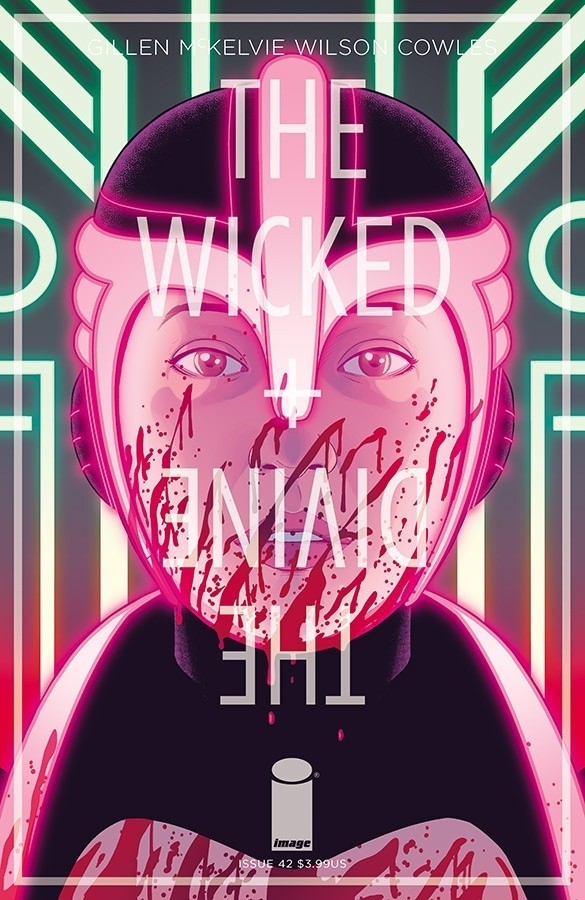
Review: The Wicked + the Divine #42

The Wicked + the Divine #42

*This review contains spoilers for WicDiv #42*

The Wicked + the Divine #42 goes all out with great reveals and brilliant character moments as Kieron Gillen, Jamie McKelvie, and Matthew Wilson craft a sweet sacrifice of a comic book. (This is a very poor choice of words.) And the book starts to take flight around page three with a moment that ties in the specials to the main series as Woden of 1831 is more alike to the “Woden” of 2015 than we think, and Gillen and McKelvie put their own unique mark on the Frankenstein mythos like they did on the Lucifer one. This is only the tip of the iceberg of a comic filled with pathos, action, beautiful and cunning speeches, and another heart getting ripped out ending that won’t be alluded to in this review because it’s that good.

Before getting into the squishy character/feels of it all, WicDiv #42 is another masterpiece in craft from Gillen, McKelvie, and Wilson. The fragile status quo of the series is dismantled, but it all makes sense in the light of the 6,000 year game that Ananke has been playing. She has to get heads to keep her immortality, and there’s nothing like some unmentionable evil to freak out impressionable youngsters, get them to die, and ensure the next Recurrence happens.

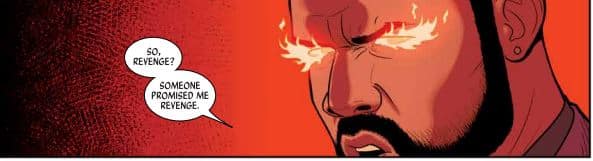
In recent issues, Baal’s own proclivity for sacrifice has popped up ranging from children to a whole stadium, and it shows how much of a master manipulator Ananke is. She can get others (See Woden throughout the series.) to play a smaller version of her game and have them destroyed for it. Baal and Inanna reunite in this issue, but it’s one of the saddest pages of the series. McKelvie gives Inanna a sick, half-dead look on his face as he realizes that Valentine Campbell is the god of fire and child sacrifice, Baal Hammon. Wilson nails the idea of fiery vengeance in his colors on the last panel of that page as he just wants to take Ananke/Minerva/who gives a fuck out because she put his family at risk. His motivation have become very primal

Sacrifice and ritual has been a series throughline in WicDiv’s first scene and has been turned up to eleven in “Okay” beginning with Baal’s ill-fated O2 gig. We get a three dimensional view of the concept in WicDiv #42 as choices have consequences, unexpected heroes rise, and one pesky misogynist meets a gory, pop art inflected end with McKelvie’s smooth style taking a back seat to bludgeoning and ultraviolence. Woden’s last scene feels like the third act of an exploitation film where the women he thinks that are under his thrall kick the shit out of him. Death Proof has nothing on the Valkyries. But due to Ananke ordering the aforementioned kicking and more cool plot throwbacks from Gillen, this moment of catharsis spoils very quickly.

Another highlight of WicDiv #42 is the tension in Laura’s narration. Although she can’t scry like Urdr, she knows what’s going on most of the time, including dark secrets like Baal’s penchant for child sacrifice. Her experiences throughout the series have made her calm and collected, but she’s also freaking out inside and feels a little like Ananke with some knowledge (Like the child sacrifice.) being doled out on a need to know basis. You can definitely see a bit of the game player that has been squaring up against Ananke for millennia like in “Mothering Invention”, and this issue only raises my anticipation for their final duel. Plus there’s that whole layer of caring about fangirl-turned-goddess/destroyed-turned mortal, and Kieron Gillen and Jamie McKelvie’s wonderful character development and facial expression work makes the surprises and plot beats even more compelling.

WicDiv #42 made me yelp in an emotional manner. Kieron Gillen, Jamie McKelvie, and Matthew Wilson have turned in stunning bits of plot structure, character arcs, visuals, and palette (Baal vs the Valkyries is a true symphony of color.) in this comic.

Story: Kieron Gillen Art: Jamie McKelvie Colors: Matthew Wilson
Story: 9.8 Art: 9.8 Overall: 9.8  Recommendation: Buy

Image Comics provided Graphic Policy with a FREE copy for review

Review: Age of X-Man: X-Tremists #1

Age of X-Man X-Tremists #1

The new X-Men event “Age of X-Man” is a crossover where X-Man aka Nate Grey from the alternate Age of Apocalypse future has created a perfect world. However, this utopia is built on a commitment to individualism so everyone lives isolated by themselves, and there are no intimate relationships whether platonic, sexual, or romantic. Overtly, there is no crime or drama in this universe, but Department X featuring Blob, Psylocke, Northstar, Jubilee, Iceman, and Moneta are the covert group that makes sure this status quo is kept. Writer Leah Williams, artists Georges Jeanty and Robert Poggi, and colorist Jim Charalampidis tell their story in Age of X-Man: X-Tremists #1.

Even though Department X are basically the secret police, Williams and Jeanty give X-Tremists #1 a joking tone from the get-go with Iceman roasting Jubilee for thinking a cookie sheet and wax paper are the same thing. (Why is something solid called a sheet though?) They are the class clowns of the team while Moneta is the team racist, Blob is the team dad (Complete with the bod and sayings out of a motivational book for junior high basketball coaches for it.), Northstar is aloof and too cool for school, and Psylocke just gets the job done. Despite Jeanty’s stiff art work, which is more like 1990s Mark Bagley than his work on the Buffy and Serenity comics, each Department X member has a unique personality that acts as a hook for a book about mutants, who arrest other mutants for falling in love.

Plus Georges Jeanty and Roberto Poggi’s work isn’t all bad. They nail a pair of great comedy scenes in X-Tremists #1 where Department X disdainfully completes one of Blob’s team building sayings, and Northstar stays in the car and uses his super speed to get “shotgun” before a try hard and possibly overcompensating for something, Iceman, can ice slide down to it. His and Psylocke’s deadpan expressions are hilarious, and Jim Charalamipdis adds a little burst of old school purple to her psychic daggers.

The fight scene in X-Tremists #1 is creative and well-blocked with Iceman making creative use of his powers to subdue to mutants, who have multiple offenses of engaging in an intimate relationship. One of them has the ability to transform into a rat, which creates a high energy series of panels from Jeanty and Poggi while Leah Williams throws in a wrinkle in her plot that makes the stakes different from Department X’s usual work. It will challenge the team’s ethics, and they have to choose between the mandates of their world and their empathy towards their fellow mutant. I’m interested to see which side each team member takes.

Age of X-Man: X-Tremists #1 introduces a cast of six characters while Leah Williams give each of them a distinct way of speaking and seeing the world and giving the book a moral dilemma of a hook that makes you want to pick up the rest of the miniseries. Georges Jeanty and Roberto Poggi’s facial and character work are nothing to write home about, but they and Jim Charalampidis do lay out a decent fight scene. This, and NextGen #1, are my favorite Age of X-Man tie-ins so far.

Story: Leah Williams Pencils : Georges Jeanty Inks: Roberto Poggi
Colors: Jim Charalampidis Letters: Clayton Cowles

Story: 9.0 Art: 7.0 Overall: 8.0 Recommendation: Buy

Marvel provided Graphic Policy with a FREE copy for review
Review: Broad City S5E5 “Artsy Fartsy”

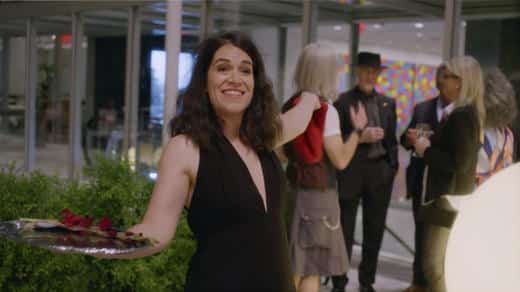
At the midpoint of its final season, Broad City crafts some crossroads moments for Abbi and Ilana in the Ilana Glazer directed and Abbi Jacobson written “Artsy Fartsy”. In this, and the previous episode where Jaime moved out, Ilana decided to follow her dream as a therapist, and Abbi quit her job at Anthropologie in a blaze of glory, Glazer and Jacobson have switched from telling stories of cultural satire to more personal ones. The episode chronicles Abbi juggling the two worlds of being a guest at a prestigious MOMA party and the caterer at one, and Ilana negotiating her relationship contract with Lincoln (Probably Hannibal Burress’ farewell) over a prix fixe pasta meal. Also, Lucia Aniello, who directed Broad City’s pilot and many of its best episodes, gets to step in front of the camera as the artist formerly known as Smelly Pussy Donna and current MOMA big wig.

The episode begins with Abbi being saved from being a third wheel on Lincoln and Ilana’s anniversary/relationship negotiation dinner by running into an old college friend, Donna, who has done well for herself in the art world. The context is that Abbi and Ilana are watching, eagle eyed, at the MOMA gift store to see if anyone buys Abbi’s cute, celebrity favorite food postcards. After getting fired from Anthropologie and getting a new job as a caterer, Abbi is jumping back into the art game, and Donna’s name dropping about teaching and residencies shows her a glimpse at a world she definitely wants to be a part of. Aniello plays Donna as a little stuck up, but likable and friendly and open about what techniques she used to shed the college nickname of Smelly Pussy Donna.

However, the emotional heart of the episode comes in Ilana and Lincoln’s plotline where Glazer (directing herself) lingers on the pain that Ilana feels when she thinks Lincoln is going to propose. Thankfully, the box just has some dangly, trendy “Jewess” earrings. This awkwardness does show that maybe their relationship isn’t long for this world even though they seemed pretty happy in the season 5 premiere. It extends to the dinner, which is shot almost pornographically by Glazer, because that’s some pretty good pasta they’re eating on.

But after the tasty food, their conversation turns from little, funny things, like letting Lincoln watch three romantic comedies (Ilana enjoys roasting the.) a year and going down from having sex in a roller coaster to the more manageable Ferris wheel, to more serious matters that have been building up for quite some time. Lincoln wants to move back to the more affordable Maryland and open a dental practice with his brother that’s adorably called Tooth Factory, get a house, married, and have kids. Ilana wants to stay in New York, try the becoming a therapist thing, and kiss at least fifty people in addition to Lincoln. They both love each other very much, but Ilana and Lincoln’s life goals have become incompatible so I guess it’s quits for them. Thankfully, Glazer and Jacobson punctuate the feels with a lot of fart jokes.

While this is going on, Abbi is having a throwback to Season 3’s “Burning Bridges” and having to play the role of guest at artsy fartsy party and caterer at one. (Lincoln and Ilana also broke up in the Aniello directed episode so they’re kind of companion pieces.) It leads to a lot of awkward physical humor from Jacobson as she tries to avoid her ever vigilant supervisor Kevin (The Punisher’s Todd Alan Crain) and still schmooze around the complex art world. And it ends up being a complete disaster involving drink spilling on artist heroes, lots of misunderstandings, and general feelings of inferiority. Abbi desperately wants to be a part of the art world, but she’s still a beret wearing caterer on the outside looking in.

But thing take a fantastic turn in one of the best character beats created for Abbi. After she passes out at the party and is brought to the hospital, she ends up flirting and hitting it off with her doctor, Leslie (Clea DuVall). Jacobson and DuVall have immediate chemistry as they shyly ask each other if they’re seeing someone between Leslie giving Abbi glucose pills and instructions. At the end of the episode where Abbi and Ilana chat, Abbi says that she was hesitant to ask Leslie out because she’s used to dating men. This scene shows that queerness and coming out isn’t always a “very special episode”, but it can sometimes be thinking that someone the same gender is attractive and asking them out. It’s a powerful, quiet moment that is well-written and acted by Jacobson and visually captured by Glazer.

“Artsy Fartsy” turns its focus back to earlier Broad City themes of feeling inadequate compared to your more successful friends (i.e. Donna) and the ever evolving nature of relationships in your late twenties and early thirties. Abbi and Ilana are changing, and this episode boasts fantastic character development for a show that’s not super serialized. It’s worth checking out for Lucia Aniello’s dance moves in the ending credits alone.

Overall Verdict: 8.4

Review: Love Romances #1

Love Romances#1

I was happily surprised while looking at the list of this week’s comics that Marvel was publishing a romance comic anthology in 2019 called Love Romances#1 Not a superhero comic masquerading as a romance book, but tales of tension, tragedy, and yes, true love featuring characters that aren’t a part of the Marvel Universe. It was pretty exciting and the book almost lived up to the hype with each story having a unique setting and theme plus varying levels of darkness and humor.

Arguably, the biggest name in the comic (writer Gail Simone) leads off with the main story with visuals from artist Roge Antonio and colorist Jim Charalampidis. It’s a futuristic, metafictional steampunk meditation on the nature of romance stories. Over the years from Jane Austen to Nancy Meyers, the romantic comedy has a formula, and Simone and Antonio show it in action steampunk-style with an Architect from Matrix Reloaded-esque (But with more gears than TV monitors) character named Gear Man making sure meet cutes happen, and the relationship between the archetypal characters, Widow and Stranger. Simone’s script is clever, a warm hug to the analog movement, and hints that the stories in this volume are more non-traditional, darker romance. However, the story ends up lacking emotional resonance. Antonio and Charalampidis draw the requisite blimps, ball dresses, and other objects.steampunk romance, but there is no liveliness to them. It’s like they’d rather be drawing superheroes punching each other.

Visuals definitely aren’t a problem in Love Romance‘s next story from writer/artists Margaux Motin and Pacco Morwling-Carter and colorist Lee Loughridge. It’s wonderfully wordless and poignant story of a man being “haunted” by the ghost of his lost love. But it’s not Gothic at all. It’s a normcore-ish bande desinee with clean, soft lines from Motin and Pacco that really nail how it feels to remember someone you’ve lost. The story is filled with expressive eyes, gestures, and faces, and Loughridge beautifully transitions from the spectral world to the real world. It’s a minimalist masterpiece, and honestly, one of the last things I expected to see in a Marvel comic.

The third story is the opposite of minimalist as Dennis “Hopeless” Halum, Annapaola Martello, and Jim Charalampidis craft a juicy, Southern Gothic riff on the Rapunzel fairy tale. The premise is basic and a patriarchal: a father wants his daughter all for himself. The most striking image is the red on her dress from Charalamipidis that draws the eye from panel to panel as you’re rooting for her to escape her father’s house somehow. This story is the most suspenseful and least funny of the bunch and has the flowing fabrics and Gothic romantic tone of an early Kate Bush video or an Ann Radcliffe novel.

The final story in Love Romances #1 is the funniest and most messed up of the bunch courtesy of cartoonist Jon Adams. It is about a couple named Richie and Mona, who transfer their consciousnesses to robots so that their love will be eternal. Anyone who has read a Warren Ellis comic knows this doesn’t end well. (Maybe.) Adams has a lot of fun in the future setting without a lot of extraneous worldbuilding and mines his short story for peak schadenfreude. There’s a lot of oozing liquids and transforming bodies as well as human mediocrity and ends the comic on a decidedly unsexy note.

Love Romances #1 is a feast of tonal shifts, O. Henry twists, and goes beyond the typical romance template in occasionally freaky ways. It would be great if this was more than just a one-shot.

Story: Gail Simone, Dennis Halum
Story/Art: Margaux Motin, Pacco Morwling-Carter, Jon Adams
Art: Roge Antonio, Annapaola Martello
Colors: Jim Charalampidis, Lee Loughridge, Tamra Bonvillain
Letters: Travis Lanham

Story: 8.5 Art: 7.8 Overall: 8.3 Verdict: Buy

Marvel Comics provided Graphic Policy with a FREE copy for review
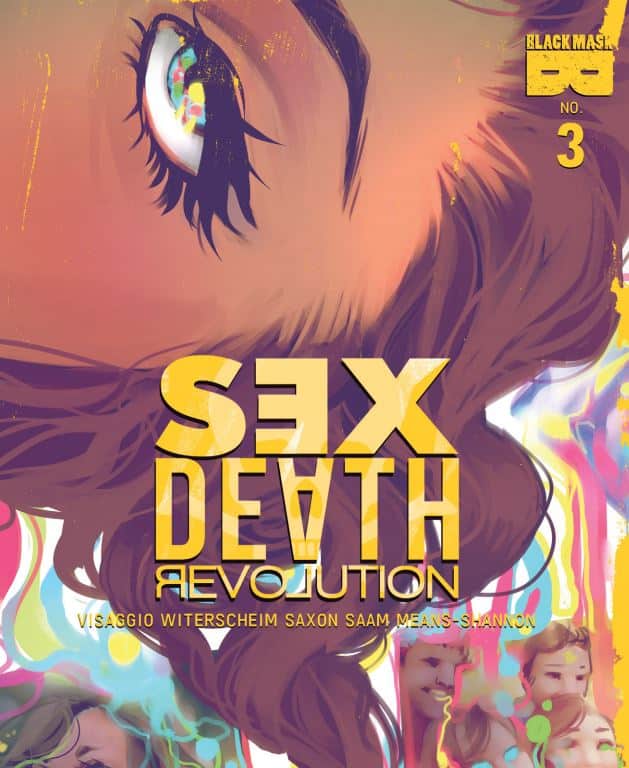
Review: Sex Death Revolution #3

Sex Death Revolution #3

Magdalene Visaggio, Kasia Witerscheim, and Harry Saxon get pretty damn personal in Sex Death Revolution #3 as our protagonist, Esperanza continues to use magic, rituals, and just talking to people to figure out how her memories are being screwed up with, especially a big one about her meeting her ex, Shannon. After last issue’s focus on our bastion of white male toxicity, Marcus, this one narrows in on how Esperanza is feeling and is pain and vulnerability in a single slice of comic book.

Sex Death Revolution #3 deals with some pretty weighty topics, including the conflict and anxiety of transitioning (Which Visaggio explored in an excellent 2018 Twitter thread) and the overall nature of gaslighting. It’s emotional powerful stuff that is conveyed through impressive character acting by Witerscheim and ever changing colors from Saxon that depend on what state in the ritual that Esperanza, Shannon, and later Annie are at. They use the famous “No, I am your father.” sequence from Empire Strikes Back as a pop cultural metaphor for gaslighting and maybe the amazing life you used to live and how people feel about you is all wrong.

It’s scary and leads to plenty of awkward questions as Esperanza and Shannon go door to door basically and try to figure out where Esperanza “changed” for the first half of Sex Death Revolution #3. Some of the responses are downright heartbreaking (Especially when Esperanza is dead named.), and it makes you realize how little people follow or care about your own personal journey, your character arc. Thank goodness for people like Shannon that chase you through the park and remind you of better times even though the darkness still lingers because this is a middle chapter.

Sex Death Revolution #3 is proof that it’s sometimes okay to spend a chapter of a comic book miniseries away from plot twists and that nonsense and really hone in on your protagonist. Openly asking people how they feel about you is a spicy kind of taboo, but it’s something that Esperanza gets to do in this issue with not the best results. And this is mirrored in Kasia Witerscheim’s art as she goes from grid layouts to something more fluid when Esperanza does a ritual with Annie before the utterly screwed up ending. And along the way, she and Magdalene Visaggio take potshots at the kind of arrogant, monologuing liberal arts major (I was one, myself, oops.) that is Marcus, and what he is trying to make Esperanza remembered even though she is trying to change.

Sex Death Revolution #3 is an empathy inducing read about dysphoria and gaslighting through the lens of magic as Magdalene Visaggio, Kasia Witerscheim, and the trippy when he needs to be, silent grey at other times Harry Saxon craft a fantastic personal narrative in the midst of an apocalyptic occult thriller.

Story: Magdalene Visaggio Art: Kasia Witerscheim
Colors: Harry Saxon Letters: Zakk Saam
Story: 7.9 Art: 8.6 Overall: 8.2 Recommendation: Buy

Black Mask Studios provided Graphic Policy with a FREE copy for review

Review: Broad City S5E3 Bitcoin & the Missing Girl

Broad City S5E3 Bitcoin & the Missing Girl

For better worse, Broad City Season 5 is settling into a routine, and that routine includes Abbi and Ilana getting in a crazy situation that ends up being a satirical look at white privilege or 21st century society. And Abbi and Ilana are usually apart from each other except for the cold open and stinger. Abbi Jacobson and Ilana Glazer no longer get to play off each other, but against a cast of usually well-cast comedians and character actors. In “Bitcoin & the Missing Girl”‘s case, these actors include James Saito (Who played Shredder in the 1990 Teenage Mutant Ninja Turtles film) and Mark Consuelos (Hiram Lodge in Riverdale).

It’s fun to watch Abbi freak out over losing the sweatshirt she lost her virginity in, or Ilana in a full-on PVC leather Matrix get-up. But sometimes you wish these shenanigans were happening with them together. However, writers Lucia Aniello and Paul W. Downs and director Lilly Burns craft a story that fits Abbi and Ilana’s personalities as well as Jacobson and Glazer’s comedic styles plus the season’s recurring theme of big picture and personal satire.

When you thought The Matrix parodies were dead and buried, Aniello, Downs, and Glazer in a trench coat brought them back in a plotline where Ilana has to track down a guy she had a one night stand with “between 2010 and 2011” to cash in her 1/3 of a Bit Coin that she got in return for getting him Wacka Flocka Flame tickets and open her phone wig “wizness”. (It’s just human hair glued to cellphones.) And said guy is played by the previously mentioned, Mark Consuelos, who proves the old adage that acting is reacting by trying to stay even keeled and corporate while Ilana twerks in the equivalent of a Trinity cosplay on his venture capitalist desk.

The Ilana BitCoin plot doesn’t really scratch the surface of ethical issues with cryptocurrency, but it is a loving spoof of The Matrix, a film that I have way too much nostalgia for. (And so do other millennials.) It’s also an excuse for Glazer to prove once again that she can pull off any outfit and spread queer, cyberpunk anarchy in a staid, sterile corporate world. It’s a little more subtle, but Burns, Aniello, and Downs also riff on the Bourne films when Ilana visits her bank vault. There aren’t passports, firearms, and Matt Damon’s credibility as an action star there, but burner dick pic phones, a must need item for anyone on a family phone plan.

In contrast with the highs, lows, sheer swagger, and energetic nostalgia of Ilana’s plotline, Abbi’s story is more, shall we say, normcore. With a little extra spending money thanks to her offscreen job at Anthropologie, Abbi decides to use a laundry business instead of going down to her build’s downright horrifying laundry room. This seems like a good idea, and of course, she does nothing productive while waiting for her clothes, but then she loses her favorite sweatshirt.

What follows is a satire of the “single white female” trope in news media where any missing white woman gets around the clock news coverage and probably a Lifetime movie. Abbi placing fliers around town for her sweatshirt inadvertently led to people think she was missing and some hilarious cameos from her former Soulstice co-workers, including Trey (Paul W. Downs), who still has a thing for her. Her story is deadpan funny, especially James Saito’s reactions to her demands, but is more serious than Ilana’s as her white privilege ends up trampling the world around her just like the toilet plot from last week’s episode.

In yet another deadpan sequence from Lilly Burns, Abbi removes her missing sweatshirt posters, only to reveal posters about more important things like Black Lives Matter and Abolish ICE. It’s a stark reminder of how self-centered and myopic she was, and hey, maybe the laundry owner is right in banning her for life. Her story might not have the pure comedic bite of Ilana’s, but it continues Abbi’s storyline of checking her privilege this scene.

It’s sad to see Abbi and Ilana continue to be apart, but Glazer’s cyberpunk antics played against Mark Consuelo‘s corporate stiffness make “Bitcoin & the Missing Girl” an amusing episode that also manages to explore white privilege in its B-plot.

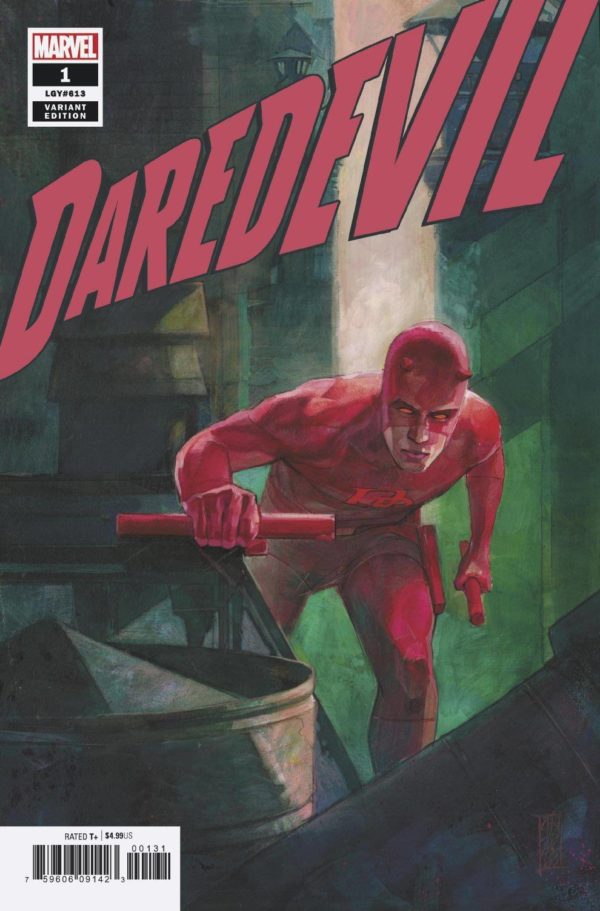
Review: Daredevil #1

The time honored rule that Daredevil is a sure bet to be a quality Marvel comic continues with his latest volume from Chip Zdarsky, Marco Checchetto, and Sunny Gho. Charles Soule’s previous run on Daredevil left him a mess as he recovered from being hit by a truck while he pushed a kid out of the way in a dark mirror of his Stan Lee and Bill Everett crafted origin story. Zdarsky and Checcheto’s Daredevil has lost a step and is taking more risks, such as casual sex with a side dish of almost torching buildings to stop shopliftters. And this is in a world where Wilson Fisk is mayor, and the NYPD has a new top cop that loves arrests, and collars, especially of vigilantes.

Marco Checchetto’s tortured artwork matches the plotline, and Sunny Gho spends a lot of time muting and keeping colors in the shadows even Daredevil’s red costume. The exception is the flashbacks to Matt’s visits to Mass as a boy because there’s a little light beaming through the windows. But Matt is in pain throughout Daredevil #1 as he writhes in bed, pops pain pills, hits the side of the rooftops he’s leaping, and has trouble with petty criminals, which is the sure sign of a rusty criminal.

And this rustiness doesn’t mix well with the fact that Zdarsky and Checchetto show that Daredevil enjoys beating on criminals. This is set up in the flashback when a priest tells a young Matt Murdock in a more professional/spiritual leader manner that it’s okay to break the law in the service of justice as long as he isn’t caught. This becomes a slippery slopes that starts at stealing back his friend’s baseball cards to beating men with his bare hands.

Zdarsky and Checchetto don’t rush these confession sequences showing Daredevil/Matt’s reactions to what he has done and giving the priest soliloquies. (The final one implies that Daredevil is playing God.) Even if he doesn’t even smell a church in the present day, Zdarsky and Checchetto do an excellent job of showing how Catholicism and an absent father influenced Daredevil. They craft scenes between the “big” events of young Matt’s life, namely, his accident and his father’s death that informs his character in the present day.

Although, Chip Zdarsky has written and/or drawn many comedic comics, like Sex Criminals, Jughead, and Howard the Duckhis fairly recent work for Marvel like Daredevil and Invaders has taken on a darker bent. Not in an edgy way, but in a “Never underestimate the propensity of humans to commit violent acts” way. Matt can be charming when he flirts with a stranger at the bar (Checchetto makes him quite attractive too), but all that charm is out the window as a red devil scampers the roof of Hell’s Kitchen purposefully putting himself on display to strike fear.

And this is where the arc title comes into play, “Know Fear”. Zdarsky and Checchetto have replaced the inward part of feeling no fear with the outward part of striking fear into everyone around Daredevil. He isn’t trying to sneak back into his life as life, but wants to make headlines even in a world where his worst enemy is the most powerful man in New York City. It’s the shadow child of the openly confident Daredevil of Mark Waid’s run. After what Daredevil went through at the end of Soule’s run and the tortuous Man Without Fear mini, it’s an earned darkness.

Daredevil #1 concludes its powerful exploration of Daredevil’s use of violence and life after a dangerous accident with Chip Zdarsky written and drawn backup story that’s a real treat. It’s a bit of a riff on the hallway fight sequence from Marvel Netflix’s Daredevil where the hero successfully cares a child to safety while being involved in a single take fight scene. Zdarsky uses grids to keep up the rhythm of the fight as well as strategic uses of overwhelming lettering and claustrophobic panels to show how he sometimes overwhelmed by loud noises. The entire exercise shows that Zdarsky is a formalist with heart, who can get to the essence of an iconic superhero.

Daredevil #1 is the dark, tortured, Old Testament God take on the Man without Fear that we deserve from Chip Zdarsky, Marco Checchetto, and Sunny Gho. You should read this comic instead of signing those silly Change.org petitions to bring the Netflix show back.

Story: Chip Zdarsky Art: Marco Checchetto
Colors: Sunny Gho Letters: Clayton Cowles
Story: 8.8 Art: 9.5 Overall: 9.2 Recommendation: Buy

Marvel Comics provided Graphic Policy with a FREE copy for review
« Older Entries Recent Entries »