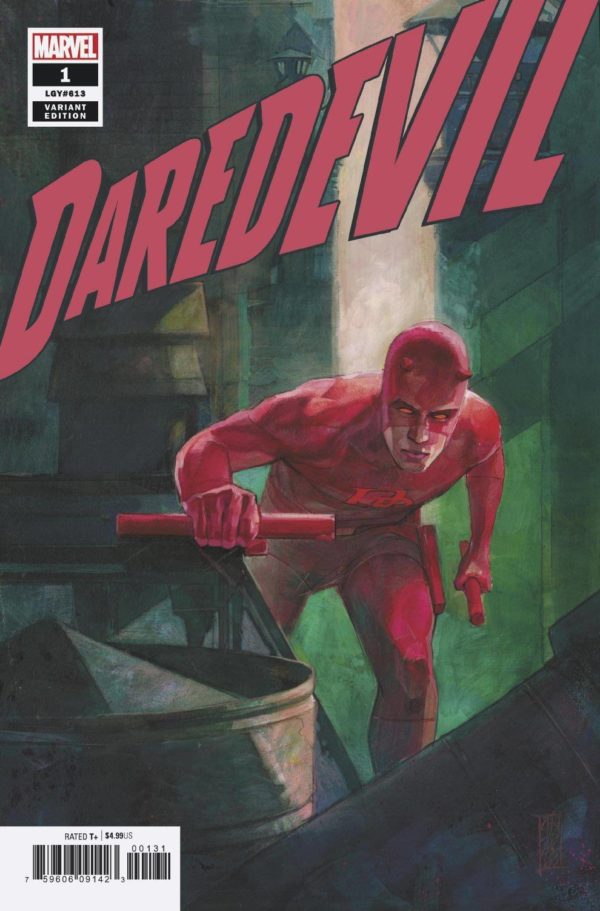
The time honored rule that Daredevilis a sure bet to be a quality Marvel comic continues with his latest volume from Chip Zdarsky,Marco Checchetto, and Sunny Gho. Charles Soule’s previous run on Daredevil left him a mess as he recovered from being hit by a truck while he pushed a kid out of the way in a dark mirror of his Stan Lee and Bill Everett crafted origin story. Zdarsky and Checcheto’s Daredevil has lost a step and is taking more risks, such as casual sex with a side dish of almost torching buildings to stop shopliftters. And this is in a world where Wilson Fisk is mayor, and the NYPD has a new top cop that loves arrests, and collars, especially of vigilantes.
Marco Checchetto’s tortured artwork matches the plotline, and Sunny Gho spends a lot of time muting and keeping colors in the shadows even Daredevil’s red costume. The exception is the flashbacks to Matt’s visits to Mass as a boy because there’s a little light beaming through the windows. But Matt is in pain throughout Daredevil #1 as he writhes in bed, pops pain pills, hits the side of the rooftops he’s leaping, and has trouble with petty criminals, which is the sure sign of a rusty criminal.
And this rustiness doesn’t mix well with the fact that Zdarsky and Checchetto show that Daredevil enjoys beating on criminals. This is set up in the flashback when a priest tells a young Matt Murdock in a more professional/spiritual leader manner that it’s okay to break the law in the service of justice as long as he isn’t caught. This becomes a slippery slopes that starts at stealing back his friend’s baseball cards to beating men with his bare hands.
Zdarsky and Checchetto don’t rush these confession sequences showing Daredevil/Matt’s reactions to what he has done and giving the priest soliloquies. (The final one implies that Daredevil is playing God.) Even if he doesn’t even smell a church in the present day, Zdarsky and Checchetto do an excellent job of showing how Catholicism and an absent father influenced Daredevil. They craft scenes between the “big” events of young Matt’s life, namely, his accident and his father’s death that informs his character in the present day.
Although, Chip Zdarsky has written and/or drawn many comedic comics, like Sex Criminals, Jughead, and Howard the Duck, his fairly recent work for Marvel like Daredevil and Invaders has taken on a darker bent. Not in an edgy way, but in a “Never underestimate the propensity of humans to commit violent acts” way. Matt can be charming when he flirts with a stranger at the bar (Checchetto makes him quite attractive too), but all that charm is out the window as a red devil scampers the roof of Hell’s Kitchen purposefully putting himself on display to strike fear.
And this is where the arc title comes into play, “Know Fear”. Zdarsky and Checchetto have replaced the inward part of feeling no fear with the outward part of striking fear into everyone around Daredevil. He isn’t trying to sneak back into his life as life, but wants to make headlines even in a world where his worst enemy is the most powerful man in New York City. It’s the shadow child of the openly confident Daredevil of Mark Waid’s run. After what Daredevil went through at the end of Soule’s run and the tortuous Man Without Fear mini, it’s an earned darkness.
Daredevil #1 concludes its powerful exploration of Daredevil’s use of violence and life after a dangerous accident with Chip Zdarsky written and drawn backup story that’s a real treat. It’s a bit of a riff on the hallway fight sequence from Marvel Netflix’s Daredevil where the hero successfully cares a child to safety while being involved in a single take fight scene. Zdarsky uses grids to keep up the rhythm of the fight as well as strategic uses of overwhelming lettering and claustrophobic panels to show how he sometimes overwhelmed by loud noises. The entire exercise shows that Zdarsky is a formalist with heart, who can get to the essence of an iconic superhero.
Daredevil #1 is the dark, tortured, Old Testament God take on the Man without Fear that we deserve from Chip Zdarsky, Marco Checchetto, and Sunny Gho. You should read this comic instead of signing those silly Change.org petitions to bring the Netflix show back.
Writer Lisa McQuillan (Blackish) and director Abbi Jacobson spin shit (Aka the most used word in this episode) in metaphorical gold in “SheWork and Shit Bucket” an episode that turns poop jokes and the running gag of Ilana being unable to find a job into a sharp satire of gentrification and technocracy. The episode splits Abbi and Ilana up for the most part as Abbi tries to improve the plumbing in her apartment building, and Ilana uses free charging ports, trash, and nicotine addictions to create SheWork, which is like Elon Musk’s Hyperloop for co-working spaces.
Building off last week’s episode’s barbs about social media stories and how they shape every day experience, McQuillan and Jacobson continue to show that Broad City’s final season is big picture oriented and more than two girls having shenanigans in New York City while still building off jokes from previous seasons and the chemistry between Jacobson and Ilana Glazer. “She Work and “Shit Bucket”‘s tech satire begins in the unlikely way that is Ilana applying for an office manager job at WeWork, a co-working office space that offers great “millennial friendly” perks like free snacks and beer.
But they’re actually trying to get her to buy office space, and she ends up on the street charging her dead phone on one of New York’s free charger’s station. However, a chance meeting with her old temp agency boss Linda Lodi (Rachel Dratch), who has a smoking habit turns into her arranging old New York street junk into a smoking friendly workspace for the price of 50 cents a minute. She’s basically doing what the tech bros are doing, but outside and with more cigarette smoke and transforms a free or inexpensive service (Chargers on the street) into a moneymaking scheme a la HyperLoops or that bus thing that Lyft and/or Uber were going to do. She calls her start-up “SheWork” to add a veneer of white feminism to it and then still ends up selling the business to WeWork for $500, and they end up stealing her money. Guess, there’s still money in the tobacco industry.
Unlike a show, like the excellent Silicon Valley, which comes at the tech sector from a male, insider POV, Lisa McQuillan takes an intersectional feminist perspective of start ups, and how women are often undermined and minimized in them. However, she also turns the tables and shows that the lure of making a profit off something that was previously given away for free or a very low cost crosses gender boundaries. She and Abbi Jacobson take a stab at some big issues in hypercapitalist American society, but with Ilana running around and picking up random odds and ends in a crop top and sketch comedy Dratch just reacting to the strangeness around her in a more extreme, open air version of her previous role as the MoneyPenny of temp agencies.
Abbi’s storyline in which she gets all gentrifying imperialist faux woke on her Latino landlord Fernando (Nelson Ascensio) starts as a bunch of poop jokes and an opportunity for Jacobson to do a highly choreographed high five/dance thing with her character’s favorite Bed, Bath, and Beyond employee. However, it turns into a critique of the kind of activism that is actually just code for gentrification. In campaigning for better plumbing so she can flush paper down the toilet, Abbi ends up losing Fernando’s job, raising rent, and being very problematic along the way.
McQuillan’s writing for Abbi is either very broad or quite subtle. For example, Abbi calls herself the “Rosa Parks of poop” as well as the “Alexandria Ocasio-Cortez of Astoria” although Ocasio-Cortez does, in fact, represent Astoria, Queens in Congress. These two lines show that Abbi is the heiress of a long line of white women, who take credit for what activists of color have done, and McQuillan boldly doesn’t give her a happy ending, but a more sinister one using her apartment building as a microcosm of how gentrification has made New York City, especially Brooklyn and Queens, unlivable and displaced the immigrants and children of immigrants who made their home there. But there’s also a funny joke about how everyone in the building know that Abbi pegged the late, great written out of the show Jeremy.
Although Lisa McQuillan and Abbi Jacobson riff off old Broad City jokes (and songs; “I Shit” becomes “She Work”), they aren’t content to retread old plots as “SheWork and Shit Bucket” is an episode that is both socially responsible, madly hilarious, and shows that both Abbi and Ilana need to check their privilege and not be seduced by exploitative capitalism.
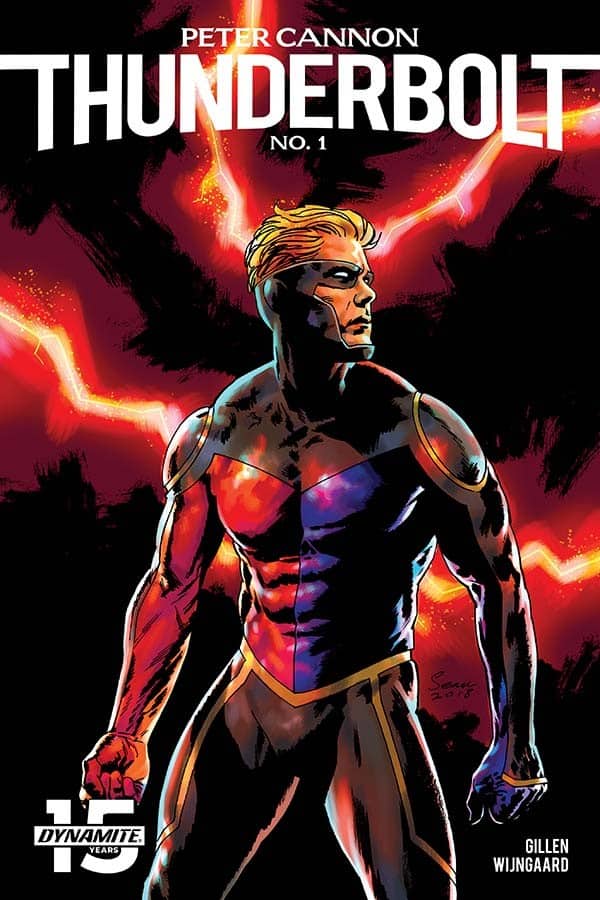
Based on the character that would inspire Watchmen antagonist Ozymandias, writer Kieron Gillen, artist Caspar Wjingaard, and colorist Mary Safro revive Charlton-turned-DC-turned Dynamite superhero Peter Cannon, Thunderbolt. They use this character, who I hadn’t heard of until the title was solicited, to play around with all kinds of superhero tropes and tricks using him and the other superheroes of his universes as tabula rasae.
That’s not necessarily true as the spectre of Watchmen and Adrian Veidt haunts almost every panel of Peter Cannon, Thunderbolt . There’s the “alien invasion” that concludes Alan Moore and Dave Gibbons’ beloved series and begins this comic to the white Ubermensch raiding indigenous cultures to gain “mystical” power a la Ozymandias and his trip around the globe. There’s also formal and visual things like nine panel grids and Wjingaard’s poses of a lonely genius standing aloof about to hatch a master plan.
However, Gillen and Wjingaard are more clever than that and lay out superhero tropes that were used by Watchmen, various Warren Ellis comics, and even Joss Whedon’s Avengers film and pick them apart, distort, and occasionally play them straight in an entertaining manner. There’s the Superman/Captain America analogue Supreme Justice, who thinks he has power because he is the embodiment of the United States Constitution and then cuts loose like he’s a character in the Authority in a neoliberal approach to American foreign policy and an originalist reading of the Constitution. But with punching.
On the more cynical side, the big action scene where Peter Cannon successfully masterminds a defeat of an alien invasion and unites disparate superheroes from the United States, Russia, and the corporate world shows the hollowness and repetitiveness of the bicker, fight, and team up against a greater, external foe formula. Peter doesn’t have a complex plan; it just involves hitting aliens in the right place with the right amount of force like a miniboss battle although these aliens wiped out the population of an entire city. And this force is depicted is some widescreen Bryan Hitch meets the disciplined grid of Dave Gibbons or Mitch Gerads by Caspar Wjingaard. Mary Safro’s palette for the aliens is stomach churning queasy in contrast with most of the heroes’ strong profiles. (Mountain dew vodka chugging and two week living The Test is a notable exception.
Peter Cannon’s “teammates” spout platitudes about avenging and banding together, but he sees the bigger picture. His mystic scrolls are superhero texts, and he knows that especially in modern comics (The works of Bendis, Hickman, and Johns spring to mind, for better or worse.), there’s a bigger, secret force pulling the strings. Villain of the month is dead, long live villain of the six issue story arc that feeds into the summer crossover or a multi-year run. With the exception of the crossover part, Kieron Gillen does do this with his plotting and gives Peter Cannon #1 an intriguing, if purposefully derivative antagonist that should elucidate more of our protagonist’s actions and moral compass. And isn’t that what any good supervillain can be expected to do?
For all its deconstructive tendencies, Peter Cannon, Thunderbolt #1 is a fine work of pop superhero storytelling from Gillen, Wijingaard, Safro, and Hassan Otsmane-Elhaou,whose letters give both Peter and Supreme Justice a layer of self-assurance. It introduces an ensemble cast in an economic fashion, gives more details about the title character’s background and motivation, is self-aware without going fully edgelord, has a pair of potent action sequences, and a classic, if damn fine cliffhanger. Wijingaard’s art is clean, easy to follow, and not afraid to get a little grotesque if the story calls for it.
If you like punching and feeling smart because you read Watchmen that one time, Peter Cannon, Thunderbolt#1 is the comic for you. Or maybe it despises you for playing devil’s advocate in the class discussion about Ozymandias or Alan Moore and Dave Gibbons’ portrayal of women.
Story: Kieron Gillen Art: Caspar Wijingaard Colors: Mary Safro Letters: Hassan Otsmane-Elhaou Story: 8.0 Art 9.0 Overall: 8.5 Recommendation: Buy
Dynamite Entertainment provided Graphic Policy with a FREE copy for review
Broad City’sfinal season premiere, “Stories”, is high concept, joke dense, a little bit satirical, and definitely a celebration of the friendship between Abbi and Ilana. The Abbi Jacobson and Ilana Glazer penned episode gets its name from Facebook and Instagram Stories, which if you’re some kind of a Luddite, are real time snapshots of your day. They can be saved, but for the most part, it’s a here today, gone tomorrow deal kind of like Abbi and Ilana’s phones. (But not their friendship.)
Director Nick Paley frames the entire episode as a series of social media stories as Ilana and Abbi celebrate Abbi’s 30th birthday by walking all of Manhattan. It’s the perfect idea for a series that has centered around Abbi and Ilana’s adventures running around New York, and this epic quest doesn’t disappoint. Also, using the Instagram story format allows for lots of visual jokes like when Abbi and Ilana see the “real life” version of the peach and eggplant emoji, and when Ilana keeps filming even after she falls into a manhole.
Paley also leans into the feels a little bit and creates some cute montages of Jaime (Arturo Castro), Lincoln (Hannibal Burress is back, yay), and Jaime’s boyfriend tipsily sending birthday messages. There’s also a montage of Abbi’s butt in various scenes of the show, which is a fantastic payoff to one of the series’ best running gags, and it continues to be riffed on throughout “Stories”. Glazer and Jacobson’s performances are non-stop energy in this episode, and the handheld style of filming is a throwback to when Broad City was a webseries and not a pop culture phenomenon. I could also not stop cracking up when Ilana was dancing with her one padawan-style braid in a self-deprecating scene where Glazer acknowledges her cultural appropriation in earlier seasons.
However, “Stories” isn’t all fun and games, and Glazer and Jacobson definitely dig into the existential crisis part of hitting the big three zero. Ilana stops with the crazy filters for a second as Abbi muses on her thankless Anthropologie job and posits that maybe she could have been a mom with kids by now. It doesn’t help when her old college friend Cheese (Cody Lindquist) shows up to retrieve her child in the mall that Abbi and Ilana were supposed to take to security, but end up using as an adorable and slightly creepy prop. Cheese reprimands Abbi and Ilana for their footloose and fancy free ways before having a total meltdown that is punctuated by dropping several “F” bombs at one of her four kids. Basically, even “stable” adults with kids don’t have their shit together. I really liked how Glazer and Jacobson showed how people can be similar ages and have totally different lives after college.
“Stories” is also a great satire of social media without being preachy or heavy handed. Broad City already showed Abbi and Ilana’s inability to function without their phone in the season 2 episode “The Matrix”, and almost four years later, it shows their inability to function without filming every second in “Stories”. The comedy from the Instagram story framing device shows that Glazer and Jacobson enjoy social media, and how it can capture fun moments, but also during the “stories”, they aren’t really living in these moments. It’s definitely a love/hate thing that I’ve thought about while being at concerts, good brunch places, and general fun experiences. Am I actually enjoying myself or just chronicling this for social media? Glazer and Jacobson ask this question in a humorous way and don’t give a definitive answer.
“Stories” starts off Broad City’s final season with some visual inventiveness, chains of jokes both visual and verbal, and of course, amazing friendship moments between Abbi and Ilana. Plus it’s a better and funnier love letter to Manhattan than the film with the same name…
This past year, BOOM! Studios took over the Whedonverse licenses from Dark Horse Comics, and this comic is their first take on Joss Whedon’s most iconic creation (and my favorite TV show of all time), Buffy the Vampire Slayer. With seven seasons of a TV show plus tie-in comics and five seasons of sequel comics, it seems like almost every narrative stone has been unturned. And, for the most part, this is sadly true.
Buffy the Vampire Slayer#1 comes across as a remake of the first season of the television show and treads many similar beats: Buffy’s combative relationship with Giles, her growing awkward friendship with Willow and Xander, her keeping secrets from her mom, and fighting inconsequential small fry bad guys with a side dish of ancient jewelry. Writer Jordie Bellaire and artist Dan Mora do throw in some new wrinkles like their take on Anya, who appears way before she played a role in the television show, adding modern technology/clothing style, and giving Buffy a part time job at a place that makes the Doublemeat Palace have Michelin stars. However, these things plus a fun Easter Egg about another Whedon property and the “surprise” appearance of another character don’t detract from the fact that this comes off as a Xerox copy of copy of the television show.
Some of this is immediately evident in Bellaire’s dialogue, which is all Whedonesque cuteness and reveals none of the traits that made Buffy, Willow, and Xander unique and enduring characters. It’s more entertaining than the platitudes that are Buffy’s narration captions though. At the end of Buffy #1, they are immediately friends, in on her secret, and having slumber parties. It makes you miss Buffy Season 1’s pilot, which managed to have life or death stakes, bring the Scooby gang together organically, set up the Big Bad and mysterious love interest, and was paced naturally thanks to its almost feature film length. There are too many moving parts in Bellaire and Mora’s Buffy “pilot” comic as they set up Buffy’s personal struggle with identity, try to make her best friends with Xander and Willow, and at the end, remember they have to have a “Big Bad”.
Where Buffy #1 falters in story, characterization, and dialogue, it actually succeeds in visuals thanks to the storytelling skills of Klaus’ Dan Moraand the steady colors of Raul Angulo. Mora cares more about dynamic panels and cartooning than making his characters look like Sarah Michelle Gellar et al. His work especially shines during the action sequences with angular leg kicks and power poses mixed with some teenage awkwardness. I also cracked up a lot at the reactions Mora draws for Willow as she watches Xander repeatedly put his foot in his mouth. Honestly, she comes off pretty well in this first issue even though the reference to her future career as a witch is super-shoehorned and comes across as fanservice and not part of her arc. And to top things off visually, Angulo adds a shadowy palette to the night sequences to make it more classic horror than suburban SoCal.
When I first read about BOOM! Studios’ plans for their Buffy the Vampire Slayer comics, it reminded me a lot of Brian Michael Bendis and Mark Bagley’s Ultimate Spider-Man or Stjepan Sejic’s sadly shortlived Switch. These comics were contemporary takes on the classic characters, Spider-Man and Witchblade respectively, and introduced their mythos to new fans. However, cheesy effects and bad fashion choices aside, “Welcome to the Hellmouth” does a better job of introducing Buffy, Willow, and Xander than this comic so it fails at being a gateway to these pop culture icons for a new generation of fans. Dan Mora is one hell of an artist though.
Story: Jordie Bellaire Art: Dan Mora Colors: Raul Angulo Letters: Ed Dukeshire Story: 5.5 Art 8.0 Overall: 6.0 Recommendation: Pass
BOOM! Studios provided Graphic Policy with a FREE copy for review
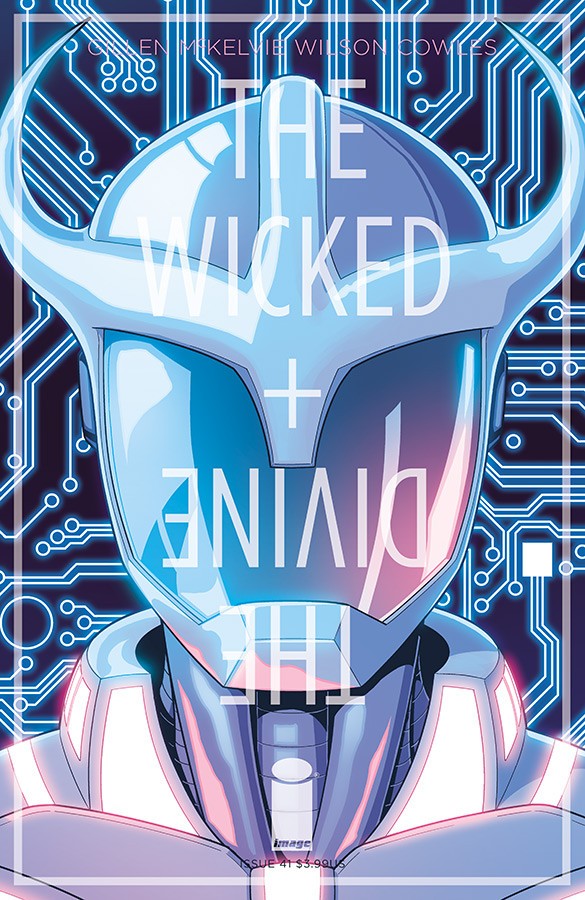
Beginning with Laura’s exciting escape from Baal’s attempted “sacrifice” at the O2 Arena and filled with rescues, big plans, and emotional reunions, Kieron Gillen, Jamie McKelvie, and Matthew Wilson constructThe Wicked + the Divine #41 like both an exciting thriller and a love letter to the fans. And Gillen lines up so many great character development moments like a skilled pool player setting up his shots and then sinking them before concluding the game with a (freaky) eight ball of a final page.
Before digging into the big plot point, WicDiv #41 tonally is an exciting book. There are explosions gamely colored by Wilson to go with McKelvie’s big panel compositions and great sense of movement in the first five pages. Even though her Pantheon powers aren’t at 100%, Laura is straining herself to save the Norns and the talking heads and make sure Baal’s sacrifice and Minerva/Ananke’s master plan doesn’t come to fruition. She herself has a plan, it’s a little crazy, and honestly, she pulls it off for the most part in this issue.
Honestly, the highlight of WicDiv #41 is getting new Kieron Gillen penned dialogue for Luci, Inanna, and Tara in the present day. Luci’s first sentence is priceless, and Jamie McKelvie especially makes the Laura/Luci reunion memorable with a big time weak to go with Gillen’s caption box of guilt. Even though Luci was pretty messed up ethically, she, Inanna, and Tara were characters who died tragically, but represent a relatively more innocent time for WicDiv. For example, Inanna asks questions about Baal’s wellbeing because he is unaware he’s a masked murderer. Gillen has done a great job laying out the bread crumbs for these character’s return, and it pays off in this issue with the help of some great design choices from McKelvie and lyrical nine panel grids.
The nine panel grids in the Underground, which is where Laura, the Norns, and the heads of Mimir, Luci, Inanna, and Tara flee to are a wonderful visual representation of the conclusion to the romantic, doomed, and at times, abusive relationship between Baphomet and the late Morrigan. They allow for a bit of fearful symmetry when Baphomet makes his final goodbyes and also let the conversation between him and Laura about change and not being stuck in his past ways breathe a little bit.
Baphomet has grown as a person and character, and McKelvie has given him a wardrobe to match. He’s gone from douche Goth to pensive, perceptive Goth, or from young Nick Cave to slightly older Nick Cave as Gillen puts it in the backmatter. Baphomet doesn’t have to consumed by Morrigan making him a god, or sacrificing herself to resurrect him in the previous. He can move on and devote his energies to more productive things like rallying an army of talking heads to fight Minerva/Ananke.
WicDiv #41 is a sterling example of how pleasurable a story pay-off in the final arc of a comic can be. Forget guns, Kieron Gillen, Jamie McKelvie, and Matthew Wilson have put all kinds of kooky items on their proverbial story wall, and now they’re starting to go off. The machine plotline, the heads, and even Baphomet’s moping and conflicts with Morrigan in the previous all flow into the bigger picture and makes for rewarding reading. This is along with all the character reunions, Laura becoming a kind of hero, and Urdr being hopeful for once.
However, this hope could all die in a moment. But, at least, we got to hear from Luci and Inanna (And fucking Tara!) before the end so be sure to drop the needle or hit the play button on a Bowie or Prince album while reading this comic.
Story: Kieron Gillen Art: Jamie McKelvie Colors: Matthew Wilson Story: 9.5 Art: 9.0 Overall: 9.3 Recommendation: Buy
Image Comics provided Graphic Policy with a FREE copy for review
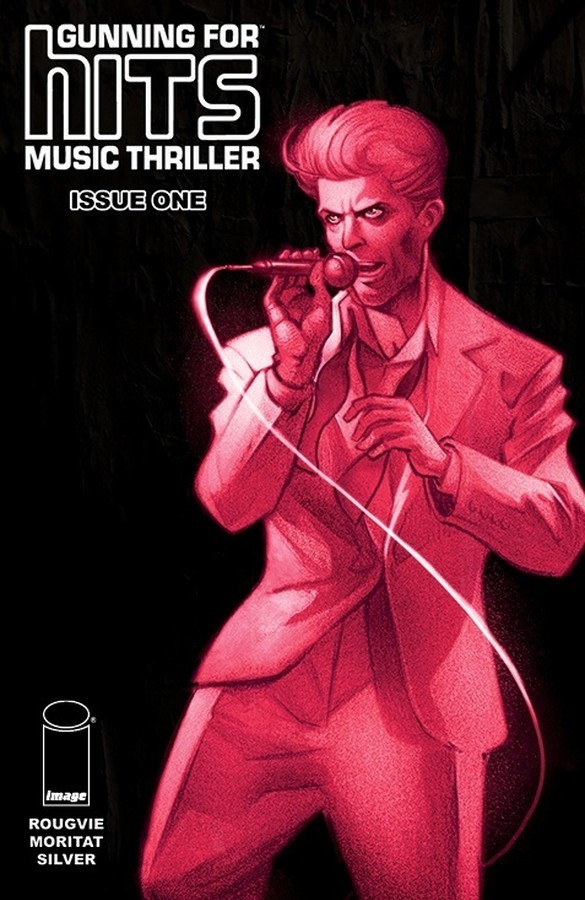
Gunning for Hitsis a resounding rebuttal to the argument that Image Comics only puts out sci-fi, horror, and fantasy comics as writer Jeff Rougvie,who helped put together re-releases of David Bowie’s album catalogue in the 1990s, artist Moritat and colorist/letterer Casey Silver tell an inside baseball music industry saga that feels more like a mid-2000s prestige television show. It’s the 1980s, MTV is booming, everyone is buying CDs, and punk and New Wave are a thing, I guess. Martin Mills is an A and R man with a secret and thinks he might have a big act on his hands in Stunted Growth and their frontman Billy. But he has to argue with the Billy’s girlfriend/manager a lot first.
Until the final pages where Moritat and Silver turn the grit and grime of a Connecticut rock club to something a little more film noir, Gunning for Hits #1 is strictly an establishing chapter. It sets up Martin, Stunted Growth, and the cutthroat music industry of the 1980s and creates a little intrigue and future plot possibilities with the mention of Brian Slade aka the David Bowie stand-in from Todd Haynes’ 1998 glam rock film Velvet Goldmine. Martin and Billy might look and react as polar opposites, but they both love Slade’s work and want to be involved in his comeback. It’s also an opportunity for Moritat to take a break from the back rooms shadows and Martin’s practiced stances to draw some wide eyes and big poses as Billy geeks out.
The sequence that stood out most to me in Gunning for Hits is Martin’s explanation of how the music industry works. Instead of a wall of text about how the sausage is made, Rougvie let Moritat and Silver lose with fun and easy to follow cartooning in the vein of Scott McCloud, Action Philosophers and Comic Book History of Comics’ Ryan Dunlavey, or even the underrated Chris Eliopoulos. Fun, simple images make exposition go down easier and also do a solid job setting up Martin Mills’ place in the music industry without revealing his whole backstory. (One panel tells a lot, to be honest.) It’s a little crazy that the guy doing this humorous cartooning was bringing the dark atmosphere at the beginning and end of the comic. However, this extended scene isn’t without its rough patches, including an anti-Semitic caricature of a record company lawyer.
But, returning back to my mention of mid-2000s television, Gunning for Hits is really an anti-hero story about a cynical, sharp (In his narrative captions especially.), and morally bankrupt white man, who is good at his job and has just a hint of likability mostly in his music taste as he takes chances on new acts and doesn’t succumb to Baby Boomer nostalgia. Martin even gets pitted against an unlikable female character throughout the first issue, who is almost parodic in her demands from billboards in Times Square to prestigious hosting gigs and even getting Madonna as an opening act. (Although, Martin does remark that she does make good points about getting Stunted Growth on the radio.) He’s like Mad Men Season 1’s Don Draper, who does business in the backroom of shitty rock clubs and not board rooms, with Dick Whitman hiding somewhere beneath the surface. Moritat draws him like a tiger ready to pounce.
Jeff Rougvie’s wealth of experience in the music industry and a strong mysterious backstory hook plus Moritat and Casey Silver’s flexibility with the visuals make Gunning for Hits #1 a strong start to a series that is filled with both passion for the pure pop single as well as cynicism towards the whole soulless enterprise around it. It pairs well with “Ashes to Ashes”.
Without further ado, these are my favorite comics of 2018. This was the year I fell back on series that I had been checking out for years and found some new faves in the worlds of newspaper comics, symbiotes, gamma irradiated beasts, and maybe even a choose your own adventure game. Marvel seriously did a 180 this year, and I went from picking zero of their comics on my last year end list to three so well done on their part, and Donny Cates and Al Ewing should receive hefty bonus checks. But, honestly, this list should show you that visual humor, character driven narratives, and weirdness are my things, and I can’t wait to read more comics in that vein in 2019.
Honorable Mentions:Sex Death Revolution (Black Mask), Runaways (Marvel), Assassinistas (IDW/Black Crown), Punks Not Dead (IDW/Black Crown), That one really good issue of Peter Parker, Spider-Man that Chip Zdarsky wrote and drew (Marvel), Gideon Falls (Image)
10.Modern Fantasy (Dark Horse)
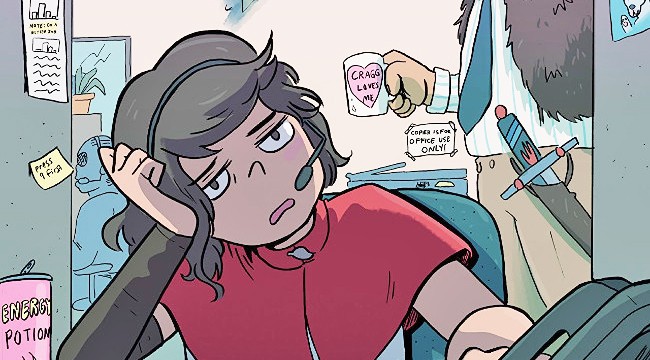
Modern Fantasy is a miniseries about a data entry worker named Sage of the Riverlands, who secretly wants to epic hero or maybe just a curator at a cool museum, and has a penchant for smooching handsome elves. Did Rafer Roberts and Kristen Gudsnuk have access to my most secret thoughts while writing this book? In all seriousness, this comic marries millennial angst and struggles (Dead end jobs, mooching friends, annoying co-workers) with all kinds of fantasy tropes, including urban, high, and good ol’ Lovecraftian. Gudsnuk’s art is both humorous and touching and filled with background details and jokes that reward a close reading. But what makes Modern Fantasy a great comic is the awkward friend group dynamic that Roberts and Gudsnuk craft filled with drama, jokes, a touch of romance, and a final showdown with a fire demon.
9.The Wicked + the Divine (Image)
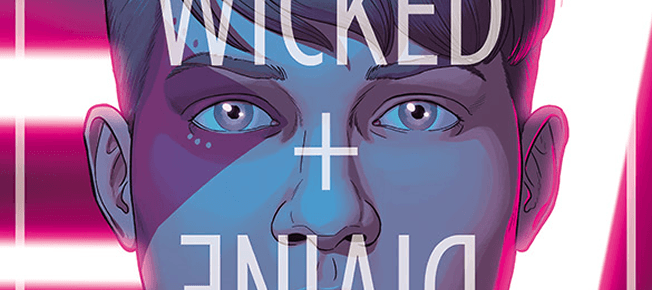
Kieron Gillen, Jamie McKelvie, and Matthew Wilson’s story of young gods and fandom hit some dark bits in 2018 and had plenty of surprises to go with the formalism and “glimpse behind the curtain” of the “Mothering Invention” arc. However, at its best, WicDiv is the story of the girl, who thought she wanted something, and then painfully realized that she didn’t really want it. That girl, of course, is Persephone whose personal journey along with McKelvie’s amazing facial expressions, Gillen’s clever quips, and Wilson’s majestic color palette keeps me returning to this series as it is about to hit its fifth year. Also, the specials were spectacularly glorious in 2018 from the illustrated prose story/murder mystery in 1923to 1373’s dark piety. Then, there was the absolute bonkers nature of The Funnies where we find out the origin of Laura’s cracked phone and the Pantheon gets to solve a Scooby Doo mystery courtesy of Kitty Curran and Larissa Zageris.
8. Nancy (Go Comics)
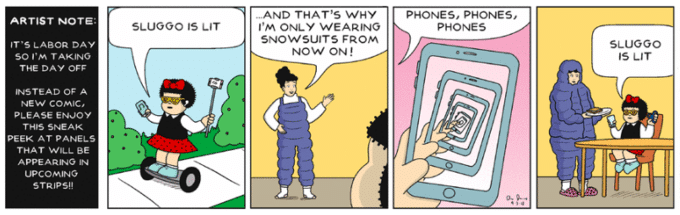
I’ve been doing year end comics lists for five years, and this is the first time I’ve put a newspaper strip on one. However, Olivia Jaimes’ work on Nancy is one of the most hilarious things to come out of 2018. There are her “millennial” gags (Even though Nancy and Sluggo are definitely Generation Z.) about Nancy’s overuse of the Internet or swapping streaming service passwords with Sluggo, who is also “lit”. But she also has a firm grasp on meta-gags and the uniqueness of the comics medium like playing with panel layouts, lettering styles, reusing panels, and then having Nancy make a joke about it. Nancy is truly a ray of sunshine in a dark landscape while still being sarcastic and self-deprecating as hell and shows that even the proverbial old dog of the newspaper comic can learn some new tricks.
7. “Milk Wars” (DC Comics/Young Animal)
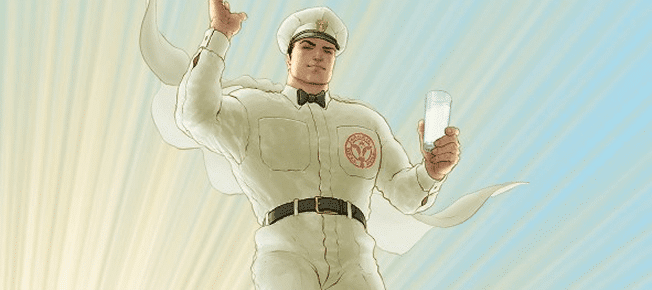
“Milk Wars” really brought the best of DC Rebirth and Young Animal together and was the only Big Two crossover I kept up with in 2018. The series brings together the Doom Patrol, Mother Panic, Shade the Changing Girl, and Cave Carson to fight warped versions of DC Comics heroes, who are under the control of the Retconn corporation. The story is a literal metaphor for how corporations sanitize characters and go for the retread instead of taking risks with iconic characters as Wonder Woman becomes a submissive housewife in her tie-in story from Cecil Castelluci and Mirka Andolfo. “Milk Wars” shows that it’s okay to be a little weird as milk goes bad if it’s left in the bridge past its expiration day. It also features some gorgeous layouts from Aco in the crossover’s first chapter, which was co-written by Gerard Way and Steve Orlando, and he and the artists did an excellent job of melding an indie and mainstream sensibility throughout “Milk Wars”. Also, the story had a real effect on Mother Panic, Cave Carson, and Shade in their solo titles and introduced Magdalene Visaggio and Sonny Liew’s wonderful, yet depressed Eternity Girl character.
6.Venom (Marvel)
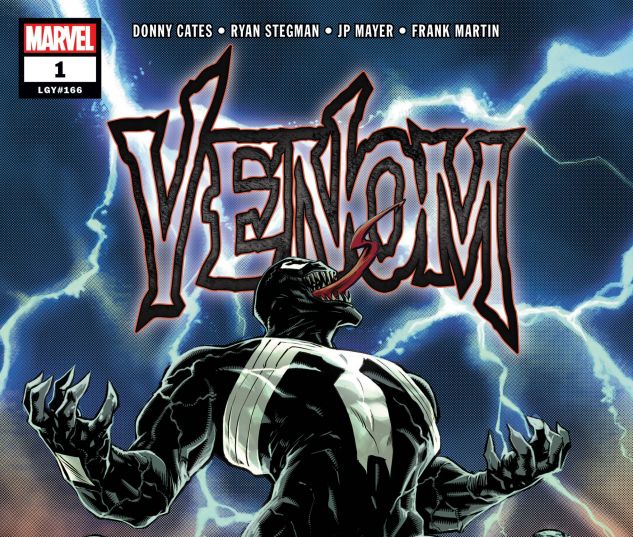
Donny Cates, Ryan Stegman, and Iban Coello’s Venom ongoing series is filled with all the fun excesses of the 1990s (Especially in the Venom Annual where James Stokoe shows him going toe to toe with Juggernaut.) and none of its toxicity. The first arc of the series is about Eddie Brock and his symbiote going to war against Knull, god of the symbiotes and a symbiote dragon. This has a terrible effect on him, and Cates carefully uses the symbiote as a metaphor for PTSD while freeing Stegman to draw unhinged heavy metal battles. And this series wasn’t just a one arc wonder as Cates, Coello, and Stegman explore the after effects of the battle with Knull on Eddie’s symbiote and have him confront his father. Plus one of the most underrated Marvel villains, Ultimate Reed Richards aka the Maker pops up for a little bit. This series work because it explores the psychological effects of the symbiote as well as the oozy, shoot-y violent bits.
5.Crowded (Image)
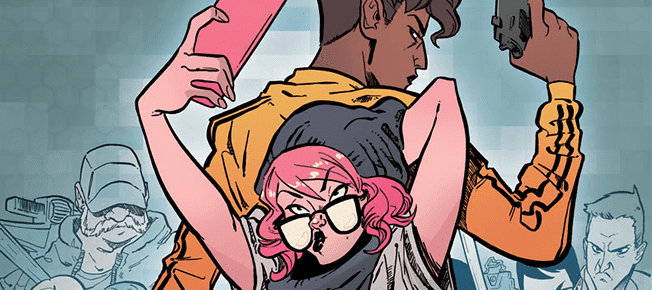
Crowded is a wicked bit of satire with a side of mismatched buddy adventure from the beautiful minds of Christopher Sebela, Ro Stein, Ted Brandt, and Triona Farrell. It is about an obnoxious woman named Charlie, who has a $2 million price on her head on an app called Reapr that is basically crowdfunded murder. Luckily, there’s an app called Defendr where Charlie hires a badass, meticulous, and noble woman named Vita to protect her. Stein and Brandt fill each page with oodles of panels, but you are able to follow every action scene, conversation, or Charlie ending up at the club or a bachelorette party even if she has a price on her head. The bounty hunting drives the plot while Sebela uses the quieter moments to develop the personality and relationships of Charlie and Vita as well as some of the “professionals” hunting them. Crowded is a thrill ride, but also looks at the dark, not so altruistic side of human nature through the Internet and constant connectivity.
4. You Are Deadpool (Marvel)
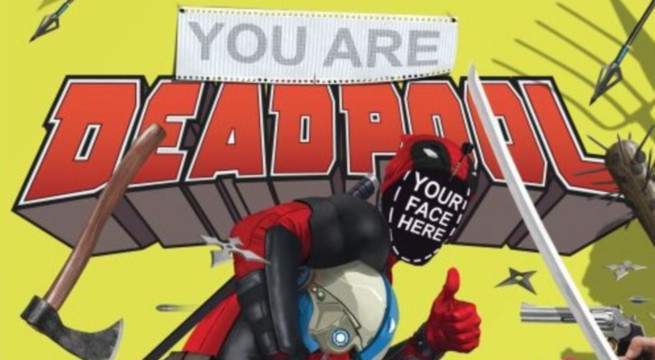
Al Ewing and Salva Espin’s You Are Deadpool was some of the most fun I had reading a comic book in 2018 beginning with Kieron Gillen showing up in the “tutorial” brandishing a sandwich as a weapon. It’s a combination spoof of different eras of Marvel Comics along with a pretty damn fun and addictive Choose Your Own Adventure Game. In some cases, you don’t even read the issues in order. Ewing and Espin also take cues from some not so table top RPGs and have the moral choices that Deadpool makes effect your reading and playing experience. Having Deadpool interact with both heroes and innocent passerbies during the Silver Age, horror/kung fu/blaxploitation, the edgy 80s, and of course, the good ol’ 90s is hilarious and shows Espin’s versatility as a cartoonist.
3. Archival Quality (Oni)
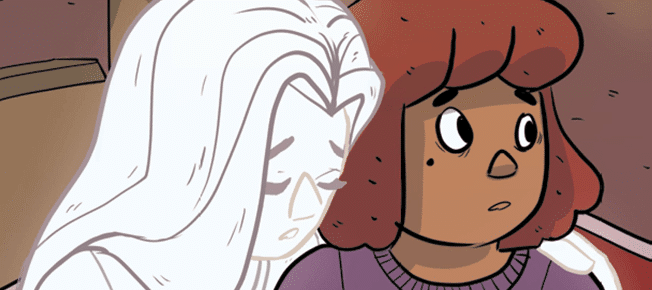
Archival Quality is a spooky graphic novel by Ivy Noelle Weir and Steenz about a young woman named Cel, who gets a job as an archivist at a medical museum. The comic tenderly explores Cel’s anxiety and depression and unexpected connection with a woman named Celine, who was a patient at the sanatorium that preceded the museum. It isn’t caught up in a fast paced thriller plot, but slowly unveils the mystery while focusing on Cel’s interactions with her boss Abayomi, super rad co-worker Holly, and her declining relationship with her boyfriend Kyle. Archival Quality has real atmosphere, and Steenz creates some fantastic spaces as Cel begins to explore her workplace with its skulls and lack of cellphone service. It is a fantastic story about mental health and relationships through the mystery genre.
2. Giant Days (BOOM! Studios)
Giant Days continues to be one of life’s true blessings thanks to John Allison, Max Sarin, Liz Fleming, Julia Madrigal, and Whitney Cogar. At this point, we know the characters and their quirks are on fully display, especially when Sarin draws the title because she is a real pro at expressive eyes and touches of surrealism to break up the slice of life. 2018 was full of drama to go with the Giant Days’ comedy as Daisy broke up with her a little too footloose and fancy free girlfriend Ingrid, and Esther missed her shot at being in a relationship with Ed when he begins a romance with Nina, a girl he met while recuperating from a pub related injury. Nina being Australian is the subject of this year holiday’s special, which was a special treat drawn and written by Allison as Ed fends for himself Down Under. Giant Days shows that it’s one of the pre-eminent slice of life comics as it enters its fourth year, and Esther, Daisy, and Susan’s relationships continue to ebb and flow.
1. Immortal Hulk (Marvel)
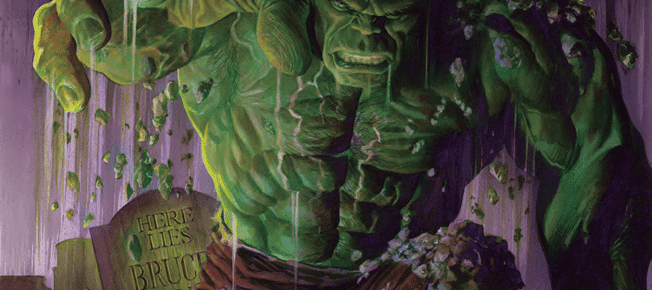
I will preface this by saying that the Hulk is one of my least favorite Marvel characters because he’s often used as a simplistic Jekyll/Hyde metaphor. Al Ewing, Joe Bennett, Ruy Jose, Lee Garbett, Martin Simmonds, and Paul Mounts blow that up in Immortal Hulk, which resembles an intelligent horror story rather than a superhero beat ’em up. It’s a road story with Bruce Banner on the run from the monster that comes out, wrecks, and kills when the sun goes down before morphing into a government conspiracy thriller and something more malevolent towards the end. Through cutting narration, Ewing reveals exactly what is going through Banner’s head while Bennett’s art shows the often gruesome effects of his rages. I also like how Ewing humanizes the supporting players from Walter Langkowski, who is struggling with his own monstrous nature to honest reporter Jackie McGee and even his opponent the Absorbing Man.
Immortal Hulk is the best comic of 2018 because it has a compelling plot, is a searing character study of an American pop culture icon, and is an homage to Jack Kirby and Bernie Wrightson while breaking new ground. (See issue 10’s final page.)
Runawaysis back, and after an incredibly cheesy cold open where the members of Pride are directed by the LAPD to cosplay knockoff versions of their children, there’s some actual running away in the season 2 premiere “Gimmie Shelter”, which is written by the show’s creators Josh Schwartz and Stephanie Savage and directed byveteran TV helmer Allison Liddi-Brown (Grey’s Anatomy, Friday Night Lights, Parenthood). The episode explores the new normal of the Runaways’ kids, and how they’ve become a family while struggling to survive away from their privileged Brentwood/rich part of LA existences. Like in Season 1, a big portion of the episode is dedicated to their parents and their varying degrees of evil and scheming. Aka Tina Minoru is one scary woman.
The building of community and awareness of privilege is a throughline that gives “Gimmie Shelter” depth and empathy that the prep school sequences in Runaways Season 1 didn’t have. In the beginning of the episode, Chase loses his Fistigons and the group’s money to a low level bike thief named Mike, and they have to humble themselves and get food at an outdoor soup kitchen because they have no money. Ariela Barer, whose performance as Gert, was the standout of Season 1 gets to showcase her character’s softer edges as she realizes that in her call for social justice that she had never really experienced injustice up close.
This sense of community continues in the Wiccan funeral of Graciela Aguirre, who is Molly’s last living relative and gave her a VHS tape with a warning from her parents about Pride and the mysterious Jonah, who still isn’t as great a bad guy as Tina Minoru or the Wilders. Her death is the big plot beat of “Gimmie Shelter”, but Schwartz and Savage take time to dwell on the emotional impact of her passing, especially Gert and Molly. Viewers didn’t get a lot of time to know Graciela as a character beyond her fierce protection of Molly and opposition towards the Pride (Her shooting a gun at the Yorkeses is this episode’s finest moment.), and Molly talks about this in her eulogy. She feels alone in the world until she slowly finds family in the Runaways with a loving shot of her snuggled up with Old Lace after the team finally discovers their underground mansion hideout from the original comics.
Like in Season 1, the extended scenes with the Pride aren’t effective as the ones with the Runaways that crackle with chemistry, raw feelings, and even a little humor. For example, Alex gets a solo plot line where he helps Darius, his father’s old business associate, paint his newborn daughter’s room instead of doing stereotypical “gangster” things. On the other hand, the Pride’s scenes are just a round table of scheming, and Schwartz and Savage’s writing for them is stiffer like they’re trying to get each actor a line in the scene instead of letting the natural charisma of Ryan Sands’ Geoffrey Wilder or Brittany Ishibashi’s Tina Minoru take over. This is because the Yorkeses continue to be grating, and Janet Stein and Leslie Dean sadly have no character apart from their husband/cult respectively.
A continued over focus on the parents aside, “Gimmie Shelter” is an excellent reminder of how talented the young cast of Runaways is, especially as they have to negotiate their identities, powers, and relationships while also being wanted fugitives. There’s also a pretty major surprise wedged in this episode somewhere that gives the series both a plot and character hook.
Moral ambiguity abounds in Firefly #2, and there is also shooting, religious satire, Shepherd Book wisdom, and tender conversations between Zoe and Wash in the franchise’s sophomore outing under new licensee BOOM! Studios. Writer Greg Pak continues to nail the voices of the cult favorite characters while artist Dan McDaid and colorist Marcelo Costa for for mood over keeping their character models just like the actor’s likenesses. Costa’s work especially shines in the flashbacks as he, Pak, and McDaid continue to unpack Zoe and Mal’s past without giving the whole game away.
Unlike Dark Horse’s Serenity comics, which acted as a continuation of the 2005 film, Firefly #2 is set before the movie and has the feel of a hypothetical season 2 of the series. This means that Wash and Shepherd Book are alive, well, and stealing scenes although sadly River Tam is relegated to spouting “crazy” things. Pak’s main focus is on Zoe and Mal and their activity in the war between the Independents and the Alliance, which has gotten them declared war criminals by the Unificators.
Pak and McDaid don’t shy away from the horrors of war as Mal has a dark flashback when a member of a pilgrim caravan that the crew of Serenity are protecting is shot in the head. The violence in Firefly #2 isn’t stylish, but dirty, chaotic like the used future setting of the show. During the couple of setpieces in the issue, it is difficult to follow who is targeting who, but this adds to the feeling of uncertainty during the fight. The action sequence also reveals Zoe’s darkness as she threatens a group of bandits with her “reputation” as a war criminal. The shadows around her face and gun are a nice touch from McDaid and Costa, and in his plot, Pak starts to separate Zoe and Mal from the other crew members leading up to more reveals about their actions in the war and how it affects them today.
Even though Firefly #2 is mostly a straightforward space western in the vein of the show it’s based on, Greg Pak injects some satirical elements into the story. For example, when it seems like he and Dan McDaid are setting up a villagers with pitchforks gag of the crew of Serenity’s clients, the pilgrims, leaving them because Mal and Zoe are war criminals, they celebrate that fact. I guess sanctity of life wasn’t under one of their tenets.
I’ve mentioned it earlier, but Dan McDaid and Marcelo Costa’s art is a huge selling point of Firefly #2 and the series in general. It has a rough beauty and really sings when characters converse with each other like Simon trying to get hints from Shepherd Book about Mal and Zoe’s past while being blissfully unaware of Book’s own past, or any time Wash and Zoe interact. McDaid doesn’t just use talking head grid for these sequence, but switches it up like using a diagonal layout for the conversation between Shepherd Book and Simon.
With its attention to the rhythms of how its characters speak, at first, Firefly #2 might seem nostalgic. However, Greg Pak, Dan McDaid, and Marcelo Costa actually start to craft a narrative casting a deep shadow on the characters we’ve quoted, admired, and dressed up like for over a decade. It strikes a nice balance between having its own story and being a prequel.
Story: Greg Pak Art: Dan McDaid Colors: Marcelo Costa Letters: Jim Campbell Story: 8.6 Art 7.5 Overall: 8.2 Verdict: Buy
BOOM! Studios provided Graphic Policy with a FREE copy for review