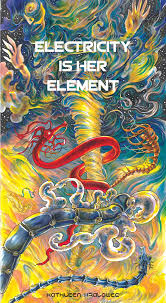
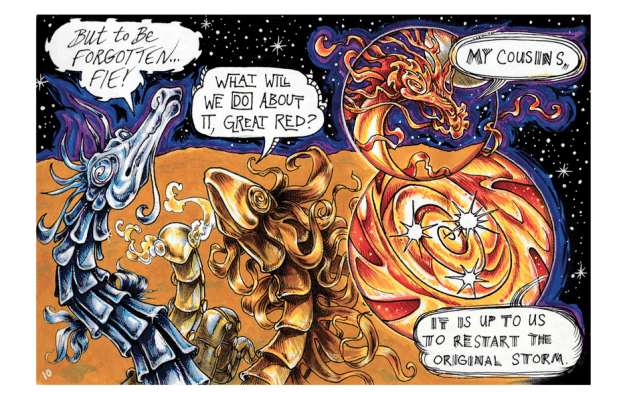
Electricity is Her Element is a self-published one-shot from cartoonist Kat Crow. A group of dragons or “snakes of chaos”, live in the storms on Jupiter and its moon Io and want to return the solar system back to pure chaos. They seek to accomplish this with the help of the elements Fire, Metal, Atmosphere, Water, and Electricity. It’s an extended meditation on the ultimate fate of the universe, the struggle between order and chaos. Even though Earth and humanity doesn’t appear in the comic, it’s a reminder of how really small we are in the universe. But with cool nature-inspired dragons, personifications of elements, and a cat angel named Ker-Bop that damn near steals the entire comic.
Taking a page from Todd Klein’s work (Especially on Sandman.), Crow uses lettering to establish characters, relationships, and tone. An example is Metal who is a warlord type figure, actively disliked by the other elements. He takes the dragons’ claws in exchange for helping them unleash chaos. Metal’s letters clank around like weapons. Its word balloons are more like a machine than the naturalism of other characters. Atmosphere’s lettering involves clumps of repeated words. It’s like one is struggling to breathe poisonous fumes. The lettering demonstrates the unpredictability of her abilities and almost the sheer luck that the dragons have in mollifying her.
Instead of just being text on a page, Crow’s lettering conveys the emotions behind the words used by the characters. The lettering complements her art style for each one. Along with being integral to the plot, Ker-Bop adds a wise-ass and puckish sense of humor to the ponderous proceedings of the first act of the comic. She’s drawn almost like a classic comic strip character. This is in comparison to the intricate rendering for the dragons and elements. The fights between Water and Dust Storm, and Atmosphere and Hail Storm are illustrated in painted splash pages. That showcases the power of these elemental clashes. They hint at how heroic these characters are even if they are from Jupiter’s moon Io, and not the Big Red Planet itself.
Another thing that makes Electricity is Her Element is the poetic way that Kat Crow structures the comic. Until Ker-Bop shows up, the dialogue between dragons and elements is almost call and response. The dragons have a need, and the elements meet or end up in a big conflict. There’s a dark feeling of yearning in the early part of the comic. The dragons are nostalgic for a time when the universe was one big storm. They’re afraid of change and Jupiter becoming a totally smooth planet. These emotions allowed me to connect to the characters beneath their pompous and divine nature and makes the story a little bit tragic.
With a scintillating, cosmic color palette, and fluid line work to match the different styles of lettering, Electricity is Her Element is a visual treat. It made me feel shock and awe when I flipped through the first couple pages before diving into the comic. Crow adds to this strong artistic foundation and distinct character designs by giving each element or dragon a unique personality. That’s while focusing on Ker-Bop, Dust Storm, and Hail Storm in this comic and fitting it into a cosmology that seems both spontaneous and planned.
Electricity is Her Element is J.RR. Tolkien’s “Ainulindale” with a sense of humor. It’s Hesiod’s Theogony without the toxic masculinity. Character sketches and bios at the end of the comic add depth to Crow’s worldbuilding. It helps make this comic worth picking up for all lovers of beauty and truth.
Story: Kat CrowArt: Kat Crow Story: 8.0 Art: 9.5 Overall: 8.7 Recommendation: Buy
Kat Crow provided Graphic Policy with a FREE copy for review
Even before cracking the opening pages of Kieron Gillen, Dan Mora, and Tamra Bonvillain‘s Once and Future #1 seemed tailor-made for my own personal interests. It’s set in the beautiful English county of Somerset where I studied Jane Austen and Edgar Wright’s Spaced for a semester and has some deep dive Arthurian lore (The Questing Beast makes an appearance!). It also seeks to interrogate and apply those legends to the current state of the U.K., namely, Brexit, Boris Johnson, and all that white nationalist nonsense.
It’s set in the beautiful English county of Somerset where I studied Jane Austen and Edgar Wright’s Spaced for a semester and has some deep dive Arthurian lore (The Questing Beast makes an appearance!). It also seeks to interrogate and apply those legends to the current state of the U.K., namely, Brexit, Boris Johnson, and all that white nationalist nonsense.
However, Once and Future isn’t a political treatise, but the latest adventure in a line of magical quests, armed knights, and killing monsters that began with the Epic of Gilgamesh and were probably best represented in 20th popular culture by the two of the four Indiana Jones films. But what sets apart Gillen and Mora’s story from this previous ones is the team-up between the constantly flustered/audience surrogate Duncan and his grandmother Bridgette, who has a dry wit and is even sharper with various gun/edged weapon and knowledge of the supernatural forces of the British Isles that are illustrated in an almost twilight palette from Bonvillain.
After a Raiders of the Lost Ark meets Nigel Farage’s wet dream MacGuffin establishing cold open, Kieron Gillen and Dan Mora use humor to establish the characters of Duncan and Bridgette and their relationship. Duncan is the handsome, kind, yet klutzy one so he gets introduced wide eyed with his hands out after accidentally splashing his date with red wine. It instantly establishes him as the equivalent of Level 1 Dungeons and Dragons character, but he’s not an utter joke as he does an okay job later on with the Questing Beast and his car is the 21st century version of him and his grandmother’s knightly steed.
In contrast, Bridgette is introduced making killer quips about breaking her fellow old folks’ home residents’ fingers when they want to change the channel from local news stories about archaeological dig thefts/murders to the more pleasant Great British Bake-Off. Gillen and Mora subvert the “crazy old lady gets lost and freaks out” trope by making her walk in the woods discover a cache of weapons. Bridgette might have lost a step, but she’s still a total badass. Honestly, her take on Arthurian lore like Excalibur’s heal-every-wound scabbard being more valuable than the sword itself and wariness about the return of Arthur is just as cool as her action scene.
Sure, Once and Future has funny lines and hilarious reactions courtesy of Gillen and Mora, but it has a noble, earnest band together against the forces evil tone that makes it super endearing. Or, at least, that’s how energetic, if a little naive Duncan sees the world. Bridgette reads between the lines, and her dialogue about the iconic hero Arthur’s return maybe not being the best thing is a classic example of reading against the grain. It also connects to white nationalists/fascists in the real world using legendary imagery like Thor’s hammer to make their hate-filled movement cooler.
Once and Future #1 modernizes and humanizes the classic Arthurian legends by making the protagonists of the story that kind of nerdy, cute guy who says smart things in the back of a college class and his tough, no-nonsense grandma that’s been through some stuff. Kieron Gillen bolsters his quest plotline and monster fights with character-based humor and sociopolitical commentary while Dan Mora and Tamra Bonvillain bring an infectious energy with just a touch of darkness to the visuals. To cut it down to its core, Once and Future #1 entertains as just as well as it enlightens and uses myths and legends to bring hope to a world in need of salt of the Earth heroes like Bridgette and Duncan.
Story: Kieron Gillen Art: Dan Mora Colors: Tamra Bonvillain Letters: Ed Dukeshire Story: 9.0 Art: 9.8 Overall: 9.4 Recommendation: Buy
BOOM! Studios provided Graphic Policy with a FREE copy for review
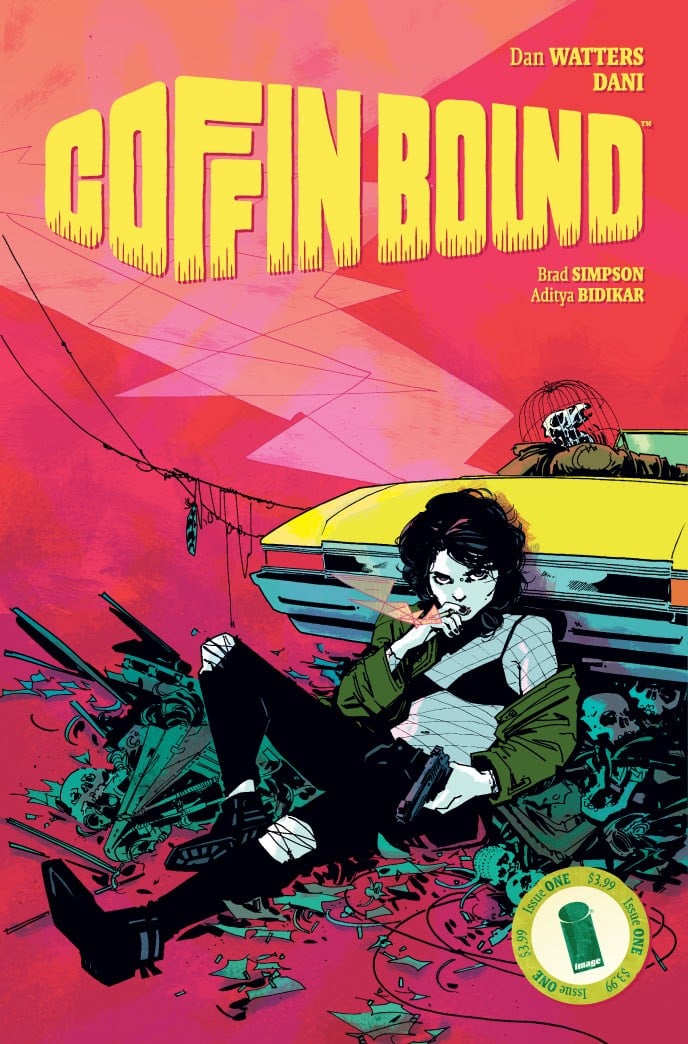
Coffin Bound #1 is either utterly pretentious or utterly sleazy. Dani and Brad Simpson‘s visuals are that of the grindhouse or carsploitation film with a touch of a Western and religious rituals. I definitely could feel a Pretty Deadly vibe from this book, but it seems sleazier. Some of that might be chalked up to Dan Watters’ writing which runs the gamut from Philosophy 101 bullshitting to terse, salt of the Earth dialogue.
Beneath all the purple prose and self-flaying strippers, Watters’ plot is a straightforward one. A girl named Isabel wants to obliterate every trace of her from her fucked up post-apocalyptic world, and a gimp mask sporting psychopomp named Earth Eater (In the literal sense). So, she goes on a road trip looking for an oracle named Cassandra, who turns out to be someone she has a warm, possibly even romantic relationship with. Her road trip buddy is a vulture, which drives home the point that, yes, this is a book about primal things like death.
Coffin Bound is a comic that I liked more for the aesthetic and general visual feel than for the contents of the issue until the very end when it maybe becomes a queer love story. Dani’s cover sets the tone for the book with a raven-haired girl slumped by a loud, yellow car with bones around her disdainfully holding a gun and cigarette like she doesn’t give a fuck. This attitude extends to the opening action scene that’s filled with equal parts humor and nihilism as Isabel struggles to put her pistol together to fight off the men who are trying to kill her for Earth Eater. A brick does the job just as well too and is maybe an homage at the original cat vs mouse comic Krazy Kat, which also had idiosyncratic use of language like this book. Later, Isabel has car problems and complains to her “manager” using florid prose, and the scene made me crack a smile because even poetic, post-apocalyptic badasses’ cars break down sometimes.
Coffin Bound is a very good comic whenever Watters and Dani focus the story on Isabel and the Earth Eater, who just shows up on a couple of pages like a good classic horror monster. However, it loses some of its momentum in the strip club sequence although Dani’s heavy inks and Simpson’s sleazy color palette and focuses on the red meat of the self-flaying stripper creates a pretty fucked up atmosphere. Watters seems to be filling in the world of Coffin Bound and the relationships that Isabel has and is trying to undo, but it hurts the comic’s pacing as a chase story. It’s like if Mad Max Fury Road cut immediately from a war rig action scene to a secondary female character working the pole for one of Immortan Joe’s lieutenant. Hopefully, it works once we get the full arc, but is a weak scene in this single unit of story.
Coffin Bound #1 is a comic that looks cool and knows it thanks to Dan Watters’ dark sense of humor, Dani’s take no prisoners visuals, and Brad Simpson’s scorched Earth color palette. It suffers a little bit when it gets away from the cat and mouse game between Isabel and Earth Eater, and sometimes the dialogue is a little bit up it’s own ass. But it’s nice to see a comic that’s not afraid to get its hands dirty in an age of house art and polished sheen.
After House of X #1’s worldbuilding and ideological treatise and Powers of X #1’s time-skipping narrative, Jonathan Hickman, Pepe Larraz, and Marte Gracia settle down into what looks to be a character study of Moira MacTaggert, long time, underrated X-Men supporting character. On a very surface/spoiler-free marketing level, House of X#2 is this. However, in actuality, this is the first issue of Hickman’s X-Men story that will be in the proverbial history books, and the changes can already be seen on Moira’s Wikipedia page.
In effect, he makes Moira MacTaggert, or X as she is known in the comic, the new center of the mutant universe taking the crown away from Xavier and Magneto, Cyclops and Wolverine, or even Apocalypse and Sinister. Her perpetual, yet unfortunately invisible connection to the X-Men ends up becoming her power. House of X #2’s main reveal is that Moira is a mutant with the ability to reincarnate, have all memories from her past life in her new one, and have her mutant nature be undetectable. Hickman and Larraz showcase this final power in a throwdown between Moira X and Destiny where they use a nine-panel grid to flex Destiny’s ability to sense when Moira reincarnates and take her out every time Edge of Tomorrow style.
At its core, House of X #2 is a wonderful speculative fiction story about how you would add differently in your life if you already knew the outcome of your decisions and relationships. Moira’s ideology and her relationship to the major X-Men universe players, including Professor X, Magneto, Apocalypse, and Sentinels, evolves throughout the issue as she plays a variety of roles from housewife to her previously canonical one as a support scientist to co-founding the X-Men with Apocalypse and being the Terminator to the Trask family.
Larraz and Gracia keep these sequences lively with an ever-shifting visual style, especially in layouts. They can go from a three-panel progression of X-Men history a la Kirby, Cockrum, and Immonen to diagonal panels to show Moira gripping with the inevitability of AI and utter darkness when she teams up with Apocalypse. But House of X #2 also has a lot of conversations, and Pepe Larraz nails the shifts in body language in the interactions between Moira and Professor X, which range from slowly building a bond to complete disdain and finally creating the world of House of X.
Moira’s lives are truly the hidden part of the metaphorical iceberg that is the world of House of X and attempt at utopia that is Krakoa. She has seen how mutant history has developed nine times, and the tenth time is the charm as she is back to Xavier’s dream, albeit, in a radically different way from a school of gifted youngsters or team of superheroes. Moira X is the container of potential and the results of ideological struggle, and the multi-page timeline at the end of House of X #2 is a fantastic representation of this and one of my favorite Hickman diagrams this side of Black Monday Murders.
House of X #2 seamlessly works at two levels. On one level, Jonathan Hickman and Pepe Larraz are telling the life story of Moira MacTaggart, who has played a pivotal role as a bridge between humans and mutants for decades of comics, and what you think about her is all wrong. Finally, on a macro level, they craft several visions for how the relationship between humans, mutants, and machines plays out and begin to provide a reason for why the world is like it is in House of X #1 and how it ends up in Powers of X #1.
*This review contains full spoilers for The Wicked + The Divine #44*
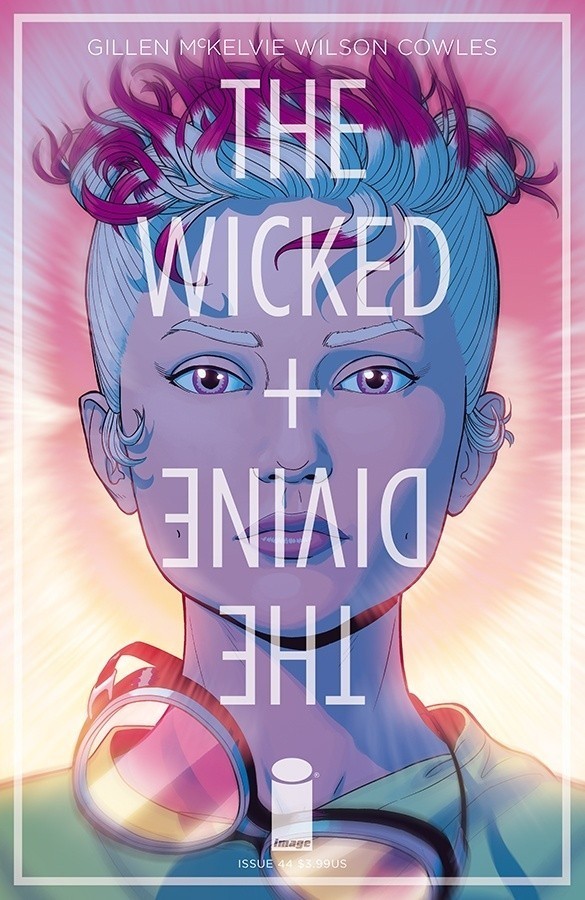
With its skull on the first page of issue one, None More Goth visual trappings, and high body count, The Wicked + the Divine sometimes seems to be a book about death. However, it’s really about life and growing up and discovering your true identity, and stuff that sounds like self-help, hippy dippy bullshit. The Wicked + The Divine #44 is executed in a beautiful way by Kieron Gillen, Jamie McKelvie, and Matthew Wilson. Even though there’s one issue left of WicDiv,this The Wicked + The Divine #44 ends the series’ main plot and the tale of godlike teenagers, Ananke and Persephone, and best of all, Luci and Laura, the relationship between mad, bad, and dangerous to know and shy, innocent fangirl that hooked me on the series and evolved well beyond that.
The amazing cliffhanger of WicDiv #43 brought Luci back to the forefront of the narrative and the general limelight just before the end. Gillen has her call herself “the whole world’s dream girlfriend”, and McKelvie and Wilson oblige with some rockstar poses and a side of hellfire. Her new costume is one of my favorite McKelvie designs of the series and gives her the swagger of a person who is only herself when she’s performing in some way. She’s Lord Byron, Bowie, Jagger, and most of all, the Adversary. Luci desires to create chaos and enjoy life with her new lease on it, doesn’t want to relinquish her powers like the other Pantheon members, and would definitely rather reign in Hell.
This is where some writers would have a big punch-up, Miracleman #15 style, with Luci being full of hubris and wrecking London. However, Kieron Gillen and Jamie McKelvie definitely “zag” away from this path and do something a little more life-affirming with Luci and Laura. In a red and black, near farce of the Pantheon transformation sequence and using third-person narration, Gillen, McKelvie, and Wilson sort through the pain that Laura has gone through the past two years, and how much she cared for Luci even when she was on trial for murder back in “Faust Act”.
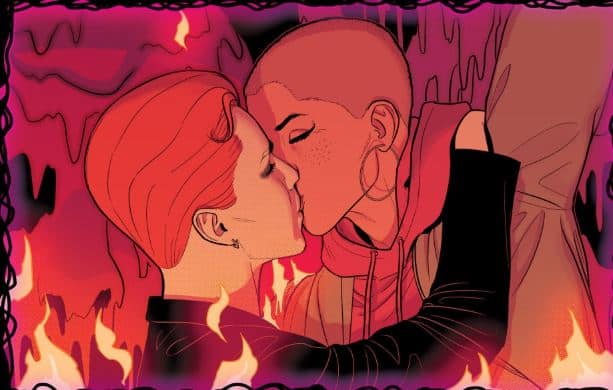
It all culminates in one of the most touching sequences of the series (And we’re only on page 8.) where Luci simply says, “I’m Eleanor”, kisses Laura, and becomes human again. This series of pages is a wonderful inversion of the other Pantheon transformation sequences throughout the series, and the moments after are raw, filled with tears, and the formerly sharp-tongued Lucifer having almost nothing to say. It expertly combines the lofty themes of identity, godhood, and immortality with two estranged friends hugging it out as Laura demonstrates growth by choosing reconciliation over alienation.
I could probably write this whole review about Luci and Laura, but hey, there are other characters and storylines in The Wicked + The Divine #44 all connected to the throughline of simply living even if it doesn’t mean being a god with worshipers or pop star with fans. With Luci returned to mortality, the situation with Minerva/Ananke is the last big plot thread on the table, and there’s a debate over what to do with her. Laura wants to kill her, but she’s growing as a person and defers to Cassandra’s sensible solution of using Mimir’s plot device engine one last time. (Cass’ reaction is priceless.) But Baal just wants to kill her and be the embodiment of toxic masculinity. His last interactions with Inanna are tragic and are a reminder of how great this series was at exploring queerness and gender performance.
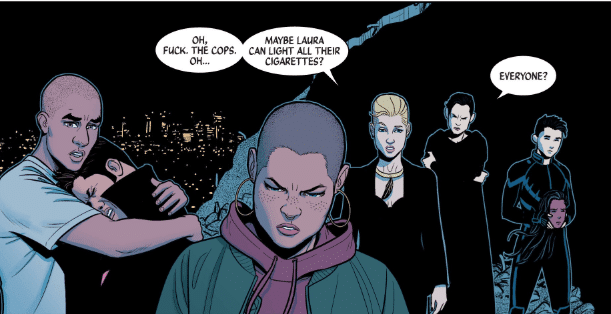
He’s done this throughout the series, but I would like to draw attention to how Jamie McKelvie draws panels with multiple figures in WicDiv #44. He doesn’t just focus on reader eye level, but in the spirit of the old film adage “acting is reacting”, imbues each figure with a small story of their own. A good example of this is the first reaction panel after the deaths of Baal and Minerva. Laura furrowing her brow and figuring what to do with two dead bodies and a SWAT on the way is the focus of the panel.
But McKelvie reminds us of the deep pain that Inanna feels about the death of his former lover and the empathy and friendship Dionysus has for him through his detailed work with them. All of this is with no words; just visuals. Also, Wilson uses a lot of black to give the panel and page a real funereal feel for the literal characters, Baal and Minerva as well as all of Ananke’s machinations and the concept of the Pantheon. There is also a slight glow in the background, which connects to the spotlights used by the cops throughout the issue and symbolizes that the ex-Pantheon members have to deal with the harsh light of reality as mortals from now on. (See the courthouse scene.)
With its opening words and repeated mantra “Once again we return” as well as the revelation of the eternal conflict between Ananke and her sister, WicDiv has been a study of cycles of life and death. This beautiful symmetry pays off big time in WicDiv #43 whose final page is not just an homage to the ending of its predecessor, Grant Morrison’s Invisibles, but the first page of WicDiv #1 with the visual of a living head instead of a skull. It’s also like the ending of John Milton’s Paradise Lostwhere Adam and Eve lost a chance of immortality in an utopia, but gained the ability to choose “their [own] place of rest”. Laura might not be a goddess any more and is still in hot water for killing Ananke, but she gets to live life as a human being untethered to any rituals or schemes.
I’ve spent the last five years living, regressing, and sometimes growing alongside these characters expertly crafted by Kieron Gillen, Jamie McKelvie, and Matthew Wilson so emotions definitely run high in The Wicked + The Divine #44 especially in regards to Luci and Laura and Baal and Inanna. But it is one of the most life-affirming comics I’ve ever read, and I’m glad that we (hopefully) get to see a peek of the lives of Laura and company in the final issue of the series. (That final cover reveal, y’all!!)
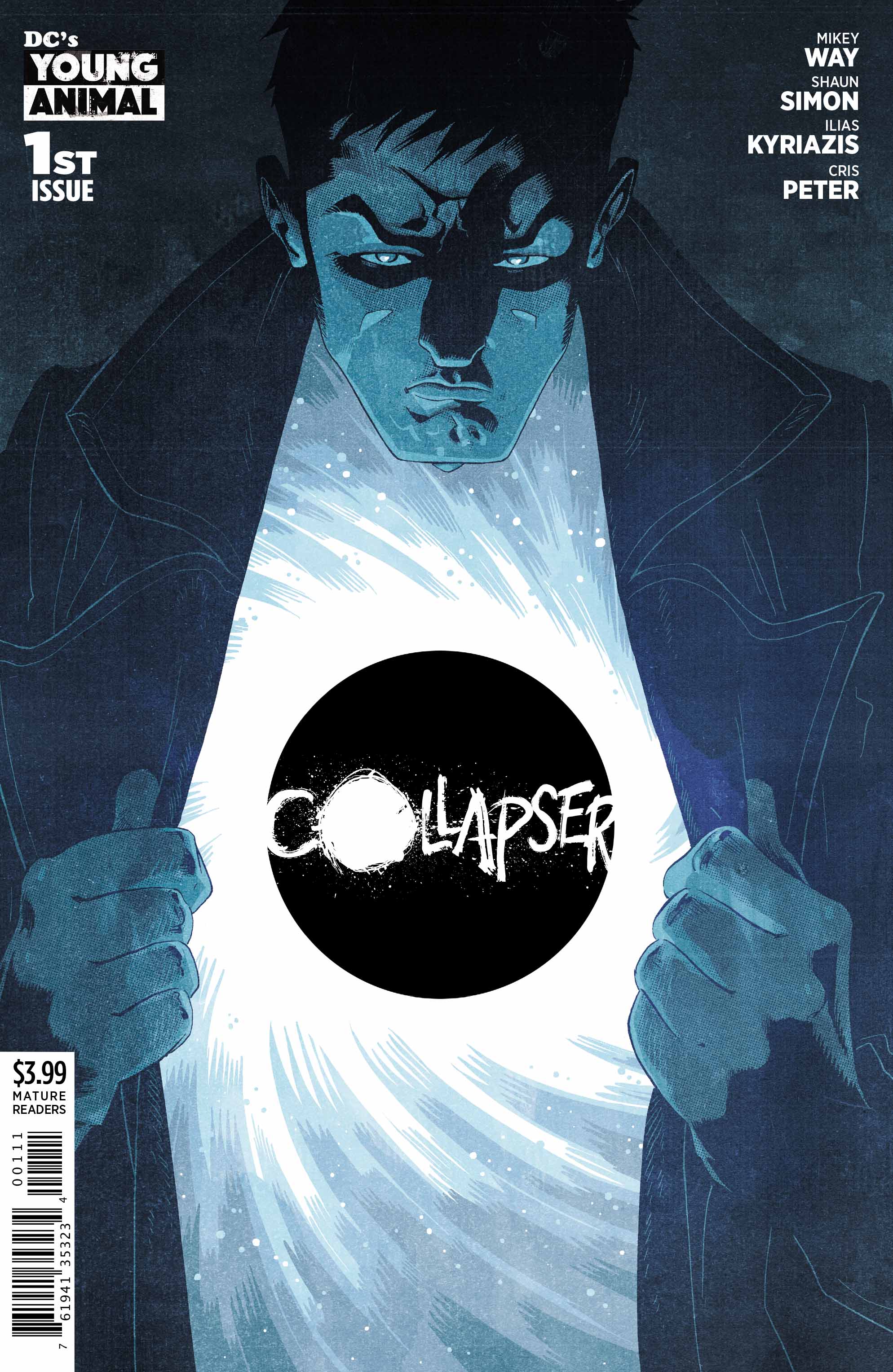
What if that empty feeling you have inside was a literal black hole? That’s the premise of Collapser #1, a new comic from writers Mikey Way and Shaun Simon, artist Ilias Kyriazis, and colorist Cris Peter. The book starts with a cosmic cold open before spending most of the issue in slice of life mode. It shows the life of Liam James. James works at an old folks’ home during the day. At night, he’s a DJ with a penchant for songs by Mancunian musicians like Morrissey and The Chemical Brothers. He’s also insecure and freaks out a lot. This is known thanks to Way and Simon’s internal captions. It intensifies as the book gets weirder ramping up to a fantastic final page.
Collapser #1 succeeds as a first issue because it focuses on establishing Liam as a protagonist and keeps the space stuff on the backburner for the most part. After the rush of the first few pages, Way, Simon, and Kyriazis slowly introduce more hazy cosmic jive into the story when it needs mystery or tension. Kyriazis and Peter equally excel at drawing the effects of the black hole and Liam going through his daily life. A nine-panel grid to shows the mundane nature of his day job although Liam genuinely cares for one of his patients, Mr. Edgar, and is sad that they don’t get to play chess together.
However, Collapser #1 has plenty of flash too. Peter adds some gorgeous pinks and Ben-Day dot effects when Liam kisses and interacts with his girlfriend. Her color palette intensifies when Liam’s DJ set begins. Way and Simon’s musical background shine through in this sequence. Liam is totally in his element and it’s my favorite sequence of the comic. There are no thought bubbles; just him, his headphones, his records, and a crowd that is dancing, drinking, and making out into the night.
Of course, it all goes wrong because of the whole blackhole thing. Ilias Kyriazis’ art style flips from Phonogram to a fucked-up take on Silver Surfer almost instantaneously. Time and space lose their meaning, and Liam witnesses all his worldly possessions becoming sucked away. He’s become part of something bigger. Way, Simon, and Kyriazis show this in a jarring way with powerful, horror-tinged imagery as Liam doesn’t recognize the world around him any more. However, the weirdness works on a narrative level because Way, Simon, and Kyriazis do a good job of introducing Liam and his everyday life as well as his passions and flaws.
Collapser #1 is characterization meets strong visuals and colors with a side dish of trippy worldbuilding to literally suck you into the story. Mikey Way and Shaun Simon make Liam a little bit of an asshole; he’s not the greatest towards his girlfriend and is a little insensitive at times. However, Liam’s passion for music and fear of failure are all too relatable. He makes a great POV character for this wild space odyssey of which Collapser #1 is a solid first few steps.
Story: Mikey Way, Shaun Simon Art: Ilias Kyriazis Colors: Cris Peter Letters: Simon Bowland Story: 8.0 Art: 9.0 Overall: 8.5 Recommendation: Buy
DC Comics provided Graphic Policy with a FREE copy for review
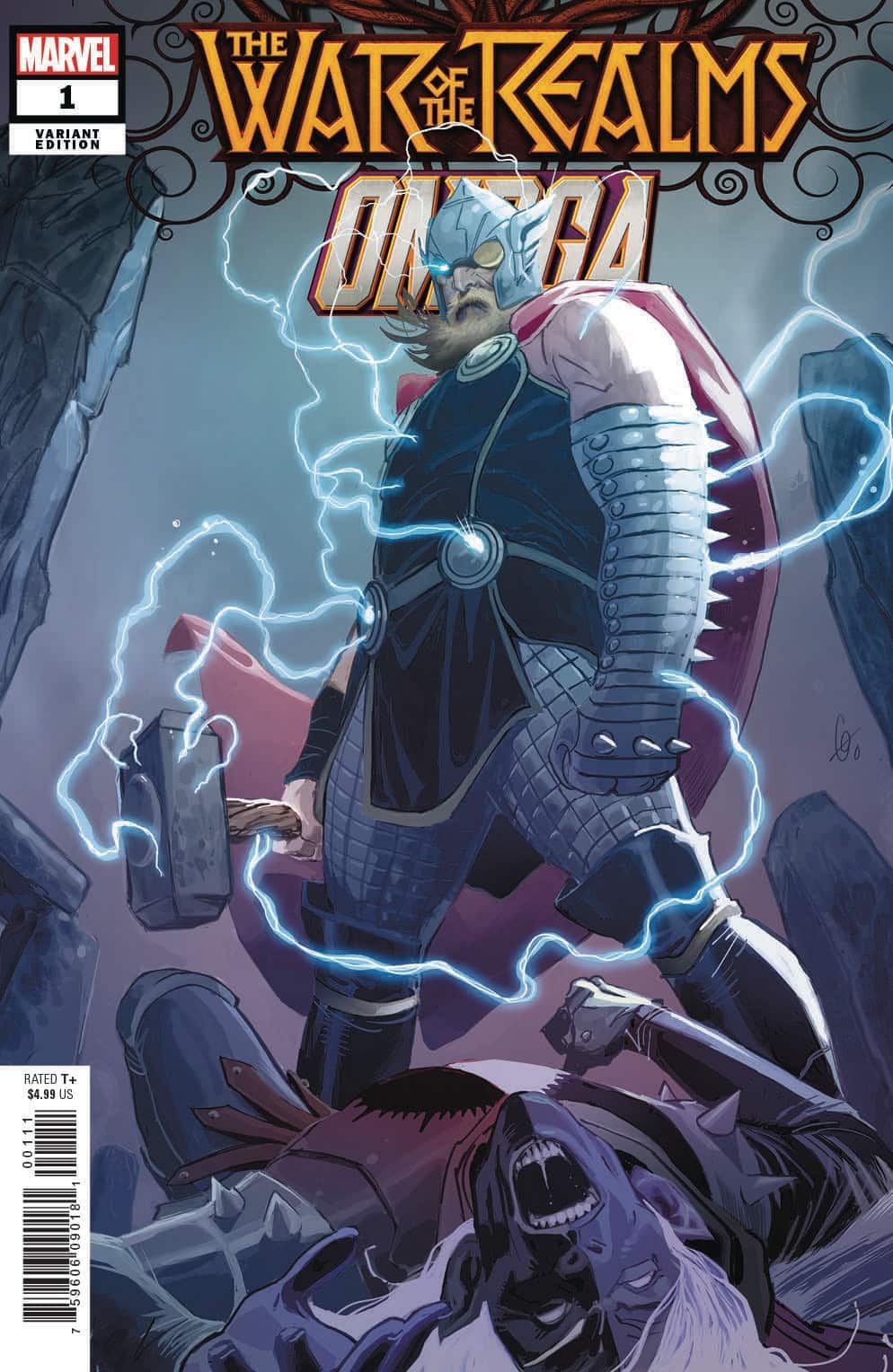
War of the Realms: Omega#1 is not so much a full epilogue story to the “War of the Realms” event as a tasting menu for the various spinoffs that come after it. Kudos to Marvel for putting these in their own comic instead of stepping on Jason Aaron, Russell Dauterman, and Matthew Wilson’s literal thunder as they hit the high point of Aaron’s Thor epic. With one last omniscient conversation between Daredevil and Heimdall as a framing narrative, Omega #1 tells the story of Jane Foster, Loki, and Punisher while setting up Jane Foster Valkyrie #1, Loki #1, and Punisher Kill Krew #1.
Even if it’s mostly just a conversation between Daredevil and Heimdall, the framing narrative of Omega #1 is a fantastic conclusion to Daredevil’s struggles with godhood that Jason Aaron penned in War Scrolls. It’s also reunion of one of my favorite recent Daredevil art teams of Ron Garney and Matt Milla, who transform the look of their framing narrative from fantasy to street level as Daredevil goes from talking about gods, prayers, and Valhalla to stopping a mugger with the help of some Yggdrasil forged fighting sticks. Aaron also brings up some interesting ideas like Daredevil’s guilt about his own faith and beliefs making him a good God of Fear that protected Midgard in their direst need. It connects to his recent writing of Thor that the best god isn’t one that fights for the mantle, but acknowledges the responsibility that is thrust upon him.
The first story in Omega #1 features Jane Foster and the Valkyries in a morgue where she hopes to help find them some peace and is written by Aaron and Al Ewing with art from Cafu and Jesus Aburtov. Jane interacts with Lisa, who used to date the superhero America Chavez, and they both can empathize on what it’s like to be connected to someone with so much power and be ordinary. It’s a nice human interaction before a beautiful transformation sequence where Jane takes on the responsibility of reopening Valhalla and finding rest for the Asgardians. Cafu’s art is clean and photorealistic, but not too stiff while Aburtov’s colors are bright, glossy, but a little sad. Jane played a major role in “War of the Realms”, and it’ll be nice to see her as headliner for a little bit in her own series that looks to continue to play on Aaron’s themes of faith and belief that he has explored throughout his Thor comics.
On the more mischievous side, there is a story starring Loki and his undersized Frost Giant buddy Drrf from Daniel Kibblesmith, Oscar Bazaldua, and David Curiel. As evidenced by his work on Valiant High, Lockjaw, and Deadpool vs. Black Panther, Kibblesmith excels at combining comics continuity with funny and genuinely heartfelt moments. And there are a few of those in this short story as Loki takes a young Frost Giant under his wing after he spots the little guy using a stew pot lid as a sled. Bazaldua’s cartoon-y style visuals are a good fit for this book and capture Loki’s every smirk and glint of mischief in his eye. He earned the role of king of Frost Giants by killing his father, but it will be difficult to keep the respect of this murderous and cannibalistic realm. However, adding Drrf to the equation keeps the tone of the story light and not super serious in a Game of Thrones kind of way.
The final Omega #1 short story is a Punisher one, from Gerry Duggan and the fantastic Juan Ferreyra that shows that the War of the Realms never really ended for one person: Frank Castle. Castle is barbecuing stray Helhounds with a flamethrower, breaking up Asgardian revelry with semi-automatic gun fire, and making sure the inhabitants of Midgard don’t loot in the post-War chaos. His mission of vengeance towards criminals has expanded from mortals to fantasy beings thanks to the losses suffered by the people, and especially the children of New York, during the War. However, the real star of the Punisher story isn’t the brooding revenge or monster becomes monster hunter narrative book, but Ferreyra’s art, which he colors himself and has a Steve Dillon meets Heavy Metal vibe. The combination of melodramatic dialogue and captions and over the top violence is a winner.
War of the Realms Omega #1 accomplished what it set out do, which is to pique my interest in the upcoming Jane Foster, Loki, and Punisher comic book series that are spinning out of the event. The artists for these books are especially well-cast, and Cafu’s beautiful take on Jane Foster’s transformation from mortal to Valkyrie was the highlight of this entire one-shot. Also, Juan Ferreyra is such an underrated artist, and I’m excited to see his take on creative fantasy monster executions.
Story: Jason Aaron, Al Ewing, Daniel Kibblesmith, Gerry Duggan Art: Ron Garney, Cafu, Oscar Bazaldua, Juan Ferreyra Colors: Matt Milla, Jesus Aburtov, David Curiel Letters: Joe Sabino, Clayton Cowles, Cory Petit Story: 8.0 Art: 8.0 Overall: 8.0 Recommendation: Buy
Marvel Comics provided Graphic Policy with a FREE copy for review
Wow, Ghosted in L.A. #1 was incredibly and painfully relatable for me. Like our heroine Daphne, I went to my first year of college thousands of miles away in L.A. I kind of flamed out mostly because I didn’t have a car. And maybe a conservative bible college wasn’t the best choice for a flaming bisexual and progressive. Like Daphne, who found her own otherworldly tribe, I got into comic books, podcasts, and even criticism big time. I don’t have as many regrets as I used of my “lost year” as an Angeleno.
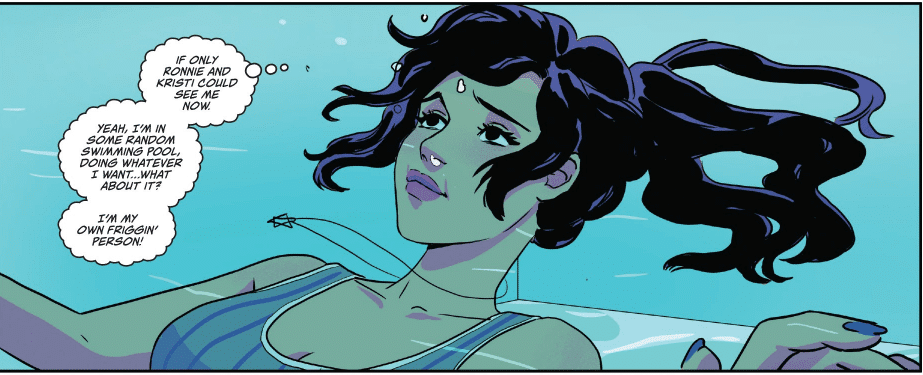
But enough of me. Sina Grace, Siobhan Keenan, and Cathy Le put a cute, wholesome spin on the mysterious, paranormal side of L.A in Ghosted in L.A. #1. The empty mansions, swimming pools, and things that make David Lynch crack a smile. However, we’re seeing this side of L.A. from the POV of a college freshman, Daphne, who is in that critical identity forging stage of her life. She gets her music taste from her (Currently estranged) friend Kristi and her college choice from her (now ex) boyfriend. Daphne is trying to develop her own personality. It’s not working out until she takes a dip in an abandoned pool and then cries against a wall after interacting with the house and pool’s ghostly denizens.
Le uses soft colors to show the weightlessness of Daphne floating. Keenan eases up on the hyperactive facial expressions that drew me into the story for a second to give her a moment of peace. Grace even gives her a “cool” and steady inner dialogue for two panels until the cartoonish facial expressions and anxiety are back with a side of a young ghost woman. Throughout Ghosted in L.A., he has crafted a signature voice for Daphne. She is desperate to fit in and wary to share her feelings, hence, all the text messages saved in drafts.
However, Daphne is no pushover and confronts her boyfriend when he breaks up with him to spend more on “self-discovery”. Cathy Le punctuates her rage with red backgrounds. Sina Grace adds a great line about how she doesn’t like the bicycle he gave her. Letterer DC Hopkins accentuates Grace’s dialogue by making the words in Daphne’s balloons smaller after her douchebag of boyfriend makes his breakup excuse.
Ghosted in L.A.‘s creative team fires on all cylinders in this issue. The book is a wonderful fusion of memorable character designs and facial expressions, well-paced plotting (Daphne discovers the ghosts after she hits rock bottom.), and a protagonist that is easy to connect to. Sina Grace and Siobhan Keenan explore the universal themes of loneliness and belonging through Daphne’s specific trials and tribulations with L.A. and a (mostly) kind family of ghosts as the backdrop. It’s what I want out of a good magical realism story. I can’t wait to learn more about Daphne and the world, no, the community that she has joined in this adorable comic.
Story: Sina Grace Art: Siobhan Keenan with Sina Grace Colors: Cathy Le Letters: DC Hopkins Story: 8.9 Art: 9.5 Overall: 9.2 Recommendation: Buy
BOOM! Studios provided Graphic Policy with a FREE copy for review
Just when you thought you’d seen the last of me, here’s another installment of “Messages from Midgard“. This isn’t a column length analysis of Unbeatable Squirrel Girl #46, which was the final “War of the Realms” tie-in to come out although I will mention Ryan North, Derek Charm, and Rico Renzi‘s hilarious and clever work with Doreen Green and the Norse squirrel god of chaos Ratatoskr later. No, I have come to survey the wreckage of “War of the Realms” and sift out what worked and what didn’t as well as the memorable moments and the comics that will gather dust in the quarter/dollar/whatever currency inflates to bin at the comic cons and stores of the future.
Without further ado, here’s “War of the Realms: The Good and the Bad“.
The Good
1. Thor’s Character Arc
The core War of the Realms series was at its finest when Jason Aaron remembers that he and Thor have been on a seven year journey together, and this event is the climax. Sure, the montages of Fire Goblin and Frost Giant destruction, superheroes making inane Tolkien and DnD quips, and Punisher shooting Elves are fun. However, the series clicks when it focuses on Thor feeling guilt for the death of the Valkyries and Loki, going on a berserker rage, returning with one arm, and then making sacrifices to not just become a hero, but the All-Father of Asgard. Tom Taylor does a good job enhancing this main narrative in his Land of the Giants tie-in where Wolverine tells his teammates to let Thor let his berserker rage burn out and kill Giants before he is ready begin the next step of his journey.
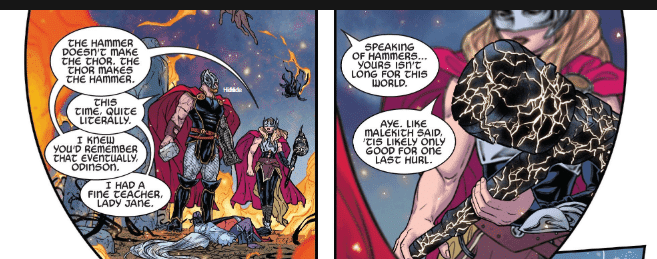
Despite the continent and realm spanning tie-ins and some issues in the middle, which feel like trailers for more interesting comics with cool battles, Jason Aaron and Russell Dauterman craft a robust arc for Thor. They also make a great one for Jane Foster too as she evacuates New York, takes on the role of All-Mother in Freyja’s absence, wields War Thor’s helmet, and finally becomes the new Valkyrie. Superhero comics are all about the illusion of change, but it’s cool to look back and see a damsel-in-distress nurse battle cancer, become the goddess of Thunder, revoke that mantle, and find new ways to be heroic in War of the Realms. Basically, people who started reading comics in the 2010s will only see Jane Foster as a hero thanks to the work of Aaron, Dauterman, and Matthew Wilson.
2. Russell Dauterman and Matthew Wilson’s Visuals
All my high-falutin’ words about responsibility, heroic journeys, and mythology aside, at its core, War of the Realms is a no holds barred good guys vs bad guys superhero throwdown except with fantasy baddies instead of the usual costumed villains. And this is all thanks to the art of Russell Dauterman and the colors of Matthew Wilson. Dauterman is like a modern day Art Adams (Who did the covers for War of the Realms) or George Perez and possesses a singular gift for splash pages with multiple characters and making them compositions that tell a story instead of glorified pinups. He excels at both layouts and character designs using the newly omniscient Daredevil as the reader’s POV on the action of the War of the Realms while coming up with cool riffs on characters like Odin’s Iron Man armor, Malekith becoming engorged by the Venom symbiote, or Freyja going full Vanir witch on Malekith and his minions.
Matthew Wilson really is the secret weapon throughout the “War of the Realms” event with his work on the core miniseries as well as issues of Thor and the Daredevil serial in War Scrolls. His colors are the ingredient that put the Frost in Frost Giants, the Fire in Fire Goblins, and the effects he uses in War of the Realms #6 make the storm caused by the four Thors truly cataclysmic. But his work isn’t all chaos and Kirby krackle, and there’s delightful minimalism to the big scenes like the reforging of Mjolnir or Daredevil gazing from above that cause one’s eye to linger on the panel and reread the issues that he has colored and that Russell Dauterman has drawn again.
3. Humor-Driven Tie-Ins
The “War of the Realms” tie-ins aren’t at their best when they’re trying to make serious points about the effects of war, like Dennis Hallum and Kim Jacinto did in War of the Realms Strikeforce: The War Avengers. They do work when they lean into the fun and lore of superhero comics and events. For example, in Superior Spider-Man, Gwenpool comments on the well-worn structure of event comics and how a B-Lister like Doc Ock doesn’t get to strike the final blow against Malekith, and in Skottie Young and Nic Klein’s Deadpool, the titular character fights trolls with the help of Australian stereotypes and the event’s single funny Lord of the Rings joke. There is also a great short story in War Scrolls #2 by Anthony Oliveira and Nick Robles where Loki (in disguise as Kate Bishop) and Wiccan go to drag brunch.
However, the two tie-ins that take the cake in the comedy department and are also fun road stories are The McElroys and Andre Araujo‘s Journey into Mystery and the aforementioned Unbeatable Squirrel Girl. Most of the humor in Journey into Mystery comes from character idiosyncrasies, like Miles Morales not knowing what to do in a casino because he’s never left Brooklyn or Death Locket’s obsession with Westerns because those were the only movies her Life Model Decoy “uncle” had programmed. The jokes also come out of the wacky situations that the ensemble cast finds them in from a Skrull trailer park to a literal Western ghost town and a henchman convention.
In Unbeatable Squirrel Girl, Ryan North, Derek Charm, and Rico Renzi send the titular character on a mission from Loki to take out the Frost Giants’ secret base in Canada. On the way, she gets a cute new costume from her mom, sees two Frost Giants make out, reads Robert Frost poetry on her own, and builds an unlikely friendship and alliance with Ratatoskr, a Norse squirrel deity that is tricksy even for Loki. North’s script continues to be joke-dense and full of fun facts about science and the world around us while insightfully showing Squirrel Girl at her conflict-avoiding and problem-solving finest. Her actions even have an effect on the larger event, and Derek Charm’s art continues to be heckin’ cute.
4. Standalone Character Studies
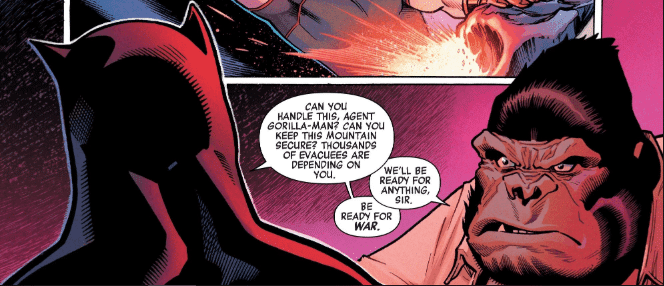
Jason Aaron plays some good 3D chess by using War of the Realms to tell the big, loud story of Malekith’s invasion and Thor finding confidence in himself again and his other titles Thor and Avengers to tell quieter (Sometimes) character studies and hint at big plans after the War. So, we get stories like Loki being visited by his past and future selves while being digested in his father’s stomach, a tale of Gorilla-Man’s day to day role at the Avengers HQ during a crisis situation, and She-Hulk dealing with people’s (and by extension readers’) perceptions of her and how she really wants to be. They provide a fresh outlook on the events of the War of the Realms that isn’t just omniscient narration or Thor’s quest.
Avengers #18-#20 end up pulling double duty by introducing the Squadron Supreme of America as well as fleshing out the aforementioned Gorilla-Man and She-Hulk and setting up future plans for Aaron’s works in the Marvel Universe. The Squadron is a great satire of nationalism with a bit of trolling towards the DC Universe, and Aaron wisely puts them in an ancillary book to not detract from “War of the Realms”. The same goes with Gorilla-Man, who is in cahoots with the imprisoned Dracula meaning that the King of the Damned still has a role to play in this book’s events. And none of this is mentioned in the core War of the Realms mini, who only spends a solitary panel setting up Marvel’s next event “Absolute Carnage” as Venom slithers away from Malekith’s Necrosword. It’s nice to enjoy the ride/event you’re on before thinking about the next one.
The Bad
5. Mediocre Minis
Most Big Two events have three to six issue miniseries to add depth to major supporting characters, give B-list heroes a showcase, or just to make money. Sadly, most of “War of the Realms'” minis were more miss than hit with the exception of Journey into Mystery and the anthology series War Scrolls. I also personally liked the end of War of the Realms: Punisher and its portrayal of Frank Castle as a defender of innocents and unrelenting executioner of criminals even if it didn’t connect to his portrayal in the event possible.
However, the rest of “War of the Realms'” minis were either untapped potential or just plain stinkers. New Agents of Atlas introduced a new team of Pan-Asian superheroes, but became overwhelmed by its ensemble cast and its intriguing character designs didn’t translate well to its interior art. Giant-Man had a madcap concept of Marvel’s size-changing heroes taking out the “source” of the Frost Giants, Ymir. But it went off the rails by its third issue with a villain who was shoehorned in and an artist that was really bad at staging and establishing scenes.
Spider-Man and the League of Realms had a cool concept of Spider-Man leading representatives from the other nine realms into battle, but it constantly changed settings, switched bad guy/threat on the fly, and like NewAgents of Atlas, didn’t make me care enough about its ensemble cast. The worst tie-in of all was War of the Realms: Uncanny X-Menwhich had a decent premise of the X-Men defending New York, but shoehorned in awkward connections to Norse mythology, killed off Sunspot for no reason and had no focus even though Sabretooth would have made a great villain. Thankfully, it will probably be all retconned when Jonathan Hickman begins his X-Men run.
If you stick to the core miniseries plus the Thor, Avengers,War Scrolls, Unbeatable Squirrel Girl, and Journey into Mystery tie-ins (I can also vouch for Cullen Bunn’s work on Asgardians of the Galaxy and Venom.), “War of the Realms” is a good time. First and foremost, it works as an event because it’s a culmination of seven years of work that Jason Aaron has done with Thor, Jane Foster, Odin, Freyja, Asgard, and the non-Midgard Realms instead of trying to tie into an MCU movie. In fact, much of the current MCU Thor’s arc seems inspired by the work that Aaron has done throughout his run.
This week marks the end of both “War of the Realms” and the Messages from Midgard column. There are a few straggler tie-ins like Unbeatable Squirrel Girl and an Omega issue, which I will cover in its own review, but the core miniseries plus three ancillary tie-in minis and Jason Aaron’s arcs on Thor and Avengers wrap up this week. Plus there’s a fun Superior Spider-Man story where Peter Parker and, of all people, Gwenpool, teaching Doc Ock that heroism is about saving individuals and not just trying to glory hog the whole event. That privilege is reserved for Thor, of which there are four, because its their event.
War of the Realms #6
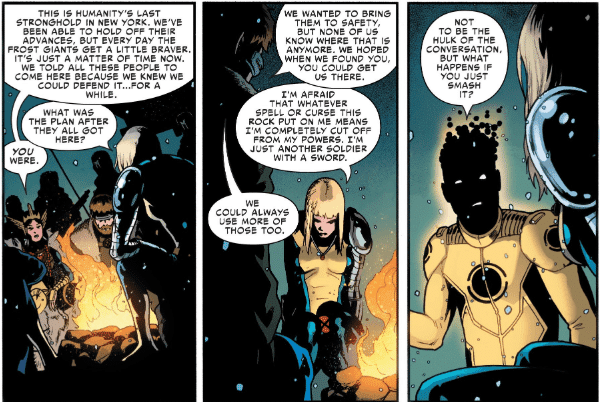
In War of the Realms #6, Jason Aaron, Russell Dauterman, and Matthew Wilson knuckle down to give both this event and basically Aaron’s seven year run on Thor one hell of a conclusion. It’s centered around a simple premise. If only Thor can break the magic circle and confront a Knull-infused Malekith, then why not bring four of them: Odinson, King Thor, Young Thor, and Jane Foster’s Thor, who now wields Mjolnir from the Ultimate Universe. What follows is an exercise in fighting, bickering, and true heroism while the rest of the heroes confront Laufey on Midgard.
Before digging into the fantastic things that Aaron does with both Thor and Jane Foster’s arcs, I would like to praise the visuals of Dauterman and Wilson, who really outdo themselves in issue six. Wilson’s palette is majestic and varied ranging from the eye of the storm to the clash of lightning on symbiote ooze and a snowstorm to end all snowstorms. Like the different hammers and weapons used by the Thors, Dauterman switches up his inking style to fit the scene from looser work when Malekith does anything symbiote-y to more clean polished art when Odinson forges Mjolnir anew in the eye of a storm. His attention to detail is uncanny, and he draws many epic moments like when Odinson punches his own hammer and memorable small ones like Screwbeard and Ivory Honeyshot doing their best Gimli and Legolas imitation at the end of the world.
One word that can be used to describe War of the Realms #6 is “satisfying”. Odinson has gone on a painful heroic journey that draws comparisons to the one his own father, Odin, went on to become All-Father sacrificing body parts to gain the wisdom and power to rule Asgard. There are also parallels to the journeys of Dionysus and Jesus Christ in his story as he humbles himself and suffers to save the whole world. But, lofty comparisons aside, this is really the story of a man who becomes a hero and “worthy” in spite of his flaws, which is a metaphor for most of the Marvel heroes, who have fantastic abilities and feet of clay. It is a rare sight to see such an iconic character, like Thor, grow and change over a run, and Jason Aaron has pulled this off with War of the Realms #6 being the finishing touch and earning an Overall Verdict of Buy.
War of the Realms: New Agents of Atlas #4
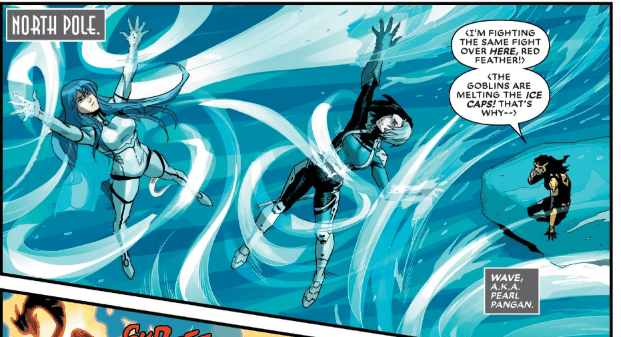
In New Agents of Atlas#4, this new pan-Asian superhero team finally gets their act together to assemble and prevent Sindr, the Fire Goblin queen from melting the polar ice caps. Greg Pak and artists Gang Hyuk Lim, Moy R, and Pop Mhan take their cues from third act of the 2012 Avengers film from Jimmy Woo playing the Nick Fury role and lying about Pele’s true nature to get the team to work together and lots of big epic splash pages of heroes doing team-up moves. However, with the exception of Brawn, Shang Chi, and the Filipina heroine Wave, I feel like I barely know these heroes so the big fight scenes look pretty, but feel like action figures in position, not characters reaching the end of their journey.
Pak, Lim, Federico Blee and the guest artists and colorists had a tall order introducing new characters and ones who had only appeared in Korean and Chinese comics as well as mobile games to a new audience. Having four issues and a big, yet underdeveloped baddie helped, but in the end, the cast of New Agents of Atlas was simply too large to get to know the new folks. Hopefully, the upcoming miniseries will take its time to develop their personalities as well as show off their cool costumes and powers. Unfortunately, New Agents of Atlas #4 earns an Overall Verdict of Pass despite its one genuinely memorable twist.
War of the Realms: Punisher #3
War of the Realms Punisher#3
features the same fantasy baddies as the rest of “War of the Realm’s” tie-ins,
but Gerry Duggan, Marcelo Ferreira, Roberto Poggi, and Rachelle Rosenberg
take a grittier, more violent, and at times, fatalistic approach to their story
beginning with Frank Castle having guns pointed to his head by former mobsters.
He gets out of this pickle pretty easily by swearing on the souls of dead wife
and kids that he’ll spare the criminals once they get the civilians to safety.
Most of them don’t have to worry about living as they’re immediately set upon
by a squad of trolls; one of which Frank tortures in a chilling scene that
makes the criminals realize that they’re not getting out of this alive too.
Duggan and Ferreira portray Frank Castle as a hardened soldier in War of the Realms Punisher #3, and his enemy is the criminal element, both mortal and otherworldly. Sure, he’ll get the civilians to safety in New Jersey, but he’ll also gun down the last criminal standing with him while the doctor he was assisting shrieks in terror. This is because Castle is as much of a monster and a force of nature as the trolls and Fire Goblins that he was gunning down or blowing up tanker trucks to stop. Duggan’s understanding of Frank Castle’s character, and that we can cheer for him to take out the bad guys and recoil at killing one in cold blood as well as the hellish visuals of Ferreira, Poggi, and Rosenberg earns War of the Realms Punisher #3 an Overall Verdict of Buy and definitely has me interested in Duggan’s upcoming Punisher Kill Krew series.
War of the Realms: Uncanny X-Men #3
Even though it’s nice to see Cyclops, Multiple Man, and your
favorite former New Mutants defending Citi Field from Frost Giants, Matthew Rosenberg, Pere Perez, and Rachelle
Rosenberg’sWar of the Realms: Uncanny X-Men has been the weak link of the tie-in
minis. Issue three is no exception with the pointless killing off of Sunspot,
the repetitive dialogue of (dead in the main series) Wolfsbane’s lover
Hrimhari, and a tacked on sequence with Dani Moonstar and the Valkyries even
though this plot point was only touched upon at the end of issue one. It could
have been a good hook for the miniseries and a through-line to the main action,
but in the end, it’s too little, too late.
War of the Realms: Uncanny X-Men #3 does have a few cool moments like Multiple Man’s dupes luring the Frost Giants into a Limbo portal, a visceral claw on claw fight between Sabretooth and Wolfsbane, and Cyclops precision sniping Frost Giants. However, these are few and far between, and after three issues, this miniseries has really done nothing to justify its existence and earns an Overall Verdict of Pass. But the silver lining is that Jonathan Hickman is coming in a month and probably all these events/pointless character deaths will be retconned.
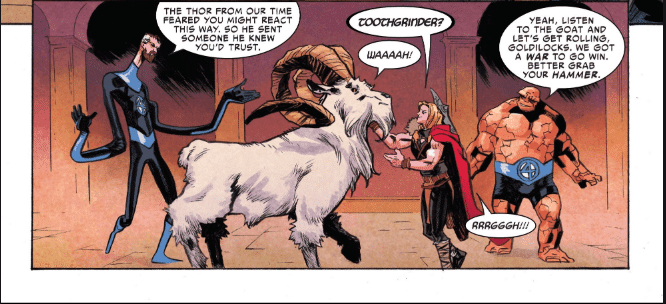
Thor #14
Jason Aaron, Scott
Hepburn, and Matthew Wilson’s story in Thor
#14 covers much of the same ground as War
of the Realms #6, but from the POV of Young Thor as the Fantastic Four
summon him from brooding and trying to lift Mjolnir to a fight for all ten
realms. I read this almost directly after War
of the Realms #6, and there are obvious re-draws of Russell Dauterman’s art
although Hepburn has an earthier take on the material to match the boisterous,
shit-talking Young Thor. The issue also has more direct connections to the last
adventure of the three Thors in Aaron’s Thor,God of Thunder series and a similar
art style although Hepburn is no Simon Bisley. There’s a lot of gruffness, talk
about hammers, and an indirect reference to Back
to the Future along the way.
However, compared to the standalone issues about Loki, Cul Borson, and even Gorilla-Man in Aaron’s tie-in issues of Thor and Avengers, Thor #14 seems less essential because Jason Aaron and Russell Dauterman portrayed Young Thor’s carelessness, brashness, and adventurous nature so well in War of the Realms #6. He does get a cool action sequence against a gnarly Hepburn-drawn Venom symbiote and lifts Mjolnir in a moment that again proves that “worthiness” and heroism is not something bestowed externally, but internally. Most of the material in Thor #14 is covered in Realms #6, but that scene and the sheer joy that Aaron gets at writing Young Thor earns the issue an Overall Verdict of Read.
Avengers #20
Avengers #20 is yet
another standalone success from Jason Aaron, Ed McGuinness, Mark Morales, and
Jason Keith and is a metafictional
look at She-Hulk, and how she’s changed as a character in the past few years.
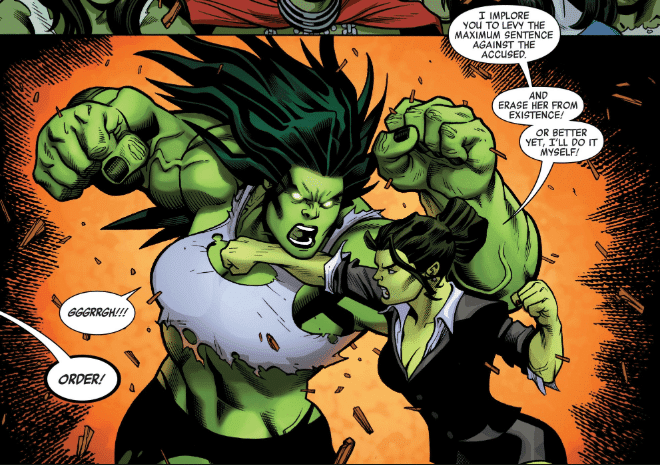
The opening sequence is brilliant and set in side a Wakandan therapy simulation
where She-Hulk looks at a pinup of the John Byrne version of her and beats up a
version of her that looks like it was drawn by Javier Pulido. The comic is a
narration about how she likes embracing the monster and getting to beat up
enemies with her new powers instead of being sexually harassed while in
costume. Unlike Bruce Banner, she enjoys the freedom of being Hulk, and
McGuinness and Morales use wide panels to show the swath of destruction she
causes with her bulging forearms.
Using the character of She-Hulk as a case study, Avengers #20 is also a bigger commentary about how women have to fit pre-conceived roles in the workforce (Even if that means the Avengers.) and society and get pushback whenever they’re assertive or show anger. Deadpool asking She-Hulk why she doesn’t crack jokes or break the fourth wall any more is the metafictional version of a male co-worker asking a woman why she doesn’t smile. And, on a more a geeky level, this issue also has some foreshadowing of Aaron’s future plans for the Avengers title with the help of omniscient Daredevil showing Aaron can work on both a micro and macro level. Avengers #20 is a fantastic, holistic character study of She-Hulk and her recent developments and easily earns an Overall Verdict of Buy with a side dish of allusions to Immortal Hulk.
Superior Spider-Man #8
Superior Spider-Mancontinues
to be an underrated delight and study in ego from Christos Gage, Lan Medina,
Cam Smith, and Andy Troy. Doc Ock continues to be terrible at reading the room,
er, event and wants to take out Malekith all by himself with the help of the
Fantastic Four and West Coast Avengers. He doesn’t want to protect New York
City, but basically hack America Chavez’s portal abilities to get to what he
thinks is the real action. This ends up backfiring, and he gets one hell of a
dressing down from Spider-Man in the nature of heroism while Spider-Man is
wearing his helmet from the Land of
Giants one-shot and is immediately abandoned by his “minions” aka the West
Coast Avengers.
Gage and Medina use the wide scope of “War of Realms” to tell an entertaining and at times fourth wall breaking (Thanks to Gwenpool.) story about how heroism isn’t just about defeating the final boss, but saving one person from death and danger. Having Spider-Man deliver the lecture about this topic makes sense because for the most part, he has focused on protecting his neighborhood instead of mixing it up with gods and monsters. Gage’s script is self-aware, and Medina and Smith have a classic, illustrator style approach where it is easy to follow the action even in a Southern California blizzard. For commenting on the nature of heroism, being funny as hell, and having plentiful America Chavez side eye, Superior Spider-Man #8 earns an Overall Verdict of Buy.
War of
the Realms #6 was the best ending to a summer Marvel event since
Jonathan Hickman and Esad Ribic’s Secret Wars,
and it shipped on time too. One thing that these two events shared in common is
that they were a culmination of two macro-stories, namely, Jason Aaron’s Thor
run and Hickman’s Fantastic Four-Ultimates-Avengers/New Avengers project. The
War of the Realms has been foreshadowed for years, and the early battles were
fought in the pages of Mighty Thor and
Thor so the event was really just
icing on the cake. Sometimes, the montage of the different battles were a
little insufferable, but when Aaron, Dauterman, and Wilson grabbed onto the
character journeys of Odinson and Jane Foster, the book really sung. Nowhere
was this more evident than in War of the
Realms #6, and the spinoff I’m most excited for is Valkyrie even if I’m little disappointed that Tessa Thompson’s take
on the character is nowhere in sight although Al Ewing may pluck her from
somewhere in the multiverse.
Panel of the Week
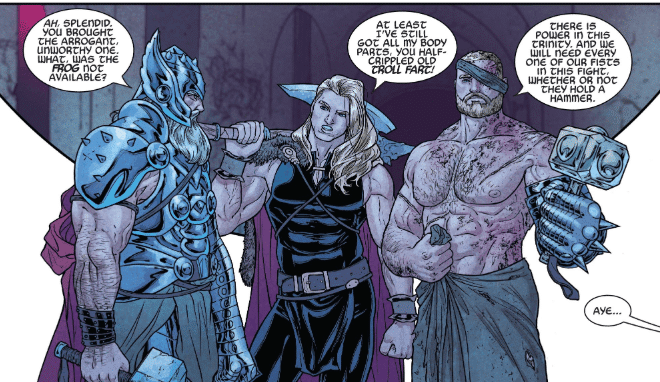
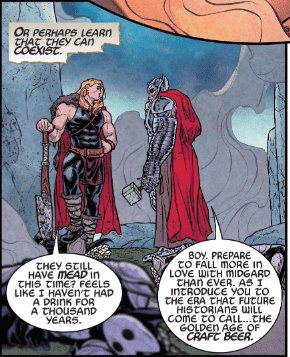
Young Thor and King Thor bonding over craft beer is the cutest thing. (From War of the Realms #6, Art by Russell Dauterman and Matthew Wilson)